Structural Steel Shapes Chart 2026 – W, S, HP, C, L, HSS & WT Guide
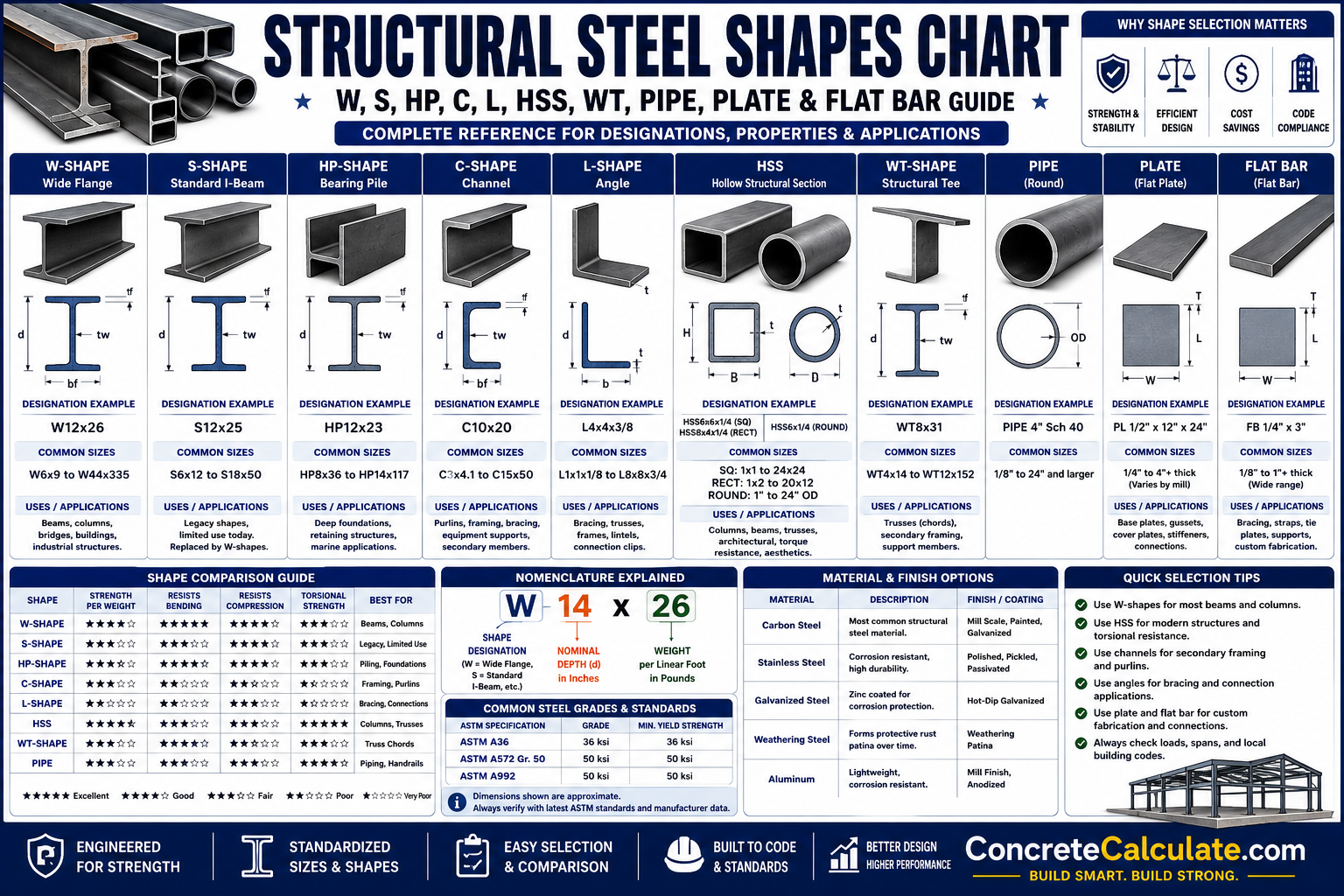
Structural Steel Shapes Chart
W, S, HP, C, L, HSS & WT Guide
Complete structural steel shape reference for engineers and contractors every major shape explained, compared, and matched to the right application.
 Reviewed by Muhammad Ramzan Babar, PhD Researcher (Plasma Physics) & Calculator Developer — View Profile
Important: Educational Reference Only
This page is designed to help you understand, compare, and identify structural steel shapes it is not a substitute for the AISC Steel Construction Manual or a licensed structural engineer’s design. Final shape selection for any load-bearing application must be verified through proper structural calculation.
⭐ Master Structural Steel Shapes Chart
Complete overview comparing all major structural steel shapes by dimension basis, key strength, and structural role.
How to Read This Chart
This page explains what each shape is, when to use it, and how to read its designation, it doesn’t reproduce the full AISC Manual’s dimension tables. For detailed beam sizing within the W-shape family, see our dedicated Steel I-Beam Chart.
| Shape | Cross-Section | Best Suited For | Key Trait |
|---|---|---|---|
| Wide Flange (W) | I-shaped, parallel flanges | Beams, columns | Efficient bending strength |
| Standard I-Beam (S) | I-shaped, tapered flanges | Legacy framing | Largely superseded by W-shapes |
| Bearing Pile (HP) | Near-square, thick flanges/web | Deep foundations | High axial/driving capacity |
| Channel (C) | C-shaped | Framing, bracing | One flat face for connections |
| Angle (L) | L-shaped | Bracing, clips, lintels | Simple, versatile, low cost |
| HSS | Closed tube (square/rect/round) | Columns, architectural exposure | Excellent torsional resistance |
| Structural Tee (WT) | T-shaped | Truss chords | Split from W-shapes |
| Pipe | Round tube | Columns, fluid piping | Different tolerance basis than round HSS |
| Plate | Flat, thick sheet | Gusset/base plates, built-up sections | Custom cut to any shape |
| Flat Bar | Flat, narrow strip | Bracing, stiffeners, small connections | Simple rectangular profile |
⭐ Structural Steel Shapes Overview
The main navigation table — common designation and primary application for every major shape covered on this page.
| Steel Shape | Common Designation | Primary Applications |
|---|---|---|
| Wide Flange | W | Beams, columns, general framing |
| Standard I-Beam | S | Legacy structural and industrial framing |
| Bearing Pile | HP | Deep foundations, driven piles |
| Channel | C | Framing, bracing, equipment supports |
| Angle | L | Bracing, connection clips, lintels |
| Hollow Structural Section | HSS | Columns, bracing, architectural exposure |
| Structural Tee | WT | Truss chords, light framing |
| Pipe | Pipe (NPS) | Columns, handrails, fluid piping |
| Plate | PL | Gusset plates, base plates, built-up members |
| Flat Bar | FB | Bracing, stiffeners, small connection parts |
⭐ Wide Flange (W) Beam Chart
The most widely used structural steel shape in modern construction, series by series.
| Series | Typical Depth | Typical Weight Range | Common Applications |
|---|---|---|---|
| W4–W6 | 4″–6″ | 7–25 lb/ft | Light residential and small framing |
| W8–W10 | 8″–10″ | 15–68 lb/ft | Garage/basement beams, light commercial |
| W12–W14 | 12″–14″ | 14–800+ lb/ft | Commercial floors, columns — widest use range |
| W18–W24 | 18″–24″ | 26–408 lb/ft | Longer commercial and warehouse spans |
| W30–W36 | 30″–36″ | 90–300+ lb/ft | Long-span industrial and bridge-adjacent use |
For detailed W-shape depth, flange width, weight, and section properties, see our full Steel I-Beam Chart.
Standard I-Beam (S Shape) Chart
The predecessor to W-shapes, now used far less frequently in new construction.
| Factor | S-Shape Character |
|---|---|
| Flange Shape | Narrower, tapered (sloped inner face) |
| Weight | Generally lighter per depth than equivalent W-shapes |
| Common Uses | Legacy structural framing, some crane rail support, older industrial buildings |
S-shapes differ from W-shapes mainly in flange geometry: the tapered flange face of an S-shape makes it less efficient for modern connection details, which is why W-shapes have replaced S-shapes as the default beam choice.
H-Pile (HP Shape) Chart
A wide-flange-like shape with near-equal flange and web thickness, designed to withstand driving forces.
| Common HP Sizes | Typical Applications |
|---|---|
| HP8, HP10 | Lighter deep foundation piles, smaller structures |
| HP12, HP14 | Bridge foundations, heavier building foundations |
HP shapes are used for deep foundations, bridge substructures, and marine structures where the pile must be driven into soil or rock — the near-equal flange/web thickness resists the bending and buckling stresses of the driving process.
⭐ Structural Channel (C Shape) Chart
A C-shaped profile with one flat back face, useful wherever a flush mounting surface is needed.
| Series | Typical Depth | Common Applications |
|---|---|---|
| C3–C6 | 3″–6″ | Light framing, small equipment supports |
| C8–C10 | 8″–10″ | Bracing, secondary framing members |
| C12–C15 | 12″–15″ | Heavier bracing, larger equipment platforms |
Channels are frequently used in pairs (back-to-back or toe-to-toe) to form box-like built-up members with better balanced properties than a single channel alone.
⭐ Structural Angle (L Shape) Chart
Comparing equal-leg and unequal-leg angles, the simplest and most versatile structural shape.
| Type | Leg Configuration | Common Thickness Range | Common Applications |
|---|---|---|---|
| Equal Angle | Both legs the same length (e.g., L4x4) | 1/8″–1″ | Bracing, lintels, symmetrical connections |
| Unequal Angle | Legs of different lengths (e.g., L6x4) | 1/8″–1″ | Connection clips, asymmetric bracing, ledger angles |
⭐ Hollow Structural Section (HSS) Chart
One of the most searched steel topics — comparing square, rectangular, and round HSS profiles.
| Profile | Typical Outside Dimensions | Common Wall Thickness | Common Structural Uses |
|---|---|---|---|
| Square HSS | 1″×1″ to 16″×16″ | 0.083″–0.625″ | Columns, architectural framing |
| Rectangular HSS | 2″×1″ to 20″×12″ | 0.083″–0.625″ | Beams, bracing, transfer members |
| Round HSS | 0.84″ to 24″+ OD | 0.065″–0.625″ | Columns, railings, architectural exposure |
Why HSS Is So Popular
The closed tubular profile of HSS distributes material efficiently around its full perimeter, giving it excellent resistance to torsion (twisting) and buckling in every direction properties that open shapes like W or C cannot match at the same weight. This is why HSS is the default choice for exposed architectural columns and diagonal bracing.
Structural Tee (WT) Chart
A T-shaped section created by splitting a W-shape lengthwise down its web.
| Aspect | Explanation |
|---|---|
| Origin | Cut from a W-shape, so a WT8 comes from a corresponding W16 shape |
| Applications | Truss chords, light beams, cantilevered brackets |
| Advantages | Efficient shape for truss top/bottom chords where connections occur along one flat flange |
Steel Pipe Chart
Distinguishing structural, mechanical, and standard pipe from round HSS.
| Pipe Type | Governing Standard | Typical Use |
|---|---|---|
| Structural Pipe | ASTM A53 (used structurally with verification) | Columns, railings, bollards |
| Mechanical Pipe | ASTM A513 | Machinery framing, non-critical structural use |
| Standard Pipe | ASTM A53 | Fluid-carrying, sometimes repurposed structurally |
Round HSS is manufactured to ASTM A500 specifically for structural service with tighter dimensional tolerances, while standard pipe under ASTM A53 is primarily intended for carrying fluids — for detailed pipe sizing, see our Pipe Size Chart.
Steel Plate Thickness Chart
Flat steel plate used throughout structural connections and built-up members.
| Common Thickness | Typical Structural Application |
|---|---|
| 1/4″–3/8″ | Light gusset plates, stiffeners |
| 1/2″–3/4″ | Base plates, moderate gusset plates |
| 1″–2″+ | Heavy base plates, built-up girder flanges |
Size base plates with our Base Plate Calculator.
Flat Bar Size Chart
Simple rectangular steel stock used for lighter structural and connection work.
| Width | Common Thickness | Typical Uses |
|---|---|---|
| 1″–3″ | 1/8″–1/2″ | Bracing, small stiffeners, light connections |
| 4″–6″+ | 1/4″–3/4″ | Heavier bracing, built-up connection parts |
⭐ Structural Steel Shape by Construction Application
Matching common project categories to the shapes typically specified.
| Project | Recommended Steel Shape |
|---|---|
| Residential Construction | Light W-shapes, HSS, or angle for small framing |
| Commercial Buildings | W-shapes for beams/columns, HSS for architectural columns |
| Warehouses | Larger W-shapes, HSS bracing, channel purlins |
| Industrial Plants | W-shapes, HSS, channel, and pipe columns per equipment loads |
| Bridges | Large W-shapes, plate girders, HP piles for substructure |
| Mezzanines | W-shapes for beams, HSS or W-shape columns |
| Towers | HSS or angle lattice members, W-shape legs |
| Equipment Platforms | Channel or W-shape framing, HSS or angle bracing |
⭐ Structural Steel Shape Comparison
One of the strongest SEO sections — comparing all major shapes across the factors that drive real selection decisions.
| Shape | Strength | Torsional Resistance | Ease of Fabrication | Typical Uses | Relative Cost |
|---|---|---|---|---|---|
| W Shape | High bending strength | Low | Excellent, widely tooled | Beams, columns | Moderate |
| S Shape | Moderate-high bending | Low | Good, less common today | Legacy framing | Moderate (limited supply) |
| HSS | High axial, good bending | Excellent | Good, requires end-cap detailing | Columns, bracing | Moderate-high |
| Channel | Moderate bending | Low | Good | Bracing, secondary framing | Moderate |
| Angle | Low-moderate | Low | Excellent, simplest to connect | Bracing, clips | Low |
| Tee (WT) | Moderate | Low | Good | Truss chords | Moderate |
| Pipe/Round HSS | High axial (columns) | Excellent | Good, requires cap plates | Columns, railings | Moderate |
Steel Shape by Structural Function
Which shapes are typically chosen for each structural role.
| Function | Common Shapes |
|---|---|
| Beams | W-shape (primary), channel or WT (secondary) |
| Columns | W-shape, square/round HSS, pipe |
| Bracing | HSS, angle, pipe |
| Trusses | WT chords, angle or HSS webs |
| Frames | W-shape beams and columns, moment connections |
| Connections | Plate, angle clips, flat bar stiffeners |
| Secondary Members | Channel, angle, light W-shapes |
Steel Shape by Load Type
Different loading conditions favor different cross-sectional geometries.
| Load Type | Best-Performing Shapes | Why |
|---|---|---|
| Bending | W-shape, S-shape | Material concentrated far from the neutral axis in the flanges |
| Compression | HSS, pipe, W-shape | Symmetric or near-symmetric shapes resist buckling in multiple directions |
| Tension | Angle, plate, flat bar | Simple, efficient shapes for pure axial tension members |
| Torsion | HSS (square/round) | Closed cross-section resists twisting far better than open shapes |
| Combined Loading | W-shape, HSS (case-dependent) | Requires engineering check balancing multiple stress types |
Structural Steel Grades Chart
Common ASTM specifications paired with the shapes above.
| Grade | Yield Strength | Typical Applications |
|---|---|---|
| ASTM A36 | 36 ksi | Plates, angles, older W-shapes, general fabrication |
| ASTM A572 Grade 50 | 50 ksi | High-strength plates and shapes |
| ASTM A992 | 50–65 ksi | Standard modern W-shape beams and columns |
| ASTM A588 | 50 ksi | Weathering steel for exposed bridges/structures |
| ASTM A500 | 42–50 ksi (grade-dependent) | HSS square, rectangular, and round shapes |
⭐ Structural Steel Shape Designation Guide
Teaching readers exactly how to read the numbers in a shape callout.
| Designation | Breakdown | What It Means |
|---|---|---|
| W12×26 | W + 12 + 26 | Wide flange, ~12″ nominal depth, 26 lb/ft weight |
| C9×13.4 | C + 9 + 13.4 | Channel, 9″ nominal depth, 13.4 lb/ft weight |
| L4×4×3/8 | L + 4 + 4 + 3/8 | Equal angle, 4″ legs both sides, 3/8″ leg thickness |
| HSS6×6×1/4 | HSS + 6 + 6 + 1/4 | Square HSS, 6″ per side, 1/4″ nominal wall thickness |
| WT8×28 | WT + 8 + 28 | Structural tee, ~8″ nominal depth, 28 lb/ft weight (cut from a W16×28-equivalent) |
The Universal Pattern
Open shapes (W, S, C, WT) are named by shape letter + nominal depth + weight per foot. Angle shapes are named by shape letter + leg 1 + leg 2 + thickness. HSS shapes are named by shape letter + outside dimension(s) + nominal wall thickness. Once you recognize this pattern, you can decode almost any structural steel callout.
US vs International Steel Shapes
Targeting international traffic — comparing AISC shapes against major regional standards.
| Region/Standard | Common Shape Names | Sizing Basis | Approximate US Equivalent Logic |
|---|---|---|---|
| United States (AISC) | W, S, HP, C, L, HSS, WT | Nominal depth (in) + weight (lb/ft) | Reference point for comparison |
| Europe | IPE, HEA, HEB | Depth in millimeters (e.g., HEB 300 = 300mm deep) | HEB 300 ≈ W12×50; IPE 300 ≈ W12×26 |
| United Kingdom | UC (Universal Column), UB (Universal Beam) | Depth in millimeters, similar to European system | UC sections roughly parallel HEB/W-shape columns |
| Australia | UB, UC, PFC (channels) | Depth in millimeters, AS/NZS standards | Broadly similar profile logic to UK sections |
Approximate Equivalents Only
Comparisons like “HEB 300 ≈ W12×50” match approximate depth or moment of inertia but are not exact substitutes — flange proportions, tolerances, and material specifications differ between AISC and European/UK/Australian standards, so always verify with the applicable regional design code.
⭐ Structural Steel Selection Guide
Quick decision reference matching structural function to recommended shape with reasoning.
| Project | Recommended Steel Shape | Why |
|---|---|---|
| Floor Beam | W-shape | Efficient bending strength-to-weight, widely available |
| Building Column | W-shape or square HSS | Good axial capacity; HSS excels when architectural exposure matters |
| Roof Truss | WT chords with angle or HSS webs | Efficient chord/web combination for triangulated trusses |
| Bridge Girder | Large W-shape or plate girder | Long-span bending capacity with deep sections |
| Industrial Platform | W-shape beams, channel framing, HSS bracing | Balances span, load, and connection simplicity |
| Mezzanine | W-shape beams and columns | Standard, well-understood system for elevated floors |
| Equipment Support | Channel or W-shape framing | Flat connection surfaces simplify equipment mounting |
⭐ Visual Structural Steel Shapes Guide
Original engineering diagrams showing every major shape’s cross-section with labeled dimensions.
W Shape
Parallel flangesS Shape
Tapered flangesChannel (C)
One flat faceAngle (L)
Equal/unequal legsSquare HSS
Closed tubeRectangular HSS
Closed tubeRound HSS / Pipe
Closed tubeStructural Tee (WT)
T-shapedPlate
Flat, custom cutFlat Bar
Narrow rectangularStructural Steel Connections Overview
Conceptual guidance on how structural shapes are joined — not a detailed design procedure.
| Connection Type | General Concept |
|---|---|
| Bolted Connections | High-strength bolts through connection plates, easy field erection |
| Welded Connections | Shop or field welds for rigid, high-strength joints |
| Gusset Plates | Flat plates connecting multiple bracing members at a common point |
| Base Plates | Transfer column loads into the foundation |
| End Plates | Plate welded to a beam end, bolted to the supporting member |
For bolt selection matched to these connection types, see our Bolt Grade Chart; for base plate and anchor sizing, use our Base Plate Calculator and Anchor Bolt Calculator.
Common Structural Steel Selection Mistakes
Avoiding these errors prevents structural failures, connection problems, and costly rework.
Choosing Shape Based Only on Depth
Depth alone ignores weight, flange proportions, and section properties that actually determine capacity.
Ignoring Torsional Behavior
Open shapes like W or C perform poorly under torsion — using them where twisting loads dominate can lead to unexpected failure.
Selecting the Wrong HSS Wall Thickness
Undersized wall thickness reduces both strength and local buckling resistance at connections.
Confusing Pipe with HSS Round Sections
Standard pipe and round HSS follow different ASTM specifications and tolerance standards — they are not automatically interchangeable in structural design.
Overlooking Connection Requirements
A shape that performs well structurally can still be difficult or costly to connect if geometry wasn’t considered early.
Ignoring Corrosion Protection
Exposed steel without adequate coating or weathering-grade material will degrade faster than the structural design assumes.
Using the Wrong Steel Grade
Substituting A36 for A992 (or vice versa) without checking yield strength assumptions can invalidate a structural design.
Assuming All W-Shapes Have Similar Properties
Flange width and section properties vary significantly by weight within the same depth series — always check the full designation, not just the nominal depth.
Contractor Worked Examples
Real-world structural steel shape selection scenarios for common project types.
Warehouse Column
Mezzanine Floor
Frequently Asked Questions
📄 Download Structural Steel Shapes Chart PDF
Get a printable engineering reference including structural shape overview tables, shape designation guide, steel grade comparison, shape selection guide, cross-section diagrams, connection overview, and field-ready engineer and contractor reference.