Crushed Stone Size Chart – ASTM Stone Numbers & Application Guide
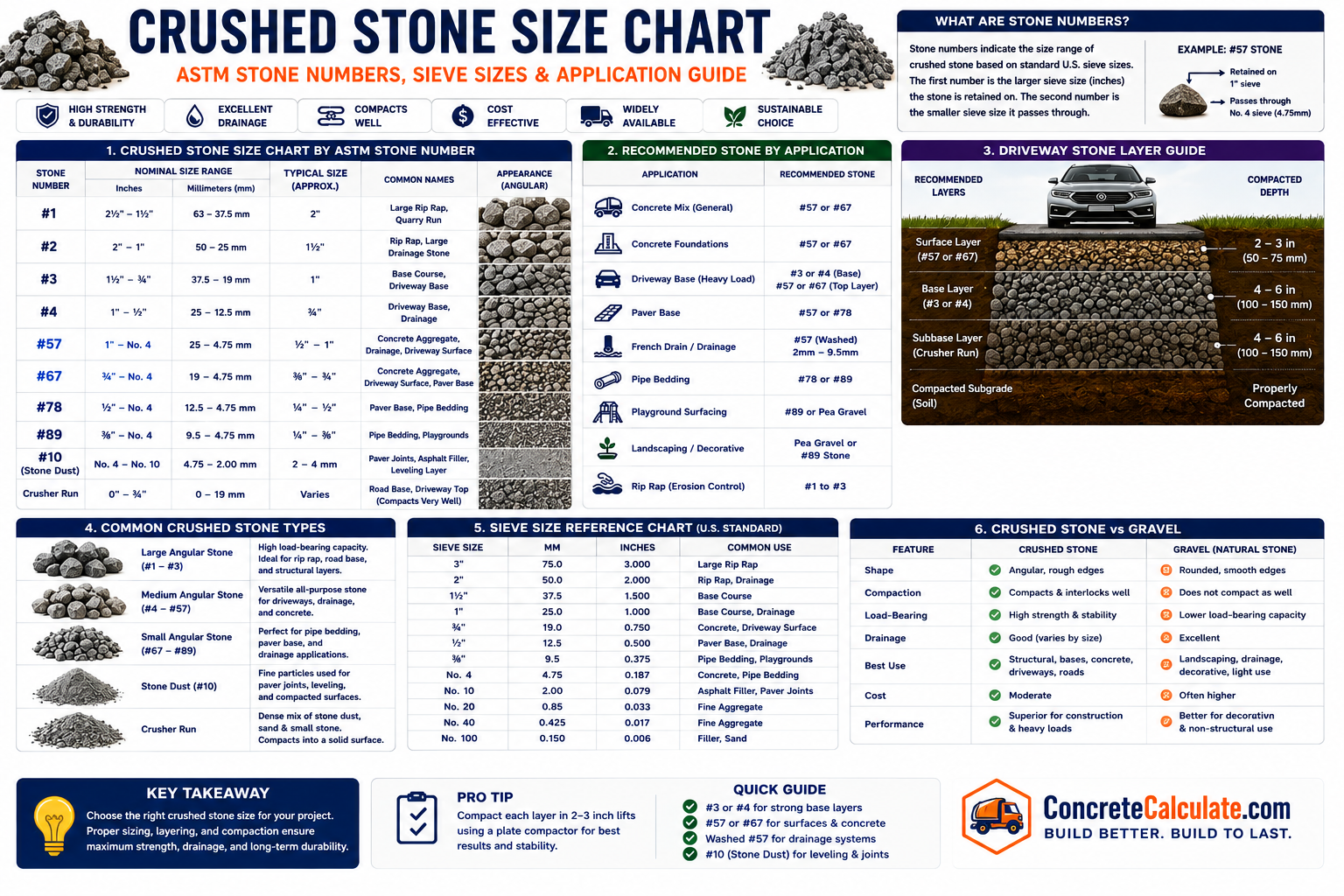
Crushed Stone Size Chart
ASTM Stone Numbers & Application Guide
The complete crushed stone sizing reference — ASTM stone numbers #1-#89, sieve sizes, and construction, drainage, and road applications.
 Reviewed by Muhammad Ramzan Babar, PhD Researcher (Plasma Physics) & Calculator Developer — View Profile
⭐ Master Crushed Stone Size Chart
Complete reference showing crushed stone sizes, ASTM stone numbers, sieve sizes, and recommended applications for construction, concrete, drainage, roads, and landscaping.
How to Read This Chart
Crushed stone sizes follow ASTM D448/C33 numbered gradation standards used across US quarries and suppliers. Estimate quantities with our Crushed Stone Calculator.
| Stone Number | Nominal Size | Common Use |
|---|---|---|
| Stone Dust (#10) | Under 3/8″ | Paver base, joint fill |
| #8 Stone | 3/8″-No. 16 sieve | Pipe bedding, drainage |
| #89 Stone | 3/8″-No. 100 sieve | Decorative, pipe fill, backfill |
| #67 Stone | 3/4″-No. 4 sieve | Concrete coarse aggregate |
| #57 Stone | 1″-No. 4 sieve | Driveways, drainage, concrete |
| #4 Stone | 1.5″-3/4″ | Heavy drainage layer |
| #3 Stone | 1″-2″ | Driveway base, heavy traffic |
| #2 Stone | 1.5″-1″ | Road base, drainage |
| #1 Stone | 2″-4″ | Erosion control, heavy base |
| Riprap | 6″-28″+ | Erosion control, shoreline protection |
Source: ASTM D448 stone size classifications and crushed stone grade reference.
⭐ Crushed Stone Size Chart by Stone Number
ASTM stone numbers correspond to specific sieve analysis gradations defined by quarry industry standards.
| Stone Number | Nominal Size | Sieve Size | Common Uses |
|---|---|---|---|
| Stone Dust | Under 3/8″ | Passes No. 4/No. 8 | Paver base, joint filler |
| #10 | Under 3/8″ (dust) | Passes No. 4 | Paver base, final surfacing |
| #8 | 3/8″-No. 16 | 3/8″ to No. 16 | Pipe bedding, drainage backfill |
| #89 | 3/8″-No. 100 | 3/8″ to No. 100 | Decorative gravel, pipe fill |
| #67 | 3/4″-No. 4 | 1″ (95%) to 3/4″ (min) | Concrete coarse aggregate |
| #57 | 1″-No. 4 | 1.5″ (100%) to 1″ (95%) | Driveways, French drains, concrete |
| #5 | 1″-1/2″ | 1″ to 1/2″ | Driveways, concrete mix |
| #4 | 1.5″-3/4″ | 2″ (100%) to 1.5″ (95%) | Heavy drainage layer |
| #3 | 1″-2″ | 2″ to 1″ | Driveway base, retaining walls |
| #2 | 1.5″-1″ | 1.5″ to 1″ | Road base, drainage |
| #1 | 2″-4″ | 4″ to 1.5″ | Erosion control, heavy base |
| Riprap | 6″-28″+ | Varies by class | Erosion control, shoreline protection |
Source: ASTM sieve analysis data for #4, #57, #67 stone gradations.
⭐ Crushed Stone Size by Construction Application
Project type determines whether structural load-bearing or drainage performance takes priority in stone selection.
| Project | Recommended Stone Size |
|---|---|
| Concrete Mixes | #67 stone |
| Footings | #57/#67 stone |
| Foundations | #57/#67 stone |
| Slabs | #57/#67 stone |
| Driveways | #3/#4 base, #57 surface |
| Roads | #1/#2 base, #57 surface course |
| Parking Lots | #3 base, #67 surface |
| Retaining Walls | #57/#89 stone (backfill) |
| Drainage Systems | #57 clean/washed stone |
| Pipe Bedding | #8/#89 stone |
Crushed Stone Size by Concrete Application
Coarse aggregate size must be matched to structural member thickness and rebar spacing for proper consolidation.
| Application | Recommended Stone Size |
|---|---|
| Sidewalks | #67 stone |
| Patios | #67 stone |
| Garage Floors | #67 stone |
| Structural Slabs | #67 stone |
| Beams | #8/#67 stone |
| Columns | #8/#67 stone (dense rebar) |
| Bridge Decks | #67 stone (engineered mix) |
For detailed aggregate grading standards, see our Aggregate Size Chart, and verify mix proportions with the Concrete Mix Design Chart.
Crushed Stone Size by Road Construction
Road layers use progressively finer stone from base to surface course to optimize load transfer and ride quality.
| Layer | Recommended Stone Size |
|---|---|
| Surface Course | #57 stone or crusher run |
| Base Course | #1/#2 stone |
| Subbase | #3 stone |
| Shoulder Material | #3/#4 stone |
| Temporary Roads | #2/#3 stone (large, self-draining) |
Crushed Stone Size by Driveway Type
Traffic load and frequency determine stone size and base depth for each driveway type.
| Driveway Type | Recommended Stone Size |
|---|---|
| Residential Driveways | #3/#4 base, #57 surface |
| Farm Roads | #2/#3 base, #57 surface |
| Gravel Roads | #1/#2 base, crusher run surface |
| Commercial Parking Areas | #3 base, #67 surface |
| Heavy Equipment Access Roads | #1/#2 stone, deep compacted base |
Crushed Stone Size by Drainage Application
Drainage systems require open-graded, angular stone with high void space to maintain fast water movement.
| Application | Recommended Stone Size |
|---|---|
| French Drains | #57 clean/washed stone |
| Foundation Drainage | #57 clean/washed stone |
| Retaining Walls | #57/#89 stone (backfill) |
| Septic Systems | 3/4″-2.5″ washed rock |
| Culverts | #2/#3 stone |
| Dry Wells | #3/#4 stone |
Crushed Stone Size by Foundation Application
Foundation applications need stable, well-compacted, and well-drained crushed stone bases.
| Application | Recommended Stone Size |
|---|---|
| House Foundations | #57/#67 stone |
| Footings | #57/#67 stone |
| Slab Base | #57/#67 stone |
| Basement Floors | #57 stone |
| Pole Barns | #3/#57 stone base |
⭐ Crushed Stone Size vs Load Capacity
Larger, angular crushed stone generally distributes and bears heavier loads once properly compacted.
| Stone Size | Typical Load Capacity | Common Uses |
|---|---|---|
| Light-Duty (#8/#89) | Low | Walkways, pipe bedding, backfill |
| Residential (#57/#67) | Moderate-High | Driveways, patios, footings |
| Commercial (#3/#4) | High | Parking lots, commercial driveways |
| Heavy Industrial (#1/#2) | Very High | Road base, heavy equipment pads |
Crushed Stone Size vs Compaction
Particle size and gradation control how densely a crushed stone layer can be compacted.
| Stone Category | Compaction | Stability | Drainage | Load Distribution |
|---|---|---|---|---|
| Stone Dust | Excellent | High | Low | Moderate |
| Fine Stone (#8-#10) | High | Moderate-High | Low-Moderate | Moderate |
| Medium Stone (#57-#67) | Moderate-High | High | Moderate-High | High |
| Large Stone (#1-#3) | Moderate | High | High | Very High |
Crushed Stone Size vs Drainage Performance
Open-graded, uniformly sized crushed stone maximizes void space and water throughput.
Water Flow
Increases with larger, single-sized stone due to bigger interconnected voids
Void Space
Open-graded #57/#4 stone maximizes void ratio for water storage
Permeability
Highest in clean, washed stone free of fines and silt
Drainage Efficiency
Best achieved with clean #57 stone in French drains and drainage layers
Crushed Stone Size by Soil Type
Underlying soil determines how much crushed stone thickness and what size is needed for base stability.
| Soil Type | Recommended Stone Size / Base |
|---|---|
| Clay Soil | #3 stone, 8″ base thickness |
| Sandy Soil | #3/#57 stone, 4″ base thickness |
| Loam | #3/#57 stone, 6″ base thickness |
| Wet Ground | #1/#2 stone with geotextile fabric |
| Expansive Soil | #2/#3 stone, 8″+ base thickness |
Crushed Stone Base Thickness Chart
Base layer thickness scales with the load requirements and stone size being used.
| Project | Stone Size | Recommended Base Thickness |
|---|---|---|
| Driveways | #3 base + #57 surface | 8″-14″ total |
| Patios | #57/#67 stone | 4″-6″ |
| Concrete Slabs | #57/#67 stone | 4″-6″ |
| Walkways | #4 base + #8 top | 4″-6″ |
| Parking Lots | #3 base + #67 surface | 10″-12″ total |
⭐ Crushed Stone vs Gravel Comparison
Crushed stone is mechanically fractured with angular edges, while gravel forms naturally through erosion with rounded edges — this fundamental shape difference drives most performance differences.
| Property | Crushed Stone | Gravel |
|---|---|---|
| Shape | Angular, sharp edges (man-made) | Rounded, smooth (natural) |
| Drainage | Good, depends on gradation | Excellent — large natural voids |
| Compaction | Excellent — locks tightly under load | Poor — particles slide and shift |
| Cost | Moderate (quarrying/processing) | Often lower for natural deposits |
| Stability | High — ideal for structural bases | Low-moderate — better for decorative use |
| Load Capacity | High | Low-moderate |
| Best Uses | Road base, concrete, foundations, driveways | Landscaping, decorative paths, French drain filler |
Source: crushed stone vs gravel comparison guides. See our full Gravel Size Chart for gravel-specific sizing.
Crushed Stone vs Pea Gravel
Pea gravel’s smooth, rounded texture makes it a poor structural material but a popular decorative choice.
| Property | Crushed Stone | Pea Gravel |
|---|---|---|
| Appearance | Angular, sharp edges, gray/white hue | Rounded, smooth, varied natural colors |
| Drainage | Good, gradation-dependent | Excellent — high void space |
| Compaction | Excellent | Poor — shifts underfoot |
| Landscaping | Used for paths, borders | Popular for beds, walkways, décor |
| Construction Uses | Structural base, concrete, drainage | Rarely used structurally |
Source: crushed stone vs pea gravel comparison.
ASTM Crushed Stone Classification Chart
ASTM D448 defines standard stone number gradations used consistently by US quarries and suppliers.
| ASTM Size No. | Nominal Size Range | Typical Engineering Application |
|---|---|---|
| No. 1 | 4″-2″ | Erosion control, heavy drainage |
| No. 2 | 1.5″-1″ | Road base, drainage layers |
| No. 4 | 2″-1.5″ (95% pass) | Heavy drainage layer |
| No. 57 | 1″-No. 4 sieve | Driveway/paver base, drainage, concrete |
| No. 67 | 3/4″-No. 4 sieve | Concrete coarse aggregate |
| No. 8 | 3/8″-No. 16 sieve | Pipe bedding, drainage backfill |
Source: ASTM D448 stone size chart.
Crushed Stone Gradation Chart
Gradation type reflects the particle size distribution curve and directly affects drainage and compaction performance.
| Gradation Type | Description | Best Performance Use |
|---|---|---|
| Well-Graded Stone | Broad, sloping particle size distribution across a wide range | Dense, compacted bases (crusher run, road base) |
| Uniformly Graded Stone | Steep, narrow curve concentrated in a small size range | Open drainage layers (#57, #67 stone) |
| Gap-Graded Stone | Flat section indicating missing particle sizes | Specialty drainage or exposed aggregate finishes |
Source: crushed stone gradation and particle size distribution guide.
⭐ Crushed Stone Selection Guide
A quick decision reference matching common project types to recommended stone size and reasoning.
| Project | Recommended Stone Size | Why |
|---|---|---|
| Concrete | #67 stone | Meets standard coarse aggregate gradation for structural mixes |
| Foundations | #57/#67 stone | Stable, well-drained support beneath footings |
| Driveways | #3 base, #57 surface | Layered system balances load support and drainage |
| Drainage | #57 clean/washed stone | Open gradation resists clogging, maximizes flow |
| Landscaping | #8/#89 stone or pea gravel | Smaller, attractive stone suits decorative use |
| Road Base | #1/#2 stone | Large angular stone distributes heavy traffic loads |
| Parking Lots | #3 base, #67 surface | Handles repeated vehicle loading without rutting |
⭐ Visual Crushed Stone Size Comparison
Relative particle size comparison across common crushed stone grades, drawn to a consistent scale.
Note: circle sizes are proportionally scaled for visual comparison, not exact millimeter dimensions.
Common Crushed Stone Selection Mistakes
These errors are the most frequent causes of crushed stone project failures reported by contractors.
Choosing oversized stone for concrete
Aggregate larger than recommended for section thickness or rebar spacing causes voids and reduces structural strength.
Using stone dust for drainage
Stone dust compacts into a nearly impermeable layer, defeating the purpose of a drainage system.
Ignoring compaction requirements
Skipping proper compaction equipment or layer thickness results in a soft, unstable base that fails under load.
Selecting the wrong base material
Using open-graded stone where a dense-graded crusher run is needed leads to a shifting, unstable surface.
Mixing incompatible stone sizes
Combining different stone sizes within one layer reduces compaction quality and creates inconsistent performance.
Poor site preparation
Skipping subgrade leveling or geotextile fabric on wet soils leads to premature settling and stone migration.
Contractor Worked Examples
Real-world crushed stone selection decisions for common job scenarios.
Concrete Slab Base
Residential Driveway
Parking Lot
French Drain
Retaining Wall
Foundation Backfill
Road Base
Frequently Asked Questions
📥 Download Crushed Stone Size Chart PDF
Use your browser’s print function to instantly save this page as a PDF — a printable contractor field reference with stone number tables, ASTM classifications, base thickness recommendations, and a visual stone-size comparison.