ABS Pipe Size Chart – Dimensions, OD, ID and Wall Thickness
ABS Pipe Size ChartDimensions, OD, ID and Wall Thickness
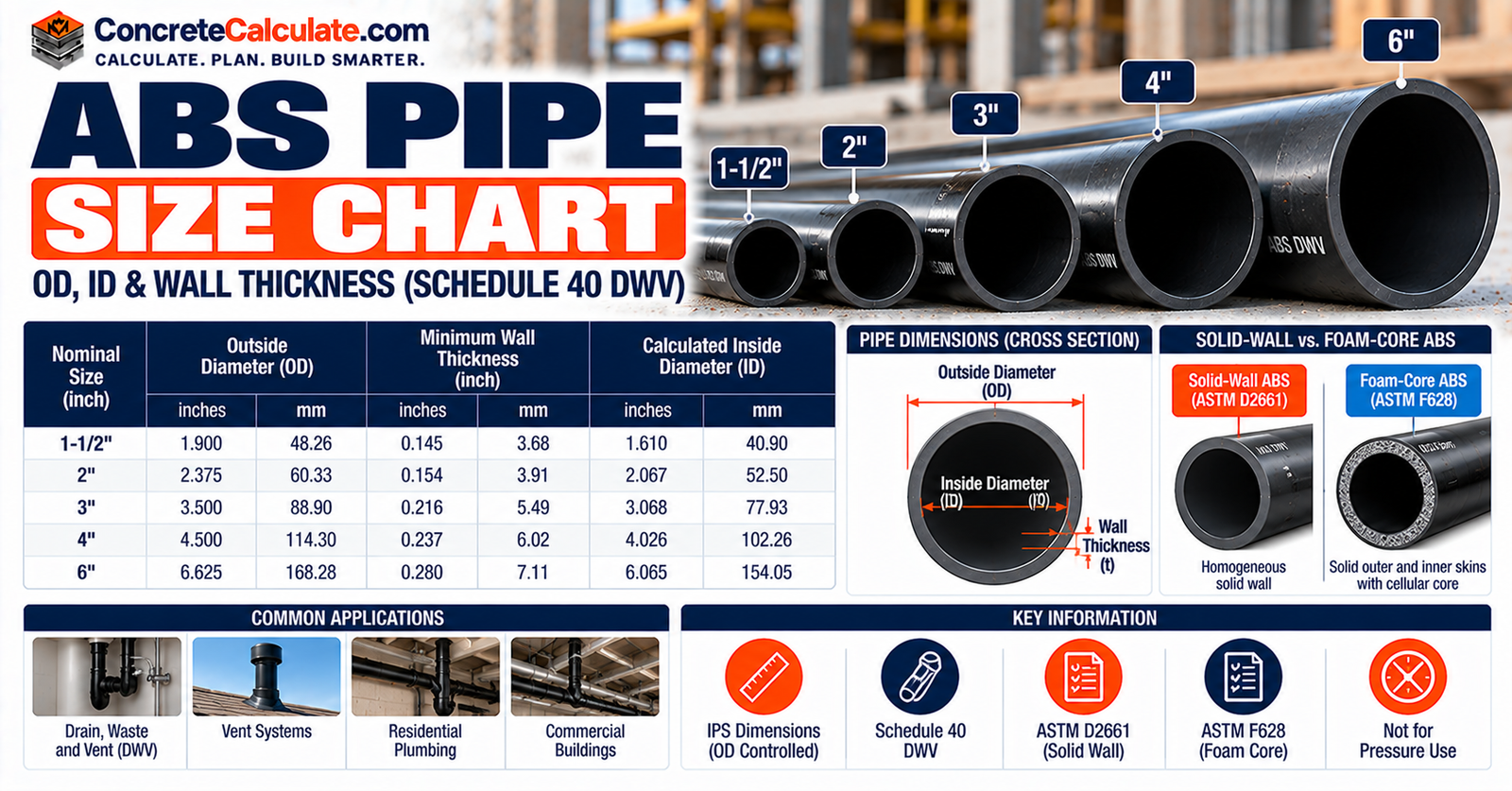
Schedule 40 ABS drain, waste and vent pipe: actual outside diameters, minimum wall, calculated inside diameters, and the differences between solid-wall and foam-core ABS.
 Reviewed by Muhammad Ramzan Babar, PhD Researcher (Plasma Physics) & Calculator Developer | View Profile
Quick Answer: ABS Pipe Is Sized by Nominal Size, Not Measured OD
- 1-1/2 in = 1.900 in OD; 2 in = 2.375 in; 3 in = 3.500 in; 4 in = 4.500 in; 6 in = 6.625 in.
- Minimum walls in the reference listing: 0.145, 0.154, 0.216, 0.237 and 0.280 in, in that order.
- ABS DWV is for non-pressure drain, waste and vent systems. Schedule 40 describes its dimensions, not a pressure rating.
ABS Pipe Size Chart
Schedule 40 ABS DWV dimensions: nominal size, actual OD, minimum wall and calculated ID.
ABS pipe sizes are nominal designations. This chart gives the actual outside diameter, minimum wall and calculated inside diameter for common ABS Schedule 40 DWV pipe.
| Nominal size | Actual OD (in) | OD (mm) | Min. wall (in) | Calc. ID (in)* | Calc. ID (mm)* |
|---|---|---|---|---|---|
| 1-1/2″ | 1.900 | 48.26 | 0.145 | 1.610 | 40.89 |
| 2″ | 2.375 | 60.33 | 0.154 | 2.067 | 52.50 |
| 3″ | 3.500 | 88.90 | 0.216 | 3.068 | 77.93 |
| 4″ | 4.500 | 114.30 | 0.237 | 4.026 | 102.26 |
| 6″ | 6.625 | 168.28 | 0.280 | 6.065 | 154.05 |
*Calculated ID = listed OD – 2 x listed minimum wall. Dimensions are in inches unless noted; millimeters use 25.4 mm per inch.
How to read this chart
Find the nominal size, then read across to the actual OD, minimum wall and calculated ID. OD and minimum wall come from the identified manufacturer listing. Calculated ID is a geometric reference, not a guaranteed or average bore.
What this table represents
These values are Charlotte Pipe’s ABS Schedule 40 foam-core DWV product data (ASTM F628), a manufacturer-specific reference for non-pressure pipe. Verify other nominal sizes from the relevant product specification instead of extrapolating, and check the applicable ASTM edition for your pipe type.
How to Read ABS Pipe Dimensions
Nominal size, outside diameter, wall thickness and inside diameter defined.
Four numbers describe an ABS pipe. Keep them separate when you read a chart.
Nominal size
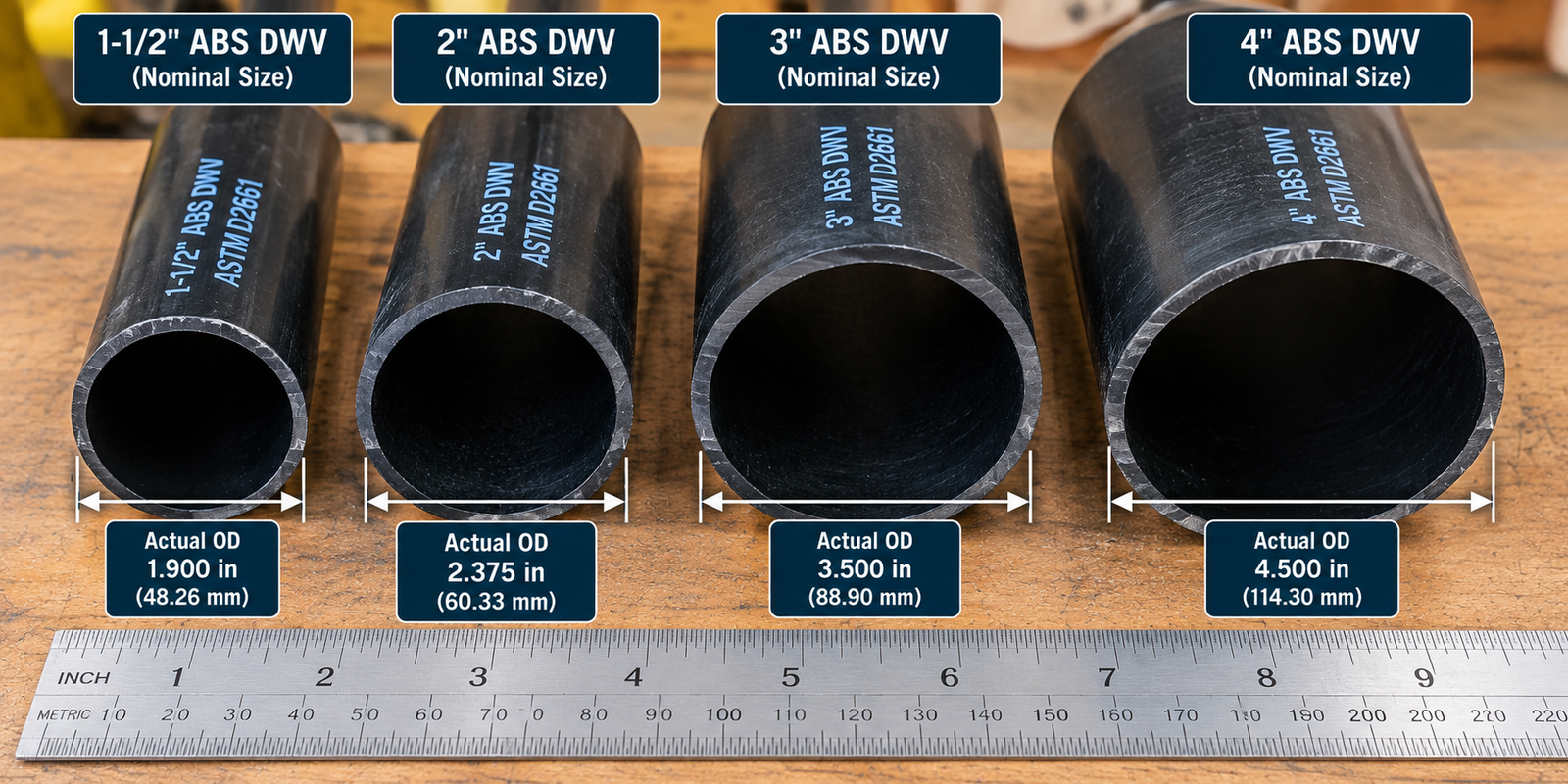
A trade name such as 2 in. Nominal 2-inch ABS does not have a 2-inch outside diameter.
Outside diameter (OD)
The external diameter that sets pipe and fitting compatibility. It is the dimension your calipers measure.
Wall thickness (t)
The minimum wall the product must meet. Actual walls vary within manufacturing tolerance.
Inside diameter (ID)
The bore. It is calculated from OD and wall here, so treat it as an estimate and not as a measured bore.
Schedule 40 names the dimensional series for iron pipe size products. It does not by itself make the pipe pressure-rated.
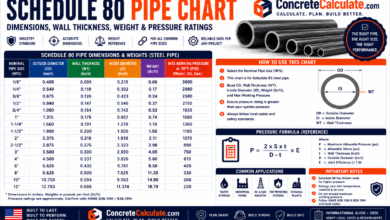
For comparisons across materials, see the Pipe Outside Diameter Chart and the Pipe Inside Diameter Chart.
Figure 1. ABS pipe cross-section showing OD, ID and wall thickness. Schematic, not to scale.
ABS Nominal Size vs. Actual Diameter
Why a 2-inch ABS pipe measures 2.375 inches outside.
A nominal 2-inch ABS pipe has an outside diameter of about 2.375 inches. The same pattern holds across the series.
| Nominal ABS size | Nominal (in) | Actual OD (in) | Actual OD (mm) | OD minus nominal (in) |
|---|---|---|---|---|
| 1-1/2″ | 1.500 | 1.900 | 48.26 | 0.400 |
| 2″ | 2.000 | 2.375 | 60.33 | 0.375 |
| 3″ | 3.000 | 3.500 | 88.90 | 0.500 |
| 4″ | 4.000 | 4.500 | 114.30 | 0.500 |
| 6″ | 6.000 | 6.625 | 168.28 | 0.625 |
The difference column is nominal size versus measured OD. It is not wall thickness.
Figure 2. Nominal 2-inch ABS versus its actual 2.375 in outside diameter.
For a general explanation of pipe sizing across materials, see the Pipe Size Chart.
ABS Pipe Outside Diameter Chart
The OD series for common ABS DWV sizes, with tolerance notes.
Use the table to identify an unmarked pipe. Measure across the pipe with calipers, or wrap a flexible tape around it and compare to the circumference.
| Nominal size | Actual OD (in) | OD (mm) | Circumference (in) | Circumference (mm) |
|---|---|---|---|---|
| 1-1/2″ | 1.900 | 48.26 | 5.97 | 151.6 |
| 2″ | 2.375 | 60.33 | 7.46 | 189.5 |
| 3″ | 3.500 | 88.90 | 11.00 | 279.3 |
| 4″ | 4.500 | 114.30 | 14.14 | 359.1 |
| 6″ | 6.625 | 168.28 | 20.81 | 528.7 |
Circumference = pi x OD, an arithmetic conversion of the listed OD values.
Average OD, tolerance and out-of-roundness
Listed ODs are average outside diameters. Real pipe varies within tolerance and can be slightly out of round, so measure at several points and use the average.
Tolerance values depend on the governing standard and product. Read them from the applicable specification or manufacturer datasheet.
The same IPS series continues for other DWV sizes, such as 1-1/4 in (1.660 in OD), 2-1/2 in (2.875 in) and 5 in (5.563 in). Confirm ABS availability, and keep multi-material comparisons on the Pipe Outside Diameter Chart.
ABS Pipe Wall Thickness Chart
Minimum wall for common ABS DWV sizes, with its product basis.
Minimum wall is the thinnest wall the product is allowed to have. It is not a measurement of every pipe.
| Nominal size | Min. wall (in) | Min. wall (mm) | Product basis |
|---|---|---|---|
| 1-1/2″ | 0.145 | 3.68 | Cellular-core ABS, F628 |
| 2″ | 0.154 | 3.91 | Cellular-core ABS, F628 |
| 3″ | 0.216 | 5.49 | Cellular-core ABS, F628 |
| 4″ | 0.237 | 6.02 | Cellular-core ABS, F628 |
| 6″ | 0.280 | 7.11 | Cellular-core ABS, F628 |
- Minimum wall is a specification floor; the actual measured wall is usually a little thicker.
- Wall tolerance is set by the governing standard and product.
- Solid-wall and cellular-core ABS can share nominal Schedule 40 dimensions, so always confirm which construction you have.
A single wall value cannot describe every product construction. For other wall systems, see the Pipe Wall Thickness Chart.
ABS Pipe Inside Diameter Chart
The ID formula, a table of calculated IDs, and a worked 2-inch example.
Inside diameter matters for internal flow area, capacity and dimensional comparison.
Inside diameter formula
- OD = listed average outside diameter (in)
- t = listed minimum wall thickness (in)
- ID = calculated inside diameter (in)
| Nominal size | Actual OD (in) | Min. wall t (in) | Calc. ID (in) | Calc. ID (mm) |
|---|---|---|---|---|
| 1-1/2″ | 1.900 | 0.145 | 1.610 | 40.89 |
| 2″ | 2.375 | 0.154 | 2.067 | 52.50 |
| 3″ | 3.500 | 0.216 | 3.068 | 77.93 |
| 4″ | 4.500 | 0.237 | 4.026 | 102.26 |
| 6″ | 6.625 | 0.280 | 6.065 | 154.05 |
2-Inch ABS Calculated ID
What it means: This is a minimum-wall geometric result. It is not a guarantee that every pipe has a 2.067 in actual ID.
Here t is the minimum wall. Using a measured wall would give a measured-based ID instead.
Common ABS Pipe Sizes and Dimensions
1-1/2, 2, 3, 4 and 6-inch ABS at a glance.
Quick reference for each common size. Fixture sizing and capacity are decided by the plumbing code, not by this chart.
1-1/2-Inch ABS
OD 1.900 in (48.26 mm)
Minimum wall 0.145 in; calculated ID 1.610 in.
A common size for lavatory, tub and kitchen drains and many vents. Fixture connections must follow the applicable plumbing code.
2-Inch ABS
OD 2.375 in (60.33 mm)
Minimum wall 0.154 in; calculated ID 2.067 in.
The measured OD is greater than the nominal 2 in, so expect about 2.375 in with calipers.
3-Inch ABS
OD 3.500 in (88.90 mm)
Minimum wall 0.216 in; calculated ID 3.068 in.
Used in building DWV systems. This chart does not assign fixture-unit capacity to any size.
4-Inch ABS
OD 4.500 in (114.30 mm)
Minimum wall 0.237 in; calculated ID 4.026 in.
“4-inch ABS” does not mean 4.000 in OD. Use the real 4.500 in OD when matching couplings and transitions.
6-Inch ABS
OD 6.625 in (168.28 mm)
Minimum wall 0.280 in; calculated ID 6.065 in.
Larger building-drain sizes use the same method. Burial depths and loading limits depend on the product, installation and code.
Solid-Wall ABS vs. Foam-Core ABS
Two constructions that can share the same nominal dimensions.
Two ABS DWV pipes with the same nominal size can be built differently. Compare construction, specification and product listing, not just size.
| Feature | Solid-wall ABS DWV | Cellular-core ABS DWV |
|---|---|---|
| Primary reference | ASTM D2661 | ASTM F628 |
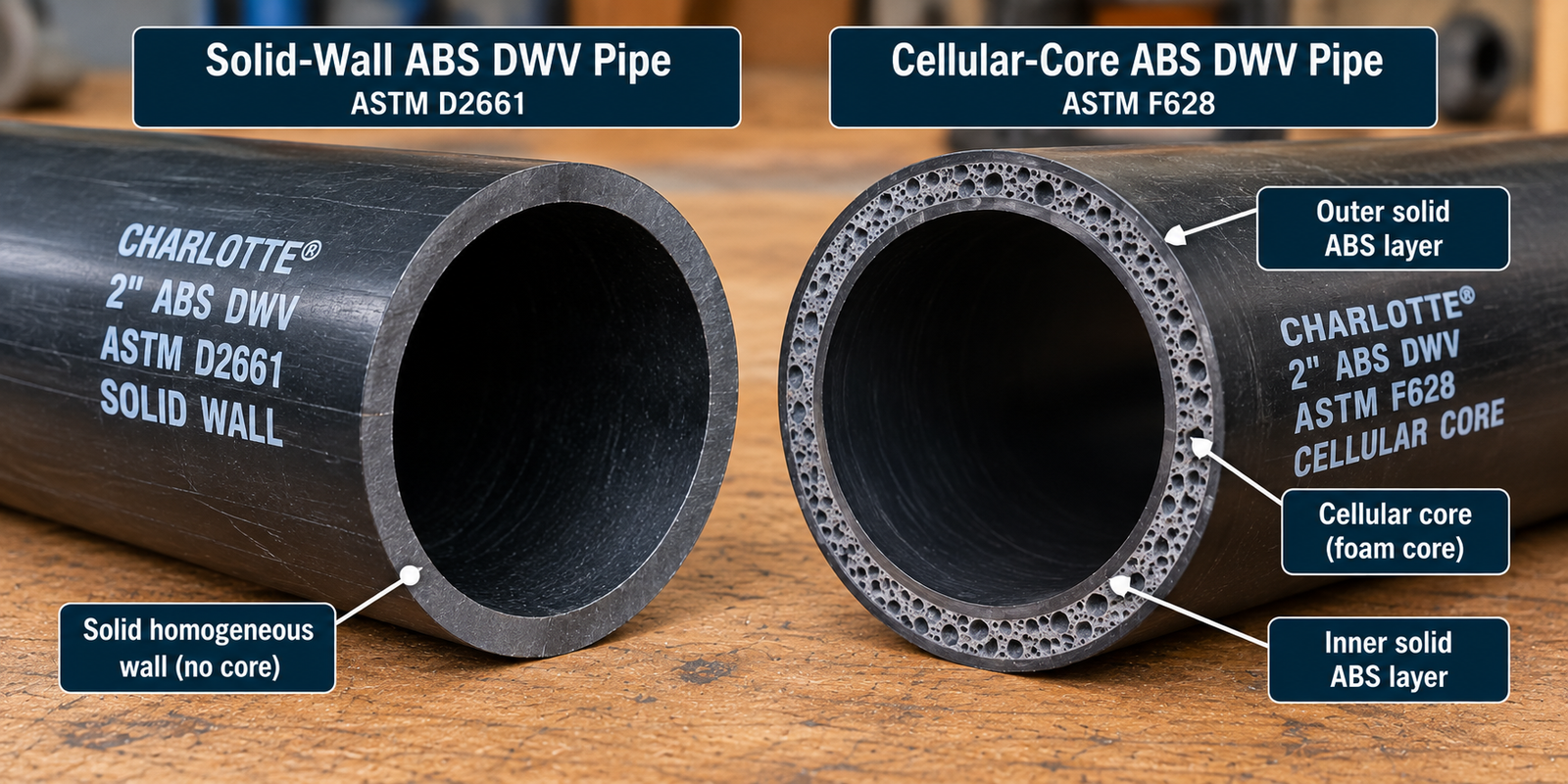
| Wall construction | Homogeneous ABS | Solid ABS skins with a cellular ABS core |
| Dimensional basis | Schedule 40 IPS | Schedule 40 IPS |
| Main application | DWV | DWV |
| Pressure suitability | Not established by the DWV designation | Non-pressure product |
| Weight | Product dependent | Product dependent |
| Fitting selection | Applicable listed DWV fittings | Compatible listed DWV fittings |
Solid-wall construction
A single homogeneous ABS wall, covered by the relevant ASTM D2661 requirements.
Cellular-core construction
A coextruded wall with solid inner and outer ABS skins around a closed-cell cellular ABS core, covered by ASTM F628.
ABS/PVC composite core
Composite cellular-core pipe, such as ABS Plus, is a separate product family under ASTM F1488 and should not be treated as ordinary F628 ABS.
Figure 3. Solid-wall and cellular-core ABS wall construction, schematic.
Weights differ by construction. These figures are one manufacturer’s published product data, not a universal comparison.
| Nominal size | ABS foam core (ASTM F628) | ABS Plus composite (ASTM F1488) |
|---|---|---|
| 1-1/2″ | 27.1 | 31.4 |
| 2″ | 37.7 | 41.9 |
| 3″ | 74.5 | 84.0 |
| 4″ | 107.1 | 118.8 |
| 6″ | 187.8 | not listed |
For more weight references, see the Pipe Weight Chart and the Pipe Weight Calculator.
What can change
Construction, product weight, marking, listing, application limits and manufacturer instructions. Do not assume equal performance because nominal dimensions match.
ASTM D2661 ABS DWV Pipe
What the main ABS DWV standard covers.
ASTM D2661-24 covers ABS Schedule 40 plastic drain, waste and vent pipe and fittings made to iron pipe sizes. It includes single-layer and coextruded pipe.
- IPS dimensional system for pipe and fittings.
- Material, dimension and tolerance requirements.
- Pipe stiffness, flattening resistance and impact requirements.
- Marking requirements.
It is not a general pressure-pipe standard. The full dimension tables are in the licensed standard, so this page cites a named manufacturer listing instead of reproducing them.
| Standard | Subject | Important distinction |
|---|---|---|
| ASTM D2661-24 | ABS Schedule 40 DWV pipe and fittings | Includes single-layer and qualifying coextruded ABS DWV products |
| ASTM F628-24 | Cellular-core ABS Schedule 40 DWV pipe | Solid ABS skins with a closed-cell ABS core |
| ASTM F1488 | Coextruded composite pipe | Separate composite construction, such as ABS/PVC cellular core |
| ASTM D2235 | ABS solvent cement | ABS joining material |
| ASTM D3138-21 | ABS-to-PVC transition cement | Specific non-pressure transition joints, 25 psi or less |
ASTM F628 Cellular-Core ABS Pipe
The standard for foam-core ABS DWV pipe.
ASTM F628-24 covers coextruded ABS Schedule 40 DWV pipe made to IPS sizes, with concentric solid ABS inner and outer layers and a closed-cell cellular ABS core.
- Coextrusion of the three layers.
- Dimensional requirements, including outside diameter and wall thickness.
- Pipe stiffness, flattening, impact and bond strength.
- Compatible fittings listed in an annex; fittings meeting D2661 are also acceptable.
The represented manufacturer products are for non-pressure use only. Cellular-core pipe is not simply a thinner version of solid-wall ABS.
Is ABS Pipe Schedule 40?
Dimensional Schedule 40 versus pressure approval.
Schedule 40 appears in ABS DWV specifications because the pipe is made to Schedule 40 IPS dimensions. That gives familiar ODs and walls that match iron-pipe-size fittings.
- Schedule 40 IPS: a dimensional geometry.
- ABS DWV: a product designation for drain, waste and vent use.
- Pressure-pipe specifications: separate standards with their own ratings.
For the general series, see the Pipe Schedule Chart and the Schedule 40 Pipe Chart.
Schedule 40 is not proof of pressure service
Matching Schedule 40 dimensions does not approve a DWV pipe for pressurized service. Manufacturers list cellular-core DWV pipe as non-pressure and warn against testing with compressed air or gas.
Equipment for Your Project
Affiliate disclosure: As an Amazon Associate, ConcreteCalculate earns from qualifying purchases. We may also earn a commission from other affiliate links at no additional cost to you.
ABS vs. PVC Pipe Dimensions
Where the two Schedule 40 DWV systems match.
Schedule 40 ABS and PVC DWV pipe share IPS outside diameters and the minimum wall values in the manufacturer data reviewed. Other PVC systems do not always match, so use the PVC Pipe Size Chart for PVC-specific sizing.
| Nominal size | OD (in) | Min. wall, ABS foam core (in) | Min. wall, PVC DWV (in) |
|---|---|---|---|
| 1-1/2″ | 1.900 | 0.145 | 0.145 |
| 2″ | 2.375 | 0.154 | 0.154 |
| 3″ | 3.500 | 0.216 | 0.216 |
| 4″ | 4.500 | 0.237 | 0.237 |
| 6″ | 6.625 | 0.280 | 0.280 |
| Item | ABS DWV | PVC DWV |
|---|---|---|
| Main DWV standard | ASTM D2661 (solid), ASTM F628 (cellular core) | ASTM D2665 (solid), ASTM F891 (cellular core) |
| Dimensional basis | Schedule 40 IPS | Schedule 40 IPS |
| Joining cement | ABS cement (ASTM D2235) | PVC cement |
| Typical color | Black | White |
Do not assume every PVC pipe system has the same dimensions as ABS DWV. Color alone does not identify the standard.
ABS DWV vs. PVC DWV
Practical selection factors without material hype.
Choose by compatibility and approval, not by a general claim that one material is better.
- Dimensional compatibility: matching IPS sizes do not make ABS and PVC components interchangeable.
- Product listing: confirm each pipe and fitting is listed for DWV.
- Construction: solid-wall and cellular-core options exist for both materials.
- Joining: use the cement made for the material.
- Local code and the manufacturer’s instructions decide acceptance.
ABS Pipe Fitting Sizes
Pipe OD versus hub dimensions, and why they differ.
Fittings include hubs, spigots, couplings, elbows, sanitary tees, wyes, cleanouts, reducers and transitions. A fitting’s outside dimensions are not the pipe’s OD.
| Nominal size | Pipe OD (in) | Socket entrance (in) | Socket bottom (in) | Socket depth (in) | Min. wall (in) | Entrance minus OD | Bottom minus OD |
|---|---|---|---|---|---|---|---|
| 1-1/2″ | 1.900 | 1.910 | 1.895 | 0.687 | 0.156 | +0.010 | -0.005 |
| 2″ | 2.375 | 2.385 | 2.370 | 0.750 | 0.156 | +0.010 | -0.005 |
| 3″ | 3.500 | 3.515 | 3.495 | 1.500 | 0.218 | +0.015 | -0.005 |
| 4″ | 4.500 | 4.515 | 4.495 | 1.750 | 0.250 | +0.015 | -0.005 |
| 6″ | 6.625 | 6.647 | 6.614 | 3.000 | 0.281 | +0.022 | -0.011 |
Hub columns follow the standard socket geometry for ABS DWV fittings: entrance and bottom diameters, socket depth and minimum wall. The last two columns are calculated differences; a negative value means the socket bottom is narrower than the pipe OD, which creates the interference fit.
These are one manufacturer’s catalog values, not a universal table. Confirm socket and insertion dimensions in the current catalog for the exact fitting you buy.
Figure 4. Plain-end ABS pipe inserted into a socket fitting. Schematic only.
ABS Pipe Solvent Cement and Joining
A short joining overview, not an installation manual.
ASTM D2235 covers solvent cement for ABS pipe and fittings. Use ABS cement on ABS joints and match the cement to the pipe and fitting products.
- Cut the pipe square, deburr the end and clean the surfaces.
- Check the dry fit; the pipe should enter the socket partway before cementing.
- Insert the pipe fully to the socket bottom and hold as the manufacturer directs.
- Follow the cement label for handling and cure time, which depend on size and temperature.
There is no universal cure time. Use the manufacturer’s instructions and the local code.
Can ABS and PVC Pipe Be Connected?
Dimensional match versus approved transition.
Matching nominal size does not make an ABS-to-PVC joint approved. The joint needs an approved method.
ASTM D3138-21 covers solvent cements for ABS-to-PVC transition joints in non-pressure applications only, at 25 psi or less. It was not written as an all-purpose cement for mixing the two materials.
- Approved transition cement where permitted.
- Listed mechanical transition couplings.
- Local plumbing-code requirements.
- Manufacturer instructions.
Do not use ordinary cement on a transition
Ordinary ABS or PVC cement is made for its own material. Use a transition cement or listed coupling where the code allows ABS to PVC connections.
ABS Pipe Flow Area and Internal Capacity
How inside diameter sets the full-bore area.
Cross-sectional flow area
- A = full-bore flow area (in²)
- ID = calculated inside diameter (in)
2-Inch ABS Full-Bore Area
What it means: This is an illustrative full-bore geometric area, not an allowable gravity-drainage flow rate.
Real DWV capacity depends on slope, flow depth, roughness, venting, fittings, fixture-unit loading and the applicable code.
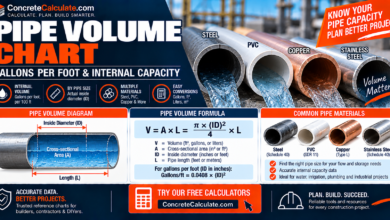
For general hydraulic references see the Pipe Flow Rate Chart, and for water held per foot see the Pipe Volume Chart.
ABS Pipe Slope and Drainage Sizing
Why pipe size alone does not set drainage performance.
Pipe diameter alone does not decide whether a drain works. Plumbing codes size drains from fixture units, slope and the type of pipe segment.
- Gravity drainage depends on pipe slope and flow depth.
- Drainage fixture units (DFU) set the load on each branch and drain.
- Trap arms, building drains and vents each have their own limits.
- Minimum slopes and sizes vary by pipe size, code edition and jurisdiction.
This page does not publish a universal slope or fixture-unit table. Use the plumbing code adopted where you build, and name its edition when you cite a number.
ABS Pipe Support Spacing
Why supports matter, with two code examples.
Supports reduce sagging, joint loading and misalignment, and they work with thermal movement provisions.
| Code reference | Horizontal spacing | Vertical support |
|---|---|---|
| 2024 International Plumbing Code, Table 308.5 | 4 ft maximum | 10 ft maximum; a guide midway for sizes 2 in and smaller |
| Uniform Plumbing Code, Table 313.3 (Schedule 40 PVC and ABS DWV) | 4 ft, all sizes; allow for expansion every 30 ft | Base and each floor; provide mid-story guides |
Examples only. The adopted code edition and the manufacturer’s instructions set the actual requirements in your jurisdiction.
For the general reference, see the Pipe Support Spacing Chart.
ABS Pipe Temperature and Application Limits
Service temperature, product limits and thermal movement.
ABS DWV is for drain, waste and vent service. Check the temperature and application limits of the specific product.
- Sanitary wastewater temperatures of 60 to 140°F are commonly considered for DWV systems.
- One manufacturer states its ABS Plus composite DWV pipe is for non-pressure systems not exceeding 140°F. That limit is product specific.
- Check the manufacturer’s limits for exposure and storage conditions.
Thermal expansion
ABS moves more than metal pipe. Plan offsets, hangers that let the pipe slide, and expansion joints on long runs.
Thermal Expansion of an ABS Run
What it means: The coefficient varies by compound; the published value for ABS/PVC composite is lower (4.2 x 10⁻⁵). Use the manufacturer’s value for design.
How to Measure and Identify ABS Pipe
A practical workflow, from print line to application check.
Follow this order to identify an ABS pipe before you buy fittings.
- Read the pipe print line.
- Identify the nominal size.
- Identify the ASTM standard.
- Check whether the pipe is solid-wall or cellular-core.
- Measure the actual OD.
- Compare it with the correct IPS table.
- Check the fittings and product listing.
- Confirm the application is permitted.
Black color alone does not prove the material is ABS.
Common ABS Pipe Sizing Mistakes
Errors that cost time at the fitting counter.
Assuming OD equals nominal size
2-in ABS measures about 2.375 in outside.
Confusing pipe OD with fitting hub OD
The fitting’s outside dimensions are not the pipe’s OD.
Treating all ABS as solid-wall
Cellular-core ABS exists and is a different construction.
Ignoring cellular-core identification
Read the print line and look at the cut end.
Using calculated ID as exact bore
It is based on minimum wall, not a measured bore.
Assuming Schedule 40 means pressure-rated
ABS DWV is non-pressure pipe.
Using generic PVC cement on ABS
Use cement made for the pipe material.
Assuming every ABS/PVC transition is allowed
Use approved transition methods only.
Sizing drains from pipe size alone
Fixture units, slope and code edition decide capacity.
Ignoring supports and expansion
Long runs need hangers that allow movement.
Assuming all black plastic pipe is the same
Different standards and materials share black color.
Using pressure-pipe specs as D2661 DWV
Industrial ABS pressure pipe follows different standards.
ABS Pipe Size FAQs
Short answers to common ABS sizing questions.
This chart covers the ABS Schedule 40 DWV sizes in the verified manufacturer listing: 1-1/2, 2, 3, 4 and 6 inches nominal. Other sizes exist in some product lines, so confirm the exact size, outside diameter and wall from the product specification instead of extrapolating.
Nominal 1-1/2-inch ABS DWV pipe has an outside diameter of 1.900 in (48.26 mm).
Nominal 2-inch ABS DWV pipe has an outside diameter of 2.375 in (60.33 mm), which is 0.375 in larger than the nominal size.
Nominal 3-inch ABS DWV pipe has an outside diameter of 3.500 in (88.90 mm).
Nominal 4-inch ABS DWV pipe has an outside diameter of 4.500 in (114.30 mm), not 4.000 in.
Nominal 6-inch ABS DWV pipe has an outside diameter of 6.625 in (168.28 mm).
ABS DWV pipe follows iron pipe size (IPS) dimensions, which control the outside diameter and a minimum wall thickness. The inside diameter is derived from OD and wall, so it varies slightly with manufacturing.
ABS DWV pipe is made to Schedule 40 IPS dimensions under ASTM D2661 (solid wall) or ASTM F628 (cellular core). Schedule 40 here describes the dimensional system and DWV designation, not a pressure rating.
No. ABS DWV pipe is intended for non-pressure drain, waste and vent service. Manufacturers state that cellular-core DWV pipe must not be used for pressure applications or tested with compressed air or gas.
Solid-wall ABS has one homogeneous wall. Foam-core (cellular-core) ABS has solid ABS inner and outer skins around a closed-cell cellular ABS core. Both can share Schedule 40 IPS dimensions but are different constructions with different specifications.
For Schedule 40 DWV, ABS and PVC share the same IPS outside diameters and minimum walls in the manufacturer data reviewed, for example 2.375 in OD and 0.154 in wall for 2-inch pipe. They are still different materials with different cements and standards.
Only with an approved method. Matching nominal size does not prove compatibility. ASTM D3138 covers transition cement for non-pressure ABS-to-PVC joints, and listed mechanical couplings may also be allowed, subject to local code and manufacturer instructions.
Use ID = OD – 2t. For 2-inch ABS with OD 2.375 in and minimum wall 0.154 in, ID = 2.375 – 2(0.154) = 2.067 in. This is a calculated estimate from minimum wall, not a guaranteed bore.
ASTM D2661 is the specification for ABS Schedule 40 plastic drain, waste and vent pipe and fittings, including single-layer and qualifying coextruded pipe made to IPS dimensions.
ASTM F628 is the specification for ABS Schedule 40 DWV pipe with a cellular core: coextruded pipe with solid ABS inner and outer layers and a closed-cell cellular ABS core.
ABS DWV pipe is not a pressurized hot-water supply pipe. It can carry drain discharge within the temperature limits of the specific product and code, for example one manufacturer limits its ABS Plus composite DWV pipe to systems not exceeding 140°F.
Do not rely on black color alone, because other black plastic pipes exist. Measure the OD with calipers or a tape, check the cut end for solid or cellular wall, and compare with the print line or supplier data. If it is still unclear, treat the pipe as unidentified.
Print This ABS Pipe Size Chart
Use your browser to save this page as a PDF for a job-site binder or estimating folder. Interactive sections are hidden when printing.