Rivet Size Chart: Diameter, Grip Range, Length and Hole Size
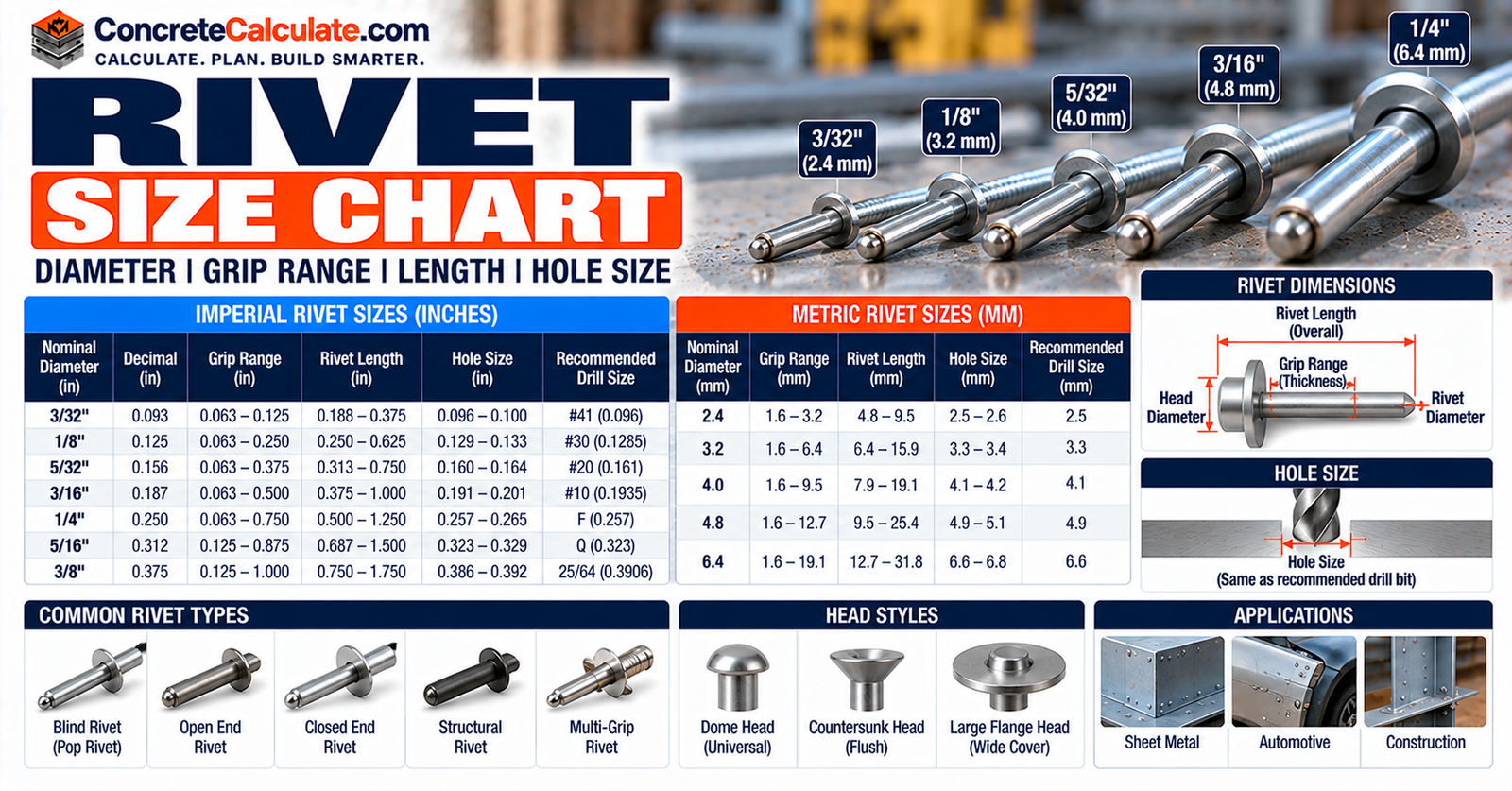
Rivet Size Chart
Diameter, Grip Range, Length and Hole Size
See common inch and metric rivet diameters, then connect them to grip range, product-specific hole sizes, drill choices, head styles, materials and strength, because rivet size is a set of values and not one number.
 Reviewed by Muhammad Ramzan Babar, PhD Researcher (Plasma Physics) & Calculator Developer – View Profile
Short Answer
Common blind rivet sizes are 3/32, 1/8, 5/32, 3/16 and 1/4 in. (about 2.4 to 6.4 mm). The right rivet depends on more than diameter: add up the layers to get the stack thickness G, choose a rivet whose grip range contains G, drill the hole to that product’s specified range, and check shear and tensile data for the exact part number.
Rivet Size Chart
Start with the common diameters, then use the sections below for grip range, hole size and selection. There is no single table that applies to every rivet family.
How to Read Rivet Sizes
Rivet size is more than one number. A designation such as 4.8 × 10 mm means a 4.8 mm nominal body diameter and a 10 mm body length. The grip range, which is the thickness of material the rivet can join, is a separate value on the data sheet. GESIPA shows this with a designation like 3.2 x 10 / 0.5-3.0: 3.2 mm diameter, 10 mm body length and a 0.5 to 3.0 mm grip range.
Common Inch and Metric Rivet Diameters
| Nominal Inch Size | Decimal (in.) | Exact Conversion (mm) | Approx. Metric Class (mm) | Typical Category |
|---|---|---|---|---|
| 3/32 | 0.09375″ | 2.381 | 2.4 | Small blind rivets |
| 1/8 | 0.125″ | 3.175 | 3.2 | Common light-duty blind rivets |
| 5/32 | 0.15625″ | 3.969 | 4.0 | General blind riveting |
| 3/16 | 0.1875″ | 4.762 | 4.8 | Common medium and heavier blind rivets |
| 1/4 | 0.25″ | 6.350 | 6.4 | Larger blind and structural systems |
| 5/16 | 0.3125″ | 7.938 | 7.9 | Structural and specialty systems |
| 3/8 | 0.375″ | 9.525 | 9.5 | Structural and specialty systems |
Metric values are dimensional conversions or near-equivalents. Do not assume an inch rivet and a metric rivet are interchangeable just because their nominal diameters are close. Which sizes exist depends on the rivet family.
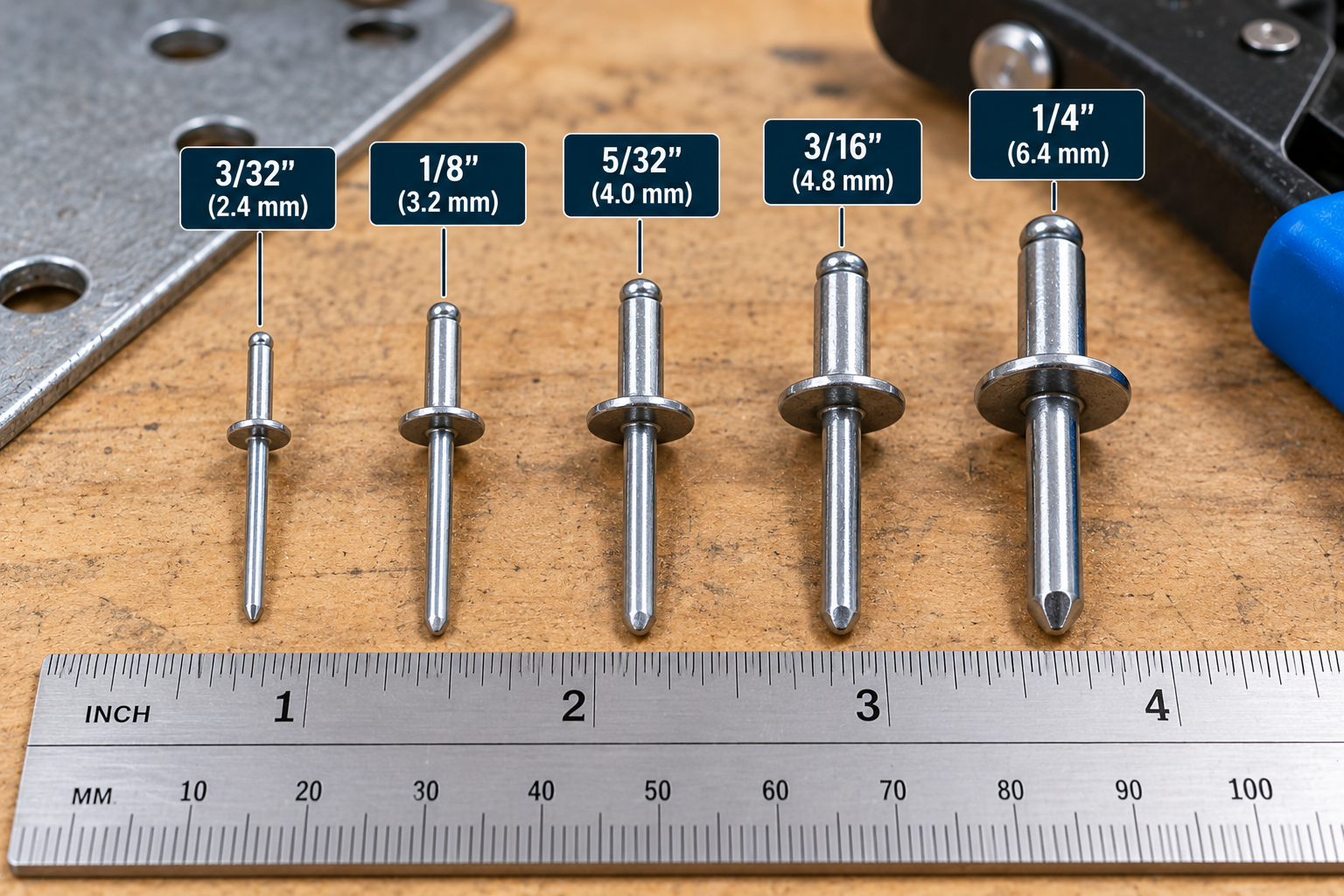
Check the Specific Rivet Family
Hole size, grip range, length and strength differ from one rivet family to the next. The numbers on this page come from named manufacturer data and are not universal.
Common Blind and Pop Rivet Sizes
Blind (pop) rivets are set from one side. Common nominal sizes are 3/32, 1/8, 5/32, 3/16 and 1/4 in. (about 2.4, 3.2, 4.0, 4.8 and 6.4 mm). The POP catalog also lists a 2.0 mm Micro rivet and a 1/4 in. High Strength series. Available diameters depend on the product family and the tool.
| Nominal Size | Metric Class (mm) | Grip Range Across Part Numbers (in.) |
|---|---|---|
| 3/32 | 2.4 | 0.032 to 0.375 |
| 1/8 | 3.2 | 0.032 to 0.625 |
| 5/32 | 4.0 | 0.063 to 0.625 |
| 3/16 | 4.8 | 0.063 to 1.000 |
| 1/4 | 6.4 | 0.062 to 1.000 |
Inch vs. Metric Rivet Sizes
3/16 in. in Millimeters
Practical interpretation: A conversion does not prove interchangeability. Hole range, grip range and strength still come from the product data.
| Nominal Inch Size | Decimal (in.) | Exact (mm) | Nominal Metric Class (mm) |
|---|---|---|---|
| 3/32 | 0.09375 | 2.3812 | 2.4 |
| 1/8 | 0.125 | 3.1750 | 3.2 |
| 5/32 | 0.15625 | 3.9688 | 4.0 |
| 3/16 | 0.1875 | 4.7625 | 4.8 |
| 1/4 | 0.25 | 6.3500 | 6.4 |
| 5/16 | 0.3125 | 7.9375 | 7.9 |
| 3/8 | 0.375 | 9.5250 | 9.5 |
Rivet Diameter, Length and Grip Range
Rivet Diameter
The body or shank size, such as 1/8 in. or 3.2 mm.
Body Length
The physical length of the rivet body before it is set.
Grip Range
The allowable combined thickness of the joined materials. POP defines it as the thickness range over which the body length will consistently produce a proper set in a hole of the specified diameter. Grip range, not body length, is the practical selection value for blind rivets.
| Specification | Meaning |
|---|---|
| Nominal diameter | Basic rivet body size |
| Body length | Rivet body length before setting |
| Grip range | Total material thickness the rivet can properly join |
| Hole size | Permitted prepared-hole diameter or range |
| Head diameter | Diameter of the manufactured head |
| Head style | Dome, large flange, countersunk and so on |
| Shear strength | Resistance to transverse joint loading |
| Tensile strength | Resistance to axial separation |
Rivet Grip Range Chart
G is the total stack thickness and t(i) is the thickness of each layer. Choose a rivet whose manufacturer-specified grip range contains G. GESIPA states that every blind rivet has a defined minimum and maximum grip range, and that correct grip selection is critical to joint formation.
| POP Part Number | Nominal Diameter (in.) | Grip Range (in.) | Body Length (in.) | Hole Size (in.) |
|---|---|---|---|---|
| AD 41 ABS | 1/8 | 0.032 to 0.062 | 0.188 | 0.129-0.133 |
| AD 42 ABS | 1/8 | 0.063 to 0.125 | 0.250 | 0.129-0.133 |
| AD 43 ABS | 1/8 | 0.126 to 0.187 | 0.313 | 0.129-0.133 |
| AD 44 ABS | 1/8 | 0.188 to 0.250 | 0.375 | 0.129-0.133 |
| AD 46 ABS | 1/8 | 0.313 to 0.375 | 0.500 | 0.129-0.133 |
| AD 62 ABS | 3/16 | 0.063 to 0.125 | 0.300 | 0.192-0.196 |
| AD 64 ABS | 3/16 | 0.126 to 0.250 | 0.425 | 0.192-0.196 |
| AD 66 ABS | 3/16 | 0.251 to 0.375 | 0.550 | 0.192-0.196 |
| AD 68 ABS | 3/16 | 0.376 to 0.500 | 0.675 | 0.192-0.196 |
| AD 610 ABS | 3/16 | 0.501 to 0.625 | 0.800 | 0.192-0.196 |
| Nominal Diameter (in.) | BOM Grip Number | Grip Range (in.) |
|---|---|---|
| 3/16 | 2 | 0.093 to 0.156 |
| 3/16 | 3 | 0.157 to 0.219 |
| 3/16 | 4 | 0.220 to 0.281 |
| 1/4 | 2 | 0.093 to 0.156 |
| 1/4 | 4 | 0.220 to 0.281 |
How to Measure Rivet Grip Thickness
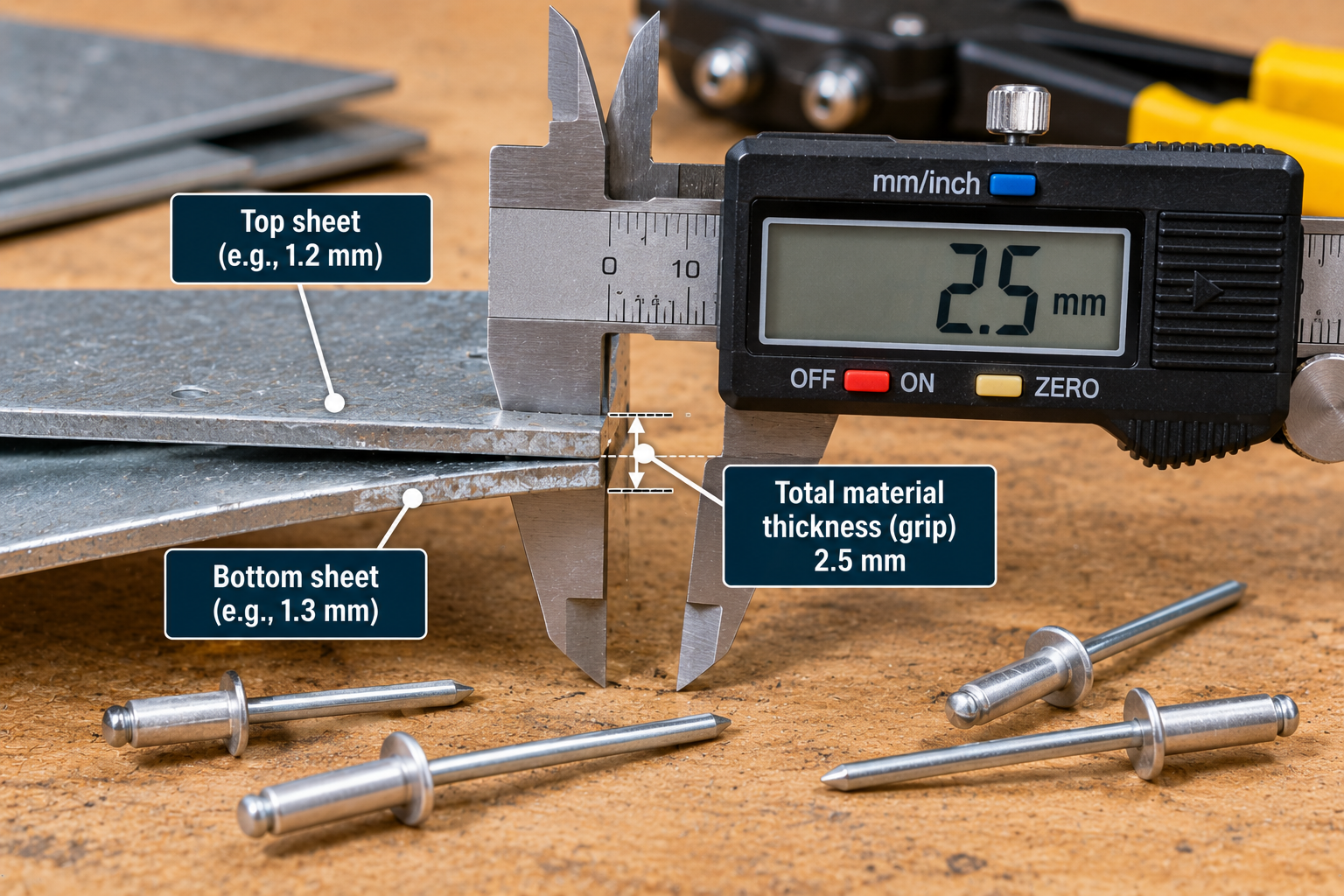
Stack every layer as it will be riveted and measure the combined thickness. Include all sheets, intermediate layers, and any gaps, coatings or interlayers that affect the stack. Measure in the assembled condition where possible, and read the thickness of sheet metal from the actual material. The Sheet Metal Gauge Chart converts gauge to nominal thickness, but measure the real sheet when fit matters.
Total Grip for Two Sheets
Practical interpretation: Do not pick a rivet only because its body length exceeds 0.153 in.
Rivet Grip Checker
The checker only searches the POP AD … ABS examples listed on this page. Use the manufacturer table for your real part number.
Rivet Hole Size Chart
Rivet Diameter Does Not Equal the Drill Diameter
Hole size comes from the selected rivet’s data sheet. The same 3/16 in. nominal size has a 0.192 to 0.196 in. hole in one POP family, 0.191 to 0.201 in. in POP Ultra-Grip, and 0.208 to 0.222 in. in Huck BOM. Holes outside the recommended range reduce joint performance. POP notes that too large a hole reduces shear and tensile strength, and too small a hole makes insertion difficult.
| Rivet System | Nominal Diameter (in.) | Specified Hole (in.) |
|---|---|---|
| POP open end (5052 aluminum, domed) | 3/32 | 0.097-0.100 |
| POP open end (5052 aluminum, domed) | 1/8 | 0.129-0.133 |
| POP open end (5052 aluminum, domed) | 5/32 | 0.160-0.164 |
| POP open end (5052 aluminum, domed) | 3/16 | 0.192-0.196 |
| POP open end (5052 aluminum, domed) | 1/4 | 0.257-0.261 |
| POP Ultra-Grip | 3/16 | 0.191-0.201 |
| POP Ultra-Grip | 1/4 | 0.261-0.272 |
| Huck BOM | 3/16 | 0.208-0.222 |
| Huck BOM | 1/4 | 0.277-0.292 |
| Huck BOM | 5/16 | 0.348-0.368 |
| Huck BOM | 3/8 | 0.413-0.435 |
General bolt and screw clearance-hole tables do not set rivet hole tolerances. For those references, see the Clearance Hole Size Chart and the Bolt Hole Size Chart.
How Much Larger Should the Rivet Hole Be?
Ordinary blind rivets usually need a hole slightly larger than the body diameter, and the permitted difference depends on the product. GESIPA gives an example of a 4.8 mm standard blind rivet in a 4.9 mm hole (about 0.1 mm larger), while engineered structural fasteners use materially different tolerances.
| Rivet System | Nominal Size | Nominal (in.) | Specified Hole (in.) | Hole Minus Nominal (in.) |
|---|---|---|---|---|
| POP open end | 1/8 | 0.1250 | 0.129-0.133 | 0.0040 to 0.0080 |
| POP open end | 3/16 | 0.1875 | 0.192-0.196 | 0.0045 to 0.0085 |
| POP Ultra-Grip | 3/16 | 0.1875 | 0.191-0.201 | 0.0035 to 0.0135 |
| Huck BOM | 3/16 | 0.1875 | 0.208-0.222 | 0.0205 to 0.0345 |
The Manufacturer Specification Overrides Shop Rules
Use the hole range from the data sheet for the exact part number.
Drill Bit Size for Rivets
- Identify the exact rivet product.
- Find its permitted hole range.
- Select a drill that produces a finished hole inside that range.
- Account for drill runout, material and process.
- Deburr and inspect the hole.
| Rivet Example | Specified Hole (in.) | Common Drills Whose Nominal Diameter Falls in the Range |
|---|---|---|
| POP open end 1/8 | 0.129-0.133 | 3.3 mm (0.1299) |
| POP open end 3/16 | 0.192-0.196 | #10 (0.1935), #9 (0.1960), 4.9 mm (0.1929) |
| POP Ultra-Grip 3/16 | 0.191-0.201 | #11 (0.1910), #10 (0.1935), #9 (0.1960), 4.9 mm (0.1929), 5.0 mm (0.1968), #8 (0.1990), #7 (0.2010) |
| POP Ultra-Grip 1/4 | 0.261-0.272 | G (0.2610), H (0.2660), 17/64 (0.2656), 6.7 mm (0.2638), I (0.2720) |
These are examples only. The full number, letter, fractional and metric drill reference is in the Drill Bit Size Chart.
Rivet Head Size and Head Styles
Dome Head
The standard low-profile head, suitable for most applications.
Large-Flange Head
Used where thin, brittle, soft or vulnerable materials are fastened. POP states it offers twice the bearing surface and can cover enlarged holes or slots.
Countersunk Head
Gives a flush surface. POP describes its countersunk head as a 120-degree design. Head diameter is not the rivet’s nominal diameter.
Countersunk Rivet Sizes
Countersunk rivets need the correct rivet diameter and hole, a countersink diameter and depth that match the head, a matching head angle, and enough material thickness. Head angles differ by product line: POP describes a 120-degree countersunk head, while one distributor lists a 100-degree countersunk head for the POP Ultra-Grip SK6331UG. Match the countersink to the part number. The Countersink Size Chart covers countersink geometry in detail.
Open-End vs. Closed-End Blind Rivets
Open-end rivets are the general-purpose design, available in many materials and head styles. Closed-end rivets have a completely closed body, which makes them suitable for water-tight or pressure-tight applications and keeps the mandrel retained. POP states its closed-end design seals against liquid or vapor at pressures up to 100 psi. Do not treat the two as interchangeable on diameter and grip alone.
Multi-Grip Rivet Sizes
Multi-grip rivets cover a wider thickness range than conventional narrow-grip rivets, which lowers inventory. POP says its Multi-Grip rivets also accommodate oversized or irregular holes and give a rattle-free, vibration-resistant joint. Each product has its own range, so confirm the minimum and maximum grip on the data sheet.
Structural Blind Rivet Sizes
Structural blind fasteners are engineered systems with their own hole tolerances, grip ranges and strengths. Huck BOM, for example, spans 3/16 to 3/4 in. diameters. Select them from the actual product data, not from pop rivet rules.
| Nominal Diameter (in.) | Hole Size (in.) | Min. Ultimate Shear (lb) | Min. Ultimate Tensile (lb) |
|---|---|---|---|
| 3/16 | 0.208-0.222 | 2,800 | 1,800 |
| 1/4 | 0.277-0.292 | 5,100 | 3,250 |
| 5/16 | 0.348-0.368 | 8,050 | 5,200 |
| 3/8 | 0.413-0.435 | 11,100 | 7,250 |
| 1/2 | 0.546-0.581 | 20,150 | 13,000 |
Solid Rivet Sizes
Solid rivets are a separate category from blind rivets. ASME B18.1.1-1972 (R2021) covers general and dimensional data for the types of small solid rivets recognized as American National Standard, up to 7/16 in. nominal diameter. Sizing involves nominal diameter, rivet length and head style, and the length must also leave enough material to form the closing head. Do not apply blind-rivet grip terminology to solid-rivet sizing.
Aluminum, Steel and Stainless Steel Rivets
Choose the rivet body to match the joined materials in properties. POP notes the rivet generally should have the same physical and mechanical properties as the components being joined. Material affects strength, corrosion resistance, installation force, galvanic compatibility and tool requirements, but there is no universal strength value by material alone.
| Material | Characteristics (POP catalog) | Notes |
|---|---|---|
| Aluminum body | 1100 suits soft materials and lower loads; 5052 and 5056 give higher shear and tensile and good corrosion resistance | Softer materials; lighter assemblies |
| Steel body | General-purpose strength; used for steel mandrels | Zinc plating is standard on POP steel rivets |
| Stainless steel body | 300-series stainless gives good corrosion resistance | Higher installation force |
| Mixed body and mandrel | Combines body and mandrel properties | Check tool capability |
Rivet Shear vs. Tensile Strength
Shear is a load applied along the joint interface, across the rivet. Tension is a load applied along the rivet’s length, trying to separate the layers. Datasheets list them separately.
| Product | Nominal Diameter (in.) | Shear (lb) | Tensile (lb) |
|---|---|---|---|
| POP AD ABS (5052 aluminum) | 1/8 | 155 | 235 |
| POP AD ABS (5052 aluminum) | 3/16 | 315 | 500 |
| POP AD ABS (5052 aluminum) | 1/4 | 600 | 750 |
| Huck BOM (steel) | 3/16 | 2,800 | 1,800 |
No Universal Strength by Diameter
These numbers belong to named products. Do not use them for another rivet family or for a design without the engineering requirements.
How to Choose Rivet Diameter
Consider the required joint strength, the thickness and material of the parts, hole constraints, edge distance and spacing, the available rivet family, the tooling, and the manufacturer’s engineering data. Do not rely on an unsupported formula such as a fixed multiple of sheet thickness.
How to Choose Rivet Length
For blind rivets, use the grip range, not a generic diameter-plus-thickness rule. For solid rivets, the length must cover the stack plus the material that forms the closing head, using the applicable rivet specification. Keep the two methods separate.
Worked Rivet Selection Example
Blind Rivet Joining Two Sheets
Practical interpretation: The joint requirements decide the diameter. GESIPA advises that when in doubt you choose a rivet with a slightly narrower grip range for a tighter fit.
Rivet Spacing and Edge Distance
Diameter selection interacts with pitch, edge distance, sheet strength, bearing and tear-out, and joint layout. As one manufacturer’s guideline, POP says the distance from the rivet centerline to the edge of a sheet should not be less than twice the rivet diameter for maximum joint strength, and that it can be reduced where strength is not critical. That is a POP guideline, not a rule for every system. For engineered or structural joints, use the governing design specification or manufacturer data.
Rivet Material Compatibility and Corrosion
Galvanic corrosion needs two dissimilar metals, an electrolyte such as moisture, and contact. Examples that need evaluation include an aluminum rivet in steel, a steel rivet in aluminum and a stainless rivet in aluminum. POP recommends choosing materials close together in the galvanic series, providing a barrier such as paint or a non-metallic washer, keeping the fastener the small cathodic area, and using a metallic finish close to the mating material. Moisture, coatings and environment all change the result, so a single table cannot decide it.
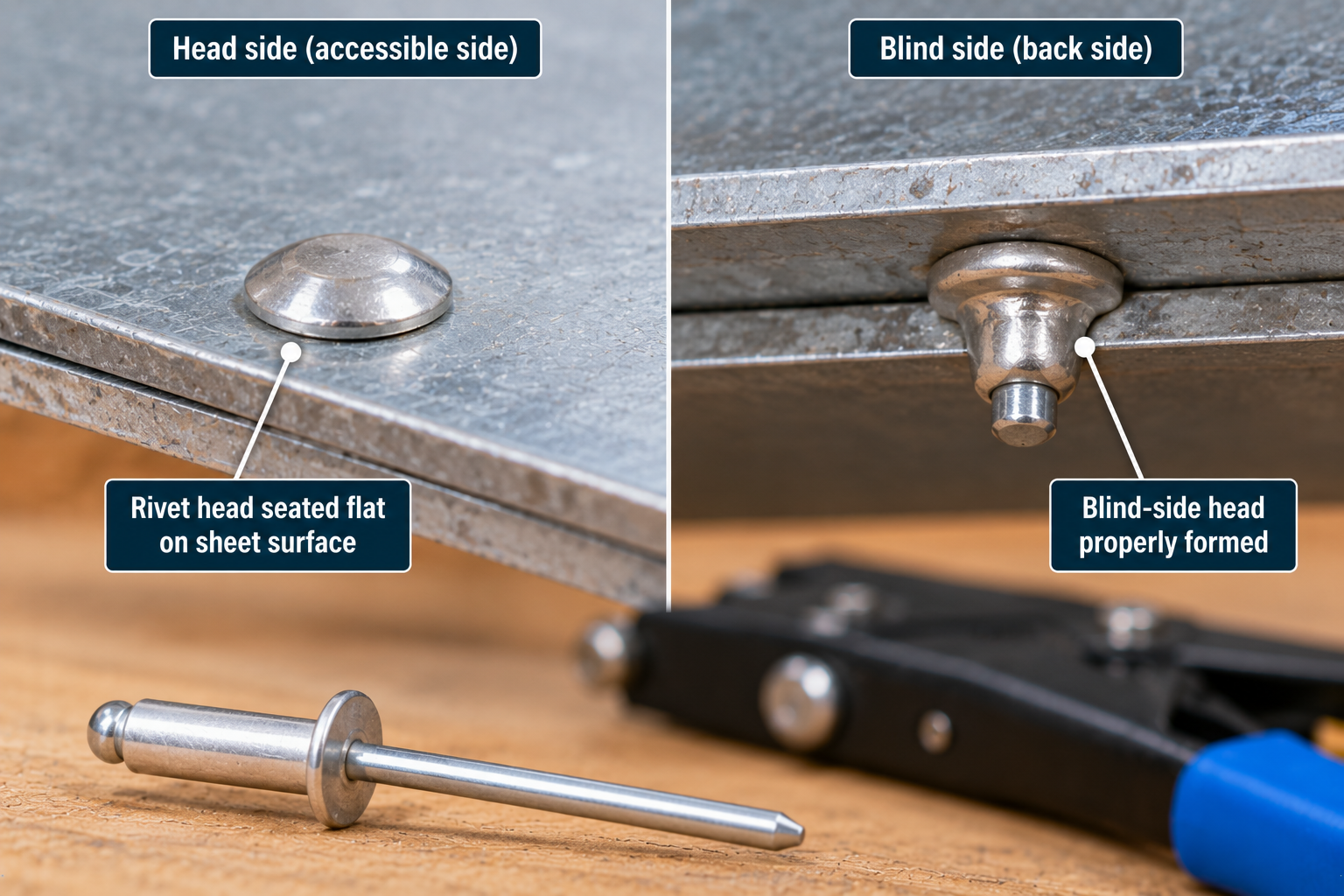
How to Install a Blind Rivet
- Prepare a correctly sized, clean hole and remove burrs.
- Insert the rivet.
- Fit the correct tool and nosepiece.
- Keep the tool aligned and straight.
- Set the rivet.
- Inspect the formed blind head and the seating.
GESIPA stresses correct hole preparation and tool alignment, and notes that the wrong nosepiece can leave the rivet incorrectly set.
Common Rivet Sizing Mistakes
Choosing by diameter alone
Hole, grip and strength matter too.
Confusing body length with grip range
Grip range is the selection value.
Assuming every 3/16 in. rivet uses the same drill size
Hole ranges differ by family.
Using a generic hole chart for structural blind rivets
They have their own tolerances.
Oversized holes
They reduce shear and tensile strength.
Undersized holes
They make insertion difficult.
Ignoring burrs
Burrs around the hole harm the joint.
Using the wrong material combination
Watch galvanic corrosion.
Ignoring shear and tensile requirements
They are separate loads.
Using ordinary blind-rivet data for structural rivets
The systems differ.
Confusing head diameter with body diameter
They are different dimensions.
Assuming inch and metric near-equivalents interchange
Check the product data.
Selecting a rivet outside its grip range
The blind head may not form correctly.
Limitations
What This Chart Does Not Establish
This page is a general rivet sizing reference. Hole sizes, grip ranges, lengths and strengths are tied to the named manufacturer products and standards. It does not provide design strength, structural joint design, spacing requirements for engineered joints or certification of any rivet. Always use the exact manufacturer data and the governing design specification. See the Construction Charts hub, the Steel Plate Thickness Chart for plate thicknesses, and the Screw Size Chart if a threaded fastener suits the joint better.
Rivet Size FAQs
What are the most common rivet sizes?
What does 1/8-inch rivet size mean?
What does 3/16-inch rivet mean?
What size hole is needed for a 1/8-inch rivet?
What drill bit should I use for a 3/16-inch rivet?
How do I determine rivet length?
What is rivet grip range?
Is rivet grip the same as rivet length?
How much larger should a rivet hole be?
Are metric and inch rivets interchangeable?
Are pop rivets and blind rivets the same thing?
What is the difference between a blind rivet and a solid rivet?
Are structural rivets sized the same way as pop rivets?
Which rivet material should I use?
Save the Rivet Size Chart as a PDF
Use your browser print function to save this reference for the shop, estimating folders and fabrication planning.