Concrete Bag Size Chart – 40, 50, 60, 80 & 90 lb Package Sizes
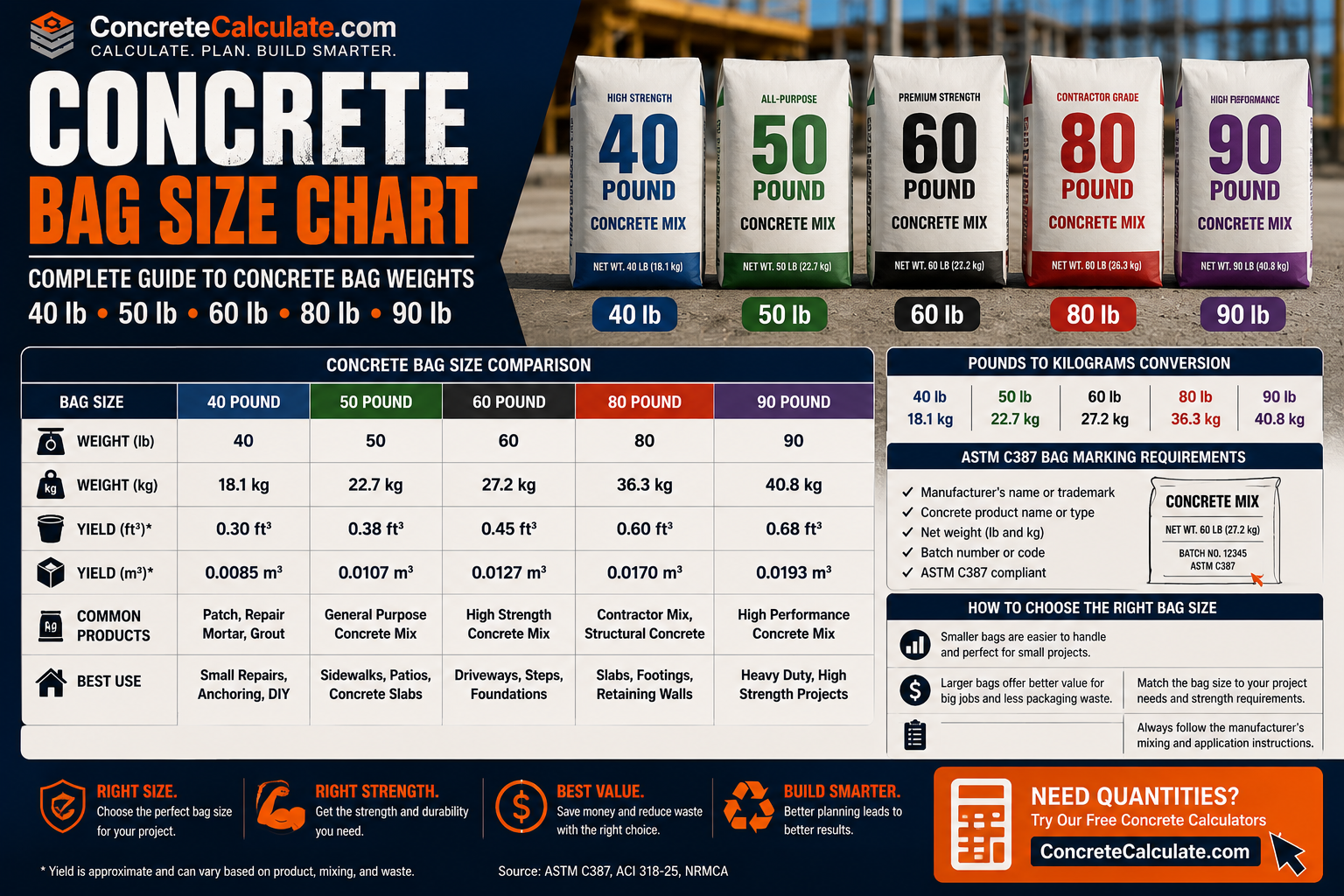
Concrete Bag Size Chart
40, 50, 60, 80 & 90 lb Package Sizes
What bag weights concrete mix is actually sold in, which manufacturer products use which sizes, and how to choose the right package. This chart covers package size only; yield and coverage live on their own dedicated charts.
 Reviewed by Muhammad Ramzan Babar, PhD Researcher (Plasma Physics) & Calculator Developer, View Profile
Bag size is one label on the package, not a shortcut for yield, strength, or coverage
ASTM C387/C387M requires packaged concrete to separately mark net mass, yield, and recommended mixing water. Bag weight alone tells you how much dry material is in the package, nothing more. For mixed-concrete volume, see the Concrete Bag Yield Chart. For area covered at a given thickness, see the Concrete Coverage Chart.
Concrete Bag Size Chart, Quick Reference
Common U.S. package sizes for standard concrete mix, based on current QUIKRETE Concrete Mix technical data.
| Bag Size | Metric Weight | Common Product Type | Typical U.S. Availability | Yield Listed Separately? |
|---|---|---|---|---|
| 40 lb | 18.1 kg | Standard concrete mix | Common | Yes |
| 50 lb | 22.6 kg | Standard / fast-setting | Common | Yes |
| 60 lb | 27.2 kg | Standard / fast-setting | Very common | Yes |
| 80 lb | 36.2 kg | Standard / high-strength / specialty | Very common | Yes |
| 90 lb | 40.8 kg | Standard concrete mix | Regional | Yes |
Bag size does not equal yield
Bag weight tells you how much dry material is in the package. It does not by itself tell you the exact mixed concrete volume. See the Concrete Bag Yield Chart for published yield by product and bag size.
Planning your next concrete project?
Plan concrete materials and project costs with our downloadable Excel estimator pack. For estimating only; follow applicable technical standards for design and installation.
One-time purchase · Digital downloadWhat Does Concrete Bag Size Mean?
Bag size refers to the net dry package weight, usually stated in pounds in the U.S. and kilograms on metric packaging.
ASTM C387/C387M, the specification for packaged, dry, combined materials for concrete and high-strength mortar, requires the package to identify the net mass in each bag, separately from the yield in liters or cubic feet and the recommended mixing water.
Bag Weight vs Finished Concrete Weight
An 80-lb bag describes the dry bag content only. Once water is added, the finished mixed concrete has both a different total weight, since water adds mass, and a separate mixed volume, which is not simply proportional to the dry weight.
Standard Concrete Bag Sizes in the United States
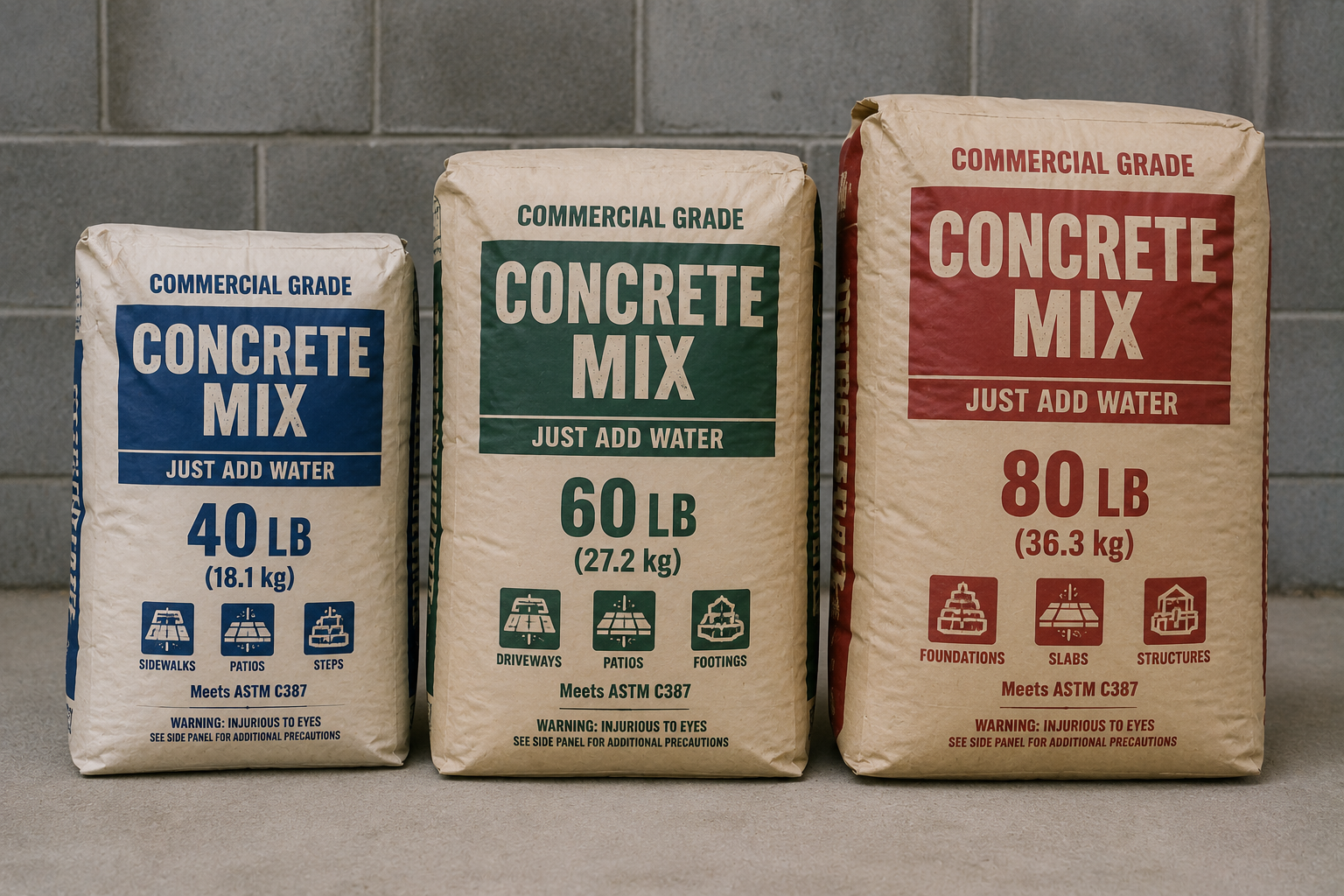
The most familiar retail and commercial package weights are 40, 50, 60, 80, and 90 lb.
These are common market package sizes, not a rule that every concrete product must be sold in all five weights. The manufacturer’s specific product line determines which sizes are actually available.
40-lb Concrete Bags
A 40-lb bag equals approximately 18.1 kg. It is an explicitly listed package size for QUIKRETE Concrete Mix and Sakrete High-Strength Concrete Mix. Smaller bags allow easier manual handling than larger bags, but typically require more packages for a given project volume. For the exact mixed-concrete volume a 40-lb bag produces, see the 40-lb section of the Concrete Bag Yield Chart.
50-lb Concrete Bags
A 50-lb bag equals approximately 22.6 kg. This size appears in some standard mixes, in fast-setting concrete, and in specialty mixes. QUIKRETE Concrete Mix lists 50 lb, and QUIKRETE Fast-Setting Concrete Mix uses 50 lb as its primary U.S. package size.
Why 50-lb Bags Are Common in Fast-Setting Products
A 50-lb package offers a practical balance between handling weight and the number of bags needed for typical fast-setting jobs like post holes, though this is a handling and batching convenience rather than a universal rule that all fast-setting products use 50 lb.
60-lb Concrete Bags
A 60-lb bag equals approximately 27.2 kg and is one of the most common U.S. sizes. QUIKRETE lists 60 lb for both standard Concrete Mix and Fast-Setting Concrete Mix, and Sakrete lists 60 lb for both High-Strength Concrete Mix and 5000 Plus. It sits at a practical middle ground between the lighter handling of 40 to 50 lb bags and the fewer-packages advantage of 80 lb bags.
80-lb Concrete Bags
An 80-lb bag equals approximately 36.2 kg. This is the most widely stocked size across standard mix, high-strength mix, and specialty or high-yield products from major U.S. brands. Fewer packages are needed for the same project volume compared with lighter bags, but individual lift weight is higher.
Critical distinction
Two 80-lb concrete products can have different yields. A standard 80-lb mix and a high-yield lightweight 80-lb mix are not interchangeable just because they weigh the same. Detailed yield comparisons live on the Concrete Bag Yield Chart.
90-lb Concrete Bags
A 90-lb bag equals approximately 40.8 kg. This size is less universally stocked than 80 lb. QUIKRETE currently marks its 90-lb Concrete Mix as regionally available rather than nationally stocked, while Sakrete lists a 90-lb High-Strength Concrete Mix package as part of its U.S. lineup. Because availability varies by brand and region, do not treat 90 lb as standard everywhere; always confirm local stock and the current product data sheet.
Concrete Bag Sizes in Pounds and Kilograms
Useful because manufacturer documentation often includes both U.S. and metric packages.
| Bag Weight (lb) | Approx. kg |
|---|---|
| 40 | 18.1 |
| 50 | 22.6 |
| 55 (Canada) | 25.0 |
| 60 | 27.2 |
| 66 (Canada) | 30.0 |
| 80 | 36.2 |
| 90 | 40.8 |
QUIKRETE Fast-Setting Concrete Mix, for example, lists 50 lb and 60 lb U.S. packages plus 25 kg (55 lb) and 30 kg (66 lb) Canada-only packages on its current technical data sheet.
U.S. Bag Sizes vs Metric Bag Sizes
Packaging differs by market.
| Market | Typical Package Labels |
|---|---|
| United States | 40 lb, 50 lb, 60 lb, 80 lb, 90 lb |
| Canada / metric markets | 25 kg, 30 kg |
QUIKRETE Fast-Setting Concrete Mix explicitly lists 25 kg and 30 kg Canada-only packages alongside its 50 lb and 60 lb U.S. sizes. Do not assume kilogram packages are exact equivalents to every U.S. bag size; a 25 kg bag (about 55 lb) and a 30 kg bag (about 66 lb) do not map directly onto the 50 lb or 60 lb U.S. sizes.
Bag Size vs Concrete Yield
One of the most important distinctions on this page.
Bag size is the dry net weight. Yield is the mixed concrete volume the bag produces. ASTM C387/C387M requires both pieces of information to be marked separately on the package.
| Bag Size | Example Published Yield |
|---|---|
| 40 lb standard mix | ≈ 0.30 ft³ |
| 60 lb standard mix | ≈ 0.45 ft³ |
| 80 lb standard mix | ≈ 0.60 ft³ |
These are example figures for standard mix only. See the complete Concrete Bag Yield Chart for full yield data across products and bag sizes.
Why Two Bags of the Same Weight Can Be Different
Same weight does not mean same product.
Aggregate type and density
Normal-weight versus lightweight aggregate changes both yield and handling density.
Strength class
Standard, high-early, and high-strength formulations differ regardless of bag weight.
Fibers and admixtures
Fiber reinforcement and chemical admixtures change performance without changing bag weight.
Setting characteristics
Fast-setting and standard-setting products can share a bag weight but behave very differently.
Intended thickness or application
Concrete mix and sand/topping mix can share similar bag weights while serving different applications.
Standard Concrete Mix Bag Sizes
QUIKRETE Concrete Mix
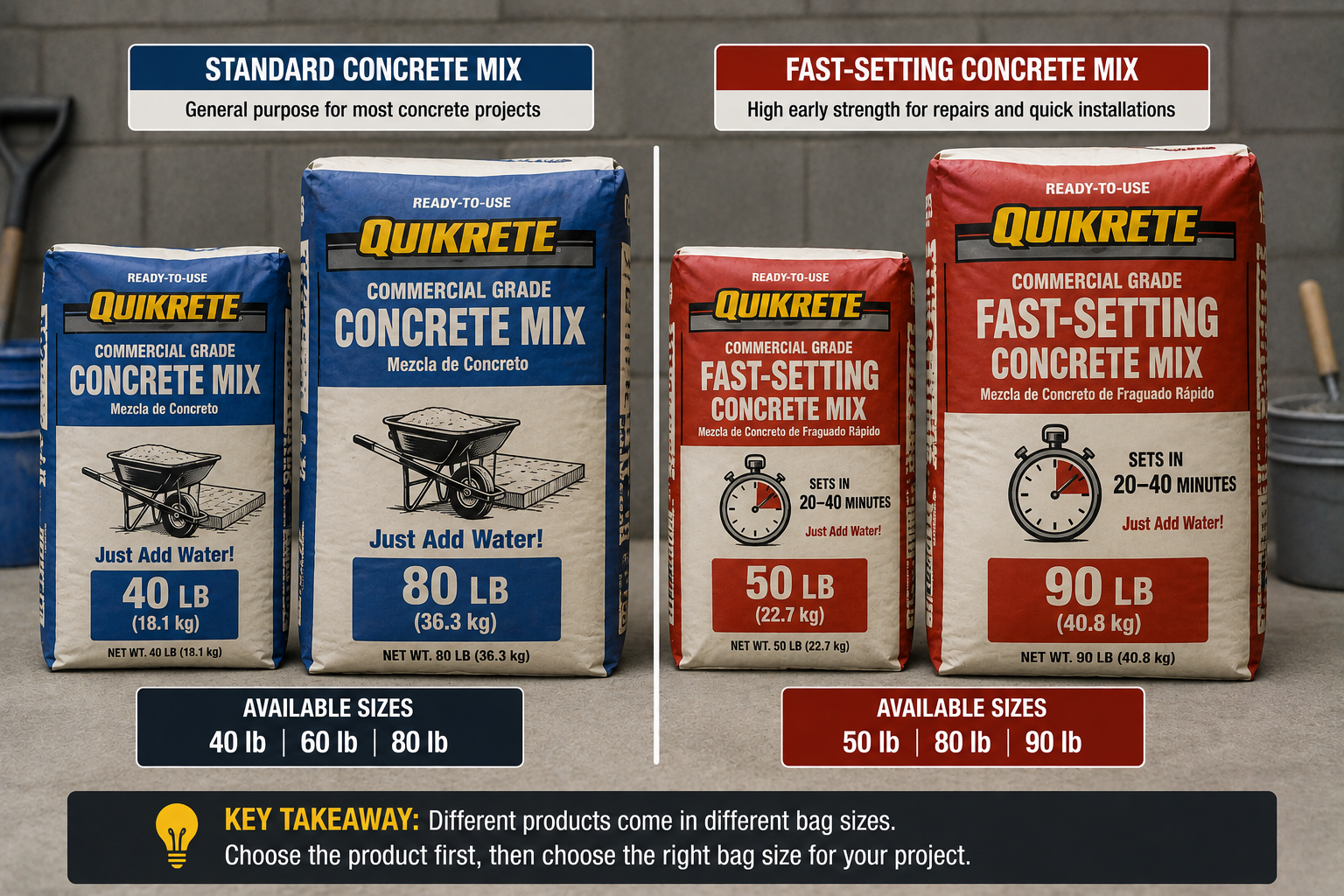
Current listed sizes: 40 lb, 50 lb, 60 lb, 80 lb, and 90 lb, with 90 lb marked as regional availability on manufacturer product documentation.
Other Verified Standard Mixes
Sakrete High-Strength Concrete Mix currently lists 40 lb, 60 lb, 80 lb, and 90 lb U.S. packages, plus 25 kg and 30 kg Canadian packages. Sakrete 5000 Plus High Early Strength Concrete Mix currently lists 50 lb, 60 lb, and 80 lb. Do not assume every brand matches QUIKRETE’s exact size lineup; always verify against the specific product’s current data sheet.
Fast-Setting Concrete Bag Sizes
QUIKRETE Fast-Setting Concrete Mix currently lists 50 lb and 60 lb U.S. packages, plus 25 kg (55 lb) and 30 kg (66 lb) Canada-only packages. Fast-setting product families often use a narrower packaging range than standard concrete lines from the same brand; QUIKRETE’s standard Concrete Mix offers five sizes while its Fast-Setting line offers only two U.S. sizes.
High-Strength Concrete Bag Sizes
High strength is a performance category, not a bag-weight category. Depending on the specific product, high-strength mixes may be packaged in 50 lb, 60 lb, or 80 lb, among other sizes. Do not assume that 80 lb means high strength; check the product name and technical data sheet rather than the weight alone.
High-Yield and Lightweight Concrete Bag Sizes
High-yield products break the intuitive weight-to-volume relationship.
A high-yield, lightweight product may be packaged at the same weight as a standard concrete mix, such as 40 lb or 80 lb, while producing meaningfully more mixed volume because the formulation uses lower-density aggregate. Bag size alone cannot be used for quantity calculations with these products. See the Concrete Bag Yield Chart for the standard vs high-yield 80-lb comparison.
Concrete Mix vs Sand Mix, Mortar, and Grout Bags
Construction aisles contain many similar-looking bags: concrete mix, sand or topping mix, mortar mix, grout, and repair products.
ASTM C387/C387M distinguishes packaged concrete from high-strength mortar in its own terminology. Normal-strength concrete is defined for general building and repair where thickness exceeds 50 mm (2 in.), while high-strength mortar, often called sand mix, is defined for a thickness of less than 50 mm (2 in.) or where a high-strength mortar mixture is specifically required, such as topping and patching existing concrete structures.
Do not select by weight alone
Do not choose a product solely because the bag weight matches another product you have used before. Confirm the product type and intended thickness first, then compare package sizes within that product line.
Equipment for Your Project
Affiliate disclosure: As an Amazon Associate, ConcreteCalculate earns from qualifying purchases. We may also earn a commission from other affiliate links at no additional cost to you.
How Bag Size Affects Handling
A practical consideration for DIYers and contractors: lifting effort, carrying distance, loading, and repetitive handling.
40/50 lb Bags
Easier individual handling for one person, but more packages needed for the same project volume.
60 lb Bags
A middle ground between lighter individual lifts and fewer total packages.
80/90 lb Bags
Fewer packages to handle overall, but a higher individual lift weight per bag.
This page does not prescribe specific lifting limits as ergonomic rules; consult OSHA or NIOSH guidance directly for workplace lifting standards applicable to your situation.
Bag Size and Mixer Capacity
Package size matters directly for batching in a portable mixer.
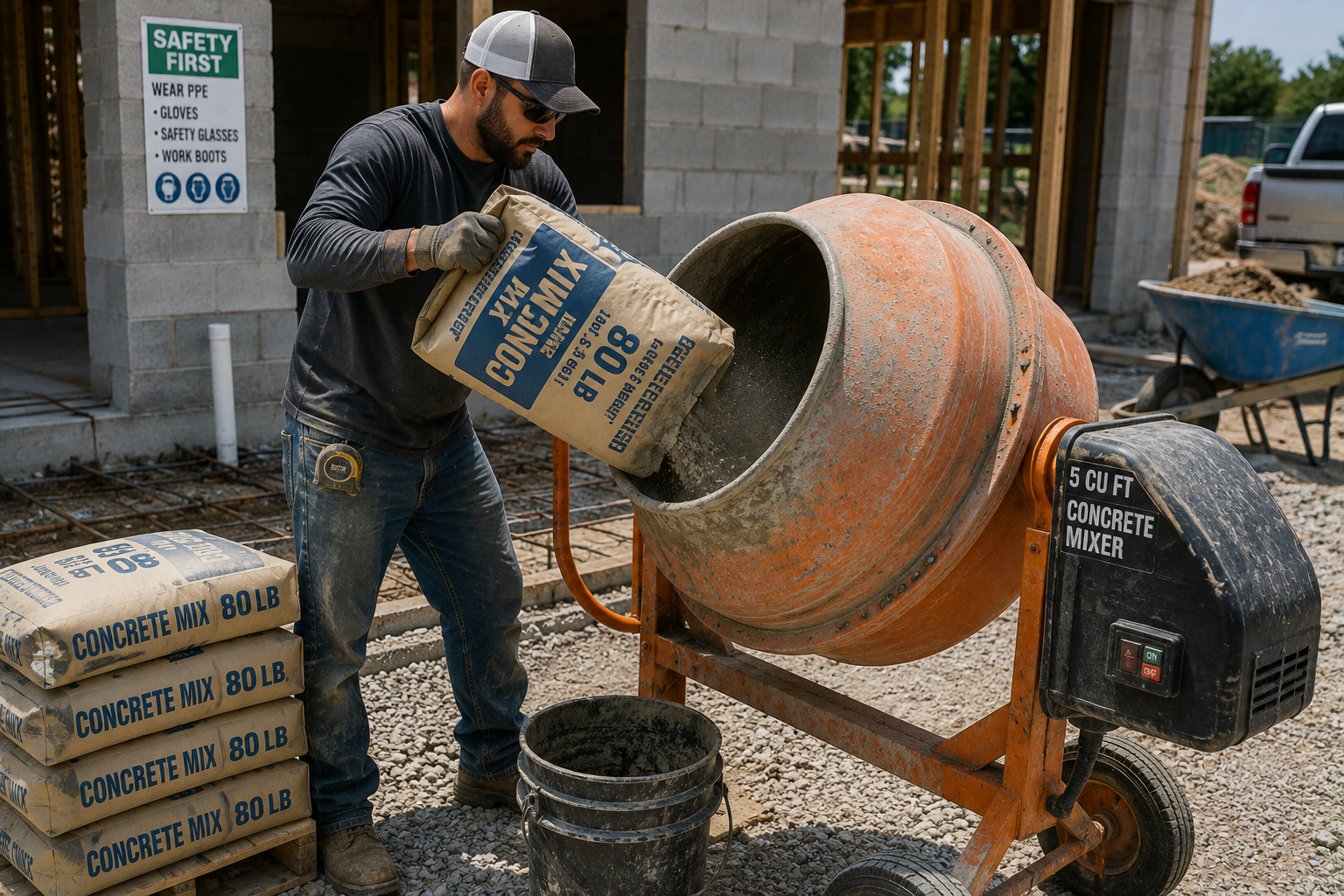
QUIKRETE Fast-Setting Concrete Mix’s current data sheet specifies allowing at least ¾ ft³ (about 20 L) of mixer capacity for each 50-lb bag mixed at one time. This is product-specific guidance, not a universal rule for all bag sizes and mixers.
Number of bags per mixer batch
Determined by both mixer rated capacity and the specific product’s mixing instructions.
Mixer rated volume
Check the mixer manufacturer’s stated drum capacity before batching.
Loading headroom
Leave adequate space in the drum to allow proper mixing action.
Avoiding overloading
Overloading a mixer can produce inconsistent, poorly mixed batches.
Do not apply a universal “X cubic feet of mixer equals Y bags” rule across different products and mixers; always check the specific product data sheet and mixer specifications.
Bag Size and Mixing Water
ASTM C387/C387M requires the recommended mixing water to be marked on the package separately from net weight and yield.
QUIKRETE Fast-Setting Concrete Mix, for example, provides water guidance specific to its 50-lb package and directs users to check the bag for other package sizes. A larger bag does not mean water should be added proportionally by guesswork; always follow the exact product instructions printed on the specific bag. For more on how water content affects strength, see the Water-Cement Ratio Chart.
Bag Size and Number of Bags Needed
Heavier bags often mean fewer packages for a fixed project volume, but the actual bag count depends on yield, not weight alone.
Formula (full calculation on the Yield chart)
N = V ÷ Y, where N is bags needed, V is project volume, and Y is yield per bag. Full calculation tables live on the Concrete Bag Yield Chart, or use the concrete bag calculator directly.
Bag Size and Square-Foot Coverage
Bag size alone cannot determine square-foot coverage.
Coverage requires the exact product’s published yield plus the concrete thickness: A = (12 × Y) ÷ T, where A is area in ft², Y is yield in ft³, and T is thickness in inches. Full coverage tables across many thicknesses live on the Concrete Coverage Chart.
Bag Size by Project Type
Small Repairs and Pads
Smaller bags can be easier to handle and reduce leftover material on small jobs.
Post Holes
Fast-setting package availability often matters more than bag weight for post-hole work. See the post hole concrete calculator and fence post concrete calculator.
Slabs and Patios
Larger bag sizes may reduce the number of bags handled for a given slab volume.
Footings and Larger Pours
Total project volume becomes more important than individual bag weight; see the concrete footing calculator.
Do not treat “use 80-lb bags for slabs” as a universal technical rule; the correct choice depends on the specific product, project volume, and handling preference.
How to Choose a Concrete Bag Size
A selection framework that keeps product suitability first, not bag weight.
Following this order prevents the common mistake of choosing a bag weight before confirming that the underlying product is even the correct one for the job.
Smaller Bags vs Larger Bags
| Factor | Smaller Bags | Larger Bags |
|---|---|---|
| Individual lift weight | Lower | Higher |
| Number of bags | More | Fewer |
| Portion control | Easier | Less granular |
| Mixer loading | Smaller increments | Larger batch increment |
| Leftover risk on tiny jobs | Often lower | Potentially higher |
| Availability | Product-specific | Product-specific |
| Yield per bag | Lower in conventional same-product family | Higher |
Neither size is universally the better value, since current retail pricing is local and time-sensitive.
Bag Size vs Cost per Cubic Foot
A useful concept, but one that must be framed carefully.
Formula
Cost per ft³ = bag price ÷ published yield. A 40-lb bag may cost less than an 80-lb bag but also yields less concrete, so price per bag alone is misleading. Current price comparisons are not published on this chart since pricing is local and time-sensitive; check current retailer pricing directly.
Pallet Quantity and Bulk Buying
Useful for larger projects, but highly supplier-specific.
Pallet quantities vary by bag weight, manufacturer, retailer, and distribution center. ASTM C387/C387M defines a lot, for weight-uniformity testing purposes, as the quantity normally placed on a pallet, generally weighing from 900 kg to 1,800 kg (2,000 lb to 4,000 lb).
Formula
Pallet weight = bags per pallet × bag weight. Always verify the actual bags-per-pallet count with your specific supplier rather than assuming a fixed number, since pallet configurations differ by manufacturer and bag weight.
Bag Storage, Moisture, and Shelf Condition
Practical value without turning into a full storage article.
ASTM C387/C387M requires product to be stored in a dry area and not stored in direct contact with the ground or floor. Keep bags dry, protect them from moisture, watch for torn packaging, and check for hardened or lumpy material before use. Use a first-in, first-out approach to inventory where practical. Heavier packages can be more difficult to move once damaged or moisture-affected, which is another reason bag size matters for storage planning. This page does not state a universal shelf-life number, since that depends on the specific manufacturer and storage conditions.
ASTM C387 Package Marking Requirements
The principal standards section for this page, and the strongest technical differentiator for a bag size chart.
ASTM C387/C387M-23 covers the production, properties, packaging, and testing of packaged, dry, combined materials for concrete and high-strength mortar. Under its packaging and package marking section, it requires that packages be identified as conforming to the specification, identify the kind and type of material, and print the net mass in each bag. Separately, the yield in liters or cubic feet, and the amount of water recommended for mixing, must be marked on the package. The standard also limits net-weight variation: the contents of any individual container shall not vary by more than 2% from the net weight stated in the markings, and the average net weight of filled containers in a lot shall not be less than the weight stated.
| Requirement | What It Covers |
|---|---|
| Specification identification | Package must state conformance to ASTM C387 and the kind/type of material |
| Net mass | Printed on each bag, separately from yield |
| Yield | Marked in liters or cubic feet |
| Recommended mixing water | Marked on the package alongside yield |
| Net weight tolerance | Individual package contents may not vary by more than 2% from the stated net weight |
This is highly relevant to a bag size chart because it establishes, by standard, that bag size is one specification on the package, not a shortcut for yield, strength, water content, or coverage.
Common Concrete Bag Size Mistakes
Assuming all concrete is sold only in 60- and 80-lb bags
Package ranges vary widely by product line and brand.
Treating 90-lb bags as nationally available everywhere
Some manufacturers explicitly mark 90 lb as regional.
Confusing bag weight with mixed yield
Weight is mass; yield is volume, and they are marked separately by standard.
Confusing pounds with cubic feet
These are different units measuring different physical quantities.
Assuming every 80-lb product yields the same amount
Standard and high-yield 80-lb products can differ substantially.
Selecting by weight before selecting the correct product
Product suitability should always come first.
Confusing concrete mix with sand mix or mortar
These are different product classes with different intended thicknesses.
Assuming fast-setting comes in every standard bag size
Fast-setting lines often use a narrower packaging range.
Guessing water amount from bag weight
Always follow the exact printed instructions for the specific package.
Ignoring mixer capacity
Overloading a mixer produces inconsistent batches.
Comparing bag prices without considering yield
Cost per bag is misleading without cost per cubic foot.
Treating kilogram and pound packages as exact interchangeable sizes
A 25 kg bag is not simply a metric label for a 50 lb bag.
Assuming every retailer stocks the full manufacturer size range
Local stock depends on the specific retailer and region.
Using an old bag-size chart without checking current packaging
Manufacturer packaging and available sizes can change over time.
Concrete Bag Size Chart Limitations
Read before purchasing
Package sizes vary by manufacturer and product. Availability varies by region and retailer. Not every product comes in every common bag weight. Bag weight does not determine yield, strength, or coverage by itself. Package size does not determine appropriate application. Product formulation and technical data must be checked directly. Pallet counts are supplier-specific. Manufacturer packaging can change over time. Current bag labels and technical data sheets should always take priority over this reference.