Concrete Dusting: Why Floors Turn Powdery and How to Fix Them
Concrete Dusting
How to tell real surface deterioration from ordinary dust, what causes a weak wearing surface, and when cleaning, a densifier, or removal and resurfacing is the right response.
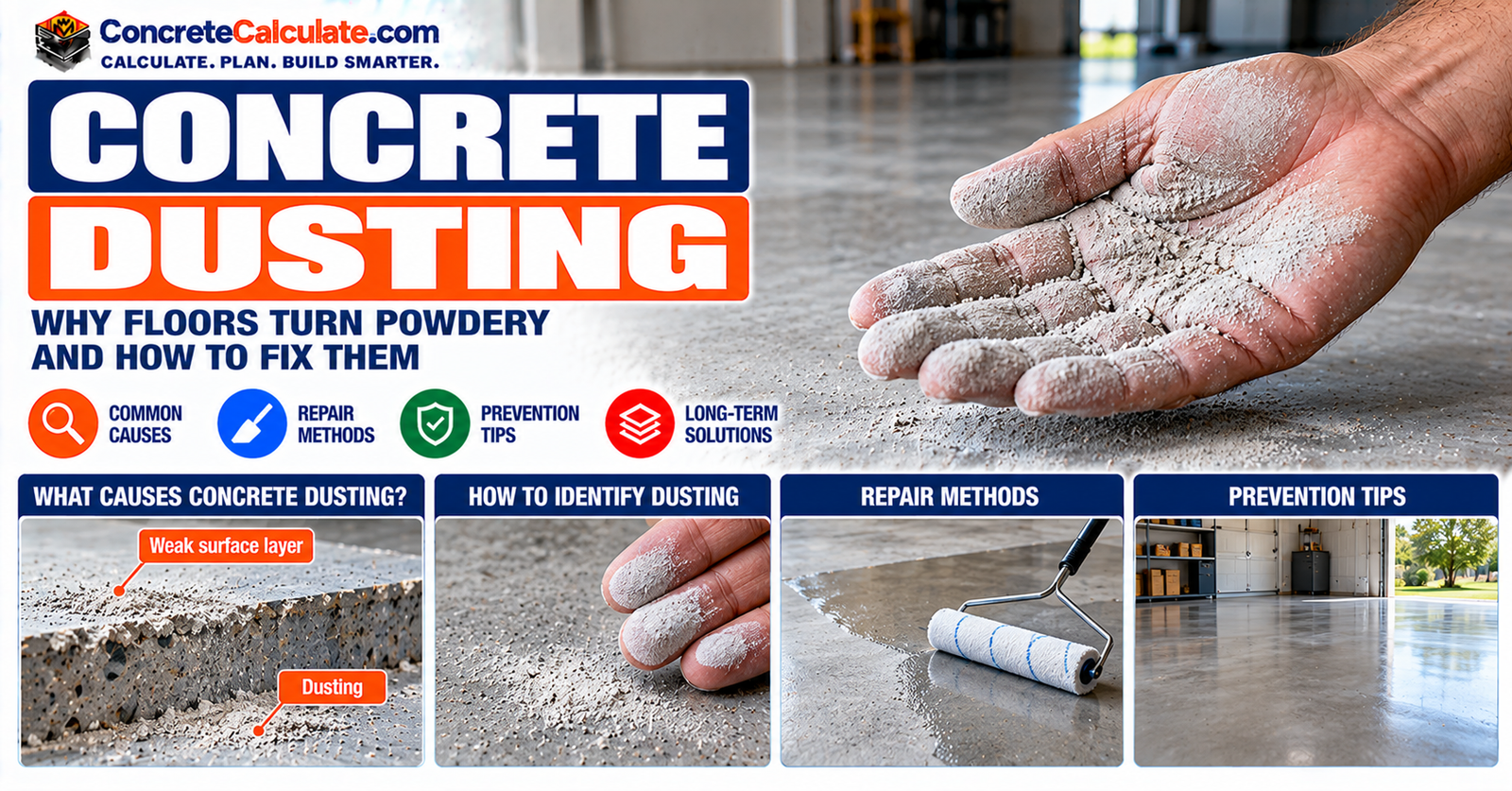
Concrete dusting is the slow release of loose powder from the surface of hardened concrete. NRMCA’s CIP 1 explains that the floor has a weak wearing surface, most often because it was finished while bleed water was present, cured poorly, or exposed to damaging conditions early on.
The right fix depends on what you find. Deposited construction dust only needs safe cleaning. A sound but chalky surface may respond to a compatible densifier. A truly unsound surface usually has to be removed and replaced with a bonded topping. In every case, avoid dry sweeping and compressed air, which put dust in the air without solving anything.
- What Is Concrete Dusting?
- What Does Dusting Concrete Look Like?
- Concrete Dusting vs. Scaling, Efflorescence and Delamination
- How to Tell Whether the Dust Comes From the Concrete Itself
- Is a Dusting Concrete Floor Dangerous?
- Light, Moderate and Severe Concrete Dusting
- What Causes Concrete Dusting?
- How Finishing Over Bleed Water Creates a Weak Surface
- Why Adding Water or Dry Cement During Finishing Causes Problems
- How Concrete Mix Design and Excessive Bleeding Affect Dusting
- How Improper Curing Causes Powdery Concrete
- Cold Weather, Surface Condensation and Early Freezing
- How Unvented Heaters and Carbonation Can Damage Fresh Concrete
- Does Pouring Concrete Over a Vapor Barrier Cause Dusting?
- Why Is My New Concrete Garage Floor Already Dusting?
- How to Assess a Dusting Concrete Surface
- When Will Cleaning Be Enough, and When Is Repair Necessary?
- What to Check Before Applying a Concrete Densifier or Sealer
- How to Clean a Dusting Concrete Floor Safely
- Can a Concrete Densifier Stop Dusting?
- Concrete Densifier vs. Sealer vs. Epoxy Coating
- How to Apply a Concrete Densifier: Step-by-Step
- When Should You Grind or Shot-Blast a Dusting Concrete Floor?
- How to Repair Severe Dusting With a Bonded Topping
- Can You Install Epoxy, Tile or Vinyl Over Dusting Concrete?
- How Much Does Concrete Dusting Repair Cost?
- How to Prevent Concrete Dusting on New and Existing Floors
- Concrete Dusting FAQs
What Is Concrete Dusting?
Concrete dusting, also called chalking, is the formation of loose powder as the surface of hardened concrete breaks down. The National Ready Mixed Concrete Association (NRMCA) describes it as disintegration of the surface that leaves powder behind, and a dusting floor typically sheds that powder under any kind of traffic.
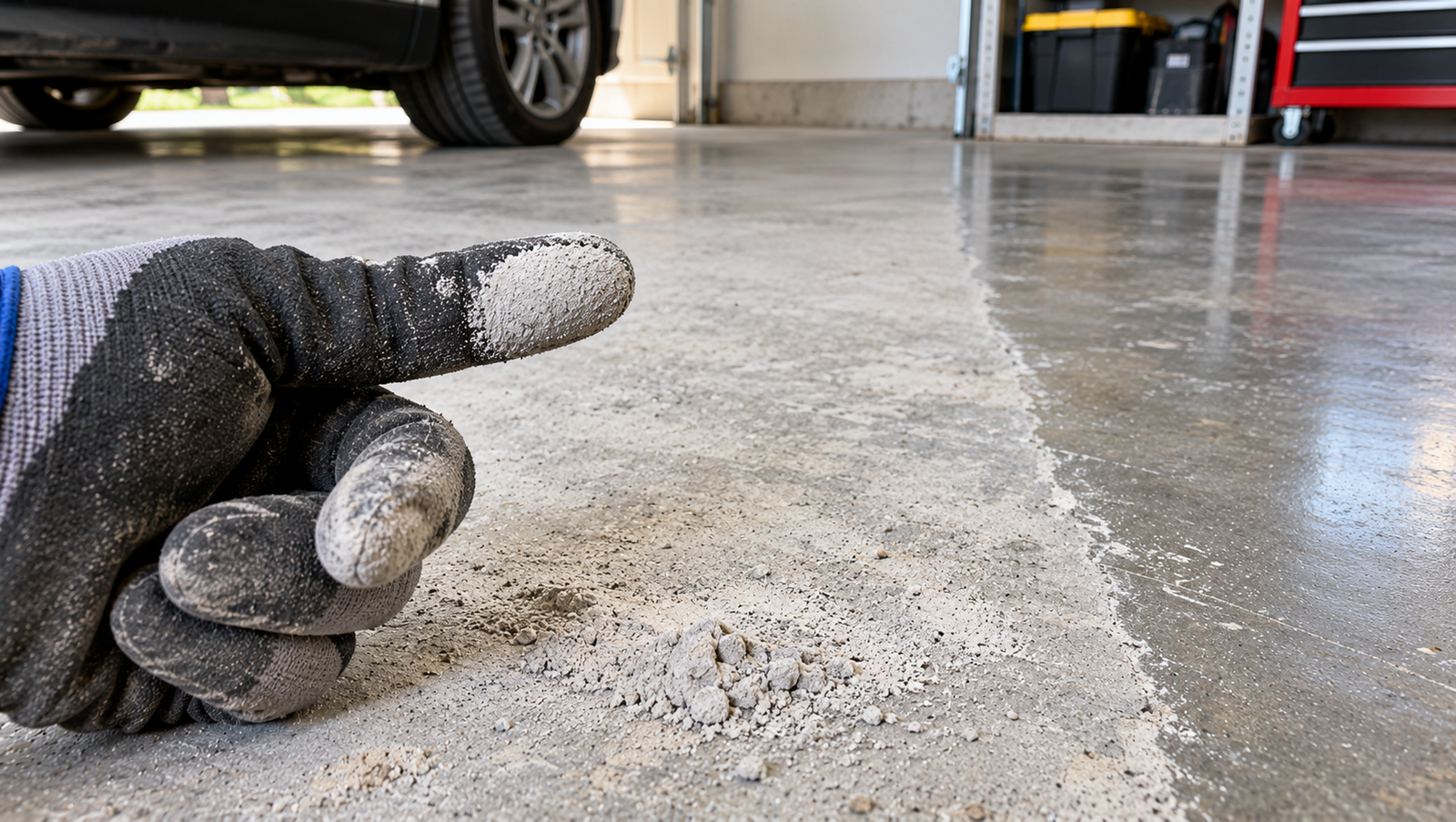
Most people notice it when a broom leaves a gray film, when shoes leave prints, or when everything stored on a garage floor ends up with a pale haze. The slab can look smooth and intact the whole time, which is why the problem is easy to misread.
This guide works in three stages. First confirm that the concrete itself is the source. Next judge how sound the surface is. Only then choose between safe cleaning, a chemical densifier, mechanical removal, or a bonded topping.
What Does Dusting Concrete Look Like?
A dusting floor usually produces fine gray or whitish powder that comes back after cleaning. It gathers along walking paths, doorways, and tire tracks, and it often shows up as footprints on a freshly swept surface. Use this checklist as a prompt to investigate, not as a diagnosis:
- Powder returns within days, even after careful, dust-controlled cleaning.
- The residue concentrates where people walk or vehicles drive.
- Dark shoes, tires, or stored items pick up a pale film.
- The floor looks worn compared with a protected spot, such as the area under a long-standing cabinet.
- Fine aggregate becomes more visible as the surface weathers.
Appearance alone cannot settle the question. A clean-looking slab can shed a surprising amount of powder, while a dirty-looking one may only be carrying construction debris. The next two sections explain how to separate those cases.
Concrete Dusting vs. Scaling, Efflorescence and Delamination
Several surface problems get mistaken for dusting, and the repairs are different. Sorting them out first can save you from buying a hardener for a floor that only needs a good, safe cleaning.
| Condition | Typical appearance | Distinguishing clue | Appropriate investigation |
|---|---|---|---|
| Concrete dusting | Recurring fine powder produced by the surface | Returns after suitable cleaning and normal use | Check surface strength and finishing history |
| Construction residue | Loose dust deposited on concrete | May disappear after effective cleaning | Identify recent construction or cutting activities |
| Scaling | Flaking or peeling of hardened concrete | Surface material detaches in patches | Investigate exposure and deterioration depth |
| Efflorescence | Usually white mineral deposits | Often associated with moisture movement | Identify the deposit and the moisture source |
| Delamination | Separated surface layer, possibly hollow-sounding | Can be hidden beneath an apparently intact finish | Assess extent and underlying cause |
| Coating deterioration | Powdery or peeling coating | Debris may come from paint or an old sealer | Identify the existing coating and substrate condition |
Pieces breaking away from the surface or edges point toward concrete spalling rather than powder. White crusty deposits that return after wet weather are covered in the concrete efflorescence guide. If you see cracks along with powder, read Why Is My Concrete Cracking? to tell the two problems apart. Delamination can sit unseen beneath a finished surface, so a hollow sound when tapped is worth reporting to a professional.
How to Tell Whether the Dust Comes From the Concrete Itself
Recurring surface powder looks different in practice from drywall dust, tracked-in dirt, saw-cutting residue, or flakes from an old coating. These steps help you tell them apart without damaging the floor.
- Rule out nearby sources. Ask whether anyone has sanded drywall, cut tile or masonry, or demolished something in or near the space. Also check whether soil is tracking in from outside.
- Look for a coating. Paint, sealer, or an old coating that is chalking can shed powder that looks like concrete dust.
- Clean a small test area with dust control. Use a HEPA-filtered vacuum, then damp-clean. Skip dry sweeping and compressed air.
- Use the floor normally and look again. If the spot stays clean, the dust was probably deposited. If powder keeps returning from the same zone, the surface itself may be deteriorating.
Avoid dry brushing and aggressive scratch tests. NRMCA lists easy scratching among the characteristics of a dusting surface, but gouging a floor to prove the point spreads dust and can mar a sound decorative finish. When you need real certainty, a qualified concrete professional can evaluate the surface.
Is a Dusting Concrete Floor Dangerous?
Ordinary surface dusting is mainly a nuisance and a housekeeping problem. The powder settles on vehicles, tools, and stored goods, it makes cleaning a constant chore, and in some settings it becomes a slip or cleanliness concern.
The larger issue is how people respond to it. Concrete contains crystalline silica from sand and aggregate, and sweeping hard, blowing the floor off with compressed air, or dry grinding can put fine particles into the air. OSHA’s construction silica standard, 29 CFR 1926.1153, sets exposure controls for covered work. How much silica any given dust carries depends on the material, so treat concrete dust cautiously.
Dusting Is Not a Structural Verdict
A powdery finish is a surface wearing problem. It does not tell you how much structural capacity the slab has left. That depends on thickness, reinforcement, subgrade, and the concrete below the surface. If powder appears alongside settlement, movement, or wide cracking, ask a qualified professional to assess the slab before any cosmetic treatment.
Light, Moderate and Severe Concrete Dusting
Contractors often call dusting light, moderate, or severe, but no universal depth or hardness threshold sits behind those words. A more honest approach is to sort the floor by what you can observe after cleaning and a period of normal use.
Different surface conditions can produce similar-looking dust but require different treatments.
| Observed condition | Initial assessment | Possible next step |
|---|---|---|
| Dust appeared after nearby construction | Check whether it is deposited residue | Suitable dust-controlled cleaning |
| Localized recurring powder on otherwise sound concrete | Confirm the concrete surface is the source | Evaluate substrate and a compatible densifier |
| Widespread surface powdering | Assess strength and depth of deterioration | Professional evaluation before treatment |
| Surface rubs away or deteriorates substantially | Suspect a weak or unsound wearing layer | Evaluate removal and appropriate resurfacing |
| Dusting with extensive cracking, movement or delamination | Possible more significant deterioration | Professional assessment before cosmetic treatment |
These are qualitative screening descriptions, not standardized severity categories. When you cannot tell which row fits, testing by a qualified professional is cheaper than guessing wrong.
What Causes Concrete Dusting?
A concrete floor dusts because its wearing surface is weak. NRMCA’s CIP 1 traces that weakness to a short list of causes, and the Concrete Society’s guidance points to the same ones. More than one often acts on the same floor, which is why a single fix does not always work.
| Possible cause | Common clue | Prevention |
|---|---|---|
| Finishing over bleed water | Weak surface on relatively new concrete | Wait until bleeding has ended before final finishing |
| Adding water during finishing | Soft, vulnerable surface | Use proper mixture and finishing practices |
| Broadcasting dry cement | Surface deterioration associated with improper finishing | Never use dry cement to absorb bleed water |
| Insufficient curing | Underdeveloped wearing surface | Use an appropriate curing procedure |
| Cold-weather condensation | Surface moisture during finishing | Control conditions and avoid finishing condensed water into concrete |
| Unvented combustion heaters | Possible early-age surface carbonation | Provide proper ventilation and suitable heating methods |
| Early freezing or severe drying | Deterioration after inadequate protection | Follow an appropriate weather-protection plan |
The Concrete Society adds two details worth knowing. Very rapid drying from wind can leave too little water at the surface for the cement to hydrate fully, and on formed surfaces, too much release agent can leave a dusty face. The first matters on floors placed on breezy days, while the second applies mostly to walls and vertical work.
How Finishing Over Bleed Water Creates a Weak Surface
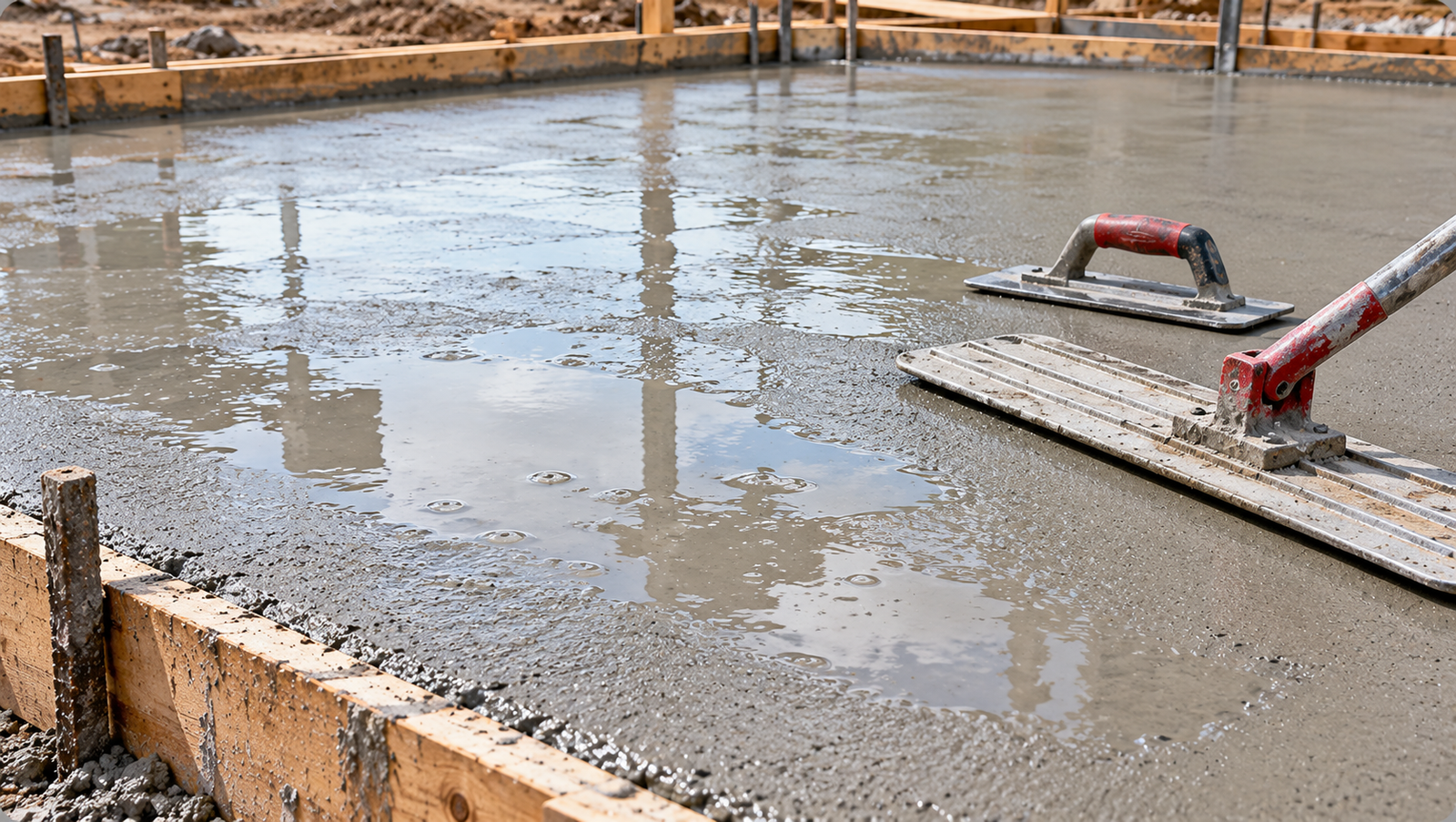
Bleed water is the thin film of mixing water that rises to the surface of freshly placed concrete as heavier solids settle. In many mixtures it is a normal part of the process. The trouble starts when finishing tools work that water back into the paste.
NRMCA explains that working bleed water into the top of the slab, which it describes as roughly the upper quarter inch, produces a very high water-cement ratio in that layer and therefore a low-strength surface. The Concrete Society describes the same mechanism through laitance, a porous skin of cement and fine particles carried up by bleed water, which tends to dust.
Finishing before bleed water dissipates can create a weakened concrete surface that later powders under traffic.
The sequence NRMCA recommends looks like this:
- Screed the slab, then bull float promptly. Delaying the bull float can let bleed water get worked into the surface.
- Leave the surface alone while water is present or while the concrete is still bleeding.
- If standing water needs to go, drag a garden hose across the surface rather than dusting it with cement.
- Skip the jitterbug, which tends to bring excess mortar to the surface.
- Start floating and troweling only after the bleed water has dissipated. Detailed technique is in the How to Finish Concrete guide.
The right moment depends on temperature, humidity, wind, and the mix, so watch the surface instead of the clock.
Why Adding Water or Dry Cement During Finishing Causes Problems
Two shortcuts cause more trouble than most: sprinkling water on a stiffening surface to keep it workable, and broadcasting dry cement to soak up bleed water. Both change the surface paste in ways the mix was never designed for. Added water raises the local water-cement ratio, and dry cement can form a thin, uneven skin that finishes quickly but wears poorly.
NRMCA is direct about this. Never sprinkle or trowel dry cement into plastic concrete to absorb bleed water, and do not add water to the surface to ease finishing.
Do not confuse these habits with sound mix design. A water-reducing admixture lets a producer deliver workable concrete at a lower water content, which is a controlled approach. Water added by hand on the slab is not.
How Concrete Mix Design and Excessive Bleeding Affect Dusting
The mix decides how much water is there to bleed in the first place. NRMCA advises using concrete with the lowest water content that still allows placing and finishing, and in general a moderate slump not exceeding 5 inches. A higher slump can work if the mixture is designed to reach the required strength without excessive bleeding or segregation, usually with water-reducing admixtures.
That distinction matters. A high slump achieved with admixtures behaves differently from one achieved by adding water at the truck. NRMCA also notes that excessive bleeding can be reduced with air-entrained concrete, adjusted mix proportions, or faster setting, which is especially relevant in cold weather when delayed set prolongs bleeding.
Strength and surface durability are related but not identical. A higher specified strength does not guarantee a hard wearing surface if finishing and curing go wrong, and the Concrete PSI Guide explains what a PSI number does and does not tell you. For ratios, see the Water-Cement Ratio Chart. Detailed proportioning belongs with your mix guides, not in a dusting repair.
How Improper Curing Causes Powdery Concrete
Curing keeps moisture in the slab so the cement near the surface can keep hydrating. Without it, the top skin stays soft. NRMCA lists insufficient curing as a cause of a soft surface that dusts easily under foot traffic, and it recommends retaining moisture for the first 3 to 7 days while protecting the concrete from the environment, especially freezing.
The two common approaches compare like this:
- Liquid membrane curing compound: quick to apply, but ask the supplier whether it is compatible with any densifier, sealer, or coating planned later, since film-forming products can block penetration.
- Water, wet burlap, or other moisture-retaining covers: effective when kept continuously damp, but they need attention until curing ends.
The Concrete Society likewise names curing compound or wet hessian and plastic sheet. For timing and procedures, use the Concrete Curing and Drying Time Guide and the Concrete Curing Time Chart.
Cold Weather, Surface Condensation and Early Freezing
Concrete sets slowly in cold weather. NRMCA points out that when warm, humid air meets a cold slab, water can condense on the fresh surface, and troweling that moisture in leads to dusting. Cold basement floors are especially prone to it. Slow set also stretches the window in which bleed water and finishing can collide.
Freezing is the other risk. NRMCA warns that allowing the surface to freeze weakens it and results in dusting, and it calls for protection from rain, snow, and drying winds. Its guidance for cold-weather placement is a concrete temperature above 50°F with an accelerating admixture, though the right plan for a real project depends on the mix and conditions.
For planning, see Best Time to Pour Concrete, Concrete Temperature Limits, and Pouring Concrete in the Rain.
How Unvented Heaters and Carbonation Can Damage Fresh Concrete
Fuel-burning equipment in an enclosed pour area can damage the fresh surface. NRMCA identifies carbon dioxide from open salamanders, gasoline engines, generators, power buggies, and mixer engines as a source of carbonation that greatly reduces the strength and hardness of the surface.
This is different from the slow carbonation of hardened concrete over many years. Here the problem is a young, still-developing surface paste exposed to carbon dioxide-rich air during its first hours. NRMCA’s prevention rule is to vent exhaust gases from gas-fired heaters in enclosed spaces. The same ventilation also protects the crew, because these units can produce carbon monoxide.
Does Pouring Concrete Over a Vapor Barrier Cause Dusting?
A polyethylene vapor retarder or other nonabsorptive base can change how concrete bleeds, because the water cannot drain downward. NRMCA says that placing concrete directly on such surfaces can contribute to dusting, scaling, and cracking, and suggests 3 to 4 inches of trimmable, compactible fill such as crusher run over the retarder. On hot or windy days it also suggests lightly dampening absorptive subgrades just before placement, without leaving water ponded.
Do not read that as a call to remove vapor retarders. NRMCA acknowledges that placing concrete directly on polyethylene can be essential for interior slabs that may receive floor coverings during their service life. In those cases, the mix and the finishing crew must allow for the bleeding conditions and wait until all bleed water has left the surface. Preparing the base properly is covered in How to Prepare Soil for a Concrete Slab.
Why Is My New Concrete Garage Floor Already Dusting?
A floor that dusts shortly after installation points to something that happened in its first days: finishing too early, water added at the surface, poor curing, cold or freezing weather, or fuel-burning heaters. Before calling the installer, gather the facts:
- Placement date, weather, and indoor temperature at the time.
- Whether finishing started while water was still on the surface.
- Whether anyone added water to the truck or to the slab.
- Curing method and how long it lasted.
- Any heaters or engines used in the space, and whether they were vented.
- The delivery ticket, which records the mix and batching details.
- Whether the floor froze, and when vehicles or heavy traffic began.
- Dated photographs of the powder, plus a clean comparison area.
Keep these records with your contract and any warranty paperwork. What an installer owes you depends on those documents and local rules, so this guide cannot say who is responsible. For other early problems, see Why Is My Concrete Cracking?
How to Assess a Dusting Concrete Surface
Good assessment starts with documentation. Record the affected area, how often powder returns, what the surface looks like, any coatings or sealers on it, and how the floor will be used. Photographs with a ruler or tape help, and a simple sketch of the room makes patterns obvious.
Visual observation has limits. Casual scratch tests give inconsistent results and can spread dust, so they should not decide the repair. If dusting is widespread, if the slab shows signs of structural trouble, or if a bonded floor covering is planned, a professional evaluation is the safer route. That person can arrange testing suited to the situation and recommend a treatment that matches the findings.
When Will Cleaning Be Enough, and When Is Repair Necessary?
Match the response to what the floor is actually doing. These options run from least to most involved:
- Safe cleaning only. The powder was deposited residue and does not return after dust-controlled cleaning.
- Chemical hardening. The concrete is sound, clean, and absorbent, and the surface is dusting lightly or in places.
- Professional surface preparation. Dusting is widespread, the cause is uncertain, or a coating or topping is planned.
- Bonded resurfacing. The weak layer has been removed and the remaining concrete can support a topping.
- More extensive repair. Delamination, structural cracking, or movement accompanies the dusting.
Vacuuming a dusting floor again and again manages the mess, but it does not strengthen the surface. If the powder keeps coming back, treat the cause.
What to Check Before Applying a Concrete Densifier or Sealer
Whether a densifier or sealer will work depends on the surface it meets. Before buying anything, review these points:
- Soundness: the surface should be strong enough to take treatment, with no crumbling or hollow areas.
- Age: follow the product data sheet on how long new concrete must cure before treatment.
- Contamination: oil, dirt, and loose dust prevent penetration and bond.
- Existing coatings: sealers and curing compounds can block a penetrating product.
- Moisture: check the manufacturer limits for moisture condition.
- Planned floor covering: make sure the treatment will not interfere with adhesives or coatings used later.
Always test a small, representative area first, and confirm with the manufacturer that the product suits your substrate. If the weak layer has to come off before any chemical will help, treating it first wastes money. The How to Seal Concrete guide and the Concrete Sealer Calculator can help once the surface is ready.
How to Clean a Dusting Concrete Floor Safely
The goal is to capture dust, not move it into the air. Use a HEPA-filtered vacuum for loose powder, then damp-clean with a method that suits the surface. Never use compressed air, and avoid dry sweeping.
OSHA’s standard backs this up for covered construction work. It prohibits dry sweeping or dry brushing where that could contribute to exposure to respirable crystalline silica, unless wet sweeping, HEPA-filtered vacuuming, or other exposure-minimizing methods are not feasible. Homeowners are not employers, but the same logic keeps dust out of your lungs and your living space.
- Wet-clean or vacuum first, before any other work on the floor.
- Keep children, pets, and nearby occupants out of the area during cleaning.
- Empty vacuums carefully and clean filters outdoors or follow the manufacturer instructions.
- Wear respiratory protection suited to the task when significant dust is likely.
Can a Concrete Densifier Stop Dusting?
Sometimes. A suitable chemical treatment can improve a weak but serviceable surface, and NRMCA lists chemical floor hardeners such as sodium silicate and metallic zinc or magnesium fluosilicate as a way to minimize or eliminate dusting when applied per the manufacturer’s directions on thoroughly dried concrete.
Modern silicate densifiers are generally described as reacting with free calcium hydroxide in the cement paste to form additional calcium silicate hydrate, the same binder that gives cured concrete its strength. Sodium, lithium, and potassium products all work this way, but they differ in formulation, residue, and handling. Manufacturer literature stresses that concentration, additives, temperature, and the porosity of the concrete matter at least as much as the cation, so compare data sheets and not labels.
A densifier needs a clean, absorbent surface with enough reactive material to work with. It will not rebuild severely deteriorated concrete or turn a poorly built slab into a high-performing one. If the product cannot penetrate or the surface keeps shedding powder after treatment, the weak layer likely needs to come off.
Concrete Densifier vs. Sealer vs. Epoxy Coating
These products solve different problems, and mixing them up is a common reason repairs fail. A densifier reacts with suitable concrete to improve the surface. A penetrating water repellent manages moisture. A film-forming sealer or epoxy coating creates a new surface layer whose performance depends on preparation, moisture, and bond.
| Treatment | Main purpose | Potential use | Important limitation |
|---|---|---|---|
| Chemical concrete densifier | Improve suitable concrete surface characteristics | Certain weak but serviceable surfaces | Cannot restore severely unsound concrete |
| Penetrating water repellent | Reduce selected types of moisture absorption | Suitable sound concrete | Not specifically a structural repair or universal dusting cure |
| Film-forming concrete sealer | Create a protective surface film | Compatible prepared surfaces | Can fail if the substrate is weak or moisture conditions are unsuitable |
| Epoxy flooring system | Form a durable bonded floor finish | Properly prepared, suitable substrates | Requires satisfactory substrate strength, preparation, and moisture condition |
| Bonded cementitious topping | Replace or build up an appropriate surface | Suitable floors after required preparation | Depends on sound underlying concrete and correct installation |
NRMCA does list coatings, such as latex formulations, epoxy sealers, or cement paint, as a next step if dusting persists after hardener use. That is different from coating a freshly powdering floor and hoping for the best. A coating suppresses dust only if it bonds, and it will not bond to powder.
How to Apply a Concrete Densifier: Step-by-Step
For a surface judged suitable, the general sequence follows. The product data sheet controls everything, so this guide does not publish universal rates or dwell times.
Prepare and clean the substrate
Remove dust and contaminants with HEPA vacuuming or compatible wet methods. Let the floor dry as the product instructions require, since NRMCA specifies thoroughly dried concrete before hardener goes on.
Test the selected product
Try it on a representative area. Check that it absorbs, does not leave unwanted residue or discoloration, and suits the floor’s intended use.
Apply according to the technical data sheet
Follow the stated coverage, number of coats, temperature range, and dwell time, and remove any excess product exactly as directed. Excess product left on the surface can leave residue, so follow the data sheet closely.
Allow the treated surface to develop its performance
Respect the product’s return-to-service and cleaning instructions. Do not install a coating or floor covering until the manufacturer says the surface is ready.
When Should You Grind or Shot-Blast a Dusting Concrete Floor?
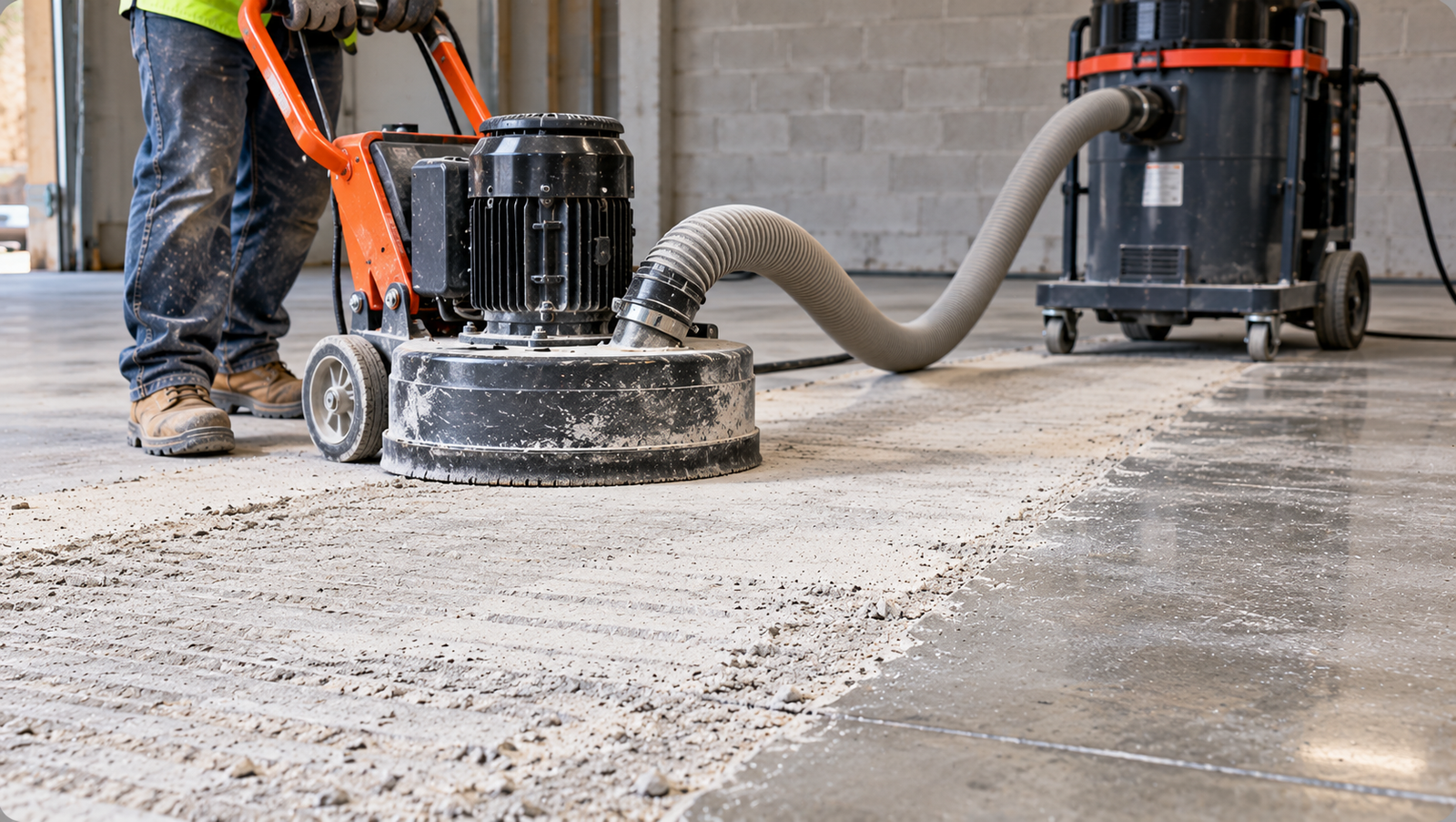
When the weak layer is too deteriorated for a chemical to help, it has to go. NRMCA describes sandblasting, shot blasting, or high-pressure washing to remove the weak layer, and wet-grinding to durable substrate concrete in severe cases. The aim is to reach sound concrete with a surface profile suited to what comes next, whether that is a coating or a topping.
This is not the same as decorative grinding for appearance. It needs an assessment of how deep the weak material goes, equipment that matches the job, and a contractor who understands dust control.
Silica Controls Are Not Optional
Grinding and blasting concrete generates respirable crystalline silica. OSHA’s fact sheet on handheld grinders describes using a grinder with a shroud and vacuum dust collection that provides at least 25 cubic feet per minute of airflow per inch of blade, with a filter that is 99 percent or more efficient. Water-fed grinders are for outdoor use only. Indoors, a vacuum system alone may not keep exposure low, so extra ventilation can be needed, and respiratory protection requirements apply. Hire a contractor equipped for this work.
How to Repair Severe Dusting With a Bonded Topping
A bonded topping is an option when the unsound layer has been removed completely and the concrete underneath is sound. NRMCA describes properly bonded placement of a topping course after wet-grinding to durable substrate, and the Concrete Society describes laying a bonded proprietary screed.
Chemical hardening and bonded resurfacing address different levels of concrete surface deterioration.
Planning a topping means working through several points:
- Complete removal of unsound concrete down to a sound substrate.
- Substrate evaluation, including strength and moisture condition.
- Surface preparation and the bonding requirements in the product literature.
- Topping thickness, which depends on the product and the repair design.
- Movement joints that follow the floor below, as covered in Concrete Control Joints.
- Curing, and compatibility with the floor’s intended use.
A thin topping cannot reliably make up for an unstable or extensively deteriorated slab. For material quantities, use the Concrete Repair Calculator, the Concrete Resurfacing Calculator, or the Concrete Overlay Calculator.
Can You Install Epoxy, Tile or Vinyl Over Dusting Concrete?
Not directly. NRMCA states that adhesives for floor coverings will not bond to floors with a dusting problem, and that dusting can permeate through carpeting. The same logic applies to coatings. A bonded finish is only as strong as the surface it grips.
- Establish a sound, clean substrate first, by treatment or removal as the assessment shows.
- Follow the flooring or coating manufacturer on moisture testing and surface preparation.
- Remember that covering a dusting floor with a coating can hide the powder without fixing the cause.
- Ask the manufacturer in writing whether the specific product is approved for your substrate.
NRMCA notes that a floor covering such as carpet or vinyl can be the least expensive solution to severe dusting, but only after the substrate preparation that allows the adhesive to bond. The Concrete Society also lists a carpet or vinyl overlay as an alternative to repair.
How Much Does Concrete Dusting Repair Cost?
This guide does not publish dollar-per-square-foot figures. Publicly available prices for dusting repair are scarce, vary widely, and often blend repair with polishing or coating. A number that fits one floor can mislead you on another, so use quotes from local contractors.
What drives cost is more predictable than the price itself:
- Cleaning: equipment, labor, and disposal of collected dust.
- Chemical treatment: product, number of coats, and labor.
- Mechanical preparation: grinding or shot blasting, dust control, and cleanup.
- Bonded resurfacing: removal, repair materials, topping, joints, and curing.
- More extensive repair: investigation, structural work, and any slab replacement.
Area, substrate condition, existing coatings, access, and local labor rates all move the total. Ask each contractor to itemize preparation, dust control, products, coats, curing, return-to-service time, and warranty.
Illustrative Quantity Worksheet: 20 by 20 ft Garage
Floor area: 20 ft × 20 ft = 400 ft².
Densifier, if suitable: assume, for arithmetic only, a data sheet lists coverage of 300 ft² per gallon. One coat needs 400 ÷ 300 = 1.33 gallons, and two coats need 2.67 gallons. Use the real figure and coat count from your product.
Topping, if approved: assume a hypothetical thickness of 0.5 inch. Volume = 400 ft² × (0.5 ÷ 12) = 16.7 ft³, or 0.62 yd³. Convert to bags using the manufacturer’s yield.
| Input | Illustrative value |
|---|---|
| Garage dimensions | 20 × 20 ft |
| Floor area | 400 ft² |
| Selected repair approach | Determined after assessment |
| Densifier coverage, if suitable | Enter product-specific coverage |
| Number of coats or applications | Enter product requirements |
| Product quantity | Calculate from actual coverage |
| Surface preparation | Obtain appropriate method and quote |
| Labor and other costs | Enter locally verified prices |
Not every dusting floor needs the same treatment, and these numbers describe area only. The manufacturer determines coverage and suitability.
Estimate Your Repair Materials
Use the repair calculators to size resurfacing or patch materials, then add your own verified local prices.
Open the Concrete Repair Calculator Repair Cost CalculatorHow to Prevent Concrete Dusting on New and Existing Floors
Prevention is cheaper than repair. This checklist follows the stages of a new floor:
| Construction stage | Action | Why it matters |
|---|---|---|
| Mix specification | Select a suitable mixture for the floor’s use | Establish appropriate strength and wear resistance |
| Delivery and placement | Avoid uncontrolled water addition | Prevent an unnecessarily weak surface |
| Bleeding | Do not finish while bleed water remains | Avoid incorporating surface water |
| Finishing | Avoid sprinkling water or broadcasting dry cement | Preserve suitable surface quality |
| Cold-weather placement | Control temperature, condensation, and combustion emissions | Avoid early-age surface damage |
| Curing | Retain moisture and provide appropriate protection | Support hydration and surface development |
| Before floor coating | Verify surface condition and moisture requirements | Reduce the risk of adhesion failure |
| Maintenance | Clean and inspect using suitable methods | Detect deterioration before inappropriate treatments are applied |
For existing floors, maintenance means cleaning with HEPA vacuuming or damp methods, choosing treatments that suit the substrate, watching for changes, and avoiding harsh abrasive cleaning that wears the surface faster. Choose products against the floor’s condition, not its looks.
These mistakes cause most repeat dusting:
- Treating the floor without assessing the substrate.
- Coating over powder.
- Skipping surface preparation.
- Letting dust become airborne during repair.
Concrete Dusting FAQs
Why does my concrete floor produce dust after sweeping?
Either the dust is deposited debris, or the wearing surface is weak and releasing powder. Clean a test area with dust control and watch whether powder returns.
Can concrete dusting stop on its own?
Rarely. If the cause was deposited residue, cleaning ends it. If the surface itself is weak, powder keeps coming until the surface is treated or removed.
Will sealing concrete stop dusting?
A sealer can only help on a sound, prepared surface that it can bond to. Applied over loose powder, it may fail. NRMCA lists coatings as a follow-up step if dusting persists after hardener.
Is a densifier better than epoxy?
They do different jobs. A densifier reacts with suitable concrete, while epoxy forms a bonded film that needs a sound, prepared substrate and suitable moisture conditions.
Can I paint over a dusty concrete garage floor?
Not directly. Coatings and adhesives do not bond reliably to a powdering surface, so the weak layer must be treated or removed first.
Should a new concrete floor produce powder?
A properly finished and cured floor should not keep shedding powder under ordinary traffic. Some loose debris from construction can appear early, but recurring powder points to a surface problem.
Can pressure washing fix concrete dusting?
Not by itself. NRMCA mentions high-pressure washing as a way to remove a weak layer, but it creates slurry, does not strengthen what remains, and needs careful handling indoors.
Does grinding remove a weak concrete surface?
Yes, if it goes deep enough to reach sound concrete. It must be done with proper dust control because it generates silica-containing dust.
Is concrete dust harmful to breathe?
It can be. Concrete contains crystalline silica, so use dust control and respiratory protection suited to the task, and follow OSHA requirements where they apply.
When should a dusting floor be resurfaced or replaced?
Resurfacing suits floors with sound concrete beneath a removable weak layer. If deterioration runs deeper, with movement, delamination, or structural cracking, a professional evaluation should decide between major repair and replacement.