
How to Remove Oil Stains From Concrete: Fresh Spills, Old Stains and Deep Oil
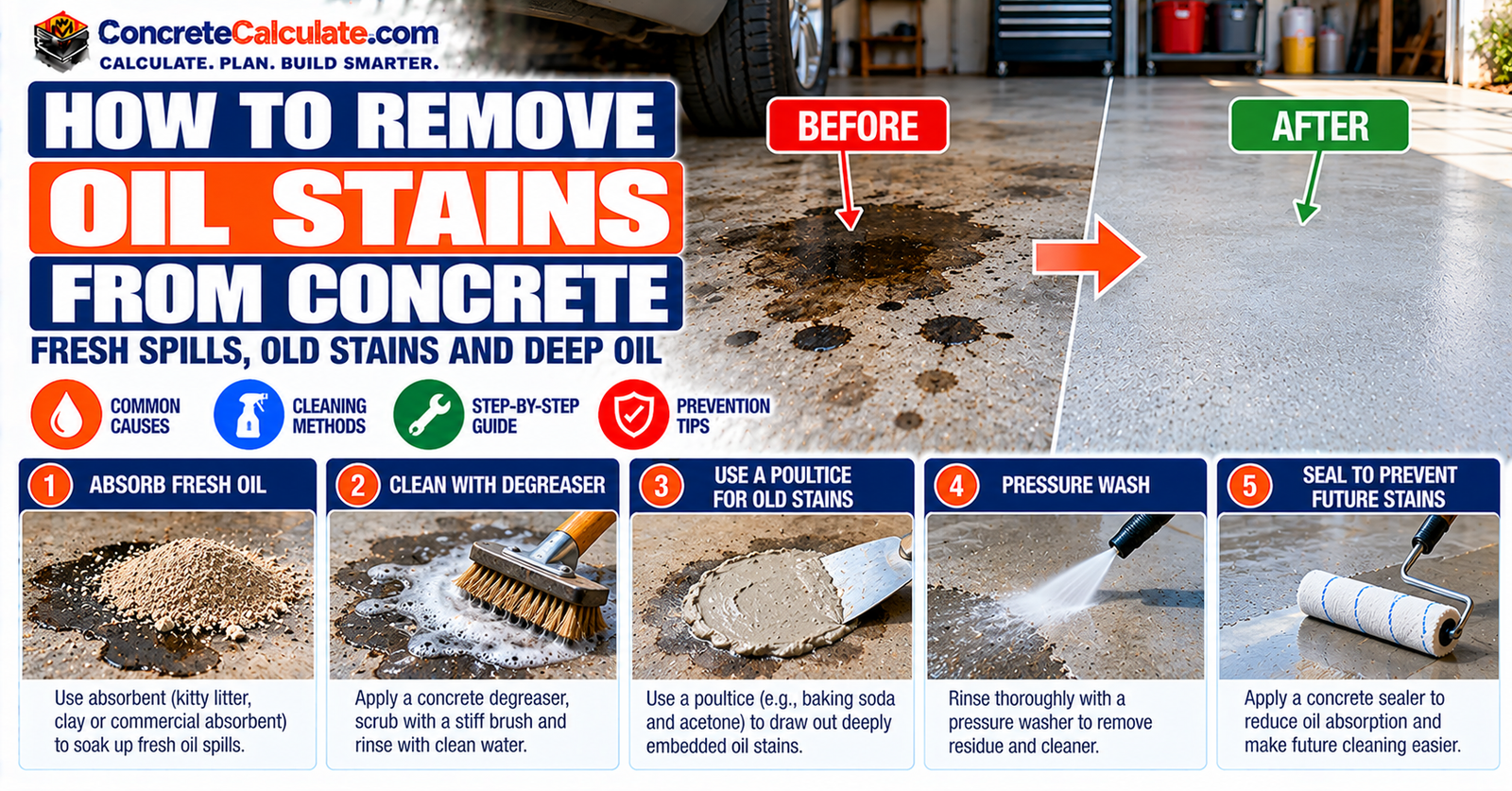
How to Remove Oil Stains From Concrete
Identify whether the oil is fresh, old, embedded, sealed in, or still leaking, then choose the gentlest method likely to work without damaging the concrete or polluting a storm drain.
How to Remove Oil Stains From Concrete: Quick Answer
Start with the gentlest method that fits the stain. Absorb fresh oil first, wash the remaining residue with detergent or a concrete degreaser, and use a poultice for oil that has soaked in.
- Absorb free oil with a suitable material, then collect it.
- Clean remaining residue with detergent or a concrete degreaser.
- Use a poultice or specialist extraction product for embedded stains.
- Let the concrete dry completely before judging the result.
- Repeat the cycle if the stain is still improving.
- Keep oily wash water out of storm drains and streets.
A few situations need extra care. Decorative or sealed concrete, large or unknown contamination, and floors headed for epoxy or resurfacing each have their own sections below.
Why Oil Stains Concrete So Easily
Concrete looks solid, but it is full of tiny capillary pores and small surface voids. Oil can wick into them, especially on unsealed, worn, or broom-finished surfaces.
PROSOCO notes that oil rarely stays on top once it reaches the pore network, where it bonds to the cement surface and resists simple cleaning.
Time matters. A fresh spill sits mostly at the surface, while an old stain has had weeks or years to move deeper, which is why old stains call for extraction instead of scrubbing.
Conditions also play a part. Warm slabs can let oil travel more readily, and low spots that hold fluid or moisture can push it deeper, so one driveway often has stains of several depths.
Fresh Oil Spill vs. Old Oil Stain
The age of a stain and whether any free liquid remains decide the first move. Use this table to place your stain before choosing a method.
| Condition | What you see | First response | Likely next step |
|---|---|---|---|
| Active fresh spill | Wet or glossy oil | Stop leak and absorb free oil | Detergent or degreaser |
| Recent stain | Dark mark but no free liquid | Surface cleaning | Dry-down evaluation |
| Old embedded stain | Persistent dark area | Degreaser or extraction test | Poultice or specialist cleaner |
| Stain returns after drying | Temporary improvement while wet | Allow complete dry-down | Repeat extraction or escalate |
| Large heavily contaminated area | Widespread darkening or repeated leaks | Containment and professional assessment | Specialized remediation |
Let the dry-down result decide whether to escalate. Most failed cleanings come from judging the stain while the concrete is still damp.
What Type of Oil or Fluid Is on the Concrete?
Not every dark automotive stain behaves the same way, so it helps to know what leaked. Here are the common culprits:
- Motor oil: the most common cause of driveway and garage stains.
- Transmission and hydraulic fluid: petroleum-based fluids that usually respond to the same oil-removal steps.
- Power-steering and brake fluid: chemistry can differ from engine oil, so check the cleaner label for the fluids it covers.
- Cooking oils and food grease: common on patios and outdoor kitchens, and often listed on oil-stain product labels.
The EPA identifies used engine oil, transmission fluid, and industrial hydraulic fluid as common used oils. Antifreeze is not classified as used oil, though it still needs proper handling.
If you do not know what spilled, treat it cautiously. Do not mix cleaners, and avoid solvents until you have identified the fluid.
Is the Oil on the Surface or Deep Inside the Concrete?
Oil that sits on the surface comes off with a good cleaning. Oil that has entered the pores behaves differently, and mixing the two up is the main reason stains seem to come back.
The cross-sections below show the difference. Note that no depth is given, because oil movement depends on porosity, sealer condition, viscosity, temperature, and exposure time.
Fresh oil can often be absorbed at the surface, while older stains may require extraction from within the concrete pores.
These clues help you judge which situation you have:
- Glossy or wet residue usually means oil is still on the surface.
- A dark color that stays after washing suggests the oil is deeper.
- A stain that becomes more visible as the concrete dries points to embedded oil.
- Oil that shows around pores or cracks may be rising from below.
When unsure, run a dry-down evaluation. Clean, let the concrete dry fully, and look again before choosing a stronger treatment.
Oil Stains vs. Tire Marks, Rust and Other Dark Concrete Stains
Plenty of dark marks on concrete are not oil. Using a degreaser on tire marks or rust wastes time, so match the stain to the right cleaner category first.
| Appearance | Possible stain | Clue | Appropriate cleaner category |
|---|---|---|---|
| Dark brown/black oily spot | Motor oil/grease | Slick or oily when fresh | Absorbent, detergent, degreaser or extraction |
| Black curved marks | Tire marks | Matches tire contact | Tire-mark cleaner or compatible degreaser |
| Orange/brown mineral stain | Rust | Often near metal | Rust-specific cleaner |
| White powder/crust | Efflorescence | Dry mineral deposit | Efflorescence-specific treatment |
| Green/brown organic stain | Leaves/algae/organic material | Seasonal/biological pattern | Organic-stain cleaner |
| Dark area beneath sealer | Trapped contamination/coating issue | Cannot be scrubbed from surface | Coating evaluation |
White crusty deposits belong in the concrete efflorescence guide, not here. If you see actual cracks along with staining, the cracking guide will point you in the right direction.
What to Do Immediately After an Oil Spill
The first few minutes decide how deep a fresh spill goes. Move quickly, but keep the cleanup dry and contained.
- Stop the leak at its source, or move the vehicle or container.
- Keep people and vehicles out of the spill so it does not get tracked.
- Protect nearby drains with a drain cover, absorbent sock, or similar barrier.
- Contain the edges of the spill so it cannot spread.
- Cover the oil with a suitable absorbent material.
EPA stormwater guidance for vehicle maintenance favors dry cleanup, drain covers, and spill materials kept on hand. It also advises using as little water as possible on spills.
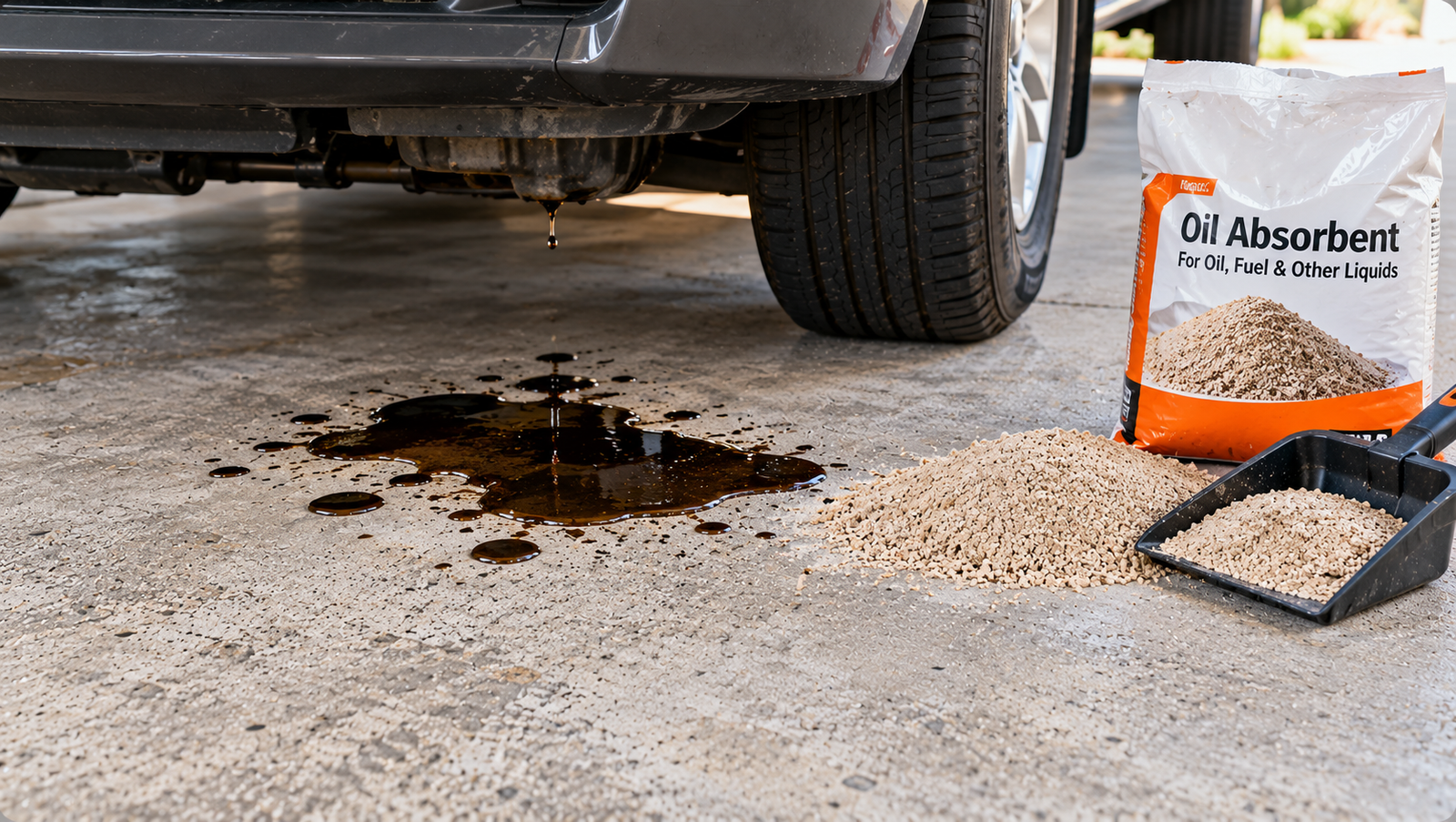
Best Absorbent Materials for Fresh Oil Spills
Absorbents soak up free liquid, which stops the spill from spreading and sinking. They do not remove the stain left behind in the surface.
- Commercial oil absorbent: sold for spills, with instructions for use and disposal.
- Absorbent clay or suitable cat litter: inexpensive and widely used for garage and driveway spills.
- Sand: a useful aid for containing and soaking up a spreading spill.
Skip sawdust and other combustible materials, especially if the fluid might include fuel. Once the absorbent has done its job, the remaining stain still needs cleaning.
How Long Should Absorbent Material Stay on the Spill?
There is no single correct number of hours. Contact time depends on how absorbent the material is, how much oil there is, and the condition of the concrete.
Follow the absorbent manufacturer’s instructions when you have them. If the material is saturated and liquid is still visible, replace it with fresh material and collect the used batch.
How to Remove and Dispose of Oil-Soaked Absorbent
Oil-soaked absorbent is waste, so treat it that way. Collect it with a dedicated broom and dustpan, and place it in a sealed, leak-proof container.
Never sweep contaminated material into soil, gutters, or storm drains. The EPA warns that used motor oil is persistent and can contaminate waterways and drinking water sources.
Disposal rules vary by location. Check your local household hazardous waste program or used-oil collection site, and ask whether oil-soaked absorbents can go with your regular waste.
A progressive oil-stain removal process minimizes unnecessary chemical or mechanical treatment.
How to Remove a Fresh Oil Stain With Detergent
Detergent works best on plain concrete when the stain is small and recent. Concrete Network describes dish soap and a scrub brush as often effective on new oil spots.
- Remove free oil first. Wipe or absorb as much as you can, and collect it for disposal.
- Apply a suitable detergent. A paste of powdered laundry detergent or baking soda with water is another option Concrete Network lists for fresh stains.
- Agitate with a stiff nylon brush. Work along the surface texture so the cleaner reaches low spots.
- Lift the emulsified residue. Pick it up with rags, absorbent, or a wet vacuum.
- Rinse only where runoff can be contained. Use as little water as possible and follow local rules.
- Let the surface dry, then recheck. Judge the result only when the concrete is dry.
Do not hose oily detergent down the driveway. Block nearby drains first, and collect rinse water instead of letting it flow toward the street.
Concrete Degreaser vs. Dish Soap
Household detergent suits small, recent stains. Purpose-made concrete degreasers are formulated for oily contamination, but they are not magic on old oil.
Concrete Network explains that a degreaser works like ball bearings, loosening oil so it can be removed. It also cautions that typical degreasers do not break the oil down, so they struggle on heavily or long-contaminated concrete and on dense, hard finishes.
| Method | Best suited for | Main advantage | Main limitation |
|---|---|---|---|
| Absorbent material | Fresh free oil | Stops spreading quickly | Does not remove embedded staining |
| Detergent + brush | Small recent stains | Simple and inexpensive | Limited on deep contamination |
| Concrete degreaser | Surface and moderate oily contamination | Designed to emulsify oil | May need multiple cycles |
| Commercial poultice | Small stubborn embedded stains | Draws oil from porous concrete | Slower and product-specific |
| Microbial/enzymatic cleaner | Compatible organic/oil contamination | Can break down certain contaminants | Requires suitable conditions and time |
| Professional extraction/preparation | Large, deep or coating-critical stains | More controlled remediation | Higher cost |
Read the table as a ladder. Move up only when the step below it has been tried, dried, and checked.
How to Use a Concrete Degreaser Correctly
Degreasers differ a lot between brands, so the label is your instruction manual. These are the points to check before you start:
- Test area: try a small, hidden spot first, especially on colored or sealed concrete.
- Surface condition: some products call for a dry surface and others for a prewetted one.
- Dilution: mix exactly as the manufacturer directs, since ratios vary by product.
- Dwell time: leave the cleaner on for the stated time without letting it dry out unless told to.
- Agitation: scrub with a stiff nylon brush along the surface texture.
- Collection and rinsing: lift the residue, then rinse with minimal water you can contain.
- Repeat cycles: allow full drying between rounds.
PROSOCO adds that dust, sand, and organic debris should be cleared first, because they keep cleaners from reaching the pores. No single dilution suits every product, so this guide does not give one.
Why the Stain Looks Gone When Wet but Returns After Drying
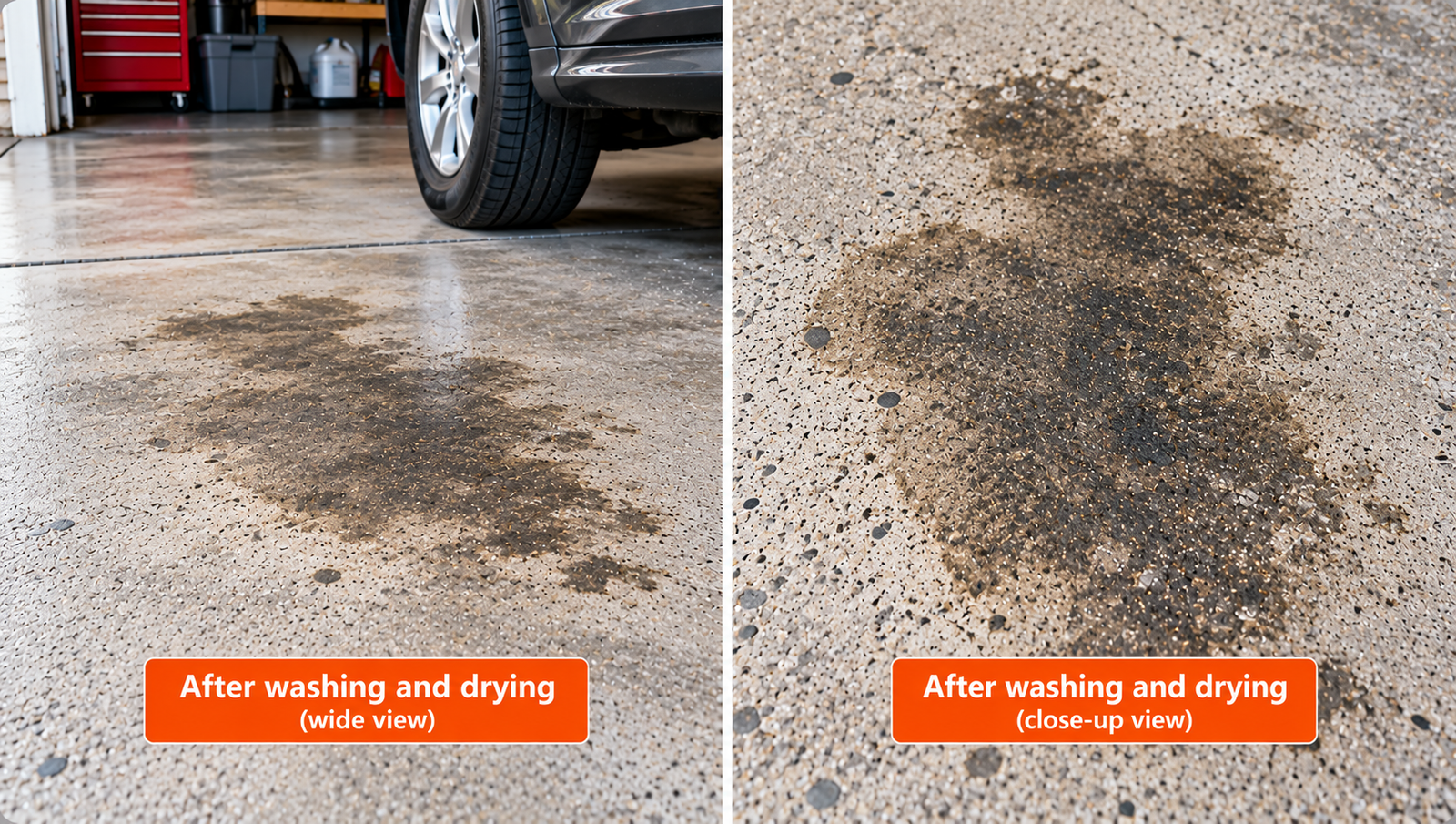
Wet concrete looks darker and more uniform, which can hide a stain that is still present. Once the surface dries, any oil left in the pores can move upward and darken the area again.
PROSOCO describes this as normal on older slabs. The returning shadow is not a new stain, it is the original contamination rising through the pores.
So wait for the slab to dry evenly before you decide. Areas that dry slower than the surroundings are another sign that deeper oil remains.
How to Remove Old Oil Stains From Concrete
Old stains call for an escalation sequence instead of one big attack. Work through it in order and let each step dry before judging:
- Clean with detergent or a concrete degreaser.
- Let the slab dry completely and evaluate the stain.
- Repeat the cleaning if the stain is clearly improving.
- Move to a poultice or extraction product if a shadow persists.
Be realistic about the finish. Old stains may never match the surrounding concrete perfectly, especially on weathered or decorative slabs, and the goal is often a stain that blends in.
What Is a Poultice and Why Does It Work?
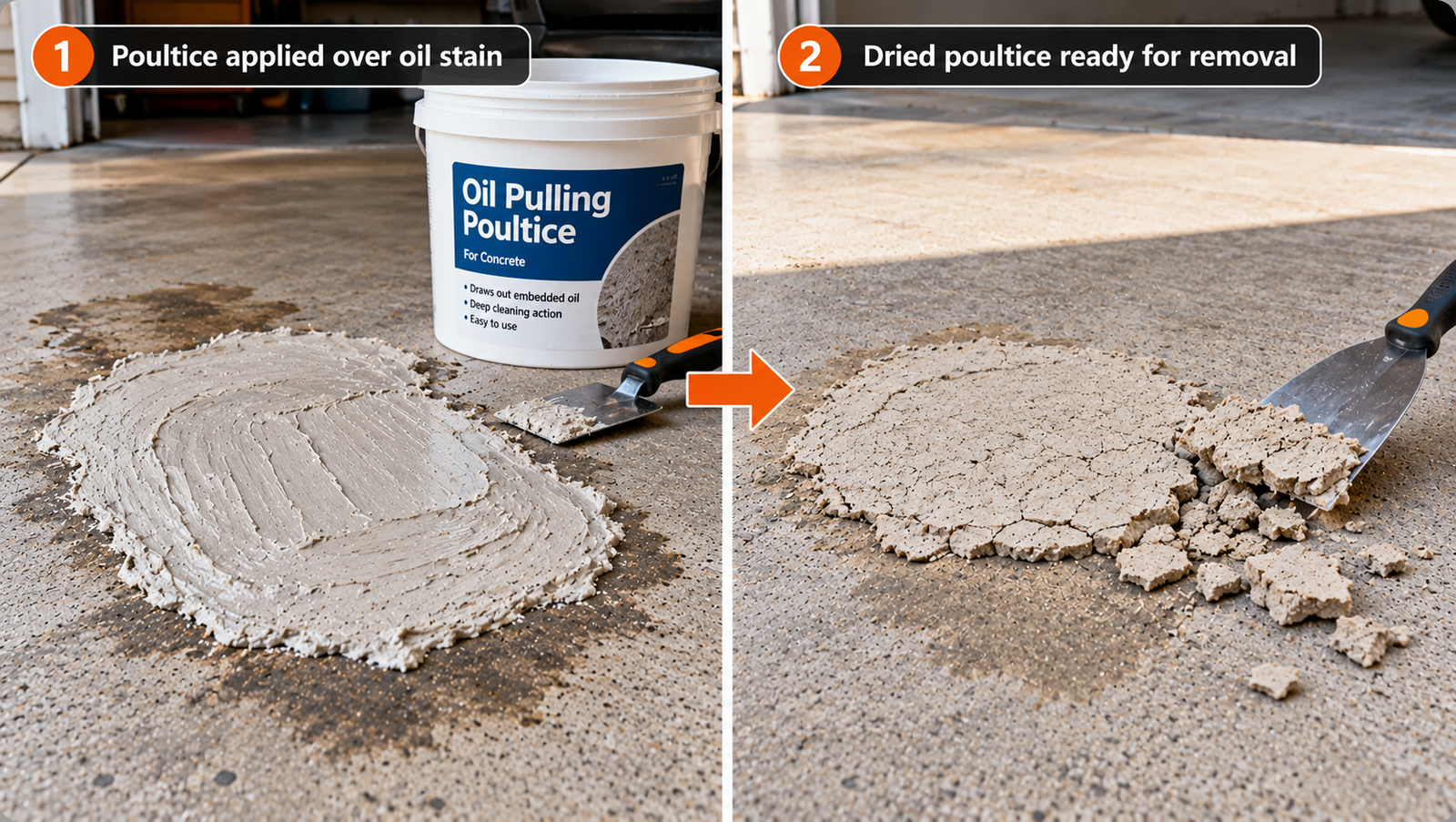
A poultice combines a cleaning or extraction liquid with an absorbent material. As it dries, it draws contamination out of porous concrete and into the absorbent.
PROSOCO describes its poultice cleaner the same way. The liquid enters the pores, the material dries in place, and the captured oil is swept up with it.
Homemade solvent recipes are not the focus here, because solvents bring flammability, exposure, and substrate-compatibility problems. For stubborn stains, use a purpose-made product or have a professional specify a system.
How to Use a Commercial Oil-Stain Poultice
Each product has its own rules, so use this as a general workflow and let the data sheet override it:
- Confirm the product is compatible with your concrete and any sealer.
- Bring the surface to the moisture condition the product requires.
- Apply the poultice over the stain and slightly beyond its edges.
- Let it dry for the time the manufacturer specifies.
- Collect the dried material and dispose of it as directed.
- Wait for the concrete to dry, then evaluate the stain.
- Repeat if the stain is improving.
As one example, PROSOCO’s technical sheet for its Oil & Grease Stain Remover calls for a dry surface, pouring past the stain edge by at least an inch, and a dry time of 5 to 8 hours. Those figures belong to that product only.
Homemade Poultices: Do They Work?
Some specialist sources describe poultices made by soaking an absorbent in a strong solvent. Concrete Network lists acetone, xylene, lacquer thinner, and MEK for this purpose.
Those solvents are flammable, produce hazardous vapors, and can damage coatings or sealers. They also take time and are impractical on large stains, so this is not a default homeowner method.
If solvent extraction is under consideration, use a commercial product designed for the job or hire a professional who can manage the safety and compatibility issues.
Can Microbial or Enzyme Cleaners Remove Oil?
Microbial and enzyme cleaners use organisms or enzymes that feed on petroleum-based contamination. Concrete Network describes them as digesting the oil, then dying off when the food source is gone.
- They tend to work more slowly than detergents or degreasers.
- Manufacturers usually specify moisture and temperature conditions for good results.
- Performance varies by product and by stain.
- They may not suit a job that needs fast, complete removal before a coating.
Treat them as one option for suitable stains, not a guaranteed cure. Follow the product directions and expect to repeat applications.
When Is an Oil Stain Too Deep for DIY Cleaning?
Some stains are beyond a weekend of scrubbing. Consider professional cleaning or a substrate evaluation if any of these apply:
- The contaminated area is large.
- Leaks have repeated for years.
- Oil is emerging through cracks.
- The site is commercial or industrial.
- A bonded coating is planned for the floor.
- You do not know what chemical spilled.
- The concrete stays oily after several extraction cycles.
If the surface is also crumbling or breaking away, read about concrete spalling. Damage of that kind is a separate problem from the stain itself.
Can You Pressure-Wash Oil Stains Off Concrete?
Pressure washing can blast loosened material off the surface, but it does not automatically extract oil from deep in the pores. It can also spread oily water and drive contamination around.
The key issue is wastewater. Oily runoff must not reach storm drains, and EPA guidance for vehicle areas says to use as little water as possible and to collect wash water when washing is unavoidable.
- Oily wastewater can spread to clean areas.
- High pressure can damage the surface or loosen sealers.
- Runoff can enter storm drains or neighboring property.
If you do wash, block drains, contain the water, and check local rules on disposal. Treat pressure washing as a collection problem first and a pressure-setting question second.
Does Baking Soda Remove Oil Stains?
Baking soda has a limited role. Concrete Network lists a paste of baking soda or powdered laundry detergent and water for small, fresh stains.
It may lighten a recent mark, but it is not an extraction system. Do not expect it to pull oil out of old, embedded stains.
Should You Use Vinegar, Bleach, Cola, WD-40 or Gasoline?
Online advice often swaps an oil stain for a new problem. Concrete Network warns that WD-40, cola, bleach, and vinegar can eat away the stain but also damage the driveway and leave a discolored spot, especially on decorative concrete.
- WD-40: adds more oil-based material to the surface.
- Cola: has uncertain strength, acidity, and additives.
- Bleach and vinegar: do not target petroleum and can discolor finishes. Never mix them.
Never Use Gasoline
Gasoline is a fire and vapor hazard, and it spreads petroleum into the concrete and the environment. It is not a cleaning method.
If you try any unusual remedy anyway, Concrete Network advises testing it on a small, out-of-sight spot first.
Can Muriatic Acid Remove Oil From Concrete?
Muriatic acid is aimed at mineral and cement-based material, not petroleum. A National Research Council publication on concrete surface preparation notes that muriatic acid is relatively ineffective in removing oil and grease.
Acid also etches. It removes cement paste, changes the surface profile, and can leave a blotchy, discolored patch around the stain. The same publication says ACI Committee 515 recommends acid etching only when no alternative surface preparation is acceptable.
A failed degreaser is not a reason to reach for acid. Move to a poultice, a specialist cleaner, or a professional instead.
| Remedy | Recommendation | Reason |
|---|---|---|
| Absorbent clay/cat litter | Useful for fresh free oil | Absorbs liquid but does not extract all staining |
| Dish detergent | Reasonable for small recent stains | Limited penetration |
| Concrete degreaser | Preferred next step | Designed for oily contamination |
| Baking soda | Limited role | May help lightly but is not an extraction system |
| Vinegar | Generally not preferred for oil | Acid can alter concrete and targets different deposits |
| Bleach | Not preferred for petroleum oil | Does not address embedded hydrocarbons well and may discolor finishes |
| Cola | Avoid as a primary method | Uncontrolled acidity/additives and uncertain performance |
| Gasoline | Do not use | Fire, vapor, environmental and contamination hazards |
| Muriatic acid | Do not use as routine oil treatment | Can etch concrete without extracting petroleum effectively |
Removing Oil From Sealed, Stamped, Colored and Polished Concrete
Finished surfaces need extra caution. Identify the coating or finish before using any aggressive cleaner or solvent, and always test a hidden area first.
- Sealer softening: some cleaners and solvents can soften or cloud a sealer.
- Gloss changes: cleaning can dull or streak a sealed or polished finish.
- Color loss: colored concrete may fade or lighten.
- Etching: acids and some chemicals can roughen a polished surface.
- Trapped contamination: a dark area under a sealer cannot be scrubbed off the top.
| Surface | First method to evaluate | Main caution |
|---|---|---|
| Plain broom-finished concrete | Absorption + degreaser | Manage runoff |
| Smooth garage slab | Degreaser or compatible extraction | Avoid making surface slippery during cleaning |
| Colored concrete | Mild tested cleaner | Color change |
| Stamped/sealed concrete | Coating-compatible cleaning | Sealer damage |
| Polished concrete | Installer/manufacturer-approved cleaner | Loss of sheen or etching |
| Concrete awaiting epoxy | Thorough contamination removal + substrate verification | Residual oil can impair bond |
Removing Oil Before Epoxy, Sealer, Stain or Resurfacing
Concrete Network is blunt about this: remove oil before staining, sealing, or resurfacing. If it is not removed, it can seep back through to the surface and ruin the new treatment.
Oil can interfere with epoxy bond, overlay bond, stain penetration, densifier penetration, and sealer performance. A stain that looks lighter on the surface can still hold oil in the pores.
Embedded oil can interfere with coatings and bonded overlays even when the surface appears cleaner.
Not every leftover discoloration holds enough oil to cause a failure. Coating makers set their own requirements for substrate cleanliness, moisture, and bond testing.
ICRI Technical Guideline 310.2R describes surface preparation goals that include removing dirt, oil, films, and coatings, plus contaminated or unsound concrete.
After chemical cleaning, mechanical preparation such as grinding or shot blasting may still be needed. Professional bond testing makes sense when a lot is at stake.
Once the concrete is clean and sound, you can plan the next step. Read When to Seal a Concrete Driveway and How to Seal Concrete, then estimate materials with the Concrete Sealer Calculator or the Concrete Repair Calculator.
For a bonded overlay, use the Concrete Resurfacing Calculator. Budget checks are available in the Concrete Resurfacing Cost Calculator and the Concrete Sealing Cost Calculator.
How to Prevent Future Oil Stains on Concrete
Prevention is far cheaper than extraction. Fix the source, then make spills easy to catch quickly.
| Prevention step | Why it helps |
|---|---|
| Repair leaks promptly | Stops repeated contamination |
| Keep absorbent/spill kit nearby | Limits penetration after a fresh spill |
| Use a drip tray or oil mat | Protects parking areas |
| Clean spills immediately | Reduces time for oil to enter pores |
| Maintain compatible sealer/coating | Can reduce penetration where suitable |
| Check garage/driveway after vehicle service | Finds new leaks early |
| Keep drains protected during cleanup | Prevents oily runoff from entering stormwater systems |
Concrete Network suggests servicing your car to stop drips, sealing with an oil-resistant product, and using an oil mat on garage floors. Follow the sealer maker’s instructions for upkeep.
No coating makes concrete maintenance-free. Even a good sealer slows oil penetration but does not replace quick cleanup.
Oil Stain Removal FAQs
What removes motor oil from concrete best?
It depends on the stain. Absorbent handles fresh spills, detergent or a concrete degreaser handles recent stains, and a poultice or specialist extraction product suits oil that has soaked in.
Can old oil stains be completely removed?
Sometimes, but not always. Old stains may leave a faint shadow even after extraction, especially on weathered or decorative concrete.
How long should degreaser sit?
Follow the label. Dwell time varies by product, and some should not dry on the surface.
Will pressure washing remove oil?
Not reliably. It can remove loose surface material, but oil in the pores usually stays, and the oily wastewater must be contained.
Does baking soda work?
It can help with small, fresh stains. It does not pull old oil out of the pores.
Can I use vinegar?
It is not recommended. Concrete Network warns that vinegar can damage or discolor concrete, and it does not target petroleum.
Can I seal over an oil stain?
It is a poor idea. Oil can interfere with sealer performance and migrate back, so clean thoroughly and dry the concrete first.
Why does the stain return after drying?
Wet concrete masks stains. As it dries, oil remaining in the pores moves up and darkens the surface again, which means another extraction cycle may be needed.
Can oil damage concrete structurally?
Oil mainly stains and contaminates the surface. Structural concerns come from other problems, so have a professional assess any cracking or crumbling.
When should I call a professional?
Call one for large or repeated contamination, unknown chemicals, oil coming through cracks, or floors that will receive epoxy or an overlay.