Concrete Bag Yield Chart 2026 – Cubic Feet, Cubic Yards & Liters by Bag Size
Concrete Bag Yield Chart
Cubic Feet, Cubic Yards & Liters by Bag Size
How much mixed concrete volume actually comes out of a 40, 50, 60, 80, or 90 lb bag, why standard and high-yield bags of the same weight do not produce the same volume, and how to convert yield into the bag count your project needs.
 Reviewed by Muhammad Ramzan Babar, PhD Researcher (Plasma Physics) & Calculator Developer, View Profile
Bag weight is not a universal volume conversion
Standard 80-lb QUIKRETE and Sakrete High-Strength mixes publish approximately 0.60 ft³ of yield. A high-yield 80-lb Sakrete MAXIMIZER bag publishes approximately 0.92 ft³ instead, based on its current technical data sheet. Always use the published yield for the exact product, not a generic bag-weight assumption. This chart covers volume produced per bag only; for area covered at a chosen thickness, see the Concrete Coverage Chart.
Concrete Bag Yield Chart, Quick Reference
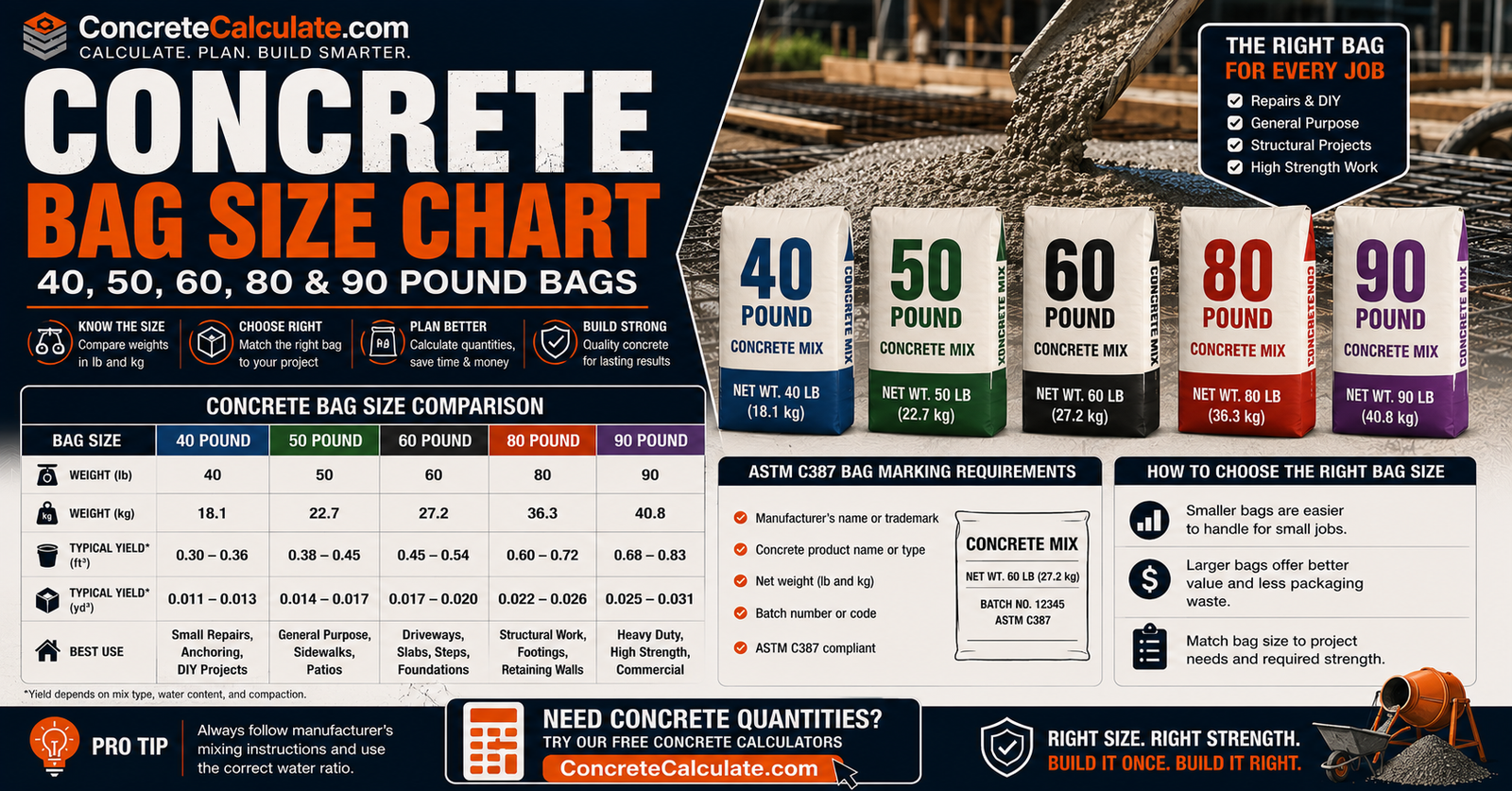
This table shows the approximate mixed-concrete volume produced by each standard bag size, based on QUIKRETE Concrete Mix’s current published technical data sheet.
| Bag Size | Yield (ft³) | Yield (yd³) | Approx. Liters | Theoretical Bags per yd³ |
|---|---|---|---|---|
| 40 lb | 0.30 | 0.0111 | 8.5 | 90 |
| 50 lb | 0.375 | 0.0139 | 10.6 | 72 |
| 60 lb | 0.45 | 0.0167 | 12.7 | 60 |
| 80 lb | 0.60 | 0.0222 | 17.0 | 45 |
| 90 lb | 0.675 | 0.0250 | 19.1 | 40 |
How to read this chart
These are approximate manufacturer-published yields for the standard mix shown, based on QUIKRETE Concrete Mix. Actual yield varies by product formulation. Always verify the yield printed on the bag or the current technical data sheet before ordering. For available package sizes by brand, see the Concrete Bag Size Chart.
Planning your next concrete project?
Plan concrete materials and project costs with our downloadable Excel estimator pack. For estimating only; follow applicable technical standards for design and installation.
One-time purchase · Digital downloadStandard vs High-Yield Bag Comparison
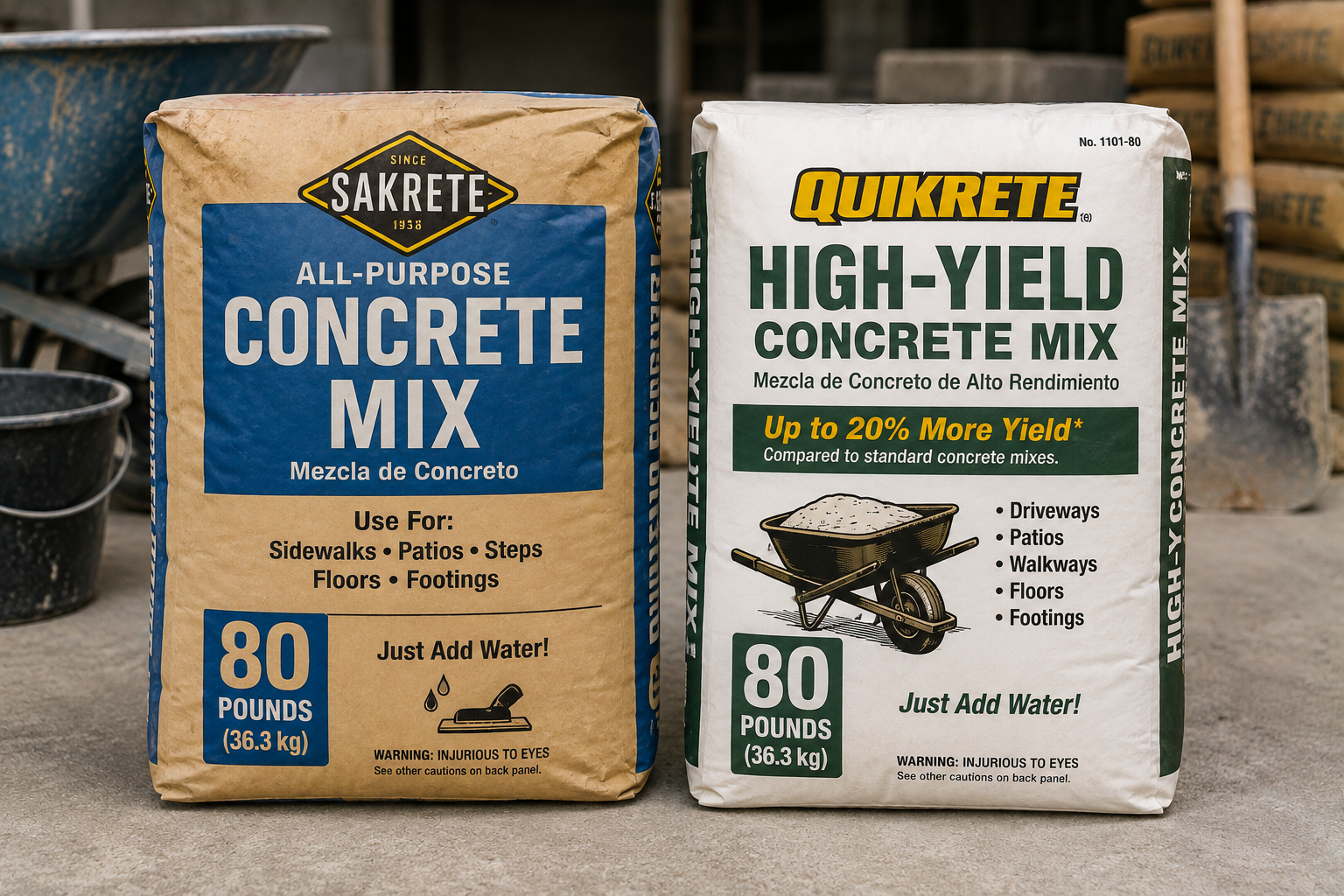
An 80-lb bag does not have one universal yield. A conventional normal-weight mix and a lightweight, high-yield mix at the same package weight can produce very different volumes.
| Product Type | Bag Weight | Published Yield | Difference vs Standard |
|---|---|---|---|
| Standard mix (QUIKRETE Concrete Mix / Sakrete High-Strength) | 80 lb | 0.60 ft³ | Baseline |
| Sakrete MAXIMIZER (lightweight, high-yield) | 80 lb | 0.92 ft³ | +53% more volume |
| Standard mix | 40 lb | 0.30 ft³ | Baseline |
| Sakrete MAXIMIZER (lightweight, high-yield) | 40 lb | 0.46 ft³ | +53% more volume |
Correction from older published figures
Sakrete MAXIMIZER’s current technical data sheet lists 0.46 ft³ for 40 lb and 0.92 ft³ for 80 lb. Some earlier data sheets for the same product listed 0.50 ft³ and 1.00 ft³. Manufacturer formulations and published yields can change, so always confirm the current data sheet rather than relying on an older figure.
What Does Concrete Bag Yield Mean?
Concrete bag yield is the approximate volume of mixed concrete produced from one package when mixed according to the manufacturer’s instructions.
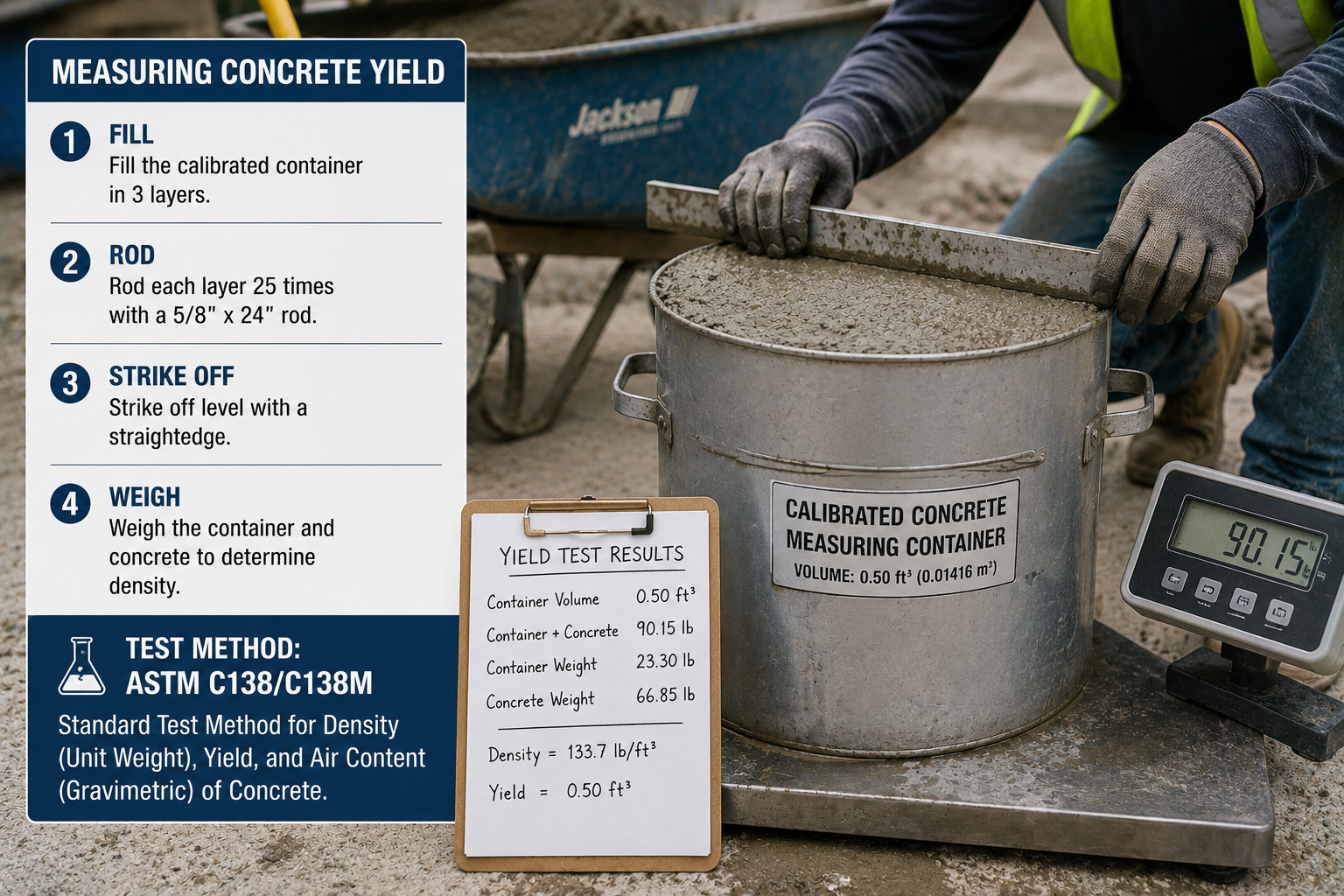
ASTM C138/C138M, the standard test method for density, yield, and air content of concrete, defines yield as the volume of concrete produced from a mixture of known quantities of component materials. Bagged-concrete manufacturers apply this same underlying concept when publishing a bag’s yield on its label.
Dry Bag Weight vs Mixed Concrete Volume
An 80-lb bag describes the mass of the dry packaged material, not the volume of finished concrete. Once water is added and the mix is combined, that same bag produces approximately 0.60 ft³ of mixed concrete for a standard product. Weight and volume are two different measurements and are not interchangeable.
Why Yield Is Given in Cubic Units
Yield describes a three-dimensional volume, so it is reported in cubic feet, cubic yards, liters, or cubic meters, never in square feet. Coverage, not yield, depends on area.
Concrete Bag Yield vs Concrete Coverage
Yield and coverage answer two different questions, and mixing them up is one of the most common bagged-concrete estimating errors.
| Term | Definition |
|---|---|
| Yield | Volume of mixed concrete produced per bag, for example 0.60 ft³ for a standard 80-lb mix |
| Coverage | Area that volume covers at a specified thickness, which depends on both yield and thickness |
Coverage formula
A = (12 × Y) ÷ T, where A is area in ft², Y is bag yield in ft³, and T is thickness in inches. Because T changes with every project, an 80-lb bag has one fixed volume yield, but no single fixed square-foot coverage number. This chart owns yield; for coverage area at a chosen thickness, see the Concrete Coverage Chart.
Concrete Bag Size vs Yield
Bag size and yield are related, but the relationship is product-specific rather than a fixed conversion.
For conventional normal-weight mixes, larger bags typically produce proportionally more concrete. But formulation choices, including aggregate type and density, cementitious content, lightweight aggregate, and specialty admixtures, can change yield substantially. Sakrete MAXIMIZER’s 80-lb bag yields approximately 0.92 ft³, well above the 0.60 ft³ typical of a standard 80-lb mix, because it uses structural lightweight aggregate rather than conventional aggregate. For the full range of package sizes each brand offers, see the Concrete Bag Size Chart.
40-lb Concrete Bag Yield
Standard QUIKRETE Concrete Mix and Sakrete High-Strength Concrete Mix both currently publish approximately 0.30 ft³ for a 40-lb bag, about 8.5 liters or 0.0111 yd³. High-yield lightweight products, such as Sakrete MAXIMIZER, publish approximately 0.46 ft³ for the same 40-lb weight. Theoretically, about 90 standard 40-lb bags are needed for one cubic yard.
50-lb Concrete Bag Yield
QUIKRETE Concrete Mix publishes approximately 0.375 ft³ for a 50-lb bag, about 10.6 liters. Sakrete 5000 Plus High Early Strength Concrete Mix currently publishes approximately 0.38 ft³ for its 50-lb bag, a very close but not identical figure. Always confirm the published yield for the specific product rather than assuming it is identical across brands.
60-lb Concrete Bag Yield
A 60-lb bag of standard concrete mix yields approximately 0.45 ft³, about 12.7 liters, shared by QUIKRETE Concrete Mix, Sakrete High-Strength Concrete Mix, and Sakrete 5000 Plus. That works out to about 60 bags per cubic yard for a standard 60-lb mix.
80-lb Concrete Bag Yield
Standard conventional concrete mix yields approximately 0.60 ft³, about 17 liters, from an 80-lb bag, per current QUIKRETE and Sakrete High-Strength technical data. Sakrete’s lightweight MAXIMIZER mix yields approximately 0.92 ft³ from the same 80-lb weight. Never calculate yield from bag weight alone when the exact product’s published yield is available.
90-lb Concrete Bag Yield
QUIKRETE Concrete Mix lists a 90-lb bag at approximately 0.675 ft³, about 19.1 liters, noting regional availability on its data sheet. Because 90-lb bag availability and yield vary by brand and region, confirm the exact product’s current data sheet before ordering at this size rather than assuming a universal figure.
Concrete Bag Yield in Cubic Feet, Cubic Yards and Liters
Convert standard bagged concrete mix yield across the three units most commonly seen on U.S. product labels.
| Bag Size | ft³ | yd³ | Liters | m³ |
|---|---|---|---|---|
| 40 lb | 0.30 | 0.0111 | 8.5 | 0.0085 |
| 50 lb | 0.375 | 0.0139 | 10.6 | 0.0106 |
| 60 lb | 0.45 | 0.0167 | 12.7 | 0.0127 |
| 80 lb | 0.60 | 0.0222 | 17.0 | 0.0170 |
| 90 lb | 0.675 | 0.0250 | 19.1 | 0.0191 |
Useful conversion equations
1 yd³ = 27 ft³. Y(yd³) = Y(ft³) ÷ 27. 1 ft³ is approximately 28.3168 liters.
How Many Bags Make One Cubic Foot?
Formula: N = 1 ÷ Y, where Y is yield per bag in ft³.
| Product | Yield per Bag | Bags per Cubic Foot |
|---|---|---|
| Standard 80-lb mix | 0.60 ft³ | 1.67 |
| Standard 60-lb mix | 0.45 ft³ | 2.22 |
| Standard 40-lb mix | 0.30 ft³ | 3.33 |
| High-yield 80-lb MAXIMIZER | 0.92 ft³ | 1.09 |
How Many Concrete Bags Make One Cubic Yard?
Formula: N = 27 ÷ Y, where Y is yield per bag in ft³. These are theoretical bag equivalents based on published yield, before any project allowance.
| Bag Size | Yield per Bag | Bags per Cubic Yard |
|---|---|---|
| 40 lb | 0.30 ft³ | 90 |
| 50 lb | 0.375 ft³ | 72 |
| 60 lb | 0.45 ft³ | 60 |
| 80 lb | 0.60 ft³ | 45 |
| 90 lb | 0.675 ft³ | 40 |
Concrete Bags per Quarter and Half Yard
Approximate bag counts for common fractional-yard quantities, rounded up to whole bags for purchasing.
| Bag Size | ¼ yd³ | ½ yd³ | ¾ yd³ | 1 yd³ |
|---|---|---|---|---|
| 40 lb | 23 | 45 | 68 | 90 |
| 50 lb | 18 | 36 | 54 | 72 |
| 60 lb | 15 | 30 | 45 | 60 |
| 80 lb | 12 | 23 | 34 | 45 |
| 90 lb | 10 | 20 | 30 | 40 |
Standard Concrete Mix Yield
QUIKRETE Concrete Mix
Current published approximate yields: 40 lb, 0.30 ft³; 50 lb, 0.375 ft³; 60 lb, 0.45 ft³; 80 lb, 0.60 ft³; 90 lb, 0.675 ft³.
Sakrete High-Strength Concrete Mix
Current published approximate yields: 40 lb, 0.30 ft³; 60 lb, 0.45 ft³; 80 lb, 0.60 ft³. This confirms the same general yield pattern as QUIKRETE Concrete Mix without turning this page into branded product content.
High-Yield and Lightweight Concrete Bag Yield
High-yield, lightweight bagged concrete breaks the usual bag-weight assumption.
Sakrete MAXIMIZER is formulated with structural lightweight aggregate and cement. Its current technical data sheet publishes approximately 0.46 ft³ for a 40-lb bag and approximately 0.92 ft³ for an 80-lb bag. Lower-density lightweight formulations can produce meaningfully more volume from the same dry bag weight, because the aggregate itself weighs less per unit volume than conventional normal-weight aggregate. This is a product-specific outcome; do not apply MAXIMIZER’s exact figures to other lightweight mixes without checking their individual data sheets.
Fast-Setting Concrete Bag Yield
Fast setting time does not automatically mean higher or lower yield. QUIKRETE Fast-Setting Concrete Mix’s current data sheet publishes approximately 0.375 ft³ for a 50-lb bag, with the data sheet also covering 60-lb and metric package sizes. Setting speed and yield are separate specifications on the label.
High-Strength Concrete Bag Yield
Higher compressive strength does not automatically mean more yield. Sakrete 5000 Plus High Early Strength Concrete Mix currently publishes approximately 0.38 ft³ for a 50-lb bag, 0.45 ft³ for a 60-lb bag, and 0.60 ft³ for an 80-lb bag, essentially matching standard mix yield at the same weights while offering greater compressive strength. Check strength rating and yield as two independent specifications.
Equipment for Your Project
Affiliate disclosure: As an Amazon Associate, ConcreteCalculate earns from qualifying purchases. We may also earn a commission from other affiliate links at no additional cost to you.
Concrete Mix vs Sand Mix and Other Packaged Products
Sakrete Sand Mix Topping & Bedding currently publishes approximately 0.30 ft³ for 40 lb, 0.45 ft³ for 60 lb, and 0.60 ft³ for 80 lb, yield figures that look similar to standard concrete mix. However, sand mix is intended for thin applications of about ½ inch to 2 inches and contains no coarse aggregate, making it a different product class from structural concrete mix. Do not assume concrete mix, sand or topping mix, mortar, grout, and repair material all produce comparable structural material just because their bag yields look similar.
Why Two Bags of the Same Weight Can Have Different Yields
Several formulation factors determine how much mixed volume a bag of given weight produces.
Aggregate density
Normal-weight versus lightweight aggregate directly changes mixed volume per unit weight.
Aggregate type and grading
Particle size distribution and shape affect how much paste and air fill the mixture.
Cementitious proportions
The ratio of cement and supplementary materials to aggregate shifts overall yield.
Entrained or entrapped air
Air content changes the effective volume of the finished mixture.
Overall product formulation
Manufacturers design each product’s intended application and yield independently.
The clearest illustration remains the flagship comparison: a standard 80-lb mix at approximately 0.60 ft³ versus Sakrete MAXIMIZER’s lightweight 80-lb mix at approximately 0.92 ft³, a difference driven by aggregate density rather than package weight.
How Concrete Yield Is Determined
For everyday bagged-concrete estimating, use the manufacturer’s stated yield rather than calculating it from bag weight.
| Method | Best Used For |
|---|---|
| Manufacturer-published yield | Everyday bagged-mix estimating and purchasing |
| ASTM C138/C138M measured yield | Laboratory and quality control contexts, using Y = total mass of batch ÷ density |
Calculating Bags Needed from Product Yield
Two-step process: find project volume, then divide by bag yield.
Bagged concrete can only be purchased in whole-bag units. A calculation that returns 11.1 bags means you buy 12 bags, before any separate waste allowance is added.
Bag Yield vs Project Volume Lookup
Reverse-lookup table for common small-project volumes, based on published standard yield per bag size, rounded up to whole bags.
| Project Volume | 40 lb | 50 lb | 60 lb | 80 lb | 90 lb |
|---|---|---|---|---|---|
| 1 ft³ | 4 | 3 | 3 | 2 | 2 |
| 2 ft³ | 7 | 6 | 5 | 4 | 3 |
| 5 ft³ | 17 | 14 | 12 | 9 | 8 |
| 10 ft³ | 34 | 27 | 23 | 17 | 15 |
| 0.25 yd³ | 23 | 18 | 15 | 12 | 10 |
| 0.50 yd³ | 45 | 36 | 30 | 23 | 20 |
| 1 yd³ | 90 | 72 | 60 | 45 | 40 |
Bag Yield by Project Type
Bag yield stays the same regardless of application; project geometry determines how many bags a job requires.
| Application | Volume Formula |
|---|---|
| Slabs and pads | Area × thickness |
| Footings | Length × width × depth |
| Post holes | Hole volume, minus post displacement where applicable |
| Steps and irregular shapes | Break into simple shapes, sum the volumes |
Use the concrete slab calculator, concrete footing calculator, or post hole concrete calculator and fence post concrete calculator to get project volume, then apply the bag-yield formulas above.
Published Yield vs Actual Jobsite Yield
QUIKRETE’s own documentation notes that calculator and label yields are approximate and do not account for uneven substrate, waste, or similar field losses.
Uneven excavation or subgrade
Requires more material than the theoretical volume calculation assumes.
Spillage and leftover material
Mixer and tool residue reduces usable yield per batch.
Thickness variation and dimension error
Inaccurate measurements change the real project volume needed.
Batch-to-batch variability
Normal product variation can shift actual yield slightly from published figures.
Important distinction
Field material requirements can exceed the theoretical bag count even when the product itself performs exactly at its published yield. This is a project-conditions issue, not a defect in the manufacturer’s stated yield.
Water Addition and Concrete Yield
Do not treat extra water as a way to stretch a bag’s yield.
Sakrete’s MAXIMIZER technical data sheet provides a specific starting water range and explicitly warns against overwatering. Excess water is not a legitimate estimating method for increasing yield; it changes concrete consistency and can reduce strength and durability. Use the stated yield and the recommended mixing water range on the current data sheet. For more on how water content affects strength, see the Water-Cement Ratio Chart.
Concrete Waste and Bag Ordering Allowance
Keep manufacturer yield and purchasing allowance separate.
A published yield of 0.60 ft³ per bag does not become 0.54 ft³ simply because you plan for waste. Instead, calculate theoretical bags using the published yield, then apply a separate project allowance. Sakrete’s bagged-concrete estimating guidance suggests adding approximately 10% for waste as an example recommendation, while QUIKRETE’s calculator documentation simply notes that its figures do not include waste or uneven subgrade allowances. Treat any specific percentage as a manufacturer example, not a universal rule, since actual waste depends on site conditions, crew experience, and project complexity.
Bagged Concrete vs Ready-Mix Yield
| Format | Typical Unit |
|---|---|
| Bagged concrete | ft³ or liters per bag |
| Ready-mix concrete | Cubic yards (yd³) per order, ordered by the truckload |
Converting bag quantities to yard equivalents, using the tables above, helps you see project scale in both formats. Whether bagged or ready-mix is more economical depends on bag prices, ready-mix short-load charges, delivery distance, and labor, all of which vary by market. See ready-mix vs bagged concrete and how many yards of concrete do I need for a fuller comparison.
Concrete Bag Yield Worked Examples
Standard 80-lb Bag
Bags Needed for 5 ft³ Using 60-lb Bags
Standard vs High-Yield 80-lb Bag for 10 ft³
One Cubic Yard with Standard 80-lb Bags
ASTM and Manufacturer Standards for Concrete Bag Yield
Two ASTM standards and the exact product’s technical data sheet govern bag yield in the United States.
| Standard / Source | Scope |
|---|---|
| ASTM C138/C138M | Standard test method for density (unit weight), yield, and air content of concrete; defines yield as volume produced from known quantities of component materials |
| ASTM C387/C387M | Active specification for packaged, dry, combined materials for concrete and high-strength mortar; requires yield in liters or cubic feet marked on the package |
| Manufacturer technical data sheets | Should govern the exact stated bag yield for actual project estimating, since ASTM sets testing and specification requirements rather than one universal number |
Common Concrete Bag Yield Mistakes
Confusing bag weight with concrete volume
Weight and volume are different measurements connected only through published yield.
Assuming every 80-lb bag yields 0.60 ft³
High-yield products at 80 lb can yield significantly more.
Treating yield and coverage as the same thing
Coverage also depends on thickness, which yield alone does not capture.
Using one manufacturer’s yield for another product
Even similar-sounding products can publish different figures.
Assuming higher strength means greater yield
Strength rating and yield are independent specifications.
Confusing sand mix or mortar yield with concrete mix
Similar bag yields do not mean comparable structural material.
Calculating bag count without rounding up
Bagged concrete can only be purchased in whole-bag units.
Adding excess water to increase yield
This changes consistency and can reduce strength rather than adding usable volume.
Forgetting 27 ft³ equals 1 yd³
A common source of unit-conversion errors in bag-count calculations.
Using outdated packaging or yield data
Manufacturer formulations and published yields can change between data sheet revisions.
Concrete Bag Yield Chart Limitations
Read before ordering
Bag yield is approximate and product-specific, not a fixed physical constant. Dry bag weight does not uniquely determine mixed volume. Manufacturer formulations may change, bag availability varies by region, and specialty or high-yield products can differ substantially from conventional mixes. Published yield assumes the product is mixed exactly per manufacturer instructions. Yield does not indicate structural suitability, compressive strength, or required slab thickness, and project losses from uneven dimensions or subgrade are separate from product yield. For purchasing, verify the current bag or technical data sheet.
For thickness selection guidance, see the Concrete Slab Thickness Chart.