Structural Steel Weight Chart – lb/ft, kg/m & Takeoff Reference
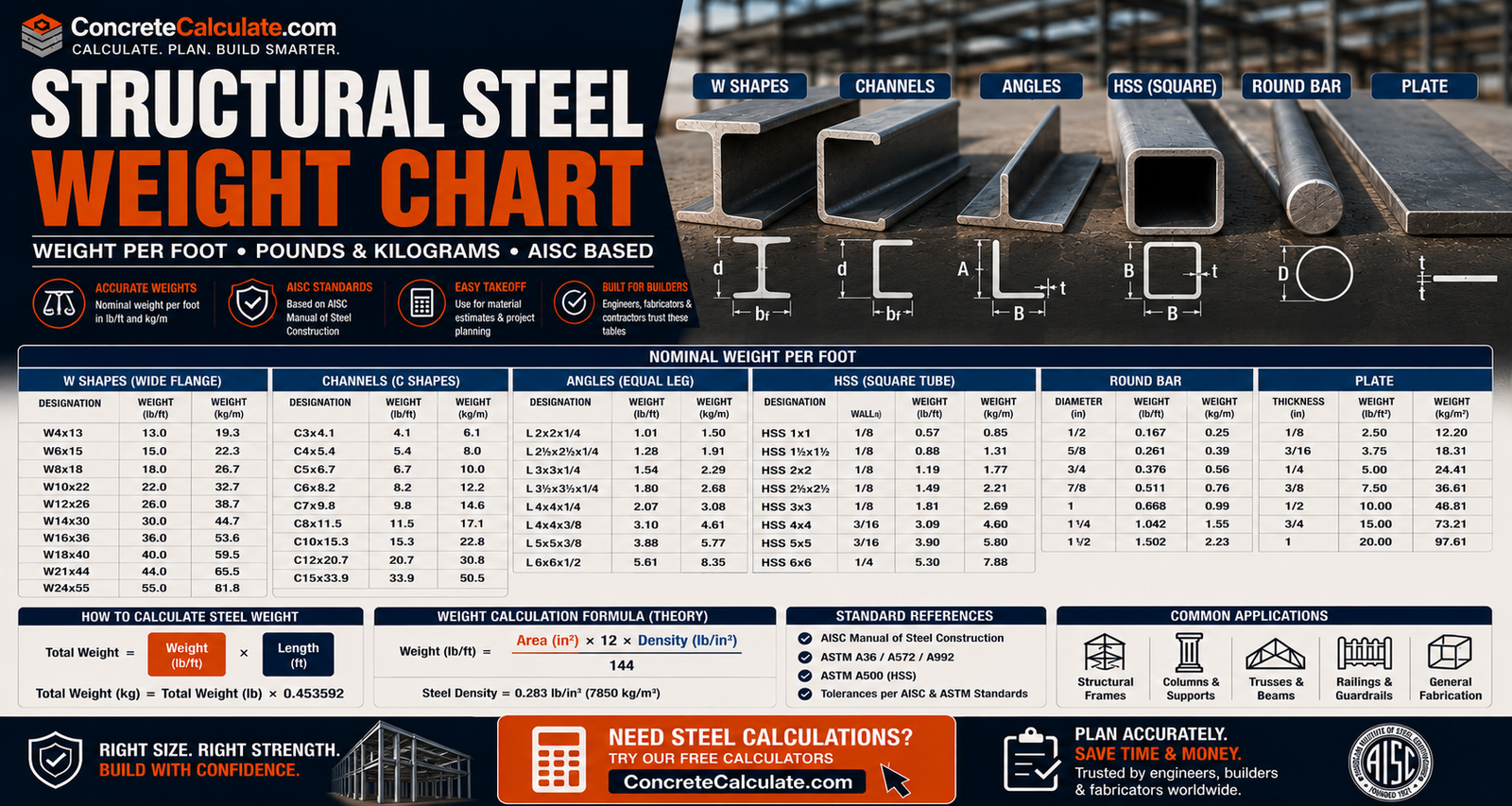
Structural Steel Weight Chart
lb/ft, kg/m & Takeoff Reference
Nominal weight per foot for W, S, M, and HP shapes, channels, angles, HSS, plate, and bar, cross-verified against AISC-sourced data, plus the Code of Standard Practice rules for calculating total steel weight correctly.
 Reviewed by Muhammad Ramzan Babar, PhD Researcher (Plasma Physics) & Calculator Developer, View Profile
Use the published shape weight first, density second
For standard AISC structural shapes, use the published nominal weight per foot from the current AISC Manual. Use 490 lb/ft³ mainly for plates, bars, custom geometry, or as a cross-check, not to replace official shape weights. This is the core rule behind AISC’s Code of Standard Practice, ANSI/AISC 303-22.
Structural Steel Weight Chart, Quick Reference
The message above this chart matters more than the chart itself: for standard AISC shapes, use the published nominal weight per foot rather than recomputing weight from simplified geometry.
| Shape Type | Example Designation | Nominal Weight | Primary Weight Unit | Weight in Designation? |
|---|---|---|---|---|
| W-Shape | W12x26 | 26 lb/ft | lb/ft | Yes |
| S-Shape | S8x18.4 | 18.4 lb/ft | lb/ft | Yes |
| M-Shape | M8x6.5 | 6.5 lb/ft | lb/ft | Yes |
| HP-Shape | HP12x53 | 53 lb/ft | lb/ft | Yes |
| C-Channel | C10x20 | 20 lb/ft | lb/ft | Yes |
| MC-Channel | MC12x10.6 | 10.6 lb/ft | lb/ft | Yes |
| Angle | L4x4x1/4 | 6.6 lb/ft | lb/ft | No, table lookup |
| HSS | HSS6x6x1/4 | 19.02 lb/ft | lb/ft | No, table lookup |
| Pipe | Pipe 4 Std (NPS) | 10.79 lb/ft | lb/ft | No, table lookup |
| Plate | 1/4 in. thick | 10.21 lb/ft² | lb/ft² | No, calculated |
| Bar | 2 in. x 1/2 in. flat | 3.40 lb/ft | lb/ft | No, calculated |
W, S, M, HP, C, and MC nominal weights are part of the shape designation itself and confirmed directly from the AISC Shapes Database v16.0. Angle, HSS, and pipe weights require a table lookup, since their designations describe geometry only. Plate and bar weights are calculated from detailed dimensions using the 490 lb/ft³ steel unit weight.
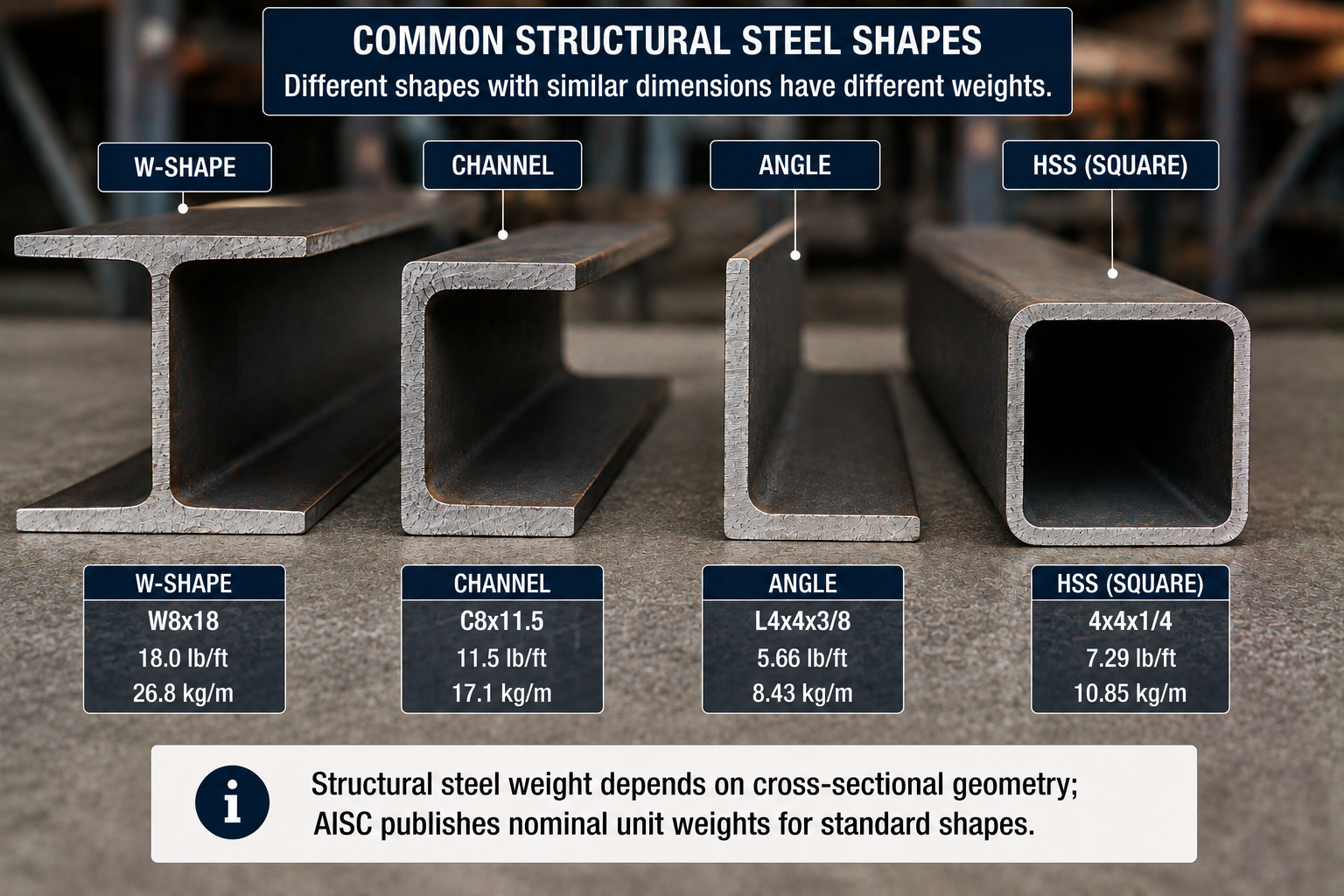
What Does Structural Steel Weight Mean?
Three distinct concepts get conflated more than any other in structural estimating.
Unit Weight / Density
490 lb/ft³, the reference density AISC uses for structural steel weight calculations.
Linear Weight
Expressed in lb/ft or kg/m, this is the weight of one unit of length for a given cross-section, such as 26 lb/ft for W12x26.
Total Piece Weight
Formula
Wtotal = w × L, where w is nominal weight per foot and L is member length.
Steel Density vs Shape Weight
One of the page’s most important sections.
AISC uses ρ = 490 lb/ft³ (7,850 kg/m³) for structural steel weight calculations. But for standard shapes, do not normally calculate W-shape, channel, angle, or HSS weight from 490 lb/ft³ if AISC already provides a nominal lb/ft value. Published section weights already incorporate the standardized actual cross-sectional geometry, including fillets, rounded corners, flange and web geometry, and standard section area.
✓ Verified against AISC 303-22, Section 9.2.1How AISC Structural Shape Weight Is Determined
AISC 303-22 states that standard structural shapes are calculated using nominal weight per foot multiplied by detailed overall length.
Why Nominal Weight Is Used
Structural estimating and fabrication use standardized tabulated shape weights for consistency across the industry.
Holes and Copes Usually Do Not Reduce Billing Weight
AISC 303 states deductions are not made for material removed by drilling, punching, cuts, copes, clips, boring, slotting, or weld preparation for the Code’s weight-calculation method. This is a very useful estimating distinction covered in more detail later on this page.
How to Read Weight from a Steel Shape Designation
Many structural shape names already contain the weight.
W-Shapes
W12x26 means nominal depth ≈ 12 in. and nominal weight = 26 lb/ft.
C and MC Channels
C10x20 means 20 lb/ft. MC12x10.6 means 10.6 lb/ft. AISC’s standardized naming conventions explicitly use nominal depth times nominal weight per foot for W and channel families.
Shapes Where Weight Is Not in the Name
Angles and HSS usually require a table lookup, since their designations describe outside dimensions and thickness, not weight.
W-Shape Weight Chart
The highest-priority shape family, grouped by nominal depth.
W4 to W8
| W-Shape | Weight (lb/ft) | Area (in²) | kg/m |
|---|---|---|---|
| W6x9 | 9.00 | 2.68 | 13.39 |
| W8x10 | 10.00 | 2.96 | 14.88 |
W10 to W14
| W-Shape | Weight (lb/ft) | Area (in²) | kg/m |
|---|---|---|---|
| W10x12 | 12.00 | 3.54 | 17.86 |
| W12x26 | 26.00 | 7.65 | 38.69 |
| W14x22 | 22.00 | 6.49 | 32.74 |
W16 to W24
| W-Shape | Weight (lb/ft) | Area (in²) | kg/m |
|---|---|---|---|
| W18x35 | 35.00 | 10.30 | 52.09 |
| W21x44 | 44.00 | 13.00 | 65.48 |
| W24x55 | 55.00 | 16.30 | 81.85 |
W27 and Larger
| W-Shape | Weight (lb/ft) | Area (in²) | kg/m |
|---|---|---|---|
| W27x84 | 84.00 | 24.80 | 125.00 |
| W30x99 | 99.00 | 29.00 | 147.33 |
Do not reproduce the entire AISC database inline; a searchable table in the finished article is preferred. For the complete W-shape inventory and full section properties, see the Steel I-Beam Chart and Steel Beam Size Chart.
S-, M-, and HP-Shape Weight Chart
Less common shape families, consolidated into one table.
S-Shapes (American Standard Beams)
| S-Shape | Weight (lb/ft) | Depth (in) | Area (in²) |
|---|---|---|---|
| S8x18.4 | 18.4 | 8.00 | 5.41 |
| S12x31.8 | 31.8 | 12.00 | 9.35 |
M-Shapes (Miscellaneous Beams)
| M-Shape | Weight (lb/ft) | Depth (in) | Area (in²) |
|---|---|---|---|
| M4x4.08 | 4.08 | 4.00 | 1.27 |
| M8x6.5 | 6.50 | 8.00 | 1.92 |
HP-Shapes (Bearing Piles)
| HP-Shape | Weight (lb/ft) | Depth (in) | Area (in²) |
|---|---|---|---|
| HP10x42 | 42 | 9.70 | 12.40 |
| HP12x53 | 53 | 11.78 | 15.50 |
Steel Channel Weight Chart
Covers both C-shapes and MC-shapes. Examples such as C10x20 are immediately readable from the designation.
| Channel | Weight (lb/ft) | kg/m | Depth (in) |
|---|---|---|---|
| C6x13 | 13.0 | 19.35 | 6 |
| C10x20 | 20.0 | 29.76 | 10 |
| C15x33.9 | 33.9 | 50.45 | 15 |
| MC8x20 | 20.0 | 29.76 | 8 |
| MC12x31 | 31.0 | 46.13 | 12 |
See the Steel Channel Size Chart for full dimensional and section-property data.
Steel Angle Weight Chart
Angle designations do not contain weight.
L4x4x1/4 means geometry (4-in. legs, 1/4-in. thickness), not lb/ft. Never interpret the final angle dimension as weight.
| Angle | Long Leg | Short Leg | Thickness | Weight (lb/ft) | kg/m |
|---|---|---|---|---|---|
| L3x3x1/4 | 3 | 3 | 0.250 | 4.90 | 7.29 |
| L4x4x1/4 | 4 | 4 | 0.250 | 6.60 | 9.82 |
| L4x3x3/8 | 4 | 3 | 0.375 | 8.50 | 12.65 |
| L6x6x1/2 | 6 | 6 | 0.500 | 19.60 | 29.16 |
See the Steel Angle Size Chart for full dimensional and section-property data.
HSS Weight Chart
Covers square, rectangular, and round HSS.
| HSS | Outside Dimensions | Wall | Weight (lb/ft) | kg/m |
|---|---|---|---|---|
| HSS6x6x1/4 | 6 in. x 6 in. | 0.250 in. | 19.02 | 28.31 |
| HSS6x6x3/8 | 6 in. x 6 in. | 0.375 in. | 27.48 | 40.88 |
| HSS8x8x3/8 | 8 in. x 8 in. | 0.375 in. | 37.69 | 56.10 |
| HSS8x6x3/8 | 8 in. x 6 in. | 0.375 in. | 32.58 | 48.47 |
Use AISC v16.0 for A500 HSS values and appropriate A1085 databases where applicable. See the HSS Size Chart for full dimensional and section-property data.
Structural Pipe Weight Chart
Pipe needs separate treatment from HSS.
Pipe weight can depend on nominal pipe size, outside diameter, and schedule or wall thickness. Do not mix HSS round sections with NPS pipe, even when both are circular, since their designation and dimensional systems differ.
See the Pipe Schedule Chart and Steel Pipe Weight Chart for full pipe-specific weight data.
Structural Steel Plate Weight Chart
One of the most useful non-shape sections, and one of the few cases where geometry-based calculation is the intended method.
Formula
W = ρV. For 1 ft² of plate: Wpsf = 490 × (tin ÷ 12) ≈ 40.833 × tin, where tin is plate thickness in inches.
| Plate Thickness | lb/ft² | kg/m² |
|---|---|---|
| 1/8 in. | 5.10 | 24.9 |
| 3/16 in. | 7.66 | 37.4 |
| 1/4 in. | 10.21 | 49.8 |
| 3/8 in. | 15.31 | 74.8 |
| 1/2 in. | 20.42 | 99.7 |
| 5/8 in. | 25.52 | 124.6 |
| 3/4 in. | 30.62 | 149.5 |
| 1 in. | 40.83 | 199.4 |
AISC 303 specifically says plate weight should be based on detailed overall rectangular dimensions. For custom plate sizes, use the steel plate weight calculator.
Flat Bar Weight Chart
Formula: Wlb/ft = (490/144)(b)(t), simplifying to approximately 3.4028bt.
| Width x Thickness | Weight (lb/ft) |
|---|---|
| 1 in. x 1/4 in. | 0.851 |
| 2 in. x 1/4 in. | 1.701 |
| 2 in. x 1/2 in. | 3.403 |
| 3 in. x 3/8 in. | 3.828 |
| 4 in. x 1/2 in. | 6.806 |
| 6 in. x 3/4 in. | 15.312 |
Round Bar Weight Chart
For solid round bar: A = πd²/4, then W = ρAL, giving Wlb/ft ≈ 2.6729d².
| Diameter (in) | Weight (lb/ft) |
|---|---|
| 0.5 | 0.668 |
| 0.75 | 1.503 |
| 1.0 | 2.673 |
| 1.5 | 6.013 |
| 2.0 | 10.690 |
| 3.0 | 24.053 |
Square Bar Weight Chart
For solid square bar: A = b², giving Wlb/ft ≈ 3.4028b², where b is in inches.
| Side (in) | Weight (lb/ft) |
|---|---|
| 0.5 | 0.851 |
| 1.0 | 3.403 |
| 1.5 | 7.656 |
| 2.0 | 13.611 |
Clearly distinguish solid square bar from HSS; a square bar has no hollow interior.
Structural Steel Weight in lb/ft and kg/m
The central conversion section.
Conversion Factors
1 lb/ft ≈ 1.48816 kg/m. kg/m = lb/ft × 1.48816. lb/ft = kg/m × 0.67197.
Keep tabulated metric weights from AISC where possible rather than repeatedly converting rounded values yourself, since AISC v16.0 already provides both unit systems.
Weight per Foot vs Weight per Piece
Example: W12x26, 20 ft Long
Structural Steel Weight by Length
A reverse lookup table for quick material estimating independent of exact shape.
| lb/ft | 10 ft | 20 ft | 30 ft | 40 ft | 50 ft |
|---|---|---|---|---|---|
| 10 | 100 | 200 | 300 | 400 | 500 |
| 20 | 200 | 400 | 600 | 800 | 1,000 |
| 26 | 260 | 520 | 780 | 1,040 | 1,300 |
| 33.9 | 339 | 678 | 1,017 | 1,356 | 1,695 |
| 42 | 420 | 840 | 1,260 | 1,680 | 2,100 |
| 53 | 530 | 1,060 | 1,590 | 2,120 | 2,650 |
Structural Steel Weight by Shape and Length
A practical combined table using representative shapes, labeled as examples, not a complete database.
| Shape | lb/ft | 10 ft | 20 ft | 40 ft |
|---|---|---|---|---|
| W12x26 | 26.0 | 260 | 520 | 1,040 |
| C10x20 | 20.0 | 200 | 400 | 800 |
| L4x4x1/4 | 6.6 | 66 | 132 | 264 |
| HSS6x6x1/4 | 19.02 | 190.2 | 380.4 | 760.8 |
How to Calculate Total Structural Steel Weight
A workflow for full project takeoffs.
Formula
Wtotal = ∑ niwiLi, plus plate and bar components calculated separately.
Structural Steel Weight Takeoff Example
A realistic worked example.
Example Material Schedule
The L4x4x1/4 weight of 6.6 lb/ft used above is populated from the current AISC Shapes Database rather than assumed.
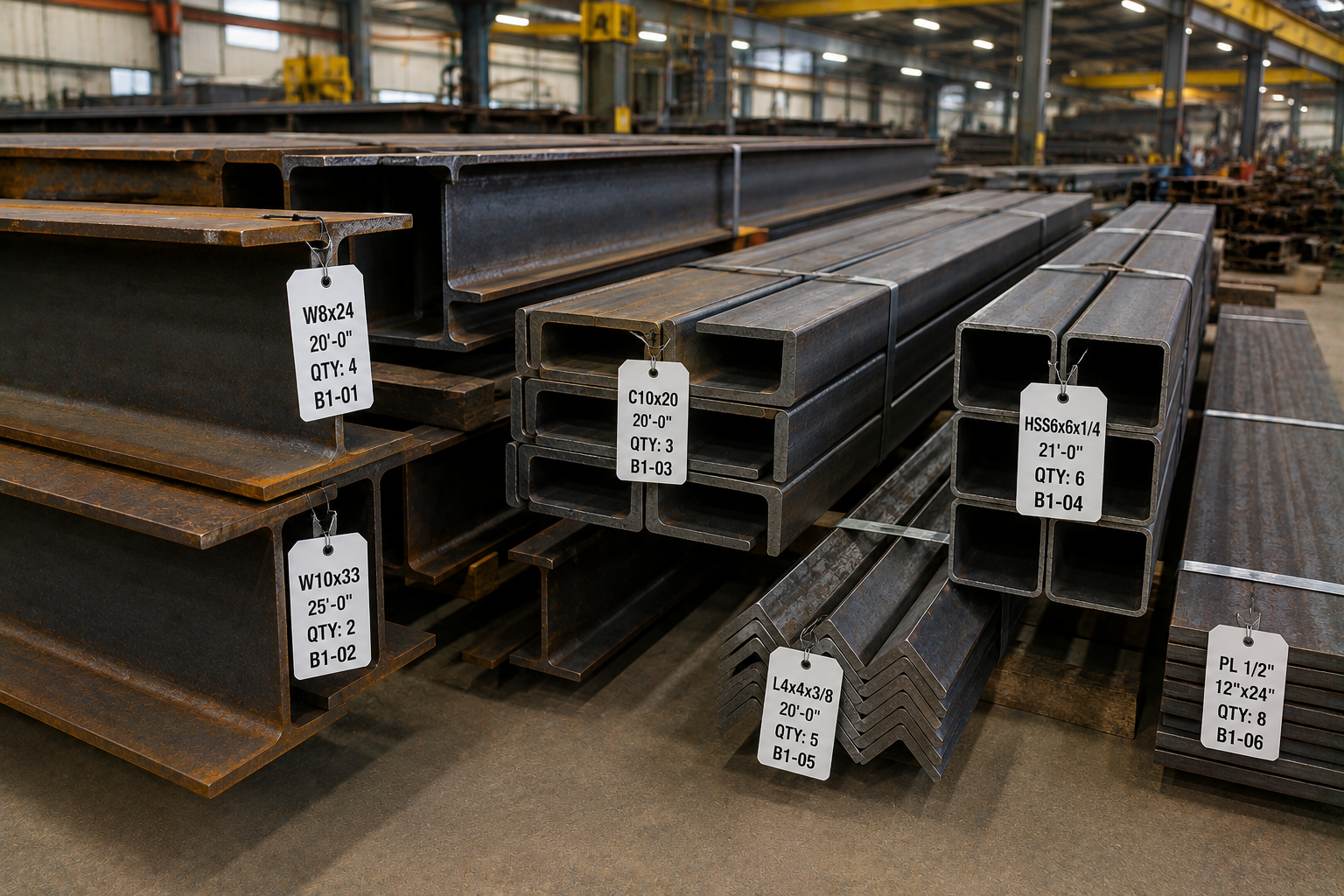
Structural Steel Weight vs Cross-Sectional Area
For constant steel density, weight is proportional to area.
Formula
Wlb/ft = Ain² × (490 ÷ 144) ≈ 3.4028 × Ain². For W12x26 (A = 7.65 in²): 3.4028 × 7.65 ≈ 26.03 lb/ft, matching the tabulated 26.0 lb/ft closely.
This is extremely useful for checking tabulated values, but use it as a cross-check, not as a replacement for current AISC shape weights.
Nominal Weight vs Actual Mill Weight
A critical technical section.
Structural shape designations and AISC tables use nominal or theoretical weight. Actual manufactured material may vary within ASTM tolerances. ASTM A6/A6M-24a specifically covers permitted variations in dimensions and mass for rolled structural steel shapes, plates, and bars.
| Type | Used For |
|---|---|
| Nominal weight | Design, reference, estimating, AISC shape designation, Code of Standard Practice calculations |
| Actual shipping/mill weight | May vary within permitted ASTM tolerances |
Do not imply every physical W12x26 piece will weigh exactly 26.000 lb/ft.
Structural Steel Weight Tolerances
Governed by ASTM A6/A6M-24a.
This covers dimensional tolerance, mass variation, and shape rolling tolerance. ASTM notes that “weight” is the inch-pound term, while “mass” is preferred in SI, and SI permitted variations may be rationalized rather than exact conversions. Full tolerance tables are not reproduced here since they are size and shape specific; consult the current standard directly for project-specific requirements.
✓ Verified against ASTM A6/A6M-24aWhy AISC Tabulated Weight Can Differ from Simple Geometry
An excellent educational distinction.
Differences arise because simplified geometry may ignore flange and web fillets, toe radii, rounded HSS corners, and actual standardized cross-sectional area. Calculating a channel as three sharp rectangles is only an approximation. For standard structural sections, current AISC tabulated weight is the reference value.
Weight of Steel Removed by Holes, Copes, and Cuts
A very useful fabrication-estimating distinction.
AISC 303-22 states weight deductions are not made for material removed for items such as drilling, punching, copes, clips, blocks, boring, slot milling, or weld preparation.
| Weight Type | Description |
|---|---|
| Physical finished weight | May be slightly lower due to material removed by fabrication |
| AISC Code-of-Standard-Practice weight | Calculated from nominal shape/plate dimensions without those deductions |
Structural Steel Weight vs Material Grade
Grade changes strength, not weight.
For ordinary carbon and low-alloy structural steels, design and estimating density is generally taken as the same 490 lb/ft³. So changing from A36 to A572 to A992 does not normally produce a meaningful structural estimating change in unit density. Grade changes strength, not the shape designation’s nominal unit weight. Alloy and stainless exceptions are outside the scope of this carbon structural-steel chart.
Structural Steel Weight vs Galvanized Weight
Useful but subordinate to the main content.
Galvanizing adds zinc coating mass, so finished galvanized product weight can exceed bare-steel nominal weight. But coating weight depends on coating thickness, surface area, galvanizing specification, and drainage or part geometry. This page does not state one universal percentage for galvanized weight gain.
Structural Steel Weight vs Concrete Weight
A useful construction comparison, kept concise.
Structural steel is much denser than concrete by unit volume, but structural steel members contain far less material volume than an equivalent concrete section because of shape efficiency. For concrete unit weight reference, see the Concrete Mix Ratio Chart.
Structural Steel Weight for Shipping, Lifting, and Erection
A practical use of the chart.
Weight matters for crane selection, rigging, truck loading, erection sequence, shop handling, and shipping.
Important
A weight chart does not establish lifting capacity or rigging requirements. Actual lift planning must consider center of gravity, rigging angle, dynamic effects, crane radius, and connection or lifting-point design.

AISC Shapes Database v16.0 as the Master Weight Source
The authoritative source section.
AISC v16.0 is consistent with the 16th Edition Steel Construction Manual, contains section dimensions and properties, includes 222 new shapes added in the 16th Edition, and provides both U.S. customary and metric units. For this page, the AISC v16.0 nominal weight column is the primary source for standard shape lb/ft values.
✓ Verified against AISC Shapes Database v16.0 (16th Edition Manual)AISC Code of Standard Practice Weight Rules
Arguably the page’s strongest standards section, using ANSI/AISC 303-22.
| Rule | Requirement |
|---|---|
| Unit weight of steel | 490 lb/ft³ (7,850 kg/m³) |
| Standard structural shapes | Nominal lb/ft × detailed overall length |
| Plates and bars | Detailed rectangular dimensions |
| Cuts, holes, copes, weld prep | No deductions for the Code’s weight-calculation method |
| Tabulated Manual weights | Use directly where available, rather than reconstructed estimates |
ASTM A6/A6M Weight and Dimensional Tolerances
The current active edition is ASTM A6/A6M-24a.
It governs common requirements for rolled structural shapes, bars, plates, and sheet piling, including permitted dimensional and mass variations. This section explains why nominal table weight does not equal a guaranteed exact scale weight, without reproducing the full tolerance tables here.
Common Structural Steel Weight Mistakes
Assuming 490 lb/ft³ is the same as lb/ft
Density and linear weight are different units entirely.
Confusing density with linear weight
Linear weight already accounts for cross-sectional area.
Reading W12x26 as 26-in. width
26 is nominal weight in lb/ft, not a dimension.
Reading C10x20 incorrectly
20 is nominal weight in lb/ft, not a second dimension.
Assuming angle designation contains weight
Angle designations describe geometry, requiring a table lookup for weight.
Assuming HSS designation contains weight
HSS designations describe outside dimensions and wall thickness only.
Confusing HSS and pipe
These use different dimensional and designation systems.
Recalculating standard shapes from sharp-corner geometry
Rolled fillets make simplified geometry only approximate.
Ignoring fillets and radii
These affect actual published area and weight.
Mixing lb/ft and kg/m
Always convert consistently using the exact factor.
Forgetting member length
Unit weight alone is not total weight.
Forgetting quantity
Total project weight requires multiplying by piece count.
Confusing nominal and actual scale weight
Actual manufactured weight can vary within ASTM tolerances.
Deducting every bolt hole from estimating weight
AISC 303 does not require these deductions for Code weight.
Using plate lb/ft when lb/ft² is required
Plate weight is an area-based unit, not linear.
Mixing plate thickness inches with feet
Convert thickness to feet before using the density formula.
Treating steel grade as a density change
Grade affects strength, not the reference density.
Using old AISC shape tables when v16.0 exists
Published weights can be revised between editions.
Assuming every published shape is stocked locally
Database listing does not guarantee availability.
Using structural weight alone for crane/rigging decisions
Lift planning requires more than total weight.
Structural Steel Weight Chart Limitations
Read before finalizing a material takeoff
AISC nominal shape weights are reference, design, and estimating values. Actual manufactured weight may vary within applicable tolerances. Standard shapes should use current tabulated AISC weights. Plate and bar weights are typically based on theoretical geometry. Galvanizing and coatings can add weight. Connection material, bolts, weld metal, deck, grating, and miscellaneous items must be added separately when estimating a whole project. Stock availability varies. Shipping and lift planning require more than total weight. Stainless, aluminum, and other alloys are outside a carbon structural-steel chart unless specifically included. Use current fabrication documents for final project takeoff.