Ready Mix Concrete Truck Load Chart – Capacity, Weight & Truckloads Needed
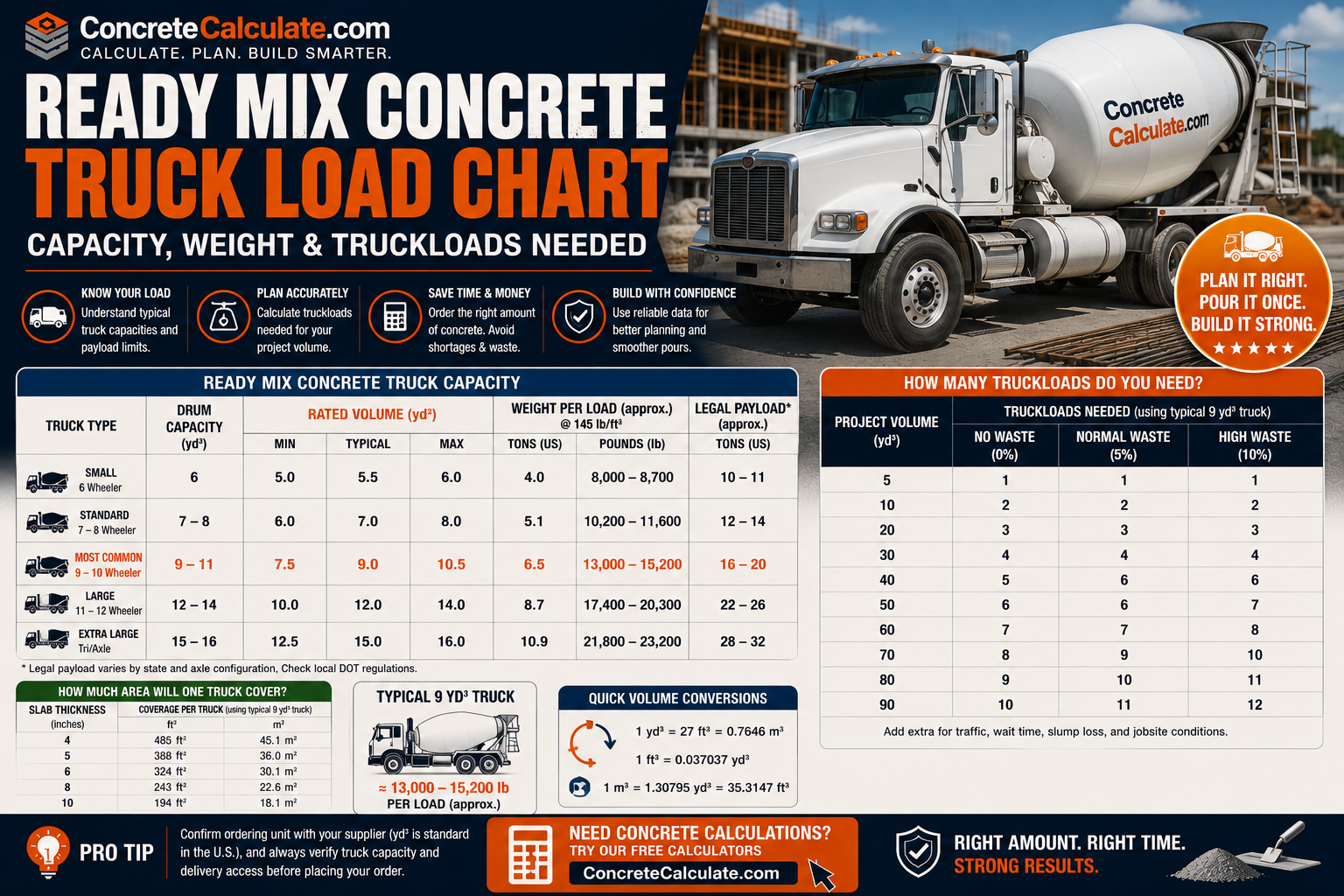
Ready Mix Concrete Truck Load Chart
Capacity, Weight & Truckloads Needed
How much a ready-mix truck actually carries, why rated capacity is not the same as legal payload, what a load weighs, and how many truckloads your project needs.
 Reviewed by Muhammad Ramzan Babar, PhD Researcher (Plasma Physics) & Calculator Developer, View Profile
There is no single universal truck load
NRMCA states that because of weight laws, the typical U.S. truck mixer is a 9 to 11 yd³ unit, but a recent NRMCA industry benchmark found an average actual delivered load of approximately 8.5 yd³. Rated capacity, legal payload, and actual delivered load are three different numbers. Always confirm the exact truck capacity with your ready-mix producer before finalizing an order.
Ready Mix Concrete Truck Load Chart, Quick Reference
NRMCA describes typical U.S. truck mixers as approximately 9 to 11 yd³ because legal payload depends heavily on truck configuration and weight regulations. Actual supplier loads may be smaller.
| Truck / Load Size | Cubic Yards | Cubic Feet | Approx. Cubic Meters | Approx. Weight* | Typical Context |
|---|---|---|---|---|---|
| 1 yd³ | 1 | 27 | 0.76 | ≈ 3,900 to 4,050 lb | Partial load |
| 3 yd³ | 3 | 81 | 2.29 | ≈ 11,700 to 12,150 lb | Short load |
| 5 yd³ | 5 | 135 | 3.82 | ≈ 19,600 to 20,250 lb | Partial load |
| 8 yd³ | 8 | 216 | 6.12 | ≈ 31,300 to 32,400 lb | Common delivered load |
| 9 yd³ | 9 | 243 | 6.88 | ≈ 35,200 to 36,450 lb | Typical mixer range |
| 10 yd³ | 10 | 270 | 7.65 | ≈ 39,150 to 40,500 lb | Common planning benchmark |
| 11 yd³ | 11 | 297 | 8.41 | ≈ 43,065 to 44,550 lb | Larger legal/configuration-dependent load |
*Weight is an estimate based on an assumed normalweight concrete density of 145 to 150 lb/ft³, not a fixed universal value. Actual weight depends on the specific mix.
Planning your next concrete project?
Plan concrete materials and project costs with our downloadable Excel estimator pack. For estimating only; follow applicable technical standards for design and installation.
One-time purchase · Digital downloadRated Capacity vs Typical Delivered Load
| Quantity | Meaning |
|---|---|
| Drum gross volume | Physical drum volume |
| Rated mixer capacity | Maximum concrete volume the drum is rated to mix |
| Legal payload | Amount that can legally be transported |
| Ordered quantity | Cubic yards purchased |
| Actual delivered load | Quantity dispatched on that trip |
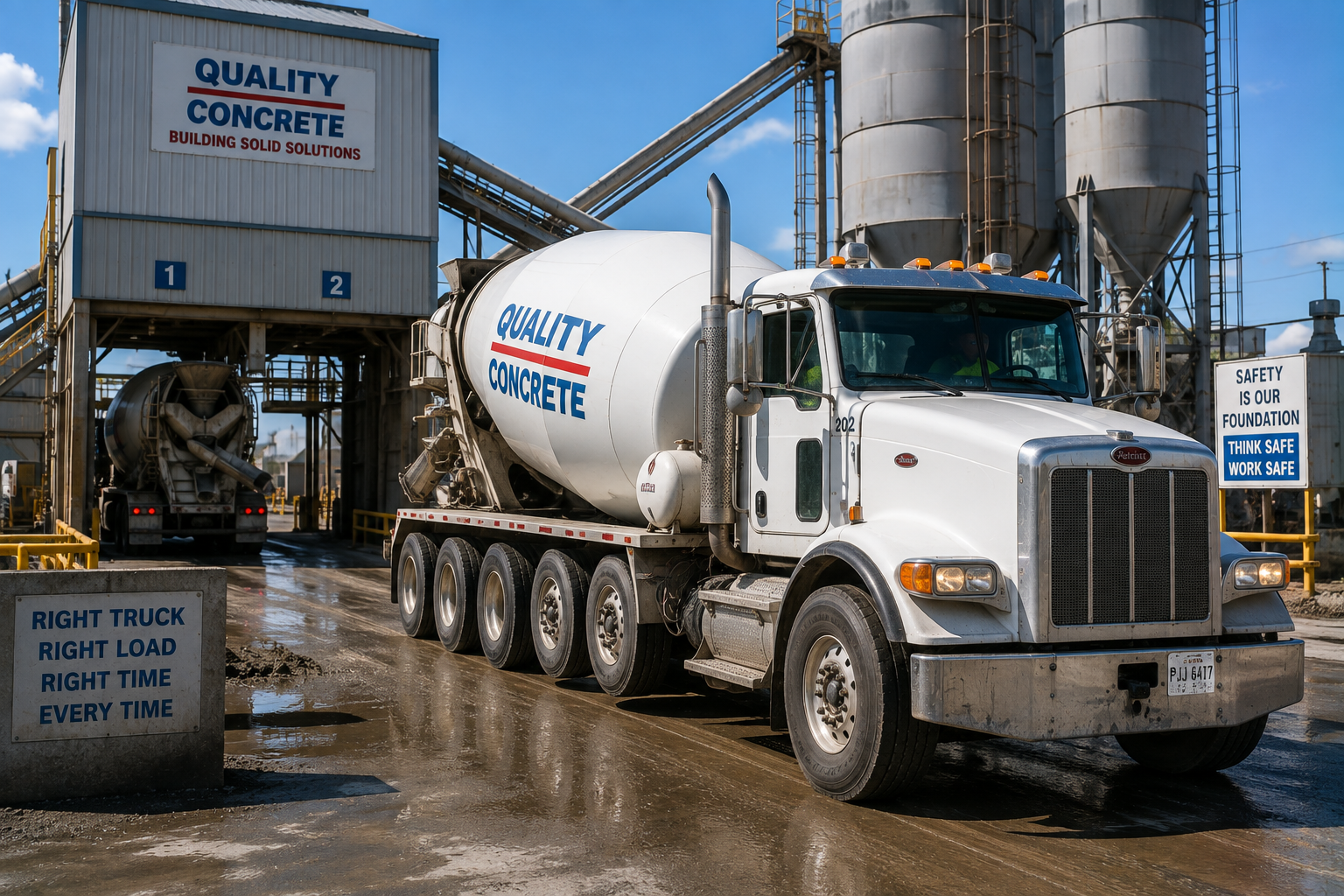
What Is a Ready-Mix Concrete Truck Load?
A truck load is the quantity of freshly mixed concrete transported on one mixer-truck delivery.
Ready-mix is normally ordered in cubic yards in the U.S. and cubic meters in metric markets. ASTM C94/C94M, the standard specification for ready-mixed concrete, covers ready-mixed concrete manufactured and delivered fresh and unhardened to the purchaser.
Load Size vs Truck Size
A truck capable of carrying 10 yd³ can deliver 4 yd³, 6 yd³, 8 yd³, or 10 yd³, subject to supplier policy and operating or legal constraints. Truck size and delivered load are not the same thing.
How Many Yards Does a Concrete Truck Hold?
A typical U.S. ready-mix truck mixer is approximately 9 to 11 yd³ rated capacity, but actual loads often fall below maximum capacity.
Is 10 Yards a Full Truck?
10 yd³ is a useful common planning benchmark, but not a universal standard. Rated capacity varies by truck and supplier fleet.
Can a Truck Carry 11 Yards?
Yes, some configurations can. ADVANCE currently offers a front-discharge mixer, the FDB7000, with a true 11 yd³ payload capacity in markets that follow Federal Bridge Formula weight standards, using a 7-axle configuration to reach that payload legally.
Can a Truck Carry Less Than Full Capacity?
Yes. Partial loads are common, though supplier minimums or short-load charges may apply.
Rated Drum Capacity vs Legal Concrete Payload
This distinction is essential to understanding why “how many yards does a truck hold” has no single answer.
NRMCA states that truck-mixer drums are designed with a rated maximum capacity of approximately 63% of gross drum volume when used as a mixer, and 80% of drum volume when used as an agitator. A drum’s physical size is therefore not the same as how many cubic yards can legally and properly be mixed and transported.
Mixer rating
The drum’s rated capacity as a mixer, below its full gross volume.
Chassis and axle count
More axles can allow a higher legal gross weight.
Tare weight
The truck’s own empty weight counts against the legal gross weight limit.
Concrete density
Denser mixes reach the legal weight limit sooner than lighter mixes.
State and federal weight laws
Legal payload is ultimately bounded by applicable weight regulations, not drum size alone.
Common Ready-Mix Truck Capacities
8-Yard Loads
A common partial or full operating load depending on the specific fleet and market.
9-Yard Loads
Sits inside NRMCA’s stated typical truck range of 9 to 11 yd³.
10-Yard Loads
A very common planning reference across the U.S. ready-mix industry.
10.5-Yard Mixers
ADVANCE currently lists front-discharge drum configurations at 10.5 yd³ among its Commander series options.
11-Yard Mixers
Available in certain axle and weight configurations, such as ADVANCE’s 7-axle FDB7000 built for Federal Bridge Formula markets.
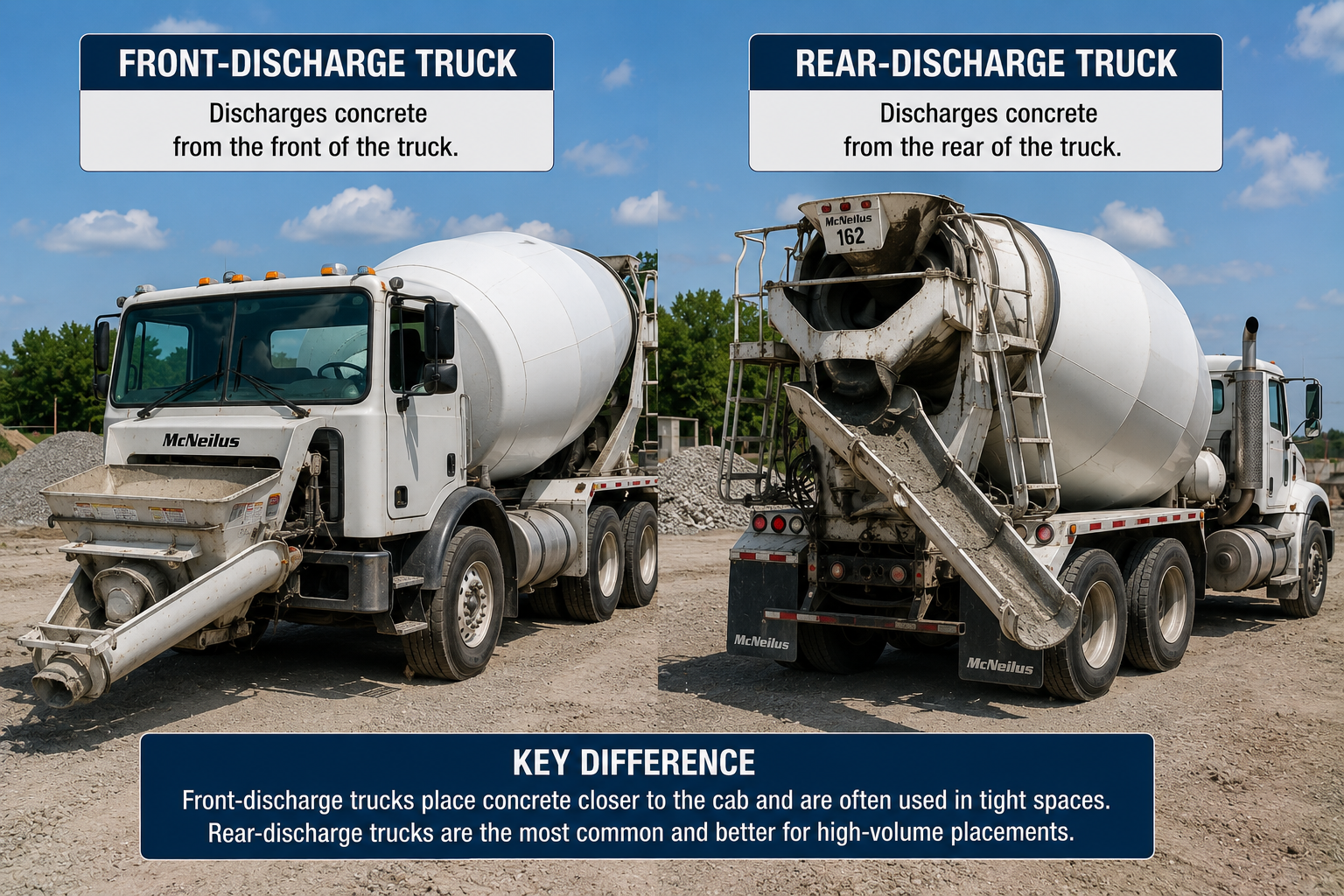
Front-Discharge vs Rear-Discharge Mixer Trucks
Two major configurations exist in the U.S. ready-mix fleet.
Rear-Discharge Mixer
The traditional U.S. configuration, discharging concrete from the rear of the truck.
Front-Discharge Mixer
Allows the driver to control chute positioning from the cab, often useful for maneuverability and driver-controlled placement.
Important
Discharge orientation does not by itself determine one fixed concrete capacity. Both front-discharge and rear-discharge trucks are available across a range of rated capacities.
Why Truck Capacity Varies
Number of axles
Additional axles distribute weight and can raise the legal gross vehicle weight.
Axle spacing
Wider axle spacing can increase the allowable weight under the Federal Bridge Formula.
Empty truck weight
A heavier chassis leaves less legal weight allowance for concrete payload.
Drum/chassis design
Different manufacturers rate mixer capacity differently for the same nominal drum size.
Concrete density
Denser mixes hit the weight limit before the volumetric limit.
State and federal weight limits
Applicable weight laws set the outer bound on legal payload.
This is a much more accurate framework than assuming every concrete truck carries exactly 10 yards.
Federal Bridge Formula and Concrete Truck Loads
An important standards and legal section for understanding legal payload.
FHWA states that Interstate vehicle weight is controlled not only by gross vehicle weight but also by axle limits, tandem limits, axle spacing, and the Federal Bridge Formula. Federal baseline limits under 23 U.S.C. 127 include 20,000 lb on a single axle, 34,000 lb on a tandem axle group, and 80,000 lb gross vehicle weight, subject to applicable exceptions and state provisions.
Why axle configuration matters
The Federal Bridge Formula allows a higher gross weight when weight is spread across more axles or greater axle spacing. This is why adding axles or increasing axle spacing can allow a mixer to carry a larger legal payload than a comparable truck with fewer or closer-spaced axles.
These are federal baseline values. State and local weight rules can differ from federal baseline rules, so do not present federal values as the only legal limits in every jurisdiction.
Concrete Weight per Truck Load
Truck payload is controlled partly by concrete density.
For normalweight concrete, planning estimates often use roughly 145 to 150 lb/ft³, but this is not a fixed universal value; actual density depends on the specific mix design.
Formula
W = V × ρ, where W is concrete weight, V is concrete volume, and ρ is concrete density.
Weight per Cubic Yard
At 150 lb/ft³: 150 × 27 = 4,050 lb/yd³. This is clearly an illustrative normalweight assumption, not a fixed universal value.
Why Lightweight or Heavyweight Concrete Changes Payload
A denser mix may cause a truck to hit legal weight limits before reaching its nominal volumetric capacity, meaning weight, not volume, becomes the limiting factor.
Concrete Truck Load Weight Chart
| Load | Concrete Volume | Approx. Weight at 145 lb/ft³ | Approx. Weight at 150 lb/ft³ |
|---|---|---|---|
| 5 yd³ | 135 ft³ | 19,575 lb | 20,250 lb |
| 6 yd³ | 162 ft³ | 23,490 lb | 24,300 lb |
| 7 yd³ | 189 ft³ | 27,405 lb | 28,350 lb |
| 8 yd³ | 216 ft³ | 31,320 lb | 32,400 lb |
| 9 yd³ | 243 ft³ | 35,235 lb | 36,450 lb |
| 10 yd³ | 270 ft³ | 39,150 lb | 40,500 lb |
| 11 yd³ | 297 ft³ | 43,065 lb | 44,550 lb |
Empty Truck Weight vs Loaded Truck Weight
Gross vehicle weight equals empty truck weight plus concrete payload plus any other carried materials.
Factors influencing empty truck weight include the chassis, drum, water tank, fuel, axles, and accessories. This page does not assign one universal empty-weight figure, since it varies significantly by manufacturer and configuration.
The real question
The legal question is not simply “how heavy is a concrete truck,” but “how is that weight distributed across the truck’s axle configuration,” since axle-group weight limits, not just total weight, govern legal operation.
Average Actual Ready-Mix Load Size
An important real-world differentiator.
NRMCA’s industry benchmarking data show an average delivered load size of approximately 8.5 yd³ among surveyed operations, which is meaningfully below the 9 to 11 yd³ typical rated mixer range. Rated capacity and typical delivered load are not the same thing.
Partial orders
Many projects legitimately need less than a full truck.
Legal weight constraints
Weight limits can cap a load before it reaches rated volume.
Mix density
Denser mixes reduce the volume that can be legally carried.
Dispatch optimization
Producers balance multiple orders and routes across a fleet.
Final cleanup/top-off loads
Smaller loads finish a pour without excess material.
Project timing and supplier policy
Scheduling and individual supplier practices also shape actual load size.
This prevents the common assumption that rated capacity equals every actual load.
Full Load vs Partial Load
| Term | Definition |
|---|---|
| Full load | At or near the truck/supplier’s permitted rated capacity |
| Partial load | Below truck capacity |
A partial truck does not mean the drum must be physically full to operate correctly. Commercial pricing, however, may make a partial load more expensive per cubic yard.
Short Loads and Minimum Concrete Orders
There is no universal national minimum.
As one supplier example, Otsego Ready Mix states it will deliver as little as 3 yd³, but applies a short-load fee to orders under 7 yd³. This illustrates why minimum delivered quantity, minimum billed quantity, and short-load-fee threshold are three different supplier policies. Never present a single figure, such as 4 or 5 yards, as a universal threshold.
Short-Load Fee vs Minimum Order
| Policy | Definition |
|---|---|
| Minimum delivered quantity | Smallest physical load the supplier will dispatch |
| Minimum billed quantity | Minimum quantity used for billing |
| Short-load threshold | Quantity below which a surcharge is added |
These can all be different numbers from the same supplier. This distinction is very useful for homeowners ordering small pours, since a low minimum delivered quantity does not necessarily mean a low short-load fee threshold. For delivery cost context, see the concrete delivery cost calculator.
How Many Truckloads Do I Need?
Core formula for planning multi-load pours.
Formula
Ntrucks = ceiling(Vorder ÷ Ctruck), where Vorder is the concrete order in yd³ and Ctruck is the confirmed truck capacity.
Example: 23 yd³ with a Confirmed 10-yd Truck
Use the concrete ready mix truck calculator to run this calculation directly.
Concrete Truckloads by Project Volume
A flagship estimating table across common truck sizes.
| Concrete Needed | 8-yd Truck | 9-yd Truck | 10-yd Truck | 11-yd Truck |
|---|---|---|---|---|
| 5 yd³ | 1 | 1 | 1 | 1 |
| 8 yd³ | 1 | 1 | 1 | 1 |
| 10 yd³ | 2 | 2 | 1 | 1 |
| 15 yd³ | 2 | 2 | 2 | 2 |
| 20 yd³ | 3 | 3 | 2 | 2 |
| 25 yd³ | 4 | 3 | 3 | 3 |
| 30 yd³ | 4 | 4 | 3 | 3 |
| 40 yd³ | 5 | 5 | 4 | 4 |
| 50 yd³ | 7 | 6 | 5 | 5 |
How Much Area Does One Truckload Cover?
Coverage depends on load volume and slab thickness.
For a 10 yd³ load, that is 270 ft³. At thickness T in inches: A = (12 × 270) ÷ T. Full coverage tables live on the Concrete Coverage Chart.
10-Yard Truck Coverage (Theoretical Geometric Coverage)
| Slab Thickness | Approx. Area from 10 yd³ |
|---|---|
| 2 in. | 1,620 ft² |
| 3 in. | 1,080 ft² |
| 4 in. | 810 ft² |
| 5 in. | 648 ft² |
| 6 in. | 540 ft² |
| 8 in. | 405 ft² |
These values are pure volume conversions before any ordering allowance.
Equipment for Your Project
Affiliate disclosure: As an Amazon Associate, ConcreteCalculate earns from qualifying purchases. We may also earn a commission from other affiliate links at no additional cost to you.
Truckload Coverage by Load Size and Thickness
| Load | 3 in. | 4 in. | 5 in. | 6 in. |
|---|---|---|---|---|
| 8 yd³ | 864 ft² | 648 ft² | 518 ft² | 432 ft² |
| 9 yd³ | 972 ft² | 729 ft² | 583 ft² | 486 ft² |
| 10 yd³ | 1,080 ft² | 810 ft² | 648 ft² | 540 ft² |
| 11 yd³ | 1,188 ft² | 891 ft² | 713 ft² | 594 ft² |
Truckloads for Slabs, Driveways, Patios, and Footings
Slabs and Garage Floors
Use the concrete slab calculator to find volume before determining truck count.
Driveways
See the concrete driveway calculator for driveway-specific volume.
Patios and Walkways
See the concrete patio calculator.
Footings and Foundations
See the concrete footing calculator and concrete foundation calculator.
Walls and Larger Structural Pours
Total calculated volume determines truck count for larger structural pours.
Key point
Project type does not determine truck count. Calculated volume and confirmed truck capacity do. Avoid treating any single slab-thickness recommendation as universal here.
How to Calculate Concrete Volume Before Ordering Trucks
Kept brief, since your calculators own the full calculation.
Formulas
For rectangular concrete: V(ft³) = L × W × T. Then V(yd³) = V(ft³) ÷ 27. If thickness is in inches: V(yd³) = (L(ft) × W(ft) × T(in)) ÷ 324.
Use the concrete volume calculator or concrete calculator for the full calculation across shapes.
Theoretical Volume vs Order Quantity
These are separate quantities.
| Quantity | What It Represents |
|---|---|
| Theoretical volume | Pure geometric concrete volume from dimensions |
| Planning/order volume | May include justified additional quantity for uneven subgrade, over-excavation, form tolerances, placement losses, or unresolved geometry |
Do not impose one universal waste percentage; the correct allowance depends on site conditions.
Final Partial Truck / Cleanup Load
Large pours rarely divide perfectly by truck capacity.
Example: 26 yd³ with 10-yd Capacity
Why the Last Load Matters
Considerations include avoiding excess concrete, avoiding a costly second or top-up dispatch, potential short-load fees, and maintaining pour continuity.
Ready-Mix Truck Scheduling for Multi-Load Pours
Number of trucks is only part of planning.
Plant-to-site travel time
Distance and route affect how quickly successive loads arrive.
Unloading duration
Discharge time per truck affects overall pour pace.
Pump/chute placement rate
Placement method controls how fast concrete can actually go into the forms.
Crew finishing capacity
The crew must keep pace with finishing before concrete sets.
Traffic and plant queue
Both site traffic and plant dispatch queues affect delivery timing.
This page does not create universal truck-spacing minutes; the ready-mix supplier and contractor should coordinate delivery intervals directly.
Truck Discharge Rate and Placement Method
Delivery methods include direct chute, concrete pump, conveyor, buggy or Georgia buggy, and crane bucket on some projects.
Not all trucks discharge at one fixed rate. Placement rate depends on slump and workability, truck design, chute arrangement, whether a pump is used, crew size, and site conditions.
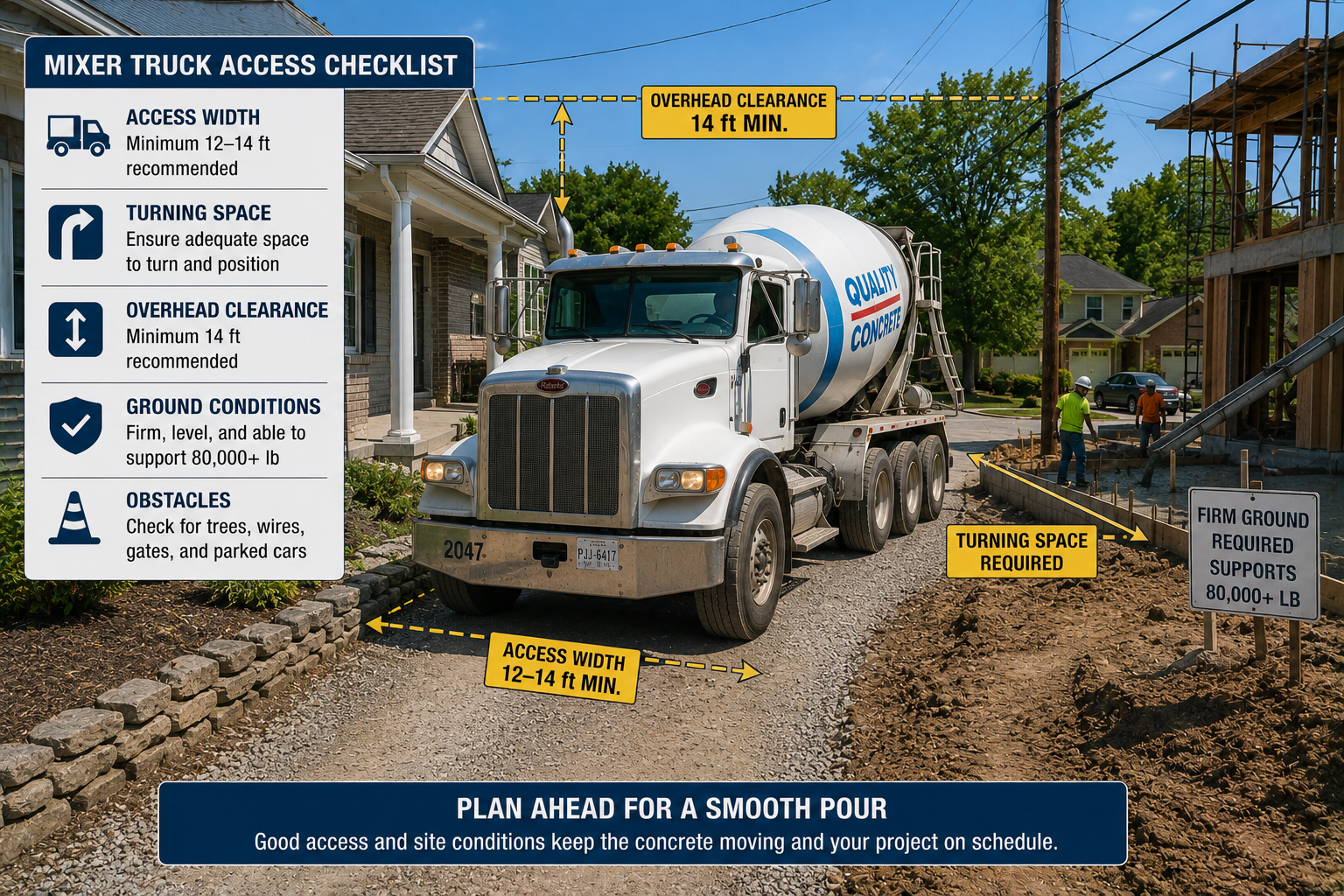
Site Access for a Loaded Concrete Truck
A very important practical section.
Driveway strength and subgrade
Soft or weak subgrade may not support a loaded mixer’s weight.
Turning radius
Large trucks need adequate space to maneuver.
Overhead wires and trees
Clearance must accommodate the truck’s height.
Gates, steep grades, and bridges/culverts
Access features must be checked against the truck’s dimensions and weight.
Underground utilities and septic systems
A heavy loaded mixer can damage buried infrastructure if driven over it.
Do not assume access is safe
Because a loaded mixer can be extremely heavy, do not assume a residential driveway or yard can support it without verification. This page does not give one universal road-width number, since access requirements vary by truck and site.
Direct Truck Discharge vs Pump Placement
| Method | When Used |
|---|---|
| Direct truck discharge | When the mixer can safely approach the forms |
| Pump placement | When access, reach, elevation, reinforcement congestion, or placement sequence makes direct truck access unsuitable |
Truck capacity does not necessarily change just because concrete is pumped, but site logistics do. For pumping cost context, see the concrete pumping guidance in your project planning resources.
Returned Concrete and Overordering
Potential consequences of ordering too much concrete.
Returned concrete
Unused concrete may need to be returned to the plant.
Disposal or recycling
Excess hardened or returned concrete requires proper handling.
Supplier charges
Some suppliers charge for returned or unused concrete.
Site washout issues
Truck washout requires proper environmental handling on site.
Deliberate significant overordering is not encouraged as a substitute for accurate estimating.
Concrete Truck Load and Mix Type
The same truck may not carry the same volume of every concrete mix.
Relevant variables include normalweight concrete, lightweight concrete, heavyweight concrete, high-density mixtures, large aggregate, and specialty mixes. For denser mixes, the limiting condition may become legal weight capacity before rated volumetric capacity is reached. This is a key technical point that prevents overestimating how much a truck can deliver for a heavier-than-normal mix.
ASTM C94/C94M and Ready-Mix Delivery Requirements
ASTM C94/C94M is the active standard specification for ready-mixed concrete, covering production and delivery through truck mixers and truck agitators.
What ASTM C94/C94M Covers
Production, materials, batching, truck mixing and agitation, purchaser requirements, and testing. The standard also addresses discharge timing: since the 2021 edition, ASTM C94/C94M no longer specifies a fixed universal 90-minute discharge rule. Instead, the purchaser states a time limit for completing discharge, or the producer establishes and communicates that limit if the purchaser does not, with the agreed limit recorded on the delivery ticket.
What ASTM C94/C94M Does Not Cover
ASTM C94/C94M explicitly does not cover placement, consolidation, curing, or protection of the concrete after delivery. That distinction adds authority to this page, since truck load and delivery are governed by a different scope than post-delivery construction practice.
NRMCA Guidance on Ready-Mix Trucks
| NRMCA Finding | Detail |
|---|---|
| Typical truck mixer size | 9 to 11 yd³, due to weight laws |
| Mixer capacity vs drum volume | Rated at approximately 63% of gross drum volume as a mixer, 80% as an agitator |
| Loading practice | Producers normally load trucks at or near rated mixer capacity |
| Concrete perishability | Concrete remains a fresh, perishable product during delivery |
| Average actual load | Approximately 8.5 yd³ per NRMCA industry benchmarking, below nominal fleet capacity |
Common Ready-Mix Truck Load Mistakes
Saying every truck holds exactly 10 yd³
Rated capacity varies significantly by truck and fleet.
Confusing drum gross volume with rated mixer capacity
Rated capacity is approximately 63% of gross drum volume as a mixer.
Confusing rated capacity with legal payload
Weight laws, not just drum rating, ultimately bound legal payload.
Ignoring truck tare weight
Empty truck weight reduces the legal weight available for concrete.
Ignoring concrete density
Denser mixes reach weight limits before volume limits.
Ignoring axle/bridge weight laws
Legal payload depends on axle configuration under the Federal Bridge Formula.
Treating 11 yd³ as legal everywhere
That payload depends on specific truck configuration and jurisdiction.
Assuming every supplier uses the same trucks
Fleet composition varies by ready-mix producer.
Assuming every actual load is full
NRMCA benchmarking shows average loads below nominal capacity.
Confusing cubic yards with cubic feet
These are different volume units requiring correct conversion.
Forgetting 1 yd³ equals 27 ft³
A frequent source of volume-conversion errors.
Calculating trucks before calculating project volume
Volume must be established first, then truck count follows.
Applying one arbitrary waste percentage universally
Justified allowances depend on actual site conditions.
Confusing short-load threshold with minimum delivered quantity
These are separate supplier policies that can differ.
Ignoring the final partial load
The last load in a multi-load pour may carry different pricing.
Failing to coordinate truck spacing
Delivery intervals need direct coordination with the supplier and crew.
Assuming a truck can safely drive onto a residential slab or yard
Ground support and access must be verified first.
Ignoring overhead, turning, and access restrictions
Site logistics affect whether a delivery can proceed as planned.
Assuming lightweight and heavyweight concrete have identical payload limits
Density directly changes the legal weight-based payload.
Using an outdated ASTM C94 delivery reference
The discharge-time rule changed starting with the 2021 edition; always check the current edition.
Ready Mix Concrete Truck Load Chart Limitations
Read before ordering
Truck capacity varies by manufacturer and configuration. Supplier fleet capacity varies. Legal payload varies by axle configuration and jurisdiction. State and local weight rules can differ from federal baseline rules. Rated mixer capacity does not guarantee that volume can legally be carried. Concrete density affects payload. A partial load may trigger commercial fees. Minimum order and short-load thresholds are supplier-specific. Truckload coverage depends on concrete thickness. Jobsite access must be verified independently. Truck count does not by itself establish a delivery schedule. Project volume and allowance must be calculated before ordering. Final dispatch quantities should be confirmed directly with the ready-mix producer.