Concrete Screw Size Chart – Diameter, Drill Bit, Length and Embedment
Concrete Screw Size ChartDiameter, Drill Bit, Length and Embedment
Drill-bit sizes, lengths, embedment and fixture thickness for small Tapcon screws and heavy-duty screw anchors, with the product-specific rules that decide each one.
 Reviewed by Muhammad Ramzan Babar, PhD Researcher (Plasma Physics) & Calculator Developer | View Profile
Quick Answer: Identify the Anchor Family Before You Pick a Bit
- Tapcon 3/16 in. uses a 5/32 in. bit and 1/4 in. uses a 3/16 in. bit, with at least 1 in. embedment.
- Simpson Titen HD and Hilti KH-EZ use a hole equal to the anchor diameter, so a 1/4 in. heavy-duty anchor takes a 1/4 in. bit.
- Screw length is fixture thickness plus embedment; load capacity cannot be read from screw diameter.
Concrete Screw Size Chart
Two product families, two sets of rules.
Concrete screws are not one product. Small-diameter tapping screws (Tapcon) and larger structural screw anchors (Titen HD, Hilti KH-EZ, DEWALT Screw-Bolt+) have different drill-bit rules, so pick the product family first, then the diameter.
Small-diameter concrete screws
| Anchor diameter | Required drill bit | Minimum embedment | Cited embedment range | Phillips bit | Hex driver |
|---|---|---|---|---|---|
| 3/16 in. | 5/32 in. | 1 in. | 1 to 1-3/4 in. | #2 | 1/4 in. |
| 1/4 in. | 3/16 in. | 1 in. | 1 to 1-3/4 in. | #3 | 5/16 in. |
The pilot hole is smaller than the anchor diameter for these Tapcon products. Do not extrapolate this to heavy-duty screw anchors. 1 in. = 25.4 mm, so 1 in. embedment is 25.4 mm.
Heavy-duty screw anchors
| Anchor diameter | Hole diameter | Hex wrench size | Min. hole-depth overdrill |
|---|---|---|---|
| 1/4 in. | 1/4 in. | 3/8 in. | 1/8 in. |
| 3/8 in. | 3/8 in. | 9/16 in. | 1/4 in. |
| 1/2 in. | 1/2 in. | 3/4 in. | 1/2 in. |
| 5/8 in. | 5/8 in. | 15/16 in. | 1/2 in. |
| 3/4 in. | 3/4 in. | 1-1/8 in. | 1/2 in. |
For Titen HD the hole equals the anchor diameter (Dhole = Danchor). That relationship is product specific and must not be applied to the Tapcon table.
How to use the chart
Find your product family, then your diameter, then read the bit, embedment and drive size. If you do not know the product, read the print on the package or the head stamp before drilling.
What Is a Concrete Screw?
A threaded post-installed anchor.
A concrete screw is a post-installed mechanical fastener that develops anchorage through thread interaction with the base material. The threads cut or interlock with the hole wall.
- Wood and drywall screws: not designed to cut masonry threads.
- Lag screws: need a separate anchor or sleeve in concrete.
- Expansion, wedge and sleeve anchors: work by expansion rather than thread cutting.
- Adhesive anchors: bond with resin.
Not all concrete screws share thread geometry or qualification. For cast-in bolts see the Anchor Bolt Size Chart, and for general screw dimensions see the Screw Size Chart.
Concrete Screw Sizes Explained
Diameter, length, embedment and the terms in between.
Seven terms define a concrete screw selection.
Diameter
Nominal anchor diameter, such as 3/16, 1/4 or 3/8 in.
Length
Overall length by the manufacturer’s definition.
Head style
Hex washer, flat Phillips or star, and others.
Drive size
The Phillips bit, hex or socket that turns the screw.
Pilot-hole diameter
The drill bit diameter specified for that product.
Embedment and fixture thickness
How deep the screw goes and what it fastens.
Small screws are 3/16 and 1/4 in. Heavy-duty screw anchors in the cited Titen HD and KH-EZ lines run 1/4, 3/8, 1/2, 5/8 and 3/4 in.
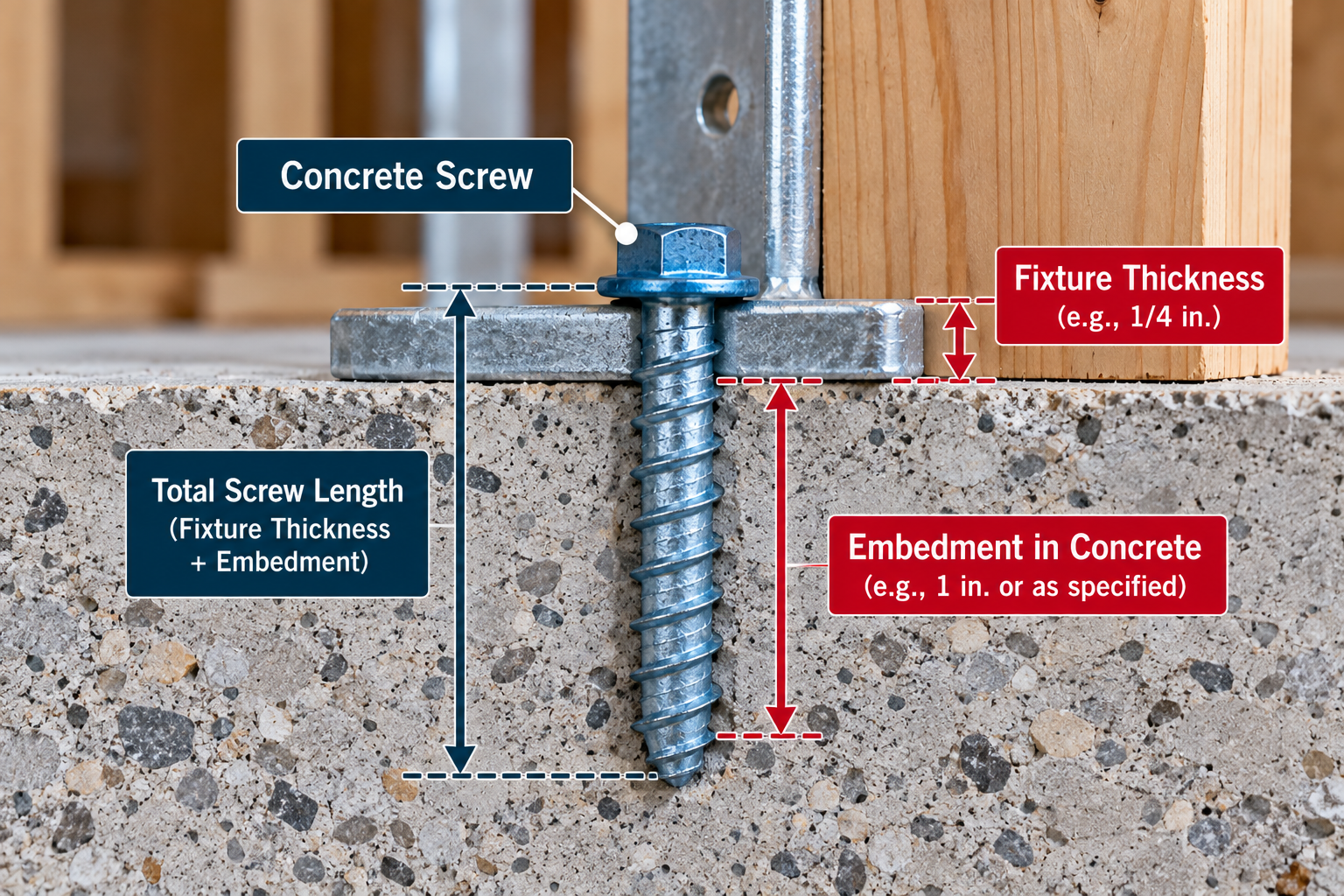
Figure 1. Concrete screw anatomy: fixture thickness, embedment, effective embedment, hole depth and overall length.
3/16-Inch Concrete Screw Size
Tapcon pilot, embedment and drive.
3/16-in. Tapcon
5/32 in. bit
Minimum embedment 1 in. (range 1 to 1-3/4 in.).
Drive: #2 Phillips or 1/4 in. hex.
Lengths
Tapcon 3/16 in. screws range from 1-1/4 to 4 in. in the manufacturer’s catalog; the exact lengths depend on head style and product.
Use the Tapcon carbide bit sold for the anchor. Tapcon states its system bits are made to tighter tolerances than standard ANSI bits.
1/4-Inch Concrete Screw Size
The strongest example of why the product matters.
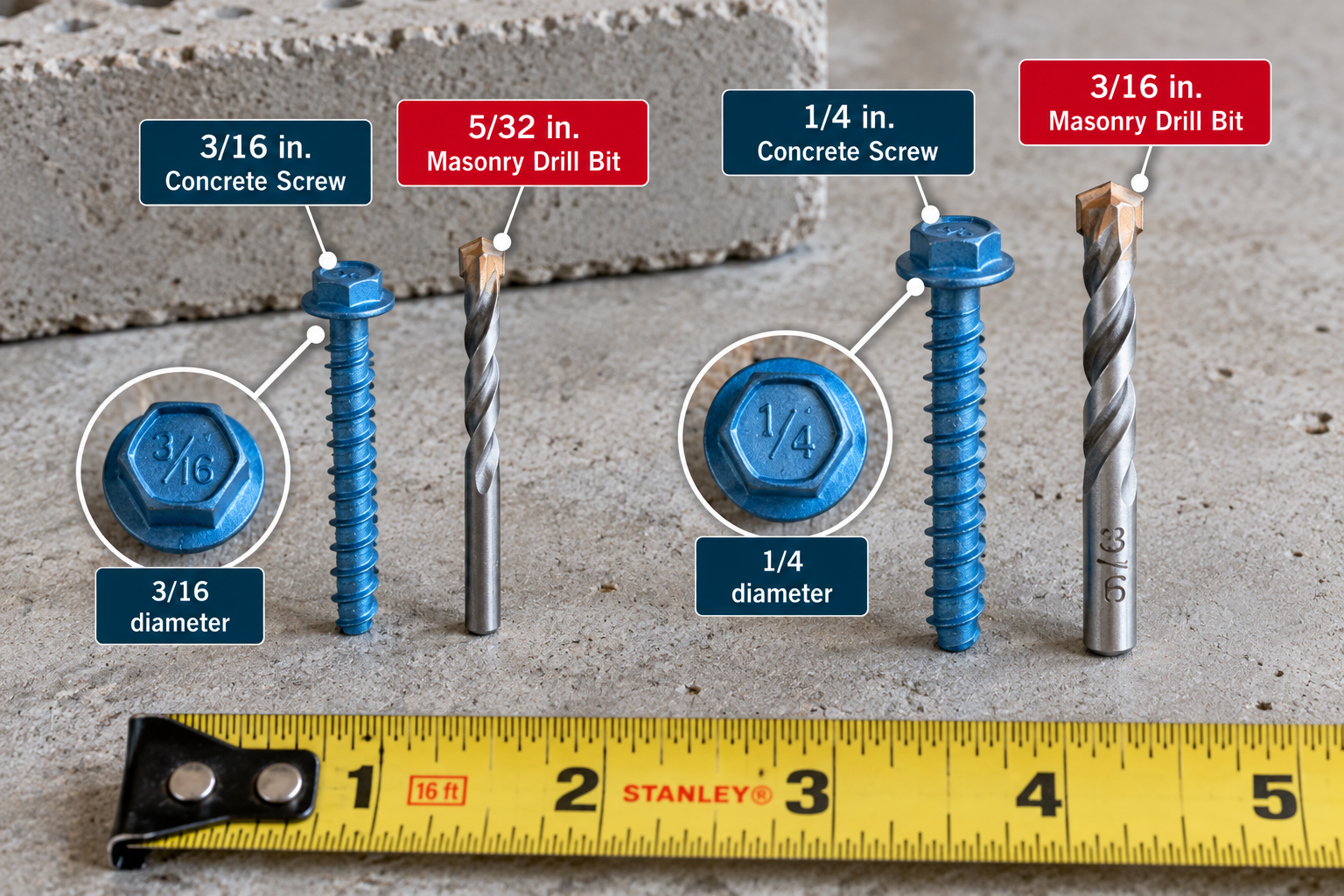
The phrase “1/4-inch concrete screw” does not tell you the bit. It depends on the product.
| Product | Anchor diameter | Bit / hole |
|---|---|---|
| Tapcon | 1/4 in. | 3/16 in. bit |
| Simpson Titen HD | 1/4 in. | 1/4 in. hole |
| Hilti KH-EZ | 1/4 in. | 1/4 in. nominal bit |
1/4-inch Tapcon
Pilot bit 3/16 in.; drive #3 Phillips or 5/16 in. hex.
1/4-inch heavy-duty screw anchors
Titen HD uses a 1/4 in. hole and a 3/8 in. wrench. Hilti lists a 1/4 in. nominal bit for KH-EZ.
Figure 2. A 1/4 in. Tapcon and a 1/4 in. Titen HD need different holes.
3/8-, 1/2-, 5/8- and 3/4-Inch Concrete Screw Anchors
Heavy-duty anchors use their own rules.
From 3/8 in. up, the cited products are heavy-duty screw anchors. Do not extrapolate the Tapcon small-diameter relationship.
- 3/8 in.: Titen HD 3/8 in. hole and 9/16 in. wrench; Hilti 3/8 in. nominal bit.
- 1/2 in.: Titen HD 1/2 in. hole and 3/4 in. wrench; Hilti 1/2 in. nominal bit.
- 5/8 and 3/4 in.: Titen HD 5/8 in. (15/16 in. wrench) and 3/4 in. (1-1/8 in. wrench); Hilti 5/8 and 3/4 in. nominal bits.
Larger anchors usually need more embedment, larger minimum concrete dimensions and base plates. They are common in structural attachments, and seismic use applies only where evaluated. Embedment and length come from the exact product configuration. For bolt dimensions see the U.S. Bolt Sizes Chart.
Concrete Screw Drill Bit Size Chart
Tapcon pilot bits and heavy-duty anchor bits.
Tapcon pilot bits
3/16 in. anchor: 5/32 in. bit. 1/4 in. anchor: 3/16 in. bit. Both are undersized because the screw cuts its own threads.
Heavy-duty anchor bits
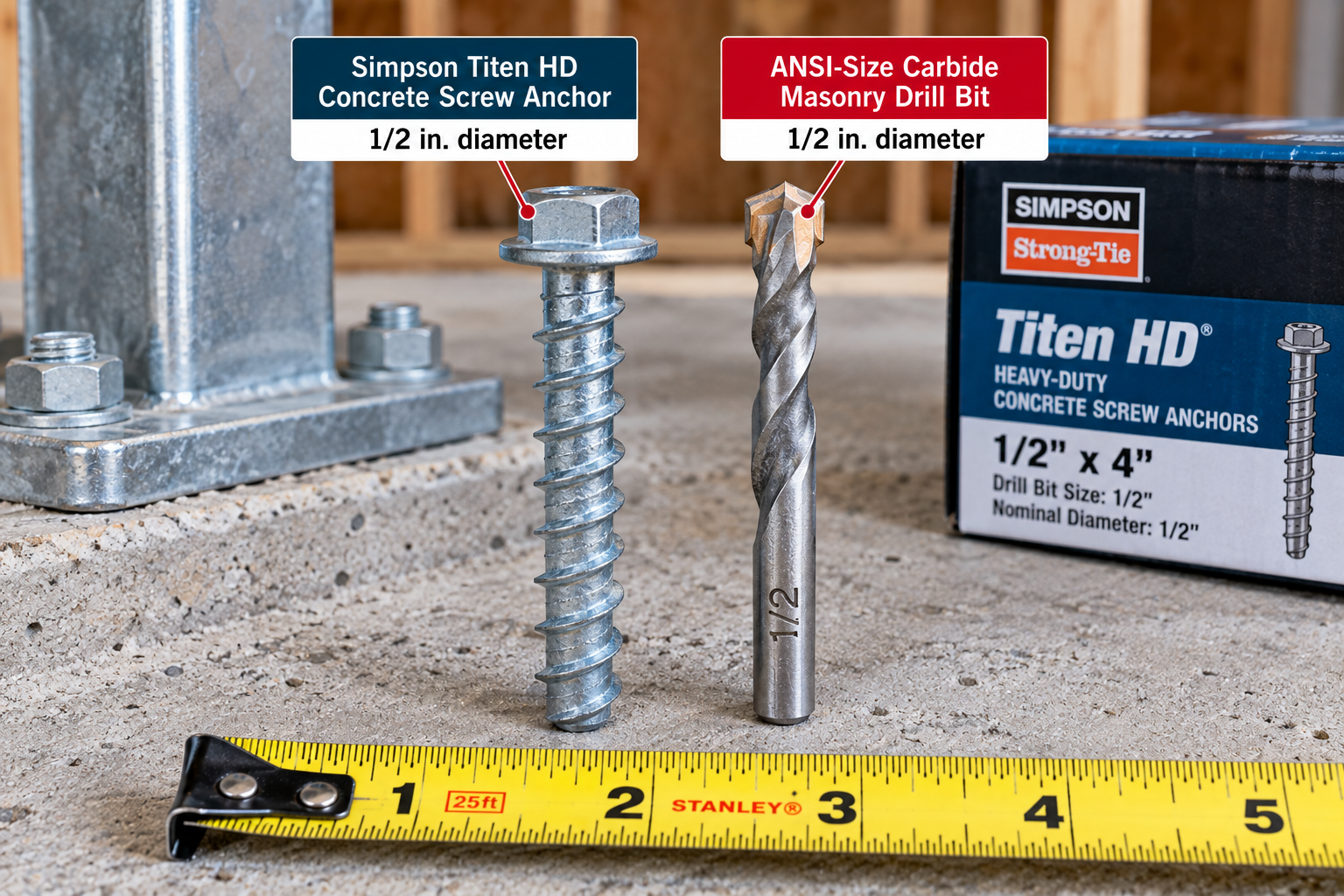
Titen HD and KH-EZ use a carbide bit equal to the nominal anchor diameter, and both are designed for standard ANSI-tolerance bits.
| Nominal diameter | Simpson Titen HD hole | Hilti KH-EZ nominal bit |
|---|---|---|
| 1/4 in. | 1/4 in. | 1/4 in. |
| 3/8 in. | 3/8 in. | 3/8 in. |
| 1/2 in. | 1/2 in. | 1/2 in. |
| 5/8 in. | 5/8 in. | 5/8 in. |
| 3/4 in. | 3/4 in. | 3/4 in. |
Sources: Simpson Strong-Tie and Hilti technical data. Same nominal diameter does not mean the same pilot-hole requirement; compare with the Tapcon table above.
For general bit sizes use the Drill Bit Size Chart, but follow the anchor manufacturer’s specified carbide bit, which overrides any general chart.
Why Concrete Screw and Drill-Bit Diameters Differ
Thread cutting versus thread interlock.
The thread design sets the hole. A tapping screw such as Tapcon cuts its own thread into a smaller pilot hole, so the hole is smaller than the nominal diameter.
The cited heavy-duty anchors are designed to interlock with a hole equal to the nominal diameter. Simpson warns that oversized holes can reduce or eliminate proper thread interlock and reduce anchor capacity.
Never choose a masonry bit from a generic screw-diameter rule. For other pilot-hole situations, such as wood, see the Pilot Hole Size Chart.
Concrete Screw Length Chart
Length, fixture, embedment and bit length.
This is the Tapcon manufacturer’s guide for its 3/16 and 1/4 in. anchors. It links screw length, fixture thickness, embedment and the bit length needed.
| Anchor length | Fixture thickness (min to max) | Anchor embedment (min to max) | Drill-bit length |
|---|---|---|---|
| 1 to 1-1/4 in. | 0 to 1/4 in. | 1 to 1-1/4 in. | 3-1/2 in. |
| 1-1/2 to 1-3/4 in. | 0 to 3/4 in. | 1 to 1-3/4 in. | 3-1/2 in. |
| 2 to 2-1/2 in. | 1/2 to 1-1/4 in. | 1 to 1-3/4 in. | 4-1/2 in. |
| 2-3/4 to 3 in. | 1 to 1-3/4 in. | 1 to 1-3/4 in. | 4-1/2 in. |
| 3-1/4 to 3-3/4 in. | 2 to 2-3/4 in. | 1 to 1-3/4 in. | 5-1/2 in. |
| 4 to 4-1/4 in. | 2-1/4 to 3 in. | 1 to 1-3/4 in. | 5-1/2 in. |
Do not use this table for Simpson Titen HD, Hilti KH-EZ, DEWALT Screw-Bolt+ or other families. Exact length availability varies by head style and product configuration.
- Screw length is not embedment.
- Hole depth is deeper than embedment.
- The bit length must be long enough to drill the full hole depth.
How to Choose Concrete Screw Length
Fixture thickness plus embedment.
Length formula
- L = required anchor length (in.)
- tf = fixture thickness (in.)
- hnom = required nominal embedment (in.)
3/4 in. Fixture
What it means: A 1-3/4 in. anchor satisfies the simplified relationship if that exact product permits the intended base material, embedment and application.
| Fixture thickness | Required embedment | Calculated minimum screw length |
|---|---|---|
| 1/4 in. | 1 in. | 1-1/4 in. |
| 1/2 in. | 1 in. | 1-1/2 in. |
| 3/4 in. | 1 in. | 1-3/4 in. |
| 1 in. | 1 in. | 2 in. |
| 1-1/2 in. | 1 in. | 2-1/2 in. |
| 2 in. | 1 in. | 3 in. |
Calculated geometric examples, not product recommendations. Washers, shims, stand-off and head style can change the result, and screws are made in set lengths, so round up to an available length.
Fixture-thickness examples
- 1/4 in. fixture: 1-1/4 in. minimum.
- 1/2 in. fixture: 1-1/2 in. minimum.
- 3/4 in. fixture: 1-3/4 in. minimum.
- 1 in. fixture: 2 in. minimum.
Figure 3. A 3/4 in. fixture plus 1 in. embedment gives a 1-3/4 in. minimum geometric length.
Concrete Screw Embedment Depth Chart
Product-specific ranges.
Embedment must stay within the product-specified range. Longer is not automatically stronger.
Tapcon
The cited guide gives a 1 in. minimum and a 1 to 1-3/4 in. range for its 3/16 and 1/4 in. anchors.
Hilti KH-EZ
Embedment depends on diameter and configuration. See the nominal and effective embedment table in the next section.
These are product-specific values. Do not combine them into one universal minimum and maximum.
Nominal vs. Effective Embedment
Three different depths.
Three embedment-related values are not synonyms.
- Nominal embedment hnom: installed depth in the base material.
- Effective embedment hef: the depth engineers use in resistance calculations.
- Hole depth ho: the drilled hole depth, deeper than the tip.
| Nominal diameter | Effective embedment hef | Nominal embedment hnom | Minimum hole depth ho | ho minus hnom (calculated) |
|---|---|---|---|---|
| 1/4 in. | 1.18 / 1.92 | 1-5/8 / 2-1/2 | 2 / 2-7/8 | 0.375 / 0.375 |
| 3/8 in. | 1.11 / 2.50 | 1-5/8 / 3-1/4 | 1-7/8 / 3-1/2 | 0.250 / 0.250 |
| 1/2 in. | 1.52 / 3.22 | 2-1/4 / 4-1/4 | 2-5/8 / 4-5/8 | 0.375 / 0.375 |
| 5/8 in. | 2.39 / 3.88 | 3-1/4 / 5 | 3-5/8 / 5-3/8 | 0.375 / 0.375 |
| 3/4 in. | 2.92 / 4.84 | 4 / 6-1/4 | 4-3/8 / 6-5/8 | 0.375 / 0.375 |
Example: a 1/4 in. KH-EZ in the first configuration has hef 1.18 in., hnom 1-5/8 in. and ho 2 in. Source: Hilti KH-EZ product data (2024 masonry anchor design guide). Engineers use effective embedment for resistance calculations, so a chart should never treat these three as the same number.
Equipment for Your Project
Affiliate disclosure: As an Amazon Associate, ConcreteCalculate earns from qualifying purchases. We may also earn a commission from other affiliate links at no additional cost to you.
Concrete Screw Hole Depth
Hole depth is not embedment.
Tapcon hole depth
1 in. Embedment
What it means: The extra depth holds drilling debris and installation tolerance. It is Tapcon-specific guidance, not a universal rule.
| Product | Rule | Example at 1 in. embedment |
|---|---|---|
| Tapcon 3/16 and 1/4 in. | Drill 1/4 in. deeper than anchor embedment | 1.00 + 0.25 = 1.25 in. |
| Simpson Titen HD | Minimum overdrill 1/8 in. (1/4 in.), 1/4 in. (3/8 in.), 1/2 in. (1/2 to 3/4 in.) | Depends on diameter |
| Hilti KH-EZ | Minimum hole depth ho listed per diameter and embedment | Diameter and configuration specific |
Drilling only to the embedment depth can stop the screw before it seats. Follow the exact product’s overdrill.
Fixture Thickness vs. Concrete Screw Length
Matching length to what you fasten.
Fixture thickness decides how much of the screw is above the concrete.
- Thin metal bracket: near 0 to 1/4 in., use a short screw.
- 1/2 in. wood member: add 1 in. embedment for a 1-1/2 in. minimum.
- 3/4 in. plywood: add 1 in. for 1-3/4 in.
- 1-1/2 in. lumber: add 1 in. for 2-1/2 in.
Check the actual thickness of lumber and plywood. A nominal 2×4 is about 1-1/2 in. thick, not 2 in. Use the Tapcon length table above for the matching length group.
Concrete Screw Head and Drive Sizes
Heads, bits and wrenches.
Head style affects the fixture hole and the finished look.
- Hex washer head: driven with a hex socket (Tapcon 3/16 in. uses 1/4 in., 1/4 in. uses 5/16 in.).
- Flat Phillips head: Tapcon uses #2 for 3/16 in. and #3 for 1/4 in.
- Star flat head, Maxi-set and stainless Scots heads: available on Tapcon products.
- Titen HD: wrench sizes of 3/8, 9/16, 3/4, 15/16 and 1-1/8 in. for 1/4 through 3/4 in.
A hex-head anchor often needs a clearance hole in the fixture. Washer and nut hardware for larger fixtures is covered in the Washer Size Chart and the Nut Size Chart.
Concrete Screw Spacing
Minimum and critical spacing.
Spacing s is the center-to-center distance between anchors. Close anchors share a stress zone and can reduce capacity.
- Minimum spacing: the closest allowed distance, usually with a reduced capacity.
- Critical spacing: the distance at which full capacity applies.
- Group effects: checked in anchor design.
| Product (source) | Min. spacing | Critical spacing | Min. edge distance | Critical edge distance |
|---|---|---|---|---|
| Tapcon 3/16 in. (ESR-1671, CMU) | 1-1/2 | 3 | 2 | 4 |
| Tapcon 1/4 in. (ESR-1671, CMU) | 2 | 4 | 2 | 4 |
| Hilti KH-EZ, any diameter (face of grout-filled CMU wall) | 4 | Not listed | 4 | Not listed |
These are labeled CMU examples, not concrete values. In ESR-1671, critical distances relate to full capacity and minimum distances can involve reduced capacity. The report version reviewed was reissued September 2021; check ICC-ES for the current status.
For cast-in anchor bolts, see the Anchor Bolt Spacing Chart; screw anchors have their own evaluated values.
Concrete Screw Edge Distance
Distance from the free edge.
Edge distance c is measured from the anchor centerline to the free edge.
Anchors close to a free edge can reduce capacity or cause splitting and breakout. In the ESR-1671 CMU example the minimum edge distance is 2 in. and the critical edge distance is 4 in., while Hilti lists 4 in. as the minimum for KH-EZ on the face of grout-filled CMU. That spread shows why there is no universal “2-inch minimum.”
Figure 4. Edge distance c versus anchor spacing s. Schematic plan view.
Concrete Screw Strength and Load Capacity
Why capacity cannot be read from diameter.
There is no valid universal “screw diameter holds X pounds” chart. Capacity depends on:
- Anchor model and diameter.
- Embedment and concrete strength.
- Cracked or uncracked condition.
- Edge distance, spacing and member thickness.
- Tension, shear and combined loading, plus seismic conditions.
- Installation quality.
One illustration: for the same 1/2 in. Hilti KH-EZ in uncracked grout-filled CMU at f’m 1,500 psi, the tabulated tension design strength is 800 lb at 1.52 in. effective embedment and 2,475 lb at 3.22 in. In cracked CMU the values are 565 and 1,745 lb. That is a data example, not a design value.
DEWALT likewise publishes Screw-Bolt+ design data by diameter, embedment and concrete strength, so the numbers change when any input changes.
Tension
Force pulling the anchor out of the concrete.
Shear
Force acting parallel to the concrete surface.
Combined loading
Structural anchor design checks tension and shear together. ACI 318 Chapter 17 covers anchoring to concrete, including tension, shear, interaction, spacing, edge distance, member thickness and seismic provisions.
How Concrete Strength Affects Screw Anchors
f’c and anchor capacity.
Concrete compressive strength f’c affects anchorage performance. DEWALT’s evaluated Screw-Bolt+ is qualified for concrete from 2,500 to 8,500 psi, and its tables change across that range.
Higher strength does not always let you use a smaller anchor without a design check. For strength classes see the Concrete PSI Chart, and for how strength develops see the Concrete Strength Gain Chart.
Concrete vs. Brick vs. CMU Screw Anchors
Base material controls the data.
Approval and allowable-load data must match the base material.
- Normal-weight concrete: the base case for most structural screw anchors.
- Grout-filled CMU: evaluated separately (Tapcon ESR-1671, Hilti ESR-3056, DEWALT ESR-4042).
- Hollow CMU: thin face shells limit embedment; do not use concrete values.
- Brick: some products list solid clay brick as a suitable base material.
Do not transfer concrete values into masonry.
Cracked vs. Uncracked Concrete
Qualification is product specific.
Structural anchor qualification distinguishes cracked and uncracked concrete.
- Simpson states the Titen HD is for use in cracked and uncracked concrete and masonry.
- Hilti and DEWALT publish cracked-concrete data for their evaluated screw anchors.
- Tapcon’s ESR-1671 limits its anchors to uncracked masonry and states that wind and seismic loads are beyond its scope.
Do not present cracked-concrete qualification as a property of all masonry screws.
Interior vs. Exterior Concrete Screws
Environment is part of selection.
- Zinc-plated carbon steel: Simpson’s standard Titen HD is intended for dry, interior, non-corrosive environments.
- Stainless steel: Titen HD stainless is for severe environments; Hilti offers a corrosion-resistant KH-EZ CRC and a 316 stainless line.
- Tapcon ESR-1671: anchors are limited to dry, interior use in that report.
Do not assume blue concrete screws are waterproof. Diameter and length alone are not enough for exterior, wet or chemically exposed applications.
How to Install Concrete Screws Correctly
A short, product-first checklist.
- Identify the base material.
- Select an evaluated anchor for that base material.
- Select the diameter and length (fixture thickness plus embedment).
- Use the specified drill bit (carbide, hammer drill).
- Drill to the required hole depth (embedment plus the product’s overdrill).
- Clean the hole with compressed air, a vacuum or a blow-out bulb as required.
- Insert the anchor through the fixture.
- Drive it per the instructions: Tapcon is driven with the drill in rotary-only mode, and Titen HD is tightened until the head contacts the fixture.
Do not install anchors in masonry that has not reached its specified strength, and follow the manufacturer’s instructions where they differ from this summary.
Common Concrete Screw Sizing Mistakes
Errors that cause loose anchors.
Assuming every 1/4 in. screw uses a 3/16 in. bit
Only Tapcon-style small screws do.
Using the anchor diameter for a Tapcon
Tapcon needs an undersized pilot.
Using a smaller bit for heavy-duty anchors
Titen HD and KH-EZ use the nominal diameter.
Confusing screw length with embedment
Length includes the fixture.
Confusing nominal and effective embedment
They are different numbers.
Drilling only to embedment depth
Add the overdrill.
Selecting length without fixture thickness
L = tf + hnom.
Assuming longer embedment is always better
Stay within the product range.
Ignoring concrete thickness
Thin members limit anchors.
Ignoring edge distance
It can cause breakout.
Ignoring anchor spacing
Close anchors share stress.
Transferring concrete loads to CMU
Masonry has its own data.
Using hollow-block values for concrete
Values are not interchangeable.
Assuming diameter sets capacity
Capacity depends on many inputs.
Ignoring cracked-concrete needs
Check the product evaluation.
Using indoor carbon steel outdoors
Pick a corrosion-rated product.
Reusing anchors the product does not allow
Follow the instructions.
Using a worn or oversized bit
It reduces thread interlock.
Ignoring the installation instructions
They control the result.
More references are in the Construction Charts hub.
Concrete Screw Size FAQs
Short answers to common concrete screw questions.
Match the screw to the application and product family: 3/16 or 1/4 in. Tapcon-style screws for light fastening, or evaluated heavy-duty screw anchors from 1/4 to 3/4 in. for structural attachments. Then choose a length of fixture thickness plus embedment.
Small-diameter Tapcon screws come in 3/16 and 1/4 in. diameters. Heavy-duty screw anchors such as Titen HD and Hilti KH-EZ come in 1/4, 3/8, 1/2, 5/8 and 3/4 in. diameters. Exact lengths vary by product and head style.
A 5/32 in. carbide bit, with at least 1 in. embedment.
A 3/16 in. carbide bit, with at least 1 in. embedment.
It depends on the product. A 1/4 in. Tapcon uses a 3/16 in. bit, while a 1/4 in. Simpson Titen HD or Hilti KH-EZ uses a 1/4 in. bit.
For Simpson Titen HD and Hilti KH-EZ, a 3/8 in. hole (carbide bit equal to the nominal anchor diameter). Confirm with the exact product’s instructions.
A 1/2 in. hole for Simpson Titen HD and Hilti KH-EZ. Confirm with the exact product’s instructions.
The cited Tapcon guide gives a 1 in. minimum and a 1 to 1-3/4 in. range for its 3/16 and 1/4 in. anchors. Heavy-duty anchors have diameter-specific embedments, for example 1-5/8 to 6-1/4 in. nominal embedment across the Hilti KH-EZ sizes.
Deeper than the embedment. Tapcon specifies 1/4 in. deeper. Titen HD lists a minimum overdrill of 1/8 to 1/2 in. by diameter, and Hilti lists a minimum hole depth per diameter.
By the required embedment: L = fixture thickness + embedment. A 3/4 in. fixture with 1 in. embedment needs a screw of at least 1-3/4 in.
For the cited small Tapcon screws, 1 in. is the minimum embedment. Whether it is enough for your load depends on the product evaluation, base material and design; heavy-duty anchors need more.
Yes. Embedment must stay within the product’s specified range, and a longer screw does not automatically mean more usable embedment or more strength. It may also bottom out or protrude.
No. Use a carbide-tipped masonry bit of the specified diameter. Tapcon system bits are made to tighter tolerances than standard ANSI bits.
Yes for drilling. Tapcon’s instructions call for a hammer drill to drill the hole; follow the manufacturer for the driving step.
It depends on the anchor, base material and design. For example, ESR-1671 lists a 1-1/2 in. minimum spacing for 3/16 in. Tapcon in CMU and Hilti lists 4 in. for KH-EZ on grout-filled CMU. There is no universal value.
It depends on the anchor and base material. ESR-1671 lists 2 in. minimum edge distance (4 in. critical) for Tapcon in CMU, while Hilti lists 4 in. minimum for KH-EZ on the face of grout-filled CMU.
There is no valid figure by screw diameter. Capacity depends on the anchor model, embedment, concrete strength, cracked condition, edge distance, spacing, thickness and the direction of load.
Not exactly. Tapcon is one brand of small-diameter concrete screw. Other concrete screws, such as Titen HD and KH-EZ, are heavy-duty anchors with different hole rules.
Some products list solid clay brick as a suitable base material, but use only products evaluated for it and do not transfer concrete values.
Only products approved for it and within their limits. Hollow CMU has thin face shells, so concrete values do not apply.
Standard carbon-steel products such as Titen HD are for dry, interior, non-corrosive environments. Outdoor use needs a corrosion-rated product such as stainless steel or a corrosion-resistant coated line.
Only if the manufacturer allows it. Some products are fully removable, but reuse can reduce performance, so follow the product’s instructions.
Only products evaluated for cracked concrete, such as the cited Titen HD, Hilti KH-EZ and DEWALT Screw-Bolt+ lines. Tapcon’s ESR-1671 limits its anchors to uncracked masonry.
A concrete screw cuts or interlocks with threads in the hole wall. A wedge anchor expands against the hole wall when tightened and uses its own hole size and embedment rules.
Print This Concrete Screw Size Chart
Use your browser to save this page as a PDF for a job-site binder or estimating folder. Interactive sections are hidden when printing.