Screw Size Chart 2026 – Gauge, Length & Pilot Hole Guide
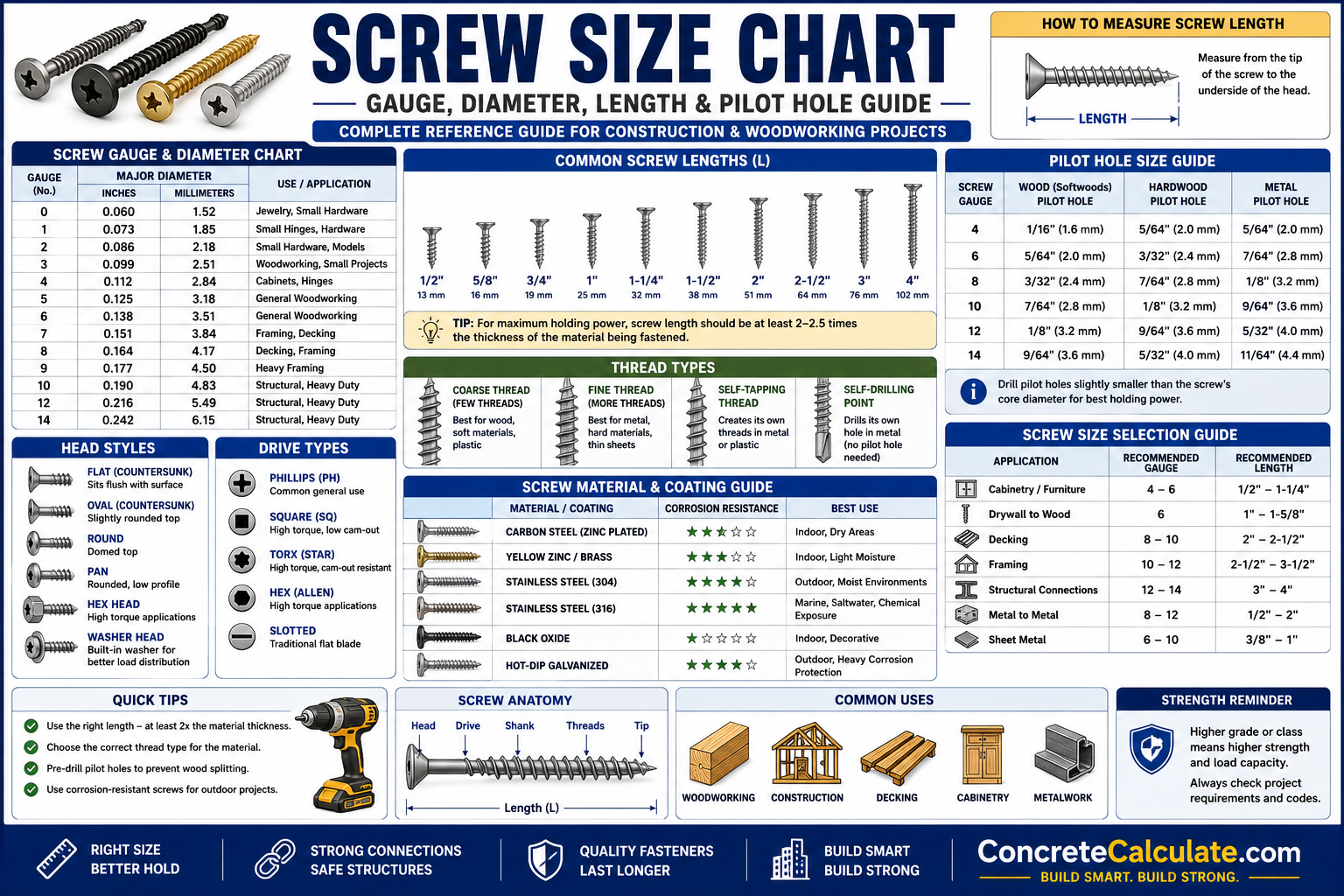
Screw Size Chart
Gauge, Length & Pilot Hole Guide
Complete screw reference for contractors and DIYers – gauges, diameters, lengths, thread types, head styles, drive types, and pilot hole sizing for every project.
 Reviewed by Muhammad Ramzan Babar, PhD Researcher (Plasma Physics) & Calculator Developer — View Profile
What This Page Helps You Decide
Rather than listing every fastener a supplier catalog carries, this page is built to answer five practical questions: which screw do I need, what size should I use, which head style is best, which thread type is appropriate, and which material or coating suits my project. Use the Table of Contents to jump straight to your project type.
⭐ Master Screw Size Chart
Complete overview of screw gauges, diameters, lengths, thread types, head styles, and driver types across common construction and woodworking uses.
How to Read This Chart
Screws are described by gauge (shank diameter), length, thread type, head style, and drive type — all five factors matter for choosing the right fastener. For structural connections like anchors and ledgers, verify capacity with our Anchor Bolt Calculator.
| Screw Category | Common Gauge/Size Range | Common Length Range | Typical Applications |
|---|---|---|---|
| Wood Screws | #4–#12 | ½”–4″ | Cabinetry, furniture, general woodworking |
| Drywall Screws | #6 | 1¼”–3″ | Drywall to wood or metal studs |
| Deck Screws | #8–#10 | 2″–3″ | Deck boards, outdoor structures |
| Sheet Metal Screws | #6–#14 | ½”–2″ | Metal panels, HVAC, light gauge steel |
| Machine Screws | #4–#12, M2–M6 | ¼”–2″ | Metal-to-metal with tapped holes or nuts |
| Lag Screws | ¼”–1″ diameter | 1½”–8″ | Deck ledgers, timber framing, heavy connections |
| Metric Screws | M2–M12 | 10mm–100mm | Imported hardware, machinery, metric-spec assemblies |
⭐ Standard Screw Size Chart
One of the highest-volume search topics — standard wood/general-purpose screw gauges with diameter and metric equivalent.
| Screw Gauge | Diameter | Metric Equivalent | Common Uses |
|---|---|---|---|
| #2 | 0.086″ | 2.2 mm | Small hinges, tiny electronics enclosures |
| #3 | 0.099″ | 2.5 mm | Light trim, small hardware |
| #4 | 0.112″ | 2.8 mm | Cabinet hinges, small hardware, thin trim |
| #5 | 0.125″ | 3.2 mm | Light-duty general fastening |
| #6 | 0.138″ | 3.5 mm | Drywall, face frames, general trim |
| #7 | 0.151″ | 3.9 mm | General woodworking, transitional size |
| #8 | 0.164″ | 4.2 mm | Most common all-purpose size — cabinets, shelving |
| #9 | 0.177″ | 4.5 mm | Slightly heavier general fastening |
| #10 | 0.190″ | 4.8 mm | Decking, heavier shelving, thick hardwood joinery |
| #12 | 0.216″ | 5.5 mm | Heavy-duty fastening, structural connections |
| #14 | 0.242″ | 6.2 mm | Heavy structural and framing applications |
| #16 | 0.268″ | 6.8 mm | Very heavy-duty fastening, rare in general use |
⭐ Screw Diameter Chart
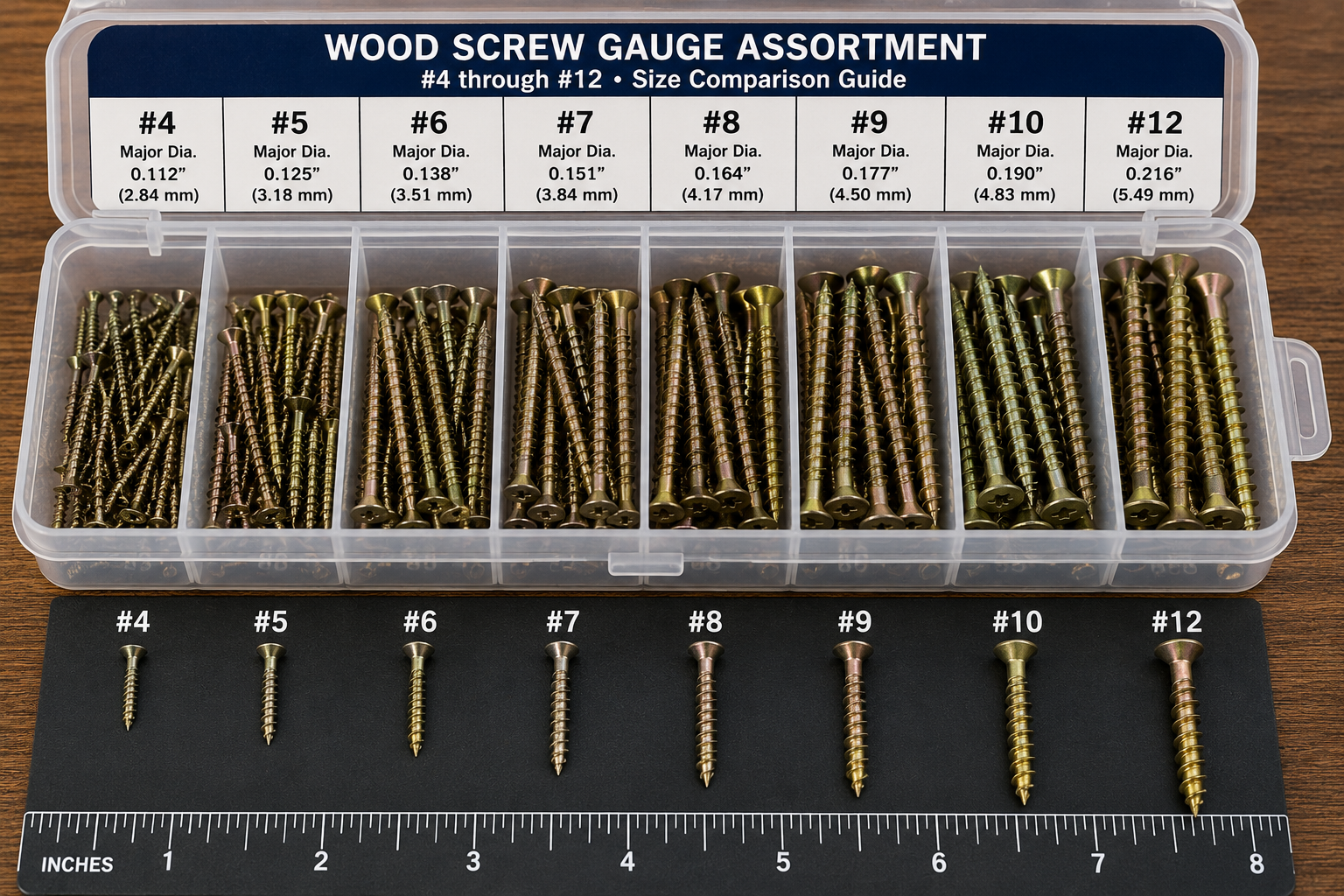
One of the most searched screw references major diameter (shank/thread crest) vs minor diameter (root, between threads).
| Gauge Number | Major Diameter | Minor (Root) Diameter | Metric Equivalent |
|---|---|---|---|
| #4 | 0.112″ | 0.078″ | 2.8 mm |
| #6 | 0.138″ | 0.094″ | 3.5 mm |
| #8 | 0.164″ | 0.112″ | 4.2 mm |
| #10 | 0.190″ | 0.130″ | 4.8 mm |
| #12 | 0.216″ | 0.148″ | 5.5 mm |
| #14 | 0.242″ | 0.166″ | 6.2 mm |
Major vs Minor Diameter
Major diameter is measured across the outer thread crests (the widest point) and determines the clearance hole size; minor diameter is measured across the root between threads and is the key figure for sizing pilot holes, since it represents the solid core the screw threads must engage.
⭐ Screw Length Chart
Common screw lengths and where each is typically used.
| Length | Common Use |
|---|---|
| 1/2″ | Thin hardware, hinges, small trim pieces |
| 3/4″ | Light trim, cabinet hardware |
| 1″ | General trim, thin panel fastening |
| 1-1/4″ | Standard drywall on wood studs, general assembly |
| 1-1/2″ | Cabinet assembly, general woodworking |
| 2″ | Framing components, thicker material fastening |
| 2-1/2″ | Deck boards to joists, general framing |
| 3″ | Deck boards, ledger fastening, heavier framing |
| 3-1/2″ | Heavy framing connections |
| 4″ | Heavy timber connections, thick material joints |
| 5″ | Heavy structural and post connections |
| 6″ | Very heavy timber framing, lag screw range begins here |
A general rule of thumb: choose a length so the screw penetrates the base (receiving) material by at least two-thirds of its total length, without breaking through the far side.
⭐ Screw Size by Construction Application
Matching common construction projects to recommended screw size and type.
| Project | Recommended Screw Size | Screw Type |
|---|---|---|
| Drywall | #6, 1¼” | Drywall screw, coarse (wood) or fine (metal stud) |
| Decking | #8–#10, 2½”–3″ | Coated or stainless deck screw |
| Framing | #9–#10, 2½”–3½” | Structural wood screw |
| Subfloor | #8–#9, 2″–2½” | Subfloor/deck screw, coarse thread |
| Cabinet Installation | #6–#8, 1¼”–2″ | Wood screw or cabinet screw |
| Roofing | #9–#10, 1½”–3″ | Self-drilling roofing screw with washer |
| Metal Stud Framing | #6–#8, ½”–1½” | Fine-thread self-drilling screw |
| Fence Construction | #8–#10, 2″–3″ | Coated deck/exterior screw |
| Furniture | #6–#8, ¾”–2″ | Wood screw, flat or pan head |
| Concrete Fastening | Varies (use concrete screw/anchor) | Concrete screw or masonry anchor system |
For concrete fastening, standard wood screws are not appropriate — use a purpose-built concrete screw or anchor system; size embedment with our Anchor Bolt Embedment Calculator.
⭐ Wood Screw Size Chart
Common wood screw combinations of gauge, length, and head style for typical woodworking projects.
| Gauge | Common Length | Common Head Style | Typical Woodworking Use |
|---|---|---|---|
| #6 | 3/4″–1½” | Flat head, oval head | Face frames, trim, hinges |
| #8 | 1″–2″ | Flat head, pan head | Cabinet boxes, shelving, general assembly |
| #10 | 1½”–3″ | Flat head, round head | Heavier shelving, workbenches, thick joinery |
| #12 | 2″–3½” | Flat head, hex head | Heavy-duty structural wood connections |
Deck Screw Size Chart
Recommended screw sizing by deck framing component.
| Component | Recommended Screw |
|---|---|
| Deck Boards | #8–#10, 2½”–3″, coated or stainless |
| Joists | #9–#10 structural screw, 3″+, or joist hangers with nails |
| Ledger Boards | Structural lag screws or through-bolts, not standard deck screws |
| Railings | #8–#10, 2½”–3″, exterior-rated |
| Stairs | #9–#10 structural screw, 3″+, exterior-rated |
Ledger Boards Need Structural Fasteners
Deck ledger boards carry significant structural load and should be attached with lag screws or through-bolts sized per local code, never with standard deck screws alone.
Drywall Screw Size Chart
Comparing fine and coarse thread drywall screws by substrate.
| Thread Type | Common Lengths | Best For |
|---|---|---|
| Coarse Thread | 1¼”–3″ | Wood stud framing |
| Fine Thread | 1″–1⅝” | Metal stud framing |
Coarse thread grips wood fibers effectively, while fine thread is designed to engage thin sheet metal studs without stripping.
Sheet Metal Screw Size Chart
Comparing self-tapping, self-drilling, and thread-cutting screws for metal applications.
| Type | Common Gauges | Common Lengths | How It Works |
|---|---|---|---|
| Self-Tapping | #6–#14 | ½”–2″ | Cuts new threads in a pre-drilled hole |
| Self-Drilling | #8–#14 | ½”–2″ | Drill-point tip creates its own hole and threads in one step |
| Thread-Cutting | #6–#12 | ½”–1½” | Cutting flutes remove material to form clean threads |
Machine Screw Size Chart
Machine screws pair with tapped holes or nuts rather than tapering to a point like wood screws.
| Screw Size | Thread Pitch (TPI) | Diameter | Typical Applications |
|---|---|---|---|
| #4-40 | 40 | 0.112″ | Small electronics, light fixtures |
| #6-32 | 32 | 0.138″ | General equipment assembly, switch plates |
| #8-32 | 32 | 0.164″ | General machinery, panel assembly |
| #10-24 | 24 | 0.190″ | Heavier equipment assembly |
| #12-24 | 24 | 0.216″ | Heavy-duty machine assembly |
Lag Screw Size Chart
Heavy-duty wood screws for structural connections, driven with a wrench rather than a screwdriver.
| Diameter | Common Length Range | Typical Structural Uses |
|---|---|---|
| 1/4″ | 1½”–4″ | Light structural connections, brackets |
| 5/16″ | 2″–5″ | Deck ledgers, medium timber connections |
| 3/8″ | 2″–6″ | Deck ledgers, pergolas, timber framing |
| 1/2″ | 3″–8″ | Heavy timber connections, structural posts |
Lag screws always require a pilot hole and are commonly used for deck ledgers, timber framing, pergolas, and other heavy wood-to-wood connections where standard wood screws lack sufficient capacity.
⭐ Metric Screw Size Chart
Common metric machine screw sizes with diameter and thread pitch.
| Size | Diameter | Thread Pitch (Coarse) | Typical Uses |
|---|---|---|---|
| M2 | 2.0 mm | 0.4 mm | Small electronics, eyewear hardware |
| M3 | 3.0 mm | 0.5 mm | Electronics, small equipment |
| M4 | 4.0 mm | 0.7 mm | General equipment assembly |
| M5 | 5.0 mm | 0.8 mm | General machinery, panel fastening |
| M6 | 6.0 mm | 1.0 mm | Machinery, structural hardware |
| M8 | 8.0 mm | 1.25 mm | Heavier machinery and equipment |
| M10 | 10.0 mm | 1.5 mm | Heavy-duty machinery, structural use |
| M12 | 12.0 mm | 1.75 mm | Heavy structural and industrial applications |
Imperial vs Metric Screw Sizes
Understanding the two systems and their approximate — not exact — relationship.
| Gauge System | Metric System | Approximate Equivalent |
|---|---|---|
| #4 | M3 | ~2.8 mm ≈ 3.0 mm |
| #6 | M3.5 (uncommon) / M4 | ~3.5 mm |
| #8 | M4 | ~4.2 mm ≈ 4.0 mm |
| #10 | M5 | ~4.8 mm ≈ 5.0 mm |
| #12 | M5.5 (uncommon) / M6 | ~5.5 mm |
Not a Direct Conversion
Gauge numbers are not derived from a metric-to-imperial conversion formula — they follow a separate historical numbering system. The equivalents above are close matches for general reference only; thread pitch and form still differ, so gauge and metric hardware should not be mixed on the same fastener/tapped-hole pair.
Screw Thread Type Chart
Comparing common thread designs and where each performs best.
| Thread Type | Best Performance In | Notes |
|---|---|---|
| Coarse Thread | Wood, drywall, softer materials | Fewer threads per inch, faster driving, strong grip in soft material |
| Fine Thread | Metal, dense hardwood, plastics | More threads per inch, better holding in hard/thin material |
| Self-Tapping | Pre-drilled metal or plastic | Cuts or forms threads into an existing hole |
| Self-Drilling | Sheet metal without pre-drilling | Drill-point tip eliminates the separate pilot-hole step |
| Twin Thread | Softwood, particleboard, MDF | Dual-lead thread drives faster with strong initial grip |
⭐ Screw Head Type Chart
Comparing common screw head styles and their typical applications.
| Head Style | Profile | Common Applications |
|---|---|---|
| Flat Head | Sits flush when countersunk | Woodworking, cabinetry, trim |
| Pan Head | Low dome profile | General assembly, machine screws |
| Round Head | Rounded dome, sits above surface | Decorative and light-duty fastening |
| Oval Head | Rounded top over a flat countersunk base | Decorative trim, hardware with washers |
| Truss Head | Wide, low-profile dome | Sheet metal, thin material, large bearing surface needed |
| Hex Head | Six-sided, wrench-driven | Lag screws, structural and heavy-duty fastening |
| Washer Head | Built-in integrated washer under head | Sheet metal, reduces need for separate washer |
| Bugle Head | Curved transition under a flat top | Drywall screws, reduces paper tearing |
Screw Drive Type Chart
Comparing common driver recess styles, their advantages, and typical uses.
| Drive Type | Advantages | Common Uses |
|---|---|---|
| Phillips | Widely available, low cost | General-purpose fastening, drywall |
| Pozidriv | Better torque transfer than Phillips, less cam-out | European and Asian hardware, some automotive |
| Slotted | Simple, traditional, works with a flat blade | Older hardware, decorative applications |
| Square (Robertson) | Excellent grip, minimal cam-out, one-handed driving | Woodworking, Canadian-standard hardware |
| Torx | High torque capacity, very low cam-out | Power-driven fastening, automotive, decking |
| Hex Socket | Maximum torque transfer, wrench or bit driven | Machine screws, lag screws, structural hardware |
Screw Material Comparison
Base material affects strength and inherent corrosion resistance independent of coating.
| Material | Corrosion Resistance | Strength | Typical Applications |
|---|---|---|---|
| Carbon Steel | Low (needs coating) | High | General interior fastening with plating/coating |
| Stainless Steel | Excellent | Moderate to high | Outdoor, marine, treated lumber |
| Brass | Good | Lower | Decorative hardware, non-structural fastening |
| Silicon Bronze | Excellent, especially marine | Moderate | Boat building, high-end exterior woodworking |
| Galvanized Steel | Good (coating-dependent) | High (base steel) | Outdoor framing, general exterior use |
| Zinc-Plated Steel | Fair (thin coating) | High (base steel) | Indoor and mild-exposure fastening |
Screw Coating Guide
Coatings protect the base material and determine compatibility with treated lumber and outdoor exposure.
| Coating | Environment Fit | Treated Lumber Compatibility |
|---|---|---|
| Zinc-Plated | Indoor, dry environments | Not recommended for ACQ-treated lumber |
| Hot-Dip Galvanized | Outdoor, general exterior use | Generally compatible; check manufacturer rating |
| Ceramic Coated | Outdoor, high-corrosion resistance | Often rated for treated lumber |
| Epoxy Coated | Outdoor, moisture-heavy environments | Often rated for treated lumber |
| Phosphate Coated | Indoor, provides paint/coating base | Not recommended for treated lumber |
Modern ACQ-treated lumber contains copper compounds that accelerate corrosion in standard zinc-plated fasteners — always check the screw manufacturer’s rating for treated lumber compatibility before use outdoors.
⭐ Screw Pilot Hole Size Chart
One of the highest-value sections — recommended pilot hole sizes by screw gauge and material.
| Screw Gauge | Softwood Pilot | Hardwood Pilot | MDF/Plywood Pilot |
|---|---|---|---|
| #4 | 1/16″ | 5/64″ | 1/16″ |
| #6 | 5/64″ | 3/32″ | 5/64″ |
| #8 | 7/64″ | 1/8″ | 7/64″ |
| #10 | 1/8″ | 9/64″ | 1/8″ |
| #12 | 9/64″ | 5/32″ | 9/64″ |
The General Rule
Pilot holes are typically sized close to the screw’s minor (root) diameter in softwood, and slightly larger — closer to or matching the root diameter with less compression — in hardwood, since denser wood is more prone to splitting. MDF and plywood generally follow softwood-sized pilot holes but benefit from pre-drilling near edges to prevent delamination.
Screw Size by Material Thickness
Recommended screw sizing based on the material being fastened.
| Material | Recommended Screw Approach |
|---|---|
| Wood (¾” stock) | #8 gauge, 1½”–2″ length |
| Plywood | #6–#8 gauge, length matched to combined panel thickness |
| MDF | #6–#8 gauge, pilot hole strongly recommended |
| OSB | #8–#9 gauge, coarse thread structural screw |
| Sheet Metal | #6–#10 self-drilling or self-tapping screw sized to gauge of metal |
| Drywall | #6 gauge, 1¼”–1⅝” depending on layer thickness |
| Composite Decking | Manufacturer-specified composite deck screw, typically #8–#10 |
Composite decking often requires manufacturer-specific screws to avoid mushrooming or splitting the composite material — always check the decking manufacturer’s fastener recommendation first.
⭐ Screw Selection Guide
Quick decision reference matching project type to recommended screw with reasoning.
| Project | Recommended Screw | Why |
|---|---|---|
| Deck | #8–#10 coated/stainless deck screw, 2½”–3″ | Outdoor durability and adequate holding power in joists |
| Fence | #8–#10 exterior screw, 2″–3″ | Weather resistance for outdoor wood connections |
| Cabinet | #6–#8 wood screw, 1¼”–2″ | Adequate holding without oversized visible heads |
| Drywall | #6 drywall screw, coarse or fine per stud type | Matches thread type to substrate for secure hold |
| Roofing | #9–#10 self-drilling roofing screw with washer | Weatherproof seal and structural hold in one fastener |
| Timber Framing | Lag screw, ⅜”–½” diameter | Structural capacity for heavy wood-to-wood joints |
| Furniture | #6–#8 wood screw, ¾”–2″ | Balanced strength and appearance for finished pieces |
| Metal Framing | #6–#8 self-drilling fine-thread screw | Engages thin steel studs without stripping |
For structural fastening into concrete or masonry, see our Anchor Bolt Size Chart and Bolt Grade Chart instead — standard screws are not rated for concrete anchoring.
⭐ Visual Screw Size Guide
Original engineering diagrams explaining screw anatomy, head comparisons, drive types, and measurement.
Flat Head
Pan Head
Round Head
Bugle Head
Hex Head
Truss Head
Phillips
Torx
Square
Slotted
Hex Socket
Common Screw Selection Mistakes
Avoiding these errors prevents split wood, stripped threads, and premature fastener failure.
Choosing the Wrong Screw Length
Too short leaves inadequate holding power; too long can blow through the far side of the base material or hit hidden utilities.
Using Drywall Screws for Structural Framing
Drywall screws are brittle and not rated for shear or structural loads — they can snap under conditions a wood screw would handle safely.
Ignoring Corrosion Resistance
Using standard zinc-plated screws outdoors or in treated lumber leads to rapid corrosion, staining, and eventual fastener failure.
Selecting the Wrong Thread Type
Coarse thread in metal or fine thread in soft wood both reduce holding power compared to the correctly matched thread type.
Using the Wrong Driver Bit
Mismatched bits cause cam-out, stripped recesses, and damaged screw heads, especially under power-tool torque.
Skipping Pilot Holes in Hardwood
Driving screws into hardwood without a pilot hole frequently splits the material, especially near edges and ends.
Mixing Metric and Imperial Screws
Forcing a gauge screw into a metric-tapped hole (or vice versa) strips threads and creates an unreliable connection.
Using Interior Screws Outdoors
Interior-rated fasteners lack the coating needed to resist moisture and will corrode and stain exterior wood over time.
Contractor Worked Examples
Real-world screw selection scenarios for common project types.
Deck Construction
Cabinet Assembly
Frequently Asked Questions
📄 Download Screw Size Chart PDF
Get a printable contractor reference including screw gauge tables, diameter conversions, length chart, head style guide, driver type guide, pilot hole chart, material comparison, and field-ready quick reference sheet.