US Bolt Sizes Chart: Diameter, Thread Pitch & Bolt Standards
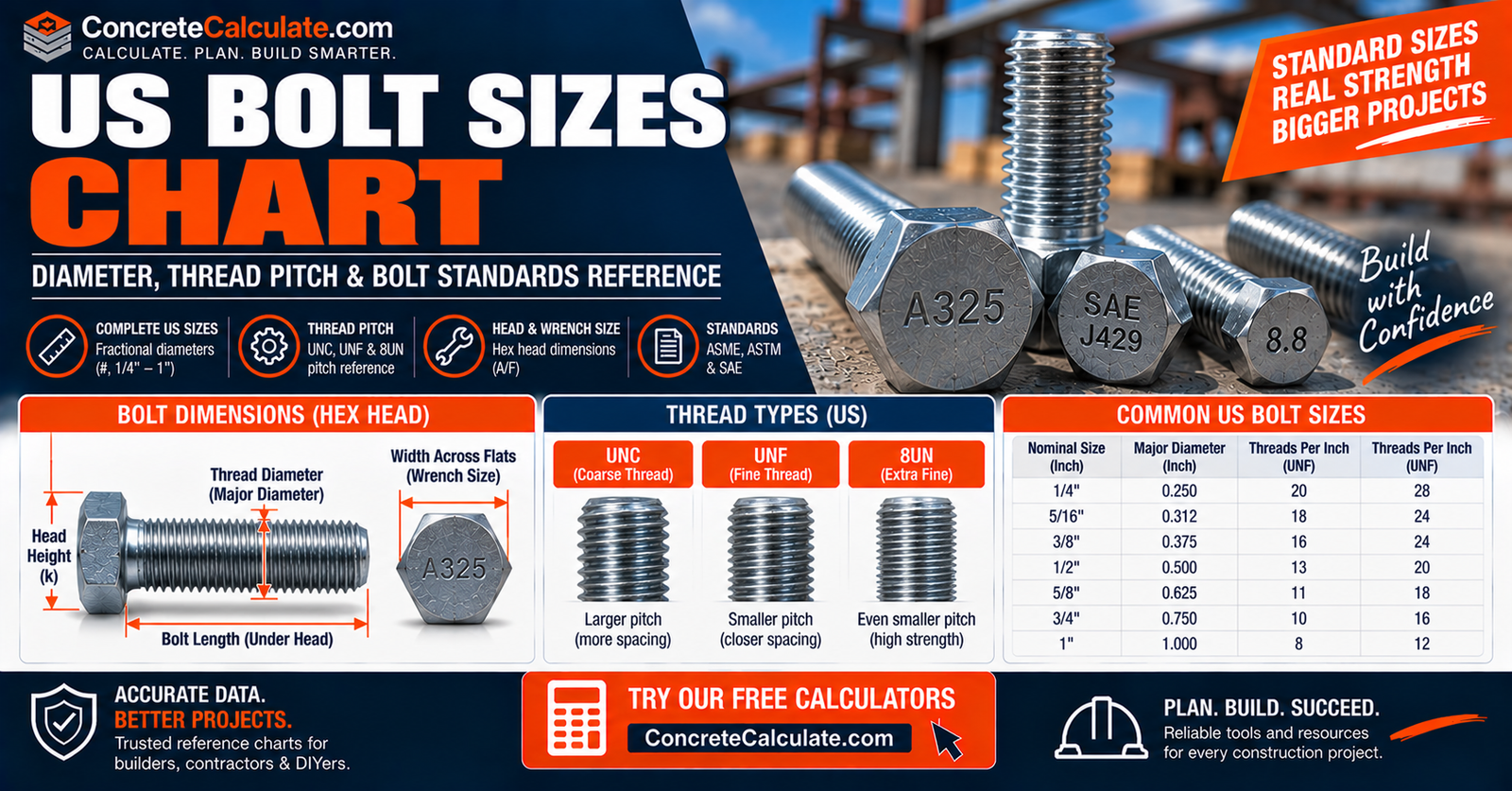
US Bolt Sizes Chart
Diameter, Thread Pitch & Bolt Standards
Fractional bolt diameters, UNC/UNF/8UN thread pitch, bolt length conventions, head and wrench size relationships, and the major U.S. bolt standards, including ASME B1.1, ASME B18.2.1/B18.2.6, ASTM F3125, ASTM F1554, ASTM A307, and SAE J429.
 Reviewed by Muhammad Ramzan Babar, PhD Researcher (Plasma Physics) & Calculator Developer, View Profile
“US bolt size” is not the same thing as “SAE bolt size”
In the U.S., general-purpose inch fasteners use the Unified Inch Screw Thread system governed by ASME B1.1-2024. SAE J429 is a mechanical and material specification for certain inch-series steel fasteners, not the dimensional definition of every U.S. bolt. A complete bolt size designation needs at minimum diameter, thread pitch, and length; grade and specification are separate layers entirely.
US Bolt Sizes Chart, Quick Reference
The flagship table for this master reference.
Standard U.S. Inch Bolt Size Chart
| Nominal Diameter | Decimal (in.) | UNC TPI | UNF TPI | 8UN Where Applicable | Standard Hex Across Flats | Typical Wrench/Socket |
|---|---|---|---|---|---|---|
| 1/4 in. | 0.250 | 20 | 28 | – | 7/16 | 7/16 in. |
| 3/8 in. | 0.375 | 16 | 24 | – | 9/16 | 9/16 in. |
| 1/2 in. | 0.500 | 13 | 20 | – | 3/4 | 3/4 in. |
| 5/8 in. | 0.625 | 11 | 18 | – | 15/16 | 15/16 in. |
| 3/4 in. | 0.750 | 10 | 16 | – | 1-1/8 | 1-1/8 in. |
| 7/8 in. | 0.875 | 9 | 14 | – | 1-5/16 | 1-5/16 in. |
| 1 in. | 1.000 | 8 | 12 | 8 | 1-1/2 | 1-1/2 in. |
| 1-1/8 in. | 1.125 | 7 | 12 | 8 | 1-11/16 | 1-11/16 in. |
| 1-1/4 in. | 1.250 | 7 | 12 | 8 | 1-7/8 | 1-7/8 in. |
| 1-1/2 in. | 1.500 | 6 | 12 | 8 | 2-1/4 | 2-1/4 in. |
Not every diameter is offered in every thread series, grade, bolt type, or length; commercial availability varies by manufacturer and product specification.
US Bolt Size Notation
1/2-13 x 3 means a 1/2-in. nominal diameter, 13 TPI, and a 3-in. length. 3/4-10 UNC x 4 means a 3/4-in. diameter, 10 TPI coarse thread, and a 4-in. nominal bolt length.
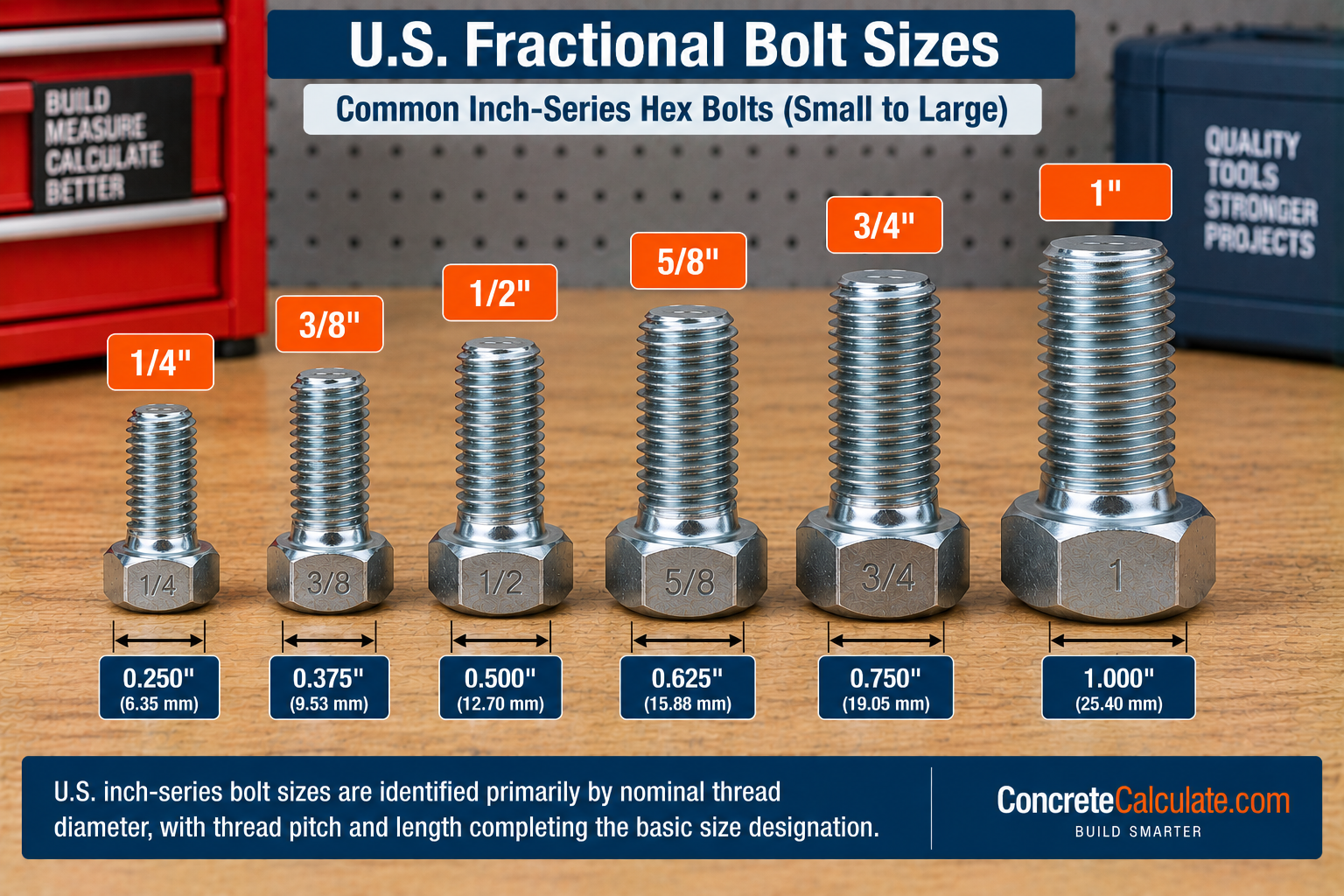
What Is a U.S. Bolt Size?
Diameter alone is not a complete bolt specification.
An inch-series bolt size is primarily defined by nominal thread diameter, thread pitch or TPI, length, thread series and class, bolt type and head style, and grade or specification. All of these layers combine to fully describe a specific bolt; diameter by itself only identifies one part of that description.
U.S. Bolt Size vs SAE Bolt Size
An extremely valuable distinction that most generic bolt charts skip.
| Term | What It Actually Describes |
|---|---|
| U.S. / Inch-Series Bolt | General dimensional and thread system based on inch units and Unified threads |
| SAE Bolt | Usually means an inch-series fastener covered by an SAE material/mechanical specification such as SAE J429 |
SAE J429 currently covers mechanical and material requirements for inch-series steel bolts, screws, studs, sems, and U-bolts through 1-1/2 in. nominal size. UNC/UNF defines the thread system; SAE grade defines mechanical properties. These are two separate layers of specification, not synonyms.
U.S. Bolt Size vs Metric Bolt Size
Do not treat 1/2 in. as simply equivalent to M12.
| Feature | U.S. Inch Bolt | Metric Bolt |
|---|---|---|
| Diameter | Fractional inch | M size |
| Pitch | Threads per inch | mm/thread |
| Example | 1/2-13 | M12x1.75 |
| Main thread system | Unified Inch | ISO Metric |
| Directly interchangeable? | No | No |
How to Read a U.S. Bolt Designation
Several worked examples.
3/8-16 x 2
Diameter = 3/8 in., TPI = 16, length = 2 in.
1/2-20 x 3-1/2
Diameter = 1/2 in., TPI = 20 (fine thread), length = 3-1/2 in.
1-1/4-8UN
Diameter = 1-1/4 in., using the separate 8-thread series rather than UNC or UNF.
Bolt Dimension Anatomy
One of the main technical diagrams for this page.
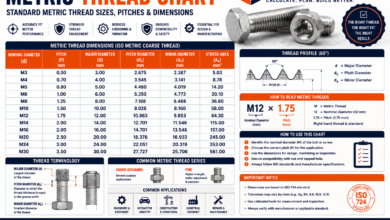
Full dimension anatomy also includes major thread diameter, pitch diameter, minor diameter, head width across flats, and head height.
U.S. Fractional Bolt Diameter Chart
Satisfies dimensional search intent while keeping metric conversion clearly secondary.
| Fractional Size | Decimal Inches | Millimeters |
|---|---|---|
| 1/4 in. | 0.250 | 6.35 |
| 3/8 in. | 0.375 | 9.525 |
| 1/2 in. | 0.500 | 12.70 |
| 5/8 in. | 0.625 | 15.875 |
| 3/4 in. | 0.750 | 19.05 |
| 7/8 in. | 0.875 | 22.225 |
| 1 in. | 1.000 | 25.40 |
U.S. Bolt Sizes Smallest to Largest
A recognized, common bolt-size series, not simply every 1/16-in. fraction.
| # | Nominal Size |
|---|---|
| 1 | 1/4 in. |
| 2 | 5/16 in. |
| 3 | 3/8 in. |
| 4 | 7/16 in. |
| 5 | 1/2 in. |
| 6 | 9/16 in. |
| 7 | 5/8 in. |
| 8 | 3/4 in. |
| 9 | 7/8 in. |
| 10 | 1 in. |
| 11 | 1-1/8 in. and larger, product-specific |
Product standards do not necessarily manufacture every fractional increment; this list reflects the commonly recognized commercial series.
UNC Bolt Size Chart
One of the main tables on this page.
| Bolt Diameter | UNC TPI | Pitch (in.) | Threads per Foot |
|---|---|---|---|
| 1/4 | 20 | 0.0500 | 240 |
| 3/8 | 16 | 0.0625 | 192 |
| 1/2 | 13 | 0.0769 | 156 |
| 5/8 | 11 | 0.0909 | 132 |
| 3/4 | 10 | 0.1000 | 120 |
| 1 | 8 | 0.1250 | 96 |
UNC (Unified National Coarse) is the most common general-purpose thread series because coarse threads are relatively tolerant of dirt and damage and assemble quickly. For the complete UNC dimensional reference, see the UNC Thread Chart.
UNF Bolt Size Chart
UNF = Unified National Fine.
| Diameter | UNF TPI | Pitch (in.) |
|---|---|---|
| 1/4 | 28 | 0.0357 |
| 3/8 | 24 | 0.0417 |
| 1/2 | 20 | 0.0500 |
| 5/8 | 18 | 0.0556 |
| 3/4 | 16 | 0.0625 |
| 1 | 12 | 0.0833 |
Fine threads use more threads per inch and have different tensile stress areas and thread engagement characteristics than UNC. For the complete UNF dimensional reference, see the UNF Thread Chart.
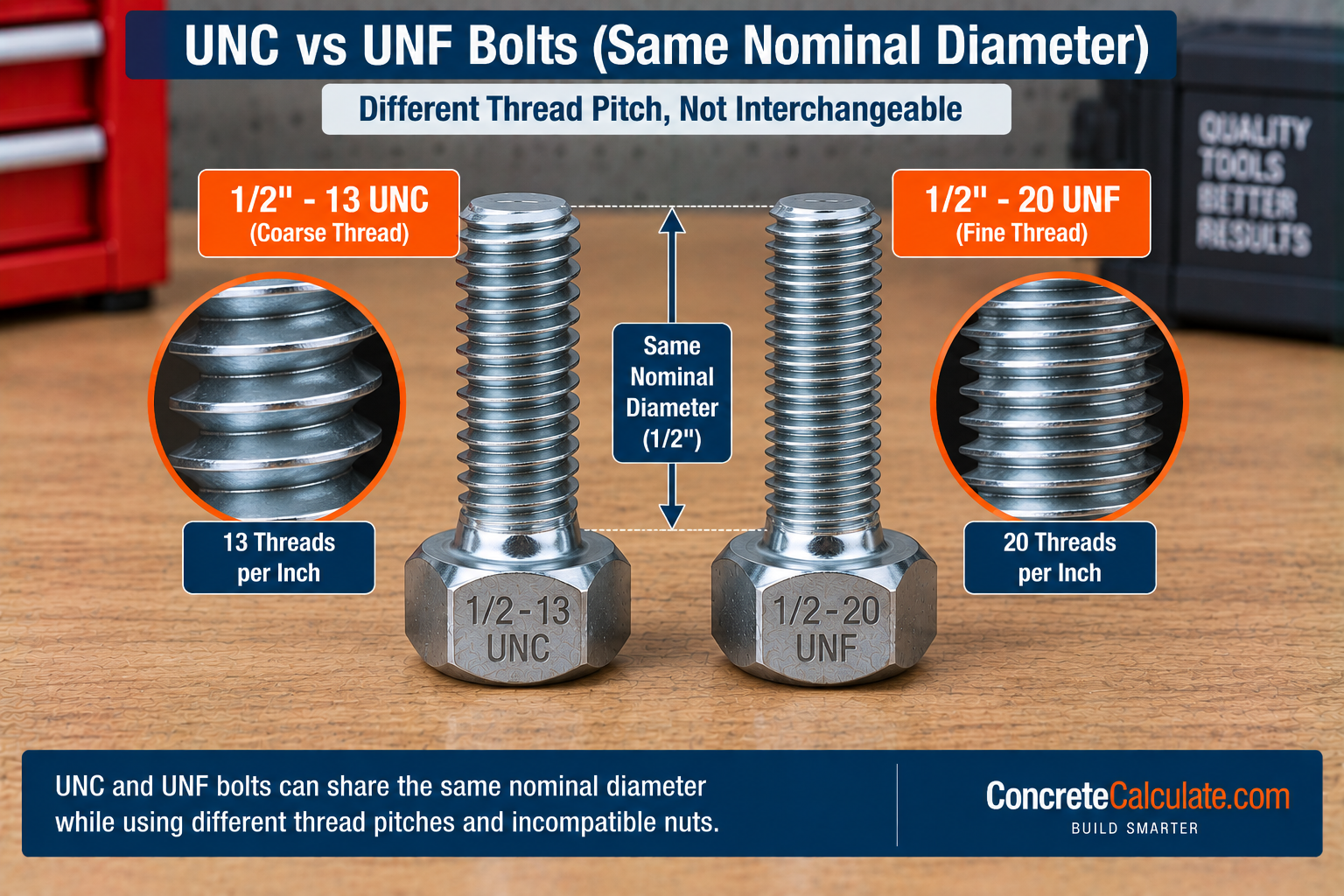
UNC vs UNF Bolts
A 1/2-13 bolt and a 1/2-20 bolt share the same diameter but are not thread-compatible.
| Feature | UNC | UNF |
|---|---|---|
| TPI | Lower | Higher |
| Pitch | Coarser | Finer |
| Assembly | Faster | More turns |
| Dirt/damage tolerance | Generally better | Lower |
| Same diameter interchangeable? | No | No |
8UN Bolt Thread Size Chart
Gives this page stronger industrial value.
| Nominal Diameter | Thread Series | TPI |
|---|---|---|
| 1 in. and above, selected applications | 8UN | 8 |
The 8-thread series (8UN) is used for several ASTM fastener specifications for diameters 1 in. and above, including some A193 and A320 applications. Do not assume every bolt 1 in. or larger uses 8UN; UNC and UNF remain common at those diameters too, depending on the product and specification.
Thread Pitch, TPI, and Thread Class
Helps translate U.S. thread notation.
Pitch equals 1 divided by TPI. For 1/2-13, pitch = 1/13 = 0.0769 in. For 1/2-20, pitch = 1/20 = 0.050 in. Common external thread classes include 1A, 2A, and 3A, with matching internal classes 1B, 2B, and 3B where applicable, all controlled under ASME B1.1.
ASME B1.1-2024 Unified Inch Thread Standard
The thread authority section for this entire page.
ASME B1.1-2024 specifies thread form, thread series, class, allowance, tolerances, and thread designation for Unified inch threads, including UN, UNR, and UNJ thread forms, along with the UNC/UNF series context used throughout this page. Detailed thread geometry lives on the dedicated Thread Pitch Chart, UNC Thread Chart, and UNF Thread Chart.
U.S. Hex Bolt Head Size Chart
Summarizes, rather than duplicates, the dedicated Hex Bolt Size Chart.
| Bolt Diameter | Standard Hex Across Flats | Heavy Hex Across Flats | Socket/Wrench |
|---|---|---|---|
| 1/2 in. | 3/4 in. | 7/8 in. | 3/4 in. (standard) / 7/8 in. (heavy) |
| 3/4 in. | 1-1/8 in. | 1-1/4 in. | 1-1/8 in. (standard) / 1-1/4 in. (heavy) |
| 1 in. | 1-1/2 in. | 1-5/8 in. | 1-1/2 in. (standard) / 1-5/8 in. (heavy) |
For the complete dimensional reference, see the Hex Bolt Size Chart.
Bolt Diameter vs Wrench/Socket Size
Bolt diameter does not equal wrench size.
A 3/4-in. standard hex bolt has a shank and thread diameter of 3/4 in., but its head across flats is 1-1/8 in., which is also the correct socket or wrench size. For the complete socket reference, see the Socket Size Chart.
Standard Hex vs Heavy Hex Bolts
Do not mix head dimensions between the two.
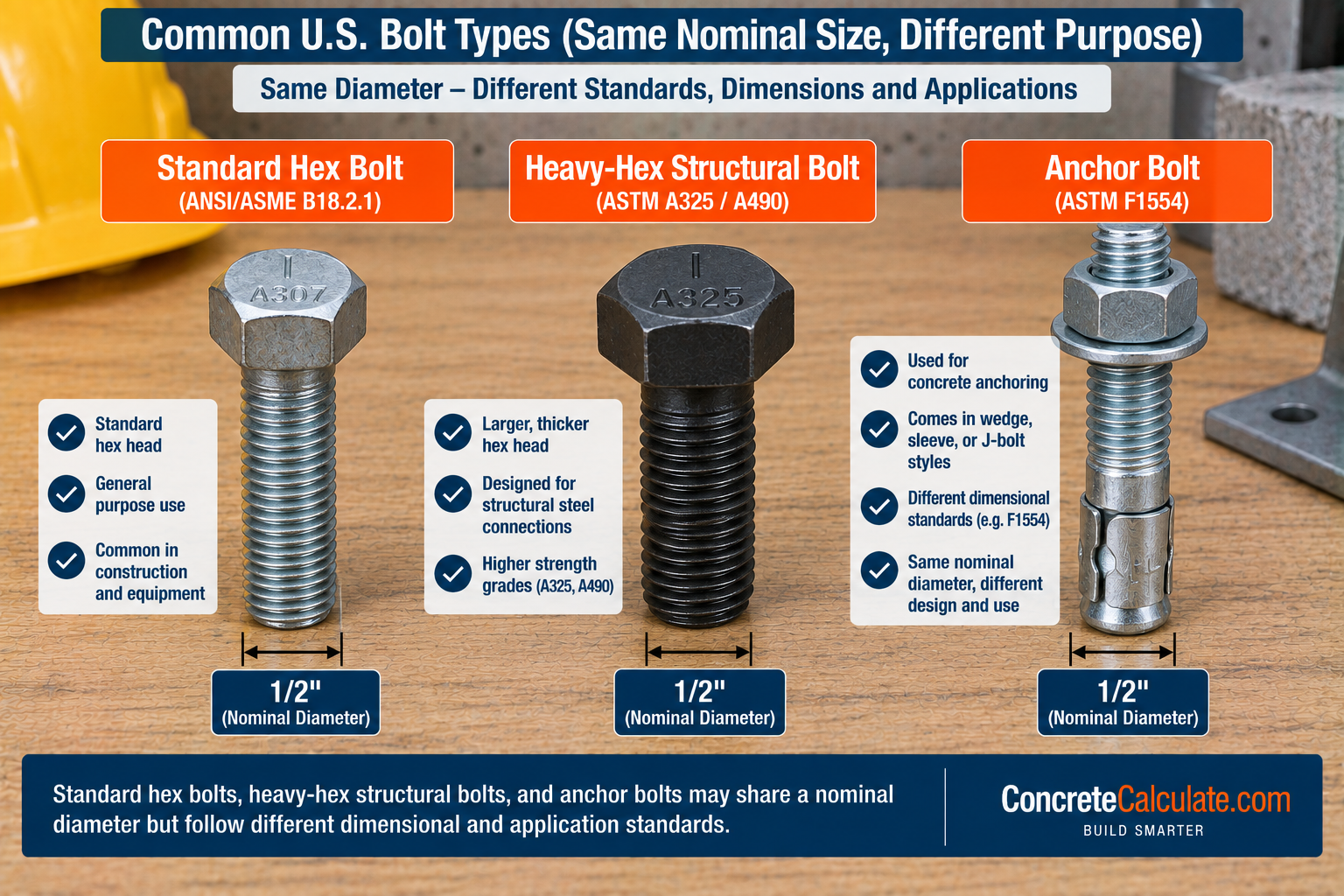
Standard hex bolts are used for general-purpose construction and mechanical fastening. Heavy hex bolts have a larger head across flats and greater bearing area. Heavy-hex structural bolt dimensional requirements are separated into ASME B18.2.6-2019, rather than being treated as ordinary B18.2.1 hex bolts.
ASME B18.2.1 Hex Bolt Dimensional Standard
The dimensional-standard section for ordinary square and hex bolts.
ASME B18.2.1 covers complete general and dimensional information for multiple inch-series square and hex bolt and screw product types, including body diameter, head width, across corners, head height, and thread-length conventions. Heavy-hex structural bolts are specifically moved to ASME B18.2.6.
U.S. Bolt Length Chart
No single universal stock length series exists.
| Category | Typical Context |
|---|---|
| Small general-purpose bolts | Under about 4 in., common hardware and equipment |
| Long construction bolts | 4 to 12 in., framing and heavier connections |
| Structural bolts | Sized per connection grip and F3125 requirements |
| Anchor bolts | Sized per embedment and F1554 requirements |
Commercially available lengths vary substantially by diameter, finish, and specification; this table shows general categories rather than one universal stock length series.
How Bolt Length Is Measured
Avoids a common user mistake.
For ordinary hex-head bolts, measure from the bearing surface beneath the head to the end of the bolt. Countersunk fasteners can be measured differently because their heads sit within the material, typically measured from the top of the flush head instead.
Bolt Thread Length Chart
Formulas apply to ordinary hex/heavy-hex bolts under the applicable ASME convention only.
Standard Thread Length Formula
For bolts 6 in. and shorter: LT = 2D + 1/4 in. For bolts over 6 in.: LT = 2D + 1/2 in., with commercial stock exceptions for very long bolts.
| Bolt Diameter | Nominal Thread Length (Bolts ≤ 6 in.) |
|---|---|
| 1/4 in. | 0.75 in. |
| 3/8 in. | 1.00 in. |
| 1/2 in. | 1.25 in. |
| 3/4 in. | 1.75 in. |
| 1 in. | 2.25 in. |
These formulas are not universal for every bolt family. Carriage bolts, structural bolts, anchor bolts, and specialty products can use different thread-length requirements; structural A325/A490 bolts, for example, follow their own thread-length table rather than this general hex-bolt formula.
Fully Threaded vs Partially Threaded Bolts
Matters for shear plane, grip, joint assembly, and ordering.
| Type | Description |
|---|---|
| Fully Threaded | Threads extend essentially along the body |
| Partially Threaded | Has an unthreaded shank/grip section |
Do not make structural strength recommendations from thread location alone; this is a specification and ordering detail, not a substitute for engineering analysis.
Common U.S. Bolt Types and Size Standards
A useful taxonomy showing that diameter alone does not identify a bolt family.
| Bolt Type | Governing Dimensional Standard |
|---|---|
| Hex bolt | ASME B18.2.1 |
| Hex cap screw | ASME B18.2.1 (distinct dimensional controls) |
| Heavy hex structural bolt | ASME B18.2.6 |
| Carriage bolt | ASME B18.5 |
| Anchor bolt/rod | ASTM F1554 |
| Flange bolt | Product-specific |
| Square-head bolt | ASME B18.2.1 |
| U-bolt | Product-specific |
| Stud/threaded rod | Product/application-specific |
The same nominal diameter does not mean the same head, length convention, thread length, or applicable standard across these types.
Carriage Bolt Sizes and ASME B18.5
Kept supporting rather than exhaustive.
ASME B18.5-2012 (R2023) covers round-head inch-series bolt forms, including round-head square-neck carriage-type fasteners and other round-head products. Relevant dimensions include nominal diameter, thread pitch, head diameter, square neck width, and head height.
Structural Bolt Sizes, ASTM F3125 / ASME B18.2.6
A separate construction-focused section.
| Structural Bolt Diameter | Heavy Hex Head Size | Applicable Specification |
|---|---|---|
| 1/2 in. | 7/8 in. | F3125 (A325/A490) / B18.2.6 |
| 3/4 in. | 1-1/4 in. | F3125 (A325/A490) / B18.2.6 |
| 1 in. | 1-5/8 in. | F3125 (A325/A490) / B18.2.6 |
The current ASTM F3125/F3125M covers high-strength structural bolts and assemblies, including familiar A325/A490 designations and styles, paired with ASME B18.2.6-2019 for structural fastener dimensions, which covers heavy-hex structural bolts, compatible nuts, hardened washers, direct-tension indicators, and twist-off structural bolts. Full strength data lives on the Bolt Grade Chart.
Anchor Bolt Sizes, ASTM F1554
Especially relevant to ConcreteCalculate’s audience.
The active ASTM F1554-20 covers straight, bent, headed, and headless anchor bolts and rods with grades 36, 55, and 105 for anchoring structural supports to concrete foundations. Anchor-bolt sizing involves diameter, overall length, thread length, bend or hook where applicable, embedment, and grade. For complete sizing and design data, see the Anchor Bolt Size Chart.
General-Purpose Carbon Steel Bolts, ASTM A307
Used as a specification example, not the definition of every U.S. bolt size.
ASTM A307 covers carbon steel bolts, studs, and threaded rod with 60 ksi minimum tensile-strength requirements over a broad 1/4 through 4-in. size range. Bolt size and bolt material specification are separate concepts; A307 defines material and strength requirements, not the thread or dimensional system covered elsewhere on this page.
SAE Bolt Grades and J429
Clarifies familiar Grade 2, Grade 5, and Grade 8 markings.
SAE J429 covers mechanical and material requirements for inch-series externally threaded steel fasteners through 1-1/2 in. Full proof load, tensile strength, and marking data are kept on the dedicated Bolt Grade Chart rather than duplicated here.
Bolt Size vs Bolt Grade
A strong distinction that prevents a common assumption error.
A 1/2-13 x 3 bolt can potentially be produced in different material or strength specifications. Diameter, pitch, and length describe size; grade or specification describes material and mechanical requirements. This prevents users from assuming “Grade 8” means a size rather than a strength classification.
Bolt Size vs Nut, Washer, and Socket Size
Shows the full assembly relationship.
For a 3/4-in. bolt, the mating nut thread is 3/4 in. with matching pitch, and the nominal washer is labeled 3/4 in., but actual nut and washer outside dimensions are larger and different from 3/4 in. Nominal fastener size keeps the assembly family together, but physical component dimensions are not all 3/4 in. See the Nut Size Chart and Washer Size Chart for the complete mating dimensions.
How to Identify and Choose a U.S. Bolt
Two practical workflows in one section.
How to Identify an Unknown U.S. Bolt
How to Choose the Correct U.S. Bolt Size
Common Mistakes and Chart Limitations
Calling all U.S. bolts “SAE bolts”
SAE J429 is a grade specification, not the dimensional system for every U.S. bolt.
Confusing bolt diameter with head size
Head across flats is always larger than the nominal shank diameter.
Confusing bolt diameter with wrench size
Wrench size matches head across flats, not shank diameter.
Ignoring thread pitch
Diameter alone does not identify a compatible mating nut.
Matching a 1/2-13 nut to a 1/2-20 bolt
Different thread series at the same diameter are not compatible.
Treating UNC and UNF as interchangeable
These are distinct, non-interchangeable thread series.
Assuming every large bolt is 8UN
UNC and UNF remain common even at 1 in. and above.
Confusing bolt size with bolt grade
Size describes dimensions; grade describes material and strength.
Thinking Grade 8 means 8-mm
SAE Grade 8 is an inch-series strength grade, unrelated to metric sizing.
Confusing SAE Grade 8 with metric class 8.8
These are separate grading systems that are not directly equivalent.
Measuring hex-bolt length including the head
Standard length is measured from under the head, not the top of the head.
Assuming every bolt is fully threaded
Many standard bolts are partially threaded per the standard formula.
Applying standard hex head dimensions to heavy hex
Heavy hex uses a distinct, larger head-width standard.
Using ordinary hex data for structural bolts
Structural F3125 bolts follow ASME B18.2.6, not B18.2.1.
Treating A325/A490 as simple dimensional sizes
These identify structural bolt grades and assemblies, not just dimensions.
Using anchor-bolt dimensions as general bolt dimensions
Anchor bolts follow ASTM F1554-specific sizing and embedment rules.
Assuming every fractional size is commercially stocked
Availability varies by manufacturer, diameter, and product line.
Using nearest metric equivalent as interchangeable
Unified and ISO metric threads are not directly substitutable.
Selecting bolt solely from diameter without the governing specification
The applicable application and specification always govern final selection.
Read before finalizing a U.S. bolt selection
There is no single specification covering every U.S. bolt type. Unified inch threads are governed by ASME B1.1, and head dimensions depend on product and head style, with structural heavy-hex bolts using separate dimensional requirements under ASME B18.2.6. Diameter does not determine thread pitch or grade, and head size does not equal thread diameter. Commercial size and length availability varies, and UNC, UNF, and 8UN are different thread series. Anchor bolts follow application-specific standards, and metric fasteners are not direct substitutes. Structural connection sizing requires project-specific engineering and the governing specification.
US Bolt Size FAQs
Download the US Bolt Sizes Chart
Get a printable reference including fractional diameters, UNC/UNF/8UN pitch, head/wrench size, and bolt standards tables on this page for jobsite or shop use.