
NPT vs NPS vs BSP Threads: Sizes & Compatibility

NPT vs NPS vs BSP threads: NPT is the American tapered 60 degree pipe thread, the NPS series (NPSM, NPSC, NPSL) are American straight threads, and BSP threads are British and ISO 55 degree threads in parallel (G) and tapered (R, Rc, Rp) forms. None should be assumed interchangeable, even at matching sizes or pitch.
NPT vs NPS vs BSP Threads: What Is the Difference?
Three thread families cause most identification trouble. NPT is the American tapered pipe thread with a 60 degree profile, while the NPS straight-thread series are American parallel threads with different jobs. BSP threads are British and ISO threads with a 55 degree profile.
- NPT: American tapered, 60° pipe thread.
- NPS straight-thread series: American parallel, 60° families such as NPSM and NPSC, each with a different purpose.
- BSPP (G): British and ISO parallel, 55° thread, whose seal is made separately.
- BSPT (R, Rc, Rp): British and ISO pressure-joint family with tapered R and Rc forms and a parallel internal Rp form.
Compatibility depends on the exact designation and the sealing arrangement, not on the label “1/2 inch” or the thread count. NPT and BSP threads should never be assumed interchangeable, even when size and pitch appear to match.
| Thread designation | Main standard | Geometry | Profile angle | Typical sealing arrangement | Main caution |
|---|---|---|---|---|---|
| NPT | ASME B1.20.1 | Tapered | 60° | Matched tapered threads with a suitable sealing method | Not interchangeable with BSP threads |
| NPSM | ASME B1.20.1 | Parallel | 60° | Connection-specific external seat or seal | Do not assume it seals on the threads |
| NPSC | ASME B1.20.1 | Parallel internal | 60° | Specified coupling to a compatible tapered thread | Internal thread for coupling arrangements only |
| NPSL | ASME B1.20.1 | Parallel | 60° | Primarily a mechanical locknut arrangement | Not a general pressure-sealing thread |
| BSPP / G | ISO 228-1 | Parallel | 55° | Separate sealing surface and seal | The threads alone do not seal |
| BSPT / R | ISO 7-1 | Tapered external | 55° | Appropriate ISO 7-1 pressure-joint arrangement | Close to NPT at some sizes but not compatible |
| BSPT / Rc | ISO 7-1 | Tapered internal | 55° | Appropriate ISO 7-1 pressure-joint arrangement | Pairs with R threads, not with NPT |
| Rp | ISO 7-1 | Parallel internal | 55° | Compatible ISO 7-1 tapered external connection | Not the same thread as G |
Table 1. NPT, NPS-series, and BSP thread comparison. Parallel threads can be used in pressure-tight assemblies when the connection design provides the seal.
What Are Pipe Threads and Why Do Thread Standards Matter?
Pipe threads join pipes, fittings, valves, and instruments. Three ideas are easy to mix up: thread engagement, which lets parts screw together, mechanical retention, which holds them, and a pressure-tight seal, which keeps the fluid in.
Different standards divide those jobs differently. Some threads are designed so the engaged flanks help form the seal, while others only provide retention and rely on a separate seal elsewhere in the joint.
A few geometric terms recur through this guide.
Major, minor, and pitch diameters describe thread size at different points, crest and root are the tops and bottoms of the teeth, and the flank joins them. Pitch is the spacing, taper is the change in diameter along the length, and thread angle is the angle between flanks.
Do not treat all threaded piping as interchangeable across materials and services. For general terminology and size lookup, see the Thread Size Chart and the Pipe Thread Chart.
What Is NPT Thread?
NPT stands for National Pipe Taper. It is the American general-purpose tapered pipe thread covered by ASME B1.20.1, which sets its dimensions and gaging.
The thread has a 60 degree form and a standard 1:16 taper on diameter, with flat crests and roots. It is written as nominal size and threads per inch, such as 1/2-14 NPT.
Conventional NPT joints typically rely on a suitable sealant or other specified sealing method to become pressure tight. For full dimensions by size, use the NPT Thread Chart instead of this comparison.
What Is NPS Thread?
NPS is an ambiguous abbreviation. In pipe dimension tables it means Nominal Pipe Size, which is a size label, not a thread. In thread discussions it is often used loosely for National Pipe Straight threads.
NPS on its own is not precise enough to specify a straight thread. The exact series matters, and ASME B1.20.1 defines several: NPSM, NPSC, and NPSL, along with the tapered NPT and NPTR.
Always obtain the full designation instead of treating every straight American pipe-thread connection as identical.
NPSM vs NPSC vs NPSL: Important Differences
All three are straight (parallel) series in ASME B1.20.1 with a 60 degree profile, but they serve different purposes.
NPSM: straight mechanical pipe threads
NPSM is for free-fitting mechanical joints. In a fluid system it generally needs a separate suitable sealing interface, such as a seat, gasket, or O-ring specified for the connection.
NPSC: straight pipe threads in couplings
NPSC is an internal straight thread used in pipe couplings. It is designed to mate with an external tapered NPT thread in the specified coupling arrangement, so it is not a general straight mechanical thread.
NPSL: straight locknut threads
NPSL is for loose-fitting mechanical joints with locknuts. Its job is mechanical fastening, so it should not be described as an ordinary general-purpose pressure-sealing thread.
Do Not Mix Series by Nominal Size
Never combine arbitrary NPT and NPSM fittings merely because they share a nominal size. Measured data show how close they can be: a 1/2 NPSM male thread measures about 0.818 in. while a 1/2 NPT male thread measures about 0.832 in., yet one is straight and the other tapered.
What Is BSP Thread?
BSP stands for British Standard Pipe. It is a family of Whitworth-based pipe threads with a 55 degree profile and rounded crests and roots, used in two broad types: parallel threads and pressure-joint threads.
BSP is common on equipment made outside the United States, so it appears on imported valves, hydraulic components, instruments, and piping accessories.
The abbreviation alone does not identify the complete standard. A part marked only “BSP” could be a parallel G thread or a tapered R or Rc thread, so confirm the ISO designation.
BSPP vs BSPT: What Is the Difference?
BSPP threads are parallel and covered by ISO 228-1. BSPT threads are covered by ISO 7-1, where the pressure-tight joint is made on the threads.
- BSPP / ISO 228-1: parallel G threads, with the seal created separately from thread engagement.
- BSPT / ISO 7-1: pressure-joint configurations that include tapered R, tapered internal Rc, and parallel internal Rp.
The two are not interchangeable.
ISO 228-1 states that its parallel threads are for mechanical assembly and are not suitable as jointing threads, and that a pressure-tight assembly should be made by compressing two tightening surfaces outside the threads with an appropriate seal. See the ISO 228-1 standard page and the ISO 7-1 standard page.
Understanding G, R, Rc, and Rp Thread Designations
ISO threads use letters instead of an acronym. Each letter points to a standard and a geometry.
- G 1/2: parallel thread under ISO 228-1.
- R 1/2: tapered external thread under ISO 7-1.
- Rc 1/2: tapered internal thread under ISO 7-1.
- Rp 1/2: parallel internal thread under ISO 7-1.
R, Rc, and Rp belong to the same ISO 7-1 family, while G belongs to ISO 228-1. Rp is not simply another name for G, because the two come from different standards and support different sealing approaches.
| Abbreviation | Full meaning or standard designation | Example marking | Identification meaning | Common confusion |
|---|---|---|---|---|
| NPT | National Pipe Taper, ASME B1.20.1 | 1/2-14 NPT | American tapered pipe thread | Confused with BSPT at 1/2 and 3/4 in. |
| NPSM | Straight pipe thread for free-fitting mechanical joints | 1/2-14 NPSM | American straight mechanical thread | Called simply “NPS” |
| NPSC | Straight pipe thread for couplings | 1/2-14 NPSC | American straight coupling-thread series | Assumed identical to NPSM |
| NPSL | Straight pipe thread for loose-fitting joints with locknuts | 1/2-14 NPSL | American straight locknut-thread series | Assumed to be a sealing thread |
| BSPP / G | Parallel pipe thread, ISO 228-1 | G 1/2 | ISO parallel pipe thread | Called “BSP” without the type |
| R | Tapered external pipe thread, ISO 7-1 | R 1/2 | ISO 7-1 tapered external thread | Confused with NPT |
| Rc | Tapered internal pipe thread, ISO 7-1 | Rc 1/2 | ISO 7-1 tapered internal thread | Confused with G or Rp |
| Rp | Parallel internal pipe thread, ISO 7-1 | Rp 1/2 | ISO 7-1 parallel internal thread | Confused with G |
| NPTF | Dryseal tapered pipe thread, ASME B1.20.3 | 1/2-14 NPTF | American dryseal tapered-thread series | Treated as identical to NPT |
Table 2. Pipe thread abbreviations and markings. In dimensional tables, NPS also means Nominal Pipe Size, which is a size label, not a thread series.
NPT vs NPS vs BSP: Tapered and Parallel Thread Geometry
A tapered male thread shrinks in diameter toward its free end, while a parallel thread keeps essentially the same diameter along its length. For a female thread, the opening is larger at the mouth and smaller deeper inside.
That difference is separate from the profile angle. NPT and NPSM share a 60 degree form but differ in taper, while G and R share a 55 degree form and differ the same way.
NPT and NPSM use 60-degree American thread profiles, while BSPP and BSPT use 55-degree British/ISO profiles; the tapered and parallel forms serve different connection designs.
The 60 and 55 degree labels describe the flank angle in the thread profile, not the small taper of the pipe. Mixing the two ideas is a common source of confusion.
55° vs 60° Thread Angles Explained
American NPT and NPS threads use a 60 degree thread form, and British and ISO pipe threads use a 55 degree Whitworth-based form. The angle is measured between the two flanks in the plane that contains the thread axis.
The two forms also differ in shape. Swagelok describes NPT as having flat crests and roots, while ISO 7-1 threads have rounded crests and roots. These differences change how the teeth seat against each other.
Matching pitch cannot fix an angle mismatch. Two threads with the same threads per inch can still have flanks that sit differently, which is why the 14 TPI sizes are tricky.
What Does 1:16 Pipe Thread Taper Mean?
Both NPT and the tapered ISO 7-1 threads use a taper of 1 in 16 measured on diameter. The diameter changes by 1 unit for every 16 units of length along the axis.
Relationship: Diametral Taper
Example: over 1 inch of axial travel, the diameter changes by 1/16 in. (0.0625 in.).
On the radius: that is only 1/32 in. per side, which is why the taper half-angle is small, about 1 degree 47 minutes.
This describes nominal taper geometry. It is not an acceptance tolerance or an installation depth requirement.
NPT vs BSP Thread Pitch: TPI Differences
Pitch is the spacing between threads, and the common pipe-thread convention counts threads per inch (TPI). The two are linked by a simple relationship.
Formula: Pitch From TPI
Example: 14 TPI gives a pitch of 1/14 = 0.0714 in., about 1.814 mm.
Table 3 compares NPT with BSP tapered threads. Values follow Swagelok’s thread identification tables, and the BSP values match the corresponding ISO 7-1 and ISO 228-1 sizes.
| Nominal size | NPT TPI | BSP TPI | Same pitch? | Identification caution |
|---|---|---|---|---|
| 1/8 in. | 27 | 28 | No | Needs a 28 TPI gauge for BSP |
| 1/4 in. | 18 | 19 | No | Gauge distinguishes the two |
| 3/8 in. | 18 | 19 | No | Gauge distinguishes the two |
| 1/2 in. | 14 | 14 | Yes | Same TPI, different form and dimensions |
| 3/4 in. | 14 | 14 | Yes | Same TPI, different form and dimensions |
| 1 in. | 11.5 | 11 | No | Half a thread per inch apart |
| 1-1/4 in. | 11.5 | 11 | No | Gauge distinguishes the two |
| 1-1/2 in. | 11.5 | 11 | No | Gauge distinguishes the two |
| 2 in. | 11.5 | 11 | No | Gauge distinguishes the two |
Table 3. Selected NPT versus BSP pitch comparison. Matching TPI at 1/2 and 3/4 in. does not mean the fittings are interchangeable.
Complete dimension tables belong in the reference pages. Use the Thread Pitch Chart for pitch conversions and the NPT Thread Chart for full NPT dimensions.
Why Nominal Pipe Thread Size Is Not the Measured Diameter
A fitting marked 1/2 inch does not measure 0.500 inch across its male threads. The label is a nominal pipe size, and the real thread diameters are larger and depend on where you measure.
- Nominal pipe size: the label, such as 1/2.
- Pipe outside diameter: about 0.840 in. for 1/2 pipe.
- Major diameter: the crest-to-crest size of the external thread.
- Pitch diameter: the effective diameter between crest and root.
- Minor diameter: the root-to-root size.
Tapered threads vary along their length, so the measurement location matters. Swagelok lists a 1/2 NPT male crest diameter of about 0.832 in. at the fourth thread, compared with 0.825 in. for ISO 7-1, and 1.043 against 1.041 in. at 3/4 inch.
Those gaps are only a few thousandths of an inch. For pipe dimensions see the Pipe Outside Diameter Chart and the pipe schedule dimensions page, and the Pipe Thread Chart for thread data by standard.
How to Measure Male and Female Pipe Threads
Measure before you compare. Swagelok’s identification guide uses calipers on crest-to-crest diameters and checks several positions to detect taper.
- Measure a male thread across the crests with calipers, not across the roots.
- For a female thread, measure the crest-to-crest bore with suitable inside jaws, or compare against a known mating part.
- Avoid damaged or partially formed threads at the end of the thread.
- Take readings at the first, fourth, and last full threads.
If the male diameters increase from the end, or female diameters decrease inward, the thread is tapered. If all readings match, it is straight. On tapered threads, take the diameter reading at the fourth or fifth full thread, as Swagelok advises.
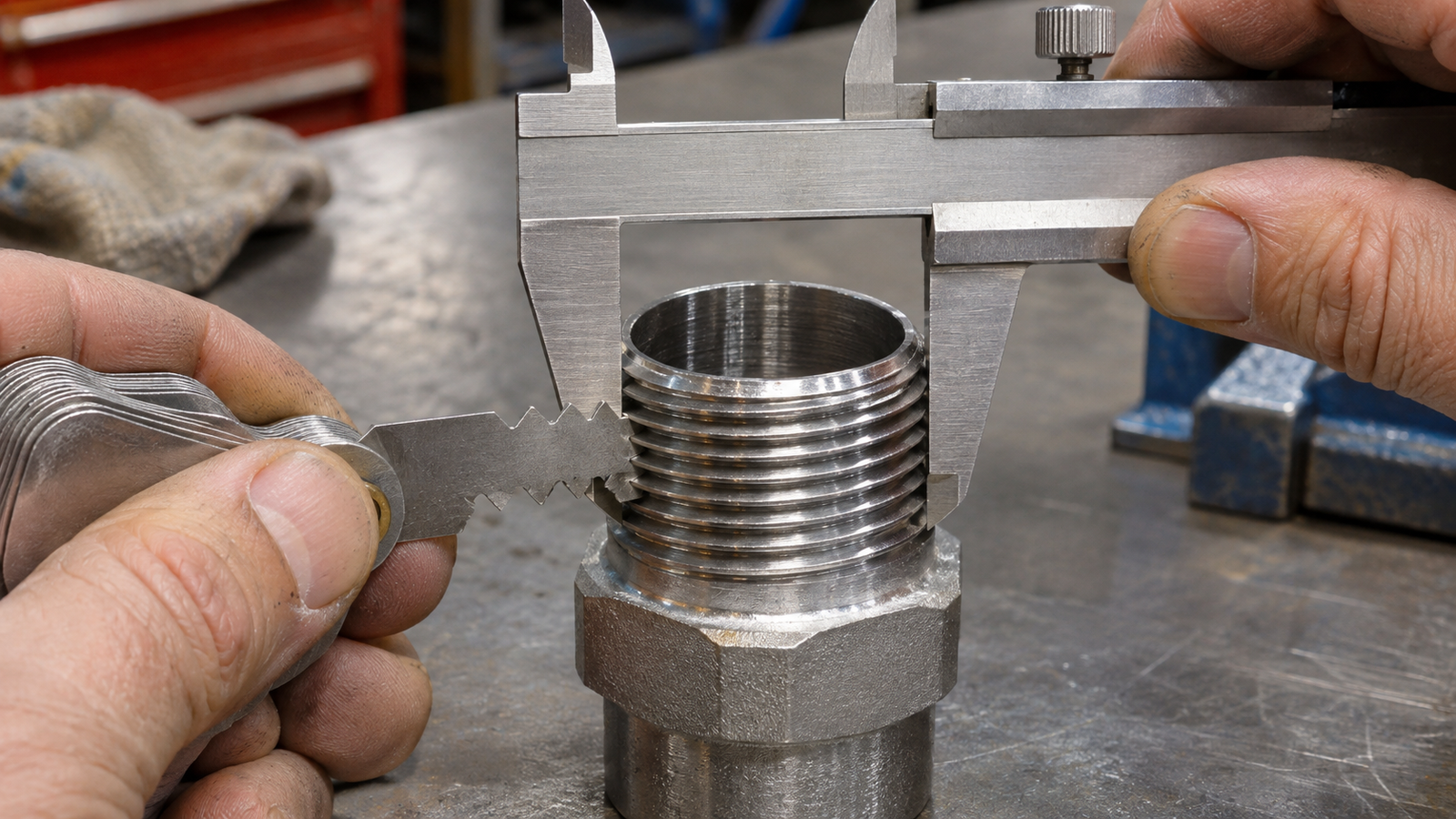
Measured values rarely match tables exactly because of tolerances, and Swagelok notes its tables are identification guides, not inspection criteria. The Thread Identification Chart supports broader identification questions.
How to Identify an Unknown Pipe Thread in Five Steps
Start by looking for markings on the fitting or its documentation. Stamped designations such as NPT, G, R, or Rc can settle the question before any measuring.
- Determine male or female. External threads are male, internal are female.
- Establish tapered or parallel. Measure crest diameters at several positions.
- Measure the diameter at the appropriate position with calipers.
- Measure pitch and compare the thread form. Use a pitch gauge and look at the profile.
- Identify the exact standard and sealing configuration. Confirm with a reference and the manufacturer.
| Identification step | Tool or evidence | What to observe | Possible interpretation | Next action |
|---|---|---|---|---|
| Inspect markings | Fitting label or documentation | NPT, NPSM, G, R, Rc, or Rp | Likely standard, if the marking is reliable | Check the manufacturer data |
| Identify thread type | Visual inspection | Male or female | External or internal thread | Choose the matching measuring method |
| Check taper | Calipers at several positions | Changing or constant diameter | Tapered or parallel thread | Narrow the standards list |
| Measure diameter | Calipers | Crest-to-crest dimension at the specified location | Nominal size candidates | Compare with a reference table |
| Check pitch | Thread pitch gauge | TPI and gauge profile | Candidate standards | Check profile and angle too |
| Compare standard | Authoritative reference chart | Matching diameter, pitch, and form together | Probable standard | Confirm with a gauge or the manufacturer |
| Check seal | Fitting inspection | Thread interface, face seal, seat, gasket | Sealing arrangement | Match the seal component |
| Confirm application | Manufacturer documentation | Approved connection and service | Approved use | Select a matched fitting |
Table 4. Pipe thread identification workflow. A diameter measurement alone should never be treated as final identification.
Safety Note
If identification is uncertain, use appropriate gauges or obtain manufacturer confirmation. Never trial-fit unknown threads under pressure.
How to Use a Thread Pitch Gauge
Choose a gauge leaf and press its teeth into the thread. The right leaf meshes fully with no gaps and no rocking, while a wrong one shows light between the teeth.
A correct pitch match does not establish the complete standard. It confirms spacing only, and you still need diameter, taper, and profile.
At 1/2 and 3/4 inch both NPT and ISO 7-1 are 14 TPI, so the gauge cannot tell them apart. Swagelok notes these sizes are very close in design and positive identification may require an optical comparator.
For ambiguous cases, use specialized optical or dimensional inspection, or confirm the standard with the manufacturer before connecting anything.
How to Read NPT, NPS, and BSP Thread Markings
A marking packs the size, pitch, and standard into a short code. Compare these examples:
- 1/2-14 NPT: 1/2 nominal size, 14 threads per inch, American tapered pipe thread.
- 1/2-14 NPSM: the same size and pitch, but a straight mechanical thread.
- G 1/2: parallel ISO 228-1 thread.
- R 1/2: tapered external ISO 7-1 thread.
- Rc 1/2: tapered internal ISO 7-1 thread.
- Rp 1/2: parallel internal ISO 7-1 thread.
Even a clear marking can omit details. A “G 1/2” tag does not state the seal type or tolerance class, and none of these codes gives the pressure rating.
Distinguish a marking printed on the fitting from wording in a retailer’s product listing, which may use “BSP” or “NPS” loosely. For related calculations, see the Pipe Thread Calculator within its stated inputs.
How NPT Pipe Threads Create a Pressure-Tight Connection
A tapered NPT joint relies on matching geometry that tightens as the male thread advances into the female thread. In practice a sealing medium fills the small spiral leak path that remains.
Swagelok states that tapered pipe threads always need a sealant to seal system fluids and to reduce galling. Common choices include PTFE tape and anaerobic pipe thread sealants, chosen for the fluid, temperature, and manufacturer instructions.
There is no standard torque or number of turns for NPT assembly. Excessive tightening does not improve sealing and can crack the female fitting or damage the threads.
How NPS Straight-Thread Connections Seal
A straight thread does not tighten against its mate as it advances, so its flanks cannot be assumed to seal. The seal comes from a designed seat or element.
Swagelok notes that parallel mating threads leave no interference, so the seal is made with a gasket, an O-ring, or metal-to-metal contact. For those straight-thread end connections it says a sealant is neither required nor recommended.
Distinguish NPSM from NPSC. NPSM connections use an engineered seal, while NPSC is designed to mate with a tapered NPT thread. Use the manufacturer’s end-connection specification to identify the actual seal.
How BSPP and BSPT Connections Seal
The two BSP families take opposite approaches. BSPP separates the threads from the seal, and BSPT makes the joint on the threads.
BSPP / G connection
The seal typically occurs at designed surfaces outside the threads, using a specified washer, gasket, O-ring, or face seal. Swagelok lists mating angled surfaces or O-ring compression for ISO 228/1 end connections.
BSPT / ISO 7-1 connection
The pressure joint is made on compatible ISO 7-1 threads, with an appropriate jointing medium or procedure. Swagelok shows BSPT with the seal on the threads and sealant required.
Pipe threads can provide mechanical retention while the pressure seal occurs either in a specified threaded joint or at a separate sealing surface.
The diagram shows representative designs. NPSM and G connections do not universally use the same washer or O-ring arrangement.
Can NPT and NPS Threads Be Used Together?
The answer depends on which NPS series, whether the thread is internal or external, and how the end connection is designed. A blanket yes or no would be wrong.
Some pairings are specified. An NPSC internal thread is designed to receive an external NPT thread in a coupling arrangement. An arbitrary NPT-to-NPSM combination is a different matter, because NPSM is a mechanical thread whose seal is provided elsewhere.
Avoid both extremes: not every NPT and NPS pair fits, and not every straight thread is incapable of engaging a tapered one. Confirm the exact series and the product specification, and do not assume a combination seals because it threads together.
Are NPT and BSP Threads Interchangeable?
No. NPT and BSP threads should not be treated as interchangeable. They differ in thread angle (60 versus 55 degrees), dimensions, pitch at some sizes, tolerances, and sealing requirements.
At 1/2 and 3/4 inch, parts may begin threading together because both use 14 TPI, yet still not form an approved connection. A thread that starts is not proof of a dimensional fit or a pressure-tight joint.
Use correctly matched fittings or a manufacturer-approved adapter. Table 5 summarizes common pairings and what to verify.
| Proposed combination | Compatibility assessment | Required sealing approach | Verification requirement |
|---|---|---|---|
| NPT male + matching NPT female | Standard intended connection when correctly specified | Suitable sealing compound or tape | Confirm size, standard, and rating |
| NPT male + suitable NPSC female | Specified coupling arrangement; confirm standard and product | As specified for the coupling joint | Confirm the product and standard |
| NPT male + NPSM female | Do not assume compatibility or sealing | Separate seal as designed, if approved | Manufacturer approval required |
| NPT + BSPT | Not a standard interchangeable connection | Not applicable | Use a purpose-built adapter |
| NPT + BSPP | Not a standard interchangeable connection | Not applicable | Use a purpose-built adapter |
| G male + matching G female | Intended connection when specified | Appropriate separate seal design | Confirm the sealing components |
| R male + Rc female | Intended ISO 7-1 joint family | Jointing medium or specified procedure | Confirm sizes and designations |
| R male + Rp female | Intended ISO 7-1 joint family | Jointing medium or specified procedure | Confirm sizes and designations |
| R male + G female | Do not assume an approved pressure-tight connection | Not defined by the threads alone | Explicit product approval |
| NPTF + NPT | Depends on the dryseal and mating requirements | As the product specification requires | Check the precise dryseal requirements |
Table 5. Thread compatibility and sealing decision matrix. Each answer depends on the product specification, not only the thread names.
Can BSPP and BSPT Threads Connect?
It depends on the exact designations, not on the BSP label. Compatible ISO 7-1 pairs exist, such as an R external thread with an Rc or Rp internal thread.
Connecting an R thread to an ISO 228-1 G port is different. Without explicit product approval, do not assume it forms an approved pressure-tight connection.
Comparable pitch or form does not establish an approved sealing arrangement. Rely on the manufacturer’s interface geometry and defined sealing method.
NPT vs NPTF: Why Dryseal Threads Are Different
NPTF is the American dryseal thread covered by ASME B1.20.3. It is based on the American pipe thread but is made with tighter control of crest and root truncation.
According to ASME’s description, the roots are truncated slightly more than the crests so metal-to-metal contact occurs at crests and roots, designed to seal without sealing compounds when mating threads meet the standard and are not galled. See the ASME B1.20.3 page.
A compatible lubricant or sealant may still be used to reduce galling. Follow the product requirements instead of treating NPTF as identical to NPT or NPSM.
How to Select the Correct Adapter Between NPT and BSP
A purpose-built adapter has the correct connection design on both ends. Work through the following identifications before choosing one.
- Male or female end on each side
- The designation: NPT, NPSM, G, R, Rc, or Rp
- Nominal sizes on each side
- Material compatibility
- Sealing surface and required sealing components
- Operating pressure and temperature
- Service fluid and regulatory requirements
Select an adapter rated for the service, with the exact standard at each end. Never force unlike thread types together or add extra sealant to compensate for a mismatch.
Common Applications of NPT, NPS, BSPP, and BSPT
Regional habits exist, but product specifications always override them. These examples show where each family often appears:
- U.S. plumbing and instrumentation: frequently NPT.
- Imported pumps and valves: often BSP, depending on origin.
- Hydraulic systems: mixed NPT, BSP, and other standards on one machine.
- Compressed-air equipment: small NPT or BSP ports, depending on origin.
- Industrial process equipment: varies by manufacturer and standard.
- Mechanical assemblies: straight threads such as NPSM.
Not all U.S. plumbing uses NPT, and not every imported fitting uses BSP. Identify each port instead of relying on where the part was made.
How to Choose the Correct Pipe Thread for Your Project
Start from the equipment interface. The connection standard stated by the manufacturer decides which thread you need, not which one is easiest to buy.
- The thread standard and end-connection type stated by the manufacturer
- The required sealing mechanism
- Pressure and temperature rating of the assembly
- Material compatibility with the service fluid
- Applicable code or project requirements
Do not pick a thread family only because it is common in your region. For flange-based alternatives, see the Pipe Flange Size Chart as a reference for non-threaded arrangements.
Why Threaded Pipe Connections Leak or Fail
Leaks come from several different mechanisms, and diagnosing them depends on telling thread engagement problems apart from sealing problems.
- Mismatched thread standards
- Incorrect pitch or profile
- Damaged or cross-threaded fittings
- Missing face seals
- Incorrect sealant for the fluid or thread
- Excessive tightening
- Pressure or temperature beyond the rating
- Defective seating surfaces
- Corrosion or mechanical stress
A leak from poor thread engagement shows up on the threads, while a missing or damaged seal leaks at the seat, washer, or O-ring. Replacing the seal will not fix a mismatched thread, and sealant will not fix a missing seal.
Common Mistakes When Identifying NPT, NPS, and BSP Threads
Errors fall into three groups: measurement, terminology, and compatibility. Table 6 lists the most common ones.
| Mistake | Why it happens | Potential consequence | Correct action |
|---|---|---|---|
| Assuming equal TPI means compatibility | The 1/2 and 3/4 in. sizes share 14 TPI | Leaks or damaged threads | Compare profile, taper, diameter, and standard |
| Confusing NPS with NPSM | NPS is used loosely | Wrong fitting ordered | Obtain the full thread-series designation |
| Treating G and Rp as identical | Both are parallel and 55° | Unsealed or unapproved joint | Identify the correct ISO standard and mating design |
| Using nominal size as measured diameter | The label sounds like a dimension | Wrong gauge or fitting chosen | Consult thread dimensions |
| Assuming every straight thread seals with tape | Taper joints are the familiar case | Leak at an unsealed seat | Identify its actual sealing interface |
| Adding sealant to mismatched threads | Hoping to close a gap | Unreliable joint | Replace with a matched fitting or adapter |
| Forcing partially engaged threads | Parts start to thread | Damaged threads | Stop and verify the thread standards |
| Ignoring damaged crests or threads | Wear is hard to see | Poor engagement | Inspect and replace damaged components |
| Choosing by geographic origin alone | Regional habits seem reliable | Wrong thread family | Use manufacturer markings and specifications |
| Using an unverified pressure rating | Ratings are assumed from size | Failure under pressure | Check the complete assembly and service requirements |
Table 6. Common thread identification and connection errors. Tightening or sealant cannot compensate for incorrectly matched thread forms.
Which Thread Standards and Reference Charts Should You Trust?
Rely on the standards themselves and on verified manufacturer documentation. The key references are listed below.
- ASME B1.20.1: NPT, NPSC, NPTR, NPSM, and NPSL dimensions and gaging. ASME lists the 2013 edition as in effect and on stabilized maintenance.
- ASME B1.20.3: dryseal pipe threads (NPTF), 1976 edition, reaffirmed in 2023.
- ISO 7-1: R, Rc, and Rp threads where pressure-tight joints are made on the threads, reconfirmed by ISO in 2020.
- ISO 228-1: G threads where pressure-tight joints are not made on the threads, reconfirmed in 2022.
- End-connection standards: the product standard that defines the seal.
- Manufacturer guides: such as the Swagelok thread identification guide.
Retailer and secondary charts are useful for screening, but they cannot substitute for thread tolerances and approved interface requirements. Our own Pipe Thread Chart and NPT Thread Chart are reference aids, and standards and product documents govern.
Standards editions change, so confirm the current edition before relying on exact values in a specification.
NPT vs NPS vs BSP FAQs and Final Identification Checklist
Is NPS the same as NPSM?
No. NPS can mean Nominal Pipe Size or be used loosely for straight pipe threads. NPSM is one specific series in ASME B1.20.1, a straight thread for free-fitting mechanical joints. NPSC and NPSL are different series. Ask for the full designation before ordering a fitting.
What is the difference between NPT and NPS?
NPT is a tapered American pipe thread designed to form a joint on its threads with a sealing method. NPS-series threads such as NPSM, NPSC, and NPSL are straight and serve different purposes. Both use a 60 degree form, but they should not be assumed to mate or seal alike.
What is the difference between BSPP and BSPT?
BSPP, designated G under ISO 228-1, is a parallel thread whose pressure seal is made separately from the threads. BSPT refers to ISO 7-1 threads, where the joint is made on the threads, using tapered external R and internal Rc or parallel internal Rp forms. Both use a 55 degree profile.
Is a 1/2-inch NPT thread compatible with a 1/2-inch BSP thread?
No, not as a standard connection. Both commonly have 14 threads per inch, but NPT uses a 60 degree profile and BSP uses 55 degrees, and the dimensions differ slightly. They may start threading yet still not form a reliable seal. Use a matched fitting or a manufacturer-approved adapter.
Can straight threads be used in pressure systems?
Yes, when the connection is designed for it. The pressure seal comes from a separate element such as an O-ring, washer, gasket, or seat rather than the thread flanks. The product’s end-connection specification and pressure rating determine whether a particular straight-thread connection is suitable.
Do NPT threads always require sealant?
Conventional NPT joints typically need a suitable sealing compound or tape to be pressure tight. Dryseal NPTF threads are designed to seal without compound when they meet the standard, though a lubricant or sealant may still be used to reduce galling. Follow the product and service requirements.
What does G 1/2 mean?
G 1/2 designates a parallel pipe thread to ISO 228-1 with a 1/2 inch size designation. It is a BSPP thread, and the pressure seal is made at a separate surface using a washer, O-ring, or other specified seal. The size label is not the measured thread diameter.
What does Rp mean on a pipe fitting?
Rp designates a parallel internal pipe thread under ISO 7-1. It is intended to mate with a tapered external R thread in a pressure-tight joint made on the threads. Rp is not the same as G, which comes from ISO 228-1 and seals separately from the threads.
Can a thread pitch gauge identify BSP and NPT?
Only partly. A gauge gives threads per inch, which helps at most sizes, such as 27 versus 28 or 11.5 versus 11. At 1/2 and 3/4 inch both are 14 TPI, so you also need taper, diameter, thread form, and often an optical comparator or manufacturer confirmation.
How do I connect NPT equipment to BSP fittings?
Use a purpose-built adapter or transition fitting with the correct connection type on each end, such as NPT on one side and G or R on the other, rated for the service. Identify both ports fully first, and do not force the threads together or add sealant to compensate.
Final Identification Checklist
- Marking: read any stamped designation first.
- Male or female: identify the end type.
- Taper or parallel: measure at several positions.
- Diameter: measure crest to crest at the right location.
- TPI and profile: use a gauge and check the form.
- Standard: match against the verified standard.
- Sealing interface: find the actual seal.
- Approved compatibility: confirm with the manufacturer.
Identify the thread by its marking, taper, diameter, pitch, and form before you buy a fitting, and verify the sealing interface and approved compatibility. When in doubt about NPT vs NPS vs BSP threads, confirm with the manufacturer instead of forcing a connection.
Check the Reference Charts
Use the thread identification reference to compare diameters, pitch, and standards before you choose a fitting or adapter.
Open the Thread Identification Chart