Cement Types Chart – Portland, Blended & Specialty Cements
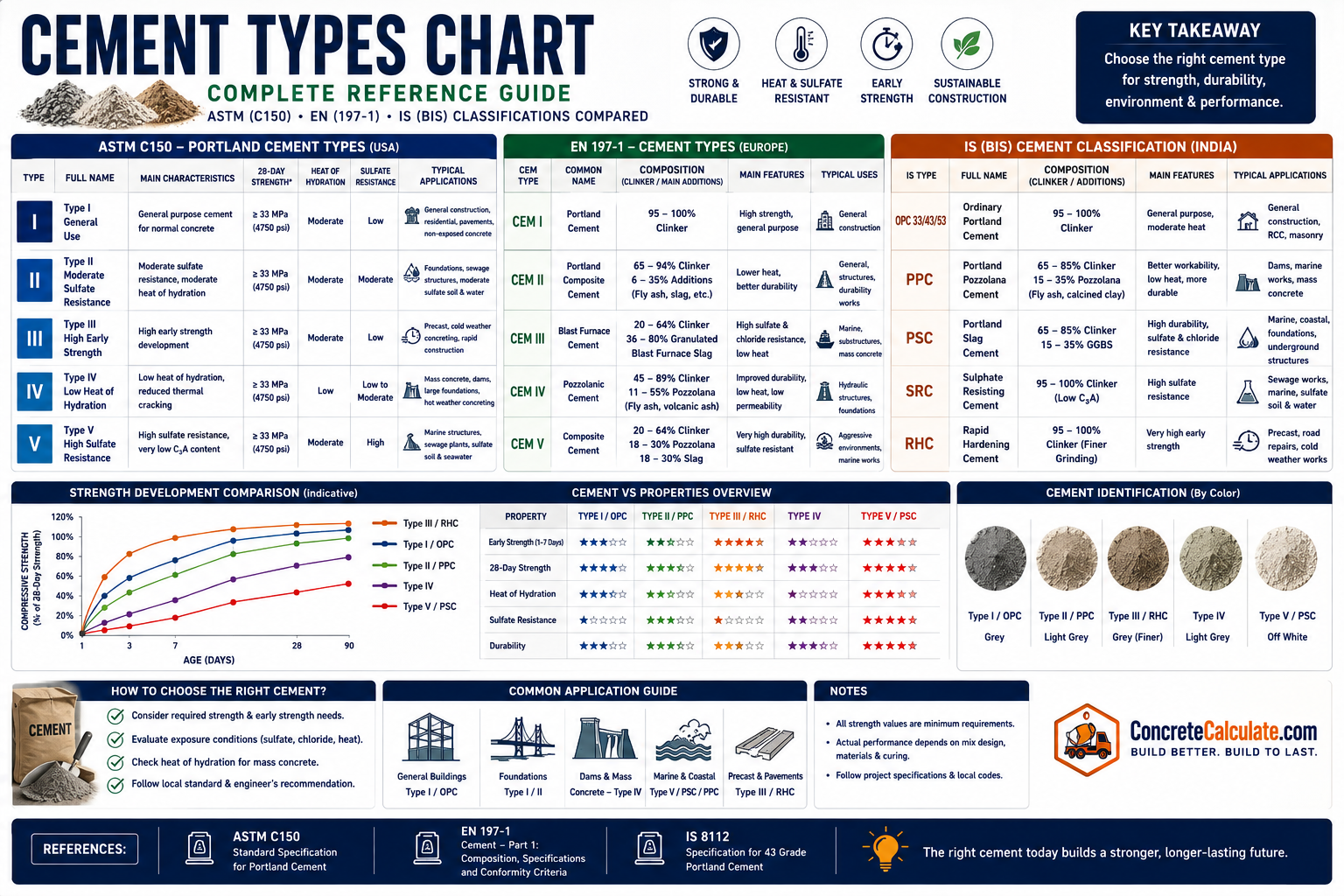
Cement Types Chart
Portland, Blended & Specialty Cements
The complete cement classification reference — ASTM Types I-V, European CEM I-V, Indian OPC/PPC/PSC, and specialty cements compared side-by-side.
 Reviewed by Muhammad Ramzan Babar, PhD Researcher (Plasma Physics) & Calculator Developer — View Profile
⭐ Master Cement Types Chart
Complete reference comparing Portland cement types, blended cements, and specialty cements by strength, key properties, and applications.
How to Read This Chart
Classifications follow ASTM C150 (US), EN 197-1 (Europe), and IS 269 (India). Estimate cement quantity for your project with our Cement Calculator.
| Cement Category | Examples | Key Trait | Common Use |
|---|---|---|---|
| Portland Cement | Type I, Type II, Type III | High clinker, predictable strength | General structural concrete |
| Blended Cement | PPC, PSC, CEM II-V | Reduced clinker, improved durability | Marine, mass concrete, sustainability |
| Specialty Cement | White, Rapid Hardening, High Alumina | Tailored performance property | Decorative, precast, refractory |
Source: ASTM C150 cement type specifications and EN 197-1 common cement family classification [web:299][web:300].
⭐ Portland Cement Types Chart
ASTM C150 defines eight standard Portland cement types based on intended use and special properties.
| Cement Type | Standard | Typical Uses | Key Properties |
|---|---|---|---|
| Type I | ASTM C150 | General construction, no special exposure | All-purpose, standard strength gain |
| Type IA | ASTM C150 | Same as Type I, air-entrained | Freeze-thaw resistance added |
| Type II | ASTM C150 | Soil/groundwater with moderate sulfates | Moderate sulfate resistance |
| Type IIA | ASTM C150 | Same as Type II, air-entrained | Moderate sulfate + freeze-thaw resistance |
| Type III | ASTM C150 | Cold weather, fast-track construction | High early strength |
| Type IIIA | ASTM C150 | Same as Type III, air-entrained | High early strength + freeze-thaw resistance |
| Type IV | ASTM C150 | Mass concrete, dams | Low heat of hydration |
| Type V | ASTM C150 | Marine, high-sulfate soils | High sulfate resistance |
Source: ASTM C150/C150M Standard Specification for Portland Cement [web:299][web:297].
⭐ Cement Types by Construction Application
Selecting the right cement type depends primarily on exposure conditions and required strength development speed.
| Project | Recommended Cement Type |
|---|---|
| Foundations | Type I (Type II/V if sulfate soils) |
| Footings | Type I (Type II if moderate sulfate) |
| Driveways | Type I / Type IA (freeze-thaw regions) |
| Sidewalks | Type I / Type IA |
| Patios | Type I |
| Garage Floors | Type I / Type III (fast-track) |
| Retaining Walls | Type II (soil contact, moderate sulfate) |
| Columns | Type I / Type III (precast/fast forms) |
| Beams | Type I / Type III |
| Bridge Decks | Type II |
| Marine Structures | Type V / CEM III |
| Dams | Type IV (low heat, mass concrete) |
| Industrial Floors | Type I / Type III |
Cement Types by ASTM Classification
ASTM C150 remains the primary US standard governing Portland cement type designations.
| ASTM Type | Intended Application | Performance Characteristic |
|---|---|---|
| Type I | General use, no special properties required | Balanced strength and cost |
| Type II | Underground structures, roadways, moderate sulfate exposure | Moderate sulfate resistance |
| Type III | Cold weather, precast, fast-track construction | High early strength |
| Type IV | Mass concrete pours, large dams | Low heat of hydration |
| Type V | Coastal structures, piers, submerged tunnels | High sulfate resistance |
Source: NPCA cement types guide referencing ASTM C150 applications [web:297].
Cement Types by EN Classification
EN 197-1 groups common cements into five families based on clinker content and secondary constituents.
| EN Type | Composition (Clinker %) | Typical Uses |
|---|---|---|
| CEM I | 95-100% clinker | Structural, precast, general concrete |
| CEM II | 65-94% clinker + composite additions | General construction, broad-range use |
| CEM III | 5-64% clinker + 36-95% slag | Marine, mass concrete, chloride/sulfate exposure |
| CEM IV | 45-89% clinker + 11-55% pozzolana | Durability-focused, later-age strength |
| CEM V | 20-64% clinker + slag & pozzolana | Low-carbon composite applications |
Source: EN 197-1:2011 common cement composition specifications [web:300][web:309][web:302].
Cement Types by IS Classification
Indian Standard IS 269:2015 defines OPC grades by 28-day compressive strength, alongside blended PPC and PSC cements.
| IS Type | Strength Class | Recommended Applications |
|---|---|---|
| OPC 33 | 33 MPa min (28-day) | Low-strength, non-structural work |
| OPC 43 | 43 MPa min (28-day) | General RCC, plastering, masonry |
| OPC 53 | 53 MPa min (28-day) | Structural RCC, precast, high-strength work |
| PPC | Comparable to OPC 33/43 | Mass concrete, durability-focused, marine |
| PSC | Comparable to OPC 33/43 | Marine, mass concrete, chemical resistance |
Source: IS 269:2015 OPC grade requirements [web:306][web:311][web:308].
Cement Types by Compressive Strength
Strength development speed varies significantly across cement types, especially at early ages.
| Cement Type | Early Strength | 7-Day Strength | 28-Day Strength |
|---|---|---|---|
| Type I | Moderate | Moderate | Standard reference |
| Type II | Moderate (slightly slower) | Moderate | Comparable to Type I |
| Type III | High | High (near 28-day levels) | Comparable/slightly higher |
| Type IV | Low | Low | Lower, gains over longer time |
| Type V | Low-Moderate | Moderate | Comparable to Type I |
| PPC/PSC | Low-Moderate | Moderate | Comparable to OPC, improves with age |
Cement Types by Setting Time
Setting time affects handling window and formwork removal schedules on site.
| Cement Type | Initial Setting Time | Final Setting Time | Early Strength Development |
|---|---|---|---|
| Type I | ~45-60 min (min) | ~6-10 hours | Standard |
| Type III | Similar or slightly faster | Slightly faster | Accelerated |
| Rapid Hardening | ~30-45 min | ~4-6 hours | Very fast |
| PPC/PSC | ~60-90 min | ~8-12 hours | Slower initial gain |
Cement Types by Heat of Hydration
Heat generation during curing determines suitability for mass pours and hot/cold weather concreting.
| Heat Level | Cement Types | Most Suitable For |
|---|---|---|
| Low Heat | Type IV, CEM III, CEM IV | Dams, mass concrete, thick foundations |
| Moderate Heat | Type II, Type V | Bridge decks, retaining walls |
| High Heat | Type III, Rapid Hardening | Precast, cold weather, fast-track jobs |
Source: NPCA guide on Type IV low-heat applications in mass pours [web:297].
Cement Types by Sulfate Resistance
Sulfate resistance depends primarily on tricalcium aluminate (C3A) content in the clinker.
| Resistance Level | Cement Type | Typical Exposure Environment |
|---|---|---|
| Ordinary Portland Cement | Type I | No sulfate exposure, normal soils |
| Moderate Sulfate Resistant | Type II | Moderate sulfate soils/groundwater |
| High Sulfate Resistant | Type V, EN Sulfate Resisting Cement | Severe sulfate soils, marine, chemical plants |
Source: EN 197-1 Sulfate Resisting Portland Cement classifications (SR0/SR3/SR5) [web:305].
⭐ Cement Types by Climate
Ambient temperature and environmental exposure significantly affect optimal cement selection.
| Climate | Recommended Cement Type |
|---|---|
| Hot Weather | Type II / Type IV (low heat) |
| Cold Weather | Type III (high early strength) |
| Marine Environments | Type V / CEM III |
| Freeze-Thaw Regions | Type IA / Type IIA (air-entrained) |
| Desert Climates | Type II / Type IV |
| High-Humidity Regions | PPC / CEM IV (pozzolanic durability) |
Blended Cement Comparison Chart
Blended cements replace part of the clinker with supplementary materials, altering strength gain and durability.
| Blended Type | Advantages | Limitations | Common Uses |
|---|---|---|---|
| Portland Pozzolana Cement (PPC) | Improved durability, lower heat, sustainable | Slower early strength gain | Mass concrete, marine, general RCC |
| Portland Slag Cement (PSC) | High sulfate/chloride resistance, lower heat | Slower strength at low temperature | Marine structures, mass concrete |
| Limestone Cement | Lower carbon footprint, cost efficient | Slightly reduced long-term strength | General construction, lower-grade concrete |
| Composite Cement | Balanced durability and sustainability | Performance varies by blend ratio | Low-carbon structural concrete |
Source: OPC vs PPC vs PSC comparison guide [web:307][web:308].
Specialty Cement Types Chart
Specialty cements are engineered for specific performance requirements outside standard structural concrete.
| Specialty Type | Common Use |
|---|---|
| White Cement | Architectural finishes, decorative concrete, terrazzo |
| Masonry Cement | Mortar, plastering, brick/block laying |
| Rapid Hardening Cement | Precast, emergency repairs, fast-track construction |
| High Alumina Cement | Refractory linings, high-temperature applications |
| Expansive Cement | Shrinkage-compensating slabs, crack control |
| Colored Cement | Decorative paving, architectural elements |
| Oil Well Cement | Well casing, petroleum industry cementing |
Cement Types vs Concrete Strength
Cement type strongly influences strength development rate but is only one factor in overall concrete performance.
Early Strength
Type III/Rapid Hardening develop strength fastest in the first days
Long-Term Strength
Blended cements (PPC/PSC) can match or exceed OPC strength beyond 28 days
Durability
Sulfate-resistant and blended cements improve long-term durability in aggressive exposure
Workability
Finer-ground and blended cements can improve workability at equal water content
Important Clarification
Cement type alone does not determine final concrete strength — mix design, water-cement ratio, aggregate quality, and curing practices all play equally critical roles in achieving target performance.
Cement Types vs Water-Cement Ratio
Different cement types tolerate slightly different water-cement ratios based on fineness and hydration rate.
| Cement Type | Typical Recommended W/C Ratio |
|---|---|
| Type I | 0.40-0.50 |
| Type II | 0.40-0.45 |
| Type III | 0.40-0.45 |
| Type V | 0.35-0.40 |
| PPC/PSC | 0.40-0.50 |
For full exposure-based ratios, see our Water-Cement Ratio Chart or the Water-Cement Ratio Calculator.
Cement Types vs Durability
Durability performance varies significantly by cement type depending on the specific deterioration mechanism.
| Cement Type | Sulfates | Chlorides | Freeze-Thaw | Chemical Attack | ASR |
|---|---|---|---|---|---|
| Type I | Low | Moderate | Low (unless air-entrained) | Low | Moderate |
| Type II | Moderate | Moderate | Low (unless air-entrained) | Moderate | Moderate |
| Type V | High | Moderate | Low (unless air-entrained) | High | Moderate |
| CEM III (Slag) | High | High | Moderate | High | High (reduces ASR) |
| PPC/CEM IV | Moderate-High | Moderate | Moderate | Moderate-High | High (reduces ASR) |
⭐ Cement Selection Guide
A quick decision reference matching common project types to the most appropriate cement type and rationale.
| Project | Recommended Cement | Why |
|---|---|---|
| Residential driveway | Type I / Type IA | General use, freeze-thaw resistance if needed |
| House foundation | Type I / Type II | Standard soil contact; Type II if sulfates present |
| Commercial precast panel | Type III | Fast strength gain for quick form reuse |
| Bridge deck | Type II | Balanced strength and moderate sulfate resistance |
| Marine pier | Type V / CEM III | High sulfate and chloride resistance needed |
| Dam / mass pour | Type IV | Minimizes heat-related thermal cracking |
| Decorative walkway | White Cement | Aesthetic finish requirement |
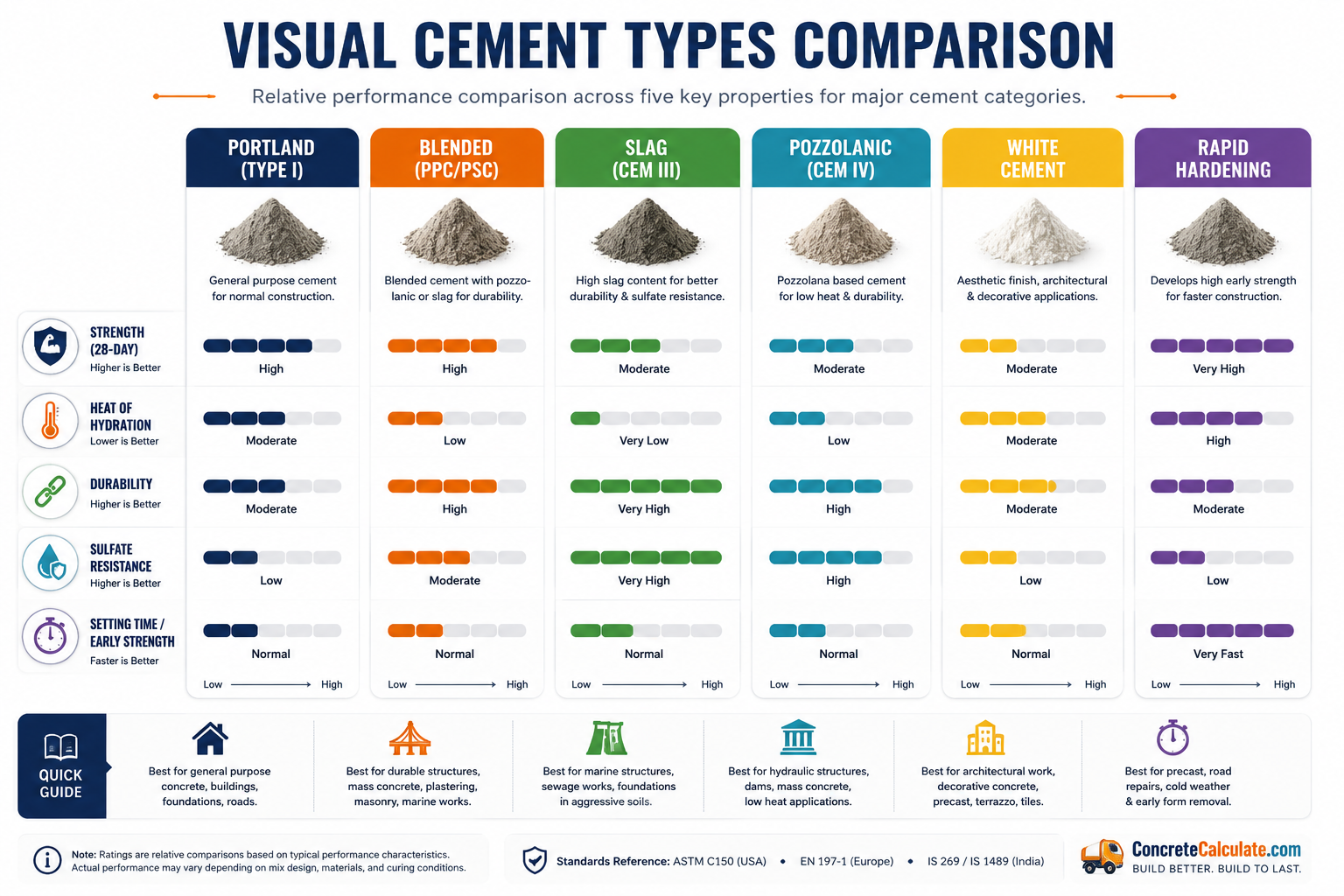
⭐ Visual Cement Types Comparison
Relative performance comparison across five key properties for major cement categories.
Portland (Type I)
Blended (PPC/PSC)
Slag (CEM III)
Pozzolanic (CEM IV)
White Cement
Rapid Hardening
Bar values represent relative comparative ranking, not absolute measured units.
Common Cement Selection Mistakes
These errors lead to premature deterioration, cost overruns, or construction delays.
Choosing Type I for sulfate-rich soils
Standard Type I cement lacks sulfate resistance and will deteriorate rapidly in aggressive soil or groundwater conditions.
Using rapid-hardening cement unnecessarily
Rapid hardening cement generates more heat and costs more, providing no benefit when standard schedules allow normal curing time.
Ignoring exposure conditions
Failing to assess sulfate, chloride, or freeze-thaw exposure before cement selection is a leading cause of premature structural failure.
Confusing cement type with concrete strength
Cement type affects strength gain rate and durability, but final concrete strength depends equally on mix design and curing.
Using specialty cement without a project need
Specialty cements like high alumina or oil well cement carry significant cost premiums that are unjustified for standard structural work.
Contractor Worked Examples
Real-world cement selection decisions for common project scenarios.
Residential Driveway
House Foundation
Marine Structure
Bridge Deck
Dam Construction
Industrial Warehouse
Decorative Concrete
Frequently Asked Questions
📥 Download Cement Types Chart PDF
Use your browser’s print function to instantly save this page as a PDF — a printable engineering reference with cement type tables, ASTM/EN/IS classifications, application guide, climate guide, strength comparison, and selection flowchart.