Concrete Air Content Chart: ACI Targets & Tolerances
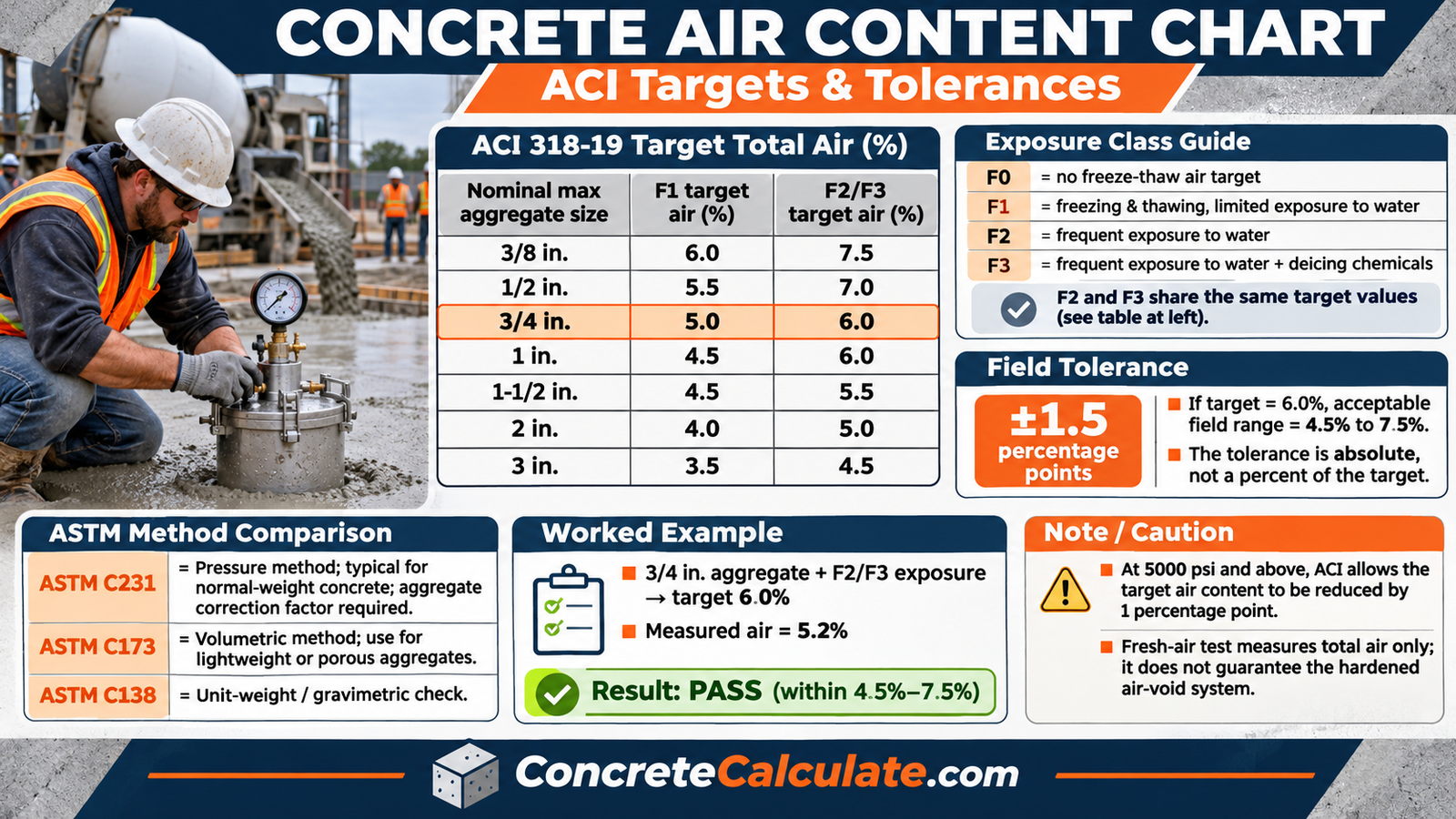
Total air content targets by aggregate size and freeze-thaw exposure class, with field tolerances, ASTM test-method selection, and worked result interpretation.
 Reviewed by Muhammad Ramzan Babar, PhD Researcher (Plasma Physics) & Calculator Developer. View Profile
⭐ Concrete Air Content Chart: Quick Reference
A concrete air content chart gives ACI 318-19 total air targets by nominal maximum aggregate size and freeze-thaw exposure class: for 3/4 in. aggregate, 5.0% for F1 and 6.0% for F2 and F3, each with a ±1.5 percentage-point field tolerance. These are code table values, not a universal air percentage.
ACI Air Content Targets by Aggregate Size
| Nominal maximum aggregate size | Approx. metric size | F1 target air (%) | F2/F3 target air (%) |
|---|---|---|---|
| 3/8 in. | 9.5 mm | 6.0 | 7.5 |
| 1/2 in. | 12.5 mm | 5.5 | 7.0 |
| 3/4 in. | 19 mm | 5.0 | 6.0 |
| 1 in. | 25 mm | 4.5 | 6.0 |
| 1-1/2 in. | 37.5 mm | 4.5 | 5.5 |
| 2 in. | 50 mm | 4.0 | 5.0 |
| 3 in. | 75 mm | 3.5 | 4.5 |
Source: ACI 318-19 Table 19.3.3.1 as reproduced in the ACI Foundation CRC 117 report (Table 2, ACI 318-19 columns) and the NRMCA guide to selecting exposure classes. Air content is total air by volume of freshly mixed concrete, including entrained and entrapped air.
✓ Checked against the ACI Foundation CRC 117 table and the NRMCA exposure-class guide (ACI 318-19 columns), November 2026- Values are total air content by volume of fresh concrete, including entrained and entrapped air.
- F1, F2, and F3 are ACI freeze-thaw exposure classes, not general severity labels. The chart does not apply to concrete outside those requirements, and it is not a shotcrete table.
- ACI 318-19 allows a field tolerance of ±1.5 percentage points. A 6.0% target means 4.5% to 7.5%, not 6.0% ± 1.5% of 6.0.
- ACI 318-19 allows the specified air content to be reduced by 1 percentage point when the specified strength is 5000 psi or more (see Section 7).
- Nominal maximum aggregate size comes from the approved mixture, not from looking at the stones. Verify the adopted code edition and project documents before using these values as acceptance criteria.
F1 vs. F2/F3 Exposure Classes
F1 is limited exposure to water; F2 and F3 are frequent exposure to water, and F3 adds deicing chemicals (see Section 5).
How to Read the Chart
Find the nominal maximum aggregate size, then read the column for the assigned exposure class. For complete size definitions see the nominal aggregate size chart.
3/4 in. aggregate: F1 vs. F2/F3
Applies where the adopted code and project documents use ACI 318-19 and the exposure class is correctly assigned.
What Is Air Content in Concrete?
Air content is the percentage of the freshly mixed concrete volume occupied by air, so 6% air means 0.06 of the volume, or 1.62 ft³ in each cubic yard.
Total Air Content by Volume
A = (V_air ÷ V_concrete) × 100. It is a volumetric proportion, not an admixture dosage, and it is different from water content, porosity, and slump.
Air in Fresh Concrete
Fresh-concrete air is measured by ASTM test methods (see Section 15).
Why Air Content Matters
Concrete exposed to freezing and thawing needs an adequate air-void system; too much air can reduce strength and complicate finishing.
Air-Entrained vs. Non-Air-Entrained Concrete
Air-entrained concrete contains many small, intentionally stabilized bubbles, while non-air-entrained concrete still contains a smaller amount of larger entrapped air.
| Property | Entrained air | Entrapped air |
|---|---|---|
| Origin | Intentionally formed with an air-entraining admixture | Incidental, from mixing and handling |
| Size | Small bubbles, stabilized in the paste | Larger, irregular voids |
| Distribution | Many, closely spaced voids | Few, widely spaced voids |
| Freeze-thaw role | Provides pressure-relief space | Not a reliable protection system |
| Present in non-air-entrained concrete? | No | Yes: measurable air can still be present |
Concepts per the NRMCA CIP 2, Scaling Concrete Surfaces and the ACI Foundation CRC 117 report. Total air percentage alone does not describe the hardened air-void system.
Why Bubble Distribution Matters
Bubble size and spacing matter as much as the total percentage. See Section 24.
⭐ ACI 318 Concrete Air Content Requirements
ACI 318-19 Table 19.3.3.1 requires air-entrained concrete for exposure classes F1, F2, and F3, with a target total air content by aggregate size and a field tolerance of ±1.5 percentage points.
ACI 318-19 Table 19.3.3.1
The target values are in the main chart. ACI 201.2R-16 gives higher recommended values; do not mix its column with ACI 318-19 values.
| Nominal maximum aggregate size | ACI 201.2R-16 F1 | ACI 318-19 F1 | ACI 201.2R-16 F2/F3 | ACI 318-19 F2/F3 |
|---|---|---|---|---|
| 3/8 in. | 7.0 | 6.0 | 7.5 | 7.5 |
| 1/2 in. | 7.0 | 5.5 | 7.0 | 7.0 |
| 3/4 in. | 6.5 | 5.0 | 7.0 | 6.0 |
| 1 in. | 6.5 | 4.5 | 6.5 | 6.0 |
| 1-1/2 in. | 6.0 | 4.5 | 6.5 | 5.5 |
| 2 in. | 6.0 | 4.0 | 6.0 | 5.0 |
| 3 in. | 5.0 | 3.5 | 5.5 | 4.5 |
Source: ACI Foundation CRC 117 report, Table 2. Use the ACI 318-19 columns for the chart on this page; ACI 201.2R-16 is a guide with higher values. Both documents allow a field tolerance of ±1.5%.
✓ Checked against the ACI Foundation CRC 117 table and the NRMCA exposure-class guide (ACI 318-19 columns), November 2026Field Tolerances
±1.5 percentage points on the target, subject to the project specification.
Adopted Code vs. Published Edition
The legally applicable code is the edition the jurisdiction adopts, and the project documents control. ACI 318-25 is the newest ACI edition (see the ACI 318 building code portal), so confirm whether the adopted edition and its table match these ACI 318-19 values before using them. Do not assume a newer edition has identical values.
⭐ Concrete Freeze-Thaw Exposure Classes F0 to F3
ACI 318-19 assigns F0 to F3 by freeze-thaw exposure, how frequently the concrete is exposed to water, and deicing chemicals, not by state climate or the word outdoor.
| Class | ACI condition | Examples from ACI commentary (as summarized by NRMCA) | Air-content implication |
|---|---|---|---|
| F0 | Concrete not exposed to freezing-and-thawing cycles | Members the designer determines are not exposed to freezing and thawing | No F-class air target in the chart |
| F1 | Freezing and thawing with limited exposure to water | Exterior walls, beams, girders, and slabs not in direct contact with soil, not subject to snow and ice accumulation | Use the F1 target |
| F2 | Freezing and thawing with frequent exposure to water | Exterior elevated slabs with snow and ice accumulation; members in contact with soil | Use the F2/F3 target |
| F3 | F2 conditions plus exposure to deicing chemicals | Horizontal members in parking structures; foundation or basement walls extending above grade where deicing chemicals accumulate | Use the F2/F3 target (plus other F3 limits) |
Source: ACI 318-19 Table 19.3.1.1 and commentary as reproduced in the NRMCA guide to selecting exposure classes and NRMCA Guide to Improving Specifications for Ready Mixed Concrete. A simplified aid, not a substitute for the adopted ACI definitions. ACI commentary says to choose the more conservative F2 if there is doubt between F1 and F2. F0 does not mean zero air; it means no freeze-thaw air requirement.
✓ Class wording checked against the NRMCA guide quoting ACI 318-19, November 2026F0, F1, F2, and F3
F1 and F2 do not anticipate deicing chemicals; F3 does. Assign the class by the exposure of each member rather than by climate alone.
⭐ Concrete Air Content by Aggregate Size
Smaller nominal maximum aggregate needs more total air, for example 6.0% (F1) and 7.5% (F2/F3) at 3/8 in. versus 3.5% and 4.5% at 3 in., because smaller aggregate means more paste and mortar.
3/8-Inch and 1/2-Inch Aggregate
6.0% and 7.5% at 3/8 in.; 5.5% and 7.0% at 1/2 in.
3/4-Inch and 1-Inch Aggregate
5.0% and 6.0% at 3/4 in.; 4.5% and 6.0% at 1 in.
1-1/2-Inch Through 3-Inch Aggregate
4.5% and 5.5% at 1-1/2 in.; 4.0% and 5.0% at 2 in.; 3.5% and 4.5% at 3 in.
Why Aggregate Size Changes the Target
Entrained air lives in the paste, so concrete with more paste per unit volume needs a higher total air content to keep a similar air fraction in the paste. ACI 201.2R-16 builds its values on 18% air in the paste fraction (ACI Foundation CRC 117 report). See the nominal aggregate size chart.
⭐ Concrete Air Content Tolerance Chart
ACI 318-19 allows ±1.5 percentage points on the target, so a 6.0% target gives a calculated interval of 4.5% to 7.5%, and a 5.0% target gives 3.5% to 6.5%.
| Nominal maximum aggregate size | F1 target | F1 calculated range | F2/F3 target | F2/F3 calculated range |
|---|---|---|---|---|
| 3/8 in. | 6.0% | 4.5 to 7.5% | 7.5% | 6.0 to 9.0% |
| 1/2 in. | 5.5% | 4.0 to 7.0% | 7.0% | 5.5 to 8.5% |
| 3/4 in. | 5.0% | 3.5 to 6.5% | 6.0% | 4.5 to 7.5% |
| 1 in. | 4.5% | 3.0 to 6.0% | 6.0% | 4.5 to 7.5% |
| 1-1/2 in. | 4.5% | 3.0 to 6.0% | 5.5% | 4.0 to 7.0% |
| 2 in. | 4.0% | 2.5 to 5.5% | 5.0% | 3.5 to 6.5% |
| 3 in. | 3.5% | 2.0 to 5.0% | 4.5% | 3.0 to 6.0% |
Arithmetic on the ACI 318-19 targets with the ±1.5 percentage-point tolerance. ASTM C94 also uses ±1.5% for air content and has its own provisions for jobsite adjustment and retesting before rejection (NRMCA Guide to Improving Specifications for Ready Mixed Concrete). These are calculated intervals, not project acceptance specifications.
✓ Calculated from stated values, arithmetic checked, November 2026What ±1.5 Percentage Points Means
It is an absolute difference in air percentage, not 1.5% of the target value.
Air content acceptance interval
Use the tolerance prescribed by the governing project documents.
Lower and Upper Acceptance Limits
The table lists them by aggregate size and class. ACI 318-19 also allows the specified air content to be reduced by 1 percentage point when the specified compressive strength is 5000 psi or more (NRMCA guide to selecting exposure classes).
Strength-based reduction (ACI 318-19 provision)
Applies only where the specification adopts that provision and f’c is at least 5000 psi. Confirm with the engineer of record.
How to Interpret Borderline Results
A reading at a boundary is within the calculated interval, but the project’s acceptance procedure decides what happens next.
⭐ Recommended Air Content for Exterior Concrete
NRMCA recommends about 6% total air for exterior slabs with 3/4 in. or 1 in. coarse aggregate that stay moist and see deicing chemicals, which matches the ACI 318-19 F2/F3 target but does not replace it.
| Source | Condition | Total air (%) |
|---|---|---|
| ACI 318-19 Table 19.3.3.1 | 3/4 in., F1 | 5.0 |
| ACI 318-19 Table 19.3.3.1 | 3/4 in. or 1 in., F2/F3 | 6.0 |
| NRMCA CIP 2 | 3/4 in. or 1 in. aggregate, exterior slab continuously moist with deicing chemicals | about 6 |
Sources: ACI 318-19 Table 19.3.3.1 and the NRMCA CIP 2, Scaling Concrete Surfaces. NRMCA also recommends a specified strength of 4000 psi for those slabs and a slump of about 3 to 5 in. The NRMCA value is practical guidance for the stated conditions, not a universal requirement or a replacement for the adopted ACI table.
✓ NRMCA 6% recommendation confirmed in CIP 2 text, November 2026Exterior Flatwork and Freeze-Thaw Exposure
Exterior slabs exposed to freezing and thawing need air-entrained concrete.
Moisture and Deicing Chemicals
Deicers increase saturation and the number of freeze-thaw cycles (NRMCA CIP 2, Scaling Concrete Surfaces).
Why One Percentage Does Not Fit Every Project
The right target comes from aggregate size, exposure class, strength, and project documents.
Concrete Air Content for Driveways and Sidewalks
Driveways and sidewalks in freezing climates generally need air-entrained concrete, but not every U.S. driveway requires 6% air, because the target depends on exposure and aggregate size.
| Item | Recommendation (NRMCA CIP 2) |
|---|---|
| Strength | 4000 psi for continuously moist slabs with deicers; 3500 psi otherwise |
| Air | Air-entrained, about 6% for 3/4 in. or 1 in. aggregate |
| Slump | About 3 to 5 in.; do not add excess water |
| Finishing | Wait until bleed water is gone; avoid steel trowels and overworking |
| Curing | Cure properly; consider a breathable sealer |
| Deicers | Avoid in the first winter; use moderate amounts afterward |
Source: NRMCA CIP 2, Scaling Concrete Surfaces. Practical guidance, not a code requirement. See the proper concrete finishing practices guide for finishing steps.
✓ Confirmed in the NRMCA CIP 2 text, November 2026Freeze-Thaw and Deicing Salt Exposure
The more often the slab is saturated and salted, the greater the scaling risk.
Surface Scaling Risk and Finishing
Finishing can reduce air near the surface. See the proper concrete finishing practices.
Concrete Air Content for Slabs and Floors
Exposed exterior slabs follow the freeze-thaw air targets, while protected interior floors have no ACI freeze-thaw air requirement, and no universal air maximum applies to every interior floor.
Exterior Slabs
Use the exposure class and aggregate size from the chart.
Interior Slabs
Interior concrete not exposed to freezing and thawing is F0, so the air chart does not apply.
Hard-Troweled Floors and Surface Defects
Entrained air can complicate dense, hard-troweled finishes, because finishing can trap air and water under the surface. Follow the project specification and the finishing guidance in the proper concrete finishing practices.
Air Content for Foundations, Walls and Structural Concrete
Whether a footing, wall, or column needs freeze-thaw air depends on its exposure to freezing, water, and deicing chemicals, not on what the member is called.
| Member and condition | Likely class (ACI commentary examples) |
|---|---|
| Exterior wall, beam, or slab not in contact with soil, no snow or ice buildup | F1 |
| Exterior elevated slab with snow and ice accumulation | F2 |
| Horizontal and vertical members in contact with soil subject to freezing | F2 |
| Foundation or basement wall extending above grade, snow and ice buildup | F2 |
| Same wall where deicing chemicals accumulate | F3 |
| Member not exposed to freezing and thawing cycles | F0 |
Source: ACI 318-19 commentary examples as reproduced by the NRMCA guide to selecting exposure classes. The licensed design professional assigns the class; choose F2 if unsure between F1 and F2.
✓ Checked against the NRMCA guide quoting ACI commentary, November 2026Below-Grade Concrete and Exposed Foundation Walls
Concrete the designer determines is not exposed to freezing and thawing is F0; walls extending above grade can be F2 or F3.
Structural Members Subject to Freezing
Check the exposure of each member and follow the engineer’s classification.
How Air Entrainment Improves Freeze-Thaw Durability
Entrained air gives freezing water in the cement paste nearby empty voids to expand into, which reduces internal pressure, and the spacing of those voids matters as much as total air.
Freezing Water in Cement Paste
Saturated paste develops internal stress as water freezes and expands. (NRMCA CIP 2, Scaling Concrete Surfaces)
Pressure Relief Through Air Voids
Millions of small air bubbles accommodate expanding water and ice and prevent stress buildup.
Air-Void Spacing and Limits of Total Air Percentage
Total air does not describe the whole system. Research shows the spacing factor is a strong predictor of freeze-thaw durability (ACI Foundation CRC 117 report).
How Air Content Affects Concrete Strength
More air than the exposure requires can reduce compressive strength, but no universal psi loss per percentage point applies, because the effect depends on the mixture and its water-cementitious ratio.
Strength vs. Air Content
Entrained air is needed for durability, and raising air changes the achievable strength of a given mixture. ACI 318-19 recognizes this by allowing a 1 percentage point lower target at 5000 psi and above.
Mixture Proportioning
Compensate through proportioning, not by guessing a loss. See the concrete mix design reference and concrete mix ratio chart.
No Universal PSI-Loss Formula
Use the Concrete PSI Strength Calculator and the concrete strength gain chart for strength questions.
How Air Content Affects Workability and Finishing
Entrained air can improve cohesion and reduce bleeding, but air content is not slump, and inappropriate finishing can strip air from the surface.
Fresh Concrete Cohesion and Bleeding
Entrained air generally makes fresh concrete more cohesive and less prone to bleeding.
Finishing Response and Surface Durability
Do not finish with bleed water present, avoid overworking, and avoid steel trowels on exterior surfaces (NRMCA CIP 2, Scaling Concrete Surfaces).
Slump and air are separate measurements. See the concrete slump chart.
⭐ ASTM Concrete Air Content Testing Methods
Fresh-concrete air is measured by the pressure method (ASTM C231), volumetric method (ASTM C173), or gravimetric method (ASTM C138), and ASTM C457 evaluates the hardened air-void system.
| Method | Standard | Material tested | Main purpose | Important limitation |
|---|---|---|---|---|
| Pressure | ASTM C231/C231M | Fresh concrete | Air from volume change under a known pressure | Not suitable for lightweight or highly porous aggregates; needs the aggregate correction factor |
| Volumetric | ASTM C173/C173M | Fresh concrete | Air removed by agitation in a water-filled vessel and read as a drop in water level | Needs correct rolling, foam control, and reading |
| Gravimetric | ASTM C138/C138M | Fresh concrete | Air calculated from measured density and theoretical air-free density | Needs accurate mixture and density data |
| Microscopy | ASTM C457/C457M | Hardened concrete | Evaluates air-void system parameters | Not a routine fresh-concrete field test |
Sources: ACI technical FAQ on fresh concrete air content; ASTM C231/C231M-26; ASTM C173/C173M-26; ASTM C457/C457M-24 (editions as listed in the approved outline, so confirm the edition your specification cites). The complete ASTM procedures govern actual testing.
✓ Method descriptions checked against the ACI technical FAQ, November 2026ASTM C231, C173, C138, and C457
The pressure and volumetric methods have some advantage over the gravimetric method. For concrete made with low-density aggregates the pressure method cannot be used because of air in the aggregate pores, so the volumetric method is used (ACI technical FAQ on fresh concrete air content).
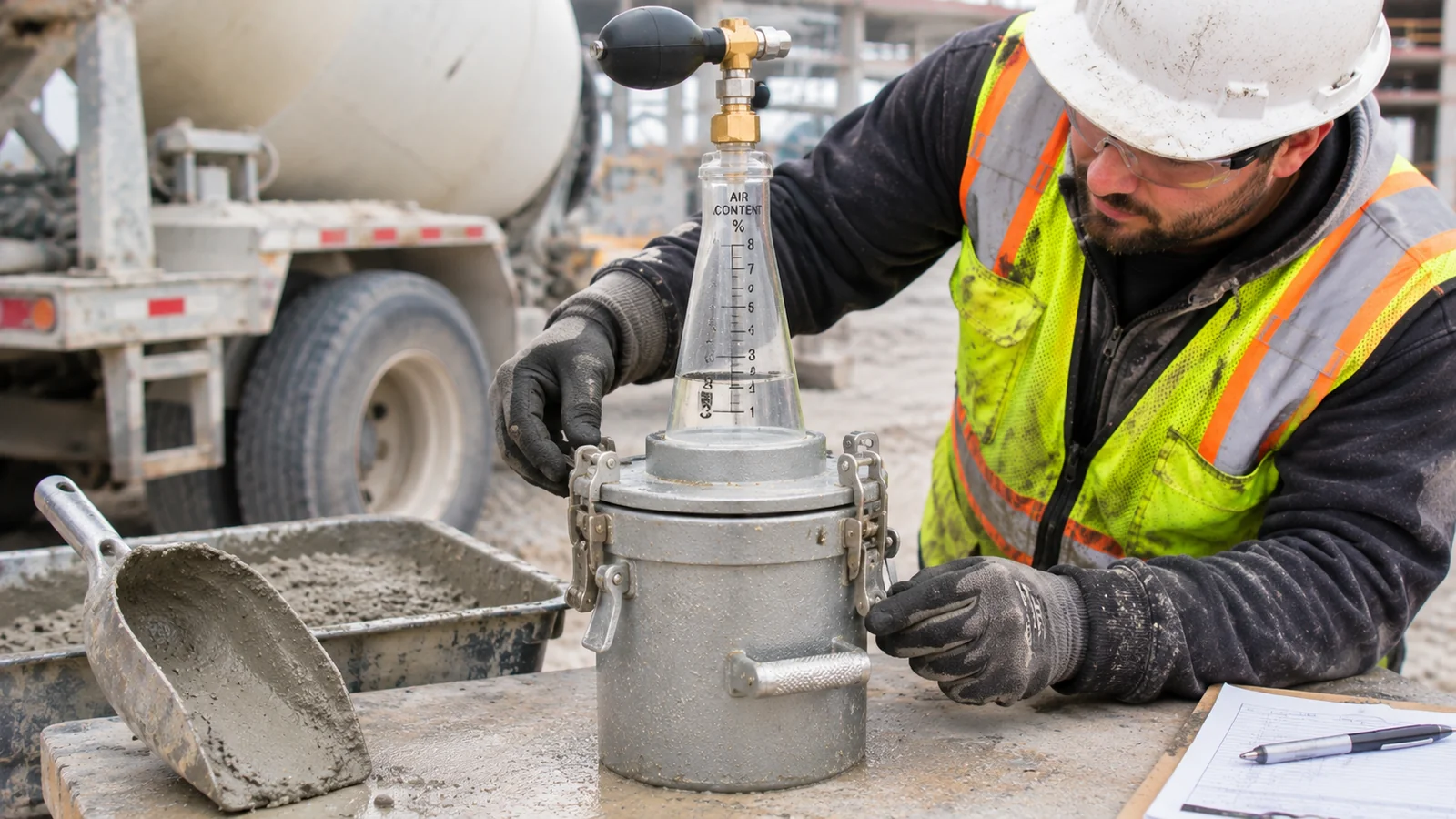
How to Test Concrete Air Content With a Pressure Meter
The pressure method (ASTM C231) finds air from the change in concrete volume under a known pressure and suits concrete made with relatively dense aggregates, using the aggregate correction factor.
When the Pressure Method Is Appropriate
Use it with dense aggregates. Do not use it with lightweight or highly porous aggregates.
Sampling and Preparing the Test
Use a representative sample and consolidate the meter bowl as the standard requires.
Aggregate Correction Factor
The factor corrects for air in the aggregate and must be determined for the aggregate in the mixture.
Reading and Recording the Result
Record the corrected reading with the sampling location. This is an overview, not a replacement for ASTM C231/C231M-26. Calibration, consolidation, and technician qualification matter.

How to Test Concrete Air Content With a Volumetric Meter
The volumetric method (ASTM C173) removes air by agitating the concrete in a closed water-filled vessel and reads the drop in water level, so it suits lightweight and porous aggregates.
When to Use a Roll-A-Meter
Use it where aggregate pores would make a pressure reading unreliable.
General Measurement Principle
Air is displaced from the concrete and measured as a change in water level. Foam control and correct rolling are essential.
Common Testing Errors
Incorrect rolling, foam on the water, and misreading the neck are common errors. Follow ASTM C173/C173M-26 for the full procedure.
⭐ How to Calculate Concrete Air Content
Air content is A = V_air ÷ V_concrete × 100, so 6% of a 27 ft³ cubic yard is 1.62 ft³, and the gravimetric method uses A = (T – D) ÷ T × 100.
Air Percentage From Volume
Air volume in one cubic yard
A volume illustration, not a way to add air. Air entrainment requires controlled proportioning and admixtures.
Gravimetric Air Content
Gravimetric air content (illustrative)
Illustration only. T must come from valid mixture-proportion data; do not assume 150 lb/ft³. Follow ASTM C138 for actual testing.
Target vs. Measured Air Content
Measured vs. target air
Inside a ±1.5 point interval, if that tolerance applies.
Percentage points vs. relative change
Use percentage points for tolerances and field-reading differences.
⭐ Concrete Air Content Field Test Examples
With a 6.0% target and ±1.5 point tolerance, a 4.0% reading is below the 4.5% to 7.5% range, while 7.0% is within it, and the project procedure decides what follows.
| Measured air (%) | Difference from target | Arithmetic comparison |
|---|---|---|
| 4.0 | -2.0 points | Below calculated range |
| 4.5 | -1.5 points | At lower boundary |
| 5.5 | -0.5 points | Within calculated range |
| 6.0 | 0.0 points | Exactly at target |
| 7.0 | +1.0 point | Within calculated range |
| 7.5 | +1.5 points | At upper boundary |
| 8.0 | +2.0 points | Above calculated range |
Interprets numbers only; it does not authorize acceptance or rejection. The project test and acceptance provisions govern.
✓ Calculated from stated values, arithmetic checked, November 2026Result Within, Below, or Above Tolerance
5.5% and 7.0% are within; 4.0% is below; 8.0% is above.
Borderline and Retest Situations
Readings at 4.5% and 7.5% sit on the boundary. Retesting follows the specification and the applicable ASTM sampling and test rules.
What Causes Low Air Content in Concrete?
Low air content can come from admixture dosage or compatibility, mixing and transport, pumping and consolidation, temperature and mixture changes, or a sampling and testing problem, and no single factor always explains it.
Admixture Dosage and Compatibility
Dosage errors and interactions with other admixtures or materials can reduce entrained air.
Mixing and Transport
Mixing time, speed, and haul time affect air.
Pumping and Consolidation
Pumping and overworking can reduce air.
Temperature and Mixture Changes
Changes in materials, mixture, or temperature can shift air.
Sampling or Testing Problems
A wrong method, uncalibrated meter, or poor consolidation of the sample gives a false reading.
What Causes Excessive Air Content in Concrete?
Excessive air can result from air-entraining admixture dosage, chemical interactions, mixing conditions, material variability, or measurement and calibration errors, and unapproved jobsite adjustments should be avoided.
Air-Entraining Admixture Dosage and Chemical Interactions
Overdose or interactions with other admixtures can raise air.
Mixing Conditions and Material Variability
Mixer type, mixing time, and material changes affect air.
Measurement and Calibration Errors
Verify the test and calibration first, then consult the supplier and quality personnel. Do not make unapproved adjustments at the jobsite.
Air Content Changes During Pumping and Placement
Air content can change as concrete is handled, so before-pump and after-pump readings can differ, and the specified sampling location determines which reading applies; no fixed percentage loss from pumping exists.
Before-Pump and After-Pump Readings
Sample at the location named in the project specification.
Pressure, Bubble Stability, and Placement Effects
Pump pressure, line configuration, drops, and consolidation can all affect air.
Project-Specified Sampling Location
Confirm it before the pour so the reading is acceptable under the specification.
Air Content and Concrete Surface Scaling
Scaling is most often caused by non-air-entrained concrete or too little entrained air, especially at the surface, so proper air must be paired with good mixture quality, finishing, and curing.
| Topic | What the NRMCA guidance says |
|---|---|
| What scaling is | Local flaking or peeling of the finished surface from freezing and thawing |
| Main causes | Non-air-entrained or too little air (especially at the surface), low strength, wrong mixture, excess deicers on new concrete, poor finishing, insufficient curing |
| Role of air | Millions of small bubbles accommodate expanding water and ice |
| Finishing | Placing and finishing can reduce entrained air at the surface |
| Quality control | Proper air is one part of durability alongside mixture quality, placement, curing, and exposure |
Source: NRMCA CIP 2, Scaling Concrete Surfaces.
✓ Confirmed in the NRMCA CIP 2 text, November 2026Freeze-Thaw Scaling and Deicing Chemicals
Deicers increase saturation at the surface and the number of freeze-thaw cycles.
Finishing-Related Air Loss and Prevention
See the proper concrete finishing practices for finishing sequence.
Air Content vs. Air-Void Spacing Factor
A fresh air reading does not prove an adequate hardened air-void system, because spacing factor and void size, measured on hardened concrete by ASTM C457, drive freeze-thaw durability.
| Property | What it measures | How it is determined |
|---|---|---|
| Total air content | Percent of concrete volume that is air | Fresh-concrete tests such as ASTM C231, C173, C138 |
| Air-void size distribution and specific surface | How fine the air voids are | Hardened-concrete microscopy (ASTM C457) |
| Spacing factor | Mean half-distance between entrained air voids | ASTM C457, which requires a trained petrographer |
| Cost and timing | Slower and more expensive than fresh tests | Often used for pre- or post-qualification |
Sources: ACI Foundation CRC 117 report (spacing factor critical since 1949 but not specified by ACI committees; total air does not guarantee a quality air-void system; spacing factors of about 0.009 in. (0.23 mm) are cited in ACI 201 commentary and reported to be reachable across a total air range of about 3% to 7%); ASTM C457/C457M-24. These are reference observations, not an acceptance criterion.
✓ Checked against the ACI Foundation CRC 117 report, November 2026Hardened-concrete microscopy needs a trained petrographer and is not a routine fresh-concrete acceptance test.
⭐ What to Do When Concrete Air Content Is Out of Specification
When air content is out of specification, first verify the test and sample, check the approved mix and delivery ticket, notify the responsible parties, and follow the project acceptance procedure, without ad hoc jobsite changes.
| Finding | Possible causes to investigate | Appropriate next action |
|---|---|---|
| Low air | Dosage, admixture compatibility, air loss, testing error | Verify test, mixture, and delivery conditions |
| High air | Admixture dosage, mixing conditions, material changes | Verify test and consult supplier or quality personnel |
| Pressure and volumetric readings disagree | Method suitability, aggregate characteristics, procedure | Check method and aggregate type |
| Change after pumping | Transport and placement effects | Follow the specified sampling and testing protocol |
| Inconsistent repeated readings | Sampling, equipment, operator, mixture variability | Review calibration and sampling procedures |
| Passing fresh air but later scaling | Surface finishing, curing, exposure, hardened void system | Investigate the full durability history |
A diagnostic framework only. ASTM C94 sets a ±1.5% tolerance, permits a jobsite adjustment when air is below the lower limit, and has retesting procedures before rejection (NRMCA Guide to Improving Specifications for Ready Mixed Concrete); the project acceptance procedure and specification control. No automatic addition of air-entraining admixture, water, or chemicals is recommended here.
Verify the Test and Sample
Check the method, calibration, and sampling location.
Check the Approved Mix and Delivery Ticket
Confirm the mixture and aggregate size match the approved submittal.
Notify and Document
Notify the responsible parties, follow the acceptance procedure, and document corrective action.
Common Concrete Air Content Mistakes
The most common air content mistakes are applying 6% everywhere, using the wrong test method, and reading a percentage-point tolerance as a percentage of the target.
| Mistake | Correction |
|---|---|
| Assuming all exterior concrete needs 6% | Use the exposure class and aggregate size; 6% is the 3/4 in. F2/F3 value |
| Confusing entrained and entrapped air | Entrained air is the stabilized small-bubble system; entrapped air is incidental |
| Using the wrong test method | Use the pressure method with dense aggregates and the volumetric method with lightweight or porous aggregates |
| Ignoring aggregate size | Read the row for the nominal maximum size in the approved mix |
| Misreading percentage-point tolerances | ±1.5 points is absolute, not 1.5% of the target |
| Confusing fresh and hardened air content | A fresh reading does not verify the hardened air-void system |
Concrete Air Content FAQs
These are the most common questions about concrete air content, answered with ACI 318-19 values and ASTM test methods.
What is the normal air content of concrete?
There is no single normal value. Concrete exposed to freezing and thawing is air-entrained, with ACI 318-19 targets from 3.5% to 7.5% depending on aggregate size and exposure class, while concrete not exposed to freezing has no freeze-thaw air target. Always use the project specification and aggregate size.
Is 5% air content acceptable?
It depends. For 3/4 in. aggregate, 5.0% is the ACI 318-19 F1 target and is within the 4.5% to 7.5% interval for a 6.0% F2/F3 target. For other aggregate sizes or classes it may be outside the range, so compare it with the specified target and tolerance.
Is 6% air content good for concrete?
Six percent is the ACI 318-19 F2/F3 target for 3/4 in. and 1 in. aggregate, and NRMCA recommends about 6% for exterior slabs with those aggregates. It is not right for every mix, because smaller aggregate needs more and larger aggregate needs less.
What is the air content for 3/4-inch aggregate?
Under ACI 318-19 Table 19.3.3.1, 3/4 in. nominal maximum aggregate has a 5.0% target for F1 and 6.0% for F2 and F3, with a field tolerance of ±1.5 percentage points. The adopted code and project specifications control the value used for acceptance.
What is the recommended air content for a concrete driveway?
For a driveway exposed to freezing, moisture, and deicers with 3/4 in. or 1 in. aggregate, the ACI 318-19 F2/F3 target and NRMCA guidance are both about 6%. A driveway not exposed to freezing needs no freeze-thaw air target, so the right value depends on the project specification.
Does concrete need air entrainment in warm climates?
ACI 318 requires air entrainment for concrete exposed to freezing and thawing (F1 to F3). Concrete that is not exposed to freezing, such as in a warm climate or a protected interior, is classified F0 and has no freeze-thaw air target, though a specification can still ask for air.
What is the difference between F1, F2, and F3?
F1 is freezing and thawing with limited exposure to water, F2 is frequent exposure to water, and F3 is frequent exposure to water plus deicing chemicals. F2 and F3 share the same air targets. If there is doubt between F1 and F2, ACI commentary says to choose F2.
What is the tolerance for concrete air content?
ACI 318-19 and ASTM C94 use ±1.5 percentage points on the target, so a 6.0% target gives 4.5% to 7.5%. The tolerance is absolute, not a percentage of the target, and the project specification can set a different range, so use the tolerance written in the contract documents.
Does air entrainment reduce concrete strength?
Adding air can reduce compressive strength for a given mixture, but the amount depends on the mixture and water-cementitious ratio, so no universal psi loss per percentage point applies. ACI 318-19 recognizes the trade-off by allowing the target to drop 1 point at 5000 psi and above.
Can concrete have too much air?
Yes. Air above the intended range can reduce strength and make finishing harder. Check the test and calibration first, then follow the project acceptance procedure with the supplier and quality personnel. Do not make unapproved jobsite adjustments to bring air down.
What happens if air content is too low?
Concrete exposed to freezing and thawing becomes more vulnerable to scaling and freeze-thaw damage, especially at the surface. Verify the test, mix, and delivery conditions, notify the responsible parties, and follow the acceptance procedure rather than assuming a field fix will restore protection.
Can a concrete pump reduce air content?
It can. Air content may change as concrete is pumped and placed, so before-pump and after-pump readings can differ. No fixed percentage loss applies to every pump or mix, so test at the sampling location named in the project specification and record where the sample was taken.
What is the difference between ASTM C231 and C173?
C231 is the pressure method, which finds air from the volume change under a known pressure and needs an aggregate correction factor. C173 is the volumetric method, which removes air by agitation in water and reads the water level, and it is used with lightweight or porous aggregates.
Can the pressure method be used with lightweight aggregate?
Generally no. Air held in the pores of low-density or highly porous aggregate makes the pressure method unreliable, so the volumetric method (ASTM C173) is used instead. Check the standard and the project specification for the aggregate in the approved mixture before choosing the test.
Does a passing fresh-air test guarantee freeze-thaw durability?
No. A fresh-air test measures total air, not the spacing and size of the hardened air voids. Transport, pumping, finishing, and curing also affect the final system, and ASTM C457 microscopy is the method that evaluates the hardened air-void system in a core.
Can air content be adjusted after the concrete arrives?
Only under the governing specification and ASTM C94 procedures, which set their own conditions and retesting rules. Do not add air-entraining admixture, water, or chemicals on your own. Verify the test first, notify the responsible parties, and follow the project acceptance process.
Is air-entrained concrete suitable for hard-troweled floors?
Often not. Dense, hard-troweled interior finishes can blister or delaminate when entrained air and bleed water are trapped under the surface. Interior floors not exposed to freezing have no ACI freeze-thaw air requirement, so follow the floor specification and finishing guidance.
How is hardened concrete air content tested?
ASTM C457 uses microscopy on hardened concrete to determine air-void system parameters such as spacing factor and specific surface. It needs a trained petrographer, takes time, and is not a routine fresh-concrete field test, so it is used for pre-qualification or investigation.
Using the Concrete Air Content Chart
This concrete air content chart gives ACI 318-19 target air by aggregate size and exposure class, with tolerances, test methods, and result interpretation.
Assign the exposure class, take the nominal maximum aggregate size from the approved mix, read the target and tolerance, and confirm the adopted code and project documents. Choose the ASTM method that suits the aggregate, treat the arithmetic as interpretation rather than acceptance, and remember that a fresh-air reading does not prove the hardened air-void system. For related references see the concrete slump chart, nominal aggregate size chart, and concrete mix design reference.
📄 Download Concrete Air Content Chart PDF
Use your browser print function to save this page as a print-ready PDF for the field and submittal folder. Buttons and image placeholders are hidden when printing.
- ACI air content chart
- Tolerance range table
- Exposure class guide
- ASTM method comparison
- Worked examples