Sheet Metal Screw Size Chart – Gauge, Diameter, Thread & Length
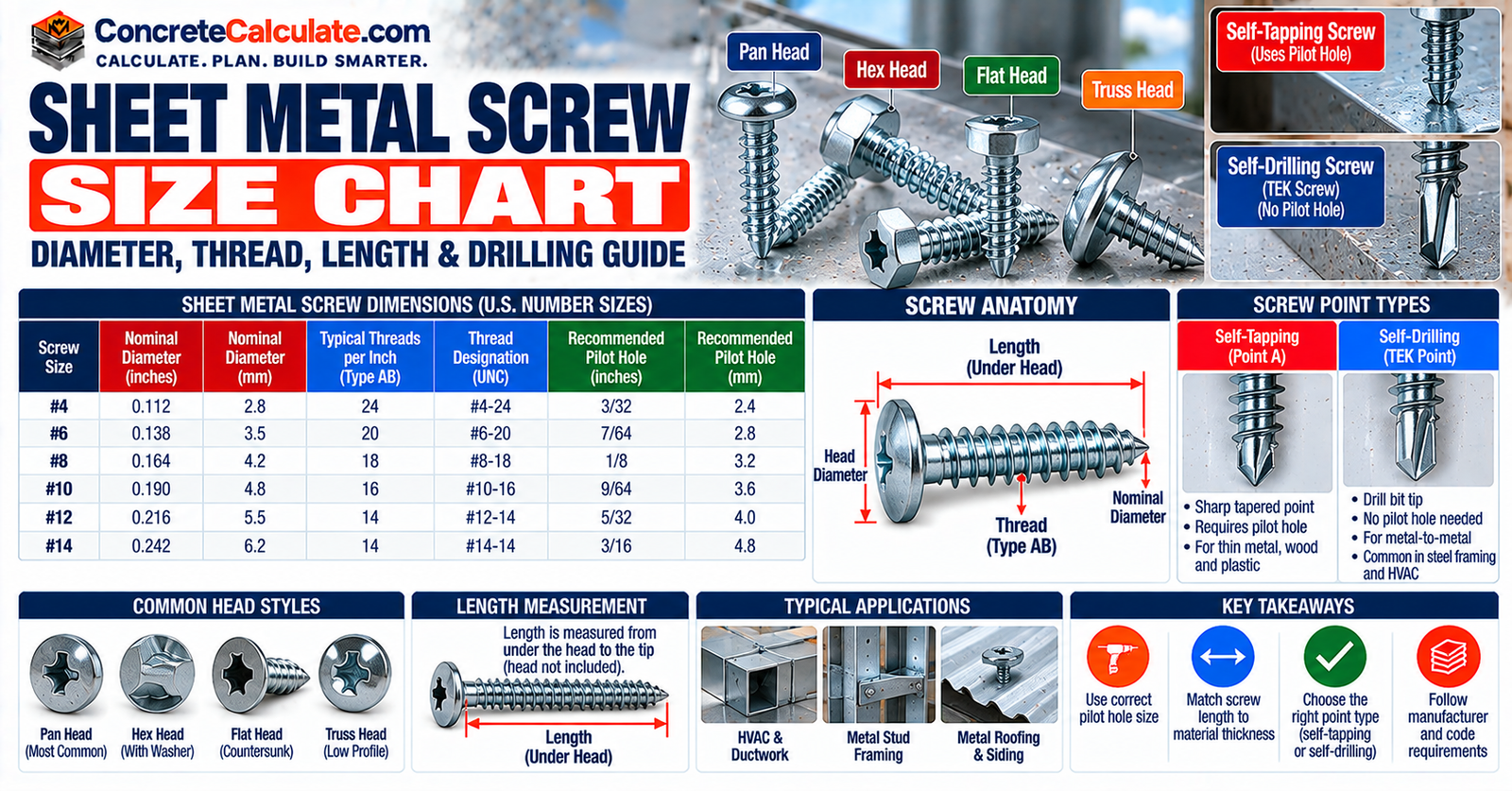
Sheet Metal Screw Size Chart
Gauge, Diameter, Thread & Length
Nominal diameters for #2 through 1/4 in. screws, how to read designations like #10-16 x 3/4, and why self-tapping, self-drilling, screw gauge and sheet-metal gauge are all different things.
 Reviewed by Muhammad Ramzan Babar, PhD Researcher (Plasma Physics) & Calculator Developer, View Profile
⭐ Sheet Metal Screw Size Chart: Gauge, Diameter and Thread Size
Nominal diameters of the numbered U.S. screw series and 1/4 in., with common tapping-thread examples.
How to Read This Chart
Find the screw number (its gauge) in the first column and read the nominal diameter. The thread column shows Type AB tapping-screw examples only. Thread count depends on the thread form and point type, so it is not one universal number per size. For general screw numbering, see the screw size chart.
| Screw Size (Gauge) | Nominal Diameter | Decimal (in.) | Metric (mm) | Common Tapping-Thread Examples* |
|---|---|---|---|---|
| #2 | 0.086 in. | 0.086 | 2.2 mm | varies by thread form and point |
| #3 | 0.099 in. | 0.099 | 2.5 mm | varies by thread form and point |
| #4 | 0.112 in. | 0.112 | 2.8 mm | 24 TPI (Type AB) |
| #5 | 0.125 in. | 0.125 | 3.2 mm | 20 TPI (Type AB) |
| #6 | 0.138 in. | 0.138 | 3.5 mm | 20 TPI (Type AB) |
| #7 | 0.151 in. | 0.151 | 3.8 mm | 19 TPI (Type AB) |
| #8 | 0.164 in. | 0.164 | 4.2 mm | 18 TPI (Type AB) |
| #10 | 0.190 in. | 0.190 | 4.8 mm | 16 TPI (Type AB) |
| #12 | 0.216 in. | 0.216 | 5.5 mm | 14 TPI (Type AB) |
| 1/4 in. | 0.250 in. | 0.250 | 6.4 mm | 14 TPI (Type AB 1/4-14); other threads such as 1/4-28 exist |
Screw Gauge Is Not Sheet-Metal Gauge
A #10 screw does not correspond to 10-gauge steel. Screw gauge names the fastener diameter; sheet-metal gauge names the material thickness. They are separate numbering systems.
*Thread counts shown are Type AB examples (#4-24, #5-20, #6-20, #7-19, #8-18, #10-16, #12-14, 1/4-14). Thread count depends on the thread form and point style, so other screws of the same diameter, including self-drilling screws such as #12-24 and 1/4-28, have different threads. Dimensions follow the ASME numbered screw series (ASME B18.6.3, current 2024 edition).
✓ Diameters checked against the ASME numbered-size formula and Type AB data, October 2026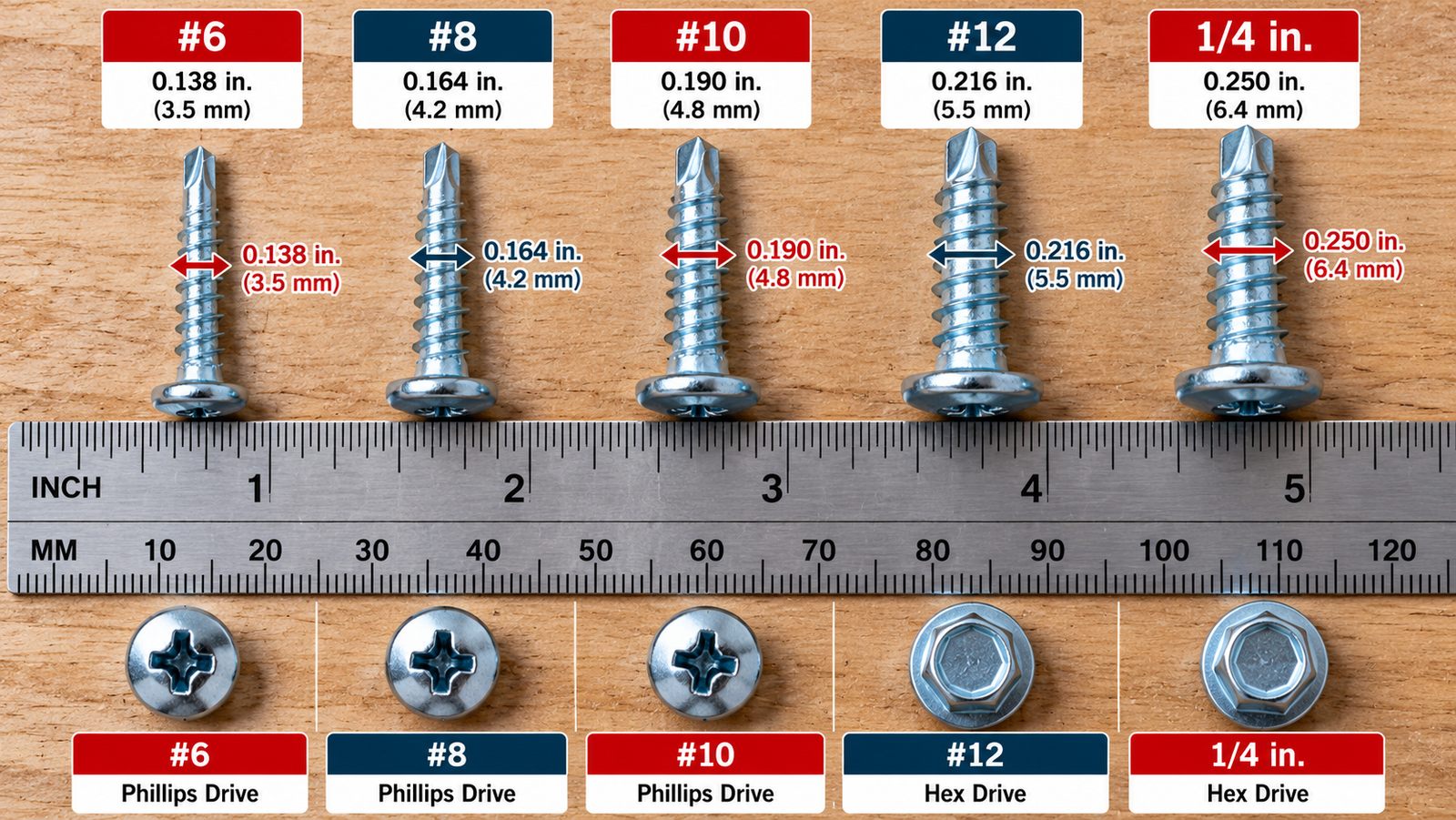
How to Read Sheet Metal Screw Sizes
Three pieces of information in one designation.
A designation such as #10-16 × 3/4 is a nominal #10 screw (0.190 in. diameter), 16 threads per inch, and 3/4 in. nominal length. It does not mean 10-gauge sheet metal, 16-gauge sheet metal, a 10/16 in. diameter or a 16 mm length.
| Designation | Screw Diameter | TPI | Length |
|---|---|---|---|
| #8-18 x 1/2 | #8 (0.164 in.) | 18 | 1/2 in. |
| #10-16 x 3/4 | #10 (0.190 in.) | 16 | 3/4 in. |
| #12-14 x 1-1/4 | #12 (0.216 in.) | 14 | 1-1/4 in. |
| #12-24 x 1-1/4 | #12 (0.216 in.) | 24 | 1-1/4 in. |
| 1/4-14 x 1 | 1/4 in. (0.250 in.) | 14 | 1 in. |
| 1/4-28 x 3 | 1/4 in. (0.250 in.) | 28 | 3 in. |
Not every diameter, thread, head and point exists in every length. Length conventions also vary by head style, as shown in the diagram above.
Sheet Metal Screw Gauge vs. Diameter
Screw numbers do not convert by simple fractions.
A screw number is a size label, not a fraction. A #6 screw is 0.138 in., not 6/64 in. (0.094 in.), and a #8 screw is 0.164 in., not 1/8 in. (0.125 in.). Use the nominal diameter column in the chart. For the numbered series, the diameter follows D = 0.060 + 0.013N, where N is the screw number.
#8 and #10 Diameter From the Formula
The formula applies to the numbered series only. Do not extend it into fractional sizes such as 1/4 in. For machine-screw and wood-screw numbering, see the machine screw size chart.
Screw Gauge vs. Sheet Metal Gauge
Fastener diameter and material thickness use different gauge systems.
Screw gauge is a fastener diameter designation. Sheet-metal gauge is a material-thickness designation, and the thickness for a given gauge depends on the material (steel, galvanized steel, aluminum) and the gauge standard. The two numbers have no connection. To look up actual thickness, use the sheet metal gauge chart.
#4 and #6 Sheet Metal Screw Sizes
Small screws for light-duty attachment.
| Size | Nominal Diameter | Type AB Thread |
|---|---|---|
| #4 | 0.112 in. (2.8 mm) | 24 TPI |
| #6 | 0.138 in. (3.5 mm) | 20 TPI |
#4 and #6 screws are small, light-duty sizes. Thread style and point type still matter, and no universal sheet-thickness capacity applies to either size. Check the manufacturer’s data for the specific screw. For drywall-to-steel attachment, a different screw family applies; see drywall screw spacing.
#8 Sheet Metal Screw Size
0.164 in. nominal, 18 TPI in the Type AB series.
A #8 screw has a nominal ASME diameter of 0.164 in. (4.2 mm). Self-drilling #8 screws are real product families: for example, a #8-18 × 1/2 hex washer head screw with a #2 drill point is listed by Hilti with a drilling capacity of 0.035 to 0.100 in. and by Buildex at 0.036 to 0.100 in. Those are product-specific values for that screw, not a rule for every #8 screw.
#10 Sheet Metal Screw Size
0.190 in. nominal, with several thread and point options.
A #10 screw is 0.190 in. (4.8 mm) nominal. The common designation is #10-16 (16 threads per inch), but other thread configurations exist. The same #10-16 size also shows how point style changes capacity: in Hilti’s technical guide, an S-MD 10-16 × 3/4 screw with a #2 point lists 0.035 to 0.110 in. drilling capacity, while the same size with a #3 point lists 0.110 to 0.175 in. Same diameter, same thread, different points.
#12 Sheet Metal Screw Size
0.216 in. nominal; common self-drilling threads are 14 and 24 TPI.
A #12 screw has a nominal ASME diameter of 0.216 in. (5.5 mm). Some manufacturers list a slightly different measured product diameter, such as 0.210 in. for certain Buildex #12 screws, so always confirm the product data. Common self-drilling designations are #12-14 and #12-24, and they should not be treated as equal in drilling capacity: the #12-14 TEKS 2 lists 0.036 to 0.210 in., while a #12-24 TEKS 5 lists 0.125 to 0.500 in.
#14 and 1/4-Inch Sheet Metal Screws
Handle the terminology carefully.
A fractional 1/4 in. screw is 0.250 in. nominal. The numbered-series formula would give 0.242 in. for #14 (0.060 + 0.013 × 14), but sheet-metal and self-drilling screws in this size range are normally sold as 1/4 in. screws, such as 1/4-14 Type AB or 1/4-28 TEKS 5. Do not casually treat every manufacturer’s “#14” and every 1/4 in. fastener as identical; check the governing product standard and the actual diameter on the data sheet.
Sheet Metal Screw Thread Size Chart
TPI, thread pitch and what they mean.
- n: threads per inch (TPI)
- P: axial thread pitch in inches, the distance between adjacent thread crests
| TPI | Pitch Calculation | Pitch P (in.) | Example Designation |
|---|---|---|---|
| 28 | 1 / 28 | 0.0357 | 1/4-28 |
| 24 | 1 / 24 | 0.04167 | #12-24, #4-24 |
| 20 | 1 / 20 | 0.0500 | #6-20, #5-20 |
| 19 | 1 / 19 | 0.0526 | #7-19 |
| 18 | 1 / 18 | 0.0556 | #8-18 |
| 16 | 1 / 16 | 0.0625 | #10-16 |
| 14 | 1 / 14 | 0.0714 | #12-14, 1/4-14 |
A #10-16 screw has a pitch of 1/16 = 0.0625 in., and a #12-24 screw has a pitch of 1/24 = 0.04167 in. Pitch is not sheet thickness, and TPI is not metal gauge. For fine and coarse thread standards in general, see the thread size chart.
Self-Tapping vs. Self-Drilling Screws
They are not synonyms.
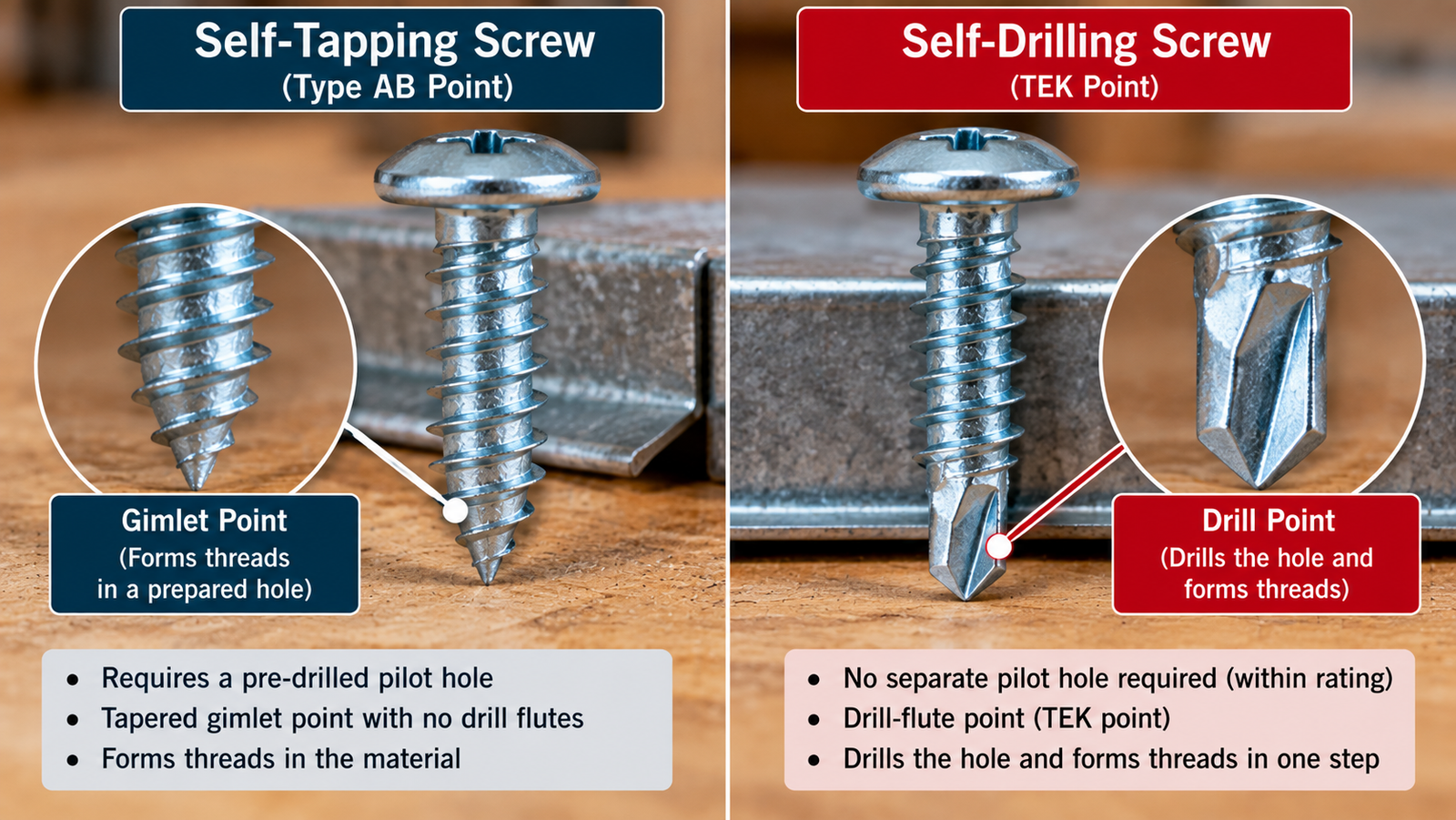
Self-tapping screws form or cut their own mating thread as they enter the material, but some require a predrilled hole. Self-drilling screws have an integrated drill point that drills the hole before the threads engage. SAE J78 describes the goal of self-drilling tapping screws as drilling a hole and then forming or cutting mating threads without deforming their own thread and without breaking during assembly.
One-Line Distinction
All self-drilling sheet-metal screws are designed to tap their own threads, but a self-tapping screw does not necessarily drill its own starting hole. People often search for “TEK vs. self-tapping”: TEK (a Buildex brand name, TEKS) is a self-drilling screw.
Type A, AB and B Sheet Metal Screws
Point and thread families, kept brief.
| Point / Thread Family | Basic Function | Predrilled Hole? | Typical Use |
|---|---|---|---|
| Type A | Thread-forming tapping screw (coarser thread) | Generally yes | Thinner sheet and other materials where applicable |
| Type AB | Thread-forming tapping screw with finer, spaced thread than Type A | Generally yes | General sheet-metal and tapping applications |
| Type B | Blunt-point thread-forming tapping screw | Yes | Preformed or predrilled hole applications |
| Self-drilling | Drills and taps in one operation | Usually no within rated capacity | Steel-to-steel and sheet-metal connections |
The ASME tapping-screw standard (B18.6.3) has separate dimensional provisions for several thread and point styles. Do not assume every Type A or AB screw uses the same pilot hole: it depends on the exact thread form, screw size, substrate material, material thickness and the manufacturer’s specification.
Self-Drilling Screw Point Size Chart
Drill-point numbers are not screw diameters, and capacity is product-specific.
Product-Specific Examples Only
These ranges come from current ITW Buildex and Hilti product listings. They are examples, not a universal capacity table. Point numbering is not interchangeable between manufacturers: Buildex lists a #12-24 TEKS 5 at 0.125 to 0.500 in., while Hilti lists a #12-24 #5 point at 0.250 to 0.500 in.
| Manufacturer | Screw (Size x Length) | Drill Point | Drill / Tap Capacity (in.) |
|---|---|---|---|
| Buildex | #8-18 x 1/2 HWH | #2 | 0.036-0.100 |
| Buildex | #12-14 x 1-1/4 HWH | TEKS 2 | 0.036-0.210 |
| Buildex | #12-14 x 1 HWH | TEKS 3 | 0.036-0.210 |
| Buildex | #12-24 x 7/8 HWH | TEKS 4 | 0.125-0.250 |
| Buildex | #12-24 x 1-1/4 HWH | TEKS 4.5 | 0.125-0.375 |
| Buildex | #12-24 x 1-1/4 HWH | TEKS 5 | 0.125-0.500 |
| Hilti | S-MD 8-18 x 1/2 HWH | #2 | 0.035-0.100 |
| Hilti | S-MD 10-16 x 3/4 HWH | #2 | 0.035-0.110 |
| Hilti | S-MD 10-16 x 3/4 HWH | #3 | 0.110-0.175 |
| Hilti | S-MD 12-24 x 7/8 HWH | #4 | 0.175-0.250 |
| Hilti | S-MD 12-24 x 1-1/4 HWH | #5 | 0.250-0.500 |
SAE J78 covers carbon steel self-drilling tapping screws with point Styles 2, 3, 4 and 5. A drill-point number is not the screw diameter: a #12 screw can be made with several different drill points. Buildex also notes that drill and tap capacities may vary with special feature designs, so refer to the product report for the exact part.
TEK 2 vs. TEK 3 vs. TEK 5
One screw size, three very different ranges.
Compare three #12 examples from Buildex. A #12-14 TEKS 2 lists 0.036 to 0.210 in. A #12-24 TEKS 4.5 lists 0.125 to 0.375 in. A #12-24 TEKS 5 lists 0.125 to 0.500 in. The nominal size is the same family, but the drilling capacity is very different, and the thread count also changes between them.
A #12-14 TEKS 3 shows the same 0.036 to 0.210 in. range as the TEKS 2 in Buildex listings, so the point number alone does not tell you the range. Always read the data for the exact part number.
Sheet Metal Screw Pilot Hole Size Chart
Reference examples for Type AB tapping screws only.
Not for Self-Drilling Screws
Do not apply this pilot-hole column to self-drilling screws or to every tapping-screw style. Verify the exact fastener manufacturer’s hole recommendation for the material and thickness being fastened.
| Type AB Screw | Nominal Diameter (in.) | Example Pilot Hole (in.) | Test Sheet Thickness (in.) |
|---|---|---|---|
| #4-24 | 0.112 | 0.0860 (#44) | 0.046-0.050 |
| #5-20 | 0.125 | 0.1065 (#36) | 0.046-0.050 |
| #6-20 | 0.138 | 0.1160 (#32) | 0.073-0.077 |
| #7-19 | 0.151 | 0.1285 (#30) | 0.073-0.077 |
| #8-18 | 0.164 | 0.1360 (#29) | 0.123-0.127 |
| #10-16 | 0.190 | 0.1590 (#21) | 0.123-0.127 |
| #12-14 | 0.216 | 0.1875 (3/16 in.) | 0.123-0.127 |
| 1/4-14 | 0.250 | 0.2165 (5.5 mm) | 0.1845-0.1905 |
The hole size in the table is tied to the test sheet thickness in the last column. In thinner sheet a smaller pilot is generally used to maintain thread engagement, while thicker or harder material may need a slightly larger one. Self-tapping screws may need a pilot hole, while self-drilling screws do not need a separate one within rated drilling capacity. For drill designations (number, letter and fractional), see the drill bit size chart and the pilot hole size page.
Equipment for Your Project
Affiliate disclosure: As an Amazon Associate, ConcreteCalculate earns from qualifying purchases. We may also earn a commission from other affiliate links at no additional cost to you.
Sheet Metal Thickness vs. Screw Size
Thickness matters, but not in a one-to-one way.
Thin sheet leans on point and thread engagement: the screw must grip the metal without stripping it. As steel gets thicker, the drill-point capacity becomes increasingly important, because the point must be able to drill through the entire stack before the threads start. Use the sheet metal thickness page for the actual thickness of a given gauge, and add up the total thickness of every layer being drilled.
Manufacturers publish thickness limits per product. For example, Hilti lists an S-MD 8-18 × 1/2 screw at 0.035 to 0.100 in. drilling capacity with a maximum total thickness of 1/8 in., and a #10-16 × 3/4 screw with a #3 point at 0.110 to 0.175 in. Those are product-specific limits.
Why There Is No Universal Gauge-to-Screw Chart
This page deliberately does not publish one.
A table like “22 gauge = #8, 18 gauge = #10, 14 gauge = #12” looks helpful but would be misleading. Screw suitability depends on all of the following:
- Screw diameter and thread pitch
- Point style and drill-point length
- Steel thickness and number of layers
- Attachment thickness and substrate thickness
- Steel strength and connection type
- Required pullout, pullover and shear strength
- Manufacturer or evaluation-report limitations
Select the Fastener System, Not a Gauge Number
Match the product’s published drilling capacity and attachment range to the total metal thickness, then confirm strength for the connection. Ranges like those in the point chart above are examples of specific products only.
Sheet Metal Screw Length Chart
Common nominal lengths, and why length does not change drilling capacity.
Common nominal screw lengths include 1/2, 5/8, 3/4, 1-1/4, 1-1/2 and 2 in., with longer sizes available in some product lines. Not every diameter, head style and point type exists in every length.
| Screw | Thread Length | Drill Capacity (in.) | Maximum Total Thickness |
|---|---|---|---|
| #10-16 x 5/8 HWH #3 | 5/16 in. | 0.110-0.175 | 3/16 in. (0.187) |
| #10-16 x 3/4 HWH #3 | 1/2 in. | 0.110-0.175 | 3/8 in. (0.375) |
| #10-16 x 1 HWH #3 | 3/4 in. | 0.110-0.175 | 5/8 in. (0.625) |
| #10-16 x 1-1/4 HWH #3 | 1 in. | 0.110-0.175 | 7/8 in. (0.875) |
| #10-16 x 1-1/2 HWH #3 | 1-1/4 in. | 0.110-0.175 | 1-1/8 in. (1.125) |
Every row has the same drilling capacity. Longer screws allow a thicker stack of material, but they do not drill thicker steel. Screw length does not equal drill capacity, and diameter does not equal drill capacity: the point design is critical. A #12 TEKS 2 × 2 in. screw may be longer than a #12 TEKS 5 × 1-1/4 in. screw, yet the TEKS 5 point can have the greater drilling capacity.
How to Choose Sheet Metal Screw Length
A simplified geometric starting point, not a selection rule.
- L: screw length (in.)
- ta: attachment thickness (in.)
- ts: substrate thickness (in.)
- p: required thread protrusion beyond the substrate (product-specific)
#12-24 With Three-Pitch Protrusion
Do Not Select From This Alone
Real selection must also allow for drill-point length, any unthreaded transition region, head style, the manufacturer’s minimum protrusion, load-bearing area and available standard lengths. Compare: a Buildex #12-24 × 1-1/4 in. TEKS 5 (part 1006000) is listed with a material attachment range of 0.125 to 0.375 in., far less than 1.25 in. minus three pitches would suggest. Use the manufacturer’s attachment range. ICC-ES ESR-1976 tabulates minimum required protrusion and load-bearing length for the TEKS products it evaluates, which shows why length cannot be chosen from plate thickness alone.
Thread Engagement and Screw Protrusion
The requirement is product-specific.
How many threads should extend through the metal depends on the product and its evaluation. Buildex states that its TEKS fasteners must penetrate beyond the metal structure a minimum of three pitches of thread. Treat that as an example for that product, not as a universal “always leave three threads showing” rule for every sheet-metal screw.
The drill point must also clear the back of the substrate before the threads engage, so a screw that only just reaches through the steel can fail to form proper threads. Follow the product data and, for structural connections, the evaluation report.
Sheet Metal Screw Head Types
Head geometry sets the bearing area.
| Screw | Hex Washer Head (HWH) | Phillips Pan Head (PPH) | Phillips Truss Head (PTH) |
|---|---|---|---|
| #8 | 0.335 | 0.311 | 0.411 |
| #10 | 0.399 | 0.364 | 0.433 |
| #12-14 | 0.415 | not listed | not listed |
Common styles are hex washer, pan, flat (countersunk), oval and pancake (low-profile) heads. A larger head or washer bears on more sheet, which affects pullover behavior, so the head style matters as much as the screw diameter. For a visual guide to head shapes, see the screw head types, and for washers see the washer size chart.
Sheet Metal Screw Drive Sizes
Drive size follows the head and product, not the screw gauge.
| Product | Head | Drive / Recess |
|---|---|---|
| Buildex #8 TEKS 2 | HWH | 1/4 in. hex socket |
| Hilti #10-16 and #12-14 S-MD | HWH | 5/16 in. |
| Buildex #12-24 x 1-1/4 TEKS 5 | 5/16 in. HWH | 5/16 in. socket |
| Buildex #12-24 x 1-1/2 TEKS 5 | 3/8 in. HWH | 3/8 in. socket |
| Hilti 1/4-14 S-MD | HWH | 3/8 in. |
| Hilti #10-16 and #8-18 PPH | Phillips pan | Phillips No. 2 |
The same #12-24 TEKS 5 screw appears with a 5/16 in. hex washer head in one length and a 3/8 in. hex washer head in another, so head style and product family can change the required driver. Hex socket, Phillips and square or combination drives are all used. Do not infer a driver size from screw gauge alone.
Sheet Metal Screw Strength
Four different failure modes.
- Tensile strength: the fastener itself pulling apart.
- Shear strength: the fastener cross-section being cut across.
- Pullout: thread engagement being pulled out of the substrate.
- Pullover: the sheet beneath the screw head or washer tearing around the head.
| Steel Thickness (Hilti gauge and thickness) | Ultimate Pullout (lb) | Ultimate Pullover, HWH (lb) |
|---|---|---|
| 22 ga (0.036 in.) | 260 | 805 |
| 18 ga (0.060 in.) | 435 | 1,290 |
| 14 ga (0.105 in.) | 765 | 1,370 |
| 12 ga (0.135 in.) | 980 | 1,370 |
Ultimate Loads, Not Design Loads
These are ultimate values for one manufacturer’s screw and head style. Hilti notes that the lower of the ultimate pullout, pullover and tension strength governs, and that AISI S100 recommends a safety factor of 3.0 for allowable strength design. Do not publish or use a generic “#10 screw holds X lb.” figure.
The table shows why bigger is not automatically stronger: pullout climbs with steel thickness, while pullover levels off once the head size becomes the limit. Connection strength can also be controlled by sheet tearing, edge distance, spacing and steel grade.
Steel-to-Steel Sheet Metal Screws
Structural connections defer to evaluated data.
Steel-to-steel connections depend on substrate thickness, attachment thickness, drill point, thread engagement and an evaluated connection. ICC-ES ESR-1976 evaluates ITW Buildex TEKS self-drilling fasteners for engineered or code-prescribed connections of cold-formed steel framing and of sheet steel sheathing to cold-formed steel framing. It tabulates drilling capacity and minimum protrusion for the products it covers. Check ICC-ES for the current active revision of the report.
When a screw is not a good fit for a thin connection, rivets are one alternative; see the rivet size chart.
Sheet Metal Screws for Aluminum, Stainless and Exterior Use
Do not transfer steel data to other materials.
Aluminum
Do not carry steel connection data over to aluminum automatically. ICC-ES AC491 sets evaluation provisions for self-drilling tapping screws used with aluminum because of aluminum’s distinct mechanical behavior. It covers aluminum-to-aluminum, aluminum-to-steel and steel-to-aluminum connections, and screws of carbon steel, stainless steel and bi-metal construction in specific sizes.
Stainless Steel
Stainless screws offer corrosion resistance, but do not assume they have the same drilling or structural capacity as carbon-steel products. Check galvanic compatibility with the metals being joined and the exposure. Hilti also warns that many hardened steel fasteners are not recommended with dissimilar metals or chemically treated wood where moisture or corrosion is present, because of the risk of delayed hydrogen-assisted stress corrosion cracking.
Exterior and Roofing
Exterior screws need corrosion-resistant coatings, sealing washers where water-tightness matters, and an appropriate head. Follow the roofing or panel manufacturer’s fastening requirements. This page does not cover roof-screw spacing.
Correct Self-Drilling Screw Installation
Product-specific guidance from Buildex.
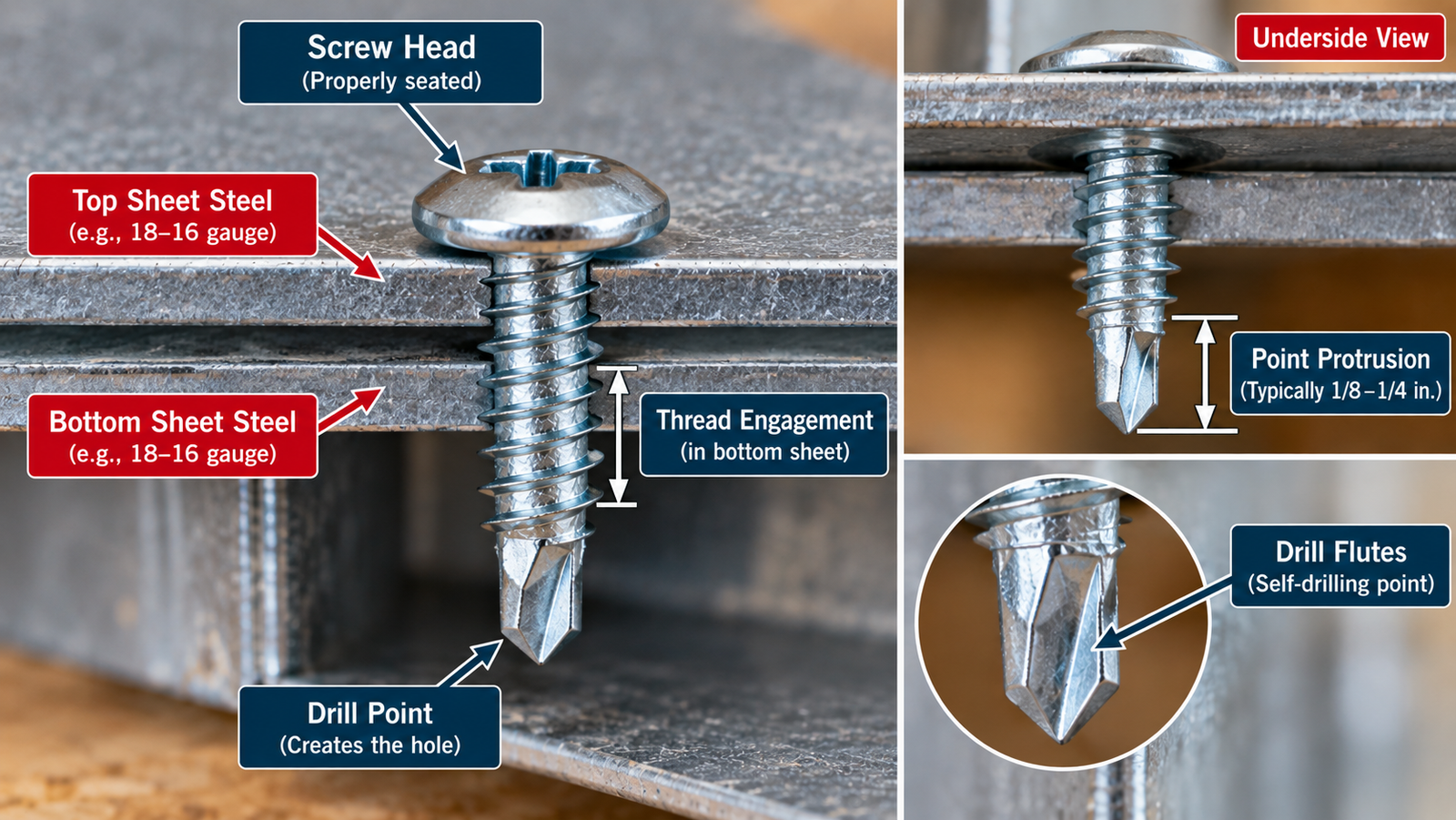
- Use the correct driver or socket for the head.
- Use a screwgun with a depth-sensitive nosepiece within the product’s recommended speed range (Buildex lists 0 to 2,000 or 0 to 2,500 RPM depending on the product, with a maximum of 1,800 RPM for TEKS 5).
- Drive perpendicular to the surface.
- Seat the fastener fully; Buildex says it is fully seated when the head is flush with the work surface.
- Do not overdrive: Buildex warns that overdriving can cause torsional failure of the fastener or stripout of the substrate.
- Confirm the fastener extends beyond the metal by the required thread protrusion (three pitches for TEKS).
These instructions come from Buildex product literature and apply to its Teks products. Follow the instructions for the fastener you actually use.
Common Sheet Metal Screw Sizing Mistakes
Quick checks before you buy or drive.
Confusing screw gauge with sheet gauge
They are separate numbering systems.
Assuming #10 means 10-gauge steel
#10 is a diameter, not a thickness.
Treating diameter as thickness capacity
A larger diameter does not drill thicker steel.
Treating length as drilling capacity
Length does not change what the point can drill.
Treating the TEK number as screw size
Point number is not diameter.
Assuming all #12 screws drill the same
TEKS 2 and TEKS 5 differ widely.
Assuming self-tapping means self-drilling
Many tapping screws need a pilot hole.
Predrilling a self-driller unnecessarily
It drills its own hole within capacity.
Skipping a needed pilot hole
Tapping screws often need a preformed hole.
One pilot size for all thicknesses
Hole size depends on material and thickness.
Confusing TPI with metal gauge
TPI is threads per inch.
Confusing screw gauge with TPI
#10-16 holds both numbers separately.
Ignoring attachment thickness
It adds to the length needed.
Ignoring substrate thickness
Total thickness sets drilling capacity needs.
Choosing a screw too short
Engagement and protrusion need length.
Long screw with an inadequate point
Length cannot replace point capacity.
Not letting the point clear the steel
Threads engage after the drill point exits.
Insufficient thread protrusion
Many products specify a minimum.
Using the wrong driver
Drive size follows the head style.
Overdriving
It can twist off the screw or strip the sheet.
Stripping the substrate
Stop when the head seats.
Under-seating sealing washers
They may not seal.
Crushing sealing washers
Overdriving damages the seal.
Using interior coatings outdoors
Exposure needs the right coating.
Ignoring dissimilar-metal corrosion
Moisture makes it worse.
Transferring steel values to aluminum
Aluminum needs its own data.
Assuming larger always means stronger
Sheet tearing or pullover can control.
Using ultimate load as allowable
Apply the proper safety factor.
Ignoring edge distance and spacing
They affect connection strength.
Ignoring the evaluation report
Structural use depends on it.
Treating one maker’s drill capacity as universal
It applies to that product only.
Sheet Metal Screw Size FAQs
Thirty-three common questions, answered with standards and product data.
What size is a #6 sheet metal screw?
What diameter is a #8 sheet metal screw?
What diameter is a #10 sheet metal screw?
What diameter is a #12 sheet metal screw?
What does #10-16 mean?
What does #12-14 mean?
What does #12-24 mean?
What does TEK 2 mean?
What does TEK 3 mean?
What does TEK 5 mean?
Is TEK number the screw size?
Is screw gauge the same as sheet-metal gauge?
What screw size should I use for 22-gauge sheet metal?
What screw size should I use for 20-gauge steel?
What screw size should I use for 18-gauge steel?
What screw size should I use for 16-gauge steel?
What screw size should I use for 14-gauge steel?
What screw size should I use for 12-gauge steel?
Do sheet-metal screws need pilot holes?
What pilot hole should I drill for a #8 screw?
What pilot hole should I drill for a #10 screw?
What pilot hole should I drill for a #12 screw?
What is Type AB sheet-metal screw?
What is the difference between self-tapping and self-drilling?
How long should a sheet-metal screw be?
How many threads should protrude through steel?
Can a self-drilling screw be too long?
Can a long TEK screw drill thicker steel?
Can sheet-metal screws be used in aluminum?
Can stainless screws be used in galvanized steel?
What head is best for sheet metal?
What size socket fits sheet-metal screws?
How strong is a sheet-metal screw?
Standards and References Used
| Reference | What It Covers | Used For |
|---|---|---|
| ASME B18.6.3 | Machine screws, tapping screws and metallic drive screws (inch series) | Numbered sizes, thread and point styles |
| SAE J78_202107 | Carbon steel self-drilling tapping screws, point Styles 2, 3, 4 and 5 | Self-drilling concepts |
| ICC-ES ESR-1976 | ITW Buildex TEKS self-drilling fasteners in cold-formed steel | Evaluated drilling capacity and protrusion |
| ICC-ES AC491 | Self-drilling tapping screws used with aluminum | Aluminum connections |
| ITW Buildex TEKS product data | Drill and tap capacity, drive sizes, installation notes | Product-specific examples |
| Hilti North American Product Technical Guide (Edition 21) | Self-drilling screw capacities, head sizes, ultimate strengths | Product-specific examples |
Manufacturer values are specific to the exact product, head style, coating and steel properties listed. Local codes, project specifications and the engineer of record govern structural connections.
📥 Download Sheet Metal Screw Size Chart PDF
Use your browser’s print function to save this page as a PDF for jobsite binders, estimating folders and shop reference.