Concrete Anchor Drill Bit Size Chart 2026 – Wedge, Screw, Sleeve & Drop-In Anchors
Concrete Anchor Drill Bit Size Chart
Wedge, Screw, Sleeve & Drop-In Anchors
The right bit depends on the anchor type, not just its diameter. A 1/4 in. Tapcon takes a 3/16 in. bit while a 1/4 in. Titen HD takes a 1/4 in. bit. See verified relationships, hole depth terms and installation cautions.
 Reviewed by Muhammad Ramzan Babar, PhD Researcher (Plasma Physics) & Calculator Developer, View Profile
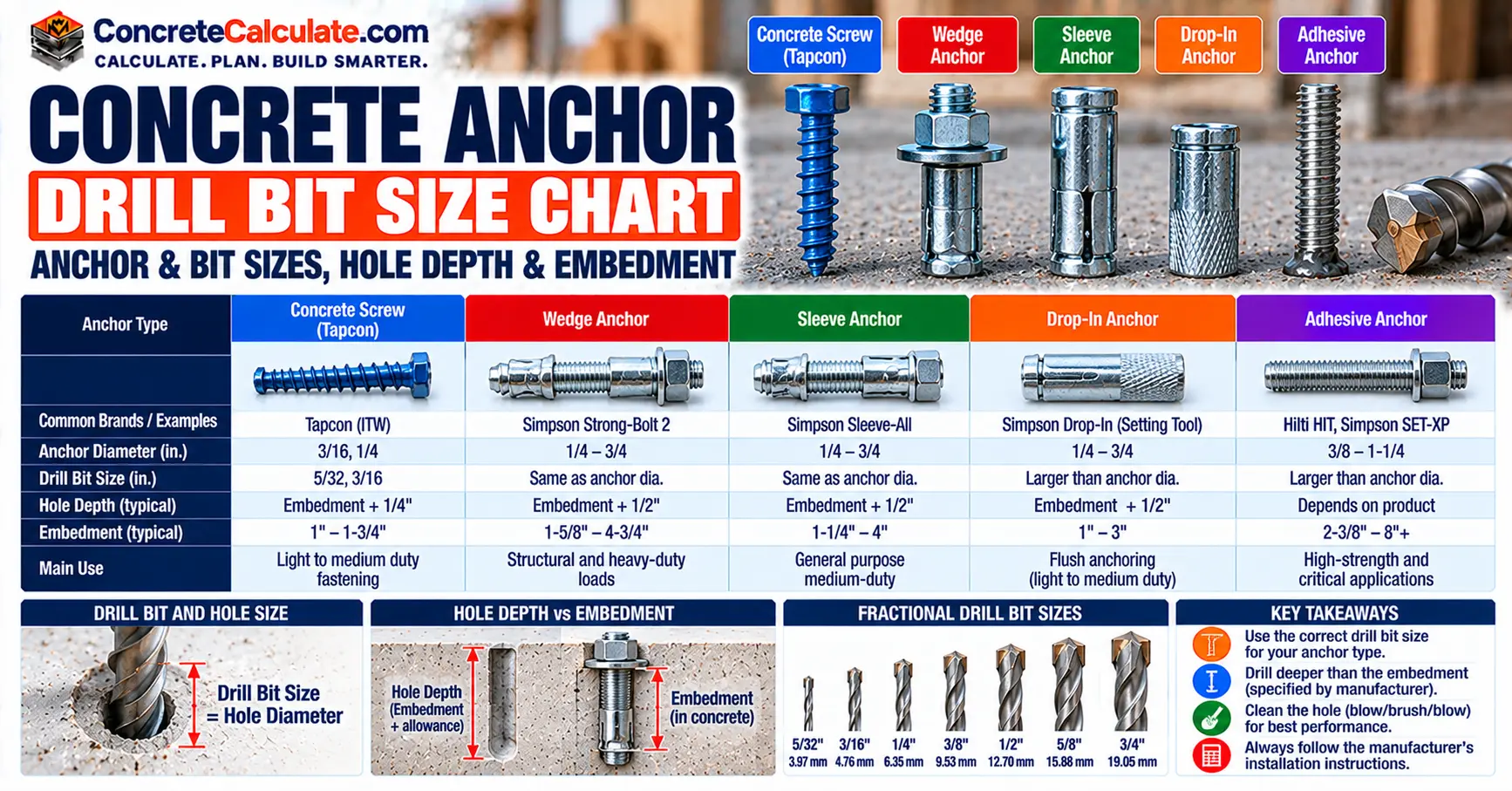
⭐ Concrete Anchor Drill Bit Size Chart: Anchor Type, Size and Required Bit
Organized by anchor system, because the bit depends on the system and not on diameter alone.
How to Read This Chart
Find your anchor type first, then your nominal size. The last columns tell you whether the relationship is manufacturer-specific. Tapcon values come from ITW Tapcon installation instructions; Simpson values come from Simpson Strong-Tie product data. For general bit dimensions, see the drill bit size chart.
| Anchor Type / Verified System | Nominal Anchor Size | Required Nominal Drill Bit | Relationship | Source Status |
|---|---|---|---|---|
| Tapcon concrete screw | 3/16 in. | 5/32 in. | Bit smaller than screw | Manufacturer-specific |
| Tapcon concrete screw | 1/4 in. | 3/16 in. | Bit smaller than screw | Manufacturer-specific |
| Simpson Strong-Bolt 2 wedge anchor | 1/4 in. | 1/4 in. | Same nominal size | Product-specific |
| Simpson Strong-Bolt 2 wedge anchor | 3/8 in. | 3/8 in. | Same nominal size | Product-specific |
| Simpson Strong-Bolt 2 wedge anchor | 1/2 in. | 1/2 in. | Same nominal size | Product-specific |
| Simpson Strong-Bolt 2 wedge anchor | 5/8 in. | 5/8 in. | Same nominal size | Product-specific |
| Simpson Strong-Bolt 2 wedge anchor | 3/4 in. | 3/4 in. | Same nominal size | Product-specific |
| Simpson Strong-Bolt 2 wedge anchor | 1 in. | 1 in. | Same nominal size | Product-specific |
| Simpson Titen HD screw anchor | 1/4 in. | 1/4 in. | Same nominal size | Product-specific |
| Simpson Titen HD screw anchor | 3/8 in. | 3/8 in. | Same nominal size | Product-specific |
| Simpson Titen HD screw anchor | 1/2 in. | 1/2 in. | Same nominal size | Product-specific |
| Simpson Titen HD screw anchor | 5/8 in. | 5/8 in. | Same nominal size | Product-specific |
| Simpson Titen HD screw anchor | 3/4 in. | 3/4 in. | Same nominal size | Product-specific |
| Simpson Sleeve-All sleeve anchor | 1/4 in. | 1/4 in. | Same nominal size | Product-specific |
| Simpson Sleeve-All sleeve anchor | 5/16 in. | 5/16 in. | Same nominal size | Product-specific |
| Simpson Sleeve-All sleeve anchor | 3/8 in. | 3/8 in. | Same nominal size | Product-specific |
| Simpson Sleeve-All sleeve anchor | 1/2 in. | 1/2 in. | Same nominal size | Product-specific |
| Simpson Sleeve-All sleeve anchor | 5/8 in. | 5/8 in. | Same nominal size | Product-specific |
| Simpson Sleeve-All sleeve anchor | 3/4 in. | 3/4 in. | Same nominal size | Product-specific |
| Simpson Drop-In anchor (DIA) | 1/4 in. | 3/8 in. | Bit larger than anchor size | Product-specific |
| Simpson Drop-In anchor (DIA) | 3/8 in. | 1/2 in. | Bit larger than anchor size | Product-specific |
| Simpson Drop-In anchor (DIA) | 1/2 in. | 5/8 in. | Bit larger than anchor size | Product-specific |
| Simpson SET-3G adhesive (threaded rod) | Per rod size | 1/16 to 1/8 in. larger than nominal anchor | Bit larger than rod | Product-specific; see product table |
Do Not Select a Bit From Diameter Alone
First identify the exact anchor family and product. Concrete screws, wedge anchors, sleeve anchors, drop-in anchors and adhesive anchors do not necessarily use the same drill-hole relationship. Follow the current manufacturer instructions and evaluation report for the exact anchor. Drop-in bits shown are for Simpson Drop-In anchors; other makers can differ.
Planning your next concrete project?
Plan concrete materials and project costs with our downloadable Excel estimator pack. For estimating only; follow applicable technical standards for design and installation.
One-time purchase · Digital downloadHow to Use the Concrete Anchor Drill Bit Chart
Start with the anchor type, not the diameter.
- Identify the anchor family: concrete screw, heavy-duty screw anchor, wedge, sleeve, drop-in or adhesive.
- Identify the exact product and its nominal size from the package or catalog.
- Read the required nominal carbide bit for that product.
- Confirm the hole depth, cleaning method and tool in the manufacturer’s instructions.
- Check the fixture hole separately, because it is a different dimension.
If a product is not in the chart, do not borrow a value from a similar-looking anchor. Use that product’s own technical data.
Is the Drill Bit the Same Size as the Concrete Anchor?
Sometimes, but not always.
The honest answer is “it depends on the anchor type.” Verified wedge anchors, heavy-duty screw anchors and sleeve anchors in the chart use a bit equal to the nominal anchor diameter. Small concrete screws use a smaller bit. Drop-in anchors use a larger bit than their size designation, and adhesive anchors use a hole larger than the rod.
- not simply dbit = danchor
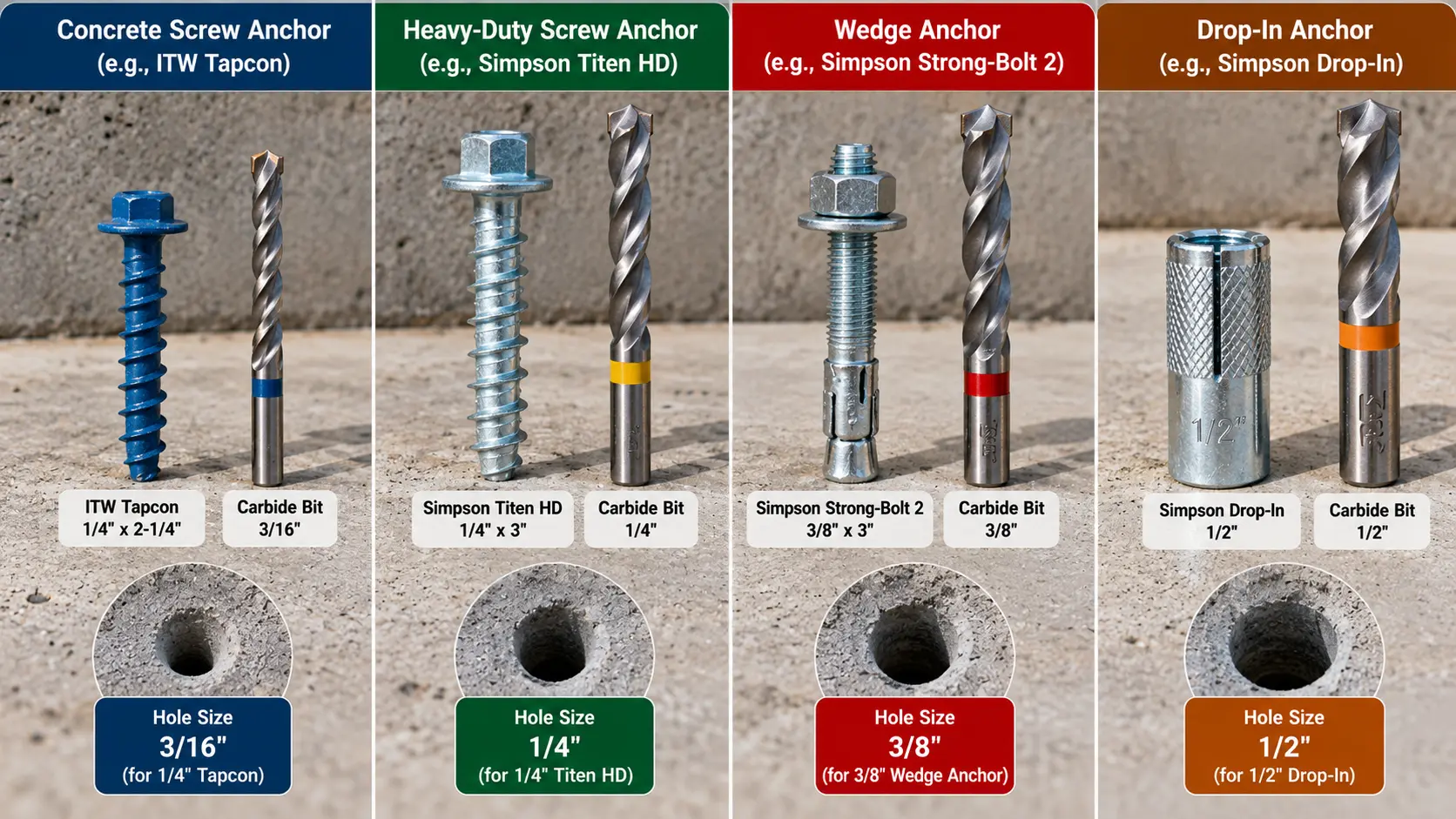
Same 1/4 in. Size, Different Bits
Concrete Anchor Types and Drill-Hole Differences
Different anchors hold differently, so holes are sized differently.
| Anchor Family | General Relationship | Can Users Assume It Universally? |
|---|---|---|
| Wedge expansion anchor | Often the same nominal diameter in the evaluated systems researched | No: verify product |
| Small-diameter concrete screw | Often a smaller pilot hole | No: verify product |
| Heavy-duty screw anchor | Can equal the nominal anchor diameter | No: verify product |
| Sleeve anchor | Often a hole matching the nominal anchor diameter | No: verify product |
| Drop-in anchor | Product-specified hole | No |
| Internally threaded expansion anchor | Product-specific | No |
| Adhesive threaded rod | Hole larger than the rod in evaluated systems | No |
| Adhesive rebar anchorage | Product, rebar and adhesive specific | No |
| Anchor Type | How It Holds | Hole-Sizing Characteristic |
|---|---|---|
| Wedge anchor | Torque-controlled expansion | Often matching nominal bit |
| Sleeve anchor | Sleeve expansion | Product-specific |
| Drop-in anchor | Internally expanded shell | Product-specific bit and setting tool |
| Small concrete screw | Threads engage base material | Smaller pilot hole common |
| Heavy-duty screw anchor | Heavy threads engage concrete | May use matching nominal bit |
| Adhesive threaded rod | Bonded with adhesive | Annular space around rod required |
| Adhesive rebar | Bonded reinforcement | Product and rebar specific |
| Undercut anchor | Mechanical bearing in an undercut | Specialized drilling and setting system |
Mechanical anchors are qualified for structural use under ACI CODE-355.2, and adhesive anchors are qualified separately under ACI 355.4, so the two should never be collapsed into one table.
Concrete Screw Drill Bit Sizes
The clearest exception to the “matching bit” idea.
| Tapcon Screw | Drill Bit | Bit Smaller Than Screw By |
|---|---|---|
| 3/16 in. (0.1875 in.) | 5/32 in. (0.15625 in.) | 0.03125 in. |
| 1/4 in. (0.2500 in.) | 3/16 in. (0.1875 in.) | 0.0625 in. |
The bit is smaller than the screw so the threads can cut into the sides of the hole and hold. Tapcon instructions call for a hammer drill and a hole 1/4 in. deeper than the anchor embedment, with a minimum embedment of 1 in. for these two sizes, then cleaning with a blow-out bulb or compressed air. These are Tapcon relationships and do not apply to every concrete-screw maker. Other Tapcon series (such as stainless or larger diameters) have their own bit sizes, so check the exact package. For full screw-anchor sizing, see the concrete screw sizes; for pilot holes in other materials, see the pilot hole size.
Heavy-Duty Concrete Screw Anchor Drill Sizes
Not sized like a small Tapcon.
Simpson’s Titen HD heavy-duty screw anchor calls for a carbide drill bit the same diameter as the nominal diameter of the anchor, for its 1/4, 3/8, 1/2, 5/8 and 3/4 in. sizes, with minimum hole depths that vary with the chosen embedment. Titen HD is listed for cracked and uncracked concrete and masonry. “Concrete screw” alone is therefore not enough to choose a bit: you need the exact screw system and nominal diameter.
Wedge Anchor Drill Bit Size Chart
Matching nominal bit for the evaluated systems.
| Wedge Anchor | Nominal Bit |
|---|---|
| 1/4 in. | 1/4 in. |
| 3/8 in. | 3/8 in. |
| 1/2 in. | 1/2 in. |
| 5/8 in. | 5/8 in. |
| 3/4 in. | 3/4 in. |
| 1 in. | 1 in. |
For Strong-Bolt 2, Simpson specifies a carbide-tipped bit complying with ANSI B212.15, matching the nominal anchor diameter, drilled with a rotary hammer to the specified nominal embedment depth. Embedment, length, torque, spacing and capacity are product-specific and covered in the wedge anchor sizes page.
Sleeve Anchor Drill Bit Sizes
Product-specific; verify before using a table.
| Sleeve-All Diameter | Drill Bit Size |
|---|---|
| 1/4 in. | 1/4 in. |
| 5/16 in. | 5/16 in. |
| 3/8 in. | 3/8 in. |
| 1/2 in. | 1/2 in. |
| 5/8 in. | 5/8 in. |
| 3/4 in. | 3/4 in. |
Simpson specifies a carbide bit the same diameter as the nominal diameter of the Sleeve-All, drilled to the specified embedment depth and blown clean. ITW Red Head’s Dynabolt sleeve anchor likewise specifies a hole equal to the anchor diameter, drilled deeper than the minimum embedment, with ANSI B212.15 carbide bits. A sleeve anchor works differently from a wedge anchor, concrete screw or drop-in, so do not infer its drill size from another expansion anchor; read your product’s table.
Drop-In Anchor Drill Bit Sizes
The size designation is not the hole size.
| Drop-In Anchor Size | Required Drill Bit | Drill Depth of Simpson Fixed-Depth Bit |
|---|---|---|
| 1/4 in. | 3/8 in. | 1-1/16 in. |
| 3/8 in. | 1/2 in. | 1-11/16 in. |
| 1/2 in. | 5/8 in. | 2-1/16 in. |
A drop-in anchor is an internally threaded expansion anchor. The thread size is not automatically the hole size: a 1/2 in. drop-in needs a 5/8 in. bit in Simpson’s table, not a 1/2 in. bit. Installation generally means drilling the specified diameter and depth, cleaning the hole, inserting the anchor, expanding it with the specified setting tool, then installing the threaded rod or bolt. Simpson notes overhead installations need not be blown clean. Other makers’ drop-in anchors can differ, so follow the exact product table. Thread terminology is covered in the thread size chart and UNC thread sizes, and tap drill sizes apply to cutting threads in metal, not to anchor holes (see the tap drill chart).
Adhesive Anchor Drill Bit Sizes
Included for completeness; always product-specific.
ACI 355.4 addresses qualification of post-installed adhesive anchors in concrete. Adhesive systems may anchor threaded rod, reinforcing bar or internally threaded inserts, and the hole diameter is set by the exact rod or bar diameter, the adhesive system, the installation method and the evaluation report. The hole must be larger than the rod to leave room for adhesive: for Simpson’s SET-3G, the drill bit diameter ranges from 1/16 to 1/8 in. larger than the nominal anchor diameter, depending on the rod and conditions. Do not build one generic rod-to-bit table by mixing adhesive manufacturers.
Anchor Diameter vs. Drill Bit Diameter
Three diameters that must never be used interchangeably.
| Symbol / Term | Meaning | Not the Same As |
|---|---|---|
| da | Nominal anchor diameter | The drill bit, necessarily |
| db | Nominal drill-bit diameter | The fixture hole |
| d0 | Specified drilled-hole diameter | The anchor diameter, necessarily |
| df | Fixture clearance hole | The concrete hole |
| h0 | Drilled-hole depth | Embedment |
| hnom | Nominal embedment | Overall anchor length |
| hef | Effective embedment | Nominal embedment, necessarily |
| tfix | Fixture thickness | Embedment |
For some evaluated systems da = db. For others db < da (small concrete screws), or db > da (drop-in anchors, adhesive rod systems). The drilled hole d0 is whatever the exact product specifies. For nominal fastener sizes in general, see the bolt diameter chart.
Concrete Hole vs. Fixture Clearance Hole
They are different holes with different sources.
A steel plate has a fixture clearance hole df, usually larger than the anchor. The concrete needs a drilled hole db set by the anchor system. For example, a 1/2 in. wedge anchor may use a 1/2 in. concrete bit while the base plate needs a larger clearance hole. The exact fixture-hole size belongs to the structural detailing. For steel holes see the bolt hole sizes and the clearance hole sizes; neither should be used to drill concrete.
ANSI B212.15 Carbide Drill Bits
The bit can be part of the evaluated system.
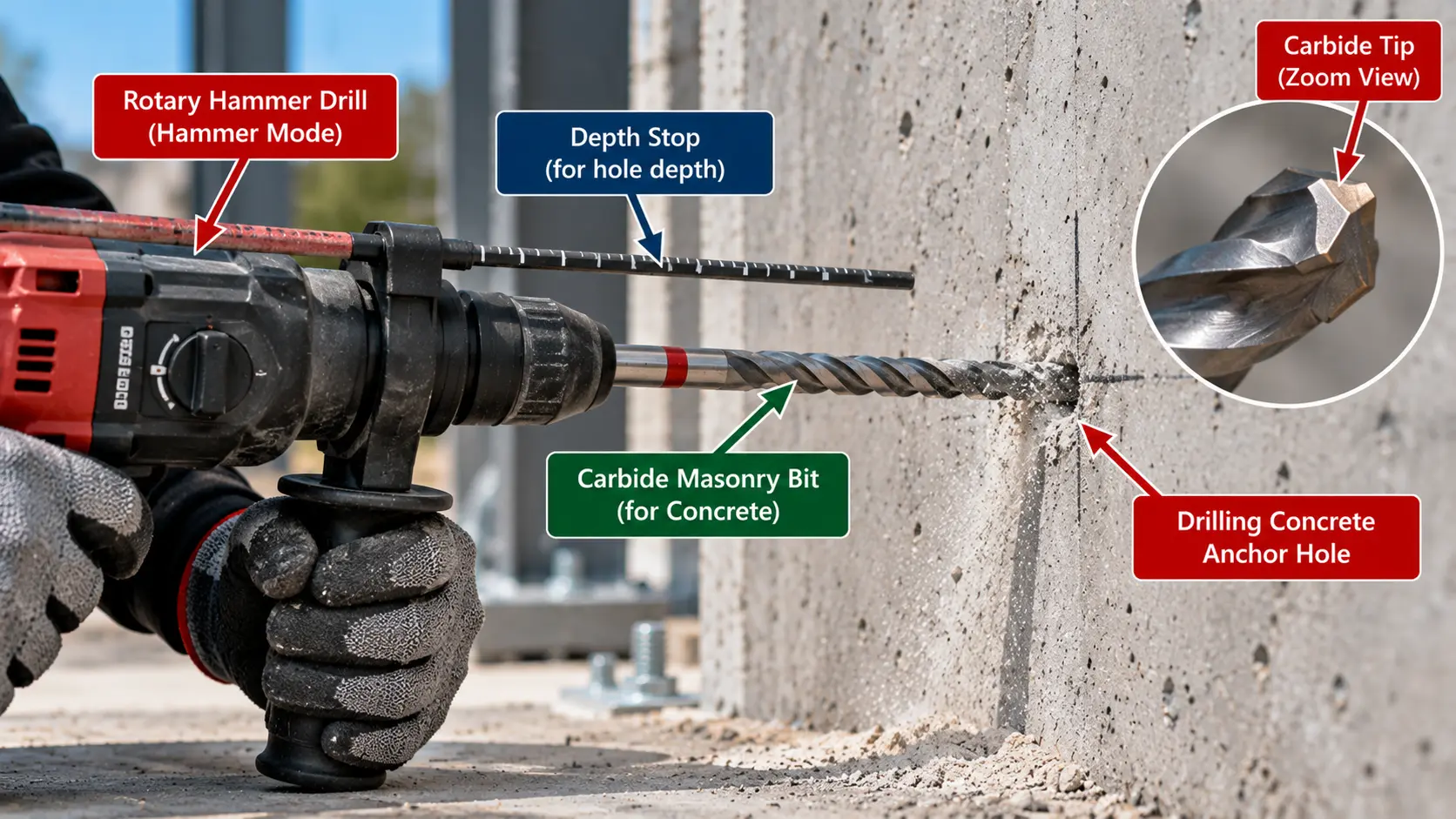
For structural mechanical anchors, the drill bit itself can be part of the evaluated installation. Simpson’s Strong-Bolt 2 instructions call for a carbide-tipped bit that complies with ANSI B212.15, and ITW’s Tapcon and Dynabolt literature also reference it. The standard governs the bit’s carbide tip and its diameter requirements, which affect the drilled hole’s real size. A worn, damaged or incorrectly sized bit can change the actual hole geometry even when the printed bit size looks right. This page does not reproduce tolerance tables from the standard.
Fractional Drill Bit Conversion Chart
Exact fraction-to-decimal conversions for common anchor bits.
| Fraction | Decimal (in.) | Metric (mm) |
|---|---|---|
| 5/32 in. | 0.15625 | 3.97 mm |
| 3/16 in. | 0.18750 | 4.76 mm |
| 1/4 in. | 0.25000 | 6.35 mm |
| 5/16 in. | 0.31250 | 7.94 mm |
| 3/8 in. | 0.37500 | 9.53 mm |
| 1/2 in. | 0.50000 | 12.70 mm |
| 5/8 in. | 0.62500 | 15.88 mm |
| 3/4 in. | 0.75000 | 19.05 mm |
| 1 in. | 1.00000 | 25.40 mm |
These are exact mathematical conversions with no engineering assumption. For number, letter and metric bit sizes, see the drill bit size chart.
How Deep Should You Drill for a Concrete Anchor?
There is no universal formula.
Required hole depth depends on the exact anchor system, its nominal and effective embedment and the installation method. The examples below show how different the rules are from product to product.
| Product | Hole-Depth Guidance | Source |
|---|---|---|
| Tapcon (small concrete screw) | 1/4 in. deeper than the anchor embedment | ITW Tapcon instructions |
| ITW Red Head Dynabolt sleeve anchor | Deeper than the minimum embedment; ITW suggests about one anchor diameter deeper for debris space | ITW Red Head guidance |
| Simpson Sleeve-All | To the specified embedment depth, then blown clean | Simpson product data |
| Simpson Strong-Bolt 2 wedge anchor | To the specified nominal embedment; deeper is an allowed alternative to cleaning | Simpson guidance |
| Simpson Drop-In anchor | Set by the product’s fixed-depth bit (for example 1-11/16 in. for the 3/8 in. size) | Simpson drill-bit table |
| Simpson Titen HD | Minimum hole depth varies with the chosen embedment | Simpson product data |
No Universal Extra-Depth Rule
Do not publish or use a universal rule such as “drill 1/2 in. deeper than the anchor.” Manufacturer A’s bit size should never be combined with manufacturer B’s hole depth.
Hole Depth vs. Nominal and Effective Embedment
Three depths for one installed anchor.
- h0: drilled-hole depth; hnom: nominal embedment; hef: effective embedment
Never publish h0 = hnom as a universal rule. Hilti, Simpson and DEWALT list nominal and effective embedment separately for their wedge anchors, and effective embedment is the depth used in structural design. See the wedge anchor sizes page for how those terms are used for wedge anchors.
Anchor Length and Fixture Thickness
Overall length is not drill depth.
A long anchor does not mean a deep hole. The overall length covers the embedment plus the fixture thickness (tfix) plus the washer, nut and thread projection above the fixture. Drill depth comes from the embedment and the product’s hole-depth rule, not from the anchor’s length. A thicker fixture generally calls for a longer anchor for the same embedment. For hardware, see the nut sizes and the washer sizes.
Hammer Drill vs. Rotary Hammer
The anchor manufacturer’s instructions control the permitted method.
A hammer drill is common for smaller holes and lighter-duty drilling, including some small concrete screws; Tapcon instructions call for a hammer drill. A rotary hammer is common for larger holes, deeper holes and repeated concrete drilling; Simpson’s Strong-Bolt 2 instructions call for a rotary hammer drill. Neither is required for every anchor. Do not say all anchors need one particular tool, and use the tool and bit type the exact product permits.
How to Drill a Concrete Anchor Hole
Mark, drill, clean, verify, install.
- Mark: lay out the location, checking edge distance, spacing and reinforcement.
- Drill: use the specified carbide bit and tool, perpendicular to the surface, to the specified depth.
- Clean: use the cleaning method the product requires.
- Verify: confirm the hole depth and that the anchor fits to the required embedment.
- Install: follow the product’s setting, torque or driving instructions.
These are general steps. Follow the exact installation instructions for your anchor.
Concrete Anchor Hole Cleaning
Drilling the right diameter is only part of the job.
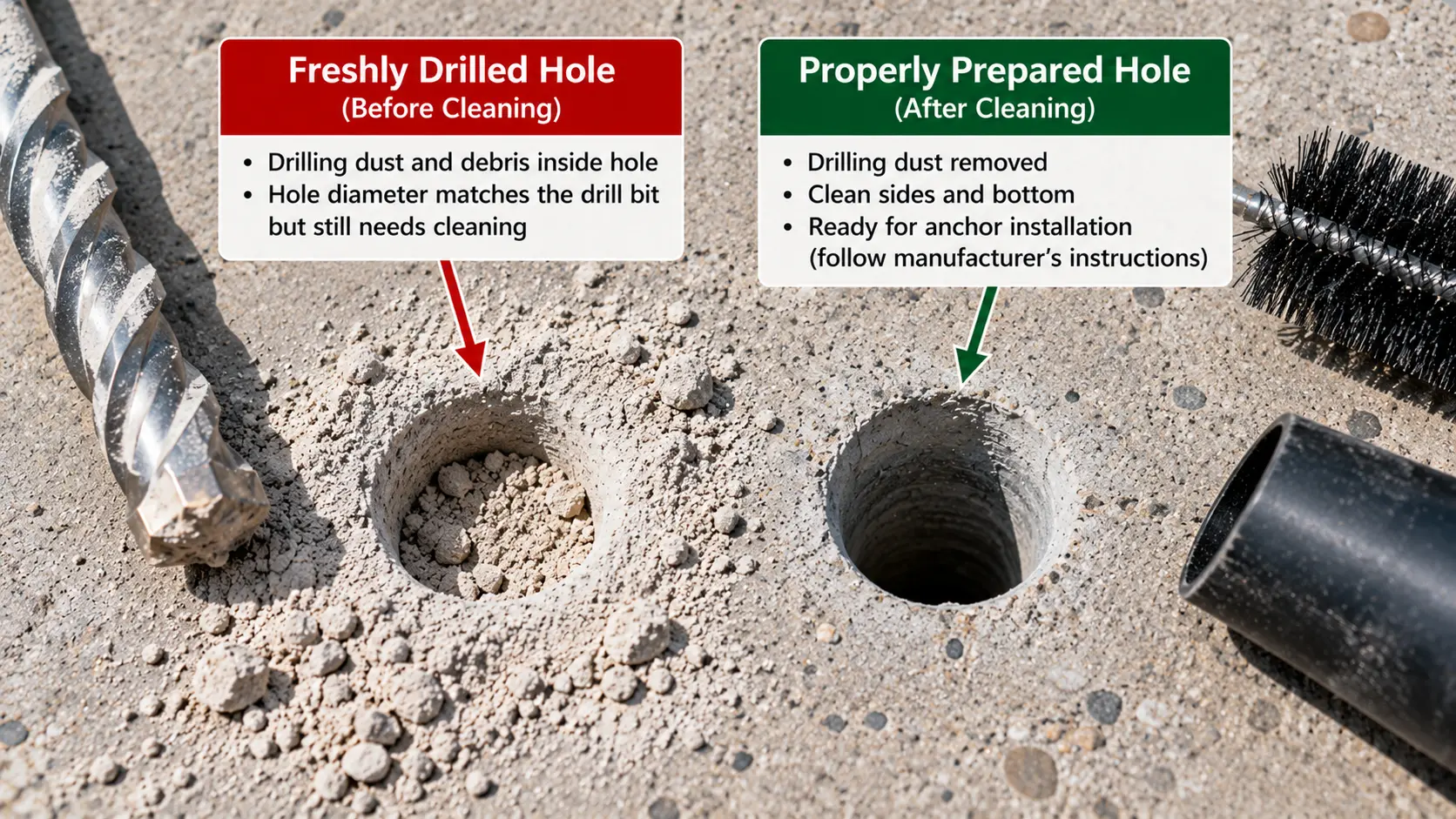
Hole preparation varies by system and can involve compressed air, brushing, vacuum drilling, blow-brush-blow sequences or manufacturer-approved alternatives. Tapcon instructions use a blow-out bulb or compressed air; Simpson’s Drop-In instructions call for compressed air, with overhead installations not needing to be blown clean. Cleaning matters most for adhesive anchors. Do not assume vacuum drilling is automatically acceptable, and do not apply one universal sequence to every anchor; follow the exact instructions for your anchor.
Oversized and Undersized Anchor Holes
Both can ruin an installation.
Oversized Holes
An oversized hole can prevent a mechanical anchor from engaging the concrete properly: improper expansion, inadequate thread engagement, reduced holding performance, a spinning anchor or installation failure. For structural applications, do not “fix” an oversized hole by installing a larger anchor unless the revised anchorage is specifically designed and permitted.
Undersized Holes
An undersized hole can keep the anchor from being inserted, require excessive driving force, damage the anchor or the concrete, cause improper thread formation or stop the evaluated installation from being achieved. Do not enlarge the hole randomly with an unsuitable bit.
Holes That Are Too Shallow or Too Deep
Too shallow, and the anchor may bottom out, miss the required embedment or be blocked by debris. Excess depth may be fine for some systems but should not be assumed acceptable. Follow the exact installation instructions.
Concrete Strength and Anchor Installation
Concrete properties do not change the bit size.
The bit dimension comes from the anchor system. Concrete strength affects the anchor’s qualified performance and tabulated values, not a user-adjusted bit size. For background on strength, see the concrete PSI.
Equipment for Your Project
Affiliate disclosure: As an Amazon Associate, ConcreteCalculate earns from qualifying purchases. We may also earn a commission from other affiliate links at no additional cost to you.
Cracked vs. Uncracked Concrete
Correct bit size is necessary but not sufficient.
ACI CODE-355.2 sets qualification criteria for mechanical anchors for uncracked concrete only, or for cracked and uncracked concrete, depending on the anchor. Drill-bit size alone tells you almost nothing about structural suitability. A correct bit is one necessary part of a compliant anchor installation, along with the right anchor, embedment, spacing, edge distance and member thickness.
Concrete vs. Block vs. Brick
Not interchangeable base materials.
Normal-weight concrete, lightweight concrete, grout-filled CMU, hollow CMU, brick and stone are different base materials. An anchor qualified for concrete is not automatically qualified for masonry, and many people call every masonry fastener a “concrete anchor.” Some products, such as the Titen HD, are listed for both concrete and masonry, but check the product report for the exact base material before drilling.
What to Do if You Hit Rebar
Stop, and do not improvise.
If the bit hits reinforcement, stop drilling. Do not cut or damage rebar without engineering authorization, and do not enlarge the hole or switch to a different anchor on the spot. Contact the engineer of record: relocating an anchor means rechecking edge distance, spacing and member thickness. Abandoned holes also affect nearby anchors. For rebar cover context, see the concrete cover chart.
Common Concrete Anchor Drilling Mistakes
Quick checks before you drill.
Selecting the bit from diameter without the anchor type
Type comes first.
Assuming every 1/4 in. anchor uses a 1/4 in. bit
Tapcon uses 3/16 in.
Assuming every concrete screw uses a smaller pilot
Titen HD uses a matching bit.
Assuming every heavy-duty screw uses the Tapcon relationship
Check the product.
Assuming every wedge system is identical
Verify each product.
Mixing drill data from different manufacturers
Never combine them.
Using a wedge-anchor table for sleeve anchors
Different systems.
Using a wedge-anchor table for drop-ins
Drop-ins use larger bits.
Using a mechanical table for adhesive anchors
Adhesives need a larger hole.
Confusing rod diameter with adhesive hole diameter
The hole is larger.
Confusing drop-in thread size with hole size
Use the product table.
Confusing the fixture hole with the concrete hole
They are different.
Using the Bolt Hole Size Chart to drill concrete
It is for steel.
Using the Clearance Hole Size Chart to drill concrete
It is for fixtures.
Confusing bit diameter with hole depth
Different dimensions.
Confusing hole depth with nominal embedment
They are not equal.
Confusing nominal with effective embedment
Design uses effective.
Assuming overall anchor length equals drill depth
Length includes hardware.
Ignoring fixture thickness
It adds to length.
Using a worn carbide bit
It drills an undersized hole.
Using a damaged bit
It changes hole geometry.
Using the wrong bit type
Use the specified bit.
Ignoring ANSI B212.15 where required
Evaluated anchors may require it.
Drilling at an excessive angle
Drill perpendicular.
Letting the bit wander
It oversizes the hole.
Failing to drill to required depth
The anchor may bottom out.
Failing to account for debris
Leave dust space where allowed.
Failing to clean the hole
Cleaning can be required.
Using an unapproved cleaning method
Follow the instructions.
Assuming vacuum drilling is always acceptable
Check the product.
Installing in an oversized hole
It reduces holding.
Forcing an anchor into an undersized hole
It can damage the anchor.
Re-drilling randomly to fix a bad hole
Ask the engineer.
Moving an anchor without rechecking edge distance
Spacing changes too.
Ignoring reinforcement
Locate rebar first.
Damaging rebar without authorization
Contact the engineer.
Assuming concrete qualification includes brick
It does not.
Assuming concrete qualification includes hollow block
It does not.
Ignoring cracked-concrete requirements
Check qualification.
Ignoring seismic qualification
It is product-specific.
Ignoring concrete strength
It affects performance.
Ignoring minimum member thickness
It limits embedment.
Ignoring edge distance
Edge breakout risk.
Ignoring anchor spacing
Breakout zones overlap.
Using a generic internet chart
Use the exact instructions.
Concrete Anchor Drill Bit FAQs
Thirty-six common questions, answered by anchor type.
What size drill bit do I need for concrete anchors?
Is the drill bit the same size as the concrete anchor?
What size bit for a 3/16-inch Tapcon?
What size bit for a 1/4-inch Tapcon?
What size drill bit for a 1/4-inch concrete anchor?
What size bit for a 3/8-inch wedge anchor?
What size bit for a 1/2-inch wedge anchor?
What size bit for a 5/8-inch wedge anchor?
What size bit for a 3/4-inch wedge anchor?
What size drill bit for a Titen HD?
What size drill bit for a sleeve anchor?
What size bit for a 1/2-inch sleeve anchor?
What size drill bit for a drop-in anchor?
What size drill bit for a 1/2-inch drop-in anchor?
What bit for a 1/2-inch threaded rod with epoxy?
How deep do I drill for a concrete anchor?
How much deeper should the hole be than the anchor?
Is hole depth the same as embedment?
What is effective embedment?
Do I need a carbide drill bit?
What is an ANSI B212.15 bit?
Can I use a regular drill?
Do I need a hammer drill?
Do I need a rotary hammer?
Can I use an SDS bit?
How do I clean the hole?
What happens if my concrete hole is too big?
What if the hole is too small?
Can I drill deeper than required?
Can I reuse an anchor hole?
Can I use the same bit for concrete and brick?
Can I drill through rebar?
What happens if I hit rebar?
Can concrete anchors be installed in block?
Can wedge anchors be installed in brick?
Does concrete PSI change the drill-bit size?
Standards and References Used
| Reference | What It Covers | Used For |
|---|---|---|
| ACI CODE-355.2-24 | Qualification of post-installed mechanical anchors | Mechanical anchor qualification |
| ACI 355.4 | Qualification of post-installed adhesive anchors in concrete | Adhesive anchor context |
| ITW Tapcon installation instructions (3/16 and 1/4) | Tapcon bit sizes, hole depth, cleaning | Concrete screw bits |
| Simpson Titen HD | Heavy-duty screw anchor product data | Titen HD bit sizes |
| Simpson Strong-Bolt 2 anchor anatomy | Wedge anchor installation, ANSI B212.15 bit | Wedge anchor bits |
| Simpson Drop-In fixed-depth drill bits | Drop-In anchor bit diameters and depths | Drop-in bits |
| ITW Red Head Dynabolt sleeve anchors | Sleeve anchor hole and depth guidance | Sleeve anchor hole sizing |
All numerical product values are specific to the named product. Manufacturer instructions and ICC-ES evaluation reports govern. Local codes, project drawings and the engineer of record govern structural anchorage.
📥 Download Concrete Anchor Drill Bit Chart PDF
Use your browser’s print function to save this page as a PDF for jobsite binders, estimating folders and reference.