Anchor Bolt Grade Chart 2026: ASTM F1554 Grade 36, 55 & 105
Anchor Bolt Grade Chart
ASTM F1554 Grade 36, 55 & 105
Yield and tensile strength, diameter ranges, color codes, weldability, nuts and washers for structural anchor bolts (anchor rods), and why grade is not the same as anchor capacity or an SAE bolt grade.
 Reviewed by Muhammad Ramzan Babar, PhD Researcher (Plasma Physics) & Calculator Developer, View Profile
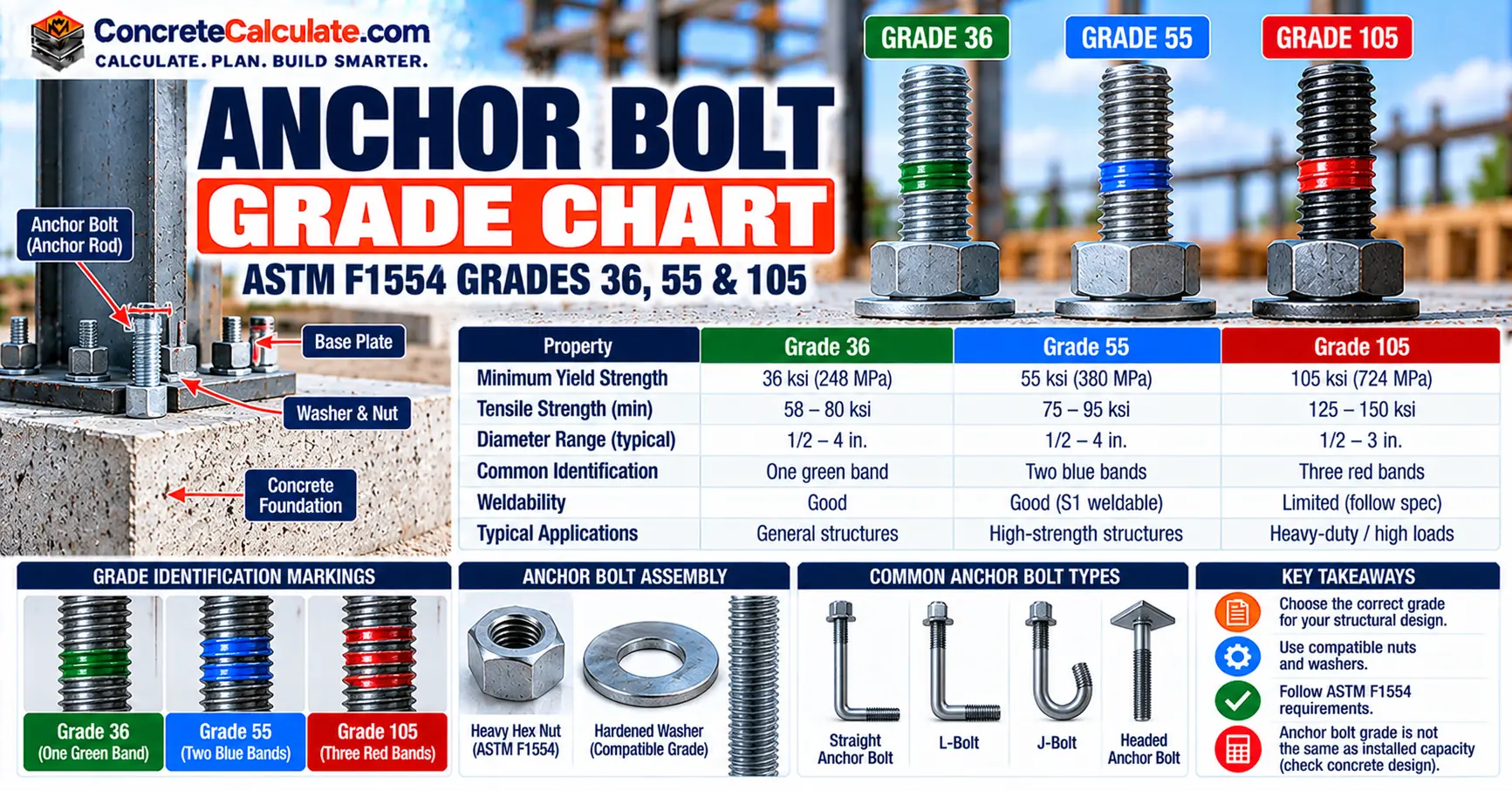
⭐ Anchor Bolt Grade Chart: ASTM F1554 Grades 36, 55 and 105
Specified minimum yield, tensile range and diameter range for the purpose-built structural anchor bolt (anchor rod) specification.
How to Read This Chart
The F1554 grade number is the specified minimum yield strength in ksi. Tensile strength is a separate range. The chart follows the F1554 mechanical-property table in current technical references; ASTM F1554-20 is the active edition. Other tables show 1/4 in. lower bounds for some grades or editions, so confirm the edition and the product certification you are actually buying. For SAE bolt grades, see the bolt grade chart.
| ASTM Specification | Grade | Minimum Yield Strength | Tensile Strength | Diameter Range | General Description |
|---|---|---|---|---|---|
| ASTM F1554 | 36 | 36 ksi | 58 – 80 ksi | 1/2 – 4 in. | Low-carbon steel anchor rod |
| ASTM F1554 | 55 | 55 ksi | 75 – 95 ksi | 1/2 – 4 in. | High-strength low-alloy steel anchor rod (weldable with S1) |
| ASTM F1554 | 105 | 105 ksi | 125 – 150 ksi | 1/2 – 3 in. | Alloy, heat-treated, high-strength anchor rod |
Grade Is Not Anchor Capacity
The F1554 grade number identifies minimum yield strength, not allowable anchor capacity in concrete. A Grade 105 anchor does not automatically have 105 ksi allowable stress, and does not automatically give a proportional increase in usable anchorage strength. Concrete breakout, pullout, side-face blowout where applicable, steel strength, edge distance, spacing, embedment, concrete strength and other limit states must still be checked.
What Do Anchor Bolt Grades Mean?
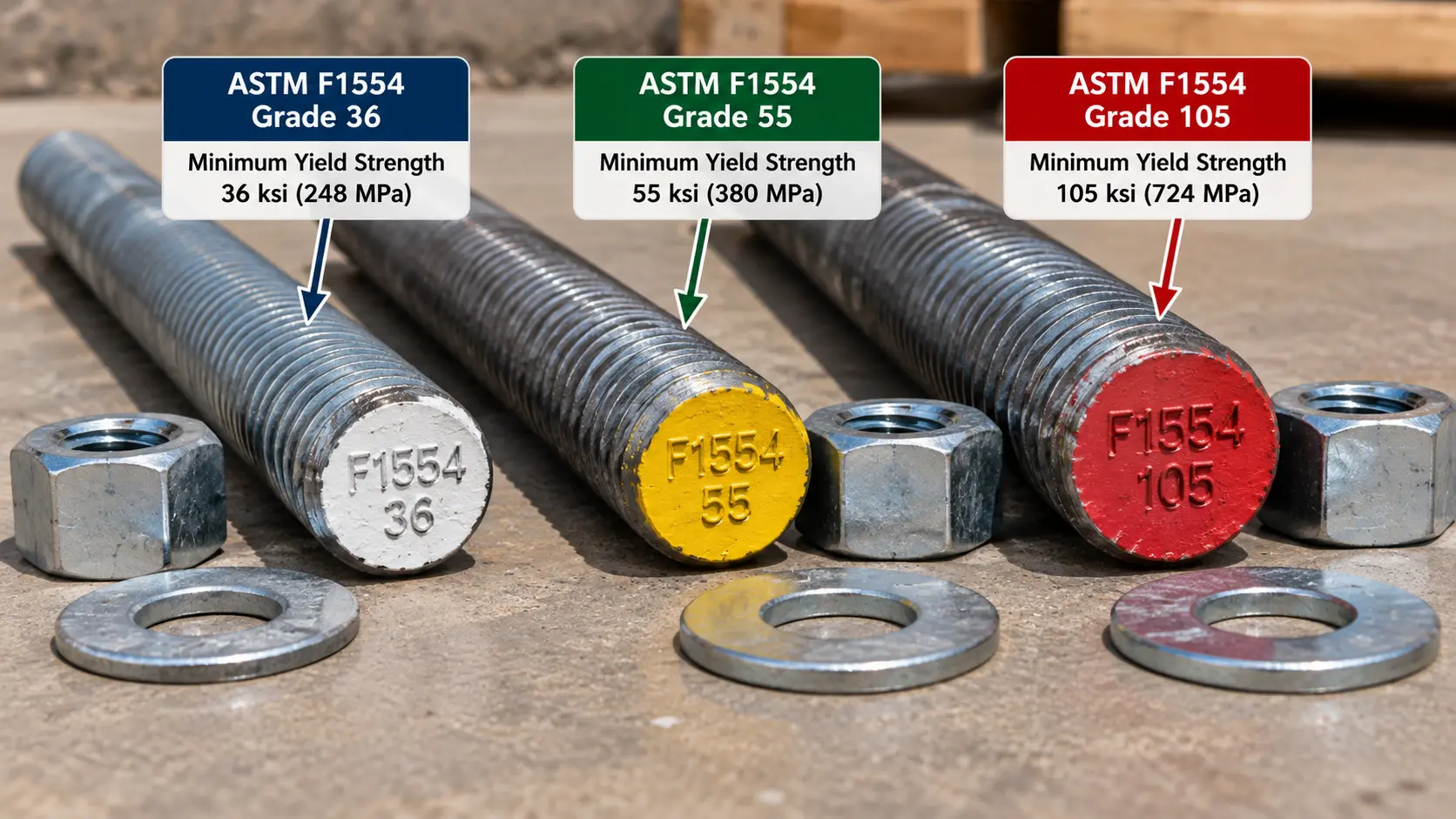
For F1554, the grade is the minimum yield strength.
- Fy: specified minimum yield strength
Do not read Grade 105 as 105 ksi tensile strength. Grade 105 has a 105 ksi minimum yield strength and a 125 to 150 ksi tensile range. Anchor bolt “grade” here means an ASTM material strength class, not a head marking like those on SAE bolts.
ASTM F1554 Anchor Bolt Grades
The principal purpose-built specification.
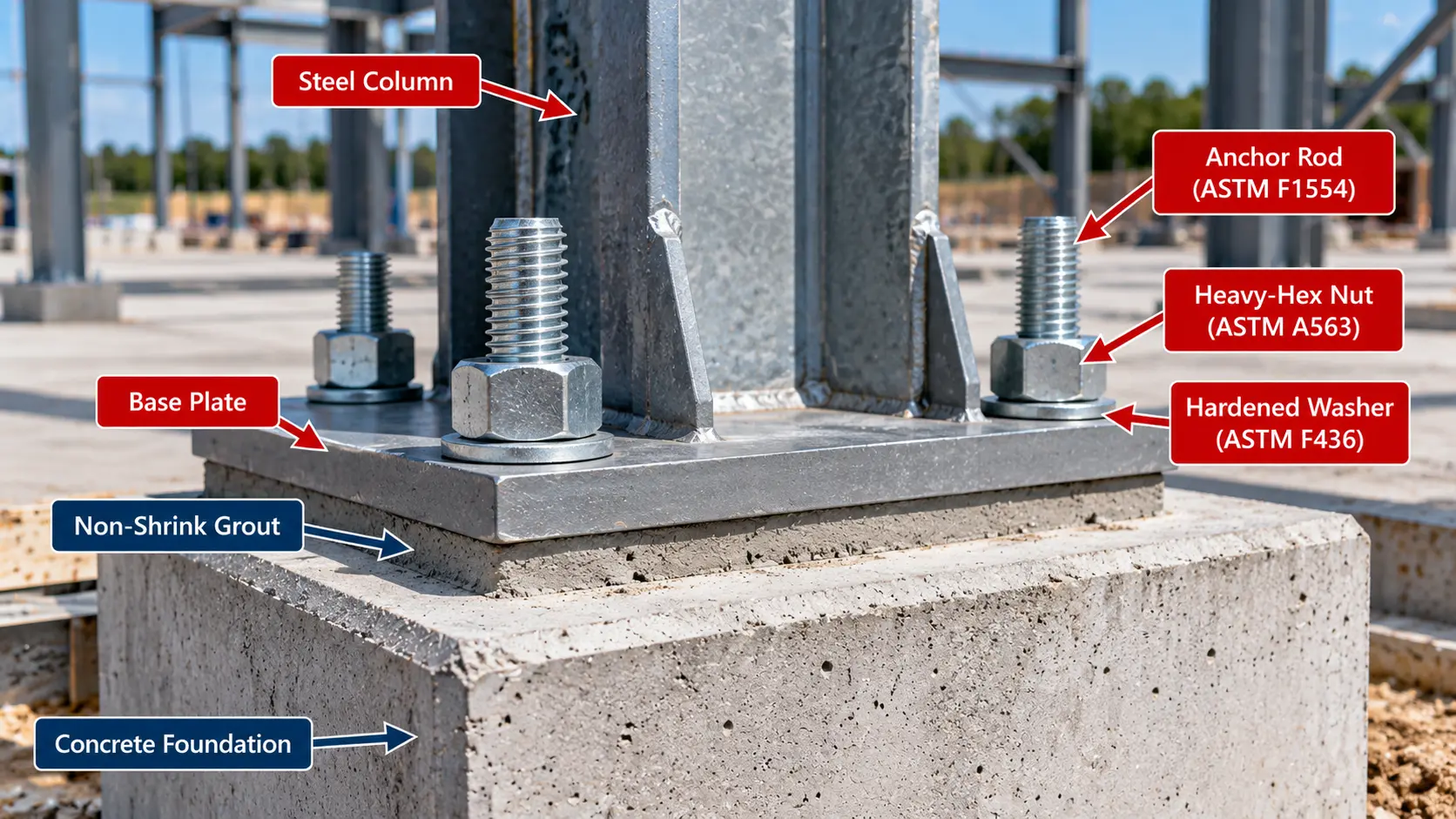
ASTM F1554 covers straight, bent, headed and headless anchor bolts (also known as anchor rods) made of carbon, medium-carbon boron, alloy or high-strength low-alloy steel, in three strength grades and two thread classes. They are intended for anchoring structural supports to concrete foundations, such as building columns, column supports for highway signs, street lighting and traffic signals, and steel bearing plates. The specification also covers all-thread rod furnished for anchoring to concrete. AISC identifies F1554 as the preferred material specification for anchor rods.
What F1554 Does Not Cover
F1554 does not cover mechanical expansion anchors, powder-activated nails or studs, or anchor bolts fabricated from deformed bar. For post-installed anchors, see the wedge anchor sizes and the concrete anchor drill bit sizes.
F1554 Grade 36
The lower-strength, widely available grade.
| Property | Value |
|---|---|
| Minimum yield strength | 36 ksi (248 MPa) |
| Tensile strength | 58 – 80 ksi |
| Diameter range | 1/2 – 4 in. |
| Elongation, minimum | 23% |
| Reduction of area, minimum | 40% |
| Identification | Blue end color unless grade-stamped (S3) |
Grade 36 is low-carbon steel and a common structural anchor-rod material. AISC notes it has historically had broad availability, while Grades 55 and 105 may be used for greater uplift or moment demands. Do not say Grade 36 is suitable for all ordinary foundations: final selection is engineered.
F1554 Grade 55
An intermediate-strength grade with a weldable option.
| Property | Value |
|---|---|
| Minimum yield strength | 55 ksi (380 MPa) |
| Tensile strength | 75 – 95 ksi |
| Diameter range | 1/2 – 4 in. |
| Elongation, minimum | 21% |
| Reduction of area, minimum | 30% |
| Identification | Yellow end color unless grade-stamped (S3) |
Grade 55 is high-strength, low-alloy steel. F1554 includes a supplementary requirement, S1, for weldable Grade 55. When S1 is not specified, the Grade 55 material may or may not be weldable. Never write that all Grade 55 anchor bolts are weldable.
F1554 Grade 105
High strength, with a smaller maximum diameter.
| Property | Value |
|---|---|
| Minimum yield strength | 105 ksi (724 MPa) |
| Tensile strength | 125 – 150 ksi |
| Diameter range | 1/2 – 3 in. |
| Elongation, minimum | 15% |
| Reduction of area, minimum | 45% |
| Identification | Red end color unless grade-stamped (S3) |
Grade 105 is an alloy, heat-treated steel. It is useful where steel tension demands are high, but higher steel grade does not remove concrete anchorage limit states, and it should not be presented as universally best. Do not assume Grade 105 is weldable.
F1554 Grade 36 vs. 55 vs. 105
One comparison chart for all three grades.
| Property | Grade 36 | Grade 55 | Grade 105 |
|---|---|---|---|
| Minimum yield | 36 ksi | 55 ksi | 105 ksi |
| Tensile range | 58 – 80 ksi | 75 – 95 ksi | 125 – 150 ksi |
| Strength level (descriptive) | Standard | Intermediate | High |
| Grade number equals minimum yield? | Yes | Yes | Yes |
| Weldability | Verify material and procedure | Weldable only with S1 (weldable Grade 55) | Do not assume weldable |
| Color identification | Blue | Yellow | Red |
| Maximum specification diameter | 4 in. | 4 in. | 3 in. |
The strength-level row is descriptive only and is not a design category.
Yield Strength vs. Tensile Strength
Two different material properties.
| Grade | Minimum Yield Fy | Tensile Fu | Minimum Yield (MPa) | Elongation, min. | Reduction of Area, min. |
|---|---|---|---|---|---|
| Grade 36 | 36 ksi | 58 – 80 ksi | 248 | 23% | 40% |
| Grade 55 | 55 ksi | 75 – 95 ksi | 380 | 21% | 30% |
| Grade 105 | 105 ksi | 125 – 150 ksi | 724 | 15% | 45% |
Yield strength is the stress at which the specified yielding behavior begins; tensile strength is the maximum tensile stress the specification requires. Neither is “anchor holding strength.” Metric values are as listed by the standard’s technical data; 55 ksi converts to about 379 MPa and is listed as 380 MPa.
Percentage Comparisons of Specified Yield
| Comparison | Ratio | Higher By |
|---|---|---|
| Grade 55 vs. Grade 36 | 55 / 36 = 1.528 | 52.8% |
| Grade 105 vs. Grade 55 | 105 / 55 = 1.909 | 90.9% |
| Grade 105 vs. Grade 36 | 105 / 36 = 2.917 | 191.7% |
These Are Steel Yield Comparisons Only
Do not translate these percentages into 52.8% more anchor capacity, 90.9% more concrete capacity or 191.7% more holding power. They compare specified minimum steel yield strength and nothing else.
Anchor Bolt Grade Color Codes
An identification aid, not a verification.
| F1554 Grade | End Color |
|---|---|
| 36 | Blue |
| 55 | Yellow |
| 105 | Red |
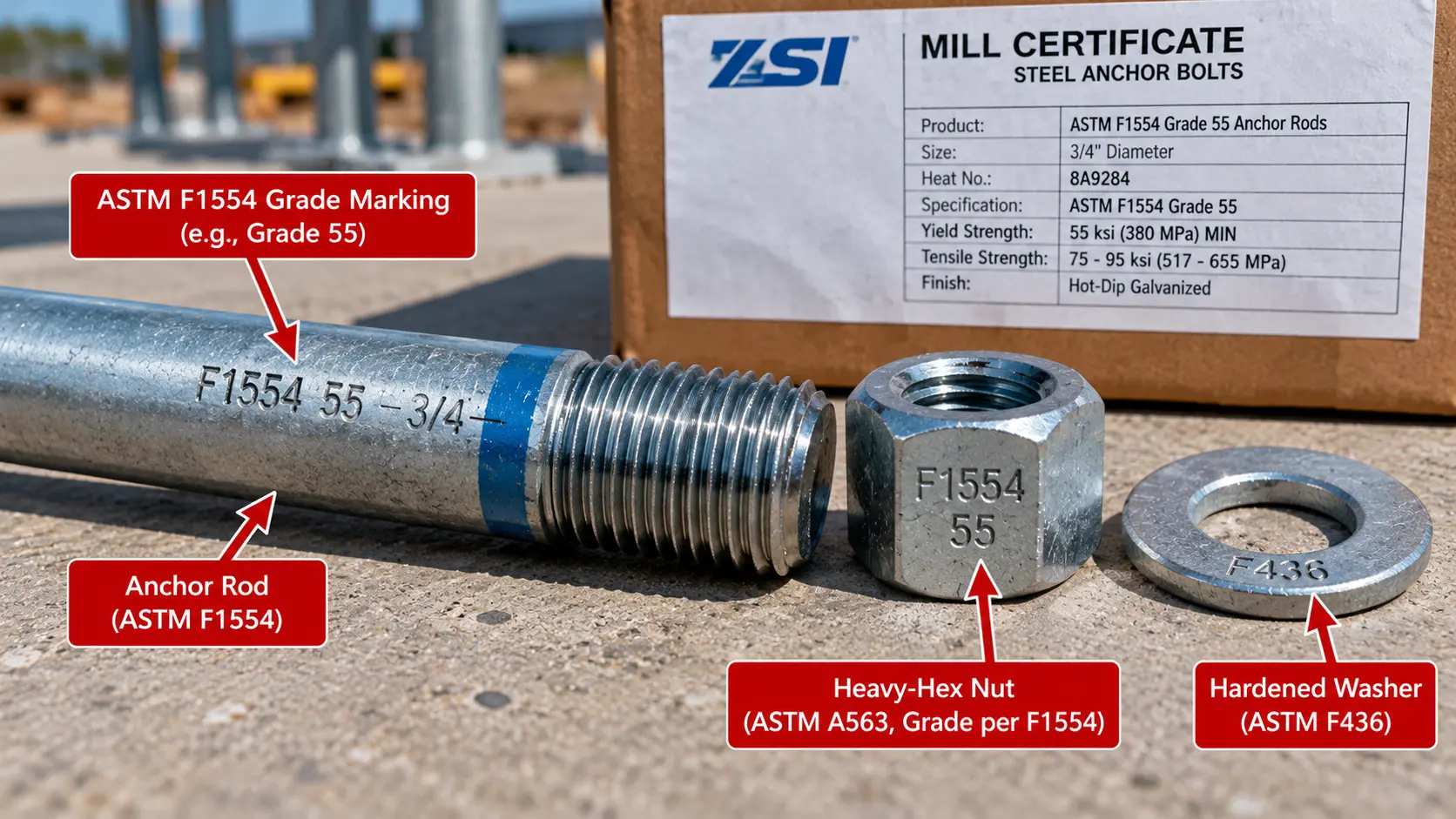
F1554 requires color coding on the end unless the grade is stamped under supplementary requirement S3. Do not identify an installed anchor by paint alone: use the project documents, certification, manufacturer or grade markings where provided, mill test reports and traceability. Color is not a substitute for material verification.
Anchor Bolt Grade Markings and Identification
Supplementary requirements S1 to S4.
| Requirement | What It Provides |
|---|---|
| S1 | Weldable version of Grade 55, with chemical composition restrictions and a carbon-equivalency check |
| S2 | Permanent manufacturer’s identification on the end projecting from the concrete |
| S3 | Permanent grade identification on that end, in lieu of color coding |
| S4 | Charpy impact requirements for Grades 55 and 105 (and a lower test temperature for Grade 105) |
These apply only when written into the purchase order or contract. Do not apply the radial-line head markings used for SAE bolts to F1554 anchor rods; they are different systems.
Anchor Bolt vs. Anchor Rod
Two names for the same family.
AISC commonly says anchor rod, because the embedded end can be headed, straight with an embedded nut, hooked or otherwise configured. ASTM F1554 says anchor bolts and notes they are also known as anchor rods. This page uses anchor bolt because that is what most people search for, and anchor rod where the structural-steel convention applies.
F1554 vs. SAE Grade 2, 5 and 8
Different systems that cannot be matched by number.
| System | Examples | What the Grade Represents | Typical Context |
|---|---|---|---|
| ASTM F1554 | 36, 55, 105 | Anchor-bolt material strength requirements | Structural anchorage to concrete |
| SAE J429 | Grades 2, 5, 8 | Mechanical properties of inch-series bolts, screws and studs | General and mechanical fastening |
F1554 Grade 55 is not SAE Grade 5, and F1554 Grade 105 is not SAE Grade 8. They belong to different specifications. For SAE grades, head markings and general bolt strength, see the bolt grade chart.
ASTM A307 vs. F1554
A307 Grade C was replaced by F1554 Grade 36.
| A307 Grade | Description |
|---|---|
| Grade A | Bolts, studs and threaded rod, 60 ksi minimum tensile strength, general applications |
| Grade B | Bolts, studs and threaded rod, 60 to 100 ksi tensile strength, for flanged joints in piping systems with cast iron flanges |
| Grade C | Replaced by Specification F1554 Grade 36 |
A307 Grade C is no longer a current anchor-bolt grade. A307 Grade A should not be casually treated as equivalent to F1554 Grade 36: AISC notes that commercially available all-thread meeting A307 will not necessarily satisfy F1554 Grade 36. A307 also does not cover mechanical expansion anchors.
Other ASTM Anchor-Rod Materials
Recognized, but not F1554 grades.
| Specification | General Category | Treat as an F1554 Grade? |
|---|---|---|
| F1554 | Purpose-built anchor-bolt specification | Yes: 36, 55, 105 |
| A36 | Structural carbon steel | No |
| A572 | High-strength low-alloy structural steel | No |
| A193 | High-temperature and pressure bolting materials | No |
| A354 | Quenched-and-tempered alloy bolts and studs | No |
| A449 | Quenched-and-tempered steel bolts and studs | No |
| A588 | Weathering structural steel | No |
| A307 | Carbon steel general fasteners | No |
AISC recognizes several of these for anchor rods but prefers F1554. Strength values for each are not listed here because each grade and diameter needs its own research.
Anchor Bolt Weldability by Grade
Never write that all anchor bolts can be welded.
| Grade | Weldability Note |
|---|---|
| Grade 36 | Low-carbon steel, usually treated as the more weldable option, but welding still needs material verification and an appropriate procedure |
| Grade 55 | Specify supplementary requirement S1 when welding is required; without S1 the material may or may not be weldable |
| Grade 105 | Do not assume it is weldable; AISC educational material distinguishes it from the weldable options |
F1554 Grade 55 S1
S1 is a supplementary requirement that applies only when written into the order. It controls chemical composition and uses a carbon-equivalency check to give assurance of weldability. This page does not reproduce the equivalency formula. Search terms like “weldable F1554 55” and “can Grade 55 anchor bolts be welded” have the same answer: only with S1 and a proper welding procedure.
Equipment for Your Project
Affiliate disclosure: As an Amazon Associate, ConcreteCalculate earns from qualifying purchases. We may also earn a commission from other affiliate links at no additional cost to you.
Can Grade 55 Replace Grade 36?
The standard allows a weldable Grade 55 under Grade 36, but project documents govern.
F1554 states that when Grade 36 is specified, a weldable Grade 55 may be furnished at the supplier’s option. That is a provision of the specification, not a field-substitution rule. Project specifications, design assumptions, welding requirements, procurement documents and Engineer-of-Record approval still govern actual substitutions.
Nut Compatibility by Anchor Grade
Anchor grade and nut grade are different things.
| Anchor Grade | Size | Plain Finish Nut | Galvanized Nut |
|---|---|---|---|
| 36 | 1/2 – 1-1/2 in. | A563 Grade A, hex | A563 Grade A, hex |
| 36 | 1-5/8 – 4 in. | A563 Grade A, heavy hex | A563 Grade A, heavy hex |
| 55 | 1/2 – 1-1/2 in. | A563 Grade A, hex | A563 Grade A, heavy hex |
| 55 | 1-5/8 – 4 in. | A563 Grade A, heavy hex | A563 Grade A, heavy hex |
| 105 | 1/2 – 1-1/2 in. | A563 Grade D, heavy hex* | A563 Grade DH, heavy hex |
| 105 | 1-5/8 – 3 in. | A563 Grade DH, heavy hex | A563 Grade DH, heavy hex |
*A563 Grade D nuts are rarely available, so Grade DH or ASTM A194 Grade 2H is commonly substituted, and DH availability in sizes 1 in. and larger can be limited. Grade 105 needs higher-strength nuts than Grades 36 and 55. This table is context, not a procurement specification: check the current standard for size, finish and style. For nut dimensions, see the nut sizes.
Washer Compatibility by Anchor Grade
F436 hardened washers are commonly specified.
F1554 hardware tables list ASTM F436 hardened washers for all three grades. Actual washer selection can depend on grade, hole size, base plate, bearing, project specification, galvanizing and detail. Dimensions belong to the washer sizes; base-plate hole context is in the bolt hole sizes and clearance hole sizes.
Galvanized Anchor Bolt Grades
Coating and grade are separate properties.
F1554 includes zinc-coating requirements. Plain, hot-dip galvanized and mechanically zinc-coated finishes use compatible nuts, and the nut selection for galvanized assemblies can differ from plain ones (for example, Grade 55 plain uses a hex nut while galvanized Grade 55 uses a heavy hex nut in the hardware table). Galvanizing does not change an F1554 Grade 36 anchor into a different grade. Coating damage and exposed environments should be considered separately from material grade.
Anchor Bolt Grade vs. Diameter
Size and grade are selected separately.
A 1 in. F1554 Grade 36 rod and a 1 in. F1554 Grade 105 rod have the same nominal diameter but different steel strengths. Diameter does not determine Fy, and Fy does not determine diameter; the engineer selects both. For sizes, see the anchor bolt size chart and the bolt diameter chart, and for general inch bolt sizes the US bolt sizes.
Anchor Bolt Grade vs. Thread Size
Grade does not define threads.
Grade does not set thread diameter, pitch, series (UNC or UNF) or threaded length. AISC permits specified unified threads for anchor rods; thread requirements are separate from material grade. For thread terminology and sizes, see the thread size chart, UNC thread sizes and the thread pitch chart.
Anchor Bolt Grade vs. Embedment Depth
A higher grade does not automatically reduce embedment.
Embedment depth is governed by the concrete anchorage design, not by steel grade. Raising the grade increases the steel strength but may shift the limiting failure mode to the concrete, so a higher grade does not automatically mean less embedment. For embedment concepts see the anchor bolt embedment calculator; spacing and edge distance are in the anchor bolt spacing.
Anchor Bolt Grade vs. Concrete Strength
Two different material properties.
Concrete compressive strength f’c and steel yield Fy are unrelated properties. An Fy of 55 ksi does not mean the concrete is 55 ksi or that the anchor can transfer 55 ksi into concrete. For concrete strength, see the concrete PSI.
Does a Higher Grade Mean Higher Anchor Capacity?
No: the anchor grade is not the anchor capacity.
An anchorage can be limited by anchor steel strength, concrete breakout, pullout, side-face blowout where applicable, pryout, concrete edge conditions, spacing, embedment, concrete strength, member thickness, load direction and seismic requirements. A higher steel grade changes only the steel material properties.
| Question | Does the F1554 Grade Tell You This? |
|---|---|
| Minimum steel yield strength | Yes |
| Steel tensile-strength range | Yes |
| Anchor diameter | No |
| Anchor length | No |
| Thread pitch | No |
| Embedment depth | No |
| Concrete breakout strength | No |
| Pullout strength | No |
| Edge distance | No |
| Anchor spacing | No |
| Concrete PSI | No |
| Base-plate thickness | No |
| Allowable anchor load | No |
| Required nut | Grade contributes, but size, finish and specification also matter |
| Weldability | Grade plus applicable supplementary and material requirements matter |
| Corrosion protection | No: finish or coating is separate |
Cast-in anchor rods in a column base differ from post-installed anchors; for those, see the wedge anchor sizes.
Anchor Bolt Steel Strength Calculations
Illustrative only: not an allowable load or a design strength.
Gross Area and Yield (Illustration)
1 in. Rod, Gross-Section Yield Load
Tensile Stress Area
A threaded anchor’s critical steel section involves the tensile stress area At, which is smaller than the gross area for ordinary external threads. For a 1 in.-8 UNC thread, At = 0.7854(d – 0.9743/n)² = 0.7854(1 – 0.9743/8)² ≈ 0.606 in², versus 0.785 in² gross. Conceptually the steel strength relates to At and the tensile strength, depending on the applicable design provision.
Tensile Stress Area Comparison
Do not use any single simplified formula as a replacement for ACI or AISC anchorage design. For thread data, see the thread size chart.
How to Choose an Anchor Bolt Grade
Follow a design chain, not a load table.
- Establish the design loads.
- Define the anchorage geometry.
- Check the concrete limit states.
- Determine the required anchor steel strength.
- Choose diameter and material specification.
- Select nuts, washers, finish and weldability requirements.
- Finalize the engineered anchor assembly.
Do not use a table like “small load, Grade 36; medium load, Grade 55; heavy load, Grade 105.” AISC notes Grade 36 is widely available and that Grades 55 and 105 may be used for higher uplift or moment demands, but that remains context and not a universal rule. For foundation context, see the footing size chart and the foundation depth chart; for related tools, the anchor bolt calculator and base plate calculator.
Common Anchor Bolt Grade Mistakes
Quick checks before you specify or order.
Calling every anchor bolt Grade 8
F1554 and SAE are different systems.
Using SAE terms for F1554 rods
Use Grade 36, 55 or 105.
Assuming F1554 55 equals SAE Grade 5
They are different specs.
Assuming F1554 105 equals SAE Grade 8
They are different specs.
Reading the grade number as tensile strength
It is minimum yield.
Thinking Grade 36 means 36 ksi ultimate
36 ksi is minimum yield.
Thinking Grade 105 means 105 ksi ultimate
Its tensile range is 125 to 150 ksi.
Confusing yield with allowable stress
They are different.
Confusing yield with design strength
Design applies reduction factors.
Confusing steel strength with concrete capacity
Concrete limit states are separate.
Assuming Grade 105 always gives the strongest anchorage
Concrete may govern.
Ignoring concrete breakout
It can limit capacity.
Ignoring pullout
It can limit capacity.
Ignoring edge distance
It affects breakout.
Ignoring spacing
Anchors can interact.
Ignoring embedment
It governs concrete strength.
Ignoring concrete strength
It changes concrete capacity.
Ignoring member thickness
It limits embedment.
Ignoring base-plate geometry
It affects the load path.
Ignoring thread tensile area
Threads reduce the section.
Using gross area as the threaded design area
It overstates the steel.
Assuming diameter determines grade
They are independent.
Assuming grade determines diameter
They are independent.
Assuming grade determines thread pitch
Threads are separate.
Assuming grade determines embedment
Concrete design does.
Assuming all F1554 grades are weldable
Only certain materials are.
Welding Grade 55 without checking S1
Verify the material.
Welding Grade 105 because steel is weldable
Do not assume it.
Treating old A307 Grade C as current
It was replaced by F1554 Grade 36.
Assuming A307 Grade A equals F1554 Grade 36
They are not equivalent.
Substituting random all-thread for certified F1554
Certification matters.
Mixing nuts from unrelated strength grades
Use compatible nuts.
Ignoring galvanized-nut requirements
Coatings affect nuts.
Mixing plain and galvanized compatibility data
They differ.
Assuming any washer works
Use the specified washer.
Identifying installed anchors from paint alone
Use documentation.
Ignoring certification and mill test reports
They verify the material.
Treating color coding as structural verification
It is an aid only.
Assuming F1554 covers wedge anchors
It does not.
Assuming F1554 covers concrete screws
It does not.
Assuming F1554 covers adhesive anchors
It does not.
Confusing cast-in and post-installed anchors
Different systems.
Using a generic internet chart instead of project specs
Specs govern.
Anchor Bolt Grade FAQs
Thirty-four common questions, answered from ASTM F1554 and AISC guidance.
What are the grades of anchor bolts?
What does F1554 mean?
What does F1554 Grade 36 mean?
What does F1554 Grade 55 mean?
What does F1554 Grade 105 mean?
What is the strongest F1554 grade?
What is the yield strength of F1554 Grade 36?
What is the tensile strength of Grade 36?
What is the yield strength of F1554 Grade 55?
What is the tensile strength of Grade 55?
What is the yield strength of F1554 Grade 105?
What is the tensile strength of Grade 105?
What is the difference between Grade 36 and Grade 55 anchor bolts?
What is the difference between Grade 55 and Grade 105?
Is F1554 Grade 55 weldable?
Is F1554 Grade 105 weldable?
What does S1 mean on F1554 Grade 55?
Can Grade 55 replace Grade 36?
Is F1554 Grade 105 the same as Grade 8?
Is F1554 Grade 55 the same as Grade 5?
Is A307 the same as F1554 Grade 36?
What happened to ASTM A307 Grade C?
What color is F1554 Grade 36?
What color is F1554 Grade 55?
What color is F1554 Grade 105?
How do I identify an anchor bolt grade?
What nuts go with F1554 anchor bolts?
What washers go with F1554 anchors?
Can F1554 anchors be galvanized?
Does a higher anchor-bolt grade require less embedment?
Does Grade 105 have three times the capacity of Grade 36?
Does anchor bolt grade affect concrete breakout strength?
What grade anchor bolt should I use for a steel column?
What grade anchor bolt should I use for a light pole?
Standards and References Used
| Reference | What It Covers | Used For |
|---|---|---|
| ASTM F1554-20 | Anchor bolts, steel, 36, 55 and 105-ksi yield strength | Scope, grades, supplementary requirements |
| Portland Bolt F1554 technical reference | F1554 mechanical properties, color coding, supplementary requirements, hardware | Property values, colors, nuts, washers |
| ASTM A307-21 | Carbon steel bolts, studs and threaded rod (60 ksi tensile) | A307 grades and the Grade C replacement |
| AISC anchor rod guidance | Anchor rod materials and F1554 as the preferred specification | Anchor rod terminology and material preference |
Mechanical-property and hardware values follow F1554 technical data for the current active edition; confirm the edition, grade, diameter and finish on the project documents and the mill certification. Local codes, project specifications and the engineer of record govern structural anchorage.
📥 Download Anchor Bolt Grade Chart PDF
Use your browser’s print function to save this page as a PDF for jobsite binders, estimating folders and reference.