PVC Pipe Size Chart 2026 – OD, ID, Schedule 40/80/120 & SDR
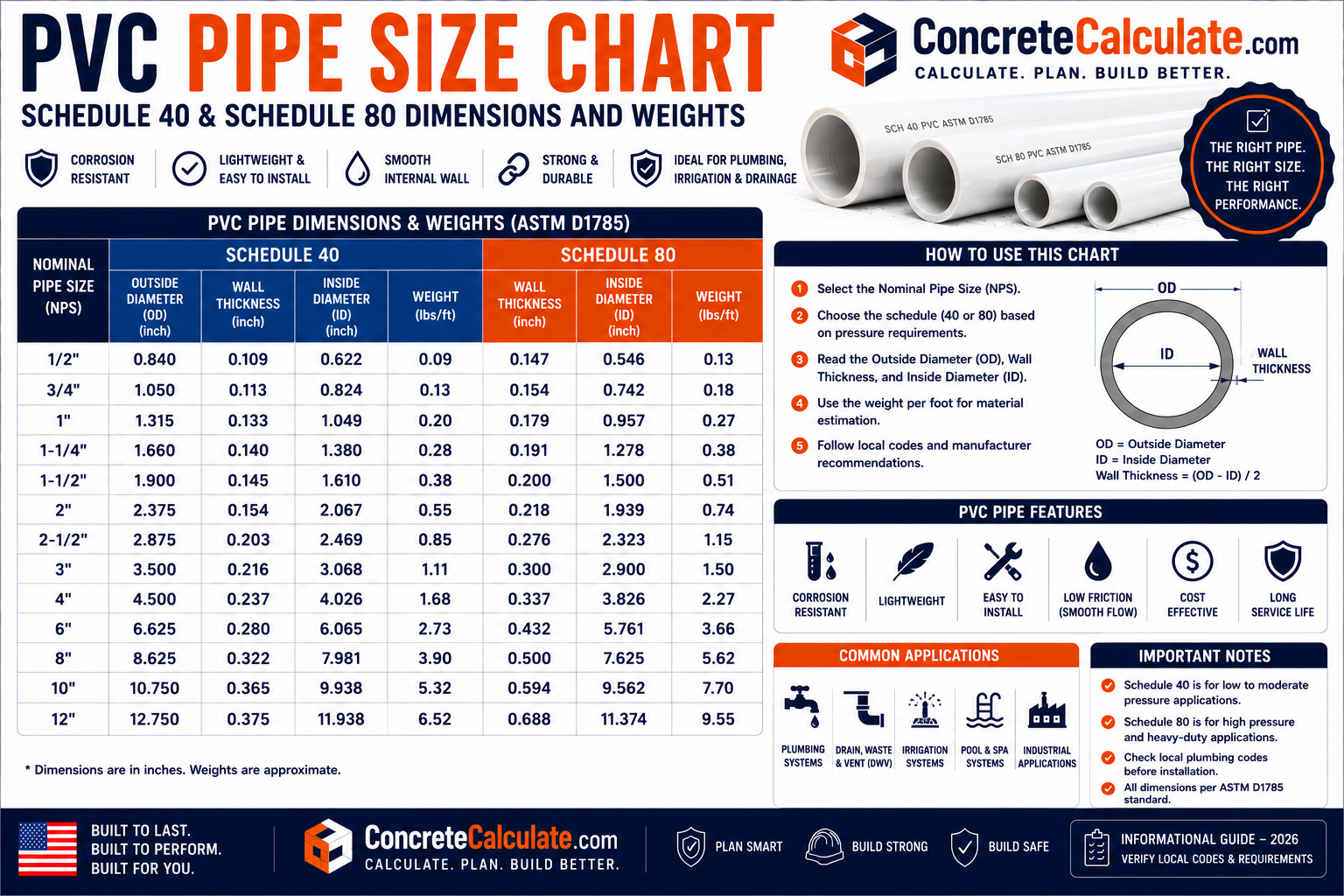
PVC Pipe Size Chart
OD, ID, Schedule 40/80/120 & SDR
Nominal PVC size is a standardized designation, not a direct measurement. This chart provides actual OD, ID and wall thickness by schedule and SDR, based on ASTM D1785 and D2241.
 Reviewed by Muhammad Ramzan Babar, PhD Researcher & Calculator Developer · View Profile
Nominal PVC size follows iron pipe size (IPS) convention. 1/2 inch PVC has an actual outside diameter of 0.840 inches. This gap between nominal label and actual measurement exists across every PVC pipe size and is one of the most common sources of confusion for first-time buyers.
⭐⭐⭐ PVC Pipe Size Chart: Quick Reference
Dimensions per ASTM D1785 for PVC Schedule 40 and 80 pipe.
| Nominal Size | OD | Sch 40 ID | Sch 80 ID | Sch 40 Wall | Sch 80 Wall |
|---|---|---|---|---|---|
| 1/2″ | 0.840″ | 0.602″ | 0.526″ | 0.109″ | 0.147″ |
| 3/4″ | 1.050″ | 0.804″ | 0.722″ | 0.113″ | 0.154″ |
| 1″ | 1.315″ | 1.029″ | 0.937″ | 0.133″ | 0.179″ |
| 1-1/4″ | 1.660″ | 1.360″ | 1.258″ | 0.140″ | 0.191″ |
| 1-1/2″ | 1.900″ | 1.590″ | 1.470″ | 0.145″ | 0.200″ |
| 2″ | 2.375″ | 2.047″ | 1.913″ | 0.154″ | 0.218″ |
| 2-1/2″ | 2.875″ | 2.445″ | 2.289″ | 0.203″ | 0.276″ |
| 3″ | 3.500″ | 3.042″ | 2.864″ | 0.216″ | 0.300″ |
| 4″ | 4.500″ | 3.998″ | 3.786″ | 0.237″ | 0.337″ |
| 5″ | 5.563″ | 4.973″ | 4.719″ | 0.258″ | 0.375″ |
| 6″ | 6.625″ | 5.945″ | 5.669″ | 0.280″ | 0.432″ |
| 8″ | 8.625″ | 7.789″ | 7.565″ | 0.322″ | 0.500″ |
| 10″ | 10.750″ | 9.760″ | 9.494″ | 0.365″ | 0.593″ |
| 12″ | 12.750″ | 11.538″ | 11.184″ | 0.406″ | 0.687″ |
Dimensions follow ASTM D1785, the governing standard for PVC Schedule 40, 80 and 120 pipe, intended for the distribution of pressurized liquids compatible with the piping material. Inside diameters shown are approximate values based on average outside diameter minus twice the minimum wall thickness.
⭐ What Is PVC Pipe?
PVC stands for polyvinyl chloride, a widely used thermoplastic piping material.
PVC pressure pipe
Designed and rated for pressurized liquid distribution, such as water supply, under ASTM D1785 or ASTM D2241.
PVC drainage/DWV pipe
Non-pressure products used for drain, waste, and vent applications, governed by separate DWV-specific standards, distinct from pressure pipe.
Common applications
Water supply, irrigation, drainage, sewer, electrical conduit, and industrial piping.
Why PVC sizing differs from tubing
PVC pipe follows nominal iron pipe size (IPS) convention, where the labeled size does not equal actual outside diameter. PVC tubing, by contrast, is typically sized directly by actual OD.
⭐⭐⭐ PVC Nominal Size vs Actual Outside Diameter
This is the single most important concept for anyone shopping for PVC pipe or fittings.
| Nominal Size | Actual OD (in) |
|---|---|
| 1/2″ | 0.840 |
| 3/4″ | 1.050 |
| 1″ | 1.315 |
| 1-1/4″ | 1.660 |
| 1-1/2″ | 1.900 |
| 2″ | 2.375 |
| 3″ | 3.500 |
| 4″ | 4.500 |
| 6″ | 6.625 |
| 8″ | 8.625 |
| 10″ | 10.750 |
| 12″ | 12.750 |
This same OD applies regardless of schedule; a 2 inch pipe measures 2.375 inches OD whether it is Schedule 40, 80, or 120. Only wall thickness and therefore ID change between schedules at a fixed nominal size.
⭐⭐⭐ PVC Schedule Explained
ASTM D1785 covers PVC Schedule 40, 80, and 120 pipe, each using the same OD series with progressively thicker walls.
Schedule 40
The thinnest wall of the three, most common for general residential and light commercial pressure applications.
Schedule 80
Thicker wall at the same OD, providing greater pressure capability and often specified for industrial, chemical, or higher-pressure service.
Schedule 120
The thickest wall of the three, available in a more limited range of nominal sizes than Schedule 40 and 80.
Since OD stays fixed for a given nominal size across all three schedules, increasing schedule number reduces inside diameter. A 2 inch pipe has a larger bore in Schedule 40 (2.047 in ID) than in Schedule 80 (1.913 in ID).
⭐⭐⭐ PVC Schedule 40 Pipe Size Chart
The most common PVC pressure pipe dimension series.
| Nominal Size | OD (in) | Min. Wall (in) | Avg. ID (in) |
|---|---|---|---|
| 1/8″ | 0.405 | 0.068 | 0.249 |
| 1/4″ | 0.540 | 0.088 | 0.344 |
| 3/8″ | 0.675 | 0.091 | 0.473 |
| 1/2″ | 0.840 | 0.109 | 0.602 |
| 3/4″ | 1.050 | 0.113 | 0.804 |
| 1″ | 1.315 | 0.133 | 1.029 |
| 1-1/4″ | 1.660 | 0.140 | 1.360 |
| 1-1/2″ | 1.900 | 0.145 | 1.590 |
| 2″ | 2.375 | 0.154 | 2.047 |
| 3″ | 3.500 | 0.216 | 3.042 |
| 4″ | 4.500 | 0.237 | 3.998 |
| 6″ | 6.625 | 0.280 | 5.945 |
| 8″ | 8.625 | 0.322 | 7.789 |
Pressure rating is a secondary reference tied to the specific product’s design stress designation and service conditions; see the Pipe Pressure Rating Chart for material-specific pressure data.
⭐⭐⭐ PVC Schedule 80 Pipe Size Chart
The same OD series as Schedule 40, with thicker walls and smaller ID at each size.
| Nominal Size | OD (in) | Min. Wall (in) | Avg. ID (in) |
|---|---|---|---|
| 1/2″ | 0.840 | 0.147 | 0.526 |
| 3/4″ | 1.050 | 0.154 | 0.722 |
| 1″ | 1.315 | 0.179 | 0.937 |
| 1-1/4″ | 1.660 | 0.191 | 1.258 |
| 1-1/2″ | 1.900 | 0.200 | 1.470 |
| 2″ | 2.375 | 0.218 | 1.913 |
| 3″ | 3.500 | 0.300 | 2.864 |
| 4″ | 4.500 | 0.337 | 3.786 |
| 6″ | 6.625 | 0.432 | 5.669 |
| 8″ | 8.625 | 0.500 | 7.565 |
⭐⭐ PVC Schedule 120 Pipe Size Chart
Schedule 120 is not available across the same broad size range as Schedule 40 and 80.
ASTM D1785 covers Schedule 120 alongside 40 and 80, but Schedule 120 is offered in a more limited range of nominal sizes and is less commonly stocked. Always confirm actual availability with the specific manufacturer before specifying Schedule 120 for a project.
| Nominal Size | OD (in) | Approx. Wall (in) |
|---|---|---|
| 1/2″ | 0.840 | 0.170 |
| 3/4″ | 1.050 | 0.184 |
| 1″ | 1.315 | 0.219 |
| 2″ | 2.375 | 0.250 |
| 4″ | 4.500 | 0.437 |
⭐⭐⭐ PVC Schedule 40 vs 80 vs 120
Same OD, progressively thicker walls, progressively smaller bore.
| 2 Inch PVC | OD (in) | Wall (in) | ID (in) |
|---|---|---|---|
| Schedule 40 | 2.375 | 0.154 | 2.047 |
| Schedule 80 | 2.375 | 0.218 | 1.913 |
| Schedule 120 | 2.375 | 0.250 | 1.875 |
| Feature | Schedule 40 | Schedule 80 |
|---|---|---|
| OD | Same for corresponding size | Same for corresponding size |
| Wall | Thinner | Thicker |
| ID | Larger | Smaller |
| Weight | Lower | Higher |
| Pressure capability | Product/temperature dependent | Product/temperature dependent |
⭐⭐⭐ PVC SDR Pipe (ASTM D2241)
SDR pressure pipe is a completely separate dimensional system from Schedule 40/80/120 and should never be merged into the same table.
SDR = Outside Diameter divided by Wall Thickness. Unlike Schedule pipe, SDR pipe maintains this constant ratio, so wall thickness increases proportionally with diameter rather than following the standardized Schedule series.
| Nominal Size | OD (in) | SDR 13.5 Wall | SDR 21 Wall | SDR 26 Wall |
|---|---|---|---|---|
| 1/2″ | 0.840 | 0.062 | — | — |
| 3/4″ | 1.050 | 0.078 | 0.060 | — |
| 1″ | 1.315 | 0.097 | 0.063 | 0.060 |
| 1-1/4″ | 1.660 | 0.123 | 0.079 | 0.064 |
| 1-1/2″ | 1.900 | 0.141 | 0.090 | 0.073 |
| 2″ | 2.375 | 0.176 | 0.113 | 0.091 |
| 2-1/2″ | 2.875 | 0.213 | 0.137 | 0.110 |
| 3″ | 3.500 | 0.259 | 0.167 | 0.135 |
| 4″ | 4.500 | 0.333 | 0.214 | 0.173 |
| 6″ | 6.625 | 0.491 | 0.316 | 0.255 |
| SDR | Reference Pressure Rating (PR) |
|---|---|
| SDR 13.5 | 315 psi |
| SDR 17 | 250 psi |
| SDR 21 | 200 psi |
| SDR 26 | 160 psi |
| SDR 32.5 | 125 psi |
ASTM D2241 covers PVC SDR-PR (Standard Dimension Ratio, Pressure Rated) pipe. ASTM F645 identifies D1785 and D2241 as separate PVC pipe specifications within the broader thermoplastic water-pressure piping framework, confirming these are genuinely distinct products, not variations of the same dimensional system.
⭐⭐⭐ PVC Schedule vs SDR
These two dimensioning philosophies should never be assumed interchangeable.
| Feature | Schedule (ASTM D1785) | SDR (ASTM D2241) |
|---|---|---|
| Dimension basis | Standardized wall thickness series | Constant OD to wall thickness ratio |
| Examples | 40, 80, 120 | 13.5, 17, 21, 26, 32.5 |
| Typical application | Pressure pipe and DWV-adjacent uses, general plumbing | Pressure pipe systems, often larger diameter water service |
| Wall thickness trend | Increases in defined steps by size | Scales proportionally with diameter at each SDR |
| Interchangeability | Not automatic with SDR | Not automatic with Schedule |
A Schedule 40 pipe and an SDR 21 pipe of the same nominal size can have different wall thickness and ID, and are governed by different ASTM standards. Confirm which dimensional system a project or fitting requires before ordering.
⭐⭐⭐ PVC Pipe Size by Nominal Diameter
Quick individual reference for the most commonly searched PVC sizes.
1/2 inch PVC ⭐⭐⭐
OD 0.840 in. Sch 40: 0.109 in wall, 0.602 in ID. Sch 80: 0.147 in wall, 0.526 in ID. Common for small water lines and equipment connections.
3/4 inch PVC
OD 1.050 in. Sch 40: 0.113 in wall, 0.804 in ID. Sch 80: 0.154 in wall, 0.722 in ID. Common residential water applications.
1 inch PVC
OD 1.315 in. Sch 40: 0.133 in wall, 1.029 in ID. Sch 80: 0.179 in wall, 0.937 in ID. Larger supply lines.
1-1/4 inch PVC
OD 1.660 in. Sch 40: 0.140 in wall, 1.360 in ID. Sch 80: 0.191 in wall, 1.258 in ID.
1-1/2 inch PVC
OD 1.900 in. Sch 40: 0.145 in wall, 1.590 in ID. Sch 80: 0.200 in wall, 1.470 in ID. Larger plumbing and irrigation applications.
2 inch PVC ⭐⭐⭐
OD 2.375 in. Sch 40: 0.154 in wall, 2.047 in ID. Sch 80: 0.218 in wall, 1.913 in ID. A very common residential and irrigation size.
3 inch PVC
OD 3.500 in. Sch 40: 0.216 in wall, 3.042 in ID. Sch 80: 0.300 in wall, 2.864 in ID. Common for drainage and larger piping.
4 inch PVC ⭐⭐⭐
OD 4.500 in. Sch 40: 0.237 in wall, 3.998 in ID. Sch 80: 0.337 in wall, 3.786 in ID. Common for drainage, sewer and larger construction piping.
6 inch PVC
OD 6.625 in. Sch 40: 0.280 in wall, 5.945 in ID. Sch 80: 0.432 in wall, 5.669 in ID. Distinguish pressure pipe dimensions from DWV products.
8, 10, 12 inch PVC
OD 8.625, 10.750, and 12.750 in respectively. Used in larger drainage, sewer, and industrial pressure piping applications.
1/2 vs 3/4 inch PVC
Flow area roughly doubles from 1/2 to 3/4 inch Schedule 40 (0.285 in² vs 0.507 in²), significant for flow-critical applications.
1-1/2 vs 2 inch PVC
A common upgrade path for irrigation and drainage where increased flow capacity is needed without a large jump in nominal size.
⭐⭐⭐ PVC Pipe Size in Inches and mm
A conversion reference; the nominal U.S. PVC size remains the actual designation regardless of unit.
| Nominal Size | OD (in) | OD (mm) | Sch 40 ID (in) | Sch 40 ID (mm) |
|---|---|---|---|---|
| 1/2″ | 0.840 | 21.34 | 0.602 | 15.29 |
| 3/4″ | 1.050 | 26.67 | 0.804 | 20.42 |
| 1″ | 1.315 | 33.40 | 1.029 | 26.14 |
| 1-1/4″ | 1.660 | 42.16 | 1.360 | 34.54 |
| 1-1/2″ | 1.900 | 48.26 | 1.590 | 40.39 |
| 2″ | 2.375 | 60.33 | 2.047 | 52.00 |
| 3″ | 3.500 | 88.90 | 3.042 | 77.27 |
| 4″ | 4.500 | 114.30 | 3.998 | 101.55 |
Equipment for Your Project
Affiliate disclosure: As an Amazon Associate, ConcreteCalculate earns from qualifying purchases. We may also earn a commission from other affiliate links at no additional cost to you.
⭐⭐⭐ Measuring & Identifying PVC Pipe
The full workflow for identifying an unmarked or unknown PVC pipe.
Remove dirt or debris that could affect measurement accuracy.
Use a caliper, tape measure, or outside micrometer at the largest point.
Note the exact reading for comparison.
Match against the standard nominal size table above.
Measure wall thickness or check printed markings to identify Schedule 40, 80, or 120.
Calculate using t = (OD minus ID) / 2 or ID = OD minus 2t for confirmation.
For larger pipe where direct diameter measurement is difficult, measure circumference with a tape and calculate OD = Circumference ÷ π. This is a geometric approximation method, useful when a caliper cannot span the full diameter.
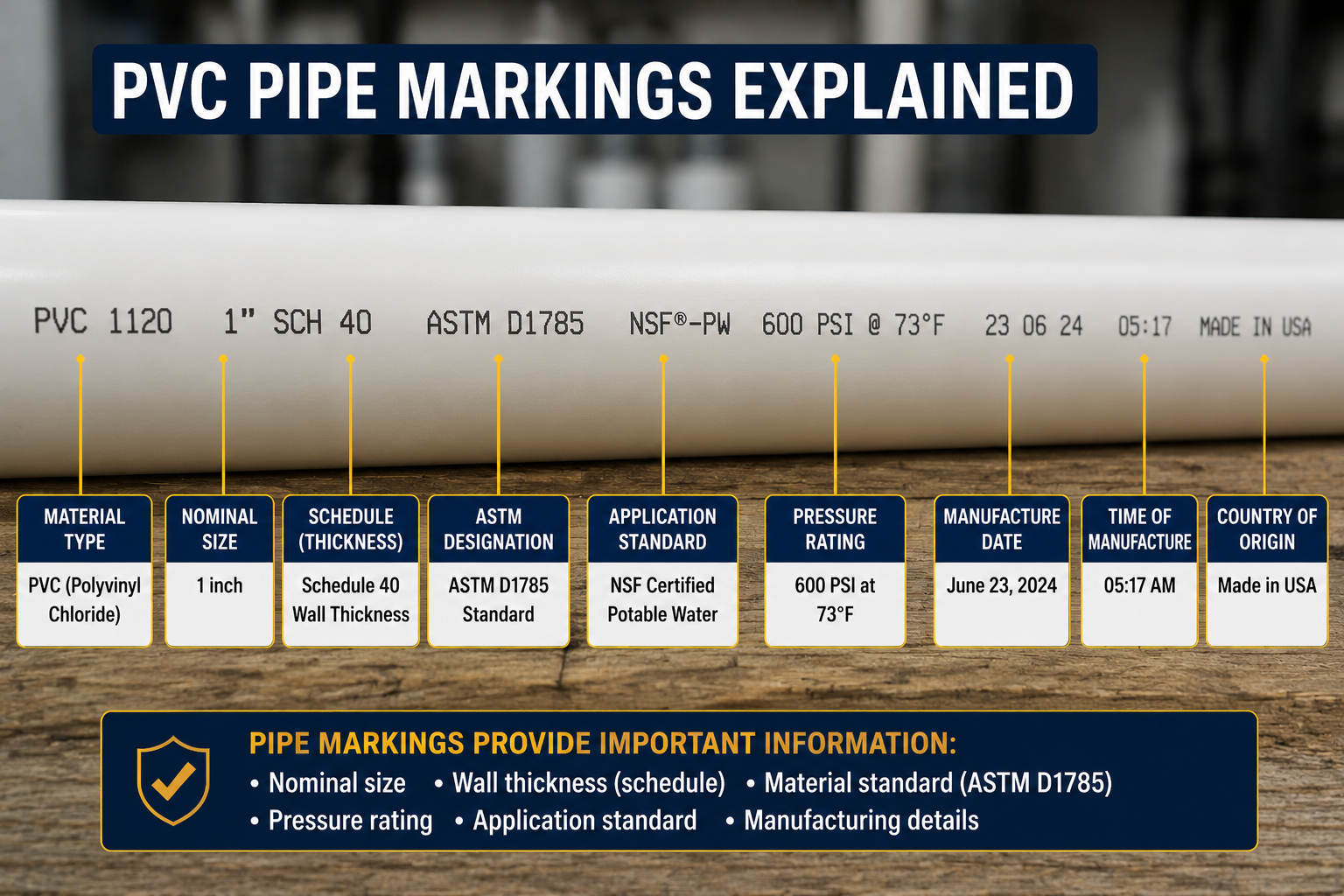
⭐⭐⭐ PVC Pipe Markings
Printed pipe markings are the fastest reliable identification method when legible.
| Marking Element | Example | Meaning |
|---|---|---|
| Manufacturer | Company name/logo | Identifies the producer for warranty and spec lookup |
| Nominal size | 2 IN | Standardized nominal designation |
| Material designation | PVC 1120 | Cell classification identifying material formulation |
| Schedule | SCH 40 | Wall thickness series |
| ASTM standard | ASTM D1785 | Governing product specification |
| Pressure/product info | PR 200 PSI @ 73F | Product-specific pressure rating and reference temperature |
| NSF marking | NSF-pw | Certification for potable water use, where applicable |
⭐⭐⭐ PVC Pipe Size Standards
Multiple ASTM standards govern different PVC pipe and fitting products.
| Standard | Covers |
|---|---|
| ASTM D1785 | PVC Schedule 40, 80 and 120 pipe, intended for distribution of pressurized liquids |
| ASTM D2241 | PVC SDR-PR (Standard Dimension Ratio, Pressure Rated) pipe |
| ASTM D2466 | PVC Schedule 40 socket-type fittings |
| ASTM D2467 | PVC Schedule 80 socket-type fittings |
| ASTM D2464 | PVC Schedule 80 threaded fittings |
| ASTM F645 | Guide for selection, design, and installation of thermoplastic water-pressure piping systems, listing D1785 and D2241 as separate specifications |
⭐⭐⭐ PVC vs CPVC Pipe
Sharing a nominal size does not make PVC and CPVC pipe or fittings interchangeable.
| Feature | PVC | CPVC |
|---|---|---|
| Governing standard | ASTM D1785 | ASTM F441 |
| Temperature capability | Lower, generally suitable to about 140°F | Higher, commonly cited to about 180 to 200°F |
| 1/2 in Sch 40 OD | 0.840 in | 0.840 in (same nominal OD) |
| Wall thickness at same schedule | Material-specific per D1785 | Can differ from PVC despite shared nominal label per F441 |
PVC and CPVC often share nominal sizes and outside diameters, allowing similar fitting appearance, but they are chemically distinct materials with separate governing standards, different wall dimensions in some cases, and very different temperature ratings. Never mix PVC and CPVC fittings on the same joint, and always confirm the correct material-specific pressure rating.
⭐⭐⭐ PVC Pressure Pipe vs DWV Pipe
These are not automatically interchangeable products, despite both being labeled PVC.
| Feature | PVC Pressure Pipe | PVC DWV Pipe |
|---|---|---|
| Application | Pressurized water supply and similar service | Drain, waste, and vent (gravity flow, non-pressure) |
| Wall thickness | Per Schedule 40/80/120 (D1785) or SDR (D2241) | Product-specific DWV standard, often thinner than pressure-rated equivalents |
| Product standard | ASTM D1785 or D2241 | Separate DWV-specific ASTM standards |
| Fitting system | Schedule 40/80 pressure fittings (D2466, D2467, D2464) | DWV-specific fittings, not interchangeable with pressure fittings |
Do not substitute DWV pipe for pressure applications or vice versa. Confirm the specific product standard printed on the pipe before use in any pressurized system.
⭐⭐⭐ PVC Pipe Size, Flow & Pressure
Inside diameter, not nominal size, determines actual flow behavior.
Cross-sectional flow area A = πD²/4, using actual inside diameter. A thicker-walled schedule at the same nominal size reduces available flow area.
| 2 Inch PVC | ID (in) | Flow Area (in²) |
|---|---|---|
| Schedule 40 | 2.047 | 3.29 |
| Schedule 80 | 1.913 | 2.87 |
Size vs pressure rating
Nominal size, schedule, wall thickness, material designation, and temperature together determine actual pressure rating; size alone never establishes it. See the Pipe Pressure Rating Chart for material-specific ratings.
Pressure drop factors
Pressure drop through a run of pipe depends on ID, flow rate, length, fluid properties, temperature, fittings, and internal roughness, not nominal pipe size alone.
⭐⭐⭐ PVC Fittings & Applications
Fitting selection follows nominal pipe size, but actual dimensions still depend on the applicable fitting standard.
Socket fittings
Solvent-welded fittings matching Schedule 40 (ASTM D2466) or Schedule 80 (ASTM D2467) socket dimensions for the corresponding nominal pipe size.
Threaded fittings
Governed by ASTM D2464 for Schedule 80 threaded PVC fittings; note that threading reduces the effective pressure rating compared to solvent-welded joints.
Common fitting types
Couplings, elbows, tees, reducers, caps, and adapters, each sized to match the corresponding nominal pipe OD for a proper socket or thread fit.
Fitting size matching
Always match fitting nominal size and schedule to the pipe; a Schedule 40 fitting is not dimensionally identical to a Schedule 80 fitting at the same nominal label.
⭐⭐⭐ How to Choose PVC Pipe Size
A practical selection workflow rather than picking a size by habit.
Establish the volume of fluid that must move through the system.
Set acceptable limits for the specific application.
Choose an ID that satisfies the flow and velocity requirement.
Match the candidate ID to a standard nominal size and schedule.
Confirm the selected product meets the required pressure and temperature.
Confirm compatible fittings exist for the chosen nominal size and schedule.
Confirm the selection satisfies the applicable plumbing or piping code.
PVC for water flow
Flow rate, velocity, ID, friction loss, and pressure together determine appropriate size; never select size without knowing required flow and system conditions.
PVC for irrigation
Flow, pressure, pipe length, elevation change, fittings, and sprinkler demand all factor into irrigation sizing.
PVC for drainage ⭐⭐
Gravity-flow drainage uses slope and DWV-specific standards rather than pressure pipe criteria; keep drainage sizing separate from pressure water piping.
PVC for construction ⭐⭐⭐
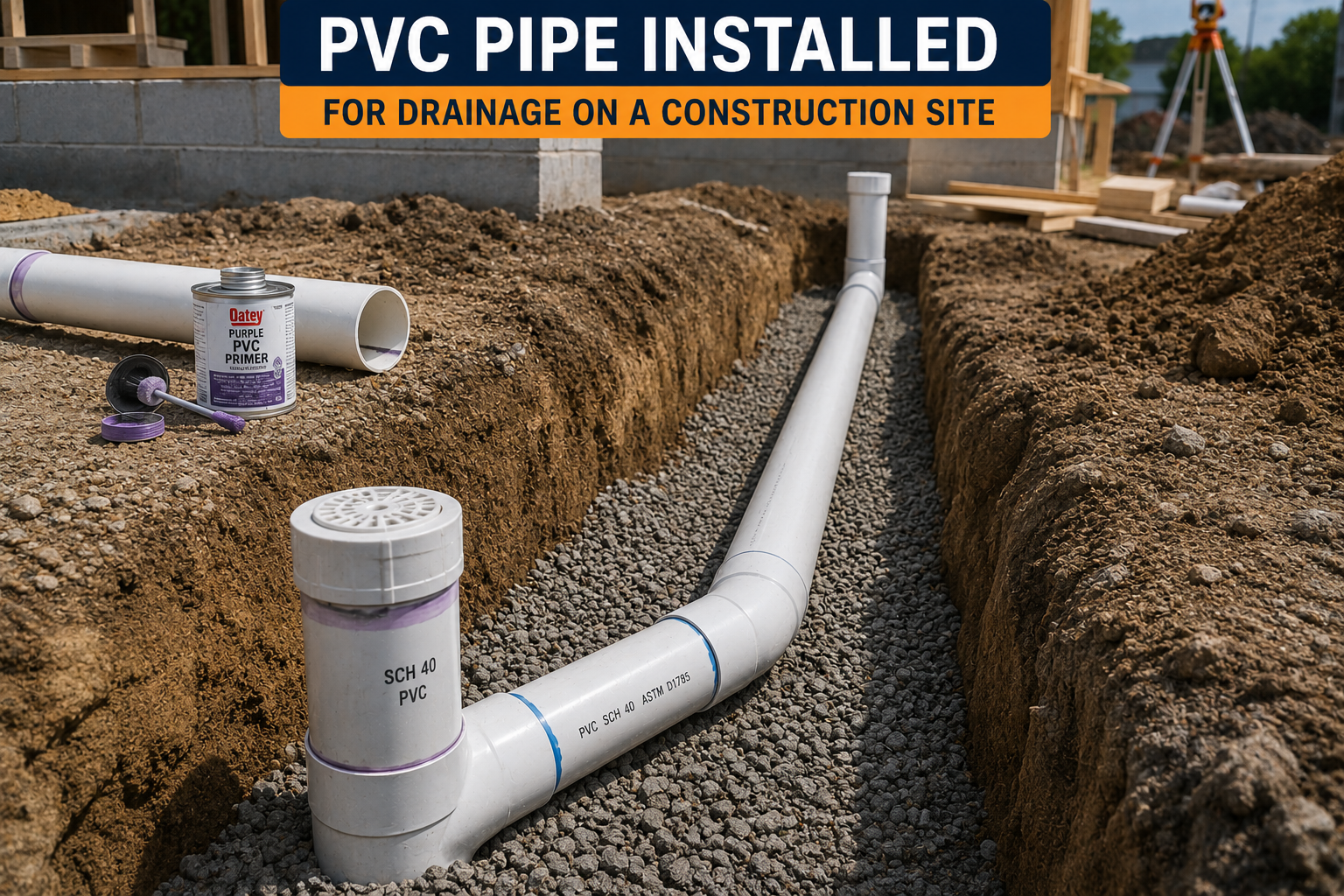
Water lines, drainage, irrigation, concrete equipment connections, and temporary construction-site plumbing each call for confirming the correct pressure or DWV product for that specific use.
⭐⭐⭐ PVC Pipe Size Visual Guide
Original diagrams explaining PVC anatomy, schedule comparison, and nominal size versus actual OD.
See the itemized image list below for exact placement, subject and caption for each recommended photograph.
⭐⭐⭐ PVC Pipe Size Worked Examples
These examples demonstrate the identification and calculation process.
1. Identify 1/2 Inch PVC
2. Calculate ID
3. Schedule 40 vs Schedule 80
4. Convert PVC OD to mm
5. Identify PVC From Markings
⭐⭐⭐ Common PVC Pipe Size Mistakes
Most PVC sizing errors trace back to one of these misunderstandings.
❌ Assuming 1/2 inch means 0.500 inch OD
Nominal size and actual outside diameter are different values.
❌ Confusing PVC pipe with PVC tubing
Pipe uses nominal IPS sizing; tubing is typically sized directly by OD.
❌ Confusing Schedule 40 with SDR
Different dimensioning systems under different ASTM standards.
❌ Mixing pressure pipe with DWV
Different applications, wall thicknesses, and fitting systems.
❌ Using steel schedule tables for PVC
PVC follows ASTM D1785, an entirely separate standard from ASME B36.10.
❌ Assuming same nominal size means same ID
ID varies significantly between Schedule 40, 80, and 120 at the same nominal size.
❌ Ignoring temperature
Pressure rating for PVC drops significantly above the reference temperature.
❌ Ignoring pressure rating
Size alone never determines pressure capability; check the product rating.
❌ Assuming PVC and CPVC are identical
Different materials, different standards, different temperature ratings.
❌ Selecting pipe based only on fitting size
Confirm the actual pipe schedule matches the fitting’s designed dimensions.
❌ Confusing OD and ID
Nominal size relates to OD, not the bore diameter available for flow.
❌ Using a generic chart without checking the product standard
Always confirm which ASTM standard governs the specific product before ordering.
Frequently Asked Questions
📄 Download PVC Pipe Size Chart PDF
This PDF is a genuine field reference. Use the print button to create a print-ready or downloadable version.
Cite or Embed This Chart
Copy the page-wide citation to reference the complete PVC Pipe Size Chart.