HSS Size Chart 2026 – Square, Rectangular & Round Dimensions
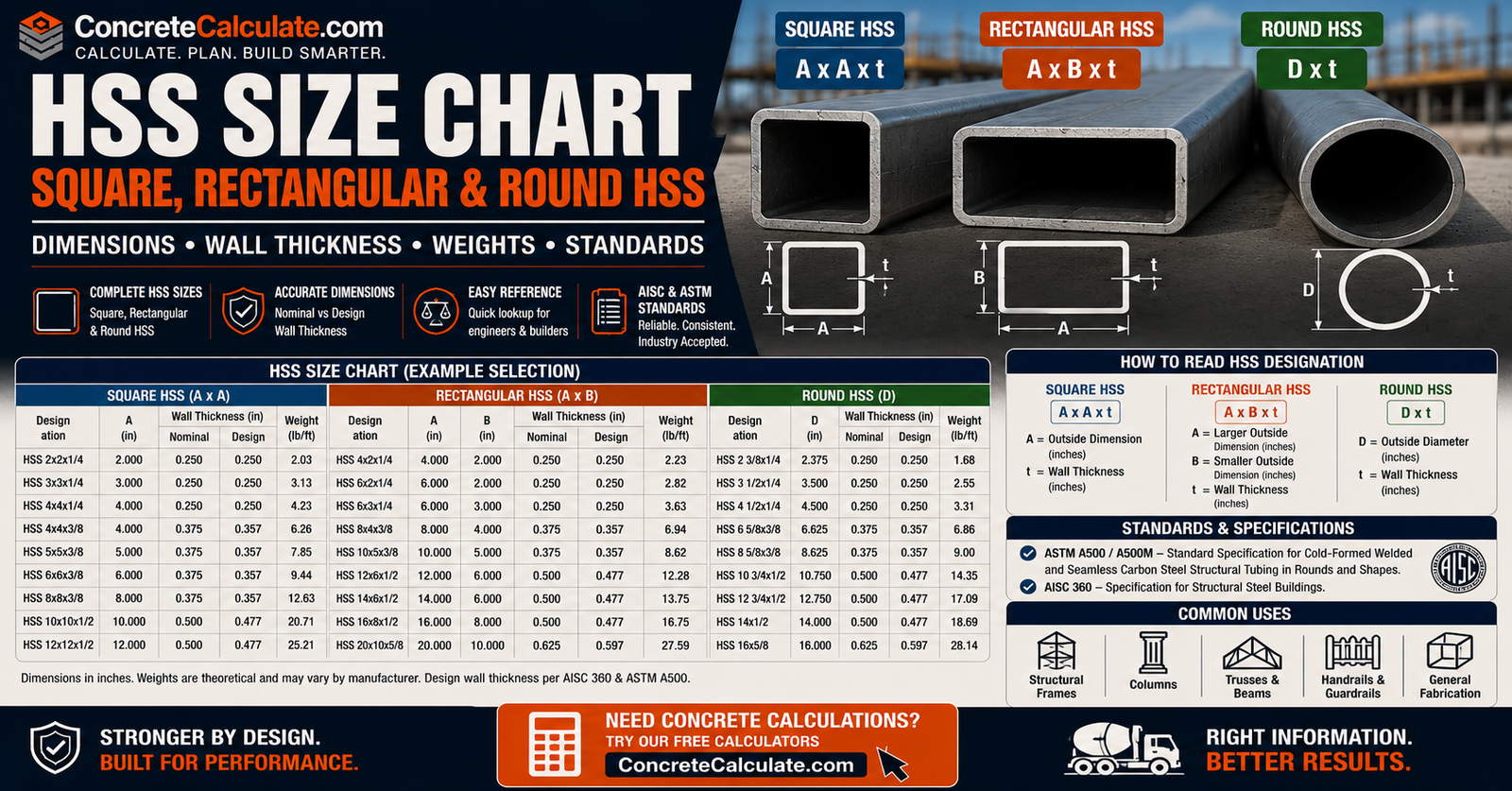
HSS Size Chart
Square, Rectangular & Round Dimensions
How Hollow Structural Section designations work, the critical difference between nominal and design wall thickness, and how square, rectangular, and round HSS sizes are organized under current AISC and ASTM standards.
 Reviewed by Muhammad Ramzan Babar, PhD Researcher (Plasma Physics) & Calculator Developer, View Profile
An HSS size chart identifies sections; it does not select them for you
This chart explains HSS designations, outside dimensions, and the nominal-versus-design wall thickness distinction that governs structural calculations. It is not a substitute for AISC design requirements or licensed structural engineering. For official dimensions and section properties, always consult the current AISC Shapes Database rather than a hand-built table.
HSS Size Chart, Quick Reference
Square, rectangular, and round HSS are presented as three separate reference tables because combining them into one large table makes the chart harder to use. All dimensional and section-property data should ultimately be verified against the current AISC Shapes Database v16.0, which aligns with the 16th Edition Steel Construction Manual.
Square HSS, Example Designations
| HSS Designation | Outside Size B × H | Nominal Wall tnom | Design Wall tdes (A500) |
|---|---|---|---|
| HSS 2×2×1/8 | 2 in. × 2 in. | 0.125 in. | 0.116 in. |
| HSS 4×4×1/4 | 4 in. × 4 in. | 0.250 in. | 0.233 in. |
| HSS 6×6×3/8 | 6 in. × 6 in. | 0.375 in. | 0.349 in. |
| HSS 8×8×1/2 | 8 in. × 8 in. | 0.500 in. | 0.465 in. |
Round HSS, Example Designations
| HSS Designation | Outside Diameter | Nominal Wall |
|---|---|---|
| HSS 4.000×0.226 | 4.000 in. | 0.226 in. |
| HSS 5.563×0.258 | 5.563 in. | 0.258 in. |
| HSS 8.625×0.322 | 8.625 in. | 0.322 in. |
These examples illustrate designation format only
Design wall thickness values shown above use the 0.93 factor for illustration. Full area, weight, and section property tables (A, I, S, r, J) for every published HSS size must come directly from the current AISC Shapes Database, not from a hand-reconstructed table, since AISC accounts for corner geometry and standardized production data that a simple formula cannot replicate accurately.
What Is HSS?
Hollow Structural Section is a structural steel tube manufactured in square, rectangular, round, and occasionally special shapes.
ASTM A500 covers cold-formed welded and seamless structural tubing used in buildings, bridges, and general structural applications.
Why HSS Is Used
HSS offers high torsional efficiency, a clean architectural appearance, compression efficiency, biaxial symmetry for square and round sections, an enclosed shape, and connection versatility. This page focuses on dimensions and sizing rather than full structural design guidance.
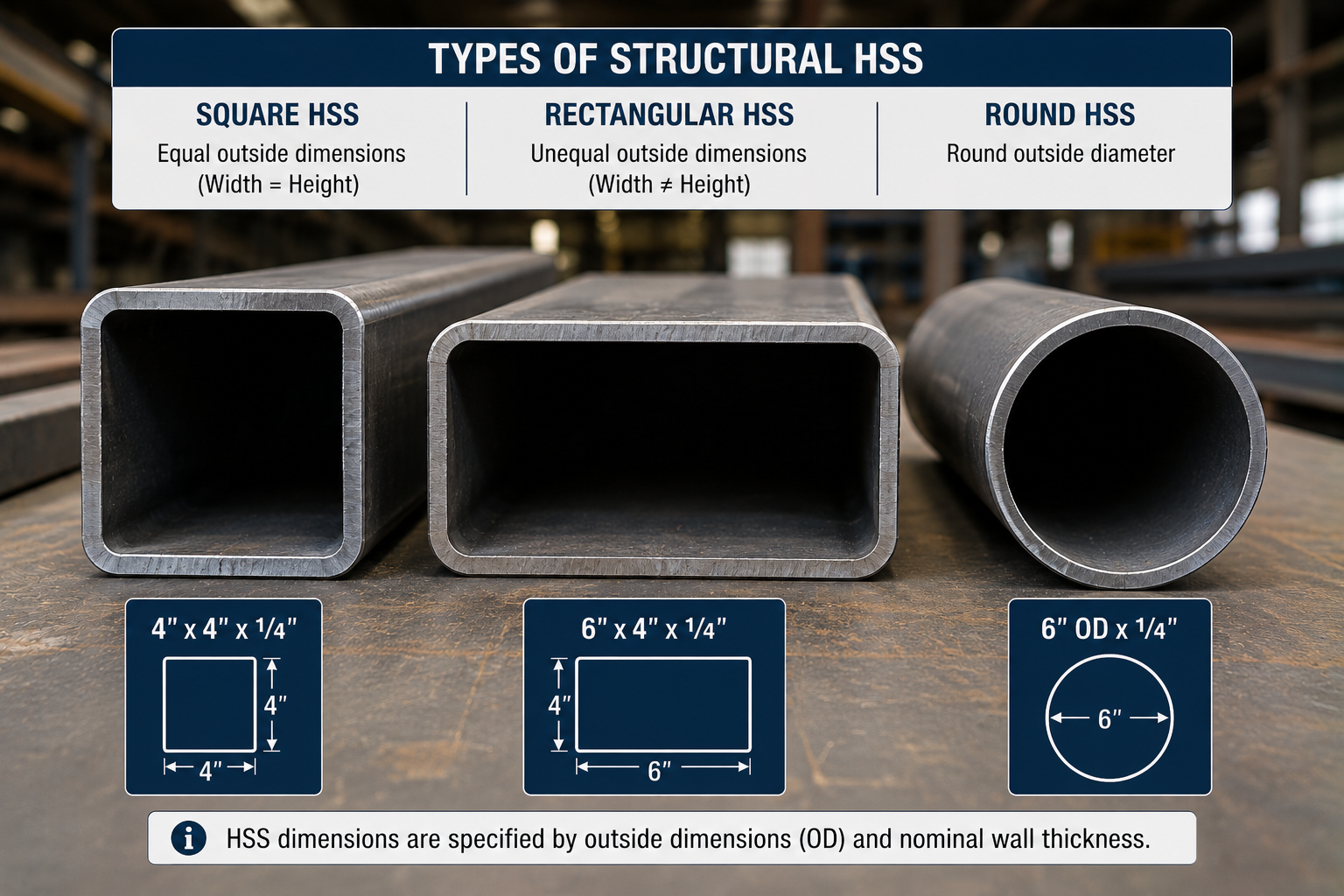
Square vs Rectangular vs Round HSS
| Shape | Primary Geometry | Symmetry | Typical Structural Strengths | Common Considerations |
|---|---|---|---|---|
| Square HSS | B = H | Two-axis symmetry | Columns, frames, braces | Connections |
| Rectangular HSS | B ≠ H | Two principal axes | Beams, lintels, framing | Strong vs weak axis |
| Round HSS | Diameter D | Radial symmetry | Columns, braces, exposed steel | Connection geometry |
This comparison helps readers choose which reference table to use; it does not by itself determine structural suitability for a project.
How to Read an HSS Designation
Understanding designation format is essential for using any HSS table correctly.
Square / Rectangular
HSS 5×4×3/8 means an outside depth of 5 in., an outside width of 4 in., and a nominal wall thickness of 3/8 in.
Round
HSS 5.563×0.258 means an outside diameter of 5.563 in. and a wall thickness of 0.258 in.
Why Round HSS Looks Different
Round sections commonly use decimal outside-diameter and wall notation, reflecting standardized round tube sizing, while square and rectangular HSS commonly use fractional wall designations that match typical nominal thickness increments.
HSS Outside Dimensions vs Inside Dimensions
An HSS designation uses outside dimensions.
Conceptual approximation only
Binside ≈ B − 2t and Hinside ≈ H − 2t. But HSS corners are rounded, so actual internal geometry is not a perfect sharp-corner rectangle. Do not use this simple subtraction for precise connection fabrication where corner geometry matters.
Why Inside Dimensions Matter
Inside dimensions affect connection plates, through-bolts, concrete filling, internal diaphragms, and sleeves or inserts.
HSS Nominal Wall Thickness Chart
Common nominal wall designations found across current U.S. HSS datasets.
| Fraction | Decimal Equivalent |
|---|---|
| 1/8 | 0.125 in. |
| 3/16 | 0.1875 in. |
| 1/4 | 0.250 in. |
| 5/16 | 0.3125 in. |
| 3/8 | 0.375 in. |
| 1/2 | 0.500 in. |
| 5/8 | 0.625 in. |
| 3/4 | 0.750 in. |
| 7/8 | 0.875 in. |
| 1 | 1.000 in. |
Actual wall availability depends on HSS size and specification. ASTM A500 allows specified wall thickness up to 1.000 in. and total section perimeter up to 88 in. Do not assume every wall thickness exists for every outside size.
Nominal Wall vs Design Wall Thickness
Probably the page’s most important technical section.
ASTM A500
Formula
tdes = 0.93 tnom. ASTM A500 permits wall thickness to be up to 10% less than specified nominal thickness, so AISC requires structural calculations to use 93% of nominal wall thickness rather than the full nominal value.
Example: 3/8 in. Nominal Wall
ASTM A1085 Exception
Formula
tdes = tnom. Because ASTM A1085 has tighter wall thickness tolerances than A500, AISC permits the full nominal wall thickness to be used for design. AISC 360 extends this same treatment to ASTM A1065 jumbo HSS as well, since it shares comparable tolerance requirements.
Square HSS Sizes
Small Square HSS
Examples around 1½×1½, 2×2, 2½×2½, and 3×3 in.
Medium Square HSS
Examples around 4×4, 5×5, 6×6, and 8×8 in.
Large Square HSS
Examples around 10×10, 12×12, 14×14, and 16×16 in. and larger. STI states domestic ASTM A500 production is available up to approximately 22×22 in. square HSS, though exact producer availability must be verified. Larger jumbo square sections fall under ASTM A1065.
Rectangular HSS Sizes
Small, Medium, and Large Rectangular HSS
Rectangular sections may have dramatically different Ix versus Iy, Sx versus Sy, and radii of gyration depending on orientation. STI states domestically produced ASTM A500 rectangular HSS can extend to dimensions around 34 in. by 10 in., subject to the 88-in. perimeter limit and actual producer capability.
Round HSS Sizes
STI reports domestically produced ASTM A500 round HSS availability up to approximately 28 in. outside diameter, subject to producer availability.
| Column | Description |
|---|---|
| OD | Outside diameter |
| Nominal / Design Wall | Nominal thickness and the reduced design thickness for calculations |
| Area, Weight | Cross-sectional area and weight per foot |
| I, S, r | Moment of inertia, section modulus, radius of gyration |
Avoid confusing round HSS with nominal pipe sizes; see the section below.
HSS vs Structural Pipe
A very important search-intent distinction.
| Category | Designation Logic |
|---|---|
| HSS | Actual outside dimensions in the designation, typically ASTM A500 or A1085 |
| Structural pipe | Nominal pipe size and schedule conventions, typically ASTM A53, where dimensions do not follow the same designation logic |
AISC’s basic design reference lists HSS separately from ASTM A53 structural pipe. For pipe dimension references, see the Pipe Schedule Chart and Steel Pipe Weight Chart.
HSS Dimensions in Inches and Millimeters
Dual-unit reference for outside width, outside depth, outside diameter, and wall thickness.
ASTM A500 explicitly states that its inch-pound and SI systems may be independently standardized and should not simply be mixed for specification compliance. Use the unit system matching the governing project specification.
HSS Cross-Sectional Area Chart
Gross area Ag is a key published section property.
Conceptual formula
For sharp-corner rectangular tubing: A ≈ BH − (B − 2t)(H − 2t). Actual published HSS properties account for rounded corners and standardized geometry, so use AISC/STI published section properties rather than a sharp-corner approximation for structural design.
HSS Weight per Foot Chart
One of the most searched practical HSS properties.
| Column | Description |
|---|---|
| HSS Size | Full designation including wall |
| Wall | Nominal wall thickness |
| Area | Gross cross-sectional area |
| Weight lb/ft, kg/m | Nominal weight per unit length |
Weight is approximately W ≈ Aρ, where A is cross-sectional area and ρ is steel density, but official AISC tabulated weight should be used for reference tables rather than hand calculations. For weight calculations on specific projects, see the steel weight calculator or metal weight calculator.
HSS Moment of Inertia Ix and Iy
Moment of inertia measures resistance to bending deformation about the strong (x-x) and weak (y-y) axes.
| Shape | Relationship |
|---|---|
| Square HSS | Ix = Iy, for ideal symmetric geometry |
| Rectangular HSS | Usually Ix ≠ Iy, depending on orientation |
HSS Section Modulus Sx and Sy
Section modulus relates to flexural stress and bending capacity, and appears alongside moment of inertia in HSS tables.
This section is meant to help readers interpret the main HSS table columns, not to serve as a complete bending-capacity guide. For beam-specific reference, see the Beam Size Chart or Beam Deflection Chart.
HSS Radius of Gyration rx and ry
Radius of gyration matters for column slenderness, buckling, and member-axis comparison.
Formula
r = √(I ÷ A). AISC’s current Basic Design Values references HSS slenderness using Lc/r. Detailed column capacity calculations are outside the scope of this size chart.
HSS Torsional Properties
Torsional behavior is one reason HSS is frequently selected over open structural shapes.
Relevant properties include the torsional constant J and the general closed-section efficiency of square, rectangular, and round HSS compared with open shapes. Advanced torsion design is outside the scope of this size chart.
Equipment for Your Project
Affiliate disclosure: As an Amazon Associate, ConcreteCalculate earns from qualifying purchases. We may also earn a commission from other affiliate links at no additional cost to you.
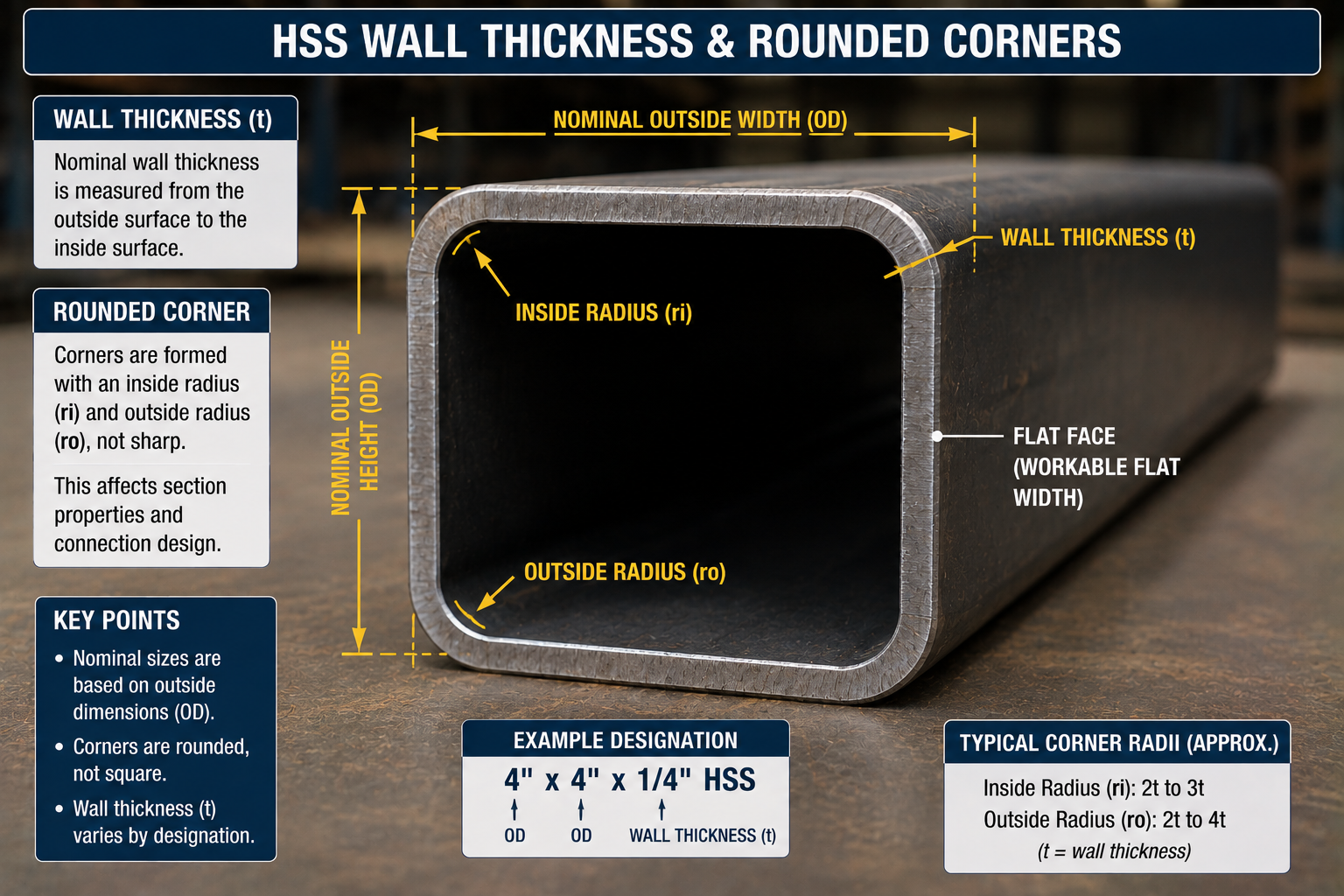
HSS Corner Radius and Workable Flat
A genuinely HSS-specific topic and an important differentiator for this chart.
Square and rectangular HSS corner geometry affects width-thickness ratios, section properties, and usable flat area for connections. STI references corner-radius conventions such as an approximate 1.5t assumption for some slenderness calculations and roughly 2.25t for workable flat, among other averaged corner assumptions used in section-property calculations.
Outside Corner Radius
The rounded exterior corner of the HSS section.
Inside Corner Radius
The rounded interior corner, which reduces usable interior space near each corner.
Workable Flat
The usable flat portion of a face available for connections, smaller than the full face width because of corner rounding. A 6-in.-wide HSS face does not provide a full 6-in. flat connection surface.
HSS Width-to-Thickness and Diameter-to-Thickness Ratios
These ratios affect local buckling, compactness or slenderness classification, effective area, and bending or compression behavior.
| Shape | Ratio |
|---|---|
| Square / rectangular | b/t, h/t |
| Round | D/t |
AISC calculates the flat width b as b = B − 3t, using the design wall thickness t, not the nominal wall thickness. STI emphasizes that AISC width-thickness calculations use design wall thickness for this reason. This page does not publish a universal maximum HSS ratio, since applicable limits depend on the specific loading case and AISC provision being checked.
HSS Size Availability vs Published Size
A section appearing in an AISC database or permitted by an ASTM specification does not necessarily mean it is available everywhere.
Design-table existence does not guarantee that every mill produces a size, every service center stocks it, or it is available locally. STI provides an HSS Capability Tool specifically because producer availability varies by size.
Regularly Produced vs Mill Order
Some sizes are regularly produced; others may require a special mill order with longer lead times.
Regional Service-Center Availability
Stocked inventory varies by region and distributor. Confirm current availability directly with a service center before finalizing a project specification.
Common HSS Stock Lengths
Kept brief, since this is a size page, not a length page.
STI identifies common A500 stock lengths such as 20 ft, 24 ft, 40 ft, and 48 ft, while stressing that actual service-center stock varies by size, wall, and region.
ASTM A500 HSS Sizes and Grades
The primary material-specification section for ordinary HSS.
The current active specification, ASTM A500/A500M, covers cold-formed welded and seamless round, square, rectangular, and special-shape structural tubing, with perimeter up to 88 in. and specified wall thickness up to 1 in.
Grade B vs Grade C
STI states Grade C is the predominant domestic material and recommends it as the default structural HSS grade. Grade C has a minimum yield strength Fy of 50 ksi and a minimum tensile strength Fu of 62 ksi for HSS shapes.
ASTM A1085 HSS Sizes
An alternative material specification with tighter dimensional controls.
The current ASTM A1085/A1085M specification covers welded cold-formed HSS with a perimeter of 88 in. or less and a specified nominal wall thickness from approximately 0.148 in. through 1.000 in., with tighter dimensional and mass controls than A500. The major sizing and design advantage is that tdes = tnom under AISC/STI design practice. AISC publishes separate square, rectangular, and round A1085 dimension and property databases.
Jumbo HSS and ASTM A1065
Justified because some users searching an HSS size chart need sections beyond ordinary A500 limits.
ASTM A1065 is a jumbo HSS specification covering larger square and rectangular sections that fall outside the standard ASTM A500 size range, extending up to a 200-in. perimeter and 1-in. wall thickness. ASTM A1065 does not include round HSS. Ordinary A500 or A1085 size charts should not be stretched beyond their standard scope; do not mix A1065 shapes into an ordinary HSS table without clearly identifying them as jumbo sections.
How to Choose an HSS Size
This needs strong safety framing.
Selection can depend on axial load, bending, shear, torsion, unbraced or effective length, slenderness, local buckling, connection design, fire requirements, corrosion, architectural dimensions, and availability.
Key message
An HSS size chart identifies available sections and properties; it does not determine the correct structural member size by itself. Structural selection must follow AISC design requirements and project engineering by a licensed professional.
HSS Size by Structural Application
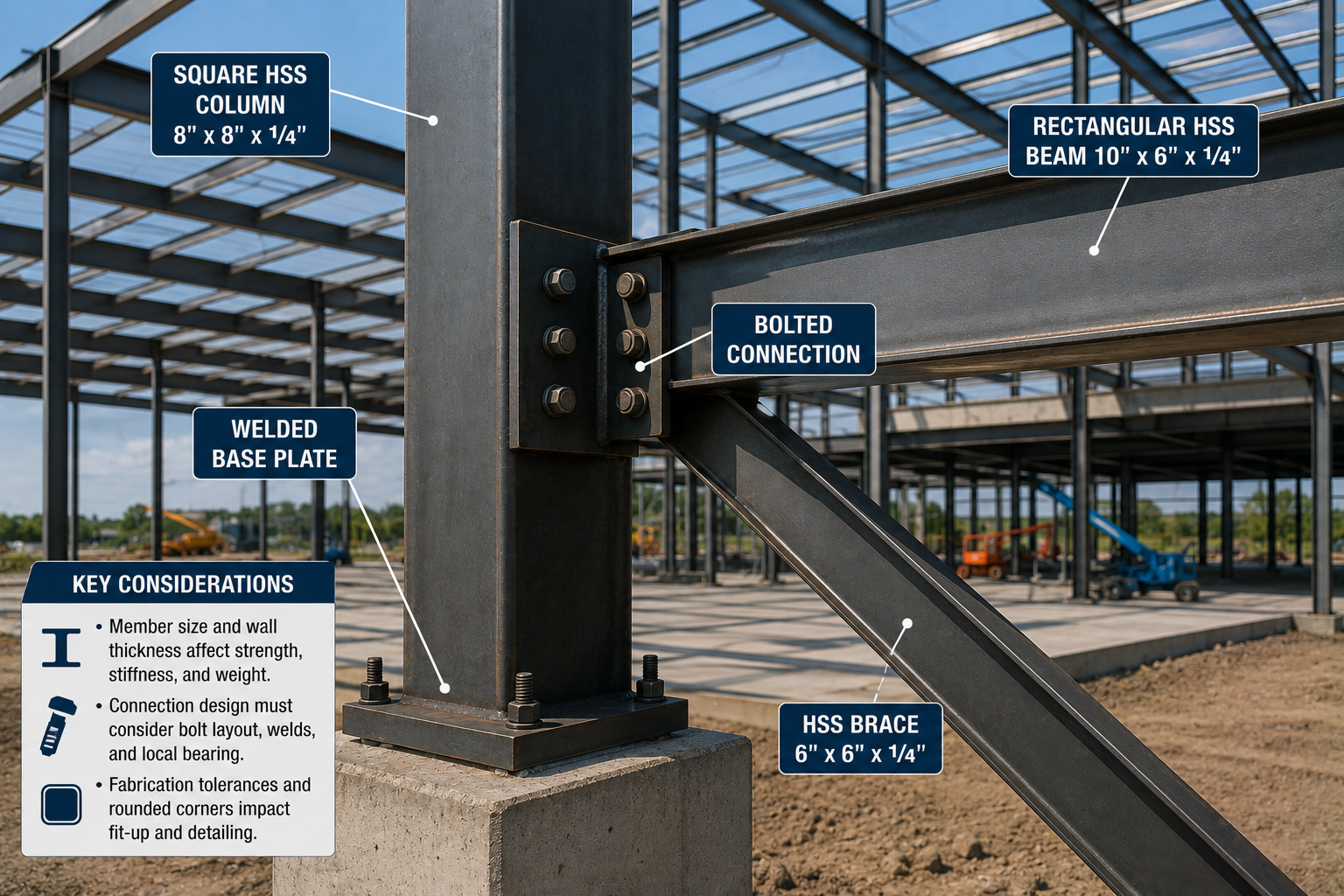
Columns
Square and round HSS are common where biaxial behavior and appearance matter. See the Column Size Chart.
Beams and Headers
Rectangular HSS may be oriented to take advantage of the stronger axis.
Braces and Trusses
Round, square, and rectangular HSS all appear depending on connection and design requirements.
Canopies, Frames, and Architecturally Exposed Steel
HSS is often selected for its clean appearance in exposed applications.
Sign Supports and Miscellaneous Structures
Additional applications with their own project-specific design requirements.
Do not select a specific size, such as HSS 6x6x1/4, for a column without structural analysis.
HSS vs Wide-Flange, Channel, and Pipe Sections
A useful shape-selection comparison without ranking one universally.
| Property | HSS | W-Shape | Channel | Pipe |
|---|---|---|---|---|
| Closed section | Yes | No | No | Yes |
| Biaxial efficiency | Good square/round | Axis-dependent | Axis-dependent | Good |
| Torsional behavior | Strong relative advantage | Lower | Lower | Strong |
| Connection accessibility | Can be challenging | Easier flange/web access | Open | Similar closed-section issue |
| Designation system | Outside dims × wall | Nominal depth × weight | C designation | NPS/schedule |
See the Structural Steel Shapes Chart, Steel I-Beam Chart, Steel Beam Size Chart, and Pipe Schedule Chart for shape-specific reference.
HSS Connection and Detailing Considerations
Physical size does not tell the full story.
Connection suitability depends on workable flat, wall thickness, local wall yielding, punching or shear-type local limit states, through-bolts, plates, weld access, and HSS-to-HSS connections. STI specifically warns that connection suitability can depend strongly on slender HSS walls and connection type. This section is not a complete HSS connection design guide.
AISC 16th Edition HSS Tables and Shape Database
The main authoritative data source for HSS dimensions and section properties.
AISC’s current Shapes Database v16.0 corresponds to the 16th Edition Steel Construction Manual, includes U.S. customary and metric dimensions and properties, adds new shapes introduced in the 16th Edition, and follows AISC EDI naming conventions. This should be the primary numerical source for detailed HSS tables. Do not manually reconstruct hundreds of HSS section properties from formulas when AISC publishes them directly.
Common HSS Size Chart Mistakes
Confusing HSS with pipe
Designation logic differs fundamentally between the two.
Treating HSS dimensions as inside dimensions
HSS designations always use outside dimensions.
Misreading rectangular HSS orientation
HSS 6x4x1/4 lists depth before width; orientation matters for axis properties.
Assuming nominal wall equals A500 design wall
The 0.93 factor applies for design calculations under A500.
Forgetting the 0.93 factor for A500
A common source of undersized design wall assumptions.
Applying the 0.93 reduction automatically to A1085
A1085 and A1065 use the full nominal thickness instead.
Assuming every published size is locally stocked
AISC database inclusion does not guarantee stock availability.
Assuming every wall is available for every outside dimension
Wall availability is size-specific, not universal.
Ignoring corner radii
Corner geometry affects section properties and inside dimensions.
Treating full face width as workable flat
Corner rounding reduces the usable connection surface.
Using nominal dimensions to approximate section properties
AISC tabulated data should be used instead of hand formulas.
Confusing section modulus with moment of inertia
These are related but distinct section properties.
Ignoring strong/weak axes on rectangular HSS
Ix and Iy differ for non-square sections.
Confusing ASTM material grade with HSS size
Grade governs strength; size governs dimensions.
Assuming larger outside size always means higher capacity
Wall thickness, slenderness, and material also govern capacity.
Ignoring wall slenderness/local buckling
Width-thickness ratios affect compactness classification.
Using ordinary A500 charts for jumbo A1065 sections
Jumbo sections require their own specification reference.
Selecting HSS from size alone without structural design
Size charts identify options; they do not replace engineering analysis.
Mixing inch and metric values carelessly
ASTM treats inch-pound and SI systems as independently standardized.
HSS Size Chart Limitations
Read before specifying HSS on a project
HSS tables identify dimensions and properties, not required structural size. Availability varies by manufacturer and region. AISC database sizes do not guarantee local stock. ASTM A500 and A1085 use different wall-thickness design treatment. Nominal wall thickness is not always design wall thickness. Section properties should be taken from current AISC/STI data. Corner geometry affects section properties and connections. Round HSS should not be confused with nominal pipe. Local buckling, global buckling, bending, shear, torsion, and connections must all be checked where relevant. Member capacity depends on material specification, unbraced or effective length, loading, and boundary conditions. Seismic, fire, or fatigue applications can introduce additional requirements. Project structural drawings and licensed-engineer design govern actual HSS selection.