Rebar Diameter Chart – Nominal vs Actual Diameter, Inch & mm Sizes
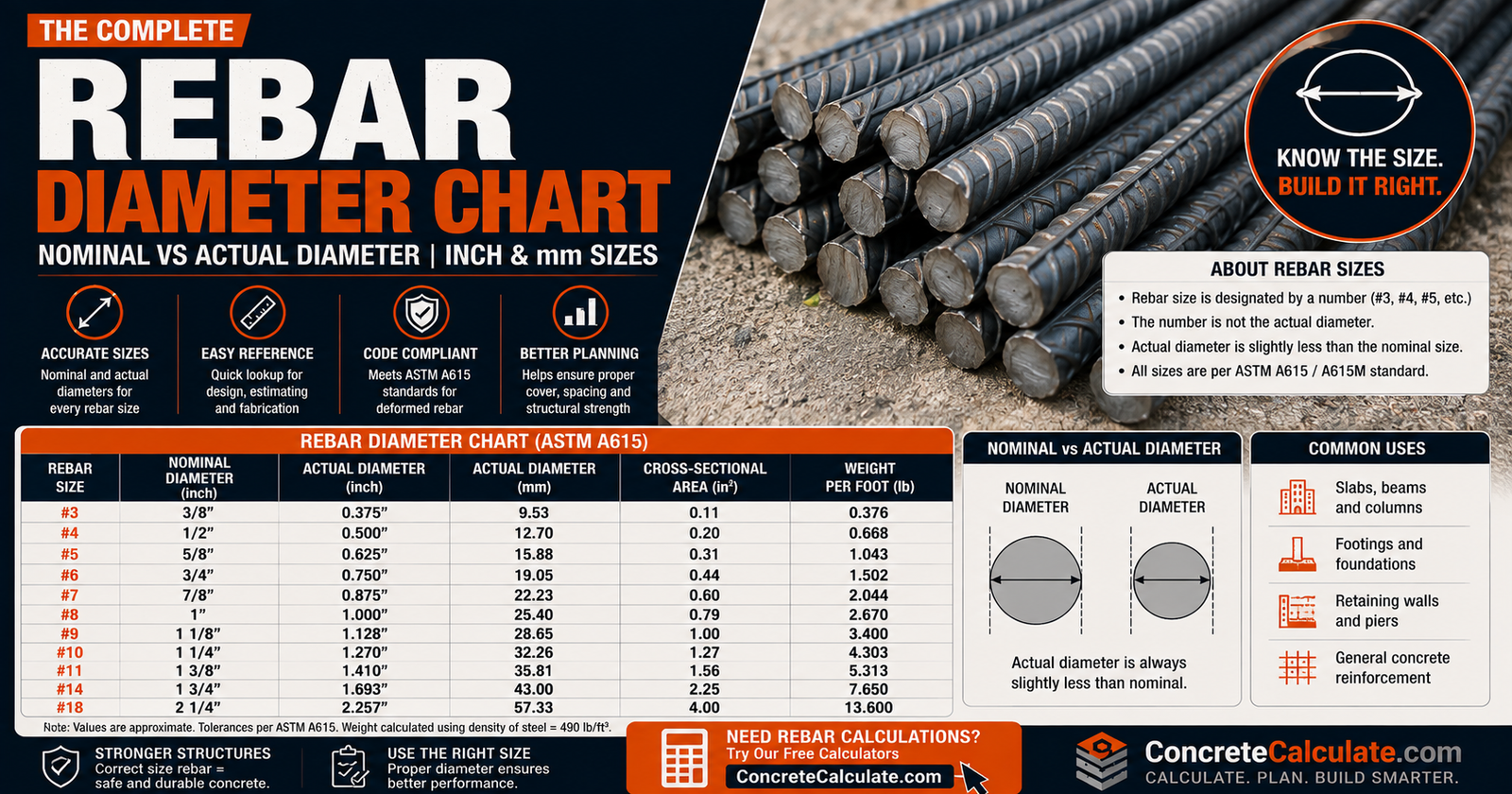
Rebar Diameter Chart
Nominal vs Actual Diameter, Inch & mm Sizes
Nominal diameter for every standard rebar size from #3 to No. 20 [64], why measured outside diameter differs from the listed nominal value, and how to identify unknown rebar in the field.
 Reviewed by Muhammad Ramzan Babar, PhD Researcher (Plasma Physics) & Calculator Developer — View Profile
⭐ Rebar Diameter Chart: Quick Reference
Nominal diameter is the dominant column here. For full area, weight, and grade data, use the Rebar Size Chart, the master reference.
| U.S. Bar Size | ASTM Metric Designation | Nominal Diameter (in.) | Nominal Diameter (mm) | Nominal Area (in²) | Weight (lb/ft) |
|---|---|---|---|---|---|
| #3 | [10] | 0.375 | 9.5 | 0.11 | 0.376 |
| #4 | [13] | 0.500 | 12.7 | 0.20 | 0.668 |
| #5 | [16] | 0.625 | 15.9 | 0.31 | 1.043 |
| #6 | [19] | 0.750 | 19.1 | 0.44 | 1.502 |
| #7 | [22] | 0.875 | 22.2 | 0.60 | 2.044 |
| #8 | [25] | 1.000 | 25.4 | 0.79 | 2.670 |
| #9 | [29] | 1.128 | 28.7 | 1.00 | 3.400 |
| #10 | [32] | 1.270 | 32.3 | 1.27 | 4.303 |
| #11 | [36] | 1.410 | 35.8 | 1.56 | 5.313 |
| #14 | [43] | 1.693 | 43.0 | 2.25 | 7.650 |
| #18 | [57] | 2.257 | 57.3 | 4.00 | 13.60 |
| No. 20* | [64] | 2.500 | 63.5 | 4.91 | 16.69 |
*No. 20 [64] Requires Code Recognition Check
ASTM A615/A615M identifies the No. 20 [64] bar as the largest bar included in the specification, but explicitly cautions that consensus design codes and specifications may not recognize its use. Structural members reinforced with No. 20 [64] bars may require approval from the building official and special detailing. See ASTM A615/A615M Rebar Diameter Standard.
Need total steel area, unit weight, or grade data for design? See the Rebar Size Chart for the full master reference, the Rebar Area Chart for cross-sectional area, and the Rebar Weight Chart for total weight calculations.
What Does Rebar Diameter Mean?
The listed rebar diameter is a nominal diameter, not necessarily a caliper measurement across the tops of the ribs.
ASTM defines nominal dimensions for deformed bars by the dimensions of a plain round bar having the same weight (mass) per unit length as the deformed bar. This is one of the most important concepts on this page, because it means nominal diameter is a calculated design equivalent, not a direct physical measurement of a deformed bar’s irregular cross-section.
Nominal Diameter
The standardized design diameter used for engineering calculations, bar identification, reinforcement detailing, development-length equations, spacing checks, and cover calculations. This is the value published in ASTM A615/A615M Table 1 and the value shown throughout this chart.
Outside Diameter Over Deformations
A real deformed bar can measure larger across its ribs than its listed nominal diameter. Detailing references have long noted that the overall diameter measured across deformations is somewhat greater than nominal diameter, which can matter where physical clearance is critical, such as tight rebar cages or congested connections. See Nominal vs Actual Rebar Diameter below.
U.S. Rebar Diameter Chart: Inch-Pound Sizes
The primary detailed diameter table for standard ASTM A615/A615M inch-pound bar sizes.
| Bar No. | Nominal Diameter (in.) | Fractional Diameter | Diameter (mm) |
|---|---|---|---|
| #3 | 0.375 | 3/8″ | 9.5 |
| #4 | 0.500 | 1/2″ | 12.7 |
| #5 | 0.625 | 5/8″ | 15.9 |
| #6 | 0.750 | 3/4″ | 19.1 |
| #7 | 0.875 | 7/8″ | 22.2 |
| #8 | 1.000 | 1″ | 25.4 |
| #9 | 1.128 | — (not 9/8) | 28.7 |
| #10 | 1.270 | — (not 10/8) | 32.3 |
| #11 | 1.410 | — (not 11/8) | 35.8 |
| #14 | 1.693 | — (not 14/8) | 43.0 |
| #18 | 2.257 | — (not 18/8) | 57.3 |
Values verified against ASTM A615/A615M Table 1 standard bar dimensions, including the current inclusion of the No. 20 [64] bar. See Why #9 and Larger Bars Break the Eighth-Inch Rule for the reason #9 through #18 don’t fit the simple fraction pattern.
Metric Rebar Diameter Chart
ASTM metric designations for the same U.S. bar family, expressed in millimeters.
| U.S. Bar | ASTM Metric Designation | Nominal Diameter (mm) | Nominal Diameter (in.) |
|---|---|---|---|
| #3 | [10] | 9.5 | 0.375 |
| #4 | [13] | 12.7 | 0.500 |
| #5 | [16] | 15.9 | 0.625 |
| #6 | [19] | 19.1 | 0.750 |
| #7 | [22] | 22.2 | 0.875 |
| #8 | [25] | 25.4 | 1.000 |
| #9 | [29] | 28.7 | 1.128 |
| #10 | [32] | 32.3 | 1.270 |
| #11 | [36] | 35.8 | 1.410 |
| #14 | [43] | 43.0 | 1.693 |
| #18 | [57] | 57.3 | 2.257 |
| No. 20 | [64] | 63.5 | 2.500 |
Inch-Pound and SI Are Independent Standards
ASTM states that its inch-pound and SI systems are each standards in their own right, and the values in each system may not be exact equivalents. Values from the two systems should not be mixed when assessing specification compliance; each system should be used independently.
How Rebar Numbers Relate to Diameter
For #3 through #8, the U.S. designation conveniently corresponds to nominal diameter in eighths of an inch.
This rule holds exactly for #3 through #8: #3 = 3/8″, #4 = 4/8″ = 1/2″, #5 = 5/8″, #6 = 6/8″ = 3/4″, #7 = 7/8″, #8 = 8/8″ = 1″. This is the most useful shortcut for common bar sizes, but it should not be extended blindly to bar #9 and larger.
⭐ Why #9 and Larger Bars Do Not Follow the Simple Eighth-Inch Rule
Many competing references get this wrong. The bar-number-to-diameter shortcut breaks down at #9.
| Bar | If Eighth-Inch Rule Applied | Actual Nominal Diameter |
|---|---|---|
| #9 | 9/8 = 1.125″ | 1.128″ |
| #10 | 10/8 = 1.250″ | 1.270″ |
| #11 | 11/8 = 1.375″ | 1.410″ |
| #14 | 14/8 = 1.750″ | 1.693″ |
| #18 | 18/8 = 2.250″ | 2.257″ |
The numbering history for larger U.S. bars relates to equivalent cross-sectional area rather than simply extending the diameter-in-eighths convention. Bar sizes #9, #10, #11, #14, and #18 were originally sized to match the weight and cross-sectional area of 1 in, 1-1/8 in, 1-1/4 in, 1-1/2 in, and 2 in square bars respectively, not to a diameter equal to the bar number in eighths of an inch.
Common Misstatement to Avoid
Do not say “#10 rebar is 1-1/4 inch.” Its nominal diameter is 1.270 inches, which is close to but not the same as 1.250 inches. This small but real difference matters for precise detailing and clearance calculations.
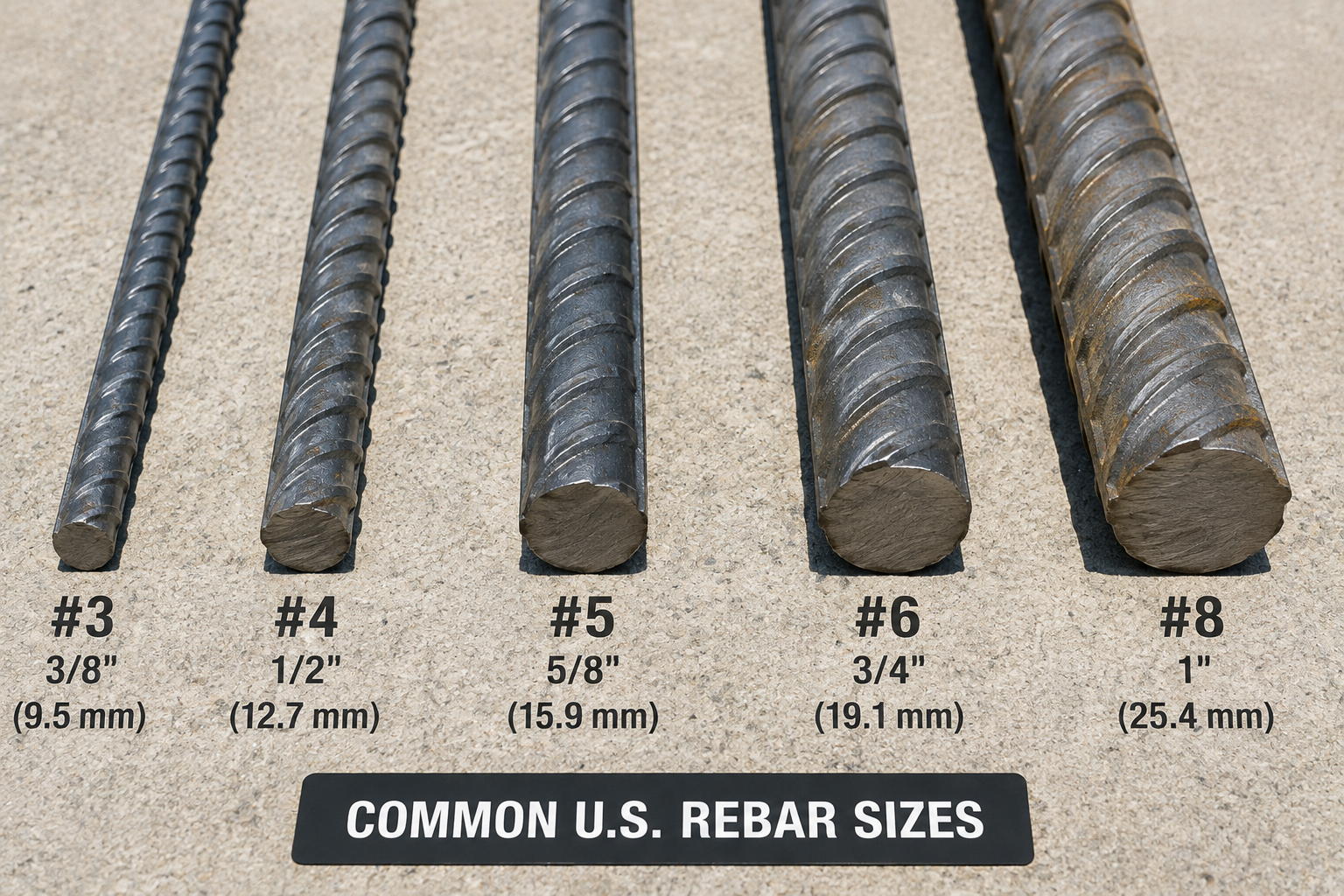
#3 to #8 Rebar Diameter Quick Chart
The most commonly searched bar sizes, condensed into one compact lookup table.
| Size | Fraction | Decimal | mm |
|---|---|---|---|
| #3 | 3/8″ | 0.375″ | 9.5 |
| #4 | 1/2″ | 0.500″ | 12.7 |
| #5 | 5/8″ | 0.625″ | 15.9 |
| #6 | 3/4″ | 0.750″ | 19.1 |
| #7 | 7/8″ | 0.875″ | 22.2 |
| #8 | 1″ | 1.000″ | 25.4 |
Large Rebar Diameter Chart: #9 through #20
Larger structural bars consolidated into one reference, including the current No. 20 [64] bar.
#9, #10, and #11
| Bar | Diameter (in.) | Diameter (mm) |
|---|---|---|
| #9 | 1.128 | 28.7 |
| #10 | 1.270 | 32.3 |
| #11 | 1.410 | 35.8 |
#14 and #18
| Bar | Diameter (in.) | Diameter (mm) |
|---|---|---|
| #14 | 1.693 | 43.0 |
| #18 | 2.257 | 57.3 |
No. 20 [64]: Current ASTM Standard Note
| Bar | Diameter (in.) | Diameter (mm) | Weight (lb/ft) |
|---|---|---|---|
| No. 20 | 2.500 | 63.5 | 16.69 |
Code Recognition Caution
The current ASTM A615/A615M specifically warns that consensus design codes and specifications may not yet recognize the use of the No. 20 [64] bar, the largest bar included in the specification. Structural members reinforced with No. 20 [64] bars may require approval of the building official or other authority and require special detailing to ensure adequate performance at service and factored loads.
⭐ Nominal Diameter vs Actual Rebar Diameter
This is the most important specialist concept on this page, and the key difference from a general rebar size table.
Nominal Diameter
The standard design value published in ASTM A615/A615M Table 1, used for all engineering calculations.
Core / Equivalent Diameter
The equivalent plain-round bar dimension associated with the bar’s standardized nominal area and mass per unit length. This is functionally the same value as nominal diameter, defined by weight equivalence rather than a direct caliper measurement.
Overall Diameter Across Ribs
The physical dimension measured over the deformation peaks with a caliper. A deformed rebar cross-section is not a perfectly smooth circle, so a caliper placed across the ribs may not equal the ASTM nominal diameter. Detailing references have specifically warned that overall diameter can matter in clearance-sensitive detailing, such as tightly spaced cages or congested splice zones.
Rebar Rib and Deformation Dimensions
Why measured diameter changes: the geometry of the deformation pattern itself.
ASTM A615 includes deformation requirements alongside nominal bar diameter, covering transverse deformations, longitudinal ribs, rib height, rib spacing, and gap requirements. These deformations are what allow the bar to bond mechanically with surrounding concrete, but they also mean the physical outside dimension varies around the bar’s circumference and along its length.
ASTM specifies limits for average deformation spacing and minimum deformation height for each bar size, ensuring adequate bond performance across all manufacturers. This chart does not reproduce the full ASTM deformation table, since that level of detail is secondary to the nominal diameter identification this page focuses on; the key takeaway for readers is that rib geometry is the physical reason measured diameter differs from nominal diameter.
⭐ How to Measure Rebar Diameter in the Field
Practical measurement methods for identifying an unknown bar on a job site.
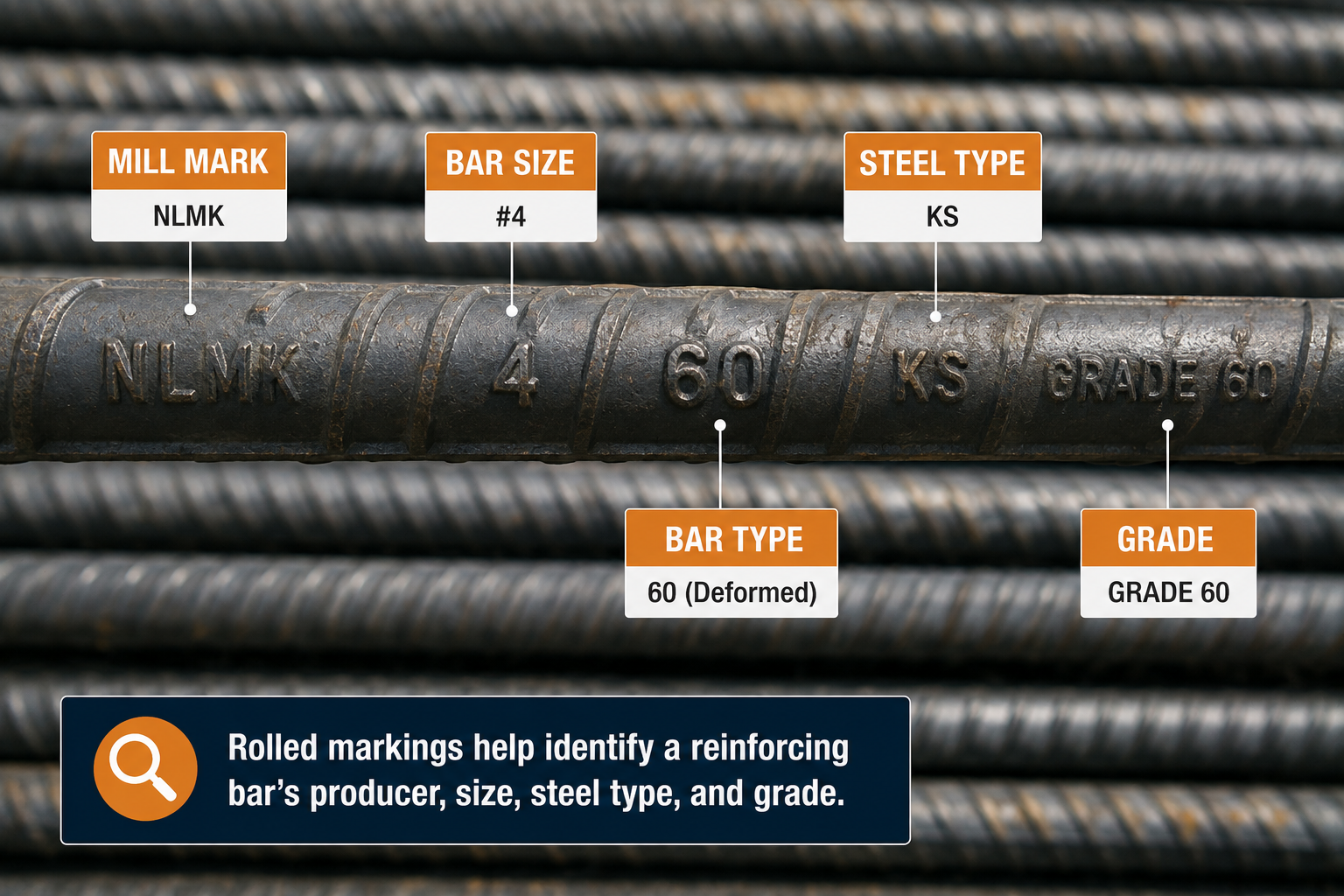
Common tools include a vernier caliper, a digital caliper, a tape measure or ruler for rough identification, comparison against a known-size bar, and checking rolled bar markings.
Measuring Across the Ribs
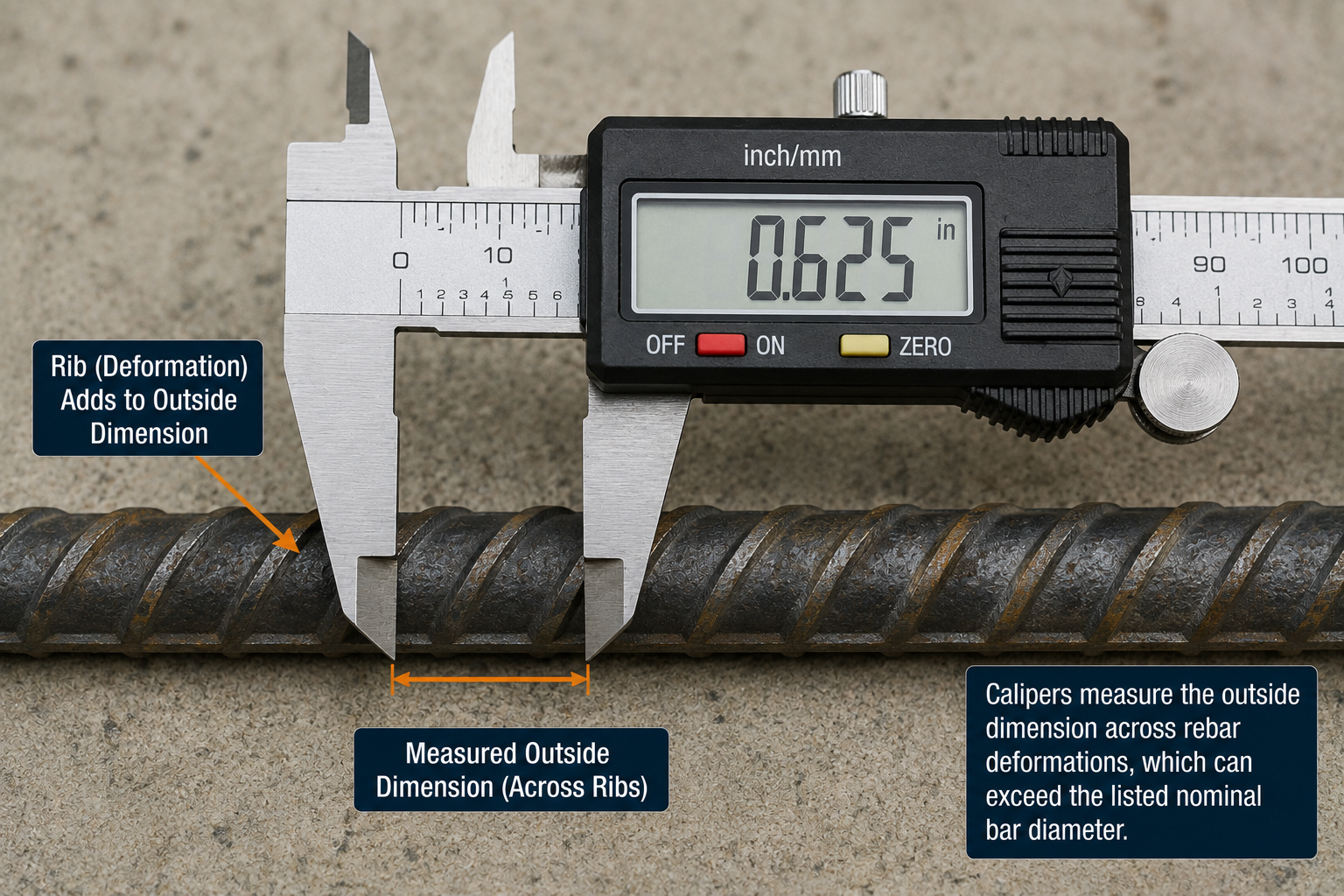
Placing calipers across the deformation peaks gives the overall outside diameter, not the ASTM nominal diameter. This measurement will typically read somewhat larger than the chart values above, which is expected and does not mean the bar is oversized or nonconforming.
Measuring an Unknown Bar
Combine the measured dimension with other identification clues: rolled bar markings, comparison against the nominal diameter chart, weight per foot if a measured length and weight are available, and the project drawings or specification, which govern the actual bar that should be installed.
How to Identify Rebar Size from Diameter
A practical workflow for confirming an unknown bar’s size before use.
- Clean a short section of the bar to remove rust, coating buildup, or debris.
- Look for rolled size markings, if visible.
- Measure outside diameter with a caliper.
- Compare the measurement against the nominal diameter chart above.
- Account for rib height when interpreting the measured value.
- Cross-check weight per foot if the bar size is still uncertain.
- Verify against project drawings or specifications before substituting any bar size.
Field Measurement Has Limits
Field diameter measurement alone may not identify every deformed bar precisely, especially between adjacent sizes with similar diameters. Rolled markings and project documentation remain the most reliable identification method.
Rebar Markings and Size Identification
Rolled marks complement diameter measurement for reliable bar identification.
ASTM specifications require rolled identifying marks on deformed bars, generally including a mark identifying the mill or producer, a mark identifying the bar size, a mark identifying the steel type, and a mark or symbol identifying the grade.
CRSI detailing guidance notes that these rolled marks are the primary way to confirm a bar’s producer, size, steel type, and grade without relying solely on a physical diameter measurement, which is especially useful since diameter alone cannot distinguish between different grades of the same bar size.
Rebar Diameter in Inches vs Millimeters
Distinguishing straightforward unit conversion from ASTM’s soft-metric designation.
| Bar | Diameter (in.) | Diameter (mm) | ASTM Metric Designation |
|---|---|---|---|
| #4 | 0.500 | 12.7 | [13] |
| #5 | 0.625 | 15.9 | [16] |
| #8 | 1.000 | 25.4 | [25] |
For #4, 0.500 in × 25.4 = 12.7 mm exactly. The ASTM metric designation [13] is a rounded designation number, not a claim that the exact physical diameter is 13.0 mm. The nominal physical diameter remains 12.7 mm. Keeping this distinction clear prevents confusion between a bar’s designation label and its actual tabulated dimension.
U.S. Rebar Sizes vs True Metric Rebar Sizes
“Metric rebar” can mean two different things, and they are not interchangeable.
ASTM soft-metric designations represent the same U.S. bar family (the identical #3 through No. 20 [64] bars) labeled with a metric designation number in brackets, such as #10 [32]. These are not separate bars; they are the same ASTM bar with a metric-style label.
True metric reinforcement systems used in other countries manufacture bars with nominal diameters such as 8 mm, 10 mm, 12 mm, 16 mm, 20 mm, 25 mm, 32 mm, or 40 mm. These round-number metric bars are governed by different national or international standards and should not be assumed automatically interchangeable with U.S. ASTM bars, even when a diameter happens to look similar.
Rebar Diameter vs Cross-Sectional Area
Area increases with the square of diameter, which is why small diameter changes matter structurally.
Because area scales with diameter squared, doubling a bar’s diameter roughly quadruples its cross-sectional area rather than simply doubling it. For the full area-per-bar and area-per-spacing reference tables, see the dedicated Rebar Area Chart.
Equipment for Your Project
Affiliate disclosure: As an Amazon Associate, ConcreteCalculate earns from qualifying purchases. We may also earn a commission from other affiliate links at no additional cost to you.
Rebar Diameter vs Weight
Larger diameter generally means higher unit weight, since cross-sectional steel area increases.
Weight per foot rises with the bar’s cross-sectional area, so it follows a similar squared relationship to diameter rather than a simple linear one. This page includes only enough weight data to help identify an unknown bar; for complete unit-weight and total-weight tables, see the dedicated Rebar Weight Chart.
⭐ Rebar Diameter vs Grade
Diameter tells you bar size; grade tells you specified yield strength. These are independent properties.
A #5 Grade 60 bar and a #5 Grade 80 bar have the identical nominal diameter of 0.625 inches, but different mechanical properties and different specified minimum yield strengths. ASTM A615/A615M currently includes Grade 40 [280], Grade 60 [420], Grade 80 [550], and Grade 100 [690] bars.
Don’t Assume Thicker Means Stronger
Do not assume that “thicker” and “higher grade” mean the same thing. A larger-diameter bar of a lower grade can have a lower specified yield strength than a smaller-diameter bar of a higher grade. Grade must be confirmed independently of diameter, typically from rolled markings or mill certification. See the Rebar Grade Chart for full grade specifications.
Rebar Diameter and Spacing
Bar diameter directly affects physical placement and reinforcement layout.
Larger bars affect required clear spacing, congestion within a rebar cage, the number of bars needed to meet a required steel area, and how easily concrete can be placed and consolidated around the reinforcement. This page covers diameter’s role in these considerations only at a conceptual level; for full spacing tables and requirements, see the Rebar Spacing Chart.
Rebar Diameter and Concrete Cover
Cover and diameter are related but distinct measurements in a reinforced concrete cross-section.
Concrete cover is measured relative to the reinforcement surface, while bar diameter affects where the bar centerline sits within the member. Larger bars can therefore influence cage dimensions, clear cover geometry, layer spacing when multiple bar layers are used, and the concrete space available around each bar. See the Concrete Cover Chart for cover requirements by exposure condition and member type.
Rebar Diameter and Lap/Development Length
Nominal bar diameter is a direct input into reinforcement detailing equations.
The nominal bar diameter, commonly written as db, appears directly in many development-length and lap-splice equations used in reinforced concrete design. Larger bars can require longer development or lap dimensions, depending on bar size, grade, concrete strength, cover, spacing, coating, confinement, and the applicable design provisions. This page does not reproduce the numerical lap-splice tables; see the dedicated Rebar Lap Splice Chart for those values.
Rebar Diameter and Bend Diameter
Bar diameter is also the basis for standard bend-diameter requirements.
Many detailing standards express minimum bend diameters as a multiple of the bar’s nominal diameter db, such as a minimum bend diameter of 6db for certain bar sizes. ASTM’s own bend-testing requirements likewise use bar diameter d in defining the bend-test pin diameters used to verify a bar’s ductility during manufacturing quality control.
Keep these two concepts separate: design bend-diameter requirements used in detailing drawings are not the same as the ASTM manufacturing bend test, even though both are expressed relative to bar diameter.
Rebar Diameter by Construction Application
Where various bar diameters commonly appear, for context only, not as a sizing recommendation.
Slabs and Driveways
Residential slabs and driveways commonly use smaller bar sizes toward the lower end of the standard range.
Footings and Foundations
Footings and foundations often use mid-range bar sizes, depending on load and soil conditions.
Walls
Reinforced walls may use a range of bar sizes depending on wall height, loading, and reinforcement layout.
Beams and Columns
Beams and columns frequently use mid-to-large bar sizes to meet longitudinal reinforcement and confinement requirements.
Bridges and Heavy Structural Work
Bridges and other heavy structural elements may use the largest standard bar sizes, including #14, #18, and where recognized by the applicable code, No. 20 [64].
Application Examples Are Not Sizing Rules
These typical project examples illustrate where various diameters appear, but the required reinforcement size must come from structural design, project drawings, applicable code, and project specifications, not from project type alone.
Choosing Rebar Diameter
A design-awareness overview, not a DIY structural-sizing method.
Inputs that go into selecting rebar diameter include required steel area, bar spacing, member dimensions, clear spacing, concrete cover, development length, congestion, constructability, loading and design requirements, and the engineer’s reinforcement schedule.
Key Point
Rebar diameter is normally selected from structural reinforcement requirements, not chosen solely from slab thickness or project type. Always follow the engineer’s drawings and specifications for the actual bar size to install.
⭐ Rebar Diameter Substitution
Changing bar size changes far more than the numbers on the label.
Replacing one bar size with another changes cross-sectional area, the number of bars needed, spacing, development and lap requirements, congestion, crack distribution, anchorage, and potentially the design strength of the member.
Never Substitute Without Verification
A #5 bar should not simply replace a #4 bar at the same spacing, or vice versa, without verifying the structural design. Any substitution should be reviewed and approved by the engineer of record. See the Rebar Area Chart to compare cross-sectional area between bar sizes before considering any change.
⭐ ASTM A615/A615M Rebar Diameter Standard
The primary U.S. standard governing rebar diameter, sizes, and number designations.
ASTM A615/A615M covers deformed and plain carbon-steel bars for concrete reinforcement in cut lengths and coils. Its scope includes standard bar sizes, number designations, nominal dimensions, grades, deformation requirements, and both inch-pound and SI unit systems.
The standard sizes and dimensions of deformed bars and their number designations are given in Table 1 of the specification. Current editions include Grade 40 [280], Grade 60 [420], Grade 80 [550], and Grade 100 [690] as the four minimum yield strength levels covered.
No. 20 [64]: Current Standard Note
ASTM’s Own Caution
ASTM explicitly states that users of the specification need to be aware that consensus design codes and specifications may not recognize the use of the No. 20 [64] bar, the largest bar included in the specification. Structural members reinforced with No. 20 [64] bars may require approval of the building official or other appropriate authority and require special detailing to ensure adequate performance at service and factored loads.
ASTM A706 and Other Rebar Specifications
Diameter references may also appear under other specifications; always confirm the specific one.
Diameter and size references may also appear with ASTM A706/A706M low-alloy weldable reinforcement, stainless steel reinforcement specifications, coated reinforcement (such as epoxy-coated or galvanized bar), and proprietary reinforcement systems. This page does not attempt to be a complete rebar-type specification article.
Confirm the Full Specification, Not Just Diameter
Always confirm the bar’s specification (A615, A706, or another applicable standard) along with its diameter and grade. The same nominal diameter can appear across multiple specifications with different mechanical or weldability requirements.
Common Rebar Diameter Mistakes
The most frequent errors when reading, measuring, or specifying rebar diameter.
Treating rib-to-rib caliper readings as nominal diameter
Measured outside diameter over the ribs is larger than the ASTM nominal value.
Assuming all bar numbers equal eighths of an inch
This rule only holds exactly for #3 through #8.
Saying #10 is exactly 1-1/4 inch
Its true nominal diameter is 1.270 inches, not 1.250 inches.
Confusing diameter with area
Diameter is a linear dimension; area scales with the diameter squared.
Confusing bar size with grade
Diameter identifies bar size; grade identifies specified yield strength. They are independent.
Treating metric designation as exact measured diameter
ASTM metric designations like [13] are rounded labels, not precise physical measurements.
Confusing U.S. soft metric with true metric bars
ASTM soft-metric bars are the same U.S. bar family; true metric bars follow different national standards.
Assuming larger diameter means acceptable substitution
Any bar size change must be verified against the structural design, not assumed acceptable.
Measuring rusty or coated bar without accounting for buildup
Surface rust, scale, or coating can add to the measured outside dimension.
Ignoring bar markings
Rolled marks are often the most reliable way to confirm producer, size, type, and grade.
Using an obsolete bar-size table
Older tables may not reflect the current standard’s largest included bar size.
Omitting No. 20 [64] from a current ASTM A615 chart
The current specification includes No. 20 [64] as its largest bar.
Applying No. 20 [64] without checking code recognition
ASTM warns that design codes may not yet recognize this bar; approval and special detailing may be required.
Rebar Diameter Chart Limitations
Important context for interpreting the values on this page correctly.
Frequently Asked Questions
📥 Download Rebar Diameter Chart PDF
Use your browser’s print function to instantly save this page as a PDF. This avoids broken file links and gives you an always up-to-date printable version for jobsite binders, estimating folders, and reinforcement identification kits.