Bolt Hole Size Chart – Clearance, Structural & Metric Holes
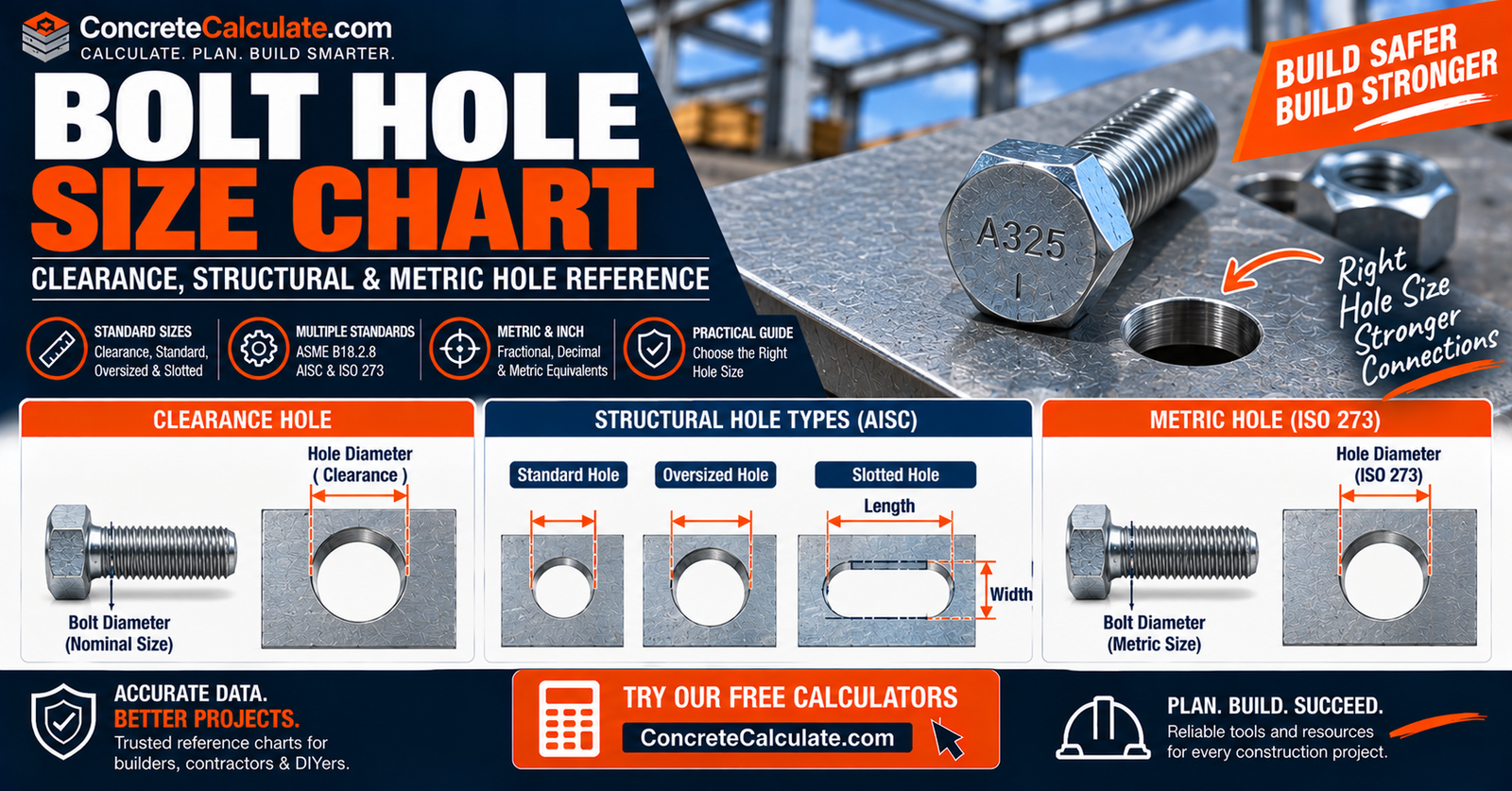
Bolt Hole Size Chart
Clearance, Structural & Metric Holes
General-purpose clearance holes under ASME B18.2.8, structural steel standard, oversized, short-slotted, and long-slotted hole dimensions under AISC 360 and RCSC, and metric clearance holes under ISO 273, plus fabrication, spacing, edge distance, and washer guidance.
 Reviewed by Muhammad Ramzan Babar, PhD Researcher (Plasma Physics) & Calculator Developer, View Profile
There is no single universal “drill the hole 1/16 in. larger than the bolt” rule
That shortcut happens to match some specific sizes, but it is not a universal standard. General-purpose inch and metric clearance holes follow ASME B18.2.8, while structural steel uses a separate standard, oversized, short-slotted, and long-slotted hole system under AISC 360 and RCSC. These two systems are not interchangeable.
Bolt Hole Size Chart, Quick Reference
Three separate flagship tables, since general clearance, structural, and metric holes are not interchangeable systems.
General-Purpose Inch Bolt Clearance Hole Chart
| Bolt Size | Close Fit Hole | Normal Fit Hole | Loose Fit Hole |
|---|---|---|---|
| 1/4 in. | 0.281 | 0.302 | 0.332 |
| 3/8 in. | 0.406 | 0.422 | 0.484 |
| 1/2 in. | 0.531 | 0.562 | 0.625 |
| 5/8 in. | 0.656 | 0.688 | 0.750 |
| 3/4 in. | 0.781 | 0.812 | 0.906 |
| 1 in. | 1.031 | 1.062 | 1.156 |
These are general-purpose clearance-hole categories, not structural-steel bolt-hole dimensions.
Structural Steel Bolt Hole Chart
| Bolt Diameter | Standard Hole | Oversized Hole | Short Slot (W x L) | Long Slot (W x L) |
|---|---|---|---|---|
| 1/2 in. | 9/16 | 5/8 | 9/16 x 11/16 | 9/16 x 1-1/4 |
| 5/8 in. | 11/16 | 13/16 | 11/16 x 7/8 | 11/16 x 1-9/16 |
| 3/4 in. | 13/16 | 15/16 | 13/16 x 1 | 13/16 x 1-7/8 |
| 7/8 in. | 15/16 | 1-1/16 | 15/16 x 1-1/8 | 15/16 x 2-3/16 |
| 1 in. | 1-1/16 | 1-1/4 | 1-1/16 x 1-5/16 | 1-1/16 x 2-1/2 |
These dimensions come from the current AISC structural-hole table framework (Table J3.3). Note that the standard hole for a 1-in. bolt is 1-1/16 in., not a simple bolt-plus-1/8-in. shortcut.
Metric Bolt Clearance Hole Chart
| Metric Bolt | Fine Clearance | Medium Clearance | Coarse Clearance |
|---|---|---|---|
| M6 | 6.4 | 6.6 | 7.0 |
| M8 | 8.4 | 9.0 | 10.0 |
| M10 | 10.5 | 11.0 | 12.0 |
| M12 | 13.0 | 13.5 | 14.5 |
| M16 | 17.0 | 17.5 | 18.5 |
ISO 273 remains current and covers general-purpose clearance holes for metric threads from 1 mm to 150 mm using fine, medium, and coarse hole series.
What Is a Bolt Clearance Hole?
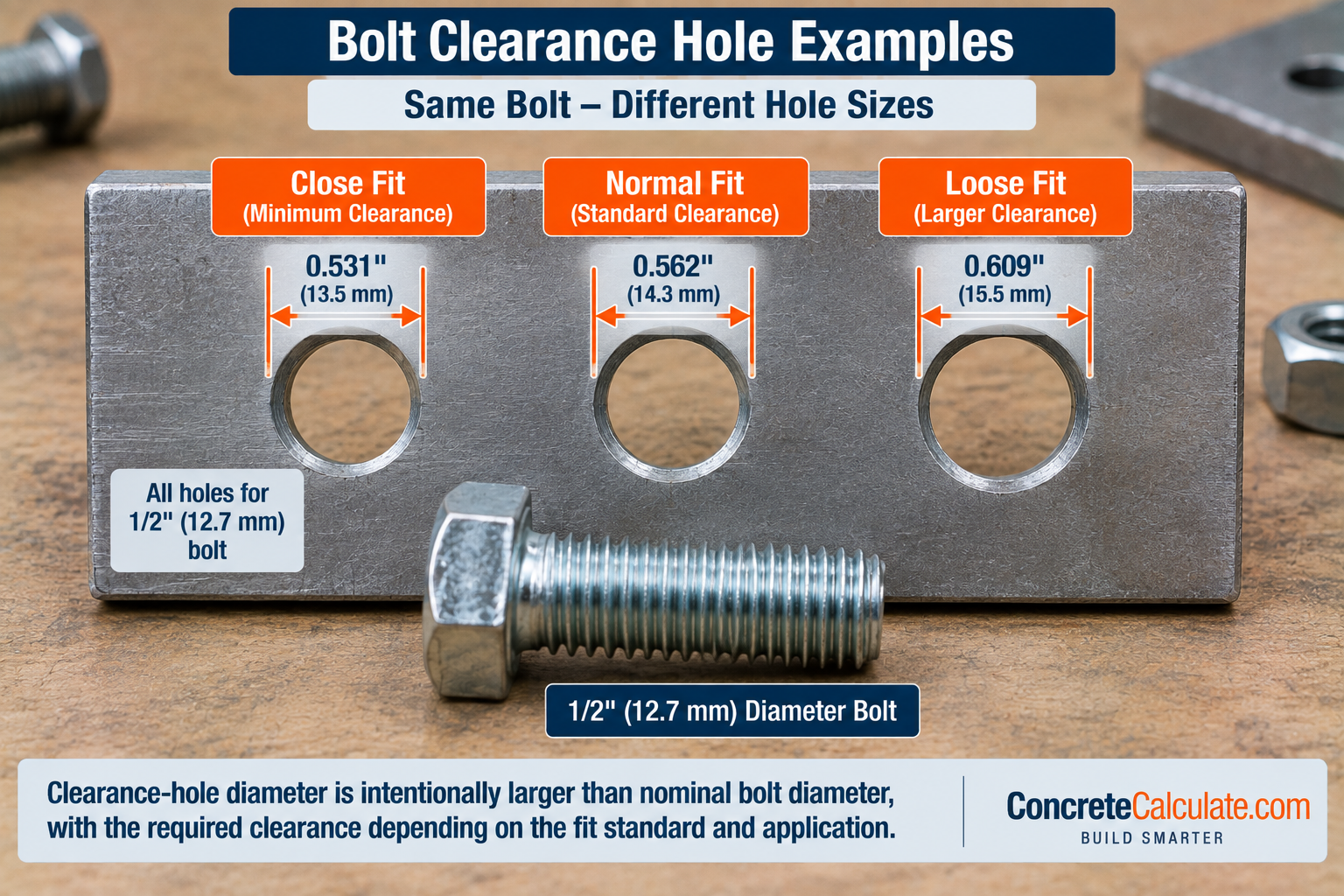
Intentionally larger than nominal bolt diameter so the bolt can pass through freely.
A clearance hole is intentionally larger than the nominal bolt diameter so the bolt can pass through without threading into the hole. The hole must provide enough clearance for insertion, alignment, and fabrication tolerance during assembly, without becoming unnecessarily large.
Bolt Diameter vs Hole Diameter
The main conceptual distinction on this page.
A 3/4-in. bolt does not ordinarily use an exactly 3/4-in. clearance hole. In structural steel, the standard hole is 13/16 in. for a 3/4-in. bolt. Nominal bolt diameter does not equal clearance-hole diameter. See the Bolt Diameter Chart for the complete bolt dimensional reference.
How Much Larger Should a Hole Be Than a Bolt?
No single universal number applies.
| Application | Governing System |
|---|---|
| General-purpose assembly | Close, normal, or loose fit under ASME B18.2.8 |
| Structural steel | Standard, oversized, short slot, or long slot under AISC/RCSC |
| Metric general-purpose | Fine, medium, or coarse clearance under ISO 273 |
Close, Normal, and Loose Clearance Holes
The key general-purpose fit section.
| Fit Class | Description |
|---|---|
| Close Fit | Minimal extra clearance, useful where better alignment or lower positional play is required |
| Normal Fit | General assembly clearance |
| Loose Fit | More positional or fabrication clearance |
ASME B18.2.8 specifically recognizes these three classes of clearing.
ASME B18.2.8 Clearance Hole Chart
The authoritative inch and general-purpose metric table.
| Fastener Size | Close | Normal | Loose |
|---|---|---|---|
| #8 | 0.180 | 0.196 | 0.213 |
| 1/4 in. | 0.281 | 0.302 | 0.332 |
| 3/8 in. | 0.406 | 0.422 | 0.484 |
| 1/2 in. | 0.531 | 0.562 | 0.625 |
| 3/4 in. | 0.781 | 0.812 | 0.906 |
| 1 in. | 1.031 | 1.062 | 1.156 |
ASME states B18.2.8 covers recommended clearance holes for #0 through 1-1/2-in. inch fasteners and M1.6 through M100 metric fasteners, using close, normal, and loose fits. ASME’s metric coverage does not replace ISO 273 where ISO conventions are specifically required.
Standard Structural Bolt Hole Size Chart
One of the highest-value construction tables on this page.
| Bolt Diameter | Standard Hole Diameter | Added Clearance |
|---|---|---|
| 1/2 in. | 9/16 | 1/16 |
| 5/8 in. | 11/16 | 1/16 |
| 3/4 in. | 13/16 | 1/16 |
| 7/8 in. | 15/16 | 1/16 |
| 1 in. | 1-1/16 | 1/16 |
Standard structural holes for these common sizes add 1/16 in. over nominal bolt diameter, but this is not a formula that extends unchanged to every larger bolt size or hole category.
Oversized Structural Bolt Hole Chart
A recognized structural-hole category, not a fabrication mistake.
| Bolt Diameter | Oversized Hole Diameter |
|---|---|
| 1/2 in. | 5/8 |
| 5/8 in. | 13/16 |
| 3/4 in. | 15/16 |
| 7/8 in. | 1-1/16 |
| 1 in. | 1-1/4 |
Oversized holes are a recognized structural-hole category, but their use affects connection design, washers, slip behavior, and pretension requirements.
Short-Slotted Bolt Hole Chart
Slot width is similar to standard hole width; length is increased in one direction.
| Bolt Diameter | Slot Width | Slot Length |
|---|---|---|
| 1/2 in. | 9/16 | 11/16 |
| 3/4 in. | 13/16 | 1 |
| 1 in. | 1-1/16 | 1-5/16 |
Do not imply slots may be oriented arbitrarily in every connection; slot orientation is a specific design detail.
Long-Slotted Bolt Hole Chart
Materially affects slip behavior, bearing, washer requirements, and connection detailing.
| Bolt Diameter | Slot Width | Slot Length |
|---|---|---|
| 1/2 in. | 9/16 | 1-1/4 |
| 3/4 in. | 13/16 | 1-7/8 |
| 1 in. | 1-1/16 | 2-1/2 |
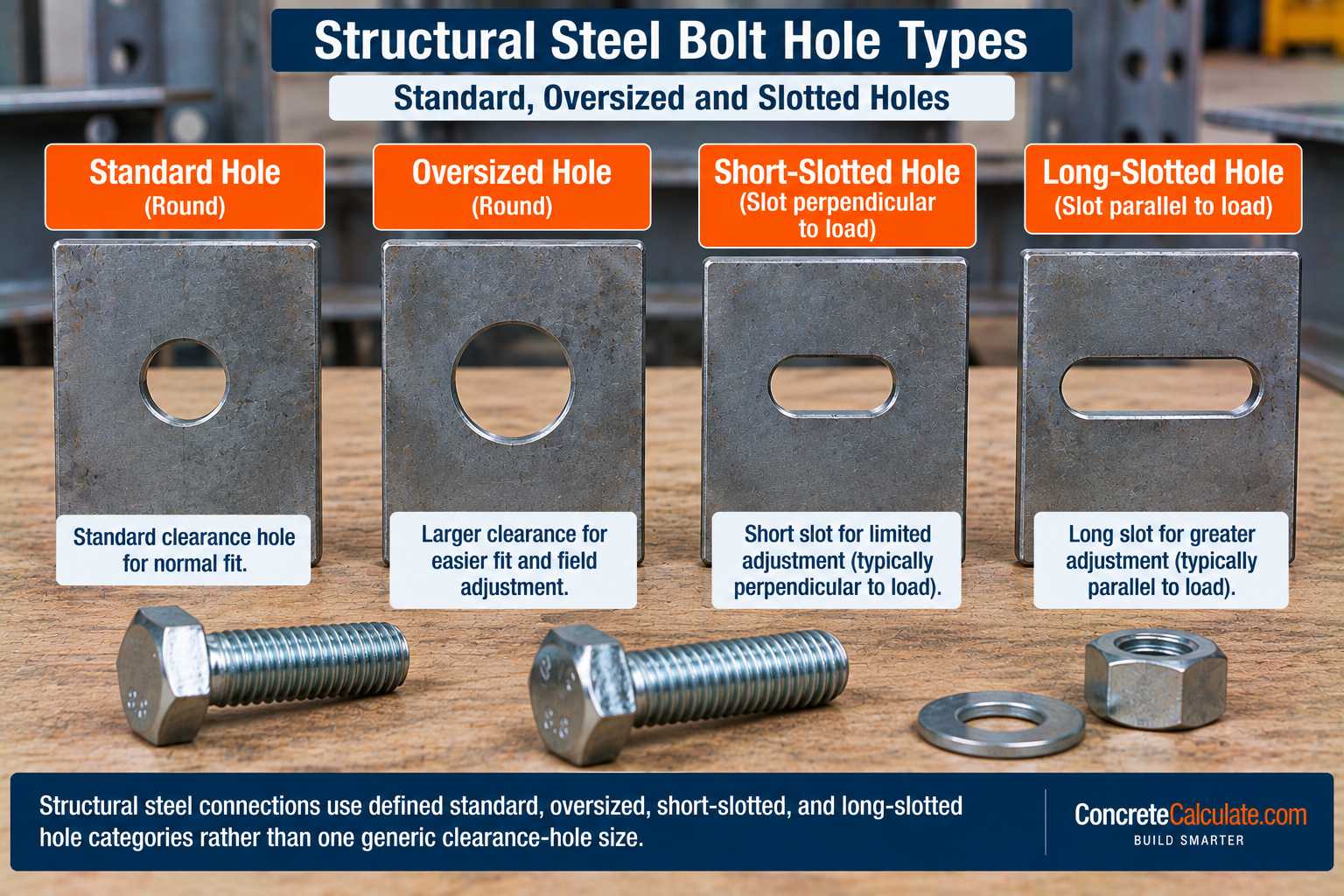
Standard vs Oversized vs Slotted Holes
Four distinct recognized categories.
| Hole Type | Shape | Main Purpose | Structural Effect |
|---|---|---|---|
| Standard | Round | Normal assembly | Baseline |
| Oversized | Round | Extra fit/tolerance | Requires special checks |
| Short slot | Elongated | Limited adjustment | Direction-sensitive |
| Long slot | Longer elongated | More movement/alignment | Greater design implications |
AISC’s guidance confirms that if actual hole dimensions exceed one category’s maximum, the connection must be treated as the next larger recognized category.
AISC and RCSC Structural Bolt Hole Requirements
Careful attention to current editions.
ANSI/AISC 360-22 is the current AISC Specification associated with the 16th Edition Manual, and it governs structural hole dimensions through Table J3.3. The Research Council on Structural Connections (RCSC) issued a 2025 Specification for Structural Joints Using High-Strength Bolts, which is the current governing document for bolt installation, pretensioning, and related joint requirements; earlier 2020 editions should not be cited as current.
Why Structural Bolt Holes Differ from General Clearance Holes
A fundamental distinction.
General machine and mechanical clearance holes mainly address assembly, fit, and clearance. Structural steel holes additionally affect bearing strength, net-section behavior, slip-critical performance, washer requirements, bolt installation, edge distance, and connection classification. Do not use a generic ASME clearance-hole chart as a substitute for AISC/RCSC structural hole requirements.
Metric Structural Bolt Hole Chart
AISC also publishes metric structural-hole dimensions.
| Bolt | Standard Hole | Oversize | Short Slot | Long Slot |
|---|---|---|---|---|
| M16 | 18 mm | 20 mm | 18 x 22 mm | 18 x 40 mm |
| M20 | 22 mm | 24 mm | 22 x 26 mm | 22 x 50 mm |
| M22 | 24 mm | 28 mm | 24 x 30 mm | 24 x 55 mm |
| M24 | 27 mm | 30 mm | 27 x 32 mm | 27 x 60 mm |
| M30 | 33 mm | 38 mm | 33 x 40 mm | 33 x 75 mm |
For sizes M36 and larger: standard = d + 3 mm, oversize = d + 8 mm, short slot = (d+3) x (d+10) mm, long slot = (d+3) x 2.5d mm, per the AISC metric structural-hole table.
ISO 273 Metric Clearance Hole Chart
The main nonstructural metric section.
| Metric Bolt | Fine Hole | Medium Hole | Coarse Hole |
|---|---|---|---|
| M6 | 6.4 | 6.6 | 7.0 |
| M8 | 8.4 | 9.0 | 10.0 |
| M10 | 10.5 | 11.0 | 12.0 |
| M12 | 13.0 | 13.5 | 14.5 |
| M20 | 21.0 | 22.0 | 24.0 |
ISO 273 remains current and covers fine, medium, and coarse clearance-hole series for metric threads from 1 mm to 150 mm. Keep this separate from the AISC metric structural table above.
Fine vs Medium vs Coarse Metric Clearance
The metric equivalent of ASME close/normal/loose.
| Class | Description |
|---|---|
| Fine | Tighter fit |
| Medium | Typical general-purpose clearance |
| Coarse | Larger fit allowance |
The same M12 bolt can legitimately use different hole diameters depending on the intended fit.
Clearance Hole vs Threaded / Tapped Hole
A critical distinction that must never be confused.
| Type | Function |
|---|---|
| Clearance Hole | Bolt passes through freely |
| Threaded / Tapped Hole | Hole is smaller and then threaded |
Do not mix the two. Tap-drill size is not a bolt clearance-hole size. See the Tap Drill Chart for threaded-hole sizing.
Equipment for Your Project
Affiliate disclosure: As an Amazon Associate, ConcreteCalculate earns from qualifying purchases. We may also earn a commission from other affiliate links at no additional cost to you.
Clearance Hole vs Tap Drill Size
Prevents a very common DIY mistake.
| Feature | Clearance Hole | Tap Drill Hole |
|---|---|---|
| Bolt passes freely? | Yes | No |
| Hole threaded? | No | Yes |
| Diameter relative to bolt major diameter | Larger | Smaller |
| Primary reference | ASME/ISO clearance standard | Thread/tap standard |
Bolt Hole Diameter vs Bolt Diameter
A worked example with an important caveat.
Example: 3/4-in. Structural Bolt
Bolt Hole Tolerances and Fabrication
Chart values are nominal; actual fabrication also involves tolerances.
Methods can include drilling, punching, reaming, thermal cutting where permitted, and CNC machining. AISC specifically notes that reamed holes still have to meet bolt-hole size and tolerance, spacing, and edge-distance provisions.
Drilled, Punched, Reamed, and Thermal-Cut Holes
Practical fabrication method differences.
| Method | Description |
|---|---|
| Drilled | Produced by drill or CNC tooling |
| Punched | Mechanically punched through plate where allowed |
| Reamed | Used during erection when alignment problems occur; finished hole must still meet applicable size and tolerance requirements |
| Thermal-Cut | Plasma, oxy-fuel, or laser, where permitted by applicable fabrication rules |
Considerations include plate thickness, edge quality, and deformation. Avoid making one process universally preferable; check the applicable specification. Reaming is not unlimited permission to enlarge a structural hole.
Bolt Hole Spacing
Hole size interacts directly with minimum spacing requirements.
AISC Structural Steel Context
Center-to-center spacing should not be less than 2-2/3 times nominal fastener diameter (s ≥ 2.67d), with 3d preferred, and clear distance between holes/slots not less than d under the cited AISC provisions.
This is structural-steel AISC context, not a universal machine-design rule for every application.
Bolt Hole Edge Distance
No single universal edge distance applies.
Edge distance affects tearout, bearing, edge rupture, and fabrication clearance. It depends on bolt diameter, hole type, edge type, load direction, and structural specification. Use AISC, RCSC, or project criteria rather than a generic rule of thumb.
Washer Requirements for Oversized and Slotted Holes
An important construction differentiator.
RCSC’s structural-joint requirements include specific washer provisions for pretensioned and slip-critical joints with oversized or slotted holes, historically requiring plate washers, bars, or extra-thick F436 washers for certain oversized or slotted-hole conditions. Because RCSC issued a 2025 specification, verify the exact current washer requirement against that edition before applying a prescriptive table. See the Washer Size Chart for washer dimensional data.
Bolt Holes in Slip-Critical Connections
Hole type materially affects behavior in these connections.
In slip-critical joints, hole type can affect permitted slip, pretension, washer requirements, design resistance, and surface conditions. Do not imply oversized or slotted holes behave exactly like standard holes; the structural-hole chart must not be used without connection context.
Bolt Holes in Bearing-Type Connections
A contrast with slip-critical behavior.
Bearing-type behavior relies partly on bolt bearing against the hole, plate bearing, and shear transfer. Hole type therefore has direct design consequences, though detailed equations are beyond the scope of this general reference chart.
Bolt Hole Size in Wood
A separate, brief section for broad search intent.
Woodworking and wood structural requirements are not governed by AISC structural-steel hole tables. Hole size can depend on bolt type, the applicable wood connection standard, manufacturer guidance, and whether a tight or clearance fit is intended. Do not copy metal-hole rules into timber construction.
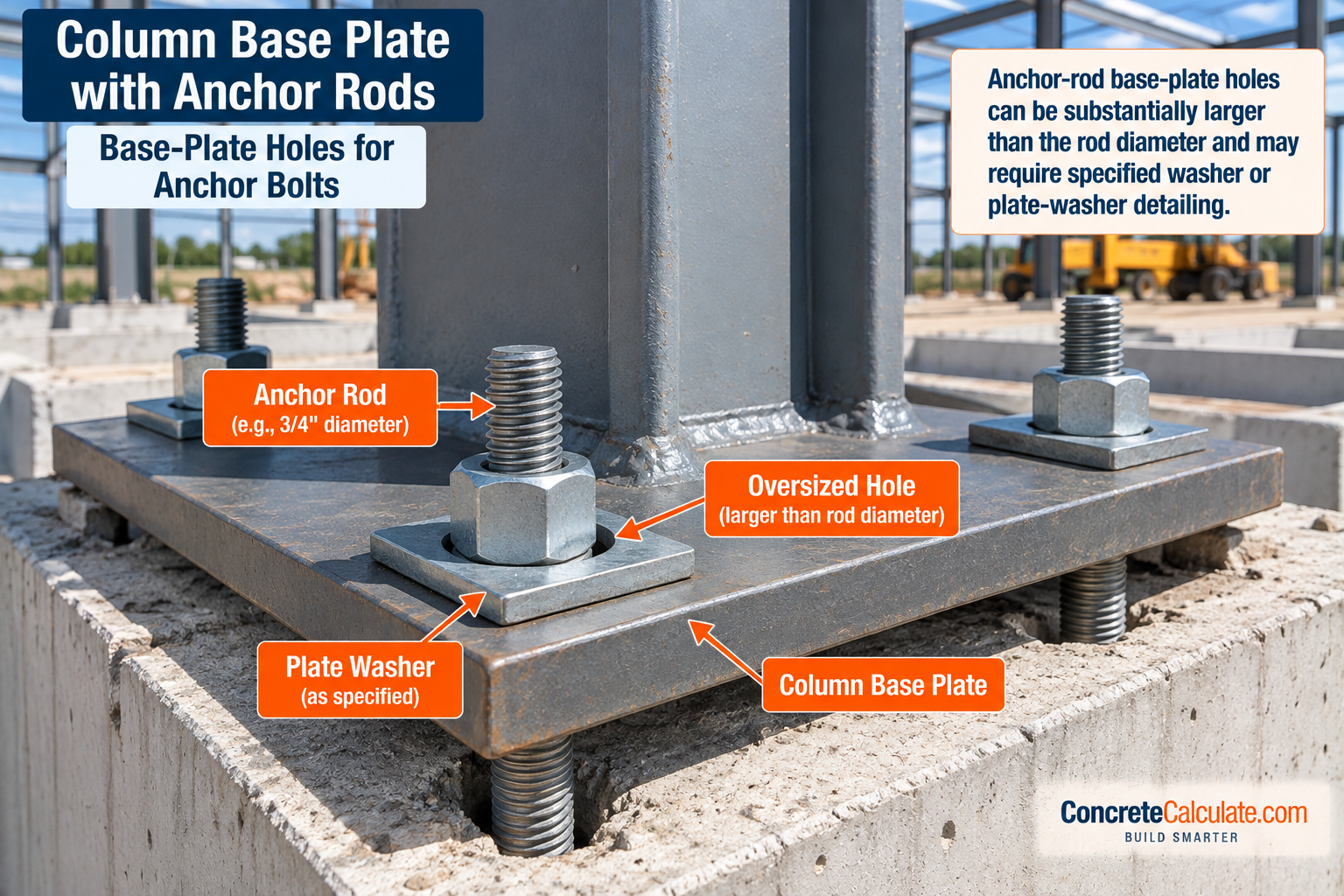
Bolt Hole Size in Base Plates and Concrete Anchor Systems
Very relevant to a construction and concrete audience.
| Hole Location | Governing Factor |
|---|---|
| Hole through steel base plate | Often larger than the anchor rod, governed by steel/detailing requirements |
| Hole drilled in concrete | Not a simple bolt-clearance hole; depends on anchor type, adhesive or mechanical system, manufacturer installation diameter, and embedment |
Do not use a steel clearance-hole chart to select the drill diameter for a concrete anchor. See the Anchor Bolt Size Chart for anchor rod and foundation-specific data.
Inch vs Metric Bolt Hole Standards
Keep the standards clearly separated.
| System | Governing Standard |
|---|---|
| Inch general-purpose clearance | ASME B18.2.8 |
| Metric general-purpose clearance | ISO 273 |
| Inch/metric structural | AISC 360 Table J3.3 |
How to Measure an Existing Bolt Hole
A practical field workflow.
Measure the hole’s inside diameter directly with a caliper, note whether the surrounding connection is structural steel or general assembly, and compare the reading against the applicable ASME, AISC, or ISO table for the corresponding bolt size to identify the hole category.
How to Choose the Correct Bolt Hole Size
The decision section.
Bolt Hole Selection Workflow
Common Mistakes and Chart Limitations
Using a hole equal to bolt diameter for a clearance joint
A true clearance hole must be sized larger than the bolt.
Using “bolt plus 1/16 in.” for every application
This is not a universal rule across all sizes and hole categories.
Using a general ASME clearance hole in a structural connection
Structural connections require AISC/RCSC hole categories, not general clearance fits.
Confusing clearance hole with tap-drill hole
These serve entirely different functions and use different sizing standards.
Assuming all structural holes are standard round holes
Oversized, short-slotted, and long-slotted are equally recognized categories.
Confusing oversized and slotted holes
These are geometrically and functionally distinct categories.
Exceeding short-slot dimensions but still calling it short-slotted
Exceeding a category’s limit reclassifies the hole to the next larger category.
Ignoring washer requirements
Oversized and slotted holes often require specific washer detailing.
Ignoring edge distance and hole spacing
Both directly affect connection capacity and code compliance.
Assuming standard steel-hole rules apply to wood
Wood fastener holes follow separate, distinct standards.
Using base-plate hole size as concrete-anchor drill size
Concrete anchor drilling is governed by the anchor manufacturer’s system, not a steel clearance chart.
Mixing metric and inch bolt-hole charts
These follow separate ASME, ISO, and AISC standards.
Reaming structural holes beyond permitted dimensions
Reaming must still satisfy applicable size and tolerance provisions.
Treating the chart as a complete bolted-connection design guide
This page identifies hole dimensions, not full connection design.
Read before finalizing a bolt hole selection
No universal clearance allowance applies to every bolt. General-purpose clearance and structural-steel holes use different standards, and close/normal/loose fit differs from standard/oversized/slotted structural categories. Metric ISO clearance series are separate from structural AISC metric holes, and hole size alone does not determine connection adequacy. Washer requirements can change with hole type, and edge distance and spacing matter for structural capacity. Structural bolt-hole use depends on connection type, and tap-drill sizes are different from clearance holes. Anchor drill diameters in concrete are product-specific, and wood fastener hole rules are separate entirely. Final structural details must follow the applicable code, specification, and design documents.
Bolt Hole Size FAQs
Download the Bolt Hole Size Chart
Get a printable reference including clearance, structural, and metric hole tables on this page for jobsite or shop use.