Fiber Mesh vs Rebar: Which Concrete Reinforcement Do You Actually Need?
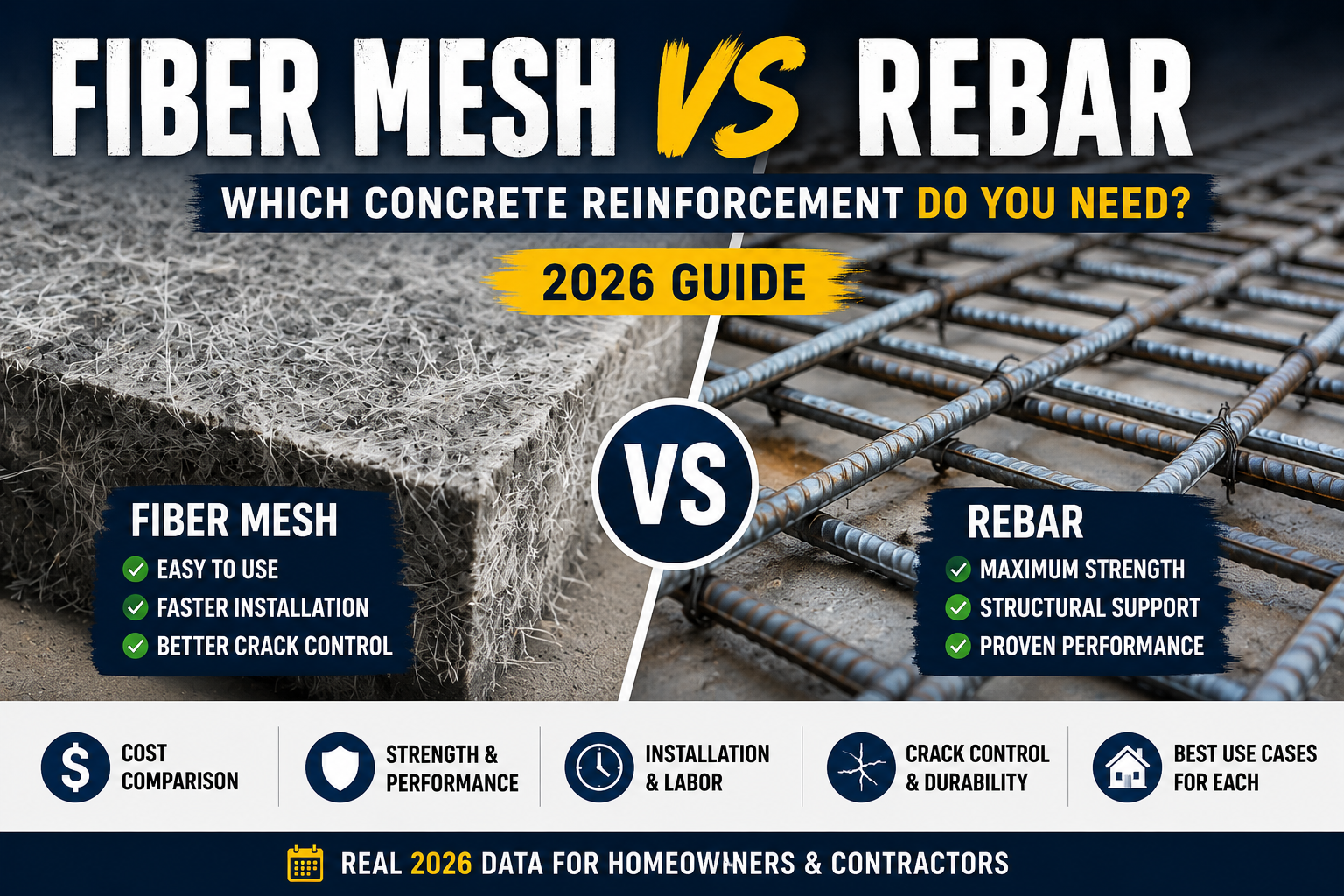
Both fiber mesh and rebar reinforce concrete – but they do completely different jobs. Using the wrong one wastes money. Using neither one at all means cracked slabs and costly repairs within a few years. This guide covers the real differences between fiber mesh and rebar on cost, strength, crack control, and installation, so you can pick the right reinforcement for your specific project in 2026.
What Fiber Mesh and Rebar Actually Do
Concrete is strong in compression but weak in tension – it resists crushing forces well but cracks when pulled or bent. Both fiber mesh and rebar address this weakness, but from completely different angles and at completely different scales.
Rebar (reinforcing bar) is steel rod placed inside concrete before the pour. It acts as a skeleton, carrying tensile loads across specific zones where the engineer predicts the most stress. When a concrete beam bends, the rebar at the bottom takes the tension and keeps the beam from snapping. Without rebar, that beam fails under load.
Fiber mesh consists of short synthetic, steel, or glass fibers mixed directly into the concrete batch before it’s poured. Rather than reinforcing along a specific line or plane, fibers distribute through the entire concrete matrix. They don’t add structural tensile capacity the way rebar does – they control cracking, improve impact resistance, and reduce shrinkage as concrete cures and dries.
Types of Fiber Mesh: Micro vs Macro
Not all fiber mesh is the same. There are two main categories, and each one serves a distinct purpose. Using the wrong type – or the wrong dosage – means you’re paying for something that won’t solve your actual problem.
Microfibers (Synthetic Monofilament)
Microfibers are typically 0.75 to 1.5 inches long and very fine – roughly the thickness of a human hair. They’re added to the concrete mix at 1 to 1.5 pounds per cubic yard. Their job is to control plastic shrinkage cracking – the hairline cracks that form in the first 24 hours while concrete stiffens and the bleed water evaporates.
Microfibers are the direct replacement for wire mesh in residential flatwork. They cost roughly $0.13 per square foot installed compared to $0.51 per square foot for wire mesh, because there’s zero extra labor. The fibers arrive pre-added to the ready-mix truck. No handling, no placement, no chairs needed.
Macrofibers (Structural Synthetic)
Macrofibers are 1.5 to 2.5 inches long and significantly thicker than microfibers. They’re added at 3 to 7.5 pounds per cubic yard and provide structural-level crack control. Macrofibers can replace light rebar (#3 or #4 bar) in slabs-on-ground, residential driveways, and industrial floors where the load demands don’t require a full engineered rebar cage.
Installed cost for macrofiber runs approximately $0.38 per square foot – still cheaper than rebar once placement labor is factored in. For industrial warehouse floors, parking lots, and heavy-duty flatwork, macrofibers are now a widely accepted structural reinforcement per ACI 360 guidance on slabs-on-ground.
Steel Fibers
Steel fibers are short crimped or hooked steel strands mixed into concrete at 25 to 100 pounds per cubic yard for very high-performance applications. They’re used in bridge decks, industrial floors, tunnel linings, and precast panels where extreme toughness and impact resistance are needed. For typical residential and light commercial work, synthetic macrofibers or rebar are more practical choices.
| Fiber Type | Length | Dosage | Replaces | Best For |
|---|---|---|---|---|
| Microfiber (synthetic) | 0.75-1.5 in | 1-1.5 lb/cy | Wire mesh (6×6 W1.4) | Residential flatwork, patios, driveways |
| Macrofiber (synthetic) | 1.5-2.5 in | 3-7.5 lb/cy | #3 or #4 rebar in slabs | Industrial floors, heavy flatwork, parking lots |
| Steel fiber | 1-2.5 in | 25-100 lb/cy | Rebar in high-impact zones | Bridge decks, tunnel linings, precast panels |
| Glass fiber (GFRC) | 0.5-1.5 in | 3-5% by weight | Wire mesh in thin sections | Decorative panels, countertops, facades |
Cost Comparison: Fiber Mesh vs Rebar in 2026
Cost is where fiber mesh has its clearest advantage over rebar – but only when you look at the fully installed price, not just the material price. Rebar looks cheap per linear foot until you add the labor to place it, tie it, and support it off the ground with chairs.
Material Costs
Steel rebar runs $0.40 to $1.25 per linear foot for standard Grade 60 in 2026. A 20×20-foot driveway slab with #4 rebar on 18-inch centers needs roughly 280 linear feet of bar, costing $112 to $350 in material. Add wire tie, rebar chairs, and the labor to cut, place, and tie everything and the total reinforcement cost rises to $350 to $700 for that same slab.
Microfiber mesh for the same 400 square foot slab at a 4-inch thickness (approximately 5 cubic yards) costs about $50 to $90 in fiber material, already added to the ready-mix at the plant. There is no placement labor, no chairs, no wire ties. Total reinforcement cost: $50 to $90. That’s a savings of $260 to $610 on one residential driveway.
Installed Cost Comparison Per Square Foot
| Reinforcement Type | Material Cost/sq ft | Labor Cost/sq ft | Total Installed/sq ft |
|---|---|---|---|
| Microfiber mesh (residential) | $0.10 – $0.15 | $0.00 (pre-mixed) | $0.13 – $0.15 |
| Wire mesh (6×6 W1.4) | $0.28 | $0.23 | $0.51 |
| Macrofiber mesh (industrial) | $0.25 – $0.35 | $0.00 (pre-mixed) | $0.38 |
| #3 rebar at 18-in spacing | $0.35 – $0.50 | $0.45 – $0.65 | $0.80 – $1.15 |
| #4 rebar at 12-in spacing | $0.65 – $0.95 | $0.65 – $0.90 | $1.30 – $1.85 |
🔢 Calculate Your Rebar Requirements
Find out exactly how much rebar you need for your slab, spacing, and bar size before buying materials.
Use the Rebar Calculator →Strength and Structural Performance
This is the one area where rebar has an absolute advantage. Grade 60 steel rebar has a yield strength of 60,000 PSI. No synthetic fiber product comes close to this for structural load carrying. When a concrete beam deflects under load, rebar at the tension face holds everything together. Without it, the beam cracks and fails.
Fiber mesh improves flexural strength – how well the slab resists bending forces distributed across its face – but not in the same concentrated, directional way rebar does. A fiber-only slab handles distributed foot traffic and light vehicle loads well. A fiber-only beam carrying a point load from a column will fail.
What the Codes Say
ACI 318 (the structural concrete code) requires rebar for all load-bearing elements: beams, columns, foundations, and structural slabs. ACI 360, which governs slabs-on-ground, explicitly allows macrofiber as a structural reinforcement in non-elevated slabs. That’s the key distinction: slabs-on-ground (floors, driveways, patios) can use macrofiber as structural reinforcement; elevated slabs and structural members require rebar per ACI 318.
Crack Control: Where Each One Wins
Cracking is the most visible failure in concrete, and it’s where the rebar vs fiber mesh choice directly affects what your project looks like 5 years from now. The two reinforcement types address different types of cracking at different stages of the concrete’s life.
Plastic Shrinkage Cracks (0 to 24 Hours)
These are the hairline cracks that form while concrete is still soft – caused by rapid moisture loss, wind, or thermal movement in the first day of curing. Rebar does nothing to prevent these. They form above the rebar plane and are unrelated to structural loads. Microfibers are highly effective at controlling plastic shrinkage cracks because they’re distributed throughout the entire concrete matrix, bridging microcracks before they open up.
Drying Shrinkage Cracks (Days to Weeks)
As concrete loses moisture over weeks and months, it contracts slightly. Without control joints or reinforcement, this contraction causes cracking. Both rebar and macrofibers help distribute and limit these cracks. Rebar pins the slab to resist movement along specific planes. Fibers distribute the tensile stress throughout the matrix, reducing crack width rather than eliminating cracking entirely.
Structural and Load Cracks
Cracks caused by loads exceeding the slab’s capacity – such as heavy truck axles or point loads from equipment – require rebar to control. Macrofibers add post-crack toughness, meaning the slab absorbs more energy before crack width becomes problematic, but they don’t replace the load-carrying capacity of a proper rebar cage.
Installation Differences
The installation process is where fiber mesh saves the most time and money on residential projects. Rebar placement is skilled, time-intensive work. Fiber mesh requires no additional labor at all.
Rebar Installation Steps
- Cut rebar to length using a rebar cutter or angle grinder
- Place rebar chairs or dobies on the subgrade to hold bars at the correct height (typically 1.5 to 2 inches from the bottom of the slab)
- Lay bars in a grid pattern at specified spacing – usually 12 to 18 inches on center each way
- Tie intersections with wire ties using a rebar tie tool
- Inspect cover depth and spacing before pouring
- Pour concrete carefully around the rebar cage without displacing bars
On a 500 square foot slab, this process takes an experienced crew 2 to 4 hours. For an inexperienced crew, budget 4 to 6 hours. Labor runs $60 to $90 per hour for a concrete crew in most US markets, putting rebar placement labor at $120 to $540 for that slab before the first yard of concrete is poured.
Fiber Mesh Installation
Synthetic fiber mesh is added to the ready-mix concrete truck at the batch plant before delivery. When the truck arrives on-site, the fiber is already distributed throughout the mix. There are no additional steps for the crew. The only change to the workflow is that concrete finishers need to tuck stray fibers at the surface level with a broom or float pass – a 5-minute task on most residential jobs.
💼 Real Example: 600 sq ft Patio Slab in Minnesota
Slab dimensions: 30×20 ft, 4 inches thick (7.4 cubic yards)
Rebar option: #4 rebar at 18 in on center, material + labor = $480 to $720
Fiber mesh option: Macrofiber at 4 lbs/cy added to mix = $95 to $130 total
Savings with fiber mesh: $350 to $590 on one patio project
Performance note: In Minnesota’s freeze-thaw climate, specify 4000 PSI concrete with the fiber mix and add control joints every 8 to 10 feet regardless of reinforcement type.
Use the concrete patio calculator to get your exact yardage, then factor fiber dosage at 4 lbs per cubic yard.
Which to Use by Project Type
The right choice depends entirely on what you’re building, what loads it will carry, and what your local building code requires. Here’s the practical breakdown for the most common residential and light commercial projects.
| Project Type | Recommended Reinforcement | Reason |
|---|---|---|
| Residential driveway (passenger cars) | Macrofiber mesh | Cost-effective, handles light vehicle loads and shrinkage |
| Driveway with heavy trucks or RVs | #4 rebar at 18 in + microfiber | Heavy axle loads need structural tensile reinforcement |
| Patio or walkway | Microfiber or macrofiber | Light loads, crack control is the main concern |
| Residential garage floor | Macrofiber or #4 rebar at 18 in | Depends on vehicle weight and planned use |
| House foundation | Rebar (required by code) | ACI 318 structural requirement, no substitutes |
| Basement slab | Microfiber or light rebar | Low structural load, crack control is primary need |
| Sidewalk | Microfiber mesh | Foot traffic only, fiber replaces wire mesh at lower cost |
| Structural beams/columns | Rebar (required by code) | ACI 318 mandates rebar, fiber cannot substitute |
| Industrial warehouse floor | Macrofiber or rebar + fiber | ACI 360 allows macrofiber for slabs-on-ground |
| Pool deck | #4 rebar at 12-18 in | Constant moisture, chemical exposure, needs rebar |
| Concrete steps | #4 rebar + microfiber | Structural loading at nosing edges requires rebar |
| Retaining wall | Rebar (required) | Lateral earth pressure requires full structural rebar design |
📐 Calculate Your Concrete Volume First
Before deciding on reinforcement, know your cubic yards. Enter your slab dimensions and get instant volume estimates.
Open Slab Calculator →Using Fiber Mesh and Rebar Together
On commercial and industrial projects, using both rebar and fiber mesh together is standard practice – and it makes sense to consider it for demanding residential projects too. Each reinforcement type fills a gap the other leaves.
Rebar provides structural tensile capacity along specific load paths. Microfibers or macrofibers fill the entire concrete matrix and control cracking everywhere else. A rebar cage keeps the slab from failing under structural loads. Fibers keep the surface from developing shrinkage cracks that let in water and deicing salts.
The combination costs roughly $0.10 to $0.20 per square foot more than rebar alone but delivers meaningfully better crack performance over the life of the slab. For garage floors, driveways exposed to road salts, and basement slabs in wet climates, it’s a worthwhile upgrade. Use our rebar calculator paired with a cubic yard count from the concrete volume calculator to spec both together.
Common Mistakes to Avoid
Most reinforcement failures on residential projects come down to a few repeatable errors. Here’s what to watch out for before you pour.
- Using microfiber where macrofiber is needed: Microfibers only control plastic shrinkage cracks. If you need structural crack control on a driveway that handles delivery trucks, use macrofiber at 3 to 4 lbs per cubic yard, not the standard 1 lb microfiber bag from the ready-mix plant
- Skipping rebar on structural elements to save money: Removing rebar from foundations, steps, or retaining walls to cut cost is a code violation in most jurisdictions and a structural risk. The material savings rarely exceed $200 to $400; the repair cost when it fails is several thousand dollars
- Placing rebar directly on the ground: Rebar sitting on the subgrade has zero concrete cover and will rust through in 10 to 15 years in wet climates, spalling the slab surface. Always use rebar chairs to maintain 1.5 to 2 inches of cover from the bottom
- Wrong fiber dosage: Under-dosing fiber (adding 0.5 lbs per cubic yard when the spec says 1.5 lbs) is a common ready-mix plant error on residential orders. Confirm the dosage on the ticket before the truck leaves the plant
- Relying on fiber mesh instead of control joints: Neither fiber nor rebar eliminates the need for control joints in flatwork. Joint spacing should be no more than 2.5 times the slab thickness in feet – so a 4-inch slab needs joints every 10 feet maximum. Our control joint calculator gives you exact spacing for any slab size
- Ordering the wrong concrete PSI with fiber mix: Fiber mesh performs best with 3500 to 4000 PSI concrete. Don’t use a 2500 PSI mix with fiber and expect the same result. Use our PSI strength calculator to confirm your mix design hits spec at 28 days
✅ Key Takeaways
- Rebar carries structural tensile loads. Fiber mesh distributes and controls cracking. They serve different purposes and are not direct substitutes in structural applications
- Microfiber costs $0.13 per square foot installed vs $0.51 for wire mesh – nearly 75% cheaper because there is zero placement labor
- Macrofiber at 3 to 7.5 lbs per cubic yard can replace #3 or #4 rebar in slabs-on-ground per ACI 360 guidelines
- Rebar is required by code (ACI 318) for foundations, beams, columns, retaining walls, and all structural elements – fiber mesh cannot substitute here
- For residential driveways and patios with passenger vehicle use, macrofiber mesh delivers comparable performance to light rebar at significantly lower cost
- Using both rebar and microfiber together costs only $0.10 to $0.20 more per square foot and gives you structural tensile capacity plus all-over crack control
- Always install proper control joints regardless of which reinforcement you choose – neither rebar nor fiber mesh replaces good joint placement