How Much Does Concrete Cost Per Yard Delivered? 2026 USA Price Guide
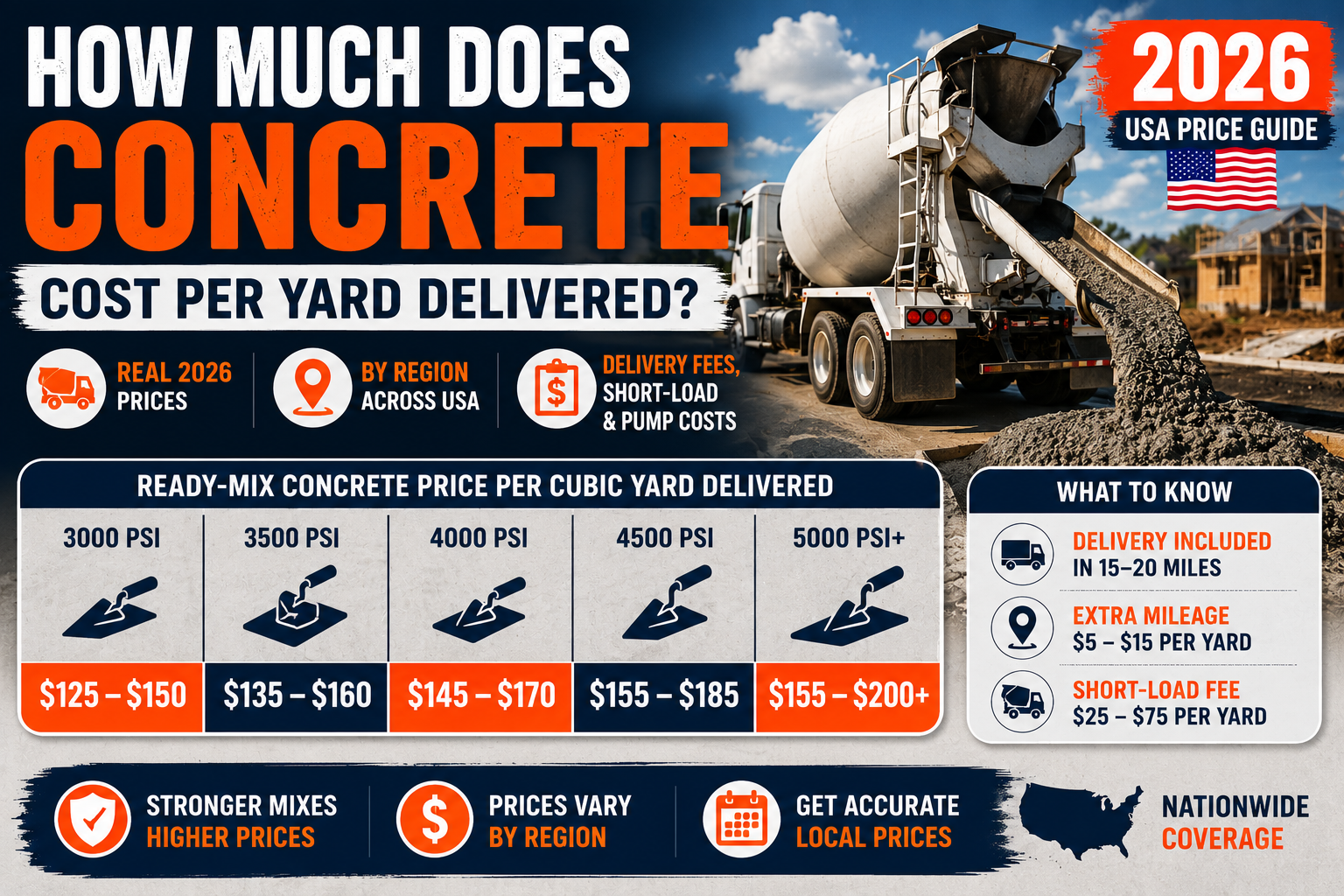
Ready-mix concrete costs $125 to $180 per cubic yard delivered in 2026 for a standard residential mix. That price covers the concrete material and standard delivery within 15 to 20 miles of the plant. High-strength mixes, fiber reinforcement, and specialty additives push the price to $150 to $210 per yard. This guide breaks down exactly what you pay for, what the hidden fees are, and what the real cost is for every common project size in 2026.
Price Per Yard by PSI and Mix Type
The price you pay per cubic yard of ready-mix concrete is primarily determined by the mix strength (measured in PSI) and any additives in the mix. Higher PSI requires more Portland cement per yard, which directly raises the material cost. Here are the 2026 national price ranges for the most common residential and light commercial mixes.
| Concrete Mix | PSI | Price Per Cubic Yard | Best Used For |
|---|---|---|---|
| Standard Residential Mix | 3000 PSI | $125 to $150 | Sidewalks, non-vehicle slabs, light patios |
| General Purpose Mix | 3500 PSI | $130 to $158 | Patios, residential driveways in mild climates |
| High-Strength Residential | 4000 PSI | $135 to $165 | Driveways, garage floors, cold climates |
| Premium Structural Mix | 4500 PSI | $145 to $178 | Foundation slabs, commercial slabs |
| High-Performance Mix | 5000 PSI | $150 to $190 | Structural beams, heavy loads, industrial |
| Fiber-Reinforced Concrete | 3500 to 4000 PSI | $148 to $195 | Industrial floors, driveways, high-crack-risk areas |
| Air-Entrained Concrete | 4000 PSI | $138 to $170 | Any slab in freeze-thaw climate zones |
| Colored / Integral Color | 3500 to 4000 PSI | $155 to $210 | Decorative patios, driveways, pool decks |
| Flowable Fill (CLSM) | 50 to 150 PSI | $90 to $130 | Utility trench backfill, void filling |
| High-Early Strength Mix | 4000 PSI | $148 to $185 | Fast-track projects, cold weather pours |
Every ready-mix supplier will ask you for your cubic yardage before quoting. Use the concrete calculator to find your exact volume. Arriving at the conversation with your number already calculated puts you in a much stronger position and prevents suppliers from over-estimating. Always add 10% for waste and subgrade variation.
What the Per-Yard Price Includes
When a ready-mix plant quotes you a price per cubic yard, here is exactly what that price covers – and what it does not.
What Is Included
- The concrete mix itself: Portland cement, aggregate (stone), sand, water, and any admixtures at the specified PSI
- Batching and quality control: The plant weighs and mixes each batch to spec and issues a delivery ticket with the exact mix design
- Truck and driver: A standard ready-mix drum truck holds 8 to 11 cubic yards
- Standard delivery radius: Most plants include delivery within 15 to 20 miles of their facility. Beyond that, a mileage surcharge applies.
- Chute delivery: Standard concrete placement directly from the truck’s chute to the pour area – this requires the truck to be within 18 to 20 feet of the pour
What Is NOT Included
- Labor to place and finish the concrete: The truck delivers the material. Your contractor or crew does everything after it leaves the chute.
- Site preparation: Excavation, forming, and reinforcement are contractor costs, not plant costs
- Pump truck fees: When the ready-mix truck cannot reach the pour area, a separate concrete pump is needed – $500 to $1,500 extra
- Short-load fees: If you order under one full truckload (typically less than 8 to 10 cubic yards), expect a surcharge of $25 to $75 per yard
- Extended waiting time charges: If your crew is not ready when the truck arrives, plants charge $50 to $100 per hour of wait time after the first 5 to 10 minutes
- Saturday or after-hours delivery: Weekend and off-hours pours typically add $80 to $150 per load
- Admixture upgrades: Accelerators, retarders, and specialty additives are charged separately – typically $15 to $30 per yard per admixture
Always build delivery fees, short-load charges, and any admixtures into your budget before comparing suppliers. A plant quoting $130 per yard with a $300 flat delivery fee on a 3-yard order costs $230 per effective yard. A plant quoting $145 per yard with delivery included is cheaper on that same order. Always do the math on total delivered cost, not just the sticker price per yard.
Delivery Fees, Short-Load Charges, and Surcharges
The fees on top of the per-yard price are where most homeowners get surprised. Here is a complete breakdown of every common concrete delivery surcharge in 2026.
| Fee Type | Typical Cost | When It Applies |
|---|---|---|
| Standard delivery (within 15-20 mi) | Included in per-yard price | Most standard orders |
| Flat truck delivery fee | $150 to $350 per load | Some plants charge this on top of per-yard rate |
| Mileage surcharge (beyond free zone) | $5 to $15/yard per mile zone | When job site is more than 15-20 miles from plant |
| Short-load fee | $25 to $75/yard premium | Orders under 8 to 10 cubic yards (less than a full truck) |
| Waiting / standby time | $50 to $100/hour | After first 5-10 free minutes if truck must wait |
| Saturday delivery | $80 to $150/load | Weekend pours |
| After-hours / early morning | $100 to $200/load | Deliveries outside standard business hours |
| Accelerator admixture | $15 to $25/yard | Cold weather or fast-track pours |
| Retarder admixture | $15 to $25/yard | Hot weather, long-distance pours, large slabs |
| Fiber reinforcement (polypropylene) | $8 to $20/yard | Crack resistance upgrade |
| Air-entraining agent | $5 to $12/yard | Freeze-thaw climate pours (recommended in northern states) |
| Pea gravel aggregate upgrade | $20 to $30/yard | When tighter aggregate is needed for thin pours |
| Slump test / QC testing | $50 to $100 | Required on engineered or permitted projects |
💰 Real Delivery Cost Example: 3-Yard Patio Order
Job: 12×12 patio at 4 inches thick = 1.8 cubic yards + 10% waste = ~2 yards ordered
Concrete material (4000 PSI): 2 yards x $140 = $280
Short-load fee (under 8 yards): 2 yards x $50 = $100
Standard delivery (within 15 miles): Included
Air-entraining agent (Ohio, freeze-thaw): 2 yards x $8 = $16
Total concrete cost: $396
Effective price per yard delivered: $198 per yard
This is why small jobs can feel expensive per yard. The short-load fee alone adds $50 per yard to the base price.
Find Out Exactly How Many Yards You Need
Enter your dimensions and get your precise cubic yardage plus a full material cost estimate.
Use the Concrete CalculatorHow Many Yards Each Project Needs
Every ready-mix quote starts with your cubic yardage. Here are the exact amounts for the most common residential project sizes, calculated at standard thicknesses with a 10% waste margin already included. These numbers are what you give the plant when you call for a price.
| Project | Dimensions | Thickness | Cubic Yards (with 10% waste) |
|---|---|---|---|
| Small walkway | 3 ft x 30 ft | 4 in | 1.1 yards |
| 12×12 patio | 12 x 12 ft | 4 in | 2.0 yards |
| 16×16 patio | 16 x 16 ft | 4 in | 3.5 yards |
| 20×20 patio | 20 x 20 ft | 4 in | 5.5 yards |
| Single-car driveway | 10 x 20 ft | 5 in | 3.4 yards |
| Two-car driveway | 20 x 35 ft | 5 in | 12.0 yards |
| Standard garage floor | 20 x 20 ft | 4 in | 5.5 yards |
| Two-car garage floor | 24 x 24 ft | 4 in | 8.0 yards |
| Basement slab | 40 x 30 ft | 4 in | 16.5 yards |
| Pool deck | 800 sq ft | 4 in | 11.0 yards |
| House foundation slab | 1,500 sq ft | 6 in | 30.5 yards |
| Small shed pad | 8 x 10 ft | 4 in | 1.1 yards |
For precise volume calculations on any shape – including round columns, footings, or irregular slabs – use the concrete slab calculator, concrete footing calculator, or concrete column calculator. To confirm whether your project triggers a short-load fee, use the ready-mix truck calculator to see how many truckloads your job requires.
Total Concrete Material Cost by Project
Here is what the concrete material alone costs for common project sizes using 2026 ready-mix prices. These figures cover only the concrete delivered to your site – they do not include labor, base prep, forming, reinforcement, or finishing.
| Project | Cubic Yards | Material Cost (3500 PSI) | Material Cost (4000 PSI) |
|---|---|---|---|
| 12×12 patio (4 in) | ~2.0 yds | $310 to $380 | $330 to $410 |
| 20×20 patio (4 in) | ~5.5 yds | $850 to $1,045 | $908 to $1,128 |
| 20×30 patio (4 in) | ~8.2 yds | $1,270 to $1,558 | $1,354 to $1,683 |
| Single-car driveway (5 in) | ~3.4 yds | $527 to $647 | $562 to $689 |
| Two-car driveway (5 in) | ~12.0 yds | $1,860 to $2,280 | $1,980 to $2,460 |
| 24×24 garage floor (4 in) | ~8.0 yds | $1,240 to $1,520 | $1,320 to $1,640 |
| Pool deck (4 in, 800 sq ft) | ~11.0 yds | $1,705 to $2,090 | $1,815 to $2,255 |
| Foundation slab (6 in, 1,500 sq ft) | ~30.5 yds | $4,728 to $5,795 | $5,033 to $6,252 |
Remember these are material-only costs. Add labor, site prep, and finishing using the concrete cost estimator for a complete project budget. For patio-specific full costs, see the concrete patio cost calculator. For driveway full costs, use the concrete driveway cost calculator.
Concrete Price Per Yard by US Region
Ready-mix concrete prices vary by region primarily because of transportation costs, local aggregate availability, and regional cement plant pricing. The variation is not as dramatic as installed labor costs, but it is real – especially between coastal and inland markets.
| Region | States | 3000 PSI Per Yard | 4000 PSI Per Yard | Delivery Fee Range |
|---|---|---|---|---|
| South / Southeast | TX, FL, GA, NC, SC | $110 to $145 | $120 to $155 | $30 to $60/load |
| Midwest | OH, IL, IN, MI, MN, WI | $115 to $148 | $125 to $160 | $25 to $55/load |
| Mountain / Southwest | AZ, CO, NV, NM, UT | $120 to $155 | $130 to $168 | $35 to $65/load |
| Pacific Northwest | WA, OR, ID | $130 to $165 | $140 to $178 | $40 to $70/load |
| Northeast | NY, NJ, MA, CT, PA | $130 to $175 | $145 to $188 | $35 to $75/load |
| California | CA | $140 to $185 | $150 to $200 | $40 to $80/load |
Use the state-level cost calculators for the most accurate regional pricing: Texas, Florida, Ohio, California, Georgia, Arizona, and New York.
Concrete Bags vs Ready-Mix: Cost Comparison
For small DIY projects, mixing bagged concrete is an alternative to ordering ready-mix. Here is how the costs stack up in 2026 so you can decide which approach makes financial sense for your job size.
| Option | Cost Per Cubic Yard | Best For | Limitations |
|---|---|---|---|
| 80 lb bags (standard) | $165 to $220 in materials | Under 0.5 cubic yards | Labor-intensive, inconsistent mix quality |
| 80 lb bags (fast-setting) | $200 to $265 in materials | Post holes, small repairs | Very short working time |
| Ready-mix (short load) | $175 to $250 delivered | 0.5 to 8 cubic yards | Short-load fee applies |
| Ready-mix (full load) | $125 to $180 delivered | 8+ cubic yards | Requires experienced finishers |
| Volumetric mixer (on-site mix) | $170 to $230 delivered | Any size, remote locations | Higher per-yard cost, pay for what you use |
The math is clear: for anything over about half a cubic yard, ready-mix concrete is cheaper in material cost than mixing bags. A 20×20 patio at 4 inches needs about 5 cubic yards. In 80 lb bags that’s approximately 175 bags at $6 to $8 each – around $1,050 to $1,400 in materials alone, not counting hours of mixing labor. Ready-mix for the same job costs $690 to $990 delivered. Use the concrete bags calculator to see how many bags your project would require and compare costs directly.
Bags are the right choice for post holes, small fence footings, mailbox bases, and repairs under a quarter cubic yard. For anything larger – including a 12×12 patio, a sidewalk section, or a small pad – order ready-mix. You’ll save money on materials and eliminate hours of mixing work.
Pump Truck and Additional Delivery Costs
A concrete pump is needed whenever the ready-mix truck cannot reach the pour area by extending its chute. This includes back-yard projects with no direct vehicle access, elevated pours like second-floor slabs, basement pours without direct truck access, and any site where the truck must be more than 18 to 20 feet from the edge of the pour.
Line Pump (Standard Residential)
A line pump uses a trailer-mounted pump and hose system to move concrete up to 200 to 400 feet from the truck. This is the most common pump used on residential jobs. Cost: $500 to $1,000 per project as a flat mobilization fee. Some operators charge an hourly rate of $100 to $150 per hour instead. Line pumps handle most residential patios, driveways, and back-yard slabs where the truck parks on the street or driveway.
Boom Pump (Large or Elevated Projects)
A boom pump uses a truck-mounted articulating arm to place concrete precisely at height or over obstacles. Used for elevated slabs, high-rise concrete work, and large commercial pours. Cost: $1,000 to $2,500 per project for residential-scale jobs, up to $3,000 to $6,000 for large commercial pours. Rarely needed for standard residential work – most homeowners will only encounter a line pump.
Volumetric Mixer (Alternative to Standard Ready-Mix)
A volumetric mixer carries dry ingredients and water separately and mixes the concrete on-site. You pay only for the exact cubic footage used, with no short-load fees and no waste. Useful for remote locations far from a ready-mix plant, or for jobs where the exact volume is uncertain. Cost: $170 to $230 per cubic yard – slightly higher than a full-load ready-mix price but lower than a short-load surcharge. The ready-mix truck calculator helps you estimate your pour volume to decide which delivery option fits your job.
How to Order Concrete and Get the Best Price
Ordering ready-mix is straightforward if you know what to ask. Here is the step-by-step process used by experienced contractors – now available to any homeowner doing their homework.
- Calculate your cubic yardage first. Use the concrete calculator and add 10% for waste. Never call a plant without knowing your number – suppliers will round up if you seem unsure.
- Specify the correct PSI for your application. Driveways and garage floors need 4000 PSI. In northern states with freeze-thaw, ask for air-entrained 4000 PSI. Sidewalks and patios in mild climates can use 3500 PSI. See the full concrete PSI guide to confirm your spec.
- Ask for the all-in price, not just the per-yard price. Request the per-yard price, the delivery fee, and any surcharges – short-load, weekend, mileage – all on one quote. Then calculate the total cost and effective price per yard.
- Call at least two plants. Ready-mix prices vary between suppliers in the same market. A $10 per yard difference on a 10-yard order saves $100 with one phone call.
- Confirm your delivery window. Ready-mix concrete has a limited working life – typically 90 minutes from batching. Confirm your delivery window and make sure your crew is ready before the truck arrives to avoid standby fees.
- Ask about admixtures for your conditions. If it will be over 85°F on pour day, request a retarder. If it will be under 40°F, request an accelerator. Both are inexpensive per yard and prevent major problems.
- Order slightly more than you think you need. Running short mid-pour is a disaster. Running slightly over is an inconvenience. Order your calculated amount plus the 10% waste buffer already included in the calculator results.
Concrete Volume and Cost Calculators
- Concrete Calculator – cubic yards for any shape
- Concrete Slab Calculator – rectangular slab volume
- Concrete Driveway Calculator – driveway cubic yards
- Concrete Patio Calculator – patio volume estimate
- Concrete Footing Calculator – footing and foundation volume
- Garage Floor Calculator – garage slab cubic yards
- Ready-Mix Truck Calculator – truckloads needed for your order
- Concrete Bags Calculator – compare bags vs ready-mix
- Concrete Cost Estimator – full project cost with labor
- Concrete Pour Cost Calculator – pour-specific cost breakdown
Key Takeaways
- Ready-mix concrete costs $125 to $180 per cubic yard delivered in 2026 for standard 3000 to 4000 PSI residential mixes.
- High-strength (5000 PSI), fiber-reinforced, and colored mixes cost $150 to $210 per cubic yard.
- Most plants include delivery within 15 to 20 miles in the per-yard price – beyond that, mileage surcharges of $5 to $15 per yard apply.
- Short-load fees of $25 to $75 per yard apply to orders under 8 to 10 cubic yards – small jobs cost significantly more per effective yard.
- Weekend and after-hours deliveries add $80 to $150 per load.
- A concrete pump truck adds $500 to $1,500 when the ready-mix truck cannot reach the pour area.
- Mixing bags yourself costs $165 to $220 per cubic yard in materials – more expensive than full-load ready-mix and impractical for any job over half a yard.
- Always calculate cubic yardage before calling any plant, add 10% for waste, and request the total all-in price – not just the per-yard sticker price.