How Much Does a Concrete Sidewalk Cost in 2026? Full Pricing Guide
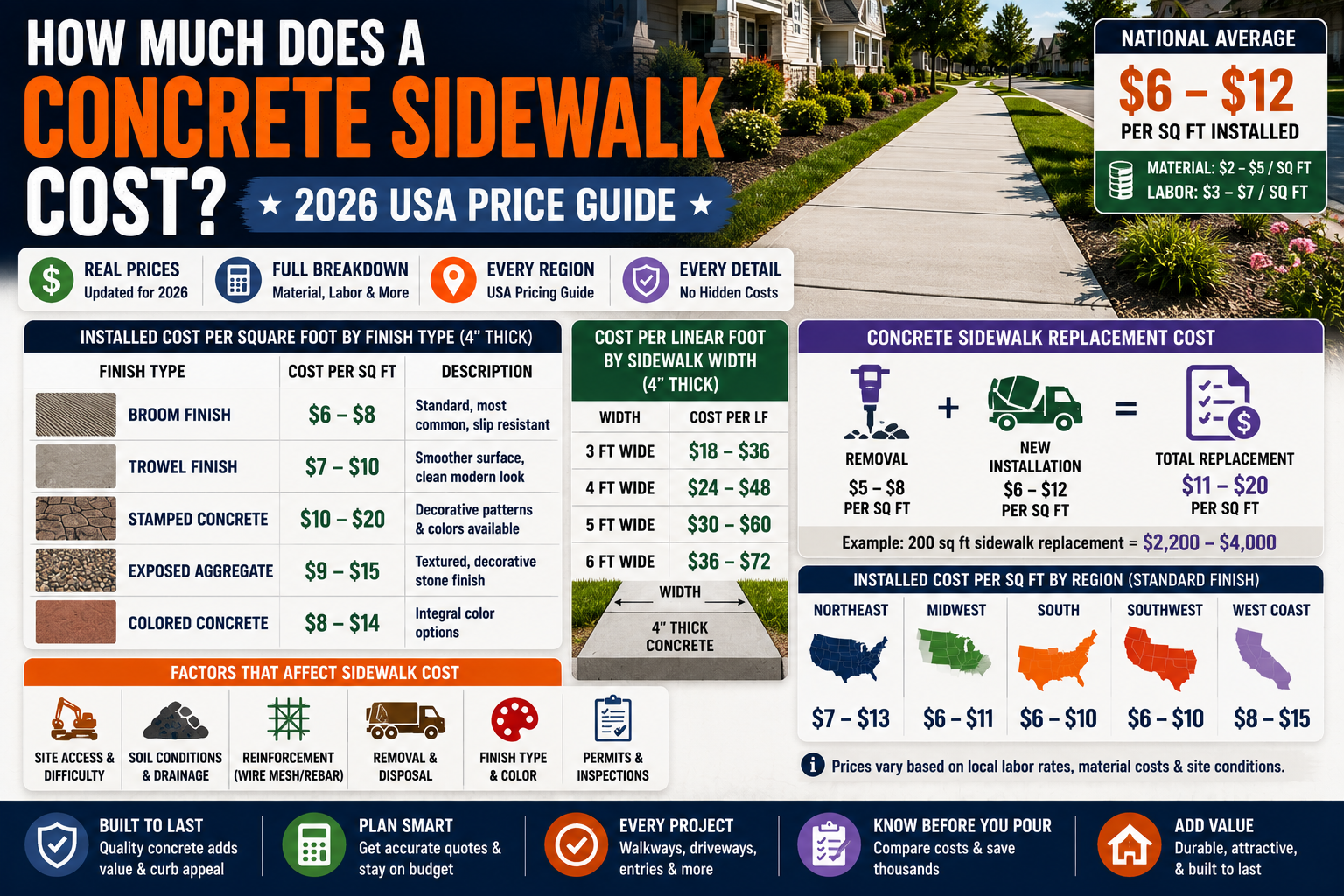
A concrete sidewalk costs $6 to $15 per square foot installed for a standard broom-finish path in 2026, according to data from Homewyse, Concrete Network, and contractor reports nationwide. On a typical 4-foot-wide, 50-foot-long sidewalk (200 sq ft), that works out to $1,200 to $3,000. Decorative finishes push costs higher. Removing an existing sidewalk adds $2 to $6 per square foot on top. This guide covers every cost factor – finish types, size-by-size pricing, regional differences, removal costs, and how to get an accurate bid from a contractor.
Average Concrete Sidewalk Cost in 2026
The national average cost to install a concrete sidewalk in 2026 is $8 to $12 per square foot for a plain broom-finish installation – the standard finish used on most residential sidewalks and front-entry walkways. Homewyse puts the installed cost at $12.00 to $14.71 per square foot as of May 2026 when factoring in contractor overhead and regional labor rates.
For a full project perspective: most homeowners spend between $1,600 and $4,500 on a new sidewalk or front walkway. Larger projects – long driveway-to-door paths, multi-section yard walkways, or commercial-adjacent sidewalks – run $5,000 to $8,000 or more. These are installed costs that include site prep, gravel base, concrete, reinforcement, labor, and basic finishing.
Every price in this guide covers the full installation – site prep, gravel base, vapor barrier, concrete, wire mesh or rebar, labor, forming, finishing, and cleanup. Permit fees, old sidewalk removal, tree root mitigation, and major grading are not included unless noted. Use the sidewalk calculator to get a volume and cost estimate for your specific dimensions before calling contractors.
Cost Per Square Foot and Per Linear Foot
The two most common ways contractors quote sidewalk work are per square foot and per linear foot. Per-square-foot pricing is the more transparent method – it tells you the cost regardless of width. Per-linear-foot pricing assumes a standard width (usually 4 feet), so it only makes sense to compare when both quotes assume the same width.
Concrete Sidewalk Cost Per Square Foot
Based on 2026 data from Concrete Network, Homewyse, and contractor reports across the US, here is how cost per square foot breaks down by finish level:
| Finish Type | Low ($/sq ft) | Average ($/sq ft) | High ($/sq ft) | Notes |
|---|---|---|---|---|
| Broom finish (plain) | $6.00 | $9.00 | $15.00 | Standard residential, non-slip texture |
| Exposed aggregate | $8.00 | $12.00 | $18.00 | Decorative, slip-resistant surface |
| Stamped concrete | $10.00 | $15.00 | $22.00 | Mimics stone, brick, or pavers |
| Colored concrete | $8.00 | $11.00 | $16.00 | Integral color or surface stain |
| Resurfacing (overlay) | $3.00 | $6.00 | $12.00 | Over existing sound concrete only |
Concrete Sidewalk Cost Per Linear Foot
A 4-foot-wide broom-finish sidewalk at $8 per square foot costs $32 per linear foot. At the high end of $15 per square foot, the same width comes to $60 per linear foot. The Concrete Network reports that most US homeowners pay $25 to $50 per linear foot for a standard 4-foot path, which aligns with the square-foot rates above.
In major cities, the linear foot cost climbs significantly. In New York, sidewalk installation runs $40-$90 per linear foot for a 4-foot-wide path due to high labor rates and permit complexity.
Concrete Sidewalk Cost by Size
Here are installed cost estimates for the most common residential sidewalk dimensions. These assume a standard broom-finish, 4-inch-thick slab with wire mesh reinforcement in moderate soil conditions.
| Sidewalk Size | Square Footage | Basic (Broom) | Mid-Range | Stamped |
|---|---|---|---|---|
| 4 ft x 25 ft | 100 sq ft | $600 – $1,500 | $1,100 – $1,800 | $1,500 – $2,200 |
| 4 ft x 50 ft | 200 sq ft | $1,200 – $3,000 | $2,000 – $3,600 | $2,800 – $4,400 |
| 4 ft x 100 ft | 400 sq ft | $2,400 – $6,000 | $4,000 – $7,200 | $5,600 – $8,800 |
| 5 ft x 50 ft | 250 sq ft | $1,500 – $3,750 | $2,500 – $4,500 | $3,500 – $5,500 |
| 5 ft x 100 ft | 500 sq ft | $3,000 – $7,500 | $5,000 – $9,000 | $7,000 – $11,000 |
| 6 ft x 50 ft | 300 sq ft | $1,800 – $4,500 | $3,000 – $5,400 | $4,200 – $6,600 |
Most concrete contractors have a minimum project charge of $800 to $1,500 regardless of size. Very small sidewalk sections – under 80-100 sq ft – may cost more per square foot than larger projects because mobilization, setup, and cleanup time is the same whether you pour 50 or 500 square feet. If your project is small, ask about bundling it with another pour such as a concrete patio or driveway apron to reduce the effective per-square-foot cost.
🔨 Calculate Your Sidewalk Cost Now
Enter your dimensions and get a concrete volume estimate plus cost breakdown in under 60 seconds.
Use Sidewalk Calculator →Cost by Finish Type
The finish you choose is one of the biggest cost drivers after square footage. Here is what each finish option actually involves and what it costs.
Broom Finish – $6 to $15 per sq ft
The standard finish for residential sidewalks. After the concrete is placed and screeded level, a stiff broom is dragged across the surface while it is still plastic. This creates fine parallel grooves that provide traction in wet conditions. It is the least expensive finish, the fastest to apply, and the most widely used across the US. Most public sidewalks and front walkways use a broom finish.
Exposed Aggregate – $8 to $18 per sq ft
In an exposed aggregate finish, the top layer of cement paste is washed or brushed away while the concrete is still green, revealing the coarse aggregate – crushed stone, pea gravel, or decorative rock – embedded in the mix. The result is a textured, slip-resistant surface that looks more refined than a plain broom finish. It costs $2 to $5 more per square foot than plain concrete and works especially well for pool decks and entry walkways where aesthetics matter.
Stamped Concrete – $10 to $22 per sq ft
Stamped concrete uses rubber or polyurethane stamps pressed into the wet concrete surface to create patterns that mimic brick, flagstone, cobblestone, slate, or wood. Color is added as an integral pigment or surface hardener. The Concrete Network reports a base range of $10 to $14 per square foot for single-pattern stamped concrete, with more complex multi-color designs reaching $20 per square foot and above.
Stamped concrete is the most expensive sidewalk finish but can dramatically improve curb appeal and home value. It costs significantly less than real stone or brick pavers. Read the full stamped concrete vs. pavers comparison to see when each makes sense.
Colored Concrete – $8 to $16 per sq ft
Color can be added to concrete in three ways: integral color mixed into the entire batch ($2-$5 per sq ft premium), surface-applied color hardener broadcast on wet concrete ($1-$3 premium), or acid staining applied after the concrete cures ($2-$5 per sq ft premium). Integral color is the most durable because the color runs all the way through the slab rather than sitting on the surface.
Concrete Resurfacing – $3 to $12 per sq ft
If your existing sidewalk is structurally sound but has a worn, stained, or cracked surface, resurfacing is significantly cheaper than full replacement. A thin polymer-modified concrete overlay is applied over the cleaned existing slab. Basic resurfacing starts at $3 to $7 per square foot. Stamped and colored overlays run $8 to $12 per square foot. This is only viable when the underlying slab has no structural damage – deep cracks, heaving, or settled sections mean full replacement is necessary. Use the concrete resurfacing calculator to estimate material needs.
Full Cost Breakdown – What You’re Paying For
A concrete sidewalk bid covers several distinct cost components. Understanding what each line item covers helps you evaluate bids intelligently and catch quotes that are missing important scope items.
💡 Full Cost Breakdown – 200 Sq Ft Sidewalk (4 ft x 50 ft), Broom Finish
Gravel base (4-inch compacted): $150 – $350
Forming (lumber and stakes): $100 – $250
Wire mesh or rebar: $120 – $300
Concrete (ready-mix, 3,000 PSI): $350 – $650
Labor – pour and finish: $500 – $900
Sealing (optional, first coat): $80 – $200
Permit (if required): $100 – $400
Total: $1,600 – $3,550
Concrete is typically the third or fourth largest cost item – labor and site prep often cost more than the concrete itself on smaller projects. Knowing your concrete volume ahead of time helps you verify contractor quantities. The concrete volume calculator gives you cubic yards for any slab dimensions so you can cross-check the numbers in any bid you receive.
Some contractors quote only the concrete and labor, leaving out the gravel base, forming materials, permit fees, and cleanup. A complete bid should explicitly include: excavation and grading, sub-base material, forming, reinforcement (mesh or rebar), concrete, finishing, permit, and site cleanup. If these items are not listed separately, ask the contractor to confirm they are included – or you may face change orders mid-project.
Old Sidewalk Removal Cost
If you are replacing an existing sidewalk rather than installing new, demo and removal adds to the total cost. Angi reports that sidewalk removal costs $900 to $2,500 for a typical residential project, or $2 to $6 per square foot including haul-away and disposal fees.
| Removal Scenario | Cost Per Sq Ft | 100 Sq Ft | 300 Sq Ft | Notes |
|---|---|---|---|---|
| Plain 4″ concrete (no rebar) | $2 – $4 | $200 – $400 | $600 – $1,200 | Standard older sidewalks |
| Reinforced 4″ concrete (wire mesh) | $3 – $5 | $300 – $500 | $900 – $1,500 | Wire mesh slows demolition |
| Reinforced (rebar) | $4 – $6 | $400 – $600 | $1,200 – $1,800 | Rebar must be cut and separated |
| Limited access (tight yard, gates) | $5 – $8 | $500 – $800 | $1,500 – $2,400 | Hand-breaking required |
Many concrete contractors will reduce the removal charge if they are also doing the new pour – they already have a crew and a dumpster on site. Always ask for a bundled price when combining removal and new installation. The concrete removal cost calculator gives you a quick estimate before you get bids.
Concrete Sidewalk Costs by Region and City
Regional labor rates, concrete delivery costs, and local permit requirements create significant price variation across the country. Here is a real-data breakdown from SlabCalc DOT bid records and Angi contractor data for 2026.
| City / Region | Cost Per Sq Ft | 200 Sq Ft Walkway | Notes |
|---|---|---|---|
| Houston, TX | $3.92 – $6.97 | $784 – $1,394 | Low labor costs, mild climate |
| Phoenix, AZ | $3.65 – $8.23 | $730 – $1,646 | No freeze-thaw, thin slabs common |
| Miami, FL | $5.02 – $8.37 | $1,004 – $1,674 | Moderate labor, stable soil |
| St. Louis, MO | $6.00 – $10.00 | $1,200 – $2,000 | Midwest average |
| Denver, CO | $6.36 – $11.42 | $1,272 – $2,284 | Higher elevation, freeze-thaw specs |
| Atlanta, GA | $8.10 – $15.84 | $1,620 – $3,168 | Growing market, higher demand |
| Los Angeles, CA | $8.00 – $15.00 | $1,600 – $3,000 | High labor rates, seismic requirements |
| Boston, MA | $9.00 – $17.00 | $1,800 – $3,400 | Freeze-thaw, high labor |
| New York, NY | $10.05 – $22.62 | $2,010 – $4,524 | Union labor, complex permitting |
State-specific concrete pricing is also available for your budget planning. See the Texas concrete cost calculator, California concrete cost calculator, Florida concrete cost calculator, and New York concrete cost calculator for localized figures.
Thickness, Specs, and Code Requirements
Getting the thickness right is critical for sidewalk longevity. Too thin and the slab cracks under load or frost heave. Too thick and you are paying for unnecessary concrete.
Standard Sidewalk Thickness
The ACI (American Concrete Institute) recommended minimum thickness for residential pedestrian sidewalks is 4 inches. This is also the standard adopted by most US municipal codes for public right-of-way sidewalks. At 4 inches, the slab handles pedestrian loads comfortably with proper sub-base preparation.
Sections where the sidewalk crosses a driveway – known as a driveway apron or curb cut – should be thickened to 6 inches to handle vehicle loads. This is a code requirement in most jurisdictions, not just a recommendation. Use the concrete thickness calculator to verify material quantities at different thicknesses.
Recommended Concrete Strength
The minimum recommended PSI for residential sidewalks is 3,000 PSI. In northern states with freeze-thaw cycles, 4,000 PSI is the right choice – ACI 318 requires 4,000 PSI for concrete exposed to freezing and thawing in a moist condition. The cost difference between 3,000 and 4,000 PSI ready-mix is typically $10 to $15 per cubic yard – a modest premium for significantly better freeze-thaw resistance.
💼 Real Example: Front Walkway in Columbus, Ohio
Project: 4 ft x 40 ft front entry walkway (160 sq ft), broom finish, replacing existing cracked sidewalk
Old concrete removal (160 sq ft, unreinforced): $420
Site prep and gravel base: $280
Forming materials: $130
Wire mesh reinforcement: $95
Ready-mix concrete (4,000 PSI, 2.2 yards): $440
Labor – pour and finish: $680
Permit: $150
Total: $2,195 – typical for this region and project size.
Control Joint Spacing
Control joints – the grooves cut or tooled into the surface – are critical for preventing random cracking. ACI 302.1R recommends joint spacing of 24 to 36 times the slab thickness. For a 4-inch slab, that means joints every 8 to 12 feet. Most contractors use 5-foot spacing on residential sidewalks as a conservative standard. Proper joint spacing is included in any complete sidewalk installation.
Permit Requirements for Concrete Sidewalks
Permit requirements vary by location and by whether the sidewalk is on private property or in the public right-of-way. Here is the general framework:
- Public right-of-way sidewalks – Almost always require a permit from the local municipality, public works department, or DOT. In New York City, a DOT sidewalk opening permit is mandatory before any work begins. Most cities require an application, plot plan, contractor details, and a permit fee ranging from $20 to a few hundred dollars.
- Private walkways on your own property – Requirements vary. Many municipalities only require a permit if the work affects drainage, exceeds a certain square footage, or connects to public right-of-way. Check with your local building department before starting.
- Driveway aprons and curb cuts – Almost always require DOT or municipal approval, even if the rest of the work does not, because they connect to the public street.
Permit costs for sidewalk work range from $50 to $500 depending on the municipality and project value. Your concrete contractor should pull the permit in most cases – if they ask you to pull it yourself, that is a red flag for an unlicensed operator.
How to Save on Your Sidewalk Project
Concrete sidewalk costs are driven by labor, concrete volume, and site conditions – but there are practical ways to keep your project within budget without cutting corners on quality.
Combine Work to Reduce Mobilization Costs
The biggest per-square-foot savings come from larger projects. If you need a sidewalk and a patio, or a sidewalk and a driveway, scheduling them together eliminates a second mobilization charge and makes more efficient use of a ready-mix truck load. A truck load minimum is typically 7-10 cubic yards – if your sidewalk only needs 2 yards, you are paying short-load surcharges. Combining pours uses the truck more efficiently.
Know Your Concrete Volume Before You Call Contractors
Calculate your concrete volume before getting bids. Use the concrete slab calculator to determine exactly how many cubic yards your sidewalk requires. When a contractor quotes you, you can cross-check their concrete quantity against your own calculation – over-ordering by even half a yard on small projects adds unnecessary cost. The ready-mix bags calculator is also useful if the project is small enough to consider bagged concrete as an alternative.
Time the Pour for Good Weather
Concrete poured in extreme heat requires retarders and accelerated finishing crews. Cold-weather pours need heated enclosures or insulating blankets. Both add cost. Scheduling your sidewalk pour during moderate temperatures – between 50°F and 85°F – avoids these premiums and produces better results. The best time to pour concrete guide covers seasonal considerations in detail.
Choose Broom Finish for Functional Paths
Stamped and exposed aggregate finishes are beautiful but add $4 to $10 per square foot over a plain broom finish. For a back yard path, side yard access, or utility walkway, a broom finish delivers the same structural performance at significantly lower cost. Save the decorative finishes for the front entry or the patio where visual impact is higher.
Seal on Schedule
A quality concrete sealer applied every 3-5 years dramatically extends the life of any sidewalk – especially in northern climates where freeze-thaw and road salt cause surface scaling. The concrete sealer calculator helps you estimate how much product you need for your square footage. The cost of regular sealing is far less than early replacement from preventable surface damage.
Concrete contractors are busiest from April through October. Scheduling your sidewalk project for late fall or winter – when contractors are slower – often gets you better pricing and more attention to detail. Many homeowners have reported saving 10-20% by scheduling work in November or February versus the peak spring rush. The concrete still cures fine in mild winter conditions with proper precautions.
🔧 Sidewalk and Concrete Calculators
- Concrete Sidewalk Calculator – Volume, bags, and cost for your exact dimensions
- Concrete Sidewalk Cost Calculator – Full installed cost estimate with labor
- Concrete Slab Calculator – For patios, floors, and any flat pour
- Concrete Walkway Calculator – Walkway-specific volume and cost tool
- Concrete Resurfacing Calculator – Cost to overlay existing concrete
- Concrete Sealer Calculator – How much sealer your sidewalk needs
- Concrete Rebar Calculator – Rebar quantities and cost for reinforced slabs
- Concrete Labor Cost Calculator – Estimate labor separately from materials
- Stamped Concrete Calculator – Materials and cost for stamped finishes
Frequently Asked Questions
✓ Key Takeaways
- Concrete sidewalks cost $6 to $15 per sq ft installed for a standard broom finish in 2026
- Stamped concrete runs $10 to $22 per sq ft – best for high-visibility front entries
- A typical 200 sq ft walkway costs $1,200 to $3,000; 400 sq ft runs $2,400 to $6,000
- Old sidewalk removal adds $2 to $6 per sq ft – bundle with new installation for the best price
- Standard thickness is 4 inches for pedestrians; 6 inches where vehicles cross
- Use 3,000 PSI concrete minimum; 4,000 PSI in any state with freeze-thaw cycles
- Prices vary significantly by region – Houston averages $3.92-$6.97/sq ft vs. $10-$22/sq ft in New York
- Permits are required for public right-of-way sidewalk work in nearly every US municipality
📑 Sources and References
- Homewyse – Cost to Install a Concrete Sidewalk (May 2026)
- Concrete Network – Walkway and Sidewalk Cost
- Angi – Concrete Walkway and Sidewalk Cost Guide 2026
- SlabCalc – Concrete Sidewalk Cost by City (State DOT Bid Records)
- HomeAdvisor – Concrete Sidewalk Cost Data
- Angi – Concrete Removal Cost 2026
- American Concrete Institute (ACI) – Concrete Standards and Guidelines
- NYC311 – Sidewalk Construction Permit Requirements