Socket Size Chart 2026: SAE, Metric, Drive Size & Conversion
Socket Size Chart
SAE, Metric, Drive Size & Conversion
SAE and metric socket openings, square drive size reference, SAE-to-metric conversion tables, 6-point versus 12-point geometry, and shallow versus deep and hand versus impact socket guidance under ASME B107.110 and ASME B107.17.
 Reviewed by Muhammad Ramzan Babar, PhD Researcher (Plasma Physics) & Calculator Developer, View Profile
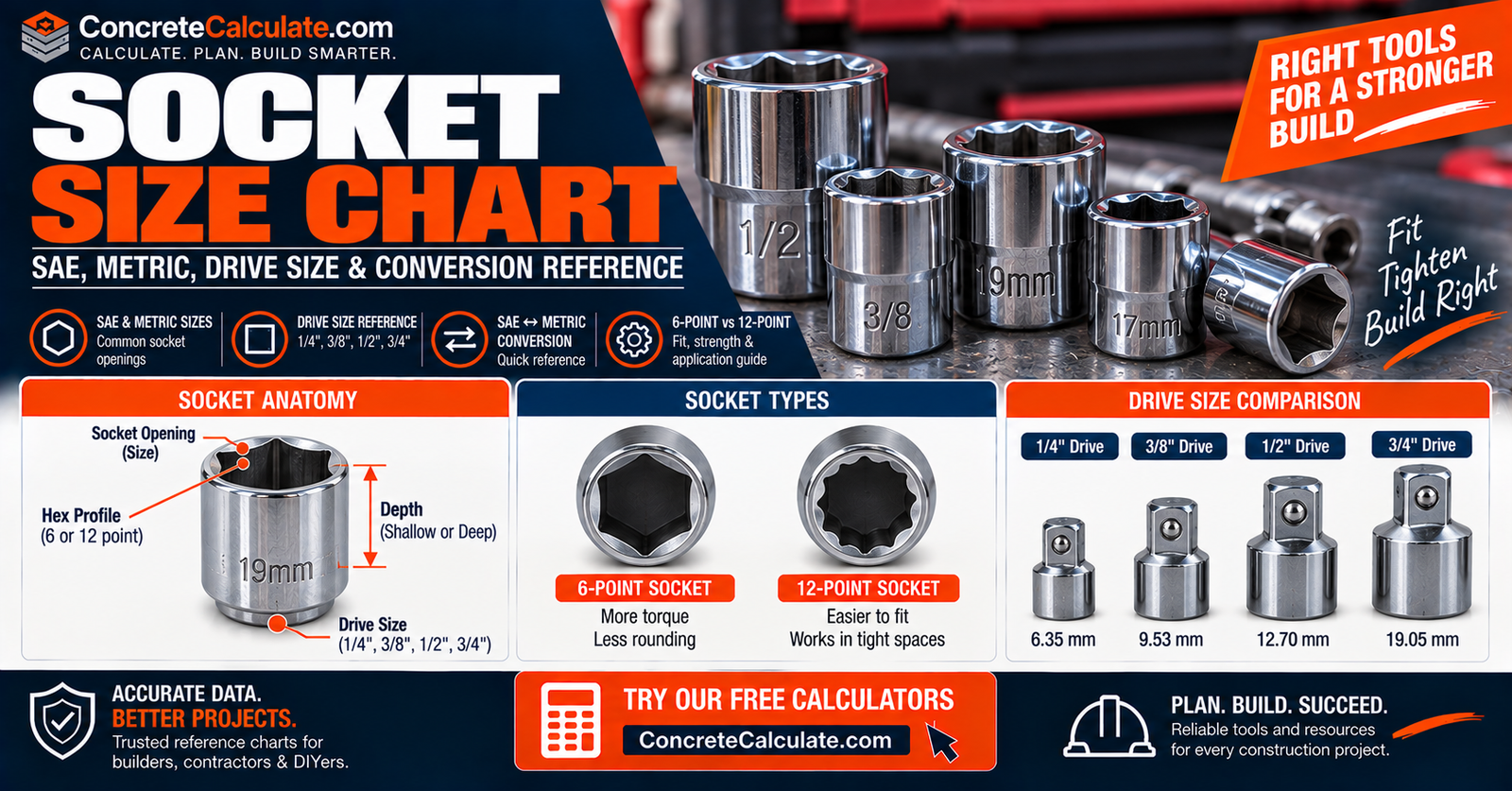
Socket size and drive size are two different dimensions
A 3/4-in. socket describes the opening that fits the fastener. A 3/8-in. drive socket describes the square connection to the ratchet. You can therefore have a 3/8-in.-drive by 3/4-in. socket. These two numbers are never the same measurement and should never be confused.
Socket Size Chart, Quick Reference
Drive availability shown is typical commercial availability, not a standard-mandated mapping.
SAE Socket Sizes
| SAE Socket Size | Decimal Inches | Millimeters | Common Drive Availability |
|---|---|---|---|
| 5/32 in. | 0.156 | 3.97 | 1/4 |
| 3/16 in. | 0.188 | 4.76 | 1/4 |
| 1/4 in. | 0.250 | 6.35 | 1/4 |
| 5/16 in. | 0.313 | 7.94 | 1/4, 3/8 |
| 3/8 in. | 0.375 | 9.53 | 1/4, 3/8, 1/2 |
| 7/16 in. | 0.438 | 11.11 | 1/4, 3/8, 1/2 |
| 1/2 in. | 0.500 | 12.70 | 1/4, 3/8, 1/2 |
| 9/16 in. | 0.563 | 14.29 | 1/4, 3/8, 1/2 |
| 5/8 in. | 0.625 | 15.88 | 3/8, 1/2 |
| 3/4 in. | 0.750 | 19.05 | 3/8, 1/2 |
| 7/8 in. | 0.875 | 22.23 | 3/8, 1/2 |
| 1 in. | 1.000 | 25.40 | 1/2 |
| 1-1/16 in. and larger | 1.063+ | 27.0+ | 1/2, 3/4, 1 |
GEARWRENCH’s current sets show 1/4-in. drive SAE sockets around 5/32 to 9/16 in. and 1/2-in. drive SAE sets around 3/8 to 1-1/2 in., demonstrating the overlap between drive families rather than fixed boundaries.
Metric Socket Sizes
| Metric Socket | Approx. Inches | Common Drive Availability |
|---|---|---|
| 4 mm | 0.157 | 1/4 |
| 6 mm | 0.236 | 1/4, 3/8 |
| 8 mm | 0.315 | 1/4, 3/8 |
| 10 mm | 0.394 | 1/4, 3/8, 1/2 |
| 12 mm | 0.472 | 1/4, 3/8, 1/2 |
| 14 mm | 0.551 | 1/4, 3/8, 1/2 |
| 16 mm | 0.630 | 3/8, 1/2 |
| 19 mm | 0.748 | 3/8, 1/2 |
| 20-24 mm | 0.787-0.945 | 3/8, 1/2 |
| 25 mm+ | 0.984+ | 1/2, larger |
GEARWRENCH currently sells 1/4-in.-drive metric sockets around 4 to 15 mm, while one current 1/2-in.-drive set extends to 36 mm. Commercial ranges vary by manufacturer and product line.
Socket Opening vs Drive Size
A 13 mm socket is the fastener opening. A 3/8-in. drive is the ratchet connection. They are not competing measurements, and a socket is always described by both numbers together.
What Is a Socket?
A removable wrenching tool that engages a fastener and connects to a drive tool.
A socket is a removable wrenching tool that fits over a fastener head or nut, engages its flats or points, and connects to a ratchet, breaker bar, torque wrench, impact wrench, or other drive tool. Main applications include construction, automotive repair, machinery, equipment maintenance, fabrication, and assembly.
Socket Size vs Drive Size
Probably the most important conceptual distinction on this page.
| Term | Definition | Examples |
|---|---|---|
| Socket Size | The opening across the fastener | 1/2 in., 3/4 in., 10 mm, 19 mm |
| Drive Size | The square interface at the rear of the socket | 1/4 in., 3/8 in., 1/2 in., 3/4 in., 1 in. |
A “1/2-in. drive by 19 mm socket” means a 1/2-in. ratchet interface paired with a 19 mm fastener opening. These two numbers describe entirely different parts of the same tool.
How Socket Sizes Are Measured
Sockets are identified by the nominal across-flats wrenching size they fit.
For ordinary hex fasteners, socket opening approximately equals the fastener’s width across flats, subject to standardized tool clearances and tolerances. ASME B107.17 establishes gages and mandrels for wrench-opening dimensions in common inch and metric sizes, providing the technical basis for how these openings are verified.
SAE Socket Size Chart
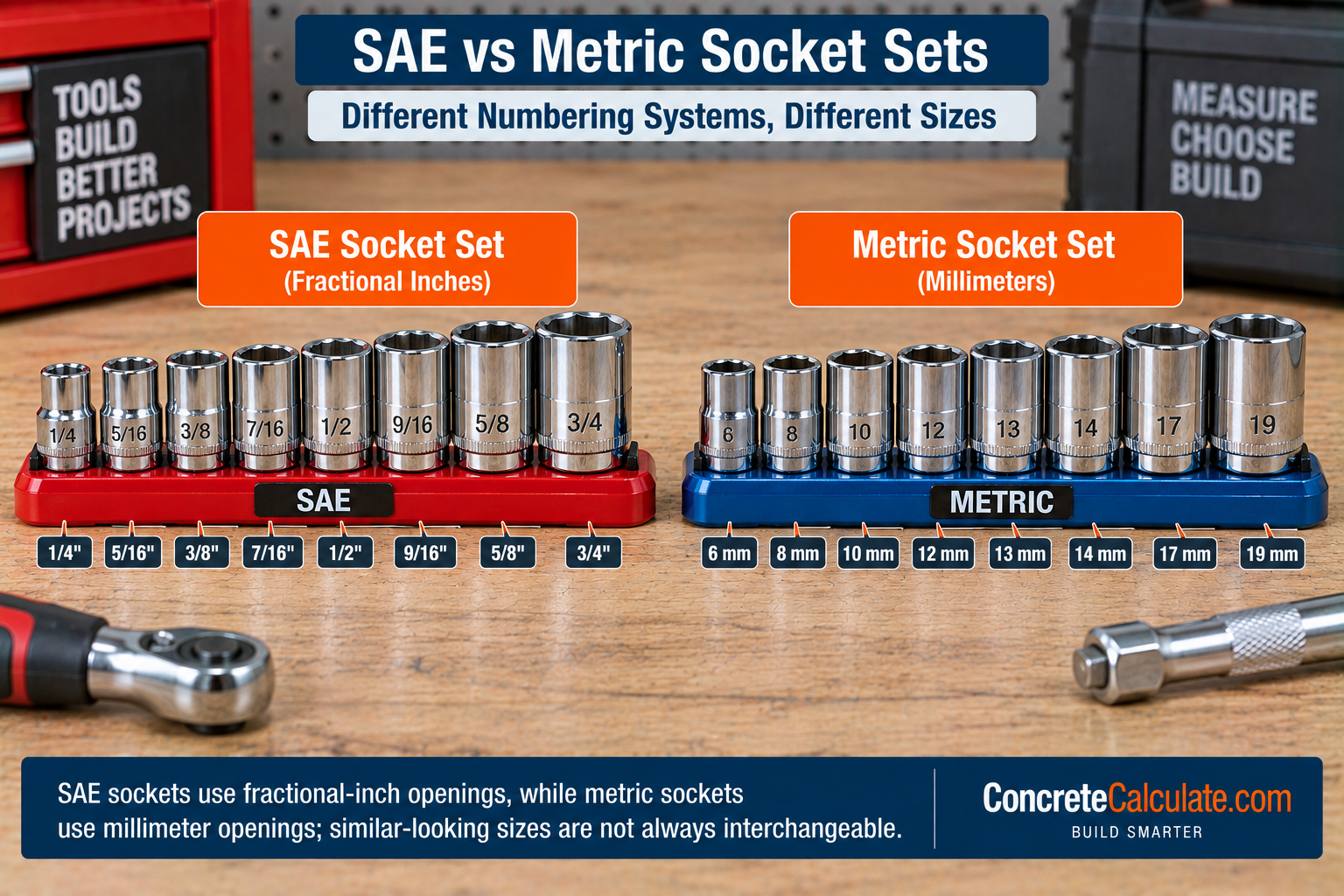
The complete inch-series lookup with exact decimal and millimeter conversions.
| SAE Socket | Decimal (in.) | Exact mm Conversion | Common Uses |
|---|---|---|---|
| 1/4 | 0.250 | 6.350 | Small fasteners, electronics enclosures |
| 5/16 | 0.313 | 7.938 | Light fixtures, small equipment |
| 3/8 | 0.375 | 9.525 | General hardware |
| 1/2 | 0.500 | 12.700 | General automotive and construction |
| 9/16 | 0.563 | 14.288 | Automotive fasteners |
| 5/8 | 0.625 | 15.875 | Structural hardware, spark plugs |
| 3/4 | 0.750 | 19.050 | Larger bolts, suspension components |
| 7/8 | 0.875 | 22.225 | Heavy hardware, equipment |
| 1 | 1.000 | 25.400 | Heavy equipment, structural bolts |
Conversions use the exact factor 1 in. = 25.4 mm. A converted metric dimension should not be treated as an automatic acceptable substitute for the correctly marked SAE socket.
Metric Socket Size Chart
The complete metric lookup with nearest common SAE comparison.
| Metric Socket | Inches Equivalent | Nearest Common SAE Size | Difference |
|---|---|---|---|
| 8 mm | 0.315 | 5/16 (0.313) | 0.062 mm |
| 10 mm | 0.394 | 3/8 (0.375) | 0.475 mm |
| 12 mm | 0.472 | 1/2 (0.500) | 0.700 mm |
| 13 mm | 0.512 | 1/2 (0.500) | 0.300 mm |
| 14 mm | 0.551 | 9/16 (0.563) | 0.287 mm |
| 16 mm | 0.630 | 5/8 (0.625) | 0.125 mm |
| 17 mm | 0.669 | 11/16 (0.688) | 0.462 mm |
| 19 mm | 0.748 | 3/4 (0.750) | 0.050 mm |
| 22 mm | 0.866 | 7/8 (0.875) | 0.225 mm |
| 24 mm | 0.945 | 15/16 (0.938) | 0.188 mm |
Nearest SAE size is a dimensional comparison, not a guaranteed safe substitute. This satisfies a major search intent while making the limitation clear.
SAE-to-Metric Socket Conversion Chart
A flagship table showing exactly how close, or how far apart, common pairs really are.
| SAE Size | Exact mm | Nearest Metric | Difference |
|---|---|---|---|
| 5/16 in. | 7.938 | 8 mm | 0.062 mm |
| 3/8 in. | 9.525 | 10 mm | 0.475 mm |
| 7/16 in. | 11.113 | 11 mm | 0.113 mm |
| 1/2 in. | 12.700 | 13 mm | 0.300 mm |
| 9/16 in. | 14.288 | 14 mm | 0.288 mm |
| 5/8 in. | 15.875 | 16 mm | 0.125 mm |
| 3/4 in. | 19.050 | 19 mm | 0.050 mm |
| 7/8 in. | 22.225 | 22 mm | 0.225 mm |
3/8 in. equals 9.525 mm, with a nearest common metric size of 10 mm, a difference of 0.475 mm. 3/4 in. equals 19.05 mm, with a nearest common metric size of 19 mm, a difference of only 0.05 mm. This shows why some SAE/metric pairs are much closer than others.
Metric-to-SAE Socket Conversion Chart
The reverse lookup, useful for U.S. users encountering metric hardware.
| Metric | Exact Inches | Nearest SAE | Difference |
|---|---|---|---|
| 8 mm | 0.3150 | 5/16 in. (0.3125) | 0.062 mm |
| 10 mm | 0.3937 | 3/8 in. (0.3750) | 0.475 mm |
| 11 mm | 0.4331 | 7/16 in. (0.4375) | 0.112 mm |
| 13 mm | 0.5118 | 1/2 in. (0.5000) | 0.300 mm |
| 14 mm | 0.5512 | 9/16 in. (0.5625) | 0.287 mm |
| 16 mm | 0.6299 | 5/8 in. (0.6250) | 0.125 mm |
| 19 mm | 0.7480 | 3/4 in. (0.7500) | 0.050 mm |
| 22 mm | 0.8661 | 7/8 in. (0.8750) | 0.225 mm |
Use this table for quick identification when working with metric hardware in the U.S., where SAE tools are also on hand.
Can SAE and Metric Sockets Be Interchanged?
Answer carefully. Sometimes very close, but substitution carries real risk.
Sometimes the dimensions are very close, but substitution can create excessive clearance, round the fastener, slip under high torque, or damage corroded fasteners. Use the correctly marked socket whenever possible; nearest-equivalent charts are for identification and reference, not automatic substitution. Especially avoid loose substitutions on high-torque bolts, damaged fasteners, impact tools, and precision assemblies.
1/4-Inch Drive Socket Size Chart
Typical current commercial coverage for the smallest common drive size.
| System | Typical Range |
|---|---|
| SAE | 5/32 to 9/16 in. |
| Metric | 4 to 15 mm |
GEARWRENCH’s current 1/4-in.-drive sets include approximately this SAE and metric range. This is a product-market range, not a mandatory ASME size boundary.
3/8-Inch Drive Socket Size Chart
Often the most versatile middle drive class.
3/8-in. drive commonly overlaps both the smaller 1/4-in. drive range and the larger 1/2-in. drive range, which is part of why it is often considered the most versatile general-purpose drive size. There is no one universal maximum socket opening for this drive size; exact coverage depends on the manufacturer and product line.
1/2-Inch Drive Socket Size Chart
The workhorse drive size for larger fasteners and higher torque.
| System | Typical Range |
|---|---|
| SAE | 3/8 to 1-1/2 in. |
| Metric | Up to approximately 36 mm depending on socket style/set |
Current GEARWRENCH examples fall in this approximate range. Typical applications include larger automotive fasteners, suspension work, structural or equipment hardware, and higher-torque assembly, but drive size does not map to a universal torque rating.
3/4-Inch and 1-Inch Drive Sockets
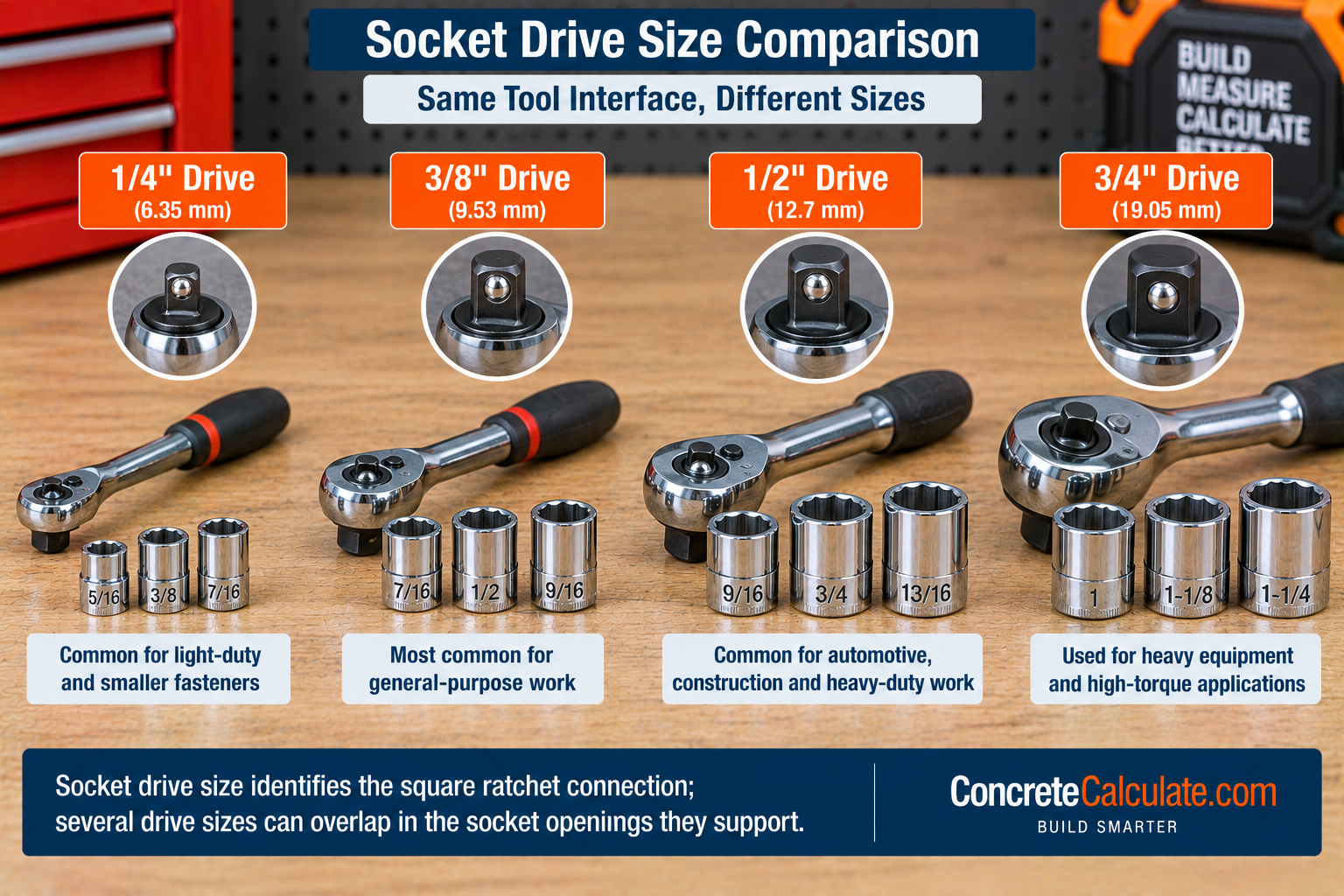
Heavy applications requiring heavier tool construction.
Typical contexts include heavy equipment, trucks, large structural fasteners, and industrial maintenance. Larger drives permit larger ratchets and breaker bars, larger sockets, and heavier overall tool construction, but actual permissible torque comes from the specific tool manufacturer’s rating, not merely from the square-drive dimension itself.
How to Choose the Correct Drive Size
General usage patterns, not engineering limits.
| Work Type | Common Drive Size |
|---|---|
| Small Fasteners | Often 1/4 in. |
| General Work | Often 3/8 in. |
| Higher Torque / Larger Fasteners | Often 1/2 in. |
| Heavy Equipment | 3/4 or 1 in. |
Selection depends on socket opening size, required torque, access, ratchet or tool dimensions, available drive tools, and whether the work is impact or hand-tool based.
6-Point vs 12-Point Sockets
A major section for tool selection.
| Feature | 6-Point | 12-Point |
|---|---|---|
| Geometry | Hex | Double hex |
| Fits hex fastener | Yes | Yes |
| Fits 12-point fastener | No | Yes |
| Engagement positions | 6 | 12 |
| High-torque hex use | Preferred generally | Less ideal |
| Tight access | Less indexing flexibility | More indexing flexibility |
A 6-point socket has six engagement points at 60-degree spacing. A 12-point socket is a double-hex design with points every 30 degrees. A 12-point socket fits an ordinary 6-point fastener, but for a 6-point fastener under substantial force, 6-point geometry generally provides better matching and contact with lower slip risk.
Socket Engagement and Fastener Round-Off
Why 6-point sockets reduce the tendency to round fasteners.
Modern sockets often use radiused or off-corner engagement. Manufacturer literature explains that six-point sockets apply force to the fastener’s flat sides rather than its more fragile corners, reducing the tendency to round the fastener, particularly under high torque or on stubborn, corroded hardware.
Shallow, Standard, Semi-Deep, and Deep Sockets
Product terminology varies between manufacturers.
| Type | Overall Length | Stud Clearance | Access |
|---|---|---|---|
| Stubby | Shortest | Low | Excellent |
| Shallow | Short | Moderate | Very good |
| Mid/Semi-deep | Medium | Good | Balanced |
| Deep | Long | Highest | Reduced tight-space access |
A shallow socket has a shorter overall length, works well where clearance is limited, and fits ordinary bolt heads or nuts without long protruding studs. Manufacturers currently offer families in shallow, semi-deep, and deep forms, alongside standard, mid-length, and low-profile variants, but exact lengths are product-specific rather than fixed by one universal dimension.
Deep Socket Size Chart
Deep sockets provide clearance for long bolts, threaded studs, and recessed nuts.
| Drive | Common SAE Range | Common Metric Range |
|---|---|---|
| 1/4 in. | 3/16 to 1/2 in. | 5 to 13 mm |
| 3/8 in. | 5/16 to 3/4 in. | 8 to 19 mm |
| 1/2 in. | 3/8 to 1-1/4 in. | 10 to 32 mm |
A deep socket has a full-length internal well providing clearance over long threaded studs. Do not assume all manufacturers use identical deep-socket lengths; these ranges are representative examples, not a fixed industry standard.
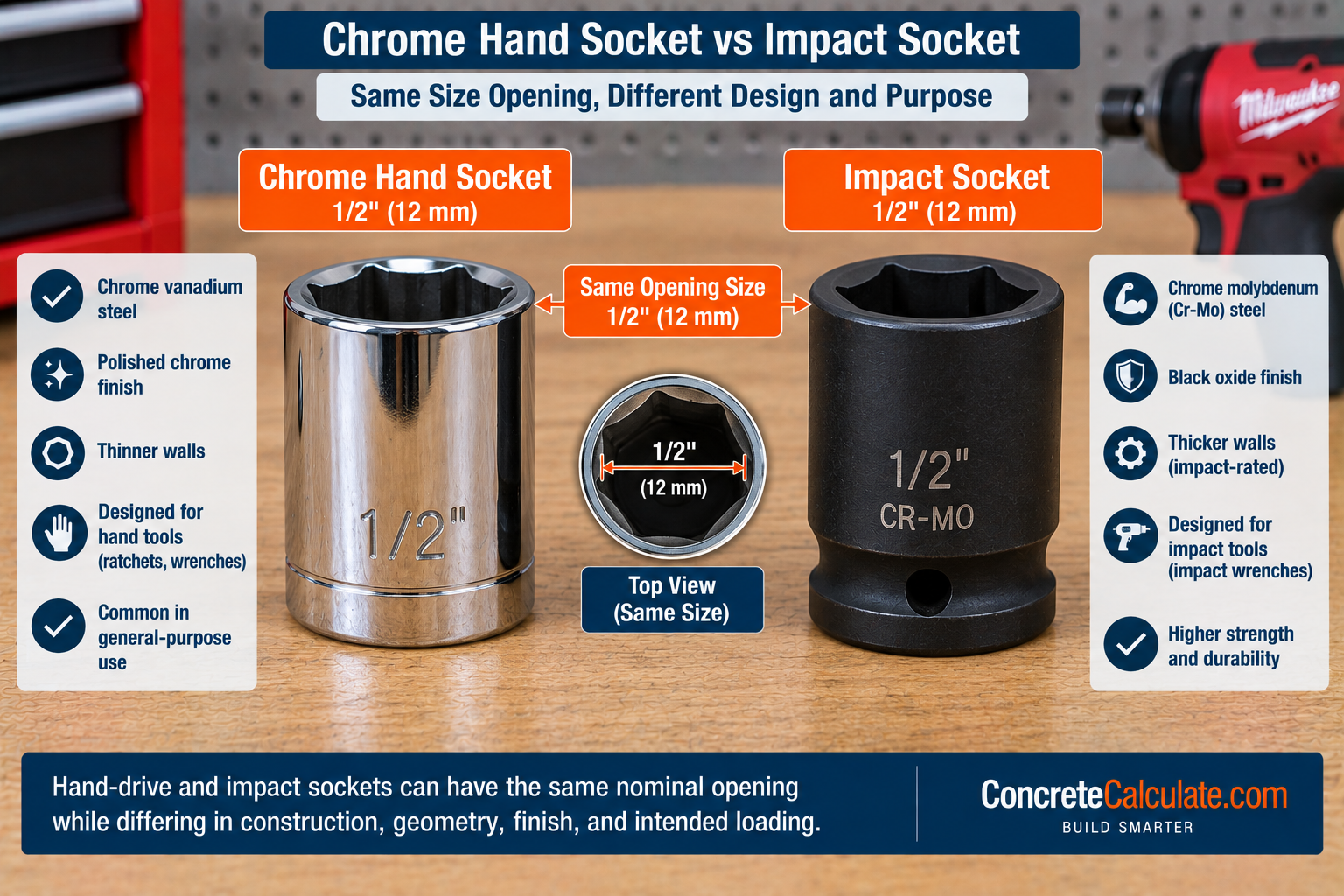
Hand Sockets vs Impact Sockets
A critical safety section.
| Type | Intended Use |
|---|---|
| Hand / Chrome Socket | Manual ratchets, torque wrenches, breaker bars |
| Impact Socket | Impact-wrench loading |
ASME B107.110 provides performance and safety requirements for socket wrenches and related components. Ordinary chrome hand sockets should not be used on impact guns, since they are not designed for the sudden rotational shock loading that impact tools generate.
Impact Socket Size Chart
Impact availability often differs from standard hand-socket ranges.
| Drive Size | SAE Opening Range | Metric Opening Range | Standard/Deep |
|---|---|---|---|
| 3/8 in. | 5/16 to 3/4 in. | 8 to 19 mm | Both available |
| 1/2 in. | 3/8 to 1-1/4 in. | 10 to 32 mm | Both available |
Manufacturer product families currently sell impact sockets in shallow, semi-deep, deep, 6-point, and 12-point configurations, so use manufacturer-supported ranges as examples rather than an absolute limit.
Chrome vs Impact Socket Construction
Practical construction differences beyond just the finish color.
Chrome hand sockets often use smooth chrome-plated exteriors for corrosion resistance. Impact sockets may use Cr-V, Cr-Mo, Ni-Cr-Mo, or phosphate-finished alloy steels depending on the manufacturer and design; not every impact socket is necessarily Cr-Mo, so the specific product’s material and finish should be confirmed rather than assumed.
Socket Size vs Nut and Bolt Head Size
A crucial connection to fastener sizing.
A socket fits the head or nut’s across-flats dimension, not the nominal bolt shank diameter. A 3/4-in. bolt, for example, has a standard hex head across flats of 1-1/8 in., which is the socket size actually needed, not 3/4 in. For the complete bolt dimensional reference, see the Hex Bolt Size Chart.
Standard Hex vs Heavy-Hex Socket Sizes
Essential coverage for a construction audience working with structural bolts.
A standard hex bolt and a heavy-hex structural bolt with the same nominal bolt diameter can use different socket sizes because their heads have different widths across flats. This distinction matters directly for readers working with ordinary hex bolts, structural heavy-hex bolts, and anchor systems. For head-width data across both types, see the Hex Bolt Size Chart, for strength and grade markings see the Bolt Grade Chart, and for anchor-specific dimensions see the Anchor Bolt Size Chart.
Socket Size vs Wrench Size
For a properly standardized fastener, these match.
For the same properly standardized external hex fastener, the nominal socket opening and wrench opening are generally the same across-flats size. A 19-mm hex head uses both a 19-mm wrench and a 19-mm socket. However, socket and wrench body geometry and clearance differ, since a socket surrounds the fastener while a wrench engages from the side, which affects access in different situations.
Socket Wall Thickness and Outside Diameter
Important for access in tight spaces.
Two sockets with the same opening can have different wall thickness, outside diameter, and overall length. This matters in recessed bolt holes, tight engine bays, equipment, and fasteners close to walls or other obstructions. This page does not publish one universal outside diameter by socket opening, since that dimension is tied to a specific product line rather than a single across-the-board standard.
Extensions, Adapters, Reducers, and Swivel Sockets
Common tool accessories that change reach, drive size, or access angle.
| Accessory | Function |
|---|---|
| Extension | Changes reach |
| Adapter | Allows drive-size transition, such as 1/4 drive to 3/8 socket |
| Reducer | Allows a larger drive tool to connect to a smaller-drive socket |
An adapter does not give the smaller socket or tool the strength capacity of the larger drive; the weakest link in the chain still governs overall capacity. Universal-joint and swivel impact sockets provide angled access for hard-to-reach fasteners, with detailed joint-angle specifications varying by product.
Spark Plug Socket Sizes
A strong, distinct practical search intent.
Spark plug sockets have specific depths, retention features, and specialized openings distinct from ordinary deep sockets. Possible common openings include 5/8 in. and 13/16 in., along with metric and specialty thin-wall sizes depending on plug design. Do not assume two sizes cover every spark plug; the exact socket needed should be confirmed against the specific plug. ASME’s socket-wrench standard consolidated multiple earlier socket standards, including prior spark-plug socket requirements, into the current combined ASME B107.110 standard.
ASME B107.110 Socket Wrench Standard
The current authority for socket wrench performance and safety.
Current ASME B107.110-2019 establishes performance and safety requirements for sockets, wrench handles, nutdrivers, and related attachments, and it consolidated several earlier B107 standards into one combined document. Standardized dimensions do not imply every listed size must be stocked by every manufacturer; ASME explicitly notes that users should consult manufacturers for actual stock production sizes and lengths.
ASME B107.17 Wrench-Opening Gages
Adds technical credibility without overloading the article.
Current ASME B107.17-2020 (R2025) establishes final-inspection gage sizes and test-mandrel sizes for common inch, metric, and spark-plug wrench openings, providing the dimensional verification framework behind the socket sizes referenced throughout this page.
Socket Proof Torque and Tool Strength
An important distinction: opening size alone does not establish torque capacity.
Socket opening size does not establish one universal torque capacity. Capacity depends on drive size, opening size, socket geometry, point count, alloy and heat treatment, and hand versus impact design. Manufacturer literature indicates current hand sockets are proof-tested relative to ASME B107.110 requirements, with some product families rated above the minimum standard proof torque. This page does not publish a generic “3/8 drive equals X ft-lb maximum” table unless tied to an exact tool standard or product, since doing so would misrepresent capacity that is actually product-specific.
How to Choose the Correct Socket
The page’s decision section.
Socket Selection Workflow
Specialty Socket Types
Kept brief since the main chart remains focused on hex SAE/metric sockets.
Possible specialty forms include square fasteners, 8-point, external Torx and E-Torx, spline, and other specialty automotive or industrial forms. These require matching specialty sockets rather than an ordinary hex socket, and should not be confused with standard hex openings covered on this page.
Common Mistakes and Chart Limitations
Confusing socket opening with drive size
These are two separate dimensions on the same tool.
Calling a socket by drive size alone
A “1/2-in. drive socket” needs its opening size specified too.
Using a metric socket on SAE hardware because it seems close
Even close pairs are not exact matches under load.
Using nearest-conversion charts as exact interchangeability charts
These charts are for identification, not automatic substitution.
Selecting socket from bolt shank diameter instead of head width
Socket size matches the head across-flats dimension, not the shank.
Assuming a 3/4-in. bolt takes a 3/4-in. socket
A standard 3/4-in. bolt uses a 1-1/8-in. socket.
Confusing standard hex and heavy hex
The two use different head widths at the same nominal diameter.
Using 6-point socket on a true 12-point fastener
A 6-point socket will not properly engage a 12-point head.
Using shallow socket where a stud blocks engagement
A deep socket is needed for clearance over long protruding studs.
Using chrome hand socket on an impact wrench
Hand sockets are not rated for impact-wrench shock loading.
Assuming every drive size has one universal socket range
Commercial ranges vary by manufacturer and overlap between drive families.
Ignoring socket outside diameter in recessed holes
Two sockets with the same opening can have different outside dimensions.
Assuming an adapter increases strength
The weakest component in the drive chain still governs capacity.
Confusing Torx/E-Torx with hex sockets
These are different fastener drive systems requiring different sockets.
Confusing spark-plug sockets with ordinary deep sockets
Spark plug sockets have specific retention features and depths.
Read before finalizing a socket selection
Socket opening size and square-drive size are separate. Commercial size ranges vary by manufacturer, and SAE-to-metric equivalents are dimensional comparisons, not guaranteed substitutions. 6-point and 12-point tools serve different engagement needs, and deep/shallow dimensions vary among manufacturers, as does socket outside diameter. Impact and hand sockets have different intended service, and drive size does not define a universal torque rating. Bolt nominal diameter does not equal socket opening, and heavy-hex heads require different openings from standard hex heads. Specialty fasteners require matching specialty sockets. Follow manufacturer and applicable torque requirements for high-load connections.
Socket Size FAQs
Download the Socket Size Chart
Get a printable reference including SAE, metric, conversion, and drive-size tables on this page for jobsite or shop use.
![Rebar Size Chart - Complete #3 to No. 20 [64] Diameter, Area & Grade Reference](https://concretecalculate.com/wp-content/uploads/2026/07/Rebar-Size-Chart-2026-Complete-3-to-No.-20-64-Diameter-Area-Grade-Reference-390x220.png)