Concrete vs Cement: Differences, Uses and Which Material You Need
Concrete vs. Cement: Differences, Uses and Which Material You Need
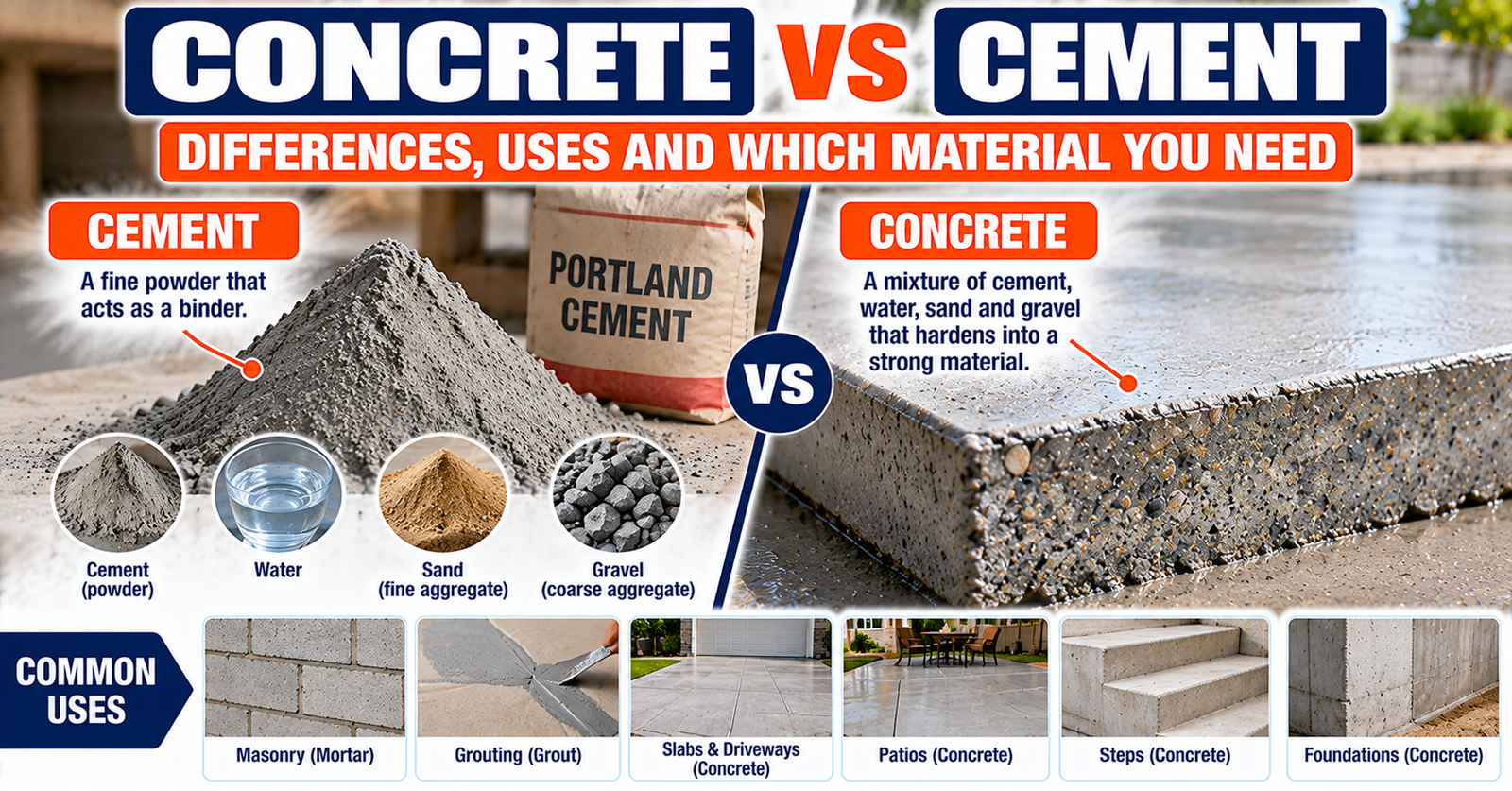
Cement is the binder and concrete is the finished material. Learn what each is made of, where mortar and grout fit, and which one to use for slabs, masonry and repairs.
What Is the Difference Between Concrete and Cement?
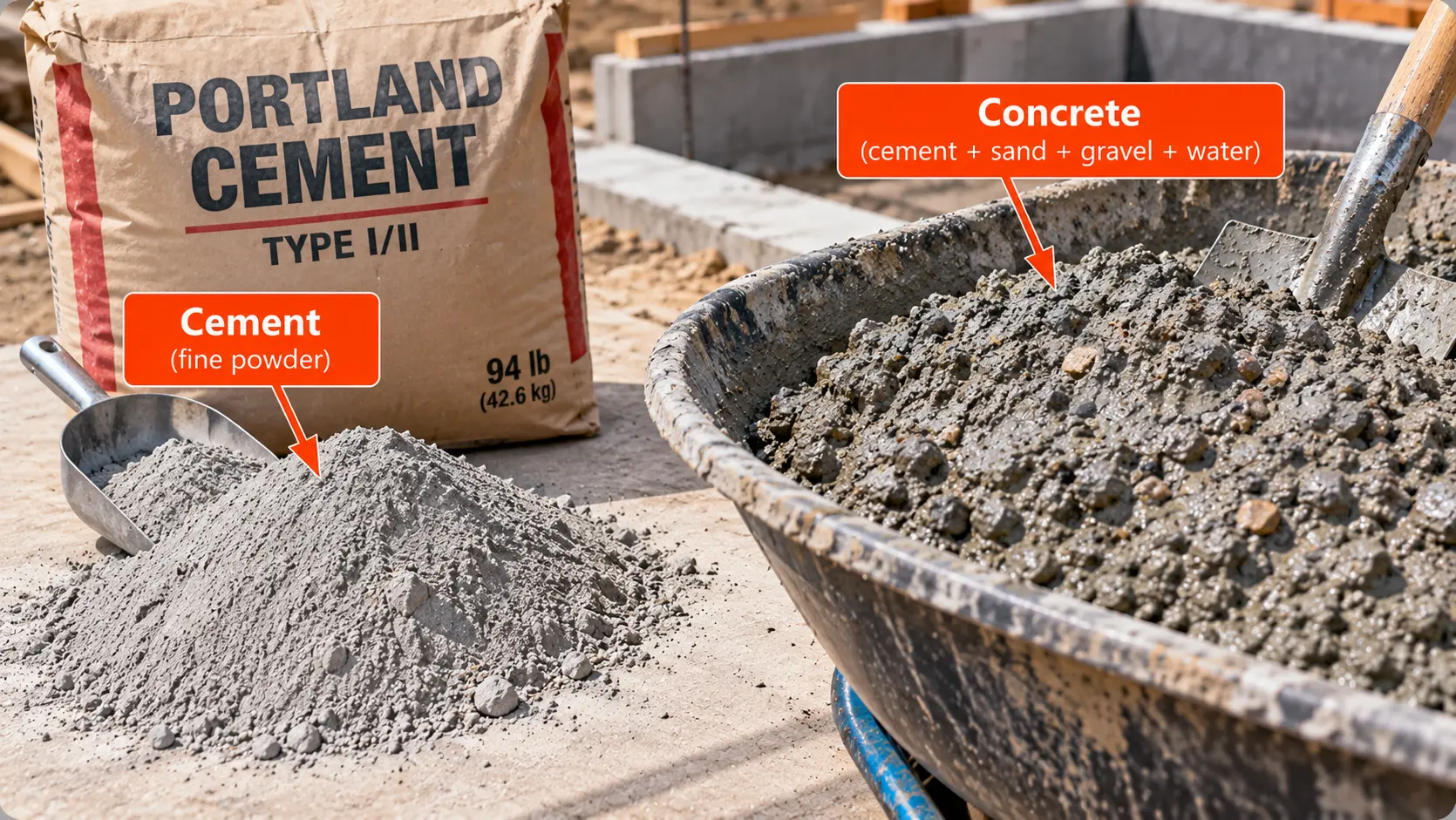
Cement is an ingredient. Concrete is the finished composite material. The American Cement Association says cement typically makes up 10 to 15 percent of a concrete mix by volume, with the rest mostly water and aggregates such as sand, gravel, or crushed stone.
That percentage is context, not a recipe. ACI defines concrete as a composite of hydraulic cement, aggregates, and water, with or without admixtures, fibers, or other cementitious materials.
| Feature | Cement | Concrete |
|---|---|---|
| What it is | Binder ingredient | Composite construction material |
| Physical form before use | Fine powder | Plastic/fresh mixture |
| Main components | Hydraulic cement constituents | Cementitious materials + water + aggregates + optional admixtures |
| Coarse aggregate | No | Usually yes |
| Common use | Ingredient in concrete/mortar/grout | Slabs, foundations, pavements, walls |
| Sold as | Bags or bulk | Bagged mix or ready-mix |
| Hardening | Hydration | Hydration of cementitious paste |
| Structural use by itself | Limited/specialized | Extensive |
Is Cement the Same Thing as Concrete?
No. Flour is an ingredient in bread, and cement is an ingredient in concrete. Nobody builds a driveway from flour, and nobody builds one from cement alone.
The finished, hardened material in a sidewalk or slab is concrete. Cement is the binder that holds it together.
Cement is one ingredient in concrete; when cementitious paste binds sand and coarse aggregate, the mixture hardens into concrete.
Why Do People Call Concrete “Cement”?
Everyday language blurs the two words, and that is fine. People say “cement truck,” “cement sidewalk,” and “cement driveway” all the time.
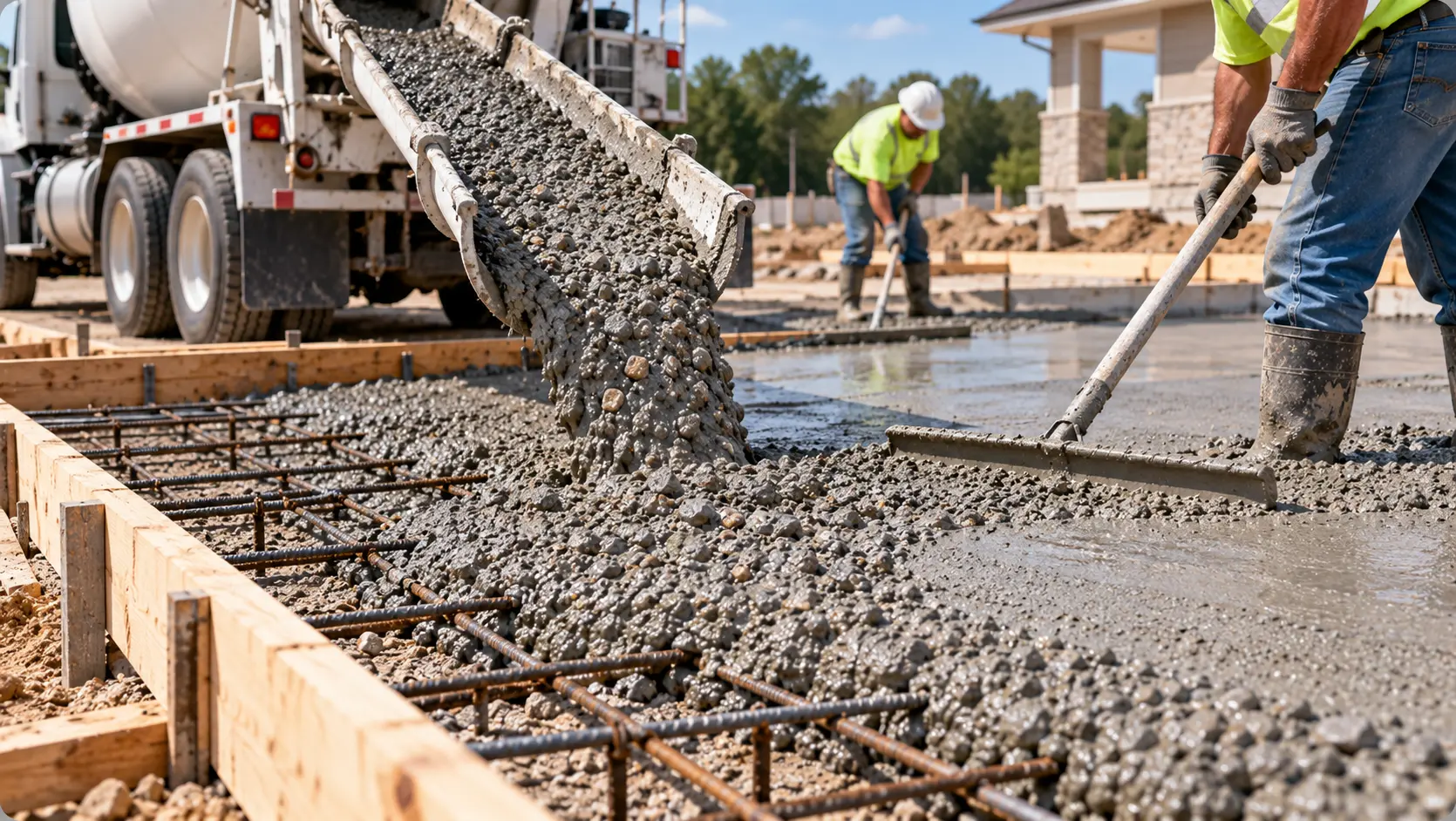
The truck usually carries ready-mixed concrete, and the driveway or slab is concrete. Cement is one key ingredient inside it. You will be understood either way, but ordering the right product matters.
Concrete vs. Cement at a Glance
At a glance, cement is a fine powder you add other things to, while concrete is the finished, aggregate-filled material you pour, place, and finish.
- Form: powder versus a plastic mixture that hardens.
- Ingredients: cement alone versus cement, water, and aggregates.
- Role: binder versus structural material.
- Delivery: bags or bulk versus bagged mix, site-mixed, ready-mixed, or precast.
What Is Cement?
ACI defines cement as any of a number of materials capable of binding aggregate particles together. The cement used in most construction is hydraulic cement.
Hydraulic cement sets and hardens by chemical reaction with water and can do so under water. That reaction is what separates it from a simple glue or a dry powder.
What Is Portland Cement?
Portland cement is the most familiar hydraulic cement. It starts as clinker that is ground with gypsum and other allowed constituents.
In the U.S., ASTM C150 covers portland cement. Its basic types are Type I for general use, Type II for moderate sulfate exposure, Type III for high early strength, and Type V for severe sulfate exposure. Type I/II has been the most widely available in recent years.
What Is Portland-Limestone Cement?
Portland-limestone cement (PLC) is a blended cement under ASTM C595, designated Type IL. It contains about 5 to 15 percent limestone and is designed for the same general uses as conventional portland cement.
NRMCA notes that portland cement can contain up to 5 percent limestone, while PLC can contain between 5 and 15 percent. PLC can be made to perform generally the same as portland cement from the same source.
What Is Blended Cement?
Blended hydraulic cements follow ASTM C595. They combine portland cement with other fine materials, such as limestone, slag cement, or pozzolans like fly ash and silica fume.
Common types include IL for portland-limestone, IP for portland-pozzolan, IS for slag, and IT for ternary blends. ASTM C1157 is a separate performance specification for hydraulic cements.
How Is Cement Made?
Cement is made in a sequence, summarized by the American Cement Association:
- Raw materials such as limestone, clay, shale, and sand are quarried, crushed, and blended.
- The mix is preheated and then fired in a kiln at about 2,700 degrees Fahrenheit, where it becomes partially molten.
- The result is clinker, gray balls about the size of marbles.
- The clinker is cooled and ground with gypsum and other ingredients into a fine powder.
The ground cement is extremely fine, around 150 billion grains per pound. The kiln stage is why cement is not simply crushed limestone.
What Happens When Cement Is Mixed With Water?
When cement meets water, a chemical reaction called hydration begins. The reaction forms products that bind the aggregate particles into a rock-like mass.
Concrete does not harden because water evaporates. It hardens because cement reacts with water, and the American Cement Association notes concrete continues to gain strength over time, with most strength developing in the first few weeks.
Cement is manufactured first, then combined with water and aggregate to produce concrete.
What Is Concrete Made Of?
Concrete combines a few main ingredients. Modern mixtures can add more, but these are the core.
| Ingredient | Main function |
|---|---|
| Cementitious binder | Binds aggregate |
| Water | Hydration + workability |
| Fine aggregate | Fills space, contributes bulk/stability |
| Coarse aggregate | Major structural skeleton/bulk |
| SCMs | Modify performance and cementitious system |
| Chemical admixtures | Adjust workability, set, air, durability, etc. |
| Air | Entrapped or intentionally entrained |
What Does Cement Do Inside Concrete?
Inside concrete, cement mixes with water to form a paste. The paste coats the aggregate and binds it into a hardened mass.
People call cement “glue,” and it helps as a picture. But cement paste is not literally an adhesive, because it works by hydrating and forming hard products that lock the particles together.
What Do Sand and Gravel Do in Concrete?
Sand and gravel make up most of concrete’s volume. They give dimensional stability, affect workability, and influence strength and durability.
They also reduce the amount of paste needed. Using aggregate is a big reason concrete is practical and economical compared with pure cement paste.
Why Is Water Important in Concrete?
Water plays two jobs. It hydrates the cement, and it makes the mixture workable enough to place and finish.
Adding more water than the mixture was designed for can reduce performance. The American Cement Association notes that, all else equal, a lower water content gives stronger concrete.
What Are Admixtures and SCMs?
Admixtures and supplementary cementitious materials (SCMs) fine-tune a mix. Common categories include:
- Water reducers.
- Air-entraining admixtures.
- Retarders.
- Accelerators.
- Fly ash.
- Slag cement.
- Silica fume.
SCMs are cementitious materials, not coarse or fine aggregate, as ACI classifies them. The American Cement Association notes that SCMs can slow early strength gain, so some specifiers use 56-day or 90-day strengths.
Cement vs. Concrete: Ingredients Compared
Cement is one component, and concrete is the composite. The table shows how they differ in practice.
| Property | Cement | Concrete |
|---|---|---|
| Typical purchase unit | lb/bag or bulk tonnage | yd³, ft³, bag |
| Project volume material | No | Yes |
| Aggregate included | No | Yes |
| Structural strength usually specified directly | Rarely as project structural element | Yes |
| Can be ready mixed | Not as finished concrete | Yes |
| Requires aggregate to make normal concrete | Yes | Already contains it |
Cement vs. Concrete: Strength
“Strength of cement” and “strength of concrete” are different measurements, and they are not interchangeable. Structural projects specify concrete compressive strength, usually in psi. See the Concrete PSI Chart.
The American Cement Association explains that 3,000 psi concrete means a compressive strength of 3,000 pounds per square inch at the 28-day mark, unless another age is specified.
Cement vs. Concrete: Cost
Cement is a manufactured binder. Concrete includes cement plus aggregate, water, batching, delivery, and possibly admixtures and labor.
Prices vary by supplier and location, so this guide gives none. See Concrete Cost Per Yard for how to think about cost.
Cement vs. Concrete: Weight
Cement is usually sold by weight. Concrete is commonly estimated by volume in cubic feet or cubic yards, and sometimes by weight. The Concrete Cubic Yard Calculator and Concrete Yardage Calculator help with volume.
There is no single unit weight for every concrete mixture, since weight depends on aggregate and mix.
Cement vs. Concrete: How They Are Sold
Cement and concrete reach you in different forms:
- Cement: bags or bulk powder.
- Concrete: bagged premix, site-mixed from ingredients, ready-mixed by truck, or precast products.
For large pours, ready-mix is common. Read How to Read a Ready Mix Concrete Delivery Ticket when it arrives, and see the Concrete Bag Yield Chart for bagged mixes.
Cement vs. Mortar
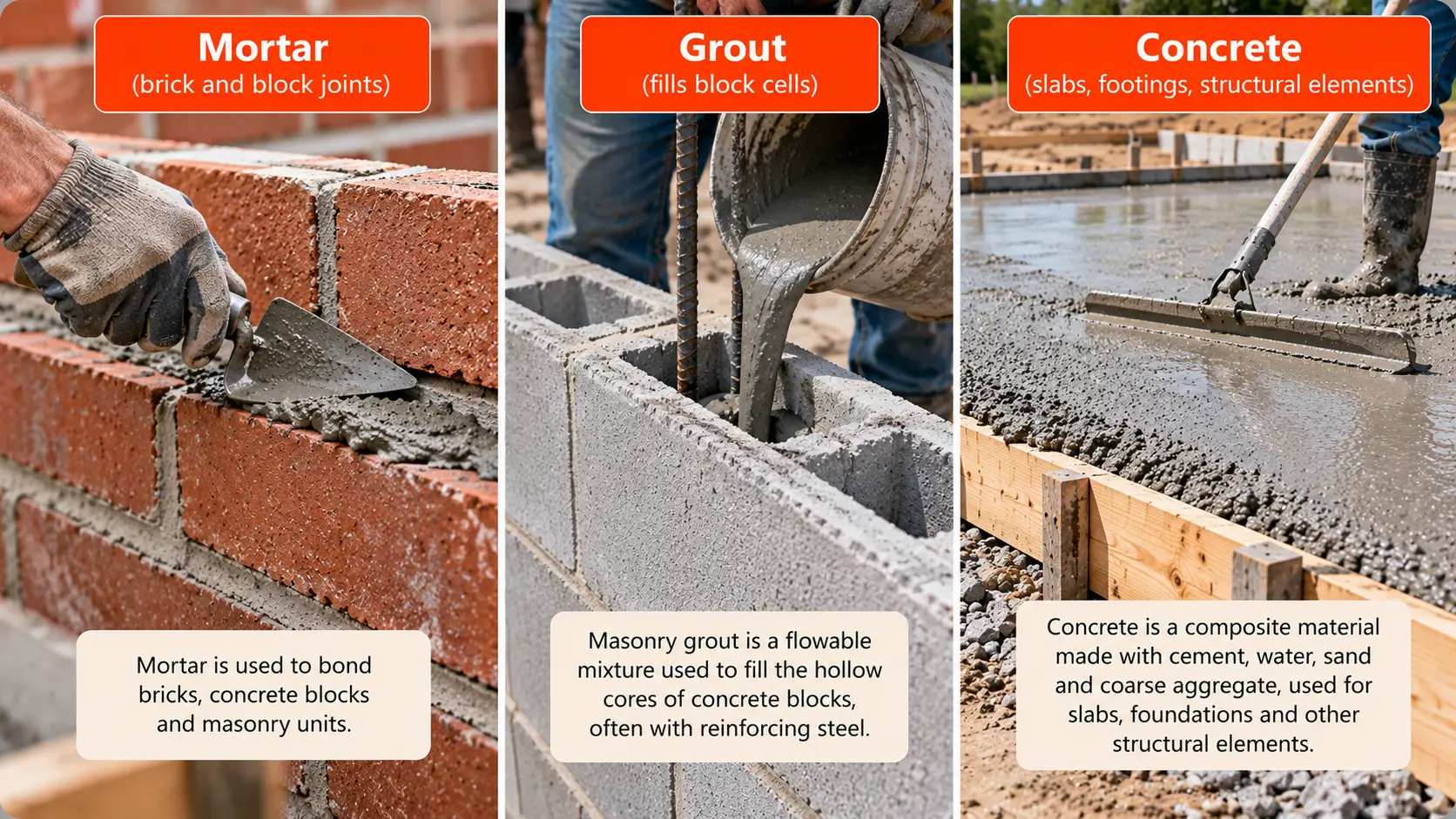
ACI defines mortar as a mixture of cement paste and fine aggregate. Masonry mortar is designed for joints between units, not for large structural slabs.
It bonds brick and block together. For types and proportions, use the Mortar Mix Ratio Chart.
Cement vs. Grout
ACI defines grout as a mixture of cementitious materials and water or another binding medium, with fine aggregate. It is a fill material and not a synonym for cement paste.
- Masonry cells.
- Base plates.
- Anchors.
Tile grout is a different product family. Do not confuse it with masonry grout.
Mortar vs. Concrete
Mortar bonds masonry units. Concrete is cast as its own structural element.
The two share cement and sand, but concrete adds coarse aggregate. The Mortar Mix Ratio Chart goes deeper, and the Concrete Mix Ratio Chart covers concrete proportions.
Cement vs. Concrete vs. Mortar vs. Grout
This table puts the four terms side by side. It is the quickest way to stop mixing them up.
| Material | Binder | Aggregate | Main job |
|---|---|---|---|
| Cement | Hydraulic binder itself | None | Ingredient |
| Mortar | Cementitious binder | Fine aggregate | Bonds masonry units |
| Masonry grout | Cementitious binder | Fine or fine + coarse aggregate | Fills reinforced cells/cavities |
| Concrete | Cementitious binder | Fine + coarse aggregate | Cast structural/nonstructural elements |
Cement is the binder; mortar bonds masonry, grout fills cavities, and concrete is cast into slabs and structural elements.
Which Material Do You Need for a Driveway, Slab, Patio or Footing?
Usually concrete, not neat cement. Driveways, patios, slabs, footings, and columns are all concrete.
| Project | Typical material | Why |
|---|---|---|
| Driveway | Concrete | Durable cast slab |
| Sidewalk | Concrete | Cast pavement |
| Patio | Concrete | Slab material |
| Footing | Concrete | Structural mass |
| Foundation wall | Reinforced concrete or masonry system | Structural |
| Brick joints | Mortar | Bonds masonry |
| CMU reinforced cells | Masonry grout | Fills cells around steel |
| Small concrete spall | Repair mortar/repair concrete | Designed for repair geometry |
| Tile joints | Tile grout | Different grout family |
If you mix concrete on site, the Cement Calculator, Concrete Mix Ratio Calculator, and Concrete Mix Design Chart can help.
Which Material Do You Need for Brick, Block and Small Repairs?
Match the material to the job:
- Brick and block joints: mortar.
- Reinforced masonry cells: grout.
- Concrete patches: repair mortar or repair concrete, depending on the geometry.
- Pure cement paste alone: generally not the default repair material.
Repair products are made for bond and shrinkage control. Neat cement paste has no aggregate to restrain shrinkage, so use a purpose-made repair product instead.
Common Cement vs. Concrete Mistakes
Most mix-ups come from mixing up the words. Watch for these mistakes:
- Ordering cement when you need concrete.
- Calling bagged concrete “cement.”
- Using neat cement paste as a structural patch.
- Confusing mortar with concrete.
- Using mortar where grout is specified.
- Assuming more cement always means better concrete.
- Adding excessive water to bagged concrete.
| Common phrase | Technically better term |
|---|---|
| Cement driveway | Concrete driveway |
| Cement slab | Concrete slab |
| Cement truck | Ready-mix concrete truck |
| Cement patio | Concrete patio |
| Cement crack | Concrete crack |
| Mortar concrete | Usually mortar or concrete, identify which |
| Grout concrete | Identify grout vs. concrete by application |
| Portland concrete | Portland-cement concrete, if distinction is needed |
Concrete vs. Cement FAQs
Is cement stronger than concrete?
They are not directly comparable. Cement is an ingredient, and strength is normally specified for concrete as a finished material, in psi.
Can you make concrete without cement?
Under ACI’s definition, concrete uses hydraulic cement. Other binders exist, such as in asphalt “concrete” or specialty binder systems, but ordinary concrete relies on cement.
Is cement waterproof?
No. Hydraulic cement reacts with water and can harden under water, but concrete made with it is not automatically waterproof. Sealers and good mix design reduce permeability.
Is cement used for driveways?
Cement is an ingredient in the concrete used for driveways. The driveway itself is concrete.
What is Portland cement?
The most common hydraulic cement, made by grinding clinker with gypsum. In the U.S. it is covered by ASTM C150.
What is bagged concrete mix?
A dry blend of cement, sand, and gravel that you mix with water on site.
Is mortar the same as cement?
No. Mortar is a mixture of cement paste and fine aggregate, used to bond masonry units.
Is grout the same as cement?
No. Grout is a fill material made with cementitious materials, water, and fine aggregate, and tile grout is a different product.
Why does concrete crack but cement does not?
Cement paste can crack too. Cement alone is just not used as a structural slab, so the cracks people notice are in concrete.
Do concrete trucks carry cement or concrete?
Ready-mix trucks carry concrete. Separate bulk trucks deliver cement powder to plants.