Concrete Block Weight Chart – Standard, Lightweight and Hollow CMU
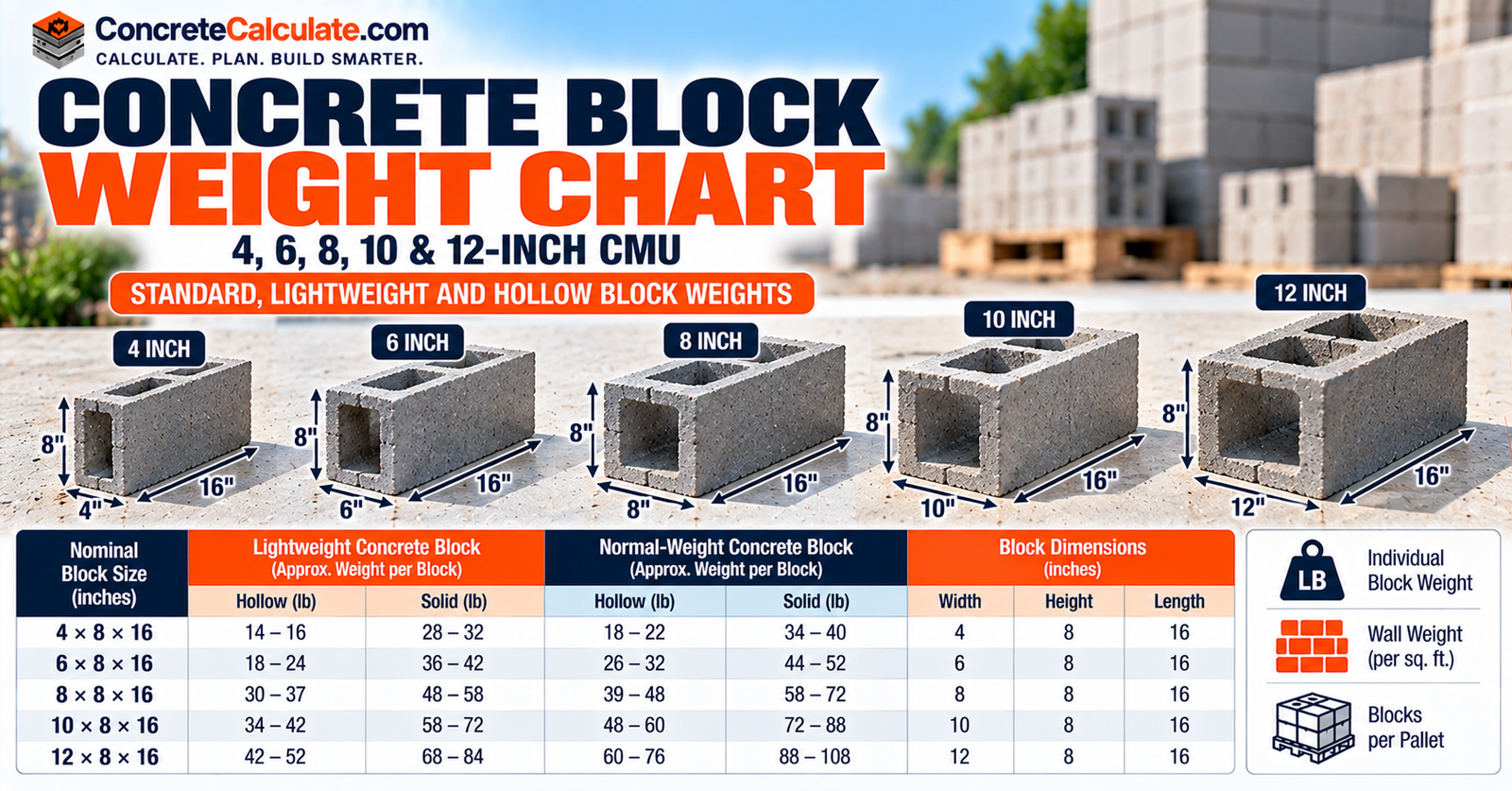
Concrete Block Weight Chart
Standard, Lightweight and Hollow CMU
Compare individual CMU weights for 4-, 6-, 8-, 10-, and 12-inch nominal blocks across lightweight, medium-weight, and normal-weight density classes, then calculate completed masonry wall dead loads for ungrouted, partially grouted, and fully grouted assemblies.
 Reviewed by Muhammad Ramzan Babar, PhD Researcher (Plasma Physics) & Calculator Developer – View Profile
Important: One Block Size Does Not Mean One Weight
An 8x8x16-inch concrete block does not have one universal weight. Two blocks with identical nominal dimensions can weigh substantially different amounts because of concrete density, aggregate type, face-shell thickness, web configuration, and moisture content. This chart distinguishes individual block weight, which depends on manufacturer product data, from completed wall assembly weight, which depends on mortar, grout, and reinforcement.
Concrete Block Weight Chart – Quick Reference
Individual CMU weight by nominal size, sourced from manufacturer product data wherever available.
How to Read This Chart
Weights below combine manufacturer-verified product data with industry-representative examples. CMU weight varies by manufacturer, concrete density, internal geometry, moisture condition, and product type. Treat approximate values as representative, not as precise universal standards.
Concrete Block Weight by Size
| Nominal Size | Actual Dimensions | Lightweight | Medium Weight | Normal Weight | Source |
|---|---|---|---|---|---|
| 4 x 8 x 16 in. | 3 5/8 x 7 5/8 x 15 5/8 in. | ~18-22 lb | ~22-25 lb | ~26-29 lb | Representative industry range |
| 6 x 8 x 16 in. | 5 5/8 x 7 5/8 x 15 5/8 in. | ~24-28 lb | ~28-32 lb | ~32-36 lb | Representative industry range |
| 8 x 8 x 16 in. | 7 5/8 x 7 5/8 x 15 5/8 in. | 30-37 lb | ~35-38 lb | 39-39.5 lb | Manufacturer-verified (Lowe’s, Kingston Block, Basalite) |
| 10 x 8 x 16 in. | 9 5/8 x 7 5/8 x 15 5/8 in. | ~34-38 lb | ~38-42 lb | ~44-48 lb | Representative industry range |
| 12 x 8 x 16 in. | 11 5/8 x 7 5/8 x 15 5/8 in. | ~38-43 lb | ~43-48 lb | ~49-54 lb | Representative industry range |
Do not calculate a hollow block’s weight from its full external dimensions as though it were solid concrete; actual net concrete volume is significantly less than gross volume.
Standard 8x8x16 Concrete Block Weight
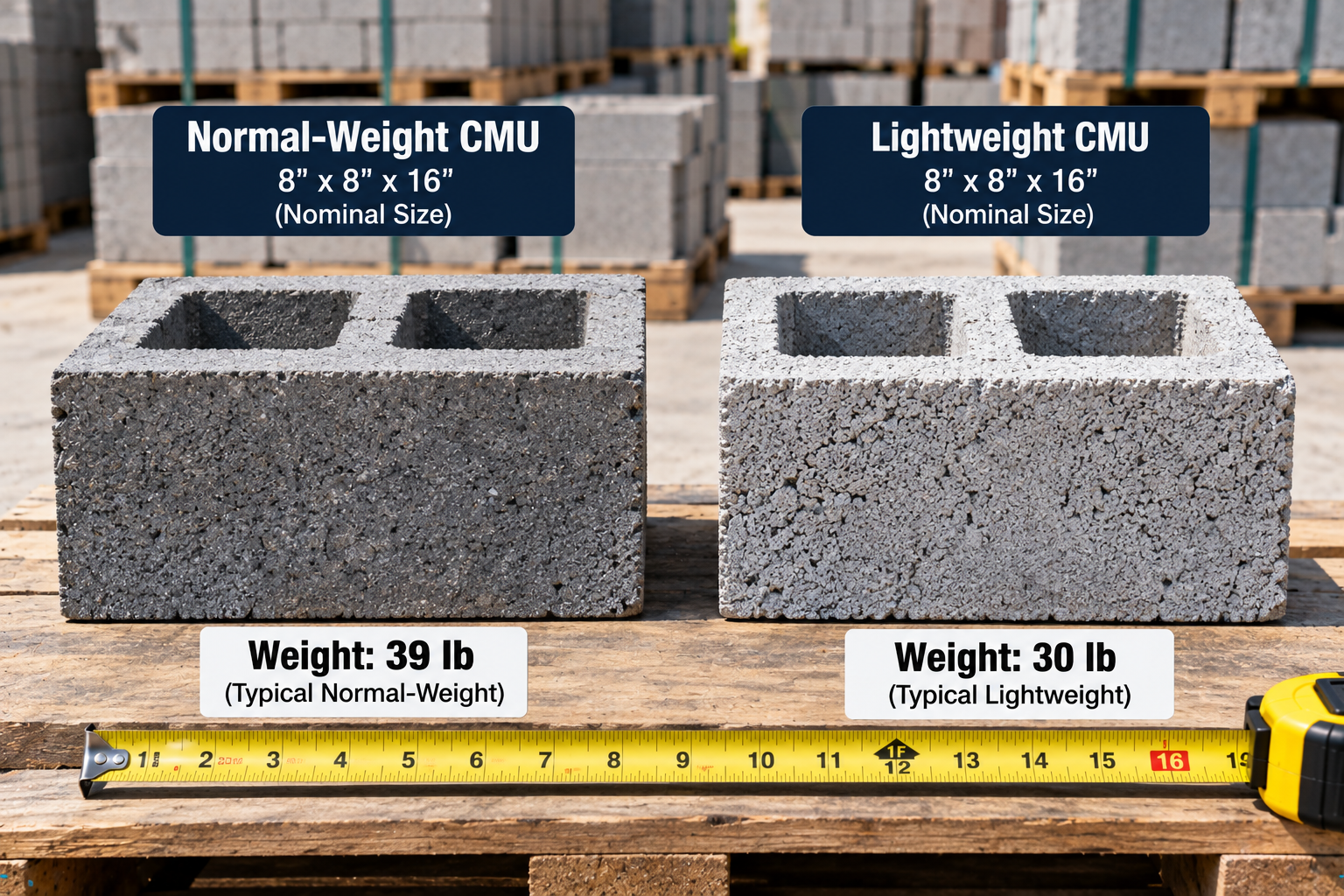
This is the most commonly searched CMU weight query. Documented examples include a lightweight hollow unit at 30 lb (premier concrete, Lowe’s listing), a lightweight unit at 37 lb (a different lightweight product line), and normal-weight units at 39 lb (Kingston Block, Basalite) and 39.5 lb (a separate normal-weight product listing). A particular supplier’s 39-lb normal-weight block is not inconsistent with another supplier offering a somewhat lighter block of the same nominal size; both can comply with ASTM C90 under their respective density classifications.
Important Weight Qualifications
CMU weights vary by manufacturer, concrete density, internal geometry, moisture content, and product type. The values in this chart are approximate and representative rather than precise universal standards; always confirm exact product weight with the manufacturer’s technical data sheet before ordering, lifting, or structural calculations.
Planning your next concrete project?
Plan concrete materials and project costs with our downloadable Excel estimator pack. For estimating only; follow applicable technical standards for design and installation.
One-time purchase · Digital downloadWhat Determines Concrete Block Weight?
- External dimensions: Nominal size sets the overall envelope, but not the weight directly.
- Concrete density: Oven-dry density of the concrete material itself, measured in lb/ft³.
- Internal voids: Core size and number reduce net concrete volume.
- Face-shell and web thickness: Thicker shells and webs increase net concrete volume and weight.
- Aggregate type: Natural stone, expanded shale, clay, or slate aggregates have different particle densities.
- Moisture content: As-delivered weight differs from oven-dry weight.
- Specialty configuration: Bond-beam, lintel, and other specialty units have different net volumes than standard two-core block.
Identical nominal dimensions do not imply identical weight; two 8x8x16-inch blocks from different manufacturers or density classes can differ by 25 percent or more.
Lightweight vs. Medium-Weight vs. Normal-Weight CMU
ASTM C90 recognizes three concrete density classifications, determined using oven-dry concrete density.
| Classification | Concrete Density |
|---|---|
| Lightweight | Less than 105 lb/ft³ |
| Medium Weight | 105 to less than 125 lb/ft³ |
| Normal Weight | 125 lb/ft³ or more |
Density Is Not the Same as Block Weight
These classifications refer to the density of the concrete material itself, not the total weight of an individual block and not the density of the completed hollow masonry assembly. A hollow lightweight unit and a solid normal-weight unit cannot be compared on density alone; the actual net concrete volume in each unit also matters.
Eight-by-Eight-by-Sixteen Concrete Block Weight
The dominant search query for CMU weight, addressed with documented manufacturer examples.
| Product/Source | Density Class | Weight |
|---|---|---|
| Lowe’s, “8x8x16 LW Split-Face” | Lightweight | 37 lb (minimum) |
| Lowe’s, “Premier Concrete Cored” (lightweight) | Lightweight | 30 lb (minimum) |
| Lowe’s, “Cored Concrete Block” (non-lightweight) | Normal weight | 39.5 lb (minimum) |
| Kingston Block, “8x8x16 Flat/Stretcher” | Normal weight (standard spec) | 39 lb |
| Basalite, “8x8x16 Standard Block” | Standard | 39 lb |
These are all documented published values for genuine products, not calculated estimates. The variation between 30 and 39.5 pounds for the same nominal size illustrates why manufacturer-specific data, not a single universal figure, should govern procurement and structural weight calculations.
Four-Inch and Six-Inch Concrete Block Weight
Nominal 4x8x16-inch partition blocks are commonly used where wall thickness is limited, such as interior partitions and furring applications. Representative industry ranges place these units around 18-29 lb depending on density class, though structural suitability should always be verified separately from weight comparison. Nominal 6x8x16-inch blocks fall in an intermediate range, around 24-36 lb, and represent a common compromise between the handling advantages of thinner units and the structural or fire-rating benefits of thicker walls.
Ten-Inch and Twelve-Inch Concrete Block Weight
Nominal 10x8x16 and 12x8x16-inch CMUs are used where greater wall thickness, higher fire ratings, or increased grouted reinforcement capacity is required. Representative industry ranges place 10-inch units around 34-48 lb and 12-inch units around 38-54 lb depending on density class, though larger units can have different face-shell and web arrangements than smaller units, so weight does not scale in strict proportion to nominal width. Published manufacturer data for the specific product should be used rather than scaling an 8-inch block’s weight purely by nominal width ratio.
Concrete Block Weight in Pounds and Kilograms
Exact Conversion
1 lb = 0.45359237 kg
| Example | Weight (lb) | Weight (kg) |
|---|---|---|
| 8x8x16 lightweight (verified minimum) | 30 lb | 13.6 kg |
| 8x8x16 normal weight (verified) | 39 lb | 17.7 kg |
| 8x8x16 normal weight (verified) | 39.5 lb | 17.9 kg |
Converted values are rounded to one decimal place. Distinguish exact unit conversions from approximate source weights when precision matters.
Hollow vs. Solid Concrete Block Weight
- Net concrete volume: The actual volume of concrete material in the unit.
- Gross external volume: The volume of the unit’s full outside envelope, including hollow cores.
- Face shells: The solid outer walls of a hollow unit.
- Internal webs: Solid cross-members connecting the face shells.
- Hollow cores: Void spaces within the unit reducing net volume and weight.
Using only outside dimensions significantly overestimates the weight of a hollow unit, since a substantial portion of the gross volume is void space. A fully grouted hollow block is also not identical in weight or construction to a manufactured solid unit; the grout fills the cores after installation, while a solid unit is cast with concrete throughout at manufacture.
Concrete Density vs. Individual Block Weight
Density is mass per unit volume; weight is the total mass of a specific object. ASTM C140 testing determines oven-dry concrete density using the actual net material volume, not the gross external volume as if the unit were solid. CMHA’s assembly-weight calculations use representative densities of 103, 115, and 135 lb/ft³ for lightweight, medium-weight, and normal-weight units respectively; these are estimating assumptions used for wall dead-load calculations, not the ASTM classification boundaries themselves.
✓ Reference: CMHA CMU-TEC-002, representative density assumptionsHow Aggregate Type Affects Concrete Block Weight
Natural aggregates such as sand and crushed stone generally produce denser, heavier concrete. Manufactured lightweight aggregates, including expanded shale, expanded clay, and expanded slate, reduce particle density and produce lighter concrete for a given volume. Blended aggregates fall between these extremes.
Lightweight Aggregate Does Not Guarantee Lightweight Classification
The use of lightweight aggregate does not automatically guarantee a CMU falls into the ASTM lightweight density class; the finished product’s actual measured oven-dry density controls classification, not simply the aggregate type used in the mix design.
Nominal vs. Actual Concrete Block Dimensions and Weight
Common nominal 8x8x16-inch CMUs are typically manufactured to approximately 7 5/8 x 7 5/8 x 15 5/8 inches to accommodate a 3/8-inch mortar joint, subject to the applicable product specification. This actual (specified) size, not the rounded nominal figure, is what determines the unit’s true net concrete volume and therefore its weight. For the complete dimensional inventory across all CMU types, see the Masonry Block Size Chart rather than duplicating that data here.
ASTM C90 Concrete Block Weight Requirements
ASTM C90-24a covers dry-cast hollow and solid loadbearing concrete masonry units, including density classification, material properties, and applicable physical requirements such as compressive strength and absorption limits. ASTM C90 classifies units by the concrete’s density but does not prescribe an identical unit weight for every standard block size; weight depends on the combination of density class and the specific unit’s net concrete volume.
✓ Reference: ASTM C90-24a, Standard Specification for Loadbearing Concrete Masonry UnitsASTM C140 Block Density and Weight Testing
ASTM C140/C140M-26a establishes the sampling and test methods manufacturers and laboratories use to determine unit dimensions, density, absorption, and moisture content. There is an important distinction between weighing a block as received (which includes ambient moisture) and determining its oven-dry density under the applicable test procedure, which dries the specimen to a constant mass before calculating density from net volume.
✓ Reference: ASTM C140/C140M-26a, Sampling and Testing Concrete Masonry UnitsLoadbearing vs. Nonloadbearing Block Weight
ASTM C90 covers loadbearing units, while ASTM C129-26 covers nonloadbearing concrete masonry units. Loadbearing classification is a structural product requirement, not a separate universal weight designation. A nonloadbearing block is not necessarily lighter simply because it is nonloadbearing; its weight still depends on the same density-class and geometry factors that govern any CMU.
Standard vs. Specialty Concrete Block Weights
| Specialty Type | Weight Consideration |
|---|---|
| Half blocks | Roughly half the net volume of a full unit, but not exactly half due to end-shell configuration |
| Bond-beam blocks | Reduced webs create a continuous channel, changing net volume from standard units |
| Lintel blocks | U-shaped or knockout-web design for horizontal reinforcement, different net volume |
| Corner units | Different face-shell arrangement at the return |
| Split-face / architectural units | Textured face can add or remove minor volume versus smooth-face units |
Specialty shapes require product-specific weights and cannot automatically be estimated by scaling the ordinary two-core CMU chart; consult the manufacturer’s data sheet for each specialty product.
Equipment for Your Project
Affiliate disclosure: As an Amazon Associate, ConcreteCalculate earns from qualifying purchases. We may also earn a commission from other affiliate links at no additional cost to you.
Concrete Block Wall Weight per Square Foot
Completed masonry wall weight depends on the units, mortar bedding, and grout, not on individual block weight alone.
| Wall Thickness | Lightweight (103 pcf), ungrouted (48 in. o.c.) | Normal Weight (135 pcf), ungrouted (48 in. o.c.) | Normal Weight (135 pcf), solid grouted |
|---|---|---|---|
| 6 in. | 34 lb/ft² | 45 lb/ft² | 63 lb/ft² |
| 8 in. | 49 lb/ft² | 55 lb/ft² | 84 lb/ft² |
| 10 in. | 53 lb/ft² | 70 lb/ft² | 104 lb/ft² |
| 12 in. | 69 lb/ft² | 83 lb/ft² | 133 lb/ft² |
These are wall assembly weights, including mortar bedding, bond beams, and reinforcing steel allowances, not individual block weights. Values assume 100-140 pcf grout density and specific unit densities as stated; the actual assembly weight depends on the specific project’s units, grout spacing, and reinforcement.
✓ Reference: Design of Reinforced Masonry Structures (CMACN), as published in concrete masonry industry technical referencesUngrouted vs. Partially Grouted vs. Fully Grouted CMU Wall Weight
| Grout Condition | 8-in. Normal-Weight Wall Weight |
|---|---|
| Ungrouted (cores empty, 48 in. o.c. minimum) | ~55 lb/ft² |
| Vertical grout at 24 in. o.c. | ~58 lb/ft² |
| Vertical grout at 16 in. o.c. | ~63 lb/ft² |
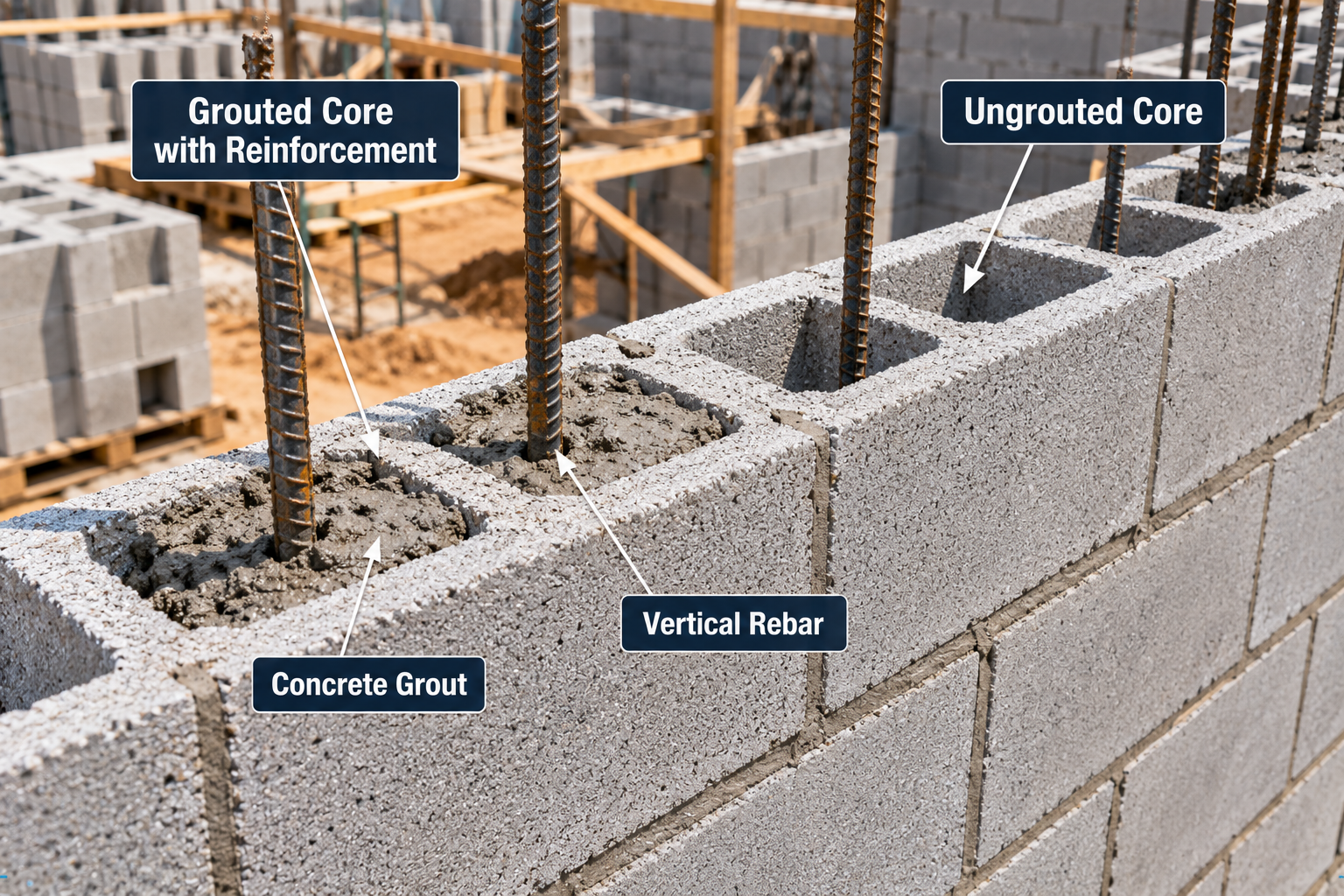
| Fully (solid) grouted | ~84 lb/ft² |
Grout substantially increases the dead load of a masonry wall; a fully grouted 8-inch normal-weight wall can weigh over 50 percent more than the same wall left ungrouted. Reinforcing steel, bond beams, mortar type, and actual unit geometry all affect a more detailed estimate beyond this representative reference table.
How to Calculate Individual Concrete Block Weight
Basic Relationship
W = Vnet × ρ, where Vnet is actual net concrete volume (not gross external volume) and ρ is concrete density.
Use actual net concrete volume when estimating hollow-unit weight; substituting gross external volume as though the unit were solid produces a significant overestimate. A manufacturer-published unit weight is preferable to a calculated estimate for procurement and lifting-equipment planning, since it reflects the actual as-manufactured product rather than idealized geometry. Calculated oven-dry weight also differs from as-delivered weight, which includes ambient moisture absorbed during storage.
How Many Concrete Blocks per Square Foot?
Standard Face-Size Calculation
For nominal 8 x 16-inch block face dimensions: N = 1.125 blocks/ft², before openings, waste, and specialty-unit adjustments.
| Nominal Face Size | Blocks per ft² |
|---|---|
| 8 x 16 in. | 1.125 |
| 4 x 16 in. (half-height) | 2.25 |
Mortar joints are already accounted for in the nominal 8 x 16-inch module used for this calculation. See the Concrete Block Calculator for a full quantity takeoff including openings.
How to Calculate Total Block Weight for a Wall
Formula
Wblocks = Nblocks × Wunit, then add mortar, grout, and reinforcement separately for complete wall weight.
Small Wall Example
Block-only weight is not complete wall weight; use the wall-weight-per-square-foot tables above (which already include mortar and reinforcement allowances) for structural dead-load estimating instead of summing block weight alone.
Concrete Block Weight by Wall Area Chart
| Wall Area | 8-in. Lightweight (~49 lb/ft²) | 8-in. Normal Weight (~55 lb/ft²) |
|---|---|---|
| 50 ft² | 2,450 lb | 2,750 lb |
| 100 ft² | 4,900 lb | 5,500 lb |
| 250 ft² | 12,250 lb | 13,750 lb |
| 500 ft² | 24,500 lb | 27,500 lb |
| 1,000 ft² | 49,000 lb | 55,000 lb |
Using the appropriate assembly weight in lb/ft² is generally more useful for structural dead-load estimating than multiplying block count by unit weight alone, since the assembly figure already accounts for mortar and typical reinforcement allowances.
Concrete Block Pallet Weight Chart
| Nominal Size | Product Weight per Block | Blocks per Pallet (example) | Total Block Weight |
|---|---|---|---|
| 8x8x16 normal weight | 39 lb | 90 (per one documented supplier) | 3,510 lb |
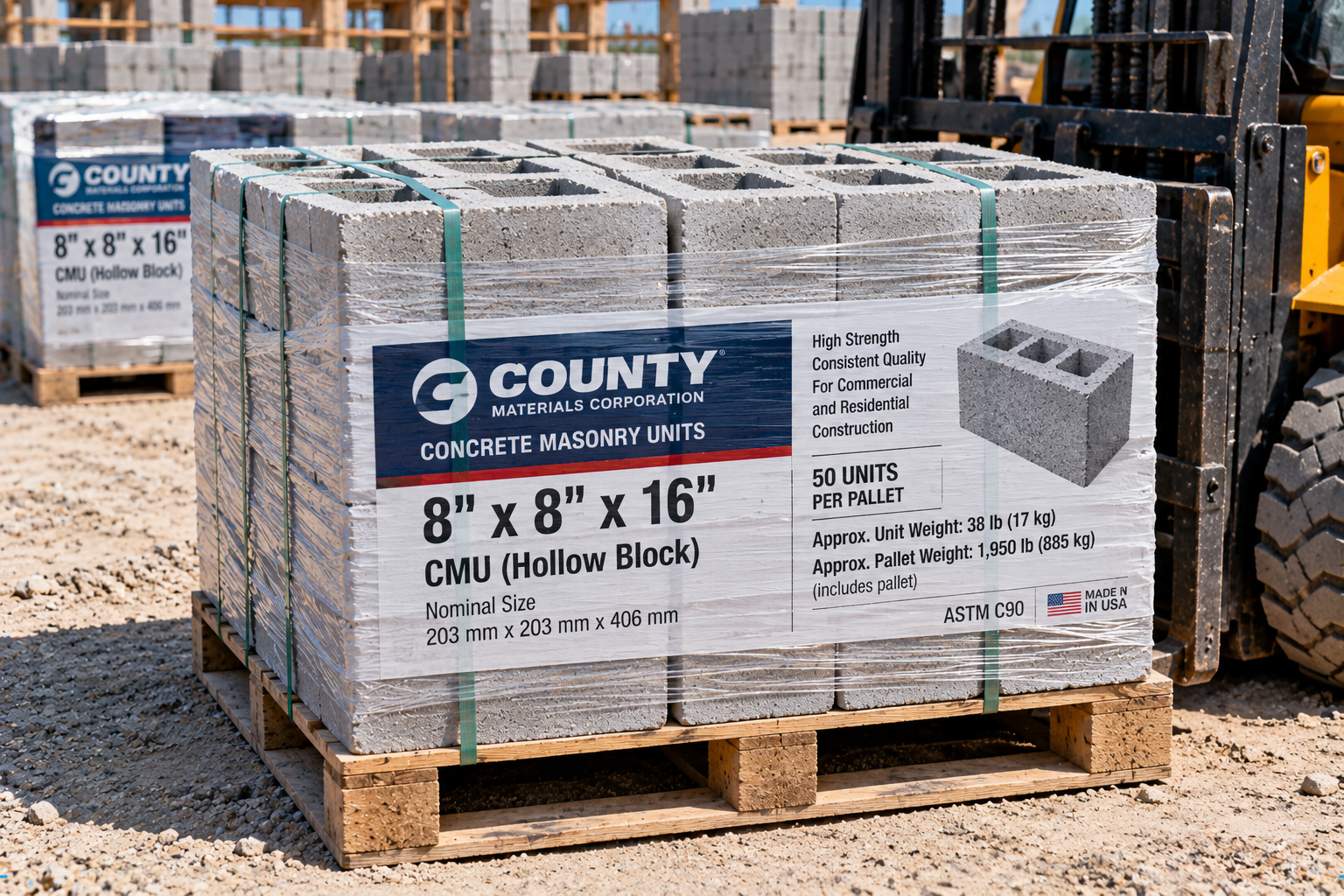
Do not assume all manufacturers use identical pallet quantities; one documented supplier lists 90 units per pallet for standard 8x8x16 block, but this varies by producer and product line. Add a packaging and pallet-weight allowance to the total block weight for an estimated gross pallet weight, and confirm with the specific supplier before planning delivery or handling equipment.
Truckload Weight and Material Delivery
Project quantity, pallet weights, vehicle payload capacity, delivery site access, and unloading equipment all affect material logistics. A theoretical block-weight estimate does not establish a vehicle’s legal payload or a crane or forklift’s rated lifting capacity; confirm actual equipment ratings and delivery logistics with the supplier and site superintendent separately from the weight chart.
Concrete Block Weight and Masonry Installation Labor
Lightweight and normal-weight blocks differ in repetitive handling effort, since masons lift each unit individually throughout a project. A lower unit weight can reduce handling fatigue over a full day of laying block, while actual installation productivity also depends on unit size, wall design, project conditions, and crew methods. Avoid presenting a specific universal labor-savings percentage without a defined comparison study.
Concrete Block Weight and Structural Dead Loads
- Wall dead load: The completed wall’s self-weight, using the assembly weight tables above.
- Floor and roof support: Masonry walls transfer their own weight plus supported loads to the foundation.
- Footing loads: Wall weight contributes to the total load a footing must support.
- Seismic mass: Heavier walls increase seismic demand in high-seismic regions.
- Reinforcement and grout contributions: Add measurably to total dead load, as shown in the grout-condition table above.
For footing sizing based on supported loads, see the Footing Size Chart and confirm soil capacity with the Soil Bearing Capacity Chart; actual footing design requires the complete structural load path and an engineered design, not just wall weight.
Block Weight, Fire Resistance, Thermal Mass, and Acoustics
CMU density and configuration can influence thermal storage capacity (heat capacity) and acoustical performance (sound transmission). Do not treat unit weight alone as proof of a particular fire-resistance rating, R-value, or sound transmission class; these properties depend on the tested or calculated complete assembly, including grout, finishes, and construction details, not weight in isolation.
How to Measure and Verify Concrete Block Weight
- Identify the block’s exact nominal and actual dimensions.
- Determine the density classification (lightweight, medium, or normal weight) from the manufacturer.
- Identify the manufacturer and specific product line.
- Note the moisture condition (as-delivered vs. oven-dry).
- Check the supplier’s technical data sheet for published unit weight.
- Test representative units directly where precise quantities are important, using ASTM C140/C140M procedures for certified results.
How to Choose the Right Concrete Block by Weight
- Identify the wall’s structural function and applicable material specification.
- Determine the permitted unit size and density classification.
- Check manufacturer availability and documented unit weight.
- Calculate complete wall dead load where required.
- Account for grout and reinforcement contributions.
- Verify delivery and handling arrangements.
Structural suitability, strength, fire resistance, and other specified performance requirements take precedence over choosing a block solely because it is lighter; weight is one input among several, not the primary selection criterion.
Common Concrete Block Weight Mistakes and Chart Limitations
Assuming every 8x8x16-inch block weighs 35 lb
Documented examples range from 30 to 39.5 lb depending on manufacturer and density class.
Confusing concrete density with block weight
Density (lb/ft³) and individual weight (lb) are related but distinct measurements.
Treating hollow blocks as solid prisms
Gross external volume significantly overestimates actual net concrete volume.
Ignoring grout when estimating wall weight
Grout can increase wall weight by 50 percent or more versus ungrouted construction.
Confusing nominal and actual dimensions
A nominal 8-inch block is actually about 7 5/8 inches, affecting true net volume.
Using incorrect pallet quantities
Blocks per pallet vary by manufacturer; do not assume a universal count.
Relying on oven-dry weight for as-delivered material
As-delivered blocks include ambient moisture not present in oven-dry test weight.
Confusing CMU with autoclaved aerated concrete
AAC uses entirely different material properties and weight characteristics.
Chart Limitations
This chart provides representative reference values, not universal guaranteed weights. Actual weights depend on manufacturer, aggregate, concrete density, block geometry, moisture, and product specification. Completed masonry wall weights depend on mortar, grout, reinforcement, wall configuration, and other design conditions. Precise structural dead loads must follow the adopted code, project drawings, and documented material properties.
Concrete Block Weight FAQs
Download Concrete Block Weight Chart PDF
Use your browser print function to save this reference as a PDF for estimating folders, jobsite binders, and delivery planning.