
Steel Plate Thickness Chart – Standard Sizes and Weight
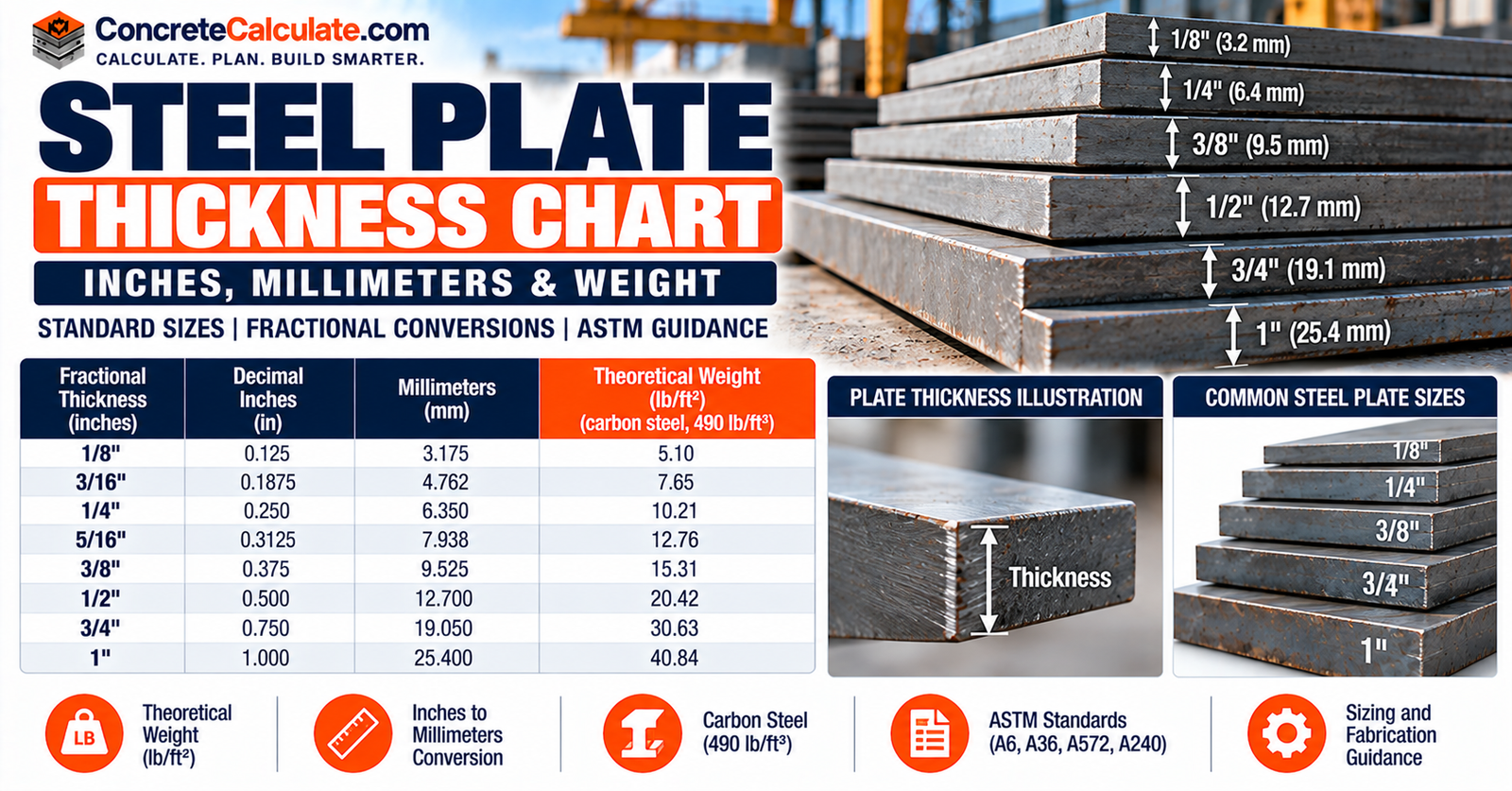
Steel Plate Thickness Chart
Standard Sizes and Weight
Convert fractional, decimal and metric steel plate thicknesses, estimate theoretical weight, and understand ASTM A6/A36/A572/A240 dimensional requirements before ordering or fabricating structural plate.
 Reviewed by Muhammad Ramzan Babar, PhD Researcher (Plasma Physics) & Calculator Developer – View Profile
Important: Specified, Actual and Structural Thickness Are Different
A specified plate thickness is not necessarily its exact measured thickness, since applicable manufacturing tolerances permit dimensional variation. Neither figure establishes structural adequacy on its own; that depends on loading, grade, geometry, connections and applicable design codes. This page is a dimensional reference, not a structural design tool.
Steel Plate Thickness Chart – Quick Reference
Standard fractional plate thicknesses with exact decimal, metric and theoretical weight values.
How to Read This Chart
Steel plate dimensions are generally specified directly rather than converted from a universal gauge system. These are exact geometric conversions and theoretical weights based on a 490 lb/ft³ density assumption, not guarantees of supplier stock availability, delivered thickness, or measured plate weight.
| Fractional Thickness | Decimal Inches | Millimeters | Weight (lb/ft²) | Weight (kg/m²) |
|---|---|---|---|---|
| 1/8 in. | 0.1250 | 3.175 | 5.10 | 24.92 |
| 3/16 in. | 0.1875 | 4.7625 | 7.66 | 37.39 |
| 1/4 in. | 0.2500 | 6.350 | 10.21 | 49.85 |
| 5/16 in. | 0.3125 | 7.9375 | 12.76 | 62.31 |
| 3/8 in. | 0.3750 | 9.525 | 15.31 | 74.77 |
| 7/16 in. | 0.4375 | 11.1125 | 17.86 | 87.23 |
| 1/2 in. | 0.5000 | 12.700 | 20.42 | 99.69 |
| 5/8 in. | 0.6250 | 15.875 | 25.52 | 124.62 |
| 3/4 in. | 0.7500 | 19.050 | 30.62 | 149.54 |
| 7/8 in. | 0.8750 | 22.225 | 35.73 | 174.47 |
| 1 in. | 1.0000 | 25.400 | 40.83 | 199.39 |
| 1-1/4 in. | 1.2500 | 31.750 | 51.04 | 249.24 |
| 1-1/2 in. | 1.5000 | 38.100 | 61.25 | 299.08 |
| 1-3/4 in. | 1.7500 | 44.450 | 71.46 | 348.93 |
| 2 in. | 2.0000 | 50.800 | 81.67 | 398.78 |
| 3 in. | 3.0000 | 76.200 | 122.50 | 598.17 |
| 4 in. | 4.0000 | 101.600 | 163.33 | 797.56 |
| 5 in. | 5.0000 | 127.000 | 204.17 | 996.95 |
| 6 in. | 6.0000 | 152.400 | 245.00 | 1196.34 |
Steel plate dimensions are generally specified directly rather than converted from a universal gauge system, unlike thinner sheet metal covered on the Sheet Metal Gauge Chart. Actual availability varies by grade, mill and supplier.
What Is Steel Plate Thickness?
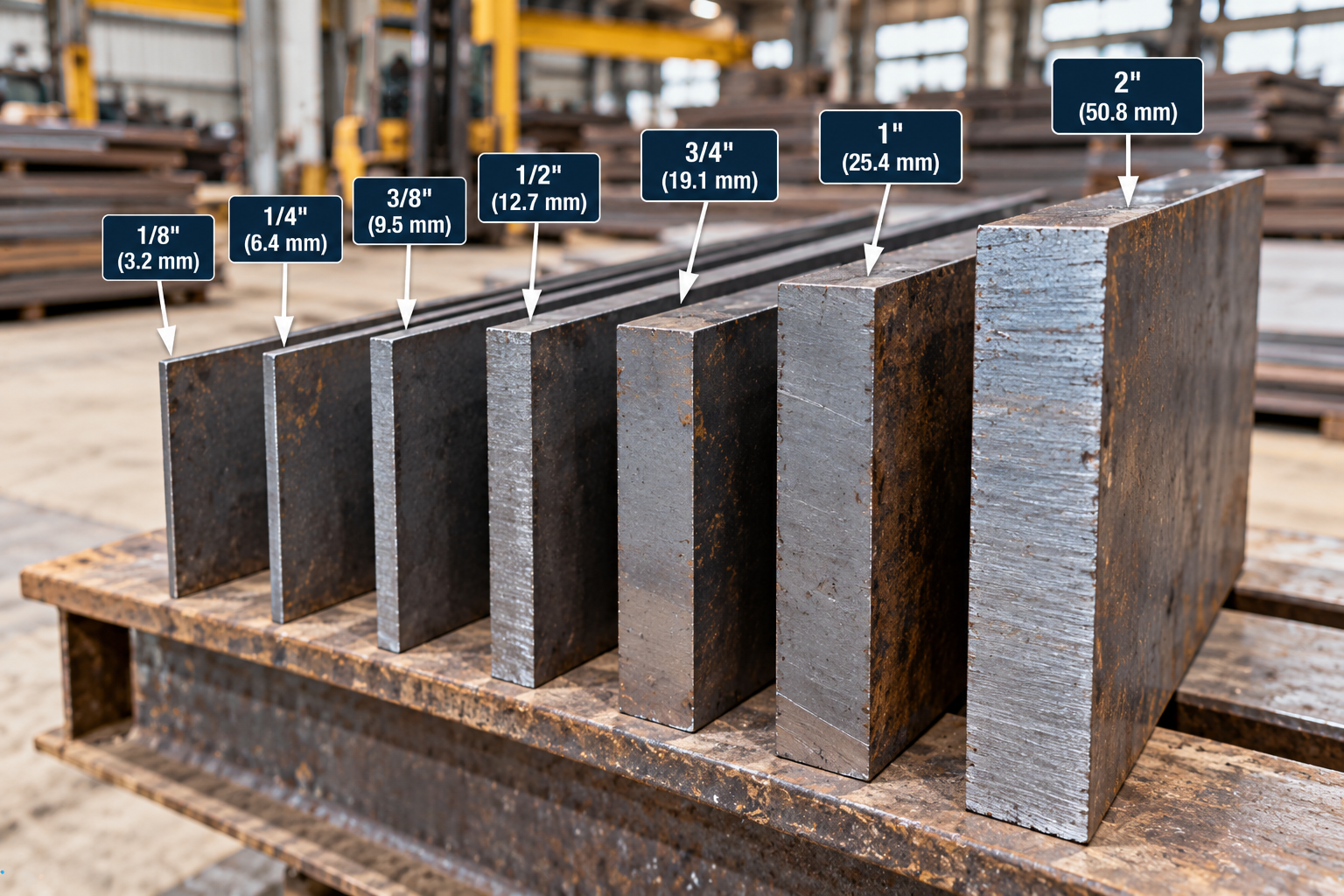
Steel plate thickness is the specified distance between the two principal rolled faces of a plate, distinct from its width and length.
- Nominal thickness: The conventional stated thickness used for ordering and reference.
- Specified thickness: The exact thickness called for in the project documents or purchase order.
- Measured thickness: The actual thickness found on the delivered plate, which can vary within permitted tolerance.
The term “plate” depends on product specification and commercial context; there is no universal physical threshold separating every steel sheet and plate product.
Steel Plate vs. Steel Sheet
Plate and sheet differ by thickness designation, product form, manufacturing process, supply condition and typical application. Some thinner flat products may be sold as plate or sheet depending on their specification and supplier terminology. For material-specific gauge conversions used with thinner sheet products, see the dedicated Sheet Metal Gauge Chart rather than duplicating its tables here.
Standard Fractional Steel Plate Thickness Chart
Common fractional sizes from 1/8 through 6 inches, marked as reference sizes rather than a guarantee that every grade is stocked in every thickness.
See the quick reference chart above for the complete fractional-to-metric-to-weight table. All values are common reference sizes; actual stocked thicknesses vary by grade, mill, and supplier location.
Metric Steel Plate Thickness Chart
Commonly specified metric thicknesses with their exact converted inch equivalents and nearest fractional-inch comparison.
| Specified (mm) | Exact Converted (in) | Nearest Fractional Size | Difference from Fractional (in) |
|---|---|---|---|
| 3 mm | 0.1181 | 1/8 in. (0.1250) | -0.0069 |
| 4 mm | 0.1575 | 3/16 in. (0.1875) | -0.0300 |
| 5 mm | 0.1969 | 3/16 in. (0.1875) | +0.0094 |
| 6 mm | 0.2362 | 1/4 in. (0.2500) | -0.0138 |
| 8 mm | 0.3150 | 5/16 in. (0.3125) | +0.0025 |
| 10 mm | 0.3937 | 3/8 in. (0.3750) | +0.0187 |
| 12 mm | 0.4724 | 1/2 in. (0.5000) | -0.0276 |
| 15 mm | 0.5906 | 5/8 in. (0.6250) | -0.0344 |
| 16 mm | 0.6299 | 5/8 in. (0.6250) | +0.0049 |
| 20 mm | 0.7874 | 3/4 in. (0.7500) | +0.0374 |
| 25 mm | 0.9843 | 1 in. (1.0000) | -0.0157 |
| 30 mm | 1.1811 | 1-1/4 in. (1.2500) | -0.0689 |
| 40 mm | 1.5748 | 1-1/2 in. (1.5000) | +0.0748 |
| 50 mm | 1.9685 | 2 in. (2.0000) | -0.0315 |
A Nominal 10 mm Plate Is Not Exactly 3/8 Inch
A specified 10 mm plate converts to 0.3937 inch, while 3/8 inch is exactly 0.3750 inch, a difference of about 0.0187 inch (0.475 mm). Converting a metric order to the nearest fractional size can introduce a real dimensional difference; specify the actual required unit rather than assuming an automatic match.
Fractional, Decimal and Metric Thickness Conversion
Conversion Formulas
t(mm) = 25.4 × t(in) and the reverse, t(in) = t(mm) / 25.4.
3/16-Inch Plate
1/2-Inch Plate
Exact converted dimensions differ from rounded commercial sizes and mixed-unit calculations; use the precise conversion for tolerance and manufacturing calculations rather than a rounded figure.
Common Steel Plate Thicknesses Explained
1/8, 3/16 and 1/4 Inch
1/8 in. (0.1250 in., 3.175 mm, 5.10 lb/ft²), 3/16 in. (0.1875 in., 4.7625 mm, 7.66 lb/ft²) and 1/4 in. (0.2500 in., 6.350 mm, 10.21 lb/ft²) are common lighter plate thicknesses used in illustrative applications such as light brackets, covers and non-critical panels, subject to the actual design requirements.
3/8, 1/2 and 5/8 Inch
3/8 in. (0.3750 in., 9.525 mm, 15.31 lb/ft²), 1/2 in. (0.5000 in., 12.700 mm, 20.42 lb/ft²) and 5/8 in. (0.6250 in., 15.875 mm, 25.52 lb/ft²) are common mid-range structural and fabrication thicknesses, illustrative of typical base plate and connection plate ranges.
3/4, 1 and 2 Inches
3/4 in. (0.7500 in., 19.050 mm, 30.62 lb/ft²), 1 in. (1.0000 in., 25.400 mm, 40.83 lb/ft²) and 2 in. (2.0000 in., 50.800 mm, 81.67 lb/ft²) are common heavier structural thicknesses used illustratively in base plates, heavy connections and built-up sections.
Thicker Plate Sizes
Thicknesses beyond 2 inches, including 3, 4, 5 and 6 inches, are used in heavier structural and industrial applications, subject to actual supplier stock and specialized fabrication requirements. No specific thickness in this section is labeled universally adequate for any structural use; the applicable design governs.
Nominal vs. Actual Steel Plate Thickness
Ordered plate thickness and delivered measured thickness may differ within permitted mill tolerances.
- Nominal dimensions: The stated thickness used for ordering.
- Permissible over- and under-thickness: Variation allowed by the applicable ASTM standard.
- Mill tolerances: Manufacturing variation inherent to the rolling process.
- Surface condition and inspection: Affects where and how thickness is properly measured.
ASTM A6/A6M is the principal structural-steel reference for these tolerances. Thickness must be assessed according to the correct product standard and its specified measurement locations, not an assumed universal rule.
ASTM A6 Steel Plate Thickness Tolerances
ASTM A6/A6M establishes dimensional tolerances for applicable rolled structural steel plate.
No Single Universal Tolerance
Permitted over- and under-thickness depend on the specified thickness, plate width and ordering conditions, not one fixed plus-or-minus value for every plate size. The current ASTM A6/A6M edition must be consulted for the applicable table and its exceptions.
| Factor | Role in Determining Tolerance |
|---|---|
| Specified thickness | Different thickness ranges carry different permitted variation |
| Plate width | Wider plates can carry different allowances than narrower plates |
| Measurement location | ASTM A6/A6M specifies where thickness must be measured on the plate |
| Ordering condition | Whether the plate is ordered to nominal thickness or another basis affects applicable rules |
| Standard edition | Tolerance tables can be revised between editions |
Do not invent a single plus-or-minus tolerance for all structural plate sizes; always confirm the specific value in the current ASTM A6/A6M edition’s applicable table.
✓ Reference: ASTM A6/A6M general requirements for rolled structural steel plates, shapes and barsMinimum Thickness vs. Nominal Thickness
Ordering to nominal thickness differs from specifying an absolute minimum required thickness. This distinction matters in structural design and fabrication, since a minimum-thickness callout on project drawings should not be automatically satisfied by a nominal size that may fall under the required value within its normal tolerance.
Nominal vs. Minimum Comparison
Plate Width, Length, Flatness and Dimensional Tolerances
Plate inspection covers more than thickness. Width, length, flatness, camber, edge condition and squareness are also addressed under ASTM A6/A6M where applicable. Sheared, flame-cut, universal-mill and other edge or processing conditions can affect the relevant tolerances for a given plate.
ASTM Standards for Structural Steel Plate
Each standard performs a different role and should not be treated as interchangeable.
| Standard | Main Role |
|---|---|
| ASTM A6/A6M | General dimensional, testing and delivery requirements for rolled structural steel plate, shapes and bars |
| ASTM A36/A36M | Carbon structural steel plates, shapes and bars |
| ASTM A572/A572M | High-strength low-alloy structural steel, Grades 42, 50, 55, 60 and 65 |
| ASTM A588/A588M | Atmospheric-corrosion-resistant (weathering) structural steel |
| ASTM A709/A709M | Bridge structural steel, where specified |
| ASTM A240/A240M | Chromium and chromium-nickel stainless steel plate, sheet and strip |
| ASTM A480/A480M | General stainless flat-product requirements, including dimensional tolerances |
These standards do different jobs: product grade, mechanical properties, dimensional requirements and application-specific specifications. A material grade specification does not substitute for the applicable dimensional standard, and vice versa.
ASTM A36 Steel Plate Thickness and Sizes
ASTM A36/A36M specifies carbon structural steel properties and product requirements, not one universal list of available plate thicknesses.
A36 material must still satisfy the applicable ASTM A6 dimensional requirements for the actual plate ordered. Certified grade, plate identification and supplier stock sizes determine what is practically available for a given project.
Illustrative A36 Ordering Example
ASTM A572 Grade 50 and Other High-Strength Plates
Higher-strength structural grades may be used where specified by the design.
ASTM A572/A572M includes Grades 42, 50, 55, 60 and 65 with grade-dependent applicability, thickness availability and strength specifications. Replacing A36 with A572 Grade 50 does not automatically permit a proportional reduction in thickness without structural verification; weldability, material certification and the complete design must be reviewed by the responsible engineer.
Weathering and Corrosion-Resistant Steel Plate
ASTM A588/A588M covers atmospheric-corrosion-resistant structural steel.
Weathering steel’s corrosion-resistance characteristics depend on project exposure conditions and the material specification. It does not eliminate corrosion concerns in every environment; local climate, detailing and maintenance still matter.
Stainless Steel Plate Thickness Chart
A concise stainless-specific thickness reference for commonly ordered fractional and metric sizes.
| Thickness | Decimal (in) | Metric (mm) |
|---|---|---|
| 1/8 in. | 0.1250 | 3.175 |
| 1/4 in. | 0.2500 | 6.350 |
| 3/8 in. | 0.3750 | 9.525 |
| 1/2 in. | 0.5000 | 12.700 |
Stainless plate selection also depends on grade, application and finish. ASTM A240/A240M covers relevant stainless plate specifications, while ASTM A480/A480M provides the associated general dimensional requirements where applicable. This table intentionally does not duplicate the material-specific gauge conversions on the Sheet Metal Gauge Chart; it focuses on actual specified plate dimensions and tolerances instead.
Hot-Rolled vs. Cut-to-Size Steel Plate
Hot-rolled mill plate, cut-to-length products and steel service-center processing carry different practical implications.
Surface condition, mill scale, edge condition, flatness and dimensional tolerance can differ between mill-produced plate and plate that has been cut, ground or machined by a service center. Confirm which condition applies to the specific product being purchased.
Steel Plate Thickness vs. Material Strength
Thickness and material strength are different properties.
- Yield strength and tensile strength vary by grade, not just thickness.
- Plate geometry, bending stiffness, unsupported span, loading, buckling and connection details all affect actual performance.
Two plates of the same thickness but different grades can have different strength properties, while increased strength does not necessarily eliminate deflection or stability concerns. Detailed structural design remains on specialized engineering resources rather than this dimensional reference.
Steel Plate Thickness and Weight Chart
Theoretical weight uses the relationship W = V x density, with consistent units.
Weight Formulas
For carbon steel at 490 lb/ft³: W(lb/ft²) = 40.8333 × t(in). For metric calculations at approximately 7,850 kg/m³: W(kg/m²) = 7.85 × t(mm). Stainless and other alloy grades may require different density values.
See the quick reference chart above for weight per square foot and square meter across the full thickness range. This table is consistent with the density approach used on the Structural Steel Weight Chart.
Weight of Common Steel Plate Sizes
Illustrative rectangular stock and cut sizes, subject to actual supplier availability.
| Size (in.) | Area (ft²) | Weight at 1/4 in. (lb) | Weight at 1/2 in. (lb) |
|---|---|---|---|
| 24 x 48 | 8.0 | 81.7 | 163.3 |
| 36 x 96 | 24.0 | 245.0 | 490.0 |
| 48 x 96 | 32.0 | 326.7 | 653.3 |
| 48 x 120 | 40.0 | 408.3 | 816.7 |
| 60 x 120 | 50.0 | 510.4 | 1020.8 |
| 72 x 144 | 72.0 | 735.0 | 1470.0 |
Not every stock size is available in every material, grade, or finish; confirm availability with the supplier. See the Structural Steel Weight Chart for the broader structural-shape weight reference and the Steel Weight Calculator for project-specific totals.
Steel Plate Weight and Material Quantity Calculations
Calculate weight from length, width, thickness and density in either imperial or metric units.
Plate Weight Calculator
Openings, cutouts, kerf, offcuts, and waste reduce the usable yield from a stock sheet and should be subtracted from a gross weight estimate for material planning. Weight calculations based on nominal dimensions produce estimates; shipping or procurement may use actual measured or contract-defined mass instead.
Steel Plate Thickness for Structural Applications
Plate is used structurally as connection plates, gusset plates, base plates, stiffeners, splice plates, and components of built-up sections and bridges.
A general reference chart cannot determine structural adequacy for any of these uses. Plate size is established through applicable structural design, including loading, connection requirements, and construction details specific to the project.
Steel Base Plate Thickness
Base plate thickness depends on column load, plate bending behavior, bearing on concrete, anchor rod layout, plate projection beyond the column, grout thickness, and the complete structural design, not column size alone. See the Anchor Bolt Size Chart and Anchor Bolt Spacing Chart for related anchorage dimensions, and the Base Plate Calculator for project-specific sizing.
Gusset, Stiffener and Connection Plate Thickness
Gusset plates, beam connection plates, stiffeners and splice plates each respond to applied forces, bolt-hole patterns, welds, local yielding, buckling, geometric constraints and fabrication requirements. A single universal thickness table would be misleading without the actual connection-design assumptions behind it.
Steel Plate Thickness for Welding and Fabrication
Plate thickness affects weld preparation, cutting method and overall fabrication approach.
- Butt-weld preparation and fillet weld selection depend on actual thickness.
- Preheat requirements, where applicable, can depend on thickness and grade.
- Heat input and distortion increase in significance with thicker material.
- Material grade and the applicable welding procedure must be qualified for the specific combination used.
Universal welding parameters are not published here without material, process and procedure qualification; consult the applicable welding procedure specification for the project.
Steel Plate Thickness for Drilling and Bolted Connections
Thickness influences hole preparation and assembly, including bolt diameter, hole size, edge distance, bolt grip, and countersinking or counterboring where applicable. Plate thickness cannot be selected independently of the complete connection design. See the Bolt Hole Size Chart, Clearance Hole Size Chart and Drill Bit Size Chart for related dimensions, and the Bolt Pattern Calculator for layout planning.

Thick Steel Plate and Special Fabrication Considerations
Heavy plate introduces additional practical issues beyond ordinary thin stock.
- Through-thickness properties and weldability at greater thickness.
- Toughness requirements for certain applications.
- Cutting methods suited to heavier sections.
- Machining, lifting and handling equipment requirements.
- Heat-treatment or additional testing requirements where specified.
Heavy plate may require more specialized purchasing and quality-assurance requirements than ordinary thin stock, including additional certification and inspection.
How to Measure Steel Plate Thickness
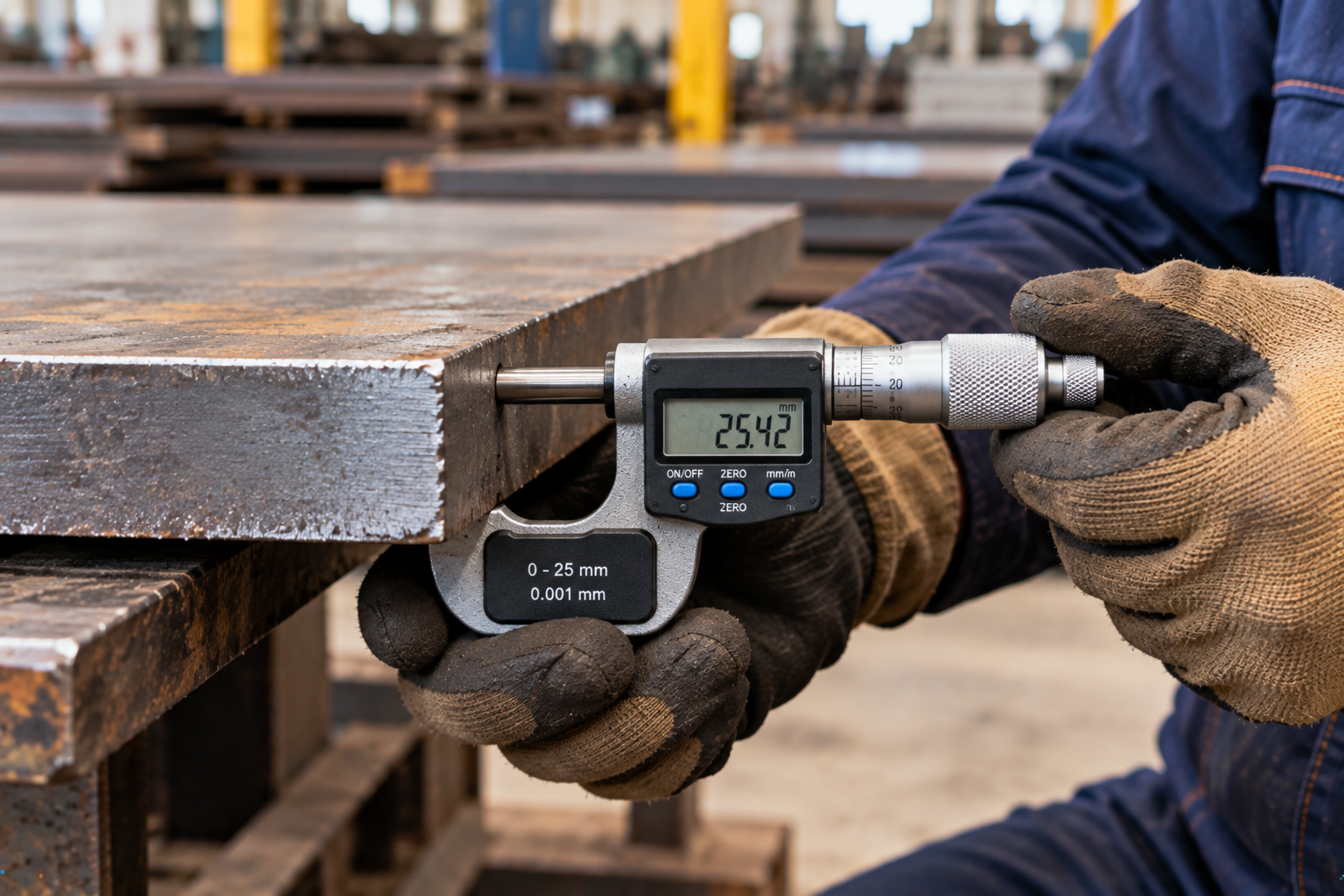
- Use a caliper for approximate field checks or a micrometer for precise measurement.
- Measure at the locations specified by the applicable standard, since ASTM A6/A6M identifies particular thickness-measurement locations for its tolerance tables.
- Account for burrs or surface irregularities that can distort a reading.
- Prefer a micrometer where precision is critical to the application.
Do not assume a single random measurement proves full compliance with the applicable dimensional standard; the correct measurement locations and method matter.
How to Read a Steel Plate Specification and Mill Test Report
- ASTM designation (e.g., A36/A36M, A572/A572M)
- Material grade
- Ordered thickness, width and length
- Heat number
- Mechanical properties (yield, tensile, elongation)
- Test report reference
- Applicable supplementary requirements
- Traceability information
Illustrative Purchase Order Format
How to Choose and Order Steel Plate Thickness
- Identify the project application and applicable design.
- Select the required steel grade.
- Determine required plate thickness from design or specification.
- Establish whether the dimension is nominal or minimum required.
- Identify applicable dimensional tolerances.
- Select inch or metric ordering units.
- Confirm commercial availability with the supplier.
- Determine width, length and cutting requirements.
- Calculate estimated weight.
- Confirm certification and delivery requirements with the supplier.
Material substitutions and changes in specified thickness should be reviewed by the responsible designer where structural performance is involved.
Common Steel Plate Thickness Mistakes
Confusing steel plate with sheet-metal gauge
Plate is generally specified directly by thickness, not by a gauge number.
Treating nominal thickness as exact measured thickness
Delivered plate can vary within the applicable manufacturing tolerance.
Assuming all grades have the same stock availability
Availability varies by grade, mill and supplier location.
Converting metric stock to the nearest fractional size without checking difference
A 10 mm plate is not exactly 3/8 inch; verify the actual dimensional gap.
Applying ASTM A6 tolerances to a different specification’s product
Different product standards carry their own applicable tolerance rules.
Ignoring plate width when interpreting thickness tolerances
ASTM A6 tolerance values can depend on plate width, not thickness alone.
Using nominal dimensions when a minimum finished thickness is specified
A minimum-thickness callout may require a heavier nominal size after accounting for tolerance.
Treating a higher-strength grade as automatic permission to reduce thickness
Any thickness reduction requires structural verification, not just a grade swap.
Ignoring plate weight when planning transport or lifting
Heavy plate requires appropriate handling equipment and planning.
Assuming the same thickness works for every base plate or gusset
Connection geometry and loading determine actual required thickness.
Ignoring actual material grade during welding
Welding procedure qualification depends on the specific material and thickness combination.
Measuring plate thickness over burrs, coatings or damaged surfaces
These can distort the reading away from the true base thickness.
Assuming an uncertified description establishes ASTM compliance
A supplier description alone does not replace a mill test report and proper certification.
Using theoretical weight as an exact measured shipping weight
Theoretical weight is a density-based estimate, not a certified scale weight.
Steel Plate Thickness Chart Limitations
This chart is a nominal dimensional reference for commonly specified steel plate sizes.
What This Chart Does Not Establish
It does not establish structural adequacy, supplier availability, actual mill tolerance, corrosion allowance, fabrication tolerance, or code compliance. Exact requirements depend on the applicable ASTM product specification, current dimensional standard, ordered grade, project drawings, and any additional engineering or inspection requirements.
Steel Plate Thickness FAQs
Download Steel Plate Thickness Chart PDF
Use your browser print function to save this reference as a PDF for shop binders, estimating folders and purchasing documentation.
![Rebar Size Chart - Complete #3 to No. 20 [64] Diameter, Area & Grade Reference](https://concretecalculate.com/wp-content/uploads/2026/07/Rebar-Size-Chart-2026-Complete-3-to-No.-20-64-Diameter-Area-Grade-Reference-390x220.png)