Rebar Number Chart – What #3 to #20 Rebar Numbers Mean
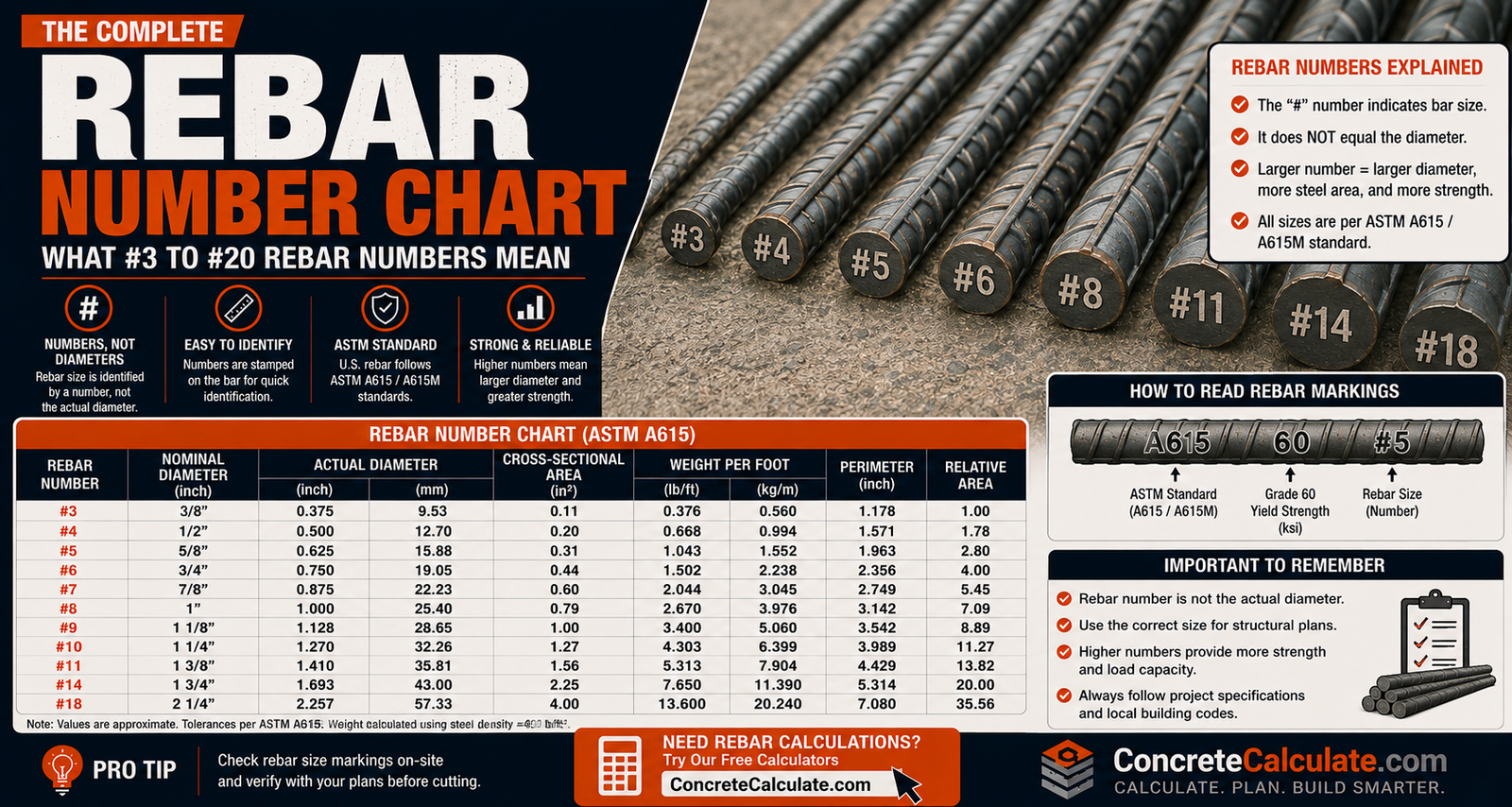
Rebar Number Chart
What #3 to #20 Rebar Numbers Mean
What a U.S. rebar number and ASTM metric designation actually mean, how numbers relate to diameter, why #9 and larger break the simple eighth-inch rule, and how to read bar markings.
 Reviewed by Muhammad Ramzan Babar, PhD Researcher (Plasma Physics) & Calculator Developer — View Profile
⭐ Rebar Number Chart: Quick Reference
Bar number is the dominant column here. Diameter, area, and weight are supporting identification data; see the dedicated Rebar Size Chart for the full master reference.
| U.S. Bar No. | ASTM Metric Designation | Nominal Diameter (in.) | Nominal Diameter (mm) |
|---|---|---|---|
| #3 | [10] | 0.375 | 9.5 |
| #4 | [13] | 0.500 | 12.7 |
| #5 | [16] | 0.625 | 15.9 |
| #6 | [19] | 0.750 | 19.1 |
| #7 | [22] | 0.875 | 22.2 |
| #8 | [25] | 1.000 | 25.4 |
| #9 | [29] | 1.128 | 28.7 |
| #10 | [32] | 1.270 | 32.3 |
| #11 | [36] | 1.410 | 35.8 |
| #14 | [43] | 1.693 | 43.0 |
| #18 | [57] | 2.257 | 57.3 |
| No. 20* | [64] | 2.500 | 63.5 |
*No. 20 [64] Requires Code Recognition Check
ASTM A615/A615M identifies No. 20 [64] as the largest bar in the current specification, but cautions that consensus design codes may not yet recognize its use. See ASTM A615/A615M Rebar Number Designations.
⭐ Rebar Number Lookup Tool
Select a bar number to instantly see its nominal diameter, metric designation, area, and weight, or enter a diameter to find the closest matching bar number.
🧮 Rebar Number ↔ Diameter Lookup
How This Tool Works
Selecting a bar number returns its official ASTM A615/A615M Table 1 values. Entering a diameter finds the nearest standard bar number, useful for identifying an unmarked or worn bar after field measurement. This is an identification aid only, not a substitute for reading rolled markings or confirming project specifications.
⭐ What Does a Rebar Number Mean?
A rebar number is a standardized size designation. It is not steel grade, quantity, bar length, strength, or exact rib-to-rib diameter.
CRSI’s own terminology defines a bar number as a number, approximately the bar diameter in eighths of an inch (or whole millimeters for metric designation), used to designate the reinforcing bar size. Bar numbers are rolled onto the bar for easy identification.
U.S. Inch-Pound Bar Number
Examples include #3, #4, #5, and #6, each corresponding to a specific standardized nominal diameter under ASTM A615/A615M.
ASTM Metric Designation
The same bars also carry a bracketed metric designation such as [10], [13], [16], or [19], referencing the approximate nominal diameter in millimeters within the ASTM SI unit system.
✓ Source: CRSI Reinforced Concrete Terminology, verified August 2026How Rebar Numbers Relate to Diameter
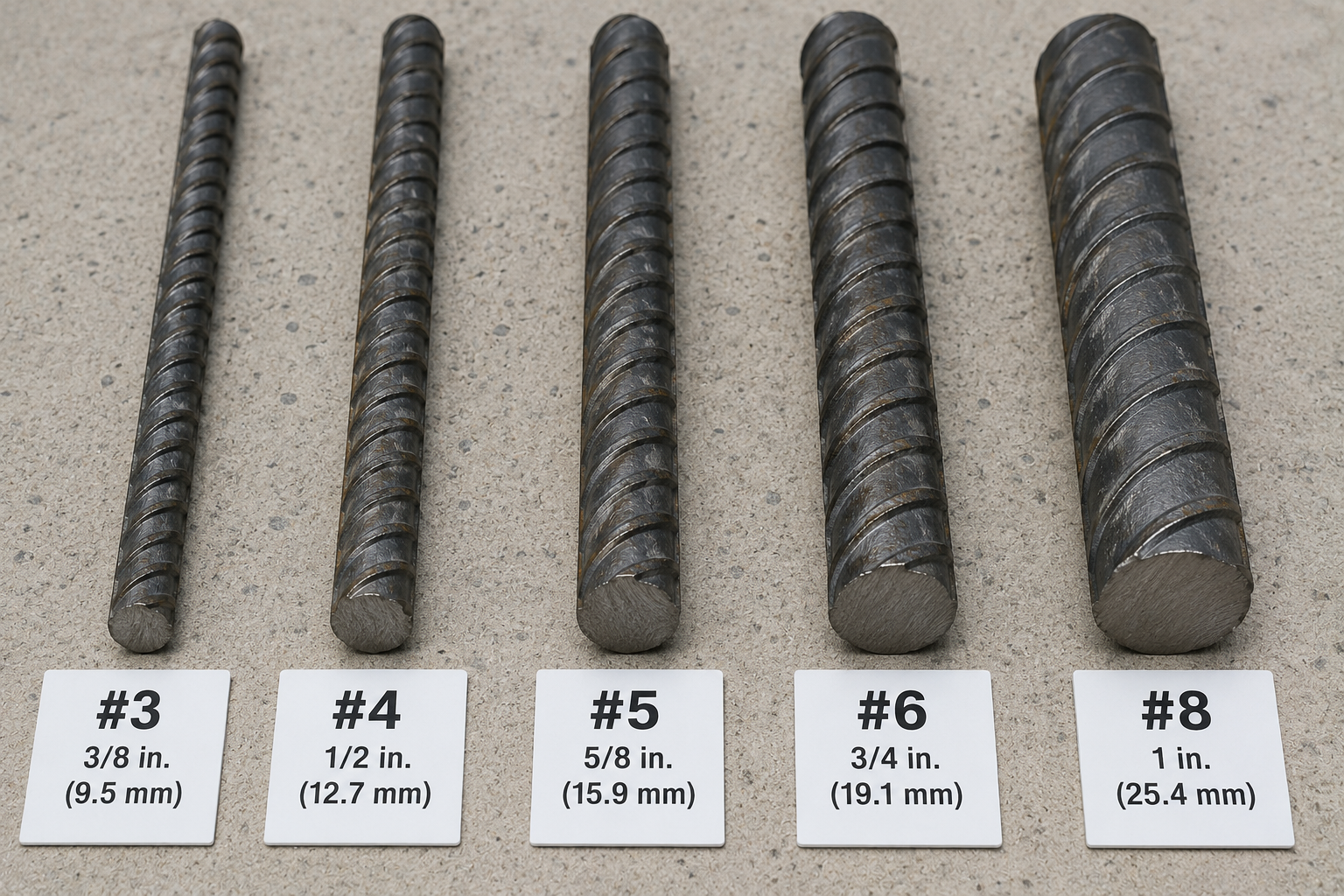
For bars #3 through #8, the familiar rule holds exactly.
This rule works precisely for #3 through #8: #3 = 3/8″, #4 = 4/8″ = 1/2″, #5 = 5/8″, #6 = 6/8″ = 3/4″, #7 = 7/8″, #8 = 8/8″ = 1″. See why #9 and larger work differently below.
#3 Through #8 Rebar Number Chart
The cleanest homeowner and contractor quick-reference table, covering the most searched bar numbers.
| Rebar No. | Fractional Diameter | Decimal Diameter | mm |
|---|---|---|---|
| #3 | 3/8″ | 0.375″ | 9.5 |
| #4 | 1/2″ | 0.500″ | 12.7 |
| #5 | 5/8″ | 0.625″ | 15.9 |
| #6 | 3/4″ | 0.750″ | 19.1 |
| #7 | 7/8″ | 0.875″ | 22.2 |
| #8 | 1″ | 1.000″ | 25.4 |
⭐ Why #9 and Larger Rebar Numbers Work Differently
Do not calculate #10 as 10 divided by 8. That is not the standardized nominal diameter.
| Bar No. | If Eighth-Inch Rule Applied | Actual Nominal Diameter |
|---|---|---|
| #9 | 9/8 = 1.125″ | 1.128″ |
| #10 | 10/8 = 1.250″ | 1.270″ |
| #11 | 11/8 = 1.375″ | 1.410″ |
| #14 | 14/8 = 1.750″ | 1.693″ |
| #18 | 18/8 = 2.250″ | 2.257″ |
| No. 20 | 20/8 = 2.500″ | 2.500″ (matches) |
For bar number #9 and larger, the designation remains a standardized size designation, but the exact eighth-inch rule no longer applies (with No. 20 [64] as a numerical coincidence). CRSI’s own definition deliberately uses the word “approximately” for this reason, rather than stating that every bar number is an exact eighth-inch dimension.
Common Misstatement to Avoid
Do not say “#10 equals exactly 10/8 inch.” Its nominal diameter is 1.270 inches, not 1.250 inches. Always read larger bar diameters from the ASTM size table rather than calculating them.
Large Rebar Number Chart: #9 Through #20
Larger structural bar numbers consolidated into one reference, including the current No. 20 [64] bar.
#9, #10, and #11
| Bar No. | Metric Designation | Diameter (in.) | Area (in²) |
|---|---|---|---|
| #9 | [29] | 1.128 | 1.00 |
| #10 | [32] | 1.270 | 1.27 |
| #11 | [36] | 1.410 | 1.56 |
#14 and #18
| Bar No. | Metric Designation | Diameter (in.) | Area (in²) |
|---|---|---|---|
| #14 | [43] | 1.693 | 2.25 |
| #18 | [57] | 2.257 | 4.00 |
No. 20 [64]
| Bar No. | Metric Designation | Diameter (in.) | Area (in²) |
|---|---|---|---|
| No. 20 | [64] | 2.500 | 4.91 |
Code Recognition Caution
ASTM A615/A615M explicitly warns that consensus design codes and specifications may not yet recognize the use of the No. 20 [64] bar, and structural members using it may require special approval and detailing.
Why Some Rebar Numbers Are Missing
Readers often wonder why the sequence jumps from #11 to #14 to #18 to No. 20.
ASTM reinforcing bar designations form a standardized discrete size series in Table 1, not a requirement to manufacture a bar for every integer number. There are no standard #12, #13, #15, #16, or #17 bars under ASTM A615/A615M.
Alternate Bar Sizes
ASTM A615/A615M does address alternate bar sizes when specifically ordered under its supplementary provisions, which should not be confused with the normal Table 1 size series covered by this chart.
U.S. Rebar Numbers vs ASTM Metric Designations
A direct mapping between the two designation systems for the same bar family.
| U.S. Number | Metric Designation |
|---|---|
| #3 | [10] |
| #4 | [13] |
| #5 | [16] |
| #6 | [19] |
| #7 | [22] |
| #8 | [25] |
| #9 | [29] |
| #10 | [32] |
| #11 | [36] |
| #14 | [43] |
| #18 | [57] |
| No. 20 | [64] |
Two Independent Standards
ASTM states that its inch-pound and SI systems are each standards in their own right and may not be exact equivalents. Values from the two systems should not be mixed when assessing specification compliance.
⭐ Metric Rebar Number vs Actual Diameter
An easy source of confusion: the bracketed metric number is a label, not an exact measurement.
#4 [13] does not mean the actual U.S. bar measures exactly 13.0 mm. Its nominal U.S. diameter is 0.500 in × 25.4 = 12.7 mm. The [13] is only the ASTM metric designation label.
Similarly, #5 [16] has a nominal diameter of about 15.9 mm, not exactly 16.0 mm. This distinction matters whenever a reader assumes the bracketed number is a precise measurement rather than a rounded designation.
ASTM Soft-Metric Rebar vs True Metric Rebar
Useful context for international readers without shifting this page away from U.S. practice.
ASTM dual-designation bars such as #4 [13], #5 [16], and #6 [19] are the identical U.S. bar family labeled with a metric designation number.
True metric reinforcement systems used in other countries commonly use nominal diameters such as 10 mm, 12 mm, 16 mm, 20 mm, 25 mm, or 32 mm under separate national standards. Do not assume every true-metric bar is automatically interchangeable with a similarly sized U.S. bar.
Rebar Number vs Nominal Diameter
The most important distinction carried over from the dedicated diameter chart.
Bar number is the standardized designation. Nominal diameter is the standardized design dimension associated with that bar number.
ASTM’s nominal dimensions for deformed bars are based on the equivalent plain round bar having the same weight per unit length as the deformed bar, which is different from measuring across the deformations with calipers. For the full treatment of this distinction, see the Rebar Diameter Chart.
Rebar Number vs Actual Outside Diameter
A #5 bar can physically measure more than its nominal 0.625 in across the rib peaks.
The bar number refers to the nominal bar size, not the maximum outside dimension across deformations. Detailed rib measurement, caliper technique, and field identification methods are covered in depth on the Rebar Diameter Chart.
Rebar Number vs Cross-Sectional Area
Increasing bar number increases area, but not in a straight linear proportion to diameter.
Because area scales with diameter squared, a larger bar number produces a disproportionately larger nominal cross-sectional area. For the complete area-per-bar and area-per-spacing reference, see the Rebar Area Chart.
Rebar Number vs Weight
Each standardized bar number has a corresponding nominal weight per unit length.
A higher bar number usually means larger diameter, greater area, and greater weight per foot. CRSI’s Ready Reference materials list ASTM standard bar sizes, diameters, areas, and weights together because these properties are all linked to the size designation. For complete unit-weight tables, see the Rebar Weight Chart.
⭐ Rebar Number vs Grade
Critical misconception: #5 does not mean Grade 5, Grade 50, or Grade 500.
The bar number identifies size. Grade identifies steel strength classification. ASTM A615/A615M currently includes Grade 40 [280], Grade 60 [420], Grade 80 [550], and Grade 100 [690]. A #5 Grade 60 bar and a #5 Grade 80 bar have the same nominal size but different mechanical properties.
Never Assume Number Implies Grade
Always confirm grade independently from rolled markings or mill certification. See the Rebar Grade Chart for full grade specifications.
Rebar Number vs Bar Length
Another common confusion: bar number never indicates length.
A #4 bar can come in many different lengths depending on supplier and project. The number does not mean 4 ft, 40 ft, or any other length. Bar number is size; bar length is a separate supply and detailing dimension. See the Rebar Length Chart for stock, cut, and fabricated length data.
Rebar Number vs Bar Quantity
Drawing notation can combine a quantity with a bar number in a way that is easy to misread.
For example, “4-#5” typically indicates a quantity of four #5 bars, depending on the drawing convention used. That quantity figure is completely different from the bar number itself, which only designates size.
Equipment for Your Project
Affiliate disclosure: As an Amazon Associate, ConcreteCalculate earns from qualifying purchases. We may also earn a commission from other affiliate links at no additional cost to you.
⭐ How to Read Rebar Markings
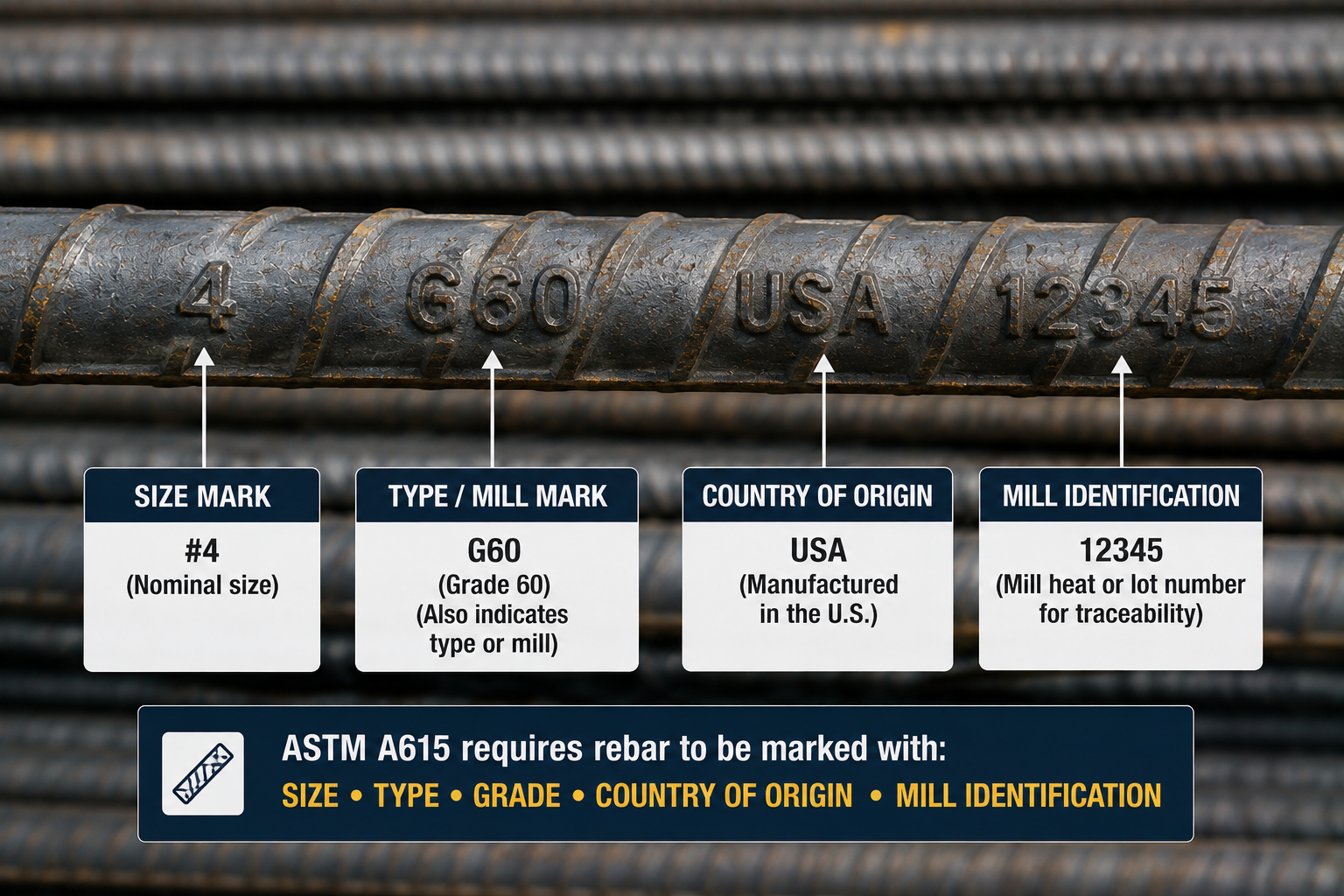
CRSI defines a standardized marking sequence rolled onto every individual bar.
According to CRSI, each individual reinforcing bar is manufactured with a series of markings in a fixed order.
Mill Identification
The first letter or symbol identifies the producing mill.
Bar Number / Size
The next marking is the bar size number.
Steel Type
The third marking symbol designates the steel type, usually “S” for carbon steel under ASTM A615, or “W” for low-alloy steel under ASTM A706.
Grade Marking
The final marking indicates grade, either as a number (60, 75, 80, 100, 120) or by a line system: one line for 60, two lines for 75, three lines for 80 or 100, and four lines for 120, each line required to run at least five deformations long.
Rebar Number Marking Examples
A simplified, illustrative example of how the marking sequence reads in practice.
Reading a Sample Marking
This example is illustrative of the general CRSI marking sequence and is not attributed to any single manufacturer’s specific bar.
Bar Tags vs Rolled Bar Numbers
Two different identification methods used at different points in the supply chain.
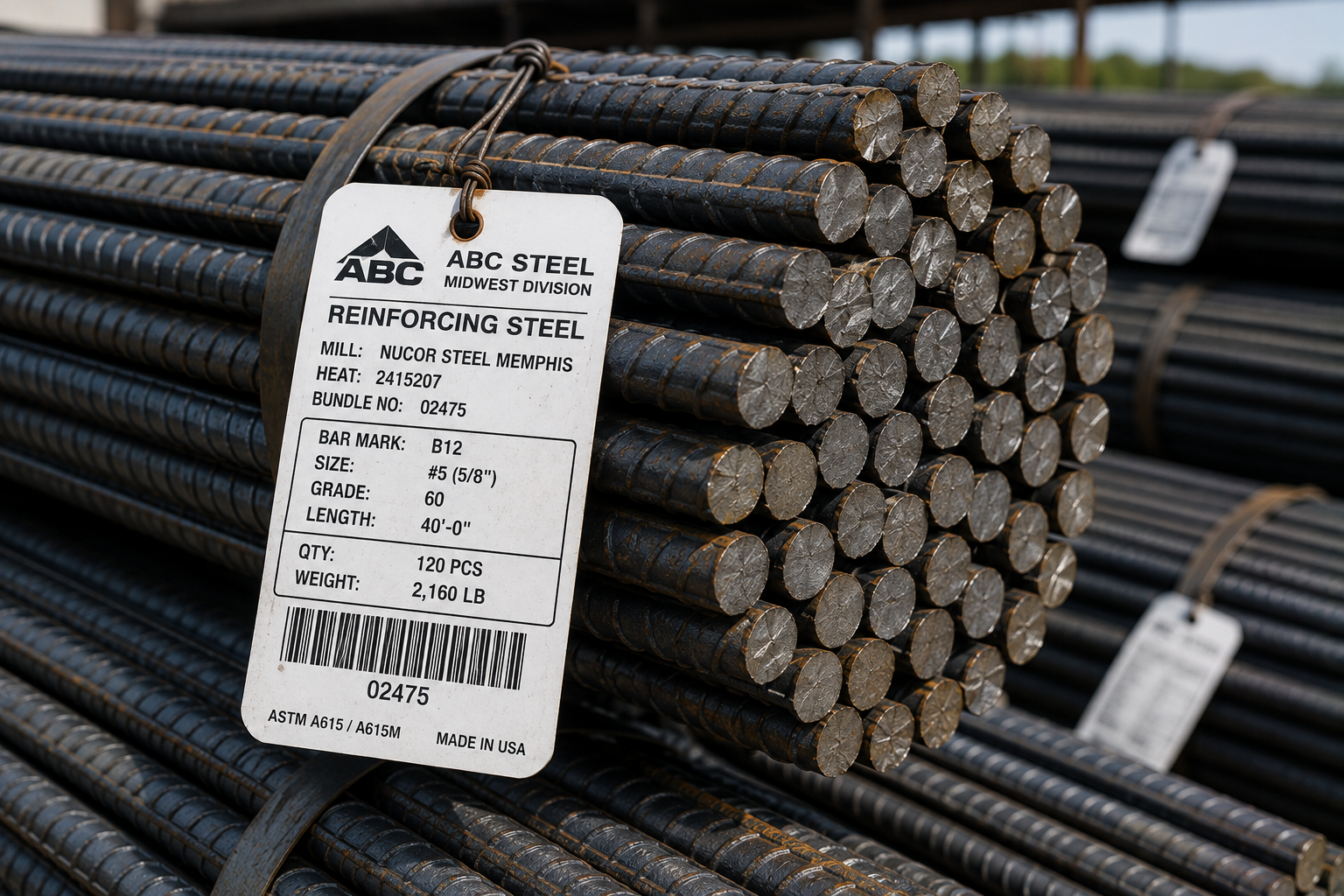
Rolled markings are built directly into each individual bar. Bar tags are attached to bundles of bars rather than to each piece.
CRSI notes that a bar tag typically shows the number of pieces in a shipment, along with dimensions of bent bars, bar markings, and total weight, making tags an important method for identifying reinforcing bar bundles when they arrive on a jobsite.
How to Identify an Unknown Rebar Number
A practical step-by-step workflow for field identification.
- Read rolled markings: look for the size number rolled onto the bar.
- Check the bundle tag: if the bar is still bundled or tagged.
- Measure the bar: compare the outside diameter against the nominal diameter chart above.
- Account for deformations: do not treat the rib-to-rib dimension as the exact nominal diameter.
- Check unit weight if needed: useful when markings are unreadable.
- Confirm drawings and specifications: especially before any substitution.
Rebar Number on Structural Drawings
The bar number communicates size; other notation communicates quantity, spacing, location, and shape.
Common examples on structural or placing drawings include “#4 @ 12 in. o.c.”, “4-#5 bars”, “#3 ties”, and “#6 longitudinal bars.” In each case, the bar number identifies size while the surrounding notation adds quantity, spacing, or role information.
Rebar Number and Spacing Notation
A frequent source of misreading on drawings.
“#4 @ 12 in. o.c.” means #4 bars spaced at 12 inches on center, not twelve #4 bars. Reading this notation correctly requires separating the size (#4), the spacing (12 in.), and the direction or each-way designation if shown. See the Rebar Spacing Chart for spacing requirements.
Rebar Number and Concrete Cover
Bar size affects reinforcement geometry, but cover is a separate design requirement.
Code and detailing provisions frequently depend partly on bar size. A larger bar number means a larger nominal diameter (db), which affects reinforcement geometry, but the required clear cover remains a separate requirement determined by exposure condition and member type. See the Concrete Cover Chart for cover values.
Rebar Number and Lap/Development Requirements
Bar size is one input among several that determine splice and development requirements.
Bar size affects development length, lap length, bend and hook dimensions, and congestion, but there is no single splice length attached only to a bar number. See the Rebar Lap Splice Chart for the full set of variables and values.
Choosing a Rebar Number
A design-awareness overview, not a lookup by project name.
Bar number selection depends on structural loading, required steel area, member dimensions, bar spacing, concrete strength, cover, development and anchorage, crack-control requirements, structural drawings, and applicable code, not on project type alone.
Key Point
Bar number is selected through structural reinforcement design, not chosen simply because a project is called a “patio” or a “driveway.” Always follow the engineer’s reinforcement schedule.
⭐ Can One Rebar Number Be Substituted for Another?
Changing bar number changes far more than the label on the drawing.
Changing #4 to #5, or #5 to #4, changes diameter, area, weight, spacing possibilities, development length, lap requirements, crack distribution, and congestion.
Never Substitute Without Verification
One bar number should not simply replace another while keeping every other design parameter unchanged. Any substitution should be reviewed and approved by the engineer of record. See the Rebar Area Chart to compare area between bar numbers before considering any change.
⭐ ASTM A615/A615M Rebar Number Designations
The primary standard governing the current bar number system.
ASTM states that Table 1 of A615/A615M provides the standard sizes, dimensions, and number designations for deformed reinforcing bars. A615 governs the inch-pound ordering system, while A615M governs the SI ordering system; each system should be used independently for specification compliance.
Current No. 20 [64] Bar
ASTM’s Own Caution
The current size set includes No. 20 [64] as the largest bar in the specification, with an explicit caution that consensus design codes and specifications may not yet recognize its use, and that structural members using it may require special approval and detailing.
ASTM A706 and Other Rebar Numbering Context
The same size designation concept appears under other material specifications too.
ASTM A706/A706M covers low-alloy steel deformed and plain bars for concrete reinforcement and uses the identical bar number and metric designation system as A615/A615M.
Bar Number Alone Does Not Identify the Specification
A #5 bar can be manufactured under A615 or A706, with different chemistry and weldability requirements. Always read the type marking (S or W) as well as the bar number.
Common Rebar Number Mistakes
The most frequent errors when reading or interpreting rebar numbers.
Thinking #4 means 4-mm rebar
The number does not directly state a millimeter measurement.
Thinking #4 means 4-ft-long rebar
Bar number has nothing to do with length.
Thinking #5 means Grade 5
Grade is a separate strength classification from size number.
Treating every number as exact eighth-inch diameter
This only holds precisely for #3 through #8.
Saying #10 equals exactly 10/8 in
Its true nominal diameter is 1.270 in, not 1.250 in.
Confusing [13] with an exact 13.0 mm measurement
Metric designations are rounded labels, not precise measurements.
Confusing U.S. metric designations with true metric bars
ASTM soft-metric bars are the same U.S. family; true metric bars follow different standards.
Using outside rib diameter as the bar number
Field-measured diameter over ribs exceeds nominal diameter.
Ignoring bar markings
Rolled marks are often the most reliable identification method.
Confusing quantity notation with bar number
“4-#5” means four #5 bars, not a different bar number.
Assuming a larger number automatically means “better”
The correct bar number comes from structural design, not from maximizing size.
Substituting numbers without recalculating area/spacing
Any substitution changes multiple design parameters at once.
Omitting No. 20 [64] from a current ASTM chart
The current specification includes No. 20 [64] as its largest bar.
Inventing nonstandard intermediate numbers
There are no standard #12, #13, #15, #16, or #17 bars.
Rebar Number Chart Limitations
Important context for interpreting this chart correctly.
Frequently Asked Questions
📥 Download Rebar Number Chart PDF
Use your browser’s print function to instantly save this page as a PDF. This avoids broken file links and gives you an always up-to-date printable version for jobsite binders, estimating folders, and reinforcement identification kits.