Pipe Thread Chart 2026: NPT, BSPT, BSPP & Metric Comparison
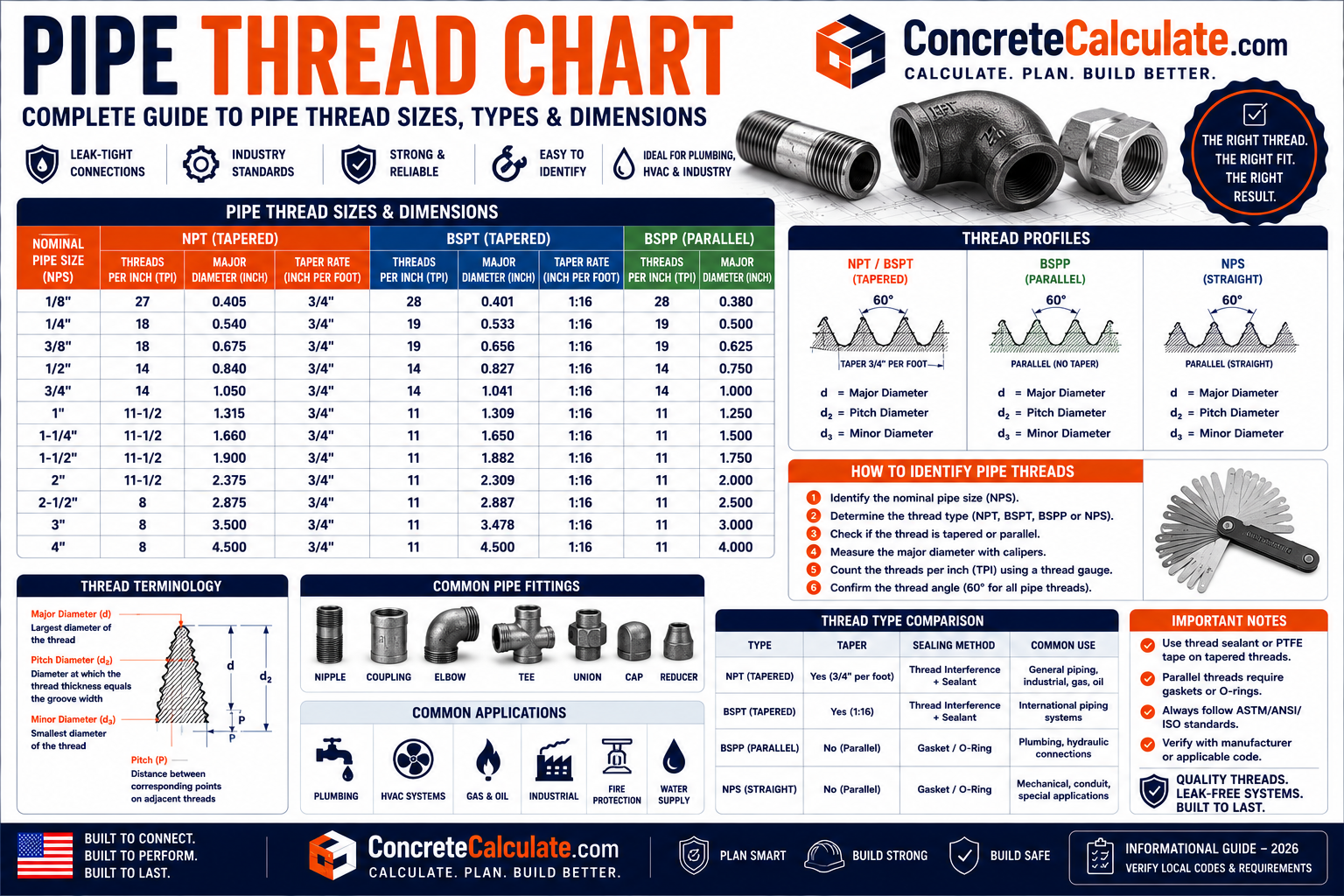
Pipe Thread Chart
NPT, BSPT, BSPP & Metric Comparison
Pipe thread is a family of standards, not one universal thread. This is the comparison and identification hub across every major inch and metric pipe thread system.
 Reviewed by Muhammad Ramzan Babar, PhD Researcher & Calculator Developer · View Profile
This page compares NPT against BSPT, BSPP and other pipe thread standards. For the complete detailed U.S. NPT dimensional reference, see the NPT Thread Chart. For general thread identification method, see the Thread Identification Chart.
⭐⭐⭐ Pipe Thread Chart: Quick Reference
Pipe thread is a family of distinct standards. Never assume any two systems below are interchangeable just because they share a similar nominal size.
| Thread Type | System | Taper/Parallel | Measurement | Typical Application |
|---|---|---|---|---|
| NPT | U.S. inch (ASME B1.20.1) | Tapered | TPI | Pipe/fittings |
| NPSC | U.S. inch (ASME B1.20.1) | Straight | TPI | Couplings/fittings |
| NPSM | U.S. inch (ASME B1.20.1) | Straight | TPI | Mechanical fittings |
| NPSL | U.S. inch (ASME B1.20.1) | Straight | TPI | Locknuts |
| BSPT / R | British/ISO 7 | Tapered | TPI | Pressure-tight pipe joints |
| BSPP / G | British/ISO 228 | Parallel | TPI | Mechanical/pipe connections |
| Metric pipe threads | Metric (various) | Varies | mm pitch | International applications |
ASME B1.20.1 covers the U.S. general purpose inch pipe thread families NPT, NPSC, NPTR, NPSM and NPSL. ISO 7-1 covers pressure-tight pipe threads including BSPT (R), where the joint is made on the threads themselves. ISO 228-1 covers parallel fastening pipe threads including BSPP (G), where the pressure-tight joint is made elsewhere in the assembly, not on the threads.
⭐ What Is a Pipe Thread?
A pipe thread is a thread form used specifically on pipes and fittings, distinct from ordinary fastener threads.
Purpose
Pipe threads join pipe sections and fittings, and in many systems contribute to a pressure-tight seal as part of the connection.
Male vs female
Male (external) threads are typically on pipe ends and nipples; female (internal) threads are typically inside fitting bodies and couplings.
Tapered vs parallel
Tapered threads decrease in diameter along their length; parallel threads maintain a constant diameter. This distinction fundamentally changes how the joint fits and seals.
Mechanical vs pressure-tight
Some pipe thread systems are designed primarily for mechanical connection with sealing achieved elsewhere, while others are designed so the thread engagement itself is part of the sealing mechanism.
⭐⭐⭐ Pipe Thread Standards
Identifying the correct standard is more important than identifying nominal size alone.
U.S. inch pipe threads (ASME B1.20.1)
- NPT: American National Standard Taper Pipe Thread
- NPSC: American National Standard Straight Pipe Thread for Couplings
- NPTR: American National Standard Taper Pipe Thread for Railing Joints
- NPSM: American National Standard Straight Pipe Thread for Free-Fitting Mechanical Joints
- NPSL: American National Standard Straight Pipe Thread for Loose-Fitting Mechanical Joints with Locknuts
British/ISO pipe threads
- BSPT / R: British Standard Pipe Taper, governed by ISO 7-1
- BSPP / G: British Standard Pipe Parallel, governed by ISO 228-1
Other systems
Additional regional and industry-specific pipe thread standards exist, including various metric pipe thread conventions used in specific international markets and industries; always confirm the applicable standard for imported or specialized equipment rather than assuming a familiar system applies.
Why the standard matters more than the size
A “1/2 inch pipe thread” could be NPT, BSPT, BSPP, or another system entirely, each with different actual dimensions, thread angle, and sealing approach. Always identify the standard first.
⭐⭐⭐ Nominal Pipe Size vs Actual Thread Diameter
This is one of the most common sources of pipe thread confusion.
A nominal pipe thread size is a standardized designation, not a direct outside diameter measurement. For example, 1/2 NPT has an actual outside diameter of approximately 0.840 inches, not 0.500 inches. This gap exists across every inch pipe thread system, and the exact actual OD differs between standards even at the identical nominal size label.
| Nominal Size | NPT Actual OD | BSPT (R) Actual OD |
|---|---|---|
| 1/4″ | 0.540 in | 0.518 in (13.157 mm) |
| 3/8″ | 0.675 in | 0.656 in (16.662 mm) |
| 1/2″ | 0.840 in | 0.825 in (20.955 mm) |
| 3/4″ | 1.050 in | 1.041 in (26.441 mm) |
| 1″ | 1.315 in | 1.309 in (33.249 mm) |
Notice that NPT and BSPT actual OD values are close but not identical at the same nominal size. This near-match is a leading cause of failed or leaking connections when someone assumes the two systems are interchangeable.
⭐⭐⭐ Full Pipe Thread Size Comparison Table
Every row is explicitly labeled by its actual standard. Never assume dimensions transfer between rows at the same nominal size.
| Nominal Size | Standard | Actual OD | TPI | Pitch | Taper |
|---|---|---|---|---|---|
| 1/2″ | NPT | 0.840 in (21.34 mm) | 14 | 0.0714 in (1.814 mm) | 1:16 |
| 1/2″ | BSPT (R 1/2) | 0.825 in (20.955 mm) | 14 | 0.0714 in (1.814 mm) | 1:16 (55° angle) |
| 1/2″ | BSPP (G 1/2) | 0.825 in (20.955 mm) | 14 | 0.0714 in (1.814 mm) | None (parallel) |
| 3/4″ | NPT | 1.050 in (26.67 mm) | 14 | 0.0714 in (1.814 mm) | 1:16 |
| 3/4″ | BSPT (R 3/4) | 1.041 in (26.441 mm) | 14 | 0.0714 in (1.814 mm) | 1:16 (55° angle) |
| 1″ | NPT | 1.315 in (33.40 mm) | 11.5 | 0.0870 in (2.209 mm) | 1:16 |
| 1″ | BSPT (R 1) | 1.309 in (33.249 mm) | 11 | 0.0909 in (2.309 mm) | 1:16 (55° angle) |
| 1/4″ | NPT | 0.540 in (13.72 mm) | 18 | 0.0556 in (1.411 mm) | 1:16 |
| 1/4″ | BSPT (R 1/4) | 0.518 in (13.157 mm) | 19 | 0.0526 in (1.337 mm) | 1:16 (55° angle) |
| 3/8″ | NPT | 0.675 in (17.14 mm) | 18 | 0.0556 in (1.411 mm) | 1:16 |
| 3/8″ | BSPT (R 3/8) | 0.656 in (16.662 mm) | 19 | 0.0526 in (1.337 mm) | 1:16 (55° angle) |
NPT dimensions follow ASME B1.20.1. BSPT dimensions follow ISO 7-1. Note that even at 1/2 and 3/4 inch nominal sizes where TPI happens to match between NPT and BSPT, the actual OD and thread angle still differ, confirming they are separate systems.
⭐⭐⭐ Tapered vs Parallel Pipe Threads
This distinction affects fit, sealing, gaging, and installation across every pipe thread standard.
| Category | Tapered Systems | Parallel Systems |
|---|---|---|
| U.S. examples | NPT, NPTR | NPSC, NPSM, NPSL |
| British/ISO examples | BSPT / R | BSPP / G |
| Diameter behavior | Decreases along thread length | Constant along thread length |
| Typical sealing approach | Thread interference can form pressure-tight joint | Often requires separate seal (gasket, O-ring, face seal) |
| Fit sensitivity | Engagement depth varies with tightening | Consistent engagement depth |
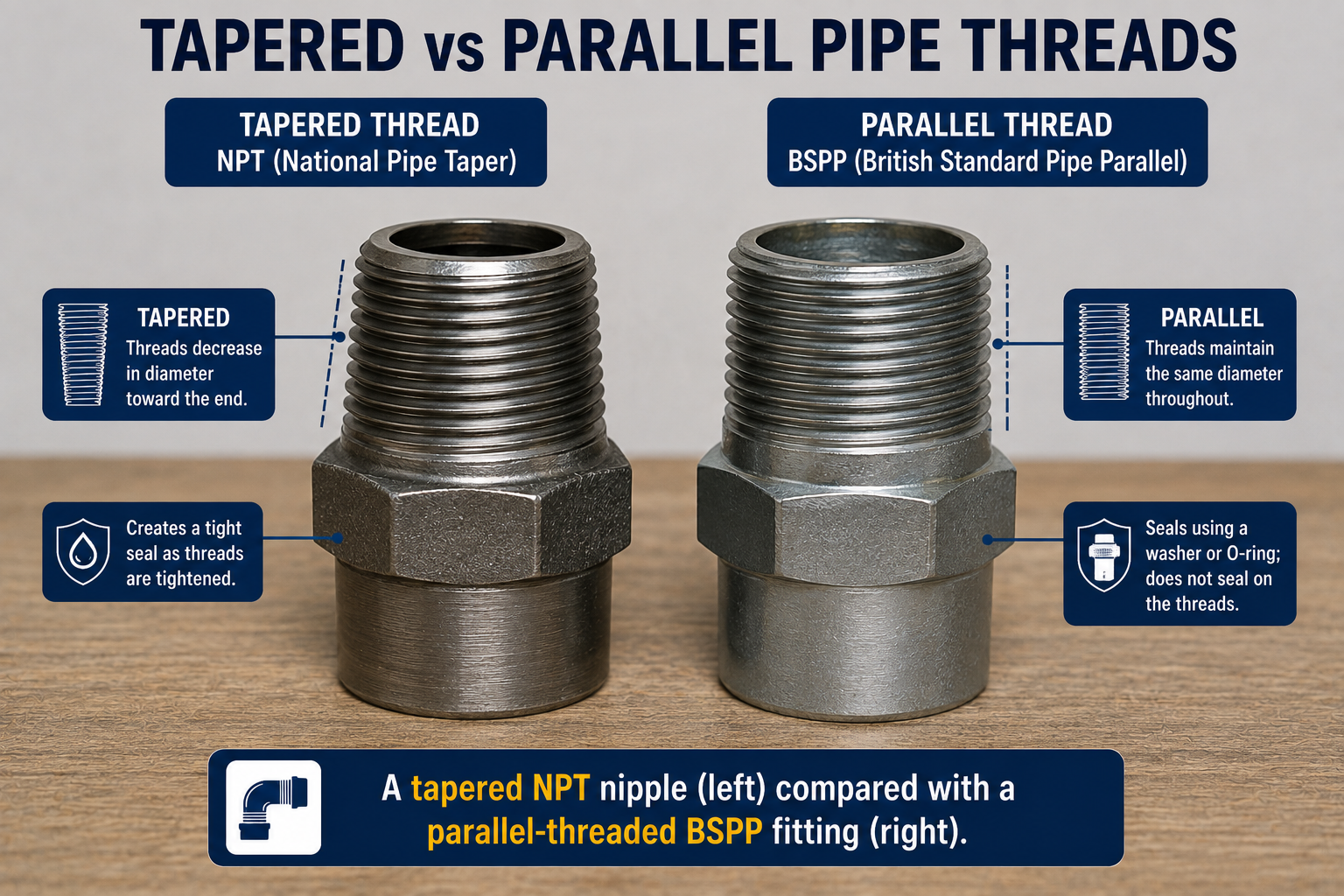
A tapered thread’s fit and sealing depend on how far it is threaded in, since diameter changes along the length. A parallel thread’s fit is more consistent regardless of how far it advances, but that same characteristic means it often cannot seal on the threads alone.
| Thread | Taper |
|---|---|
| NPT | 1:16 (3/4 inch per foot) |
| BSPT / R | 1:16, per ISO 7-1 |
| NPSC, NPSM, NPSL | None (parallel) |
| BSPP / G | None (parallel) |
NPT and BSPT happen to share the same 1:16 taper ratio convention, but this does not make them interchangeable, since thread angle, actual diameter and pitch still differ between the two standards.
⭐ NPT, NPSC, NPSM, NPSL & NPTR: The U.S. Family
ASME B1.20.1 covers all five of these related but distinct thread forms.
NPT vs NPS ⭐⭐⭐
NPT is tapered. NPS is a general term for straight (parallel) pipe thread forms, including NPSC, NPSM and NPSL. NPT and NPS based fittings serve different sealing roles and should not be assumed interchangeable simply because they may share a nominal size.
NPSC
Internal straight thread specifically used in pipe couplings, designed to mate with an external NPT taper thread to form a pressure-tight joint when assembled with lubricant or sealant. NPSC itself is straight even though it works with a tapered mating thread.
NPSM
Straight thread for free-fitting mechanical joints, commonly used where a mechanical connection is needed but sealing is handled by another means, such as a separate gasket or O-ring.
NPSL
Straight thread for loose-fitting mechanical joints with locknuts, typically used in swivel or locknut assemblies rather than as a primary sealing connection.
NPTR
Tapered thread specifically intended for railing joints, a specialized application distinct from general piping despite sharing the general tapered NPT thread form.
⭐⭐⭐ BSPT vs BSPP
These are two distinct British/ISO pipe thread forms that should never be combined into one generic “BSP” table.
| Feature | BSPT / R | BSPP / G |
|---|---|---|
| Full name | British Standard Pipe Taper | British Standard Pipe Parallel |
| Profile | Tapered | Parallel |
| Governing standard | ISO 7-1 | ISO 228-1 |
| Thread angle | 55 degrees | 55 degrees |
| Sealing | Can seal on the threads (pressure-tight) | Typically requires a separate sealing surface |
| Designation example | R 1/2 (external), Rp 1/2 or Rc 1/2 (internal) | G 1/2 |
| BSPT (R) Size | Major Dia. (mm) | TPI | Pitch (mm) |
|---|---|---|---|
| R 1/8 | 9.728 | 28 | 0.907 |
| R 1/4 | 13.157 | 19 | 1.337 |
| R 3/8 | 16.662 | 19 | 1.337 |
| R 1/2 | 20.955 | 14 | 1.814 |
| R 3/4 | 26.441 | 14 | 1.814 |
| R 1 | 33.249 | 11 | 2.309 |
| BSPP (G) Size | Major Dia. (mm) | TPI | Pitch (mm) |
|---|---|---|---|
| G 1/8 | 9.728 | 28 | 0.907 |
| G 1/4 | 13.157 | 19 | 1.337 |
| G 3/8 | 16.662 | 19 | 1.337 |
| G 1/2 | 20.955 | 14 | 1.814 |
| G 3/4 | 26.441 | 14 | 1.814 |
| G 1 | 33.249 | 11 | 2.309 |
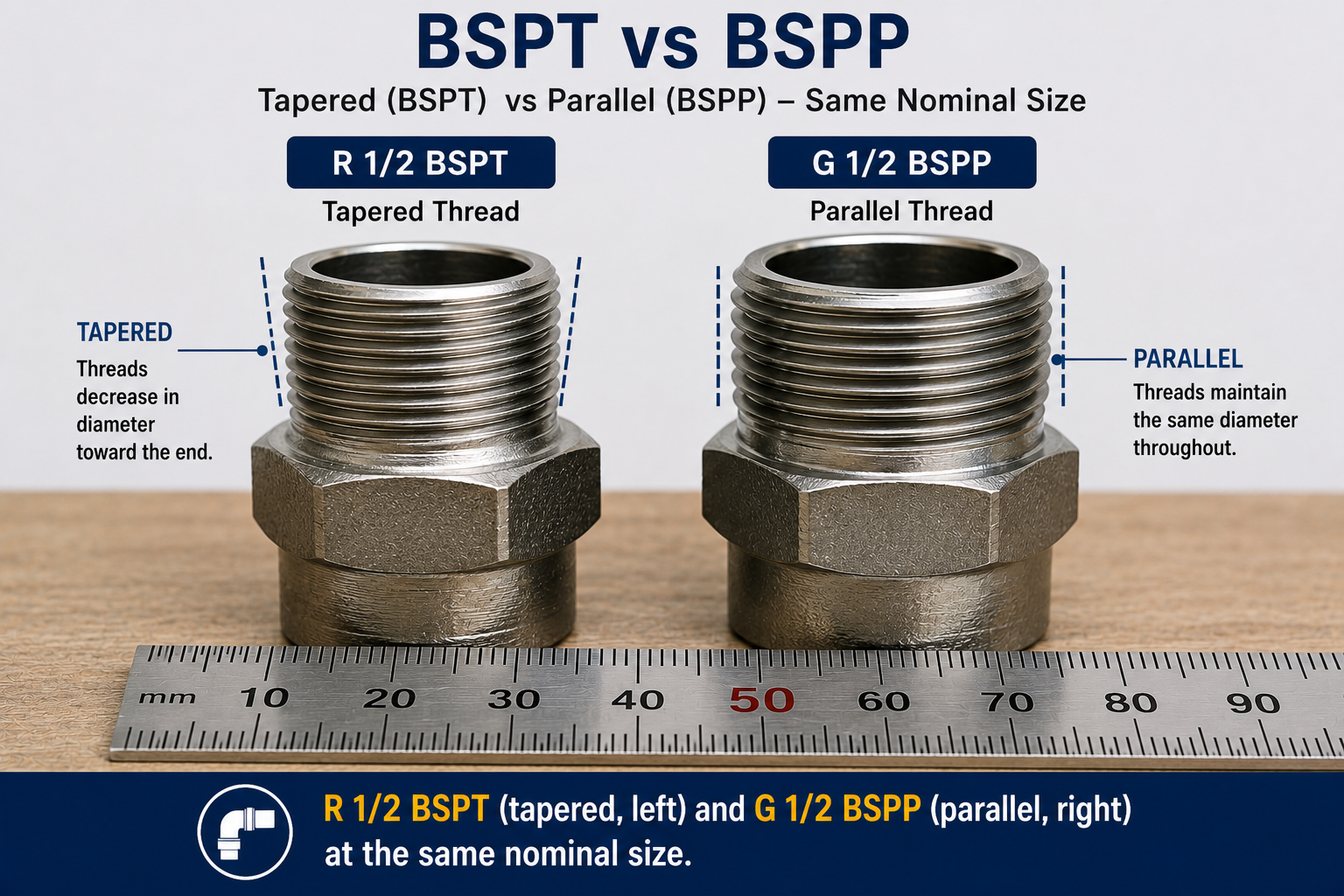
BSPT and BSPP share the same major diameter, TPI and pitch values at each nominal size, since both derive from the same Whitworth 55 degree thread form; the defining difference is BSPT’s taper versus BSPP’s parallel profile.
⭐⭐⭐ NPT vs BSP
One of the highest value comparisons on this page, essential for anyone working with imported equipment.
| Feature | NPT | BSP (BSPT/BSPP) |
|---|---|---|
| Origin/system | U.S. inch (ASME B1.20.1) | British/ISO (ISO 7 and ISO 228) |
| Thread angle | 60 degrees (Sellers profile) | 55 degrees (Whitworth profile) |
| Crest/root form | Flattened | Rounded |
| Tapered form | NPT | BSPT / R |
| Parallel form | NPSM, NPSC, NPSL | BSPP / G |
| Pitch system | TPI | TPI |
| Compatibility | Standard-specific | Standard-specific |
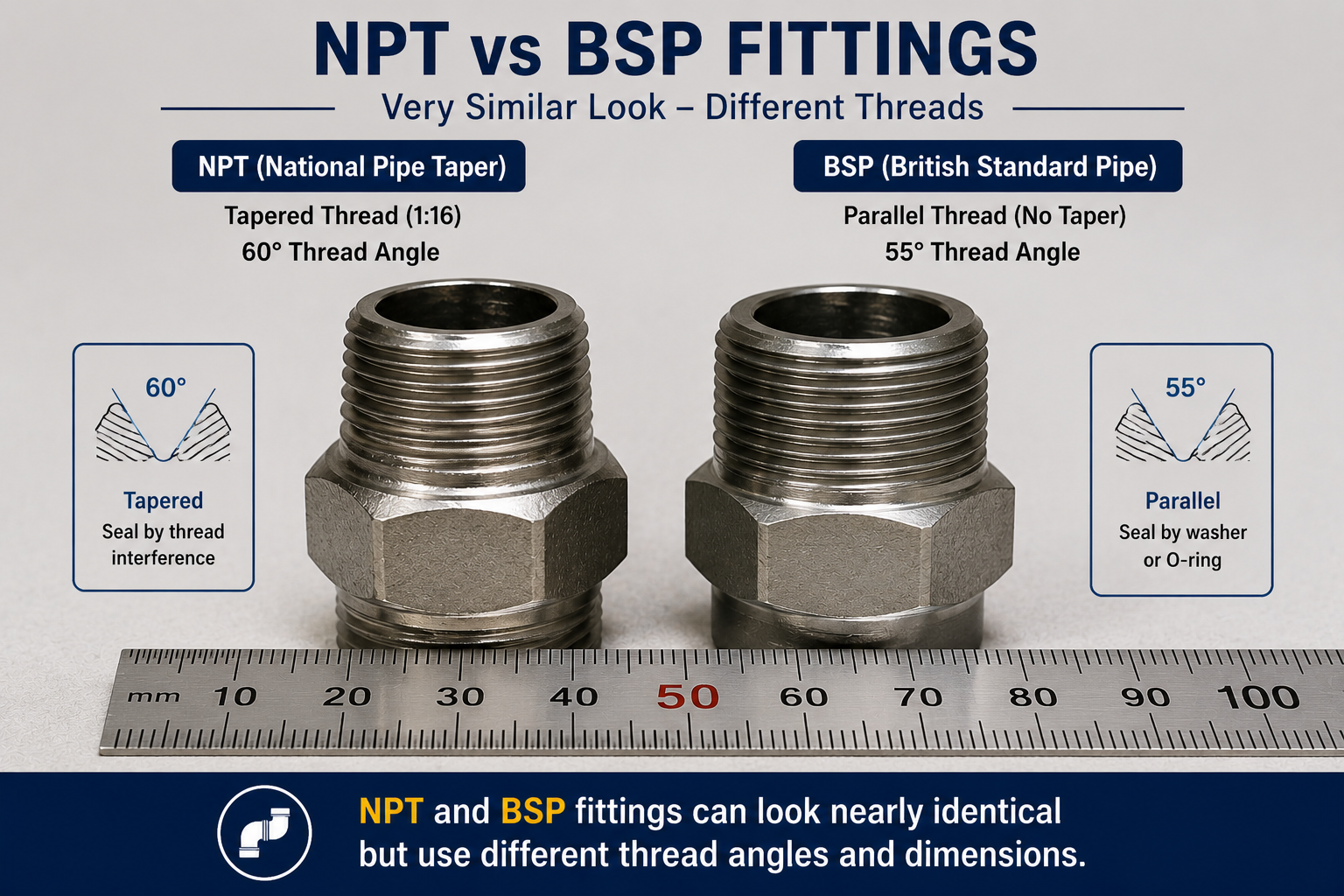
Even where nominal sizes and sometimes TPI happen to match (as with 1/2 and 3/4 inch), NPT’s 60 degree flattened thread form differs from BSP’s 55 degree rounded thread form, and actual outside diameters differ slightly as well. Forcing NPT and BSP fittings together risks leaks, cross-threading, and joint failure even when they appear to partially engage.
NPT vs BSPT
Both are tapered with a 1:16 taper ratio, but differ in thread angle (60 vs 55 degrees), crest/root shape, and precise dimensions at each nominal size.
NPT vs BSPP
NPT is tapered while BSPP is parallel; a fitting that looks similar in a photo can still be entirely incompatible because one relies on taper interference for sealing and the other does not seal on the threads at all.
⭐⭐⭐ Pipe Thread Designation Systems
Reading a designation correctly identifies both the standard and the thread form in one glance.
| Designation | Standard | Meaning |
|---|---|---|
| 1/2 NPT | ASME B1.20.1 | 1/2 inch nominal NPT tapered pipe thread |
| R 1/2 | ISO 7-1 | 1/2 inch BSPT external tapered thread |
| Rp 1/2 | ISO 7-1 | 1/2 inch BSPT internal parallel thread mating with an R external taper |
| Rc 1/2 | ISO 7-1 | 1/2 inch BSPT internal taper thread |
| G 1/2 | ISO 228-1 | 1/2 inch BSPP parallel thread (internal or external, class A/B for external) |
NPT designation
Commonly written as a nominal size followed by “NPT,” such as 1/2 NPT, sometimes with TPI explicitly included such as 1/2-14 NPT.
BSPT / R designation
ISO 7-1 uses R for external threads (always tapered), Rp for internal parallel threads mating with an external taper, and Rc for internal tapered threads, each followed by the nominal size.
BSPP / G designation
ISO 228-1 uses G followed by nominal size for both internal and external parallel threads, with class A or B specified for external threads to indicate tolerance level.
⭐⭐⭐ How to Identify a Pipe Thread
The complete diagnostic workflow for an unknown pipe thread.
Identify whether the thread is external (male) or internal (female).
Use a caliper at the largest point of an external thread, or measure the internal diameter for a female thread.
Use a thread pitch gauge or count threads over a measured length.
Look for a visibly decreasing diameter along the thread’s length.
A 60 degree flattened profile suggests NPT; a 55 degree rounded profile suggests BSP.
Match diameter, TPI, taper and profile together against NPT, BSPT, BSPP or other applicable tables.
State the complete designation including standard, such as 1/2 NPT or R 1/2.
Confirm with a matching fitting of the suspected standard and size, threaded carefully by hand.
⭐ Male vs Female Pipe Threads
External and internal pipe threads require different measurement approaches.
Male (external) pipe thread
Found on pipe ends, nipples, and plugs. Measure major/outside diameter directly with a caliper at the largest point of the thread.
Female (internal) pipe thread
Found inside fitting bodies, couplings, and valves. Measure using inside calipers, a bore gauge, or by testing with a known male fitting of a candidate size.
External thread measurement relies primarily on direct outside diameter and pitch gauge readings; internal thread measurement often relies more heavily on gauge verification or testing with a known mating part, since internal diameter measurement is less direct.
Equipment for Your Project
Affiliate disclosure: As an Amazon Associate, ConcreteCalculate earns from qualifying purchases. We may also earn a commission from other affiliate links at no additional cost to you.
⭐⭐⭐ Pipe Thread Sealing Concepts
Two fundamentally different sealing philosophies exist across pipe thread standards.
Thread itself creates the pressure-tight joint
Systems such as NPT and BSPT (governed by ISO 7-1 for pressure-tight joints made on the threads) rely on taper interference between mating male and female threads, typically assisted by sealant or tape, to achieve a leak-tight connection.
Thread is primarily for fastening
ISO 228-1 explicitly covers parallel fastening pipe threads (BSPP/G) where the pressure-tight joint is not made on the threads; sealing instead comes from an appropriate separate sealing surface, such as a bonded washer, O-ring, or metal-to-metal face seal.
Tapered pipe thread sealing
Relies on thread interference from the taper, commonly supplemented with PTFE tape or pipe thread sealant compound depending on the fluid, pressure, and manufacturer instructions. No single sealant method is universally correct for every tapered application.
Parallel pipe thread sealing
Because the thread itself does not create reliable interference along a constant diameter, most parallel pipe thread connections require a dedicated sealing surface, gasket, bonded seal, or O-ring at the joint face.
| Sealing Method | Best Suited To |
|---|---|
| PTFE tape | Tapered threads such as NPT and BSPT |
| Pipe thread sealant (dope) | Tapered threads, especially where tape may be unsuitable for the fluid or thread condition |
| Gasket or bonded seal washer | Parallel threads such as BSPP where a face seal is used |
| O-ring | Parallel threads or specific fitting designs incorporating an O-ring groove |
⭐⭐⭐ Pipe Thread Gaging by Standard
Each pipe thread standard has its own formal verification approach, distinct from casual field identification.
NPT thread gaging
ASME B1.20.1 defines dimensional and gaging concepts including hand-tight engagement (L1) and effective thread length, verified using L1 plug and ring gauges specific to NPT.
BSP thread gaging
International pipe thread systems use their own applicable verification standards; ISO 7-2 specifically addresses verification of pressure-tight pipe threads (including BSPT) by limit gauges, separate from the NPT gaging system.
Plug and ring gauges
Plug gauges verify internal (female) threads; ring gauges verify external (male) threads, for the specific standard being checked.
GO / NOT-GO concept
GO confirms the thread is not oversized on the checked dimension; NOT-GO confirms it is not undersized, following the same general acceptance logic used across formal thread gaging systems, but always specific to the standard’s own gauge design.
Formal gaging determines whether a manufactured thread meets its specification’s tolerance requirements. Field identification with a caliper and pitch gauge is typically sufficient to determine which standard and size a thread likely is, but does not replace formal gaging for production acceptance.
⭐⭐⭐ Pipe Thread Compatibility Chart
A practical reference for whether two thread systems can be directly connected.
| Thread A | Thread B | Compatible? | Reason |
|---|---|---|---|
| NPT | NPT | Yes, when size and thread form match | Same system |
| NPT | BSPT | Generally not directly interchangeable | Different thread angle and standard, despite similar nominal sizing |
| NPT | BSPP | Not a direct standard match | Taper versus parallel profile, plus thread angle differences |
| NPT | Metric pipe thread | Not interchangeable | Different systems and dimensional conventions |
| NPT | UNC/UNF | Not interchangeable | Pipe thread versus fastener thread; entirely different purpose and geometry |
| BSPT | BSPP | Not directly interchangeable as a sealing pair | Tapered versus parallel profile, despite sharing thread angle and dimensions |
Purpose-built adapters and transition fittings exist specifically because these systems are not directly interchangeable. Use a properly designed and rated adapter rather than attempting to force two different pipe thread standards together.
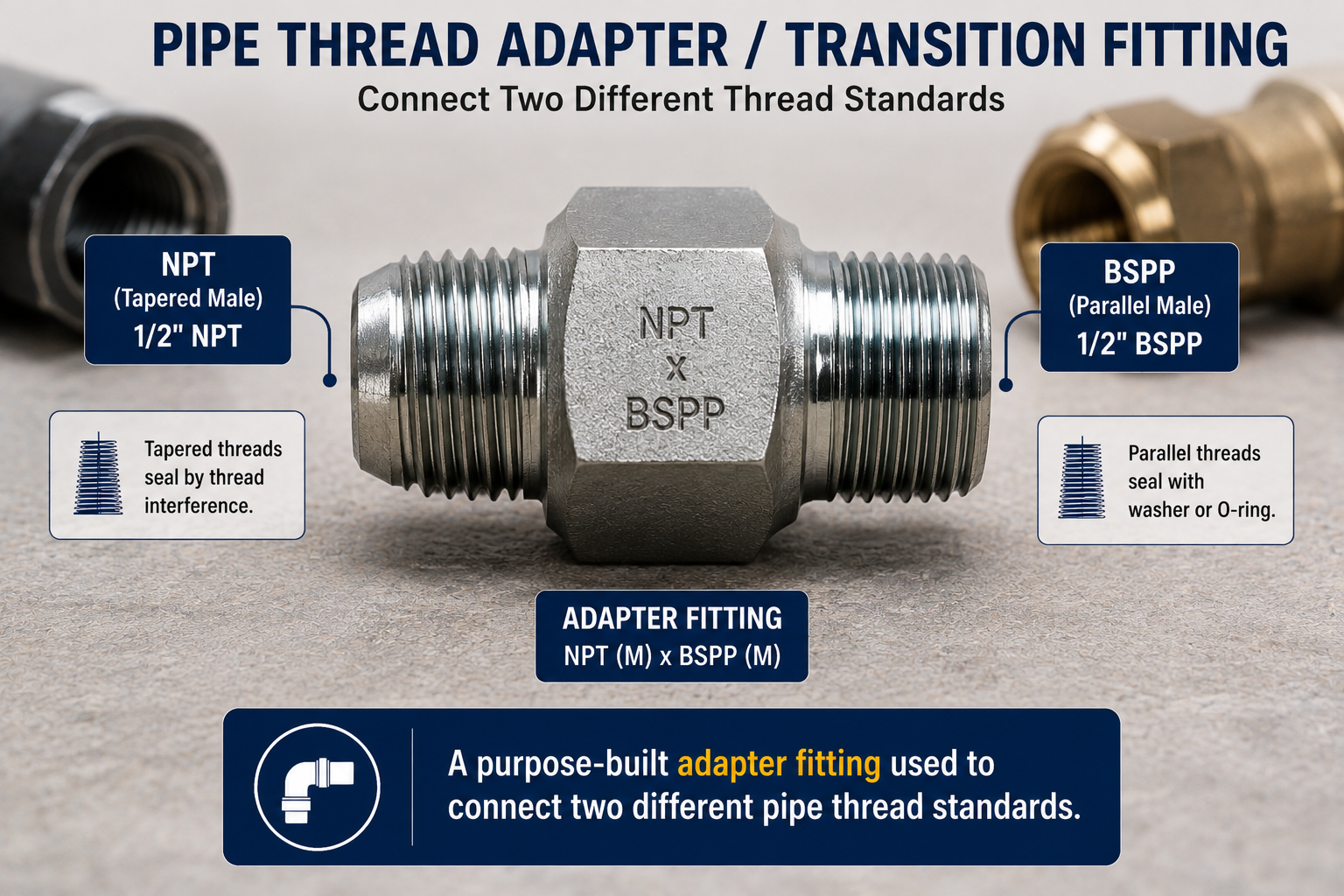
⭐⭐⭐ 1/2 Inch Pipe Thread & Other Common Sizes
Users frequently search for a specific nominal size without realizing multiple distinct standards use that same label.
| Standard | Designation | Actual Diameter | TPI | Taper/Parallel |
|---|---|---|---|---|
| NPT | 1/2 NPT | 0.840 in (21.34 mm) | 14 | Tapered |
| BSPT | R 1/2 | 0.825 in (20.955 mm) | 14 | Tapered |
| BSPP | G 1/2 | 0.825 in (20.955 mm) | 14 | Parallel |
1/4 inch pipe thread
NPT: 0.540 in OD, 18 TPI. BSPT/BSPP: 0.518 in (13.157 mm) OD, 19 TPI. Different OD and different TPI at the same nominal label.
3/8 inch pipe thread
NPT: 0.675 in OD, 18 TPI. BSPT/BSPP: 0.656 in (16.662 mm) OD, 19 TPI.
3/4 inch pipe thread
NPT: 1.050 in OD, 14 TPI. BSPT/BSPP: 1.041 in (26.441 mm) OD, 14 TPI. TPI matches here, but OD and thread angle still differ.
1 inch pipe thread
NPT: 1.315 in OD, 11.5 TPI. BSPT/BSPP: 1.309 in (33.249 mm) OD, 11 TPI.
⭐⭐⭐ Pipe Thread vs Pipe Size vs Tube Size
These related but distinct concepts frequently cause confusion.
Pipe thread vs pipe size
Nominal pipe size and thread designation are related but are not always the same as the measured thread diameter. See the Pipe Size Chart for nominal pipe sizing conventions separate from thread dimension detail.
Pipe vs tube
Pipe is conventionally sized by nominal designation with actual OD differing from that label; tube is conventionally sized directly by its actual outside diameter. A fitting for tube of a given OD is not automatically compatible with pipe thread of a similarly labeled nominal size.
Pipe schedule vs thread size
Pipe schedule describes wall thickness at a given nominal pipe size and does not define or change the thread standard used on that pipe’s ends; a Schedule 40 and Schedule 80 pipe of the same nominal size typically use the same thread standard and dimensions at the threaded connection.
⭐ Pipe Thread Applications
Different industries and regions favor different pipe thread standards.
Plumbing
NPT is standard in North American plumbing; BSP is common in many other regions, and imported fixtures may use either system.
Hydraulic systems ⭐
Hydraulic fittings can use NPT, BSP, SAE, metric, and other specialized systems on the same piece of equipment. Never identify a hydraulic fitting solely by appearance; always measure and verify.
Pneumatic systems
Air fittings, regulators, valves, and compressors commonly use smaller NPT or BSP sizes depending on the equipment’s origin.
Construction ⭐
Water lines, pumps, compressors, and pressure equipment on construction sites may use NPT or, for imported equipment, BSP fittings; always verify the thread standard before sourcing replacement parts.
⭐⭐⭐ Pipe Thread Visual Guide
Original diagrams built specifically to compare pipe thread standards.
⭐⭐⭐ Pipe Thread Identification Worked Examples
These examples show the complete measure, compare, and verify process across standards.
1. Unknown NPT Fitting
2. NPT vs BSPT at the Same Nominal Size
3. Parallel Pipe Thread
4. 1/2-Inch Pipe Thread Comparison
⭐⭐⭐ Common Pipe Thread Identification Mistakes
Most pipe thread failures and leaks trace back to one of these errors.
❌ Assuming nominal size equals actual OD
Every pipe thread standard’s nominal size differs from its measured diameter.
❌ Confusing NPT with BSP
Different thread angle and actual dimensions despite similar labels.
❌ Confusing NPT with NPS
Tapered versus straight forms serve different sealing roles.
❌ Confusing BSPT with BSPP
Same thread angle and dimensions, but tapered versus parallel profile changes everything about fit and sealing.
❌ Measuring diameter only
TPI and taper checks are also required for reliable identification.
❌ Measuring TPI only
Some standards share TPI at certain sizes; diameter and profile confirm the match.
❌ Ignoring taper
Failing to check for a tapered profile can lead to a wrong standard assumption.
❌ Ignoring thread profile
60 versus 55 degree angle and crest/root shape distinguish NPT from BSP.
❌ Using the wrong sealant
Tapered and parallel systems generally call for different sealing approaches.
❌ Assuming similar-looking fittings are interchangeable
Visual similarity is not proof of thread compatibility.
❌ Confusing pipe size with thread size
Nominal pipe size and actual thread dimensions are related but distinct.
❌ Assuming all 1/2 inch threads are the same
NPT, BSPT, and BSPP all differ at the identical nominal label.
⭐ Pipe Thread Safety & Pressure Considerations
Correct thread identification is especially critical for pressurized and safety-relevant systems.
For pressurized water, compressed air, hydraulic systems, gas, steam, and other industrial fluid systems, thread misidentification can lead to leaks, joint failure, or unsafe conditions. For safety-critical or pressure-containing systems, always follow the applicable code, manufacturer documentation, and engineering requirements rather than relying solely on a general identification chart like this one.
Frequently Asked Questions
📄 Download Pipe Thread Chart PDF
This PDF is designed as a genuine field reference. Use the print button to create a print-ready or downloadable version for jobsite or shop use.
Cite or Embed This Chart
Copy the page-wide citation to reference the complete Pipe Thread Chart.