Concrete Density Chart – kg/m3, lb/ft3 & Unit Weight Guide
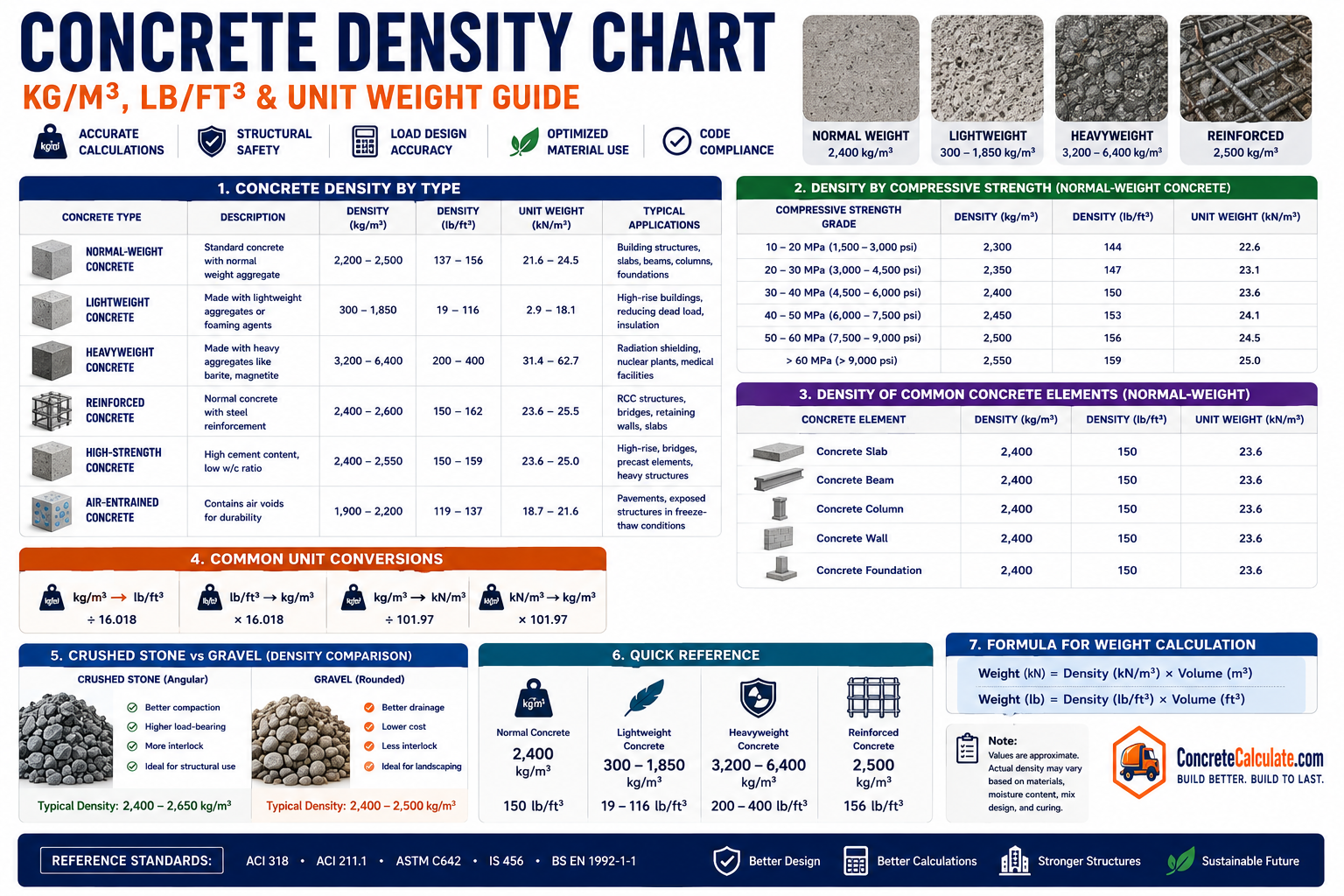
Concrete Density Chart
kg/m3, lb/ft3 & Unit Weight Guide
The complete concrete density reference — normal, lightweight, heavyweight, and reinforced concrete in Imperial and Metric units.
 Reviewed by Muhammad Ramzan Babar, PhD Researcher (Plasma Physics) & Calculator Developer — View Profile
⭐ Master Concrete Density Chart
Complete reference showing the density of normal-weight, lightweight, heavyweight, reinforced, fresh, and hardened concrete in Imperial and Metric units.
How to Read This Chart
2,400 kg/m3 (150 lb/ft3) is the standard ACI 318 reference density for normal-weight concrete. Calculate exact project weight with our Concrete Weight Calculator.
| Concrete Type | Density (kg/m³) | Density (lb/ft³) |
|---|---|---|
| Lightweight Concrete | 300-1,850 | 19-115 |
| Normal-Weight Concrete | 2,300-2,400 | 145-150 |
| Reinforced Concrete | 2,400-2,500 | 150-156 |
| Heavyweight Concrete | 2,600-3,900 | 162-243 |
| Fresh Concrete | 2,350-2,450 | 147-153 |
| Hardened Concrete | 2,300-2,400 | 145-150 |
Source: ACI 318 standard density references, concrete weight calculators.
⭐ Concrete Density Chart by Concrete Type
Density varies significantly across concrete categories based on aggregate composition and mix design.
| Concrete Type | Density (kg/m³) | Density (lb/ft³) | Density (kN/m³) |
|---|---|---|---|
| Lightweight Concrete | 300-1,850 | 19-115 | 2.9-18.1 |
| Normal-Weight Concrete | 2,300-2,400 | 145-150 | 22.6-23.5 |
| Heavyweight Concrete | 2,600-3,900 | 162-243 | 25.5-38.2 |
| Reinforced Concrete | 2,400-2,500 | 150-156 | 23.5-24.5 |
| Roller-Compacted Concrete | 2,300-2,500 | 144-156 | 22.6-24.5 |
| Self-Consolidating Concrete | 2,350-2,450 | 147-153 | 23.0-24.0 |
| High-Strength Concrete | 2,400-2,550 | 150-159 | 23.5-25.0 |
Source: concrete weight calculator density references across mix types.
Concrete Density by Strength Grade
Density varies only slightly with strength grade — aggregate type has a much greater influence on overall density.
| Grade | Density (kg/m³) | Typical Applications |
|---|---|---|
| M10 | ~2,300 | Blinding, non-structural fill |
| M15 | ~2,350 | Footpaths, low-load footings |
| M20 | ~2,400 | Residential slabs, footings |
| M25 | ~2,400 | RCC structural work |
| M30 | ~2,400 | Beams, columns, slabs |
| M35 | ~2,410 | High-rise structural members |
| M40 | ~2,420 | Bridges, heavy structures |
| M50 | ~2,450 | High-strength precast, towers |
Key Insight
Density is largely aggregate-driven — a high-strength mix with lightweight aggregate can weigh less than a low-strength mix with dense natural stone.
Concrete Density by PSI
PSI grade correlates loosely with density since higher-strength mixes often use denser, well-graded aggregate.
| PSI | Density (lb/ft³) | Typical Uses |
|---|---|---|
| 2500 PSI | ~145 | Sidewalks, non-structural slabs |
| 3000 PSI | ~145-148 | Residential slabs, footings |
| 3500 PSI | ~148 | Driveways, patios |
| 4000 PSI | ~148-150 | Garage floors, exterior flatwork |
| 5000 PSI | ~150 | Structural slabs, columns |
| 6000 PSI | ~150-155 | High-rise, precast, bridges |
For PSI-specific mix guidance, see our 2500 PSI Concrete Uses, 3000 PSI Guide, and 4000 PSI Guide.
⭐ Fresh Concrete vs Hardened Concrete Density
Density changes slightly after curing due to moisture loss through evaporation and ongoing cement hydration.
| State | Density (kg/m³) | Density (lb/ft³) |
|---|---|---|
| Fresh Concrete | 2,350-2,450 | 147-153 |
| Hardened Concrete | 2,300-2,400 | 145-150 |
Fresh concrete typically weighs slightly more per unit volume because it still contains its full mix water. As curing progresses, some water evaporates and reacts chemically during hydration, causing a small net density reduction in the hardened state.
Source: ASTM C138 unit weight testing standards for fresh concrete.
Reinforced vs Plain Concrete Density
Embedded steel reinforcement slightly increases the overall density of structural concrete members compared to plain concrete.
| Concrete Type | Density (kg/m³) | Density (lb/ft³) |
|---|---|---|
| Plain Concrete | 2,300-2,400 | 144-150 |
| Fiber-Reinforced Concrete | 2,350-2,450 | 147-153 |
| Reinforced Concrete | 2,400-2,500 | 150-156 |
Source: plain vs reinforced cement concrete unit weight comparison.
Lightweight Concrete Density Chart
Lightweight concrete achieves reduced density through air entrainment, foaming agents, or lightweight aggregates.
| Type | Density (kg/m³) | Density (lb/ft³) |
|---|---|---|
| Cellular Concrete | 400-1,850 | 25-115 |
| Foamed Concrete | 400-1,850 | 25-115 |
| Aerated Concrete (AAC) | 300-700 | 19-44 |
| Lightweight Aggregate Concrete | 1,400-1,850 | 87-115 |
Source: AAC and foamed concrete density research.
Heavyweight Concrete Density Chart
Heavyweight concrete replaces normal aggregate with dense minerals or metal to increase mass for shielding applications.
| Aggregate | Density (kg/m³) | Typical Application |
|---|---|---|
| Barite | ~3,500 | Radiation shielding, medical imaging rooms |
| Magnetite | ~3,900 | Nuclear facility shielding |
| Hematite | ~3,000-3,400 | Radiation shielding, counterweights |
| Steel Shot | ~3,700-4,600 | Extra-heavy structural/shielding elements |
| Steel Punchings | ~3,700-4,800 | Counterweights, extra-heavy concrete |
Source: radiation shielding concrete research using barite and magnetite aggregate.
⭐ Concrete Density by Aggregate Type
Aggregate selection is the single greatest factor influencing final concrete density.
| Aggregate Type | Typical Density (kg/m³) |
|---|---|
| Limestone | 2,300-2,400 |
| Granite | 2,400-2,450 |
| Basalt | 2,450-2,550 |
| Gravel | 2,300-2,400 |
| Crushed Stone | 2,350-2,450 |
| Lightweight Aggregate | 1,400-1,850 |
| Expanded Clay | 300-900 |
| Expanded Shale | 650-1,100 |
For full aggregate gradation standards, see our Aggregate Size Chart.
Concrete Density by Construction Application
Most construction applications use normal-weight concrete, with specialty applications requiring lightweight or heavyweight mixes.
| Application | Typical Density (kg/m³) |
|---|---|
| Foundations | 2,400 |
| Footings | 2,400 |
| Slabs | 2,300-2,400 |
| Driveways | 2,300-2,400 |
| Sidewalks | 2,300-2,400 |
| Bridges | 2,400-2,500 |
| High-Rise Buildings | 2,400-2,500 |
| Industrial Floors | 2,400 |
| Radiation Shielding | 2,600-3,900 |
Concrete Density vs Unit Weight
Density and unit weight describe the same physical property, expressed in different unit systems.
| Measure | Normal Concrete Value |
|---|---|
| Density (kg/m³) | 2,400 |
| Unit Weight (kN/m³) | ~23.5 |
| Weight per Cubic Foot | 150 lb |
| Weight per Cubic Yard | 4,050 lb |
Source: ACI 318 unit weight of concrete standards.
Concrete Weight per Unit Volume Chart
A field-ready reference for converting normal-weight concrete volumes to weight across common units.
| Volume Unit | Weight (Normal Concrete) |
|---|---|
| Per Cubic Inch | 0.0868 lb |
| Per Cubic Foot | 150 lb (68 kg) |
| Per Cubic Yard | 4,050 lb (1.84 t) |
| Per Cubic Meter | 2,400 kg (5,291 lb) |
Source: concrete weight per volume reference tables.
Concrete Density Conversion Chart
Convert between the most common density units used in international construction and engineering standards.
| From | To | Multiply By |
|---|---|---|
| kg/m³ | lb/ft³ | ÷ 16.018 |
| lb/ft³ | kg/m³ | × 16.018 |
| kg/m³ | lb/in³ | ÷ 27,680 |
| kg/m³ | kN/m³ | × 0.00981 |
| kg/m³ | g/cm³ | ÷ 1,000 |
| kg/m³ | t/m³ | ÷ 1,000 |
Source: standard density unit conversion factors.
Concrete Density vs Mix Design
Mix design variables — water-cement ratio, aggregate type, air content, and cement content — all interact to shape final density.
| Mix Variable | Effect on Density |
|---|---|
| Water-Cement Ratio | Higher ratio slightly reduces density due to increased porosity |
| Aggregate Type | Largest influence — dense aggregate increases, lightweight decreases density |
| Air Content | Higher entrained air reduces density |
| Cement Content | Minor effect; cement is denser than water but lighter than aggregate |
For complete mix proportioning guidance, see our Concrete Mix Design Chart.
Concrete Density vs Moisture Content
Moisture state at the time of measurement significantly affects recorded density values.
Dry Concrete
Lowest recorded density after full moisture evaporation from hardened mass
Saturated Concrete
Highest density due to water filling internal pore structure
Fresh Concrete
Slightly higher than hardened dry state, before evaporation and hydration
Concrete Density vs Compressive Strength
Higher strength does not always translate into significantly higher density — the two properties are governed by different mix factors.
| Property | Primary Driver |
|---|---|
| Density | Aggregate type and air content |
| Strength | Water-cement ratio and cement quality |
| Durability | Water-cement ratio, curing, and air entrainment |
Concrete Density by Structural Element
Most structural elements use normal-weight concrete density unless specified otherwise for weight or shielding reasons.
| Structural Element | Typical Density (kg/m³) |
|---|---|
| Slabs | 2,300-2,400 |
| Beams | 2,400-2,500 |
| Columns | 2,400-2,500 |
| Footings | 2,400 |
| Retaining Walls | 2,400 |
| Precast Members | 2,400-2,550 |
⭐ Concrete Density Selection Guide
A quick decision reference matching project type to recommended concrete type, density, and reasoning.
| Project | Recommended Concrete Type | Typical Density | Why |
|---|---|---|---|
| Residential Buildings | Normal-weight concrete | 2,400 kg/m³ | Standard structural performance at lowest cost |
| Bridges | Normal/high-strength concrete | 2,400-2,500 kg/m³ | High durability and load-bearing requirements |
| High-Rise Buildings | Reinforced normal-weight concrete | 2,400-2,500 kg/m³ | Structural strength with manageable dead load |
| Marine Structures | Normal-weight, low-permeability concrete | 2,400 kg/m³ | Durability against chloride/sulfate exposure |
| Radiation Shielding | Heavyweight concrete (barite/magnetite) | 2,600-3,900 kg/m³ | Maximum mass needed for radiation attenuation |
| Lightweight Roof Systems | Lightweight aggregate concrete | 1,400-1,850 kg/m³ | Reduces dead load on supporting structure |
⭐ Visual Concrete Density Comparison
Equal-sized cubes scaled by relative weight to illustrate the dramatic density differences across concrete types.
Note: cube sizes are proportionally scaled to relative weight per unit volume for visual comparison.
Common Concrete Density Mistakes
These errors are the most frequent causes of miscalculated loads and material estimates.
Confusing density with strength
Higher PSI concrete does not always mean heavier concrete — strength and density are controlled by different mix factors.
Ignoring moisture content
Measuring density on saturated vs. dry concrete gives significantly different values, skewing weight calculations.
Using incorrect unit conversions
Mixing up kg/m3 and lb/ft3 without proper conversion factors leads to major structural calculation errors.
Assuming all concrete weighs the same
Lightweight and heavyweight mixes can differ by a factor of 10 or more from normal-weight concrete.
Forgetting reinforcement weight
Omitting steel reinforcement weight in dead load calculations underestimates total structural load.
Contractor Worked Examples
Real-world density-based weight calculations for common job scenarios.
Calculating Slab Weight
Foundation Dead Load
Concrete Truck Load Estimation
Reinforced Concrete Beam Weight
Retaining Wall Weight
Frequently Asked Questions
📥 Download Concrete Density Chart PDF
Use your browser’s print function to instantly save this page as a PDF — a printable engineering reference with density tables, unit conversions, weight-per-volume tables, aggregate density comparisons, and a dead-load quick reference.