Thread Size Chart 2026 – UNC/UNF, Metric, BSP & NPT
Thread Size Chart
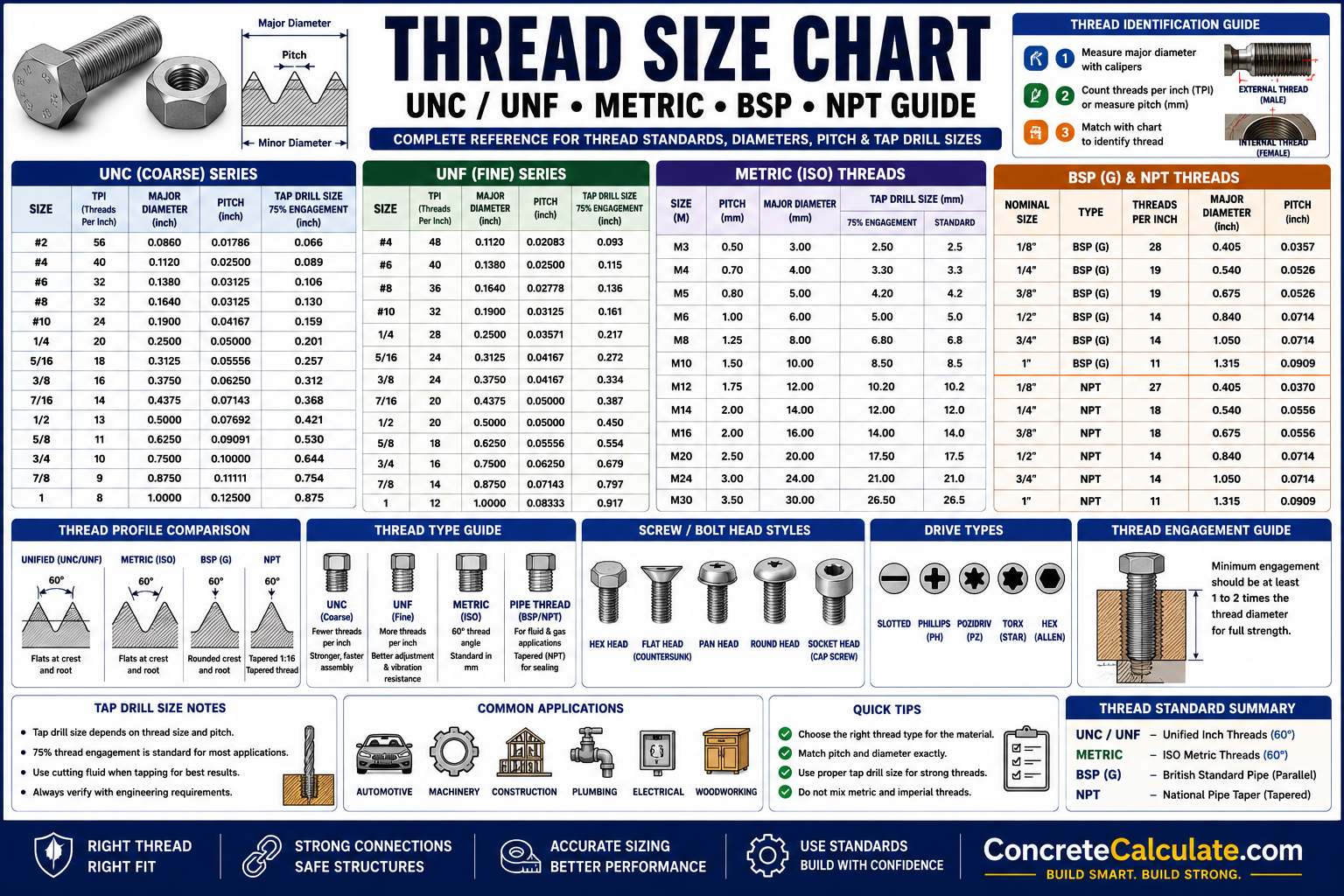
UNC/UNF, Metric, BSP & NPT
Complete thread reference for engineers and contractors, identify unknown threads, compare standards, and find the right tap drill size.
 Reviewed by Muhammad Ramzan Babar, PhD Researcher (Plasma Physics) & Calculator Developer — View Profile
What This Page Helps You Decide
Rather than reproducing endless engineering tables, this page is built to answer five practical questions: what thread do I have, how do I measure it, which standard should I use, which tap drill is correct, and can these thread types fit together. Use the Table of Contents to jump straight to what you need.
⭐ Master Thread Size Chart
Complete overview comparing the four major thread standards used across construction and machinery.
How to Read This Chart
A thread is fully defined by three things: its diameter, its pitch (or threads per inch), and its standard/form. Get any one wrong and hardware won’t mate correctly. For structural anchor threading, verify capacity with our Anchor Bolt Calculator.
| Thread Standard | Sizing Units | Thread Angle | Typical Region/Use |
|---|---|---|---|
| ISO Metric | Millimeters (e.g., M8) | 60° | Global standard, machinery, automotive, structural |
| Unified (UNC/UNF) | Inches (e.g., 1/2″-20) | 60° | North American fasteners, structural bolts |
| BSP (BSPP/BSPT) | Inches, nominal pipe size | 55° | UK, Europe, Commonwealth plumbing/pneumatics |
| NPT | Inches, nominal pipe size | 60° | North American pipe and plumbing connections |
⭐ Unified Thread Size Chart (UNC/UNF)
Common inch-series thread sizes under ASME B1.1, showing major diameter and threads per inch for both coarse and fine series.
| Thread Size | Major Diameter | UNC TPI | UNF TPI |
|---|---|---|---|
| #0 | 0.060″ | — | 80 |
| #1 | 0.073″ | 64 | 72 |
| #2 | 0.086″ | 56 | 64 |
| #4 | 0.112″ | 40 | 48 |
| #6 | 0.138″ | 32 | 40 |
| #8 | 0.164″ | 32 | 36 |
| #10 | 0.190″ | 24 | 32 |
| #12 | 0.216″ | 24 | 28 |
| 1/4″ | 0.250″ | 20 | 28 |
| 5/16″ | 0.3125″ | 18 | 24 |
| 3/8″ | 0.375″ | 16 | 24 |
| 1/2″ | 0.500″ | 13 | 20 |
| 5/8″ | 0.625″ | 11 | 18 |
| 3/4″ | 0.750″ | 10 | 16 |
| 1″ | 1.000″ | 8 | 12 |
A thread designation like “1/2-13 UNC” or “1/2-20 UNF” combines diameter and TPI — the number after the dash is always threads per inch, not a separate size.
⭐ Metric Thread Size Chart
Common ISO metric thread sizes with coarse and fine pitch options.
| Thread Size | Major Diameter | Coarse Pitch | Fine Pitch | Typical Applications |
|---|---|---|---|---|
| M2 | 2.0 mm | 0.4 mm | — | Small electronics, eyewear |
| M2.5 | 2.5 mm | 0.45 mm | — | Small precision hardware |
| M3 | 3.0 mm | 0.5 mm | 0.35 mm | Electronics, small equipment |
| M4 | 4.0 mm | 0.7 mm | 0.5 mm | General equipment assembly |
| M5 | 5.0 mm | 0.8 mm | 0.5 mm | General machinery, panels |
| M6 | 6.0 mm | 1.0 mm | 0.75 mm | Machinery, structural hardware |
| M8 | 8.0 mm | 1.25 mm | 1.0 mm | Heavier machinery, automotive |
| M10 | 10.0 mm | 1.5 mm | 1.25 mm | Heavy-duty machinery, structural |
| M12 | 12.0 mm | 1.75 mm | 1.25 mm | Heavy structural and industrial use |
| M16 | 16.0 mm | 2.0 mm | 1.5 mm | Structural steel connections |
| M20 | 20.0 mm | 2.5 mm | 1.5 mm | Heavy structural and anchor bolts |
| M24 | 24.0 mm | 3.0 mm | 2.0 mm | Large structural connections |
| M30 | 30.0 mm | 3.5 mm | 2.0 mm | Heavy industrial and bridge anchoring |
⭐ Thread Size by Construction Application
Matching common project categories to the thread standard typically specified.
| Project | Recommended Thread Standard |
|---|---|
| Structural Steel | UNC (North America) or ISO Metric Coarse (most other regions) |
| Machinery | UNF or Metric Fine, depending on manufacturer origin |
| Automotive | Metric (global standard), some UNF on older US vehicles |
| Plumbing | NPT (North America) or BSP (UK/Europe/Commonwealth) |
| Concrete Anchors | UNC or Metric Coarse, per anchor manufacturer specification |
| Heavy Equipment | Metric Coarse or UNC, depending on manufacturer |
| Pipe Connections | NPT or BSPT (tapered pipe threads) |
| Wood Fasteners | Proprietary screw threads, not standardized like machine threads |
For wood screw sizing rather than machine threads, see our Screw Size Chart.
⭐ Thread Diameter Chart
Understanding the three key diameter measurements that define any screw thread.
| Diameter | What It Means | Where It’s Measured |
|---|---|---|
| Major Diameter | Largest diameter of the thread — the nominal size (e.g., the “8” in M8) | Outer crests of external thread, outer points of internal thread |
| Pitch Diameter | Theoretical diameter where thread width equals the gap between threads | Midway between major and minor diameter, on the thread flank |
| Minor Diameter | Smallest diameter of the thread, at the root of the groove | Root (bottom) of external thread, crest of internal thread |
⭐ Thread Pitch Chart
One of the highest-value sections — comparing pitch classifications across thread standards.
| Series | Standard | Pitch Character | Best For |
|---|---|---|---|
| UNC | Unified | Coarse (fewer threads/inch) | General fastening, soft materials, quick assembly |
| UNF | Unified | Fine (more threads/inch) | Precision, thin materials, vibration resistance |
| UNEF | Unified | Extra fine (most threads/inch) | Thin-wall parts, instruments, aerospace |
| Metric Coarse | ISO Metric | Larger pitch in mm | General fastening, soft materials |
| Metric Fine | ISO Metric | Smaller pitch in mm | Precision, thin-wall, vibration-prone joints |
Coarse vs Fine, in One Sentence
Coarse threads install faster and resist stripping in soft materials; fine threads pack more thread surface into the same length, improving tensile efficiency and resistance to loosening from vibration.
⭐ UNC vs UNF Thread Comparison
A very common comparison with strong practical implications for fastener selection.
| Factor | UNC (Coarse) | UNF (Fine) |
|---|---|---|
| Thread Pitch | Fewer threads per inch | More threads per inch |
| Strength | Slightly lower tensile strength per diameter | Slightly higher tensile strength per diameter |
| Assembly Speed | Faster to thread and drive | Slower, requires more turns |
| Vibration Resistance | Lower resistance to loosening | Higher resistance to loosening |
| Typical Applications | General construction, structural steel, wood-adjacent hardware | Precision machinery, automotive, thin-wall parts |
Metric Coarse vs Metric Fine Threads
The metric equivalent comparison, following the same underlying principle as UNC vs UNF.
| Factor | Metric Coarse | Metric Fine |
|---|---|---|
| Thread Engagement | Deeper thread profile per turn | Shallower thread profile, more turns per length |
| Strength | Good general strength, standard default | Higher tensile efficiency in same diameter |
| Common Uses | General bolts, structural hardware, default choice | Precision assemblies, thin materials, automotive |
| Advantages | Widely available, more forgiving of minor damage/dirt | Better vibration resistance, finer adjustment |
| Limitations | Slightly lower strength-to-diameter ratio | More prone to cross-threading, less forgiving of damage |
BSP Thread Size Chart
British Standard Pipe threads, common throughout the UK, Europe, and Commonwealth countries.
| Nominal Pipe Size | Type | Threads Per Inch | Notes |
|---|---|---|---|
| 1/8″ | BSPP or BSPT | 28 | Small fittings, instrumentation |
| 1/4″ | BSPP or BSPT | 19 | Common pneumatic and plumbing fittings |
| 3/8″ | BSPP or BSPT | 19 | General plumbing and pneumatic use |
| 1/2″ | BSPP or BSPT | 14 | Common water and gas fittings |
| 3/4″ | BSPP or BSPT | 14 | Larger plumbing and irrigation fittings |
| 1″ | BSPP or BSPT | 11 | Heavier-duty pipe connections |
BSPP (parallel) threads seal via a washer or O-ring at a shoulder, while BSPT (tapered) threads seal by the taper itself wedging into the mating fitting.
NPT Thread Size Chart
National Pipe Thread (tapered), the standard for pipe connections across North America.
| Nominal Pipe Size | Threads Per Inch | Common Use |
|---|---|---|
| 1/8″ | 27 | Small gauge and instrument fittings |
| 1/4″ | 18 | Compressed air, small plumbing fittings |
| 3/8″ | 18 | General plumbing and pneumatic fittings |
| 1/2″ | 14 | Common water supply and gas line fittings |
| 3/4″ | 14 | Larger water and gas fittings |
| 1″ | 11.5 | Heavier-duty plumbing connections |
| 1-1/4″ | 11.5 | Larger diameter pipe runs |
| 1-1/2″ | 11.5 | Larger diameter pipe runs |
| 2″ | 11.5 | Main supply lines, larger fixtures |
NPT threads are tapered by design — sealing occurs because the taper compresses as the fitting is tightened, typically requiring thread sealant or tape for a leak-free joint.
Thread Size by Fastener Type
Different fastener categories tend to favor particular thread series.
| Fastener Type | Common Thread Series |
|---|---|
| Bolts | UNC, UNF, or Metric Coarse |
| Screws | Proprietary (wood/sheet metal) or UNC/UNF (machine screws) |
| Studs | UNC or Metric Coarse, matched to nut standard |
| Anchor Bolts | UNC or Metric Coarse per anchor manufacturer |
| Set Screws | UNC, UNF, or Metric, often with a cup or flat point |
| Machine Screws | UNC, UNF, or Metric Fine for precision assemblies |
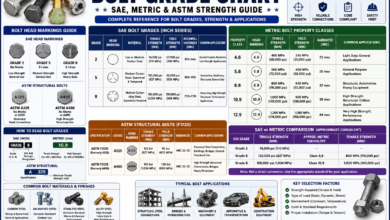
For bolt strength grades matched to these thread series, see our Bolt Grade Chart.
⭐ Tap Drill Size Chart
One of the highest-searched thread topics — recommended tap drill sizes for common metric, UNC, and UNF threads.
| Thread Size | Pitch/TPI | Recommended Tap Drill |
|---|---|---|
| M3 (metric) | 0.5 mm | 2.5 mm |
| M4 (metric) | 0.7 mm | 3.3 mm |
| M5 (metric) | 0.8 mm | 4.2 mm |
| M6 (metric) | 1.0 mm | 5.0 mm |
| M8 (metric) | 1.25 mm | 6.8 mm |
| M10 (metric) | 1.5 mm | 8.5 mm |
| #6-32 (UNC) | 32 TPI | #36 (0.106″) |
| #8-32 (UNC) | 32 TPI | #29 (0.136″) |
| #10-24 (UNC) | 24 TPI | #25 (0.150″) |
| 1/4″-20 (UNC) | 20 TPI | #7 (0.201″) |
| 1/4″-28 (UNF) | 28 TPI | #3 (0.213″) |
| 3/8″-16 (UNC) | 16 TPI | 5/16″ (0.3125″) |
The Underlying Formula
For inch threads, tap drill size ≈ major diameter minus (1 ÷ TPI). This targets roughly 75% thread engagement, which balances strength against tapping ease going smaller increases strength slightly but raises the risk of tap breakage.
Thread Engagement Guide
Minimum thread engagement needed to reach a fastener’s full rated strength, by material.
| Material | General Engagement Guidance |
|---|---|
| Steel | Approximately 1× the thread’s major diameter |
| Aluminum | Approximately 1.5–2× the major diameter due to lower shear strength |
| Cast Iron | Approximately 1–1.5× the major diameter |
| Stainless Steel | Approximately 1× the major diameter, similar to carbon steel |
Softer materials need proportionally longer thread engagement to develop the same holding strength as a shorter engagement in steel — this is a general planning guideline, not a substitute for manufacturer specifications.
Thread Size by Material
How the material being threaded influences thread performance and selection.
| Material | Consideration |
|---|---|
| Steel | Handles most thread series well; standard engagement rules apply |
| Stainless Steel | Prone to galling — anti-seize or lubrication recommended during assembly |
| Aluminum | Softer, needs longer engagement or thread inserts for repeated use |
| Brass | Machines cleanly, generally forgiving for fine threads |
| Cast Iron | Brittle, can crack if over-torqued or threads placed too close to edges |
| Plastic | Often uses coarser or specialized thread-forming screws rather than standard machine threads |
Thread Class & Fit Chart
Unified thread classes define how tightly external and internal threads fit together.
| Class | Fit Type | Typical Applications |
|---|---|---|
| 1A / 1B | Loose fit, generous clearance | Fasteners requiring frequent assembly/disassembly, dirty environments |
| 2A / 2B | General-purpose fit, standard clearance | Most commercial bolts, screws, and nuts |
| 3A / 3B | Close, precise fit, minimal clearance | High-precision assemblies, critical alignment applications |
“A” designates external threads (bolts, screws), and “B” designates internal threads (nuts, tapped holes) Class 2A/2B is by far the most common in general commercial hardware.
Metric Thread Tolerance Classes
ISO tolerance classes serve the same purpose as Unified thread classes, using a different notation.
| Class | Thread Type | Typical Use |
|---|---|---|
| 6g | External (bolt/screw) | Standard general-purpose fit, most common external class |
| 6H | Internal (nut/tapped hole) | Standard general-purpose fit, most common internal class |
| 4h | External | Tighter, more precise fit for critical assemblies |
| 5H | Internal | Tighter fit paired with precision external threads |
Lowercase letters (g, h) denote external threads and uppercase letters (H) denote internal threads in ISO notation — the number indicates tolerance grade, where smaller numbers mean tighter tolerance.
⭐ Thread Standard Comparison
Side-by-side comparison of the four major thread standards covered on this page.
| Standard | Thread Angle | Units | Typical Regions | Applications |
|---|---|---|---|---|
| ISO Metric | 60° | Millimeters | Global (default outside North America) | Machinery, automotive, structural, general hardware |
| Unified (UNC/UNF) | 60° | Inches | United States, Canada | Structural bolts, machinery, general hardware |
| BSP | 55° | Inches (pipe size) | UK, Europe, Commonwealth nations | Plumbing, pneumatics, hydraulics |
| NPT | 60° | Inches (pipe size) | United States, Canada | Plumbing, gas lines, pipe fittings |
BSP and NPT Look Similar But Aren’t Compatible
Both use inch-based nominal pipe sizes, but BSP has a 55° thread angle while NPT has a 60° angle with a different taper rate — they can partially thread together but will not seal properly and can damage fittings if forced.
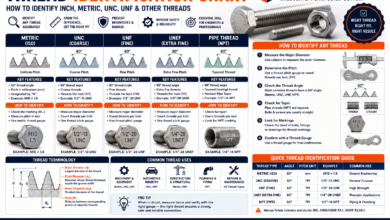
⭐ Thread Identification Guide
One of the most practical sections — a step-by-step method for identifying an unknown thread.
Measure Major Diameter
Use calipers to measure across the outer crests of the thread — this narrows down the size range immediately.
Determine the Pitch
Use a thread pitch gauge (a set of comb-like blades) to find the exact match, or count the number of thread crests within one inch for TPI.
Check the Thread Gauge Fit
A proper pitch gauge blade will sit flush against the threads with no gaps or rocking — this confirms both pitch and helps distinguish metric from inch threads.
Cross-Reference a Thread Chart
Compare your measured diameter and pitch against a chart like the ones above to identify the exact size and standard (e.g., M8 x 1.25 or 1/2″-20 UNF).
Try a Known Fastener as a Test Fit
If you have a fastener you believe matches, thread it gently by hand — it should turn smoothly without binding or excessive play.
⭐ Thread Selection Guide
Quick decision reference matching project type to recommended thread standard with reasoning.
| Project | Recommended Thread Standard | Why |
|---|---|---|
| Structural Steel | UNC (North America) or ISO Metric Coarse | Matches certified structural bolt specifications (e.g., ASTM F3125) |
| Automotive | Metric (modern), UNF (some legacy US vehicles) | Matches OEM specification and available replacement parts |
| Plumbing | NPT (North America) or BSP (UK/Europe) | Matches regional fitting availability and code requirements |
| Machinery | Metric Fine or UNF | Precision fit and vibration resistance for moving assemblies |
| General Construction | UNC or Metric Coarse | Widely available, forgiving of field conditions and minor damage |
| Heavy Equipment | Metric Coarse or UNC per manufacturer | Matches OEM fastener specification for replacement parts |
| Pipe Connections | NPT or BSPT | Tapered thread provides mechanical seal for fluid/gas lines |
⭐ Visual Thread Guide
Original engineering diagrams explaining thread anatomy, profile comparisons, and measurement technique.
Common Thread Selection Mistakes
Avoiding these errors prevents cross-threading, leaks, and connection failures.
Mixing Metric and Imperial Threads
Forcing a metric fastener into an imperial-tapped hole (or vice versa) strips threads and creates an unreliable connection.
Confusing Thread Pitch with Diameter
The two numbers in a designation like M8x1.25 or 1/2-20 describe completely different properties and both must match for proper fit.
Choosing the Wrong Thread Class
Using a loose Class 1A/1B fit where precision Class 3A/3B is needed (or vice versa) can cause excessive play or binding.
Cross-Threading Fasteners
Starting a bolt or screw at an angle can damage both the external and internal threads, requiring re-tapping or fastener replacement.
Using Incorrect Tap Drill Sizes
A drill too small can break the tap; a drill too large produces weak, shallow threads with reduced holding power.
Mixing BSP and NPT Fittings
These pipe threads have different angles and taper rates — combining them risks leaks or fitting damage even if they partially thread together.
Assuming Coarse and Fine Threads Are Interchangeable
A coarse-thread nut will not properly engage a fine-thread bolt of the same nominal diameter, and forcing the fit damages both parts.
Ignoring Thread Engagement Requirements
Too little engagement length, especially in soft materials like aluminum, can allow the fastener to strip out under load.
Contractor Worked Examples
Real-world thread identification and selection scenarios for common project types.
Concrete Anchor Installation
Pipe Thread Connection
Frequently Asked Questions
📄 Download Thread Size Chart PDF
Get a printable engineering reference including metric thread tables, UNC/UNF thread tables, BSP and NPT comparisons, tap drill reference, thread identification guide, thread anatomy diagrams, selection guide, and field-ready quick reference sheet.