
How to Calculate Concrete Wastage Percentage + Formula
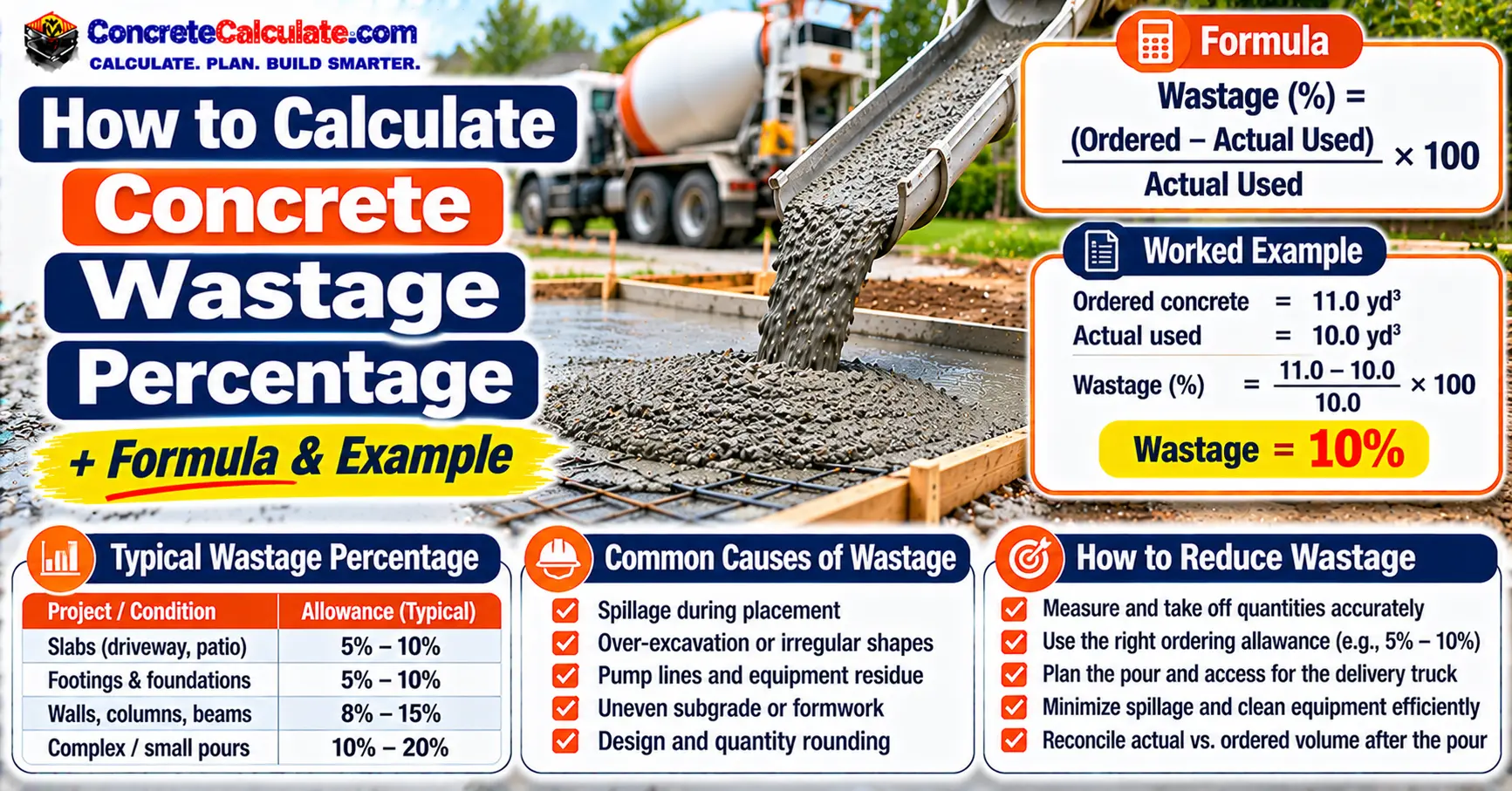
How to separate true concrete waste from ordering allowance, quantity overrun, yield discrepancy and returned concrete, with formulas and worked examples for each.
Concrete wastage percentage is documented waste divided by delivered concrete, times 100, where waste means spilled, returned or rejected concrete. It is not the same as your ordering allowance. NRMCA’s 4% to 10% extra order is a contingency, not a prediction of waste.
- Calculate the net theoretical volume from the drawings or field dimensions.
- Add a deliberate ordering allowance: A % = (ordered – theoretical) ÷ theoretical × 100.
- After the pour, find overrun: (actual used – theoretical) ÷ theoretical × 100.
- Find documented waste: (returned + spilled + rejected) ÷ delivered × 100.
- State the denominator, and keep the three percentages separate.
A. Define concrete wastage
- What Is Concrete Wastage Percentage?
- Concrete Waste vs. Ordering Allowance
- Concrete Waste vs. Quantity Overrun
- Concrete Waste vs. Yield Discrepancy
B. Theoretical quantity
- Calculate Net Concrete Volume First
- Calculate Irregular Shapes Separately
- Avoid Double-Counting Overlaps
- Why Accurate Field Dimensions Matter
C. Planning allowance
- How to Calculate Concrete Ordering Allowance Percentage
- How Much Extra Concrete Should You Order?
- When a Lower Allowance May Be Reasonable
- When More Allowance May Be Needed
D. Actual waste after the pour
- Actual Concrete Waste Percentage Formula
- Example: Calculate Returned Concrete Waste
- Example: Calculate Spillage and Returned Waste Together
- Calculate Concrete Quantity Overrun
E. Where the extra concrete went
- Extra Slab Thickness
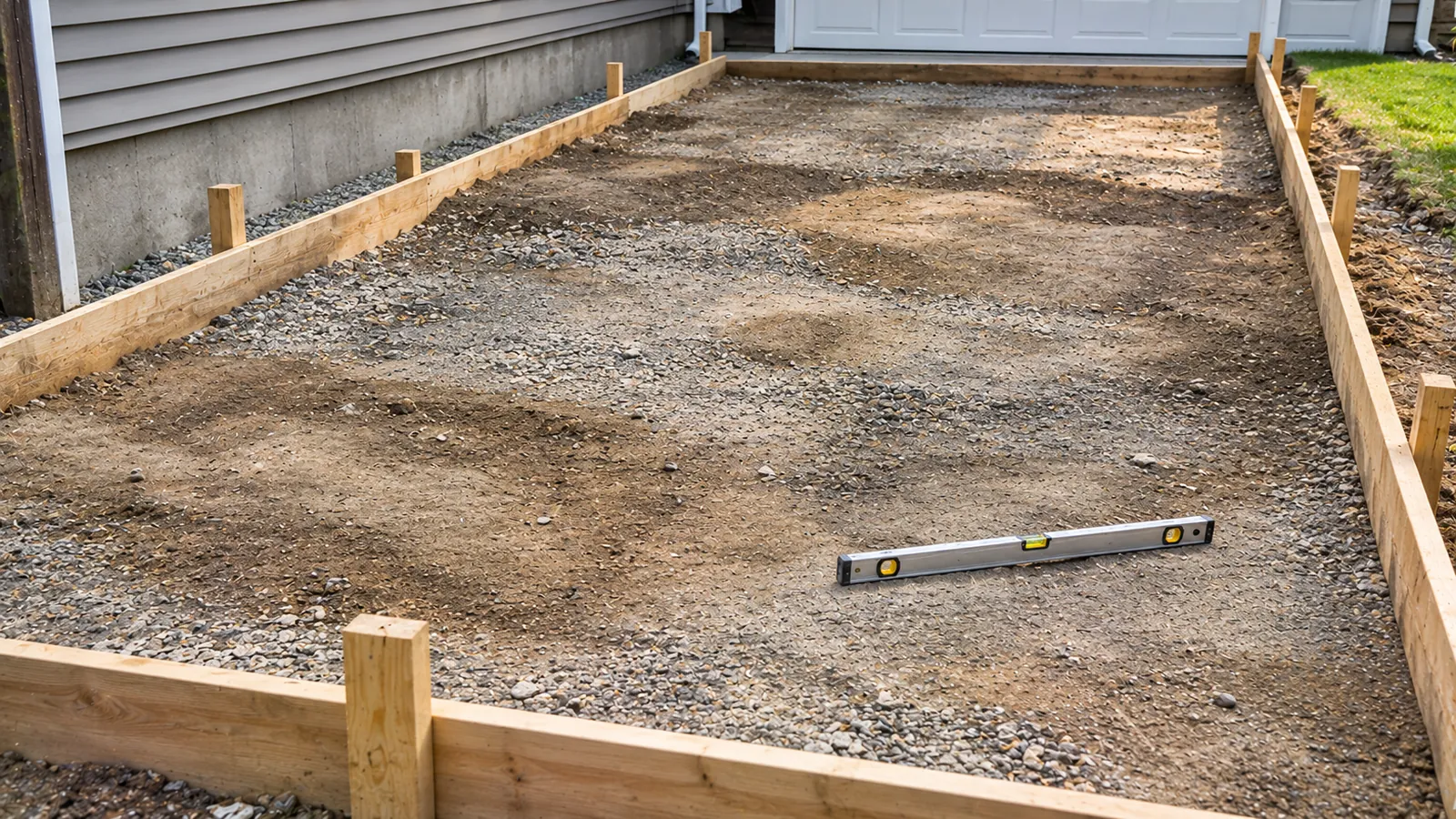
- Over-Excavation and Uneven Subgrade
- Form Bulging and Dimensional Changes
- Spillage and Placement Losses
- Concrete Left in the Truck or Returned to the Plant
F. Check concrete yield
G. Reduce and track waste
What Is Concrete Wastage Percentage?
Concrete wastage percentage measures the share of concrete that never became useful intended work. To calculate it, you must define both what counts as waste and which quantity you divide by.
- Spilled material
- Discarded excess
- Returned unused concrete
- Rejected concrete
- Hardened, unusable leftovers
The most important point comes first: a 4% to 10% extra order is a contingency allowance over calculated plan volume, not proof that 4% to 10% of the concrete will be wasted.
NRMCA says to order 4% to 10% more than the estimate from plan dimensions to account for contingencies (NRMCA CIP 31).
So the keyword has a precise answer, with three different percentages for three different questions. This guide shows each formula and when to use it.
Concrete Waste vs. Ordering Allowance
An ordering allowance is planned extra concrete, while waste is concrete that was actually lost or left unused. They are measured at different times, with different numbers.
Example
Theoretical volume is 10.0 yd³ and the order is 10.7 yd³. Allowance = (10.7 – 10.0) ÷ 10.0 × 100 = 7%.
If you calculate 50 yd³ and deliberately order 53 yd³, that is a 6% allowance. It becomes waste only if those extra 3 yd³ are actually lost or unused.
Concrete Waste vs. Quantity Overrun
Overrun is actual consumption above the theoretical quantity. A job can overrun without wasting anything, because the extra concrete may be sitting in the slab.
Say the takeoff is 10.0 yd³ and the crew places 10.6 yd³. That is a 6% overrun, with virtually no leftover. The concrete went into real field dimensions that were larger than the drawings.
Reporting that as 6% waste would point the crew toward the wrong problem. The real cause is in the dimensions, not in the handling.
Concrete Waste vs. Yield Discrepancy
Yield is a separate question again. NRMCA defines it as the volume of fresh concrete produced from a known quantity of materials, and notes that a yield discrepancy may be real or only perceived (NRMCA CIP 8).
A truck that seems to deliver less than ordered may simply be filling a form that is bigger than calculated. Waste, overrun and yield each need their own check, and Table 1 lists the terms.
| Term | Meaning | Example |
|---|---|---|
| Theoretical quantity | Geometry from plan or field dimensions | 20.0 yd³ |
| Ordering allowance | Planned extra quantity | +1.2 yd³ |
| Ordered quantity | Quantity requested | 21.2 yd³ |
| Delivered quantity | Quantity on the tickets | 21.0 yd³ |
| Actual consumption | Concrete used during placement | 20.7 yd³ |
| Returned concrete | Unused concrete returned | 0.3 yd³ |
| Quantity overrun | Actual use above theoretical | 0.7 yd³ |
| Yield discrepancy | Batch-volume issue found by density and yield testing | Separate test |
Concrete ordering allowance, actual quantity overrun and documented waste are different measurements and should not be reported as the same percentage.
Calculate Net Concrete Volume First
Start with the net theoretical volume, before any allowance. For a rectangular slab, multiply length, width and thickness, then convert to cubic yards.
Example: 20 ft × 30 ft slab, 4 in. thick
V = 20 × 30 × 4 ÷ 324 = 7.41 yd³. This is the net theoretical volume, with no allowance in it.
The 324 comes from dividing 27 cubic feet per yard by 12 inches per foot. Check results with the Concrete Cubic Yard Calculator or the Concrete Slab Calculator.
Calculate Irregular Shapes Separately
Split an irregular pour into simple shapes, calculate each volume, and add them. This is more accurate than averaging dimensions.
- Rectangles: L × W × T
- Triangles: ½ × base × height × T
- Circles: π × r² × T
- Strips and thickened edges: length × width × depth
Example
The 20 ft × 30 ft slab is 7.41 yd³. A triangular extension with a 10 ft base and 8 ft height is ½ × 10 × 8 = 40 ft², and at 4 in. thick it is 40 × 4 ÷ 324 = 0.49 yd³.
Total = 7.41 + 0.49 = 7.90 yd³.
The Concrete Calculator, Concrete Driveway Calculator and Concrete Footing Calculator handle common shapes.
Avoid Double-Counting Overlaps
Double-counting inflates the theoretical quantity, which makes real use look like a shortage. It also makes any allowance you add look bigger than it is.
- A slab plus its thickened edge
- Footing intersections
- A wall meeting a footing
- Column pads
Example: thickened edge
A 4 in. slab has a 12 in. deep, 12 in. wide edge around a 100 ft perimeter. Count only the extra depth: 12 – 4 = 8 in. Extra = 100 × 1 × (8 ÷ 12) = 66.7 ft³, or 2.47 yd³.
Adding the full 12 in. section on top of the full slab would count the base thickness twice. The material takeoff guide covers boundaries element by element.
Why Accurate Field Dimensions Matter
Small thickness errors add up quickly. NRMCA notes that just 1/8 in. of extra thickness in a nominal 4 in. slab causes about a 3 percent shortage, or roughly 1 yd³ on a 32 yd³ order (NRMCA CIP 8).
Example: 3,000 ft² slab
A nominal 4 in. slab of 3,000 ft² needs 3,000 × 4 ÷ 324 = 37.04 yd³. If the real average thickness is 1/8 in. more, the extra is 3,000 × (0.125 ÷ 12) = 31.25 ft³, or 1.16 yd³.
That extra concrete is in the slab. It is overrun, not waste.
Measure forms and subgrade elevations before the pour. See how to measure concrete properly.
How to Calculate Concrete Ordering Allowance Percentage
Subtract the theoretical quantity from the order, divide by the theoretical quantity, and multiply by 100. Work backward to find the order from a chosen allowance.
Here Qo is the order quantity and Qt is the theoretical quantity. Do the allowance after you convert to cubic yards, so the unit conversion is not distorted.
Example
Qt = 50.0 yd³ and a chosen allowance of 6%. Qo = 50.0 × 1.06 = 53.0 yd³.
How Much Extra Concrete Should You Order?
NRMCA says the quantity ordered should be about 4% to 10% more than the volume calculated from plan dimensions, to cover contingencies (NRMCA CIP 31). That is a range, not a single recommendation.
For a 50 yd³ takeoff, the range works out to 50 × 1.04 = 52.0 yd³ up to 50 × 1.10 = 55.0 yd³. Where you land depends on the job.
Calculate the net theoretical volume first, then add an explicit ordering allowance that fits the project. Do not add a flat 10 percent to every job by habit.
CIP 31 also notes that truck mixer capacity varies, commonly about 8 to 12 yd³, so confirm loads with the supplier. See the Ready Mix Truck Calculator and truck load chart.
When a Lower Allowance May Be Reasonable
A lower allowance fits jobs where the quantity is easy to predict. Accuracy of forms and subgrade matters most.
- Accurate, rigid forms
- A uniform, compacted subgrade
- Repetitive work
- Good quantity tracking during the pour
- Simple geometry
NRMCA notes that repetitive operations permit more accurate concrete estimates, because earlier jobs show how much concrete the work really takes.
When More Allowance May Be Needed
Irregular or uncertain conditions call for a larger allowance. The less predictable the dimensions, the more contingency the job needs.
- Irregular excavation
- Incidental fill
- Complicated footings
- Variable subgrade
- Uncertain existing conditions
NRMCA notes that sporadic or irregular placement operations may need a larger contingency. Do not treat a figure above 10 percent as an NRMCA rule, and base it on conditions you can name.
Actual Concrete Waste Percentage Formula
Actual waste is measured after the pour, against what was delivered. Pick one convention and use it every time.
A company may choose another denominator, such as ordered quantity. What matters is that you define it before comparing jobs, and state it whenever you report the number.
Example: Calculate Returned Concrete Waste
Returned concrete is the clearest measurable form of unused concrete. Divide what came back by what was delivered.
Example
Delivered = 12.0 yd³ and returned = 0.4 yd³. Returned % = 0.4 ÷ 12 × 100 = 3.33%.
Example: Calculate Spillage and Returned Waste Together
When several kinds of loss are documented, add them before dividing. Keep the same delivered denominator.
Example
Delivered = 20 yd³, documented spill = 0.25 yd³ and returned = 0.35 yd³. Waste = 0.25 + 0.35 = 0.60 yd³.
Waste % = 0.60 ÷ 20 × 100 = 3%.
Calculate Concrete Quantity Overrun
Overrun compares what the job actually used with the theoretical takeoff. Use the same formula every time.
Example
Theoretical = 25 yd³ and actual used = 26.5 yd³. Overrun = (26.5 – 25) ÷ 25 × 100 = 6%.
Now put all three together. In Table 2 the formulas sit side by side, and Table 3 shows one project worked through each.
| Metric | Formula |
|---|---|
| Theoretical yd³ | L × W × T(in) ÷ 324 |
| Ordering allowance % | (Order – Theoretical) ÷ Theoretical × 100 |
| Order quantity | Theoretical × (1 + A ÷ 100) |
| Overrun % | (Actual – Theoretical) ÷ Theoretical × 100 |
| Waste % | Waste ÷ Delivered × 100 |
| Returned concrete % | Returned ÷ Delivered × 100 |
| Quantity | Amount |
|---|---|
| Theoretical takeoff | 30.0 yd³ |
| Ordered | 31.8 yd³ |
| Ordering allowance | 6.0% |
| Delivered | 31.5 yd³ |
| Estimated actual placed | 31.1 yd³ |
| Returned | 0.3 yd³ |
| Documented spill | 0.1 yd³ |
| Quantity overrun | 3.67% |
| Documented waste | 1.27% |
The three percentages differ because they answer three different questions. This is why one “waste percentage” is not enough.
Extra Slab Thickness
Thickness is one of the biggest hidden drivers of extra concrete. The percentage effect equals the extra thickness divided by the planned thickness.
Example: effect of added thickness on a nominal 4 in. slab
1/8 in. extra: 0.125 ÷ 4 = 3.1%. 1/4 in. extra: 0.25 ÷ 4 = 6.3%. 1/2 in. extra: 0.5 ÷ 4 = 12.5%.
The first figure matches NRMCA’s example of about 3 percent for 1/8 in. on a 4 in. slab.
That concrete is in the slab, not on the ground. It is overrun, and it is a reason to check subgrade and form elevations before the pour.
Over-Excavation and Uneven Subgrade
Earth-formed surfaces are rarely exactly to dimension, and every extra inch fills with concrete. Footing trenches, grade beams, slab subgrades and pads are all affected.
Example: footing trench (illustrative geometry)
A footing is planned at 12 in. wide by 12 in. deep, a 144 in² cross-section. If the trench is dug 1 in. wider and 1 in. deeper, the section is 13 × 13 = 169 in².
That is 169 ÷ 144 = 1.174, or about 17% more concrete for the same footing length.
The extra concrete fills earth-formed irregularities. It is overrun, but it is not discarded, and a good allowance for irregular excavation anticipates it.
Form Bulging and Dimensional Changes
Forms can deflect or spread under the pressure of fresh concrete. NRMCA lists deflection and distortion of forms as a cause of extra concrete demand and of perceived under-yield (NRMCA CIP 8).
Example (illustrative)
An 8 in. wall bows out an average 1/4 in. along its length. The extra thickness is 0.25 ÷ 8 = 3.1% more concrete than the drawings show.
Rigid, well-braced forms reduce the effect. Check form dimensions again after the first load goes in.
Spillage and Placement Losses
Some concrete is lost in handling, and that is genuine waste. Typical places include:
- Pump priming and discharge losses
- Chute spills
- Dropped material
- Wheelbarrow handling losses
- Rejected material
ACI notes that concrete should be transported and placed by methods that avoid segregation and loss of ingredients (ACI technical FAQ). Careful placement lowers both the lost quantity and the quality risk.
Concrete Left in the Truck or Returned to the Plant
Leftover concrete is common, because builders often order a little more than they need. EPA says it is common for trucks to have wet concrete remaining in the drum after a delivery (EPA concrete washout guidance).
- The final load is larger than the remaining work.
- A load is rejected.
- The job was over-ordered.
EPA lists several controlled uses for returned concrete: precast products, paving the plant’s yard, washing into a reclaimer, or placing on an impervious surface to harden and be crushed for aggregate. It should not be dumped on bare ground at the site.
Table 4 sorts the common causes of extra concrete into waste and overrun.
| Cause | True waste? | Quantity overrun? |
|---|---|---|
| Extra slab thickness | No | Yes |
| Over-excavation | Usually no | Yes |
| Form bulging | No | Yes |
| Spillage | Yes | Yes |
| Returned excess | Yes, unused | Not placed |
| Rejected load | Waste or rejected material | Separate |
| Air loss and settlement | Not conventional jobsite waste | Can affect perceived volume |
| Incorrect takeoff | No | Apparent overrun |
| Supplier under-yield | No | Production discrepancy |
Extra concrete consumed by low subgrade or larger dimensions is quantity overrun, while spilled or returned concrete is actual unused material.
What Is Concrete Yield?
Concrete yield is the volume of fresh concrete produced from a known quantity of materials. Ready-mixed concrete is sold by fresh volume under ASTM C94/C94M, and NRMCA explains that yield is checked using fresh-concrete density under ASTM C138 (NRMCA CIP 8).
Yield is not found by measuring the hardened slab. Hardened volume can be about 2 percent lower than fresh volume because of air loss, settlement, bleeding, paste-volume changes and drying shrinkage.
How Is Ready-Mix Yield Checked?
Yield equals the total batch weight divided by the measured density of the fresh concrete, then converted to cubic yards.
Example (illustrative numbers only)
Total batch weight = 33,000 lb and measured density = 145 lb/ft³. Yield = 33,000 ÷ 145 = 227.6 ft³.
In yards, 227.6 ÷ 27 = 8.43 yd³.
NRMCA recommends representative density testing when a yield discrepancy is suspected, and notes that ASTM C94 bases yield on the average of several determinations from different delivery vehicles.
When Should You Question Supplier Yield?
Question yield only after the other explanations are ruled out. A load that fills less than expected is not proof of short delivery.
- The shortage repeats across several loads.
- Field geometry has been verified.
- Forms and subgrade have been checked.
- Spillage has been quantified.
- A density and yield test shows a discrepancy.
Do not blame the supplier solely because the forms consumed more concrete than calculated. Compare the tickets first, as explained in how to read a ready-mix concrete delivery ticket.
How to Reduce Concrete Wastage on Site
Reducing waste is mostly about knowing the quantity as you go. NRMCA recommends reevaluating the quantity needed as the pour nears completion, so later loads can be adjusted and excess or small clean-up loads avoided (NRMCA CIP 31).
| Action | Benefit |
|---|---|
| Verify dimensions before the pour | Reduces takeoff error |
| Compact subgrade to elevation | Reduces extra thickness |
| Brace forms properly | Limits bulging |
| Track cumulative truck volume | Detects overrun early |
| Mark progress along forms | Compares use against expected volume |
| Adjust final loads | Reduces returns and short loads |
| Control pump and chute placement | Reduces spills |
| Record returned concrete | Improves future estimates |
Good planning starts before the pour. See the material takeoff guide, how to pour a concrete slab and how to protect fresh concrete from heavy rain.
How to Track Concrete Waste Using Delivery Tickets
A simple log turns delivery tickets into a reconciliation. Record one line per load, and update it as you pour.
- Truck or load number
- Ticket volume
- Cumulative delivered volume
- Placement progress
- Returned quantity
- Spill or rejection notes
The ticket shows what was delivered, which is the denominator for your waste percentage. See how to read a ready-mix concrete delivery ticket, and compare actual and estimated cost with the Job Cost Variance Calculator.
A complete concrete reconciliation tracks the job from plan quantity through delivery and final unused material.
How to Handle Leftover Concrete and Washout
Plan for leftover concrete before the pour, and keep wet concrete and washout out of drains and bare ground. Coordinate returns with the producer.
- Agree on returned concrete with the supplier.
- Use a designated washout area.
- Do not dump wet concrete or washout into drains or uncontrolled ground.
EPA describes concrete washout as a caustic slurry with a pH near 12, and says washout should be collected in leak-proof containers placed at least 50 feet from storm drains, ditches and waterbodies (EPA).
It also advises inspecting washout containers daily and after heavy rain, and emptying them before they pass 75 percent of capacity.
On sites that need stormwater coverage, EPA says the federal construction rule prohibits discharging concrete washout wastewater unless it is managed by appropriate controls (EPA stormwater guidance). Keep this environmental task separate from the quantity estimate.

Finish every pour with a reconciliation, using the worksheet in Table 6, so the next estimate starts from real data.
| Field | Quantity |
|---|---|
| Net theoretical volume | |
| Selected ordering allowance | |
| Planned order | |
| Actual delivered | |
| Actual placed estimate | |
| Returned concrete | |
| Rejected concrete | |
| Spillage | |
| Ordering allowance % | |
| Quantity overrun % | |
| Documented waste % | |
| Notes or reason for variance |
Concrete Wastage Percentage FAQs
What is the formula for concrete wastage percentage?
Waste % = (unused + spilled + rejected concrete) ÷ delivered concrete × 100. State the denominator you use, since some companies divide by ordered quantity instead. Do not confuse it with the ordering allowance, which is (ordered – theoretical) ÷ theoretical × 100.
Is 10% concrete waste standard?
No. NRMCA recommends ordering about 4% to 10% more than the volume calculated from plan dimensions, as a contingency allowance. That is not a standard waste rate. Actual waste, measured as spilled or returned concrete, is often far lower, and depends on the job.
What is the difference between waste and allowance?
An allowance is planned extra concrete you order before the pour. Waste is concrete that was actually spilled, rejected or left unused after it. Ordering 6% extra is a 6% allowance, and it only becomes waste if that extra concrete is lost or unused.
How much extra concrete should I order?
NRMCA suggests about 4% to 10% more than the plan-dimension volume, depending on conditions. Accurate forms and a uniform subgrade support a lower figure, while irregular excavation supports a higher one. Calculate the net volume first, then add the allowance as its own step.
Why did my slab use more concrete than calculated?
Common reasons are a low or uneven subgrade, over-excavation, bowed forms, a slab thicker than planned, takeoff errors and spills. Even 1/8 in. extra on a 4 in. slab adds about 3 percent. Check dimensions before suspecting the supplier.
Is extra slab thickness considered waste?
No. Concrete that fills extra thickness is in the structure, so it is quantity overrun, not waste. It is still worth finding the cause, such as low subgrade or form movement, so you can correct it and plan a better allowance.
How do I calculate returned concrete percentage?
Divide the returned quantity by the delivered quantity and multiply by 100. For example, 0.4 yd³ returned from 12.0 yd³ delivered is 3.33%. Use the ticket total for the delivered quantity, and record what the driver took back.
How do I calculate concrete overrun?
Overrun % = (actual used – theoretical) ÷ theoretical × 100. For example, using 26.5 yd³ against a 25 yd³ takeoff is a 6% overrun. It shows consumption above the plan, but not whether any of the concrete was wasted.
What is concrete yield?
Yield is the volume of fresh concrete produced from a known quantity of materials. It is checked using total batch weight and measured fresh density, with ASTM C94 and ASTM C138 as the reference methods. Hardened slab dimensions alone cannot show whether a supplier under-yielded.
How do I know if a ready-mix load under-yielded?
Rule out the common causes first: check field dimensions, forms, subgrade and spillage. If the shortage repeats, request a representative density test and compare the batch yield with the ticket volume. A single short-looking pour is not proof.
Should I add waste before or after converting to cubic yards?
Calculate the net volume and convert to cubic yards first, then apply the ordering allowance to that figure. That keeps the theoretical quantity clean and makes the allowance visible, instead of hiding a flat percentage inside the takeoff.
How can I reduce leftover concrete?
Verify dimensions, get the subgrade to elevation, brace forms, track cumulative truck volume, and reevaluate the remaining quantity before the last load is ordered. NRMCA advises adjusting later loads so excess and small clean-up loads are avoided. Record what comes back to improve the next estimate.
Conclusion
To calculate concrete wastage percentage correctly, keep three numbers apart: the ordering allowance you plan, the overrun you actually see, and the documented waste you can prove. Start with the net volume, add a deliberate allowance, and reconcile against delivery tickets after the pour.
Work out your net volume before you order.
Open the Concrete Cubic Yard Calculator