Water Coming Up Through Basement Floor After Heavy Rain: Fixes
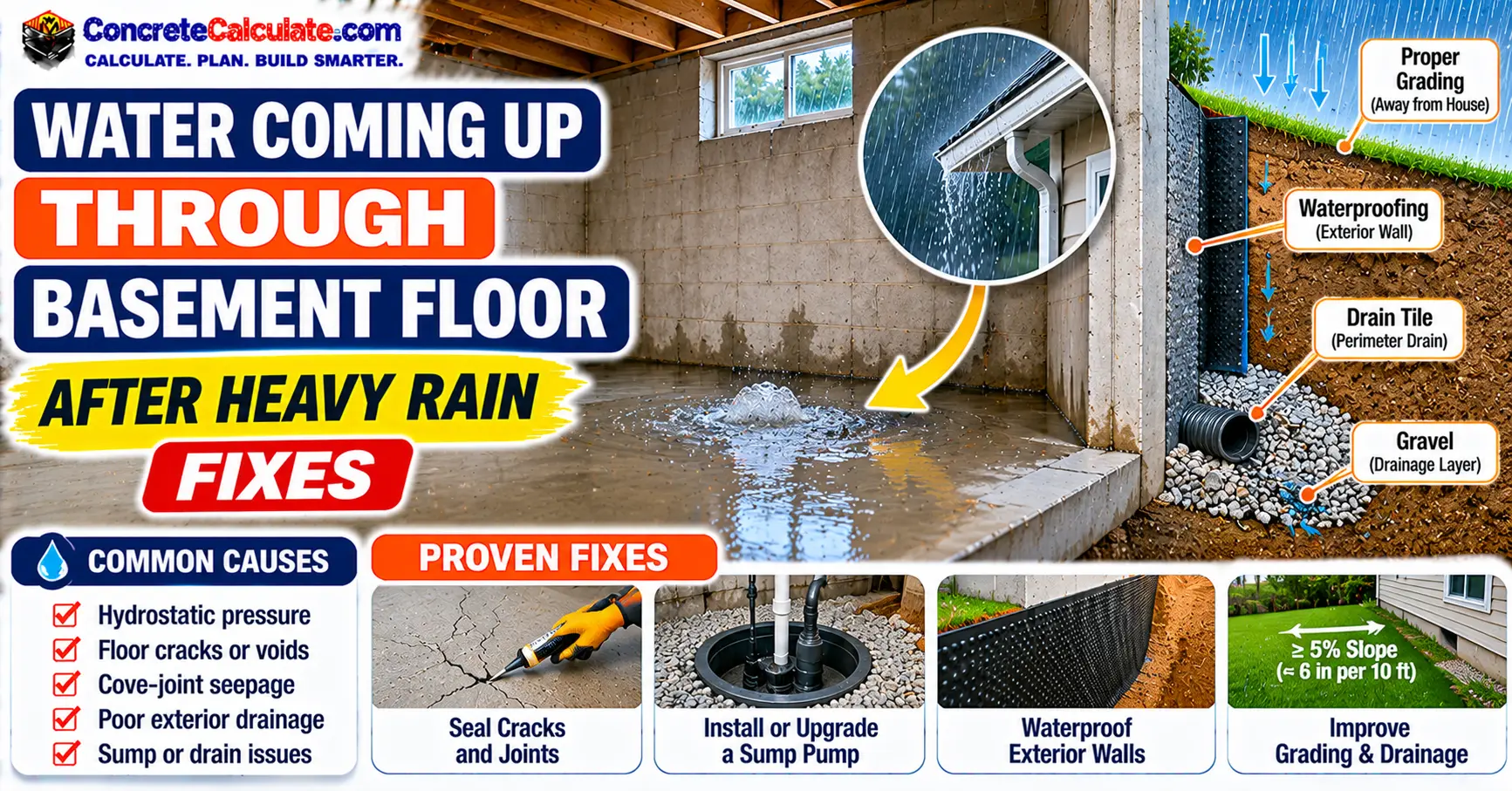
How to tell where post-rain basement water is really coming from, which fixes address the source, and when to call a plumber, drainage contractor or structural engineer.
Water comes up through a basement floor after heavy rain when saturated soil raises groundwater around the foundation and the drainage system cannot keep up, so water enters through floor cracks, the wall-floor joint or other openings. Fix the source first: gutters, grading and window wells, then the footing drain and sump.
- Find the first wet point, not the biggest puddle.
- Rule out sewer backup, plumbing leaks and condensation.
- Correct gutters, downspouts and grading around the house.
- Inspect the footing drain and sump pump system.
- Repair local leak paths only after the water source is controlled.
- Use interior or exterior drainage for recurring groundwater.
A. Diagnose where the water enters
- Why Is Water Coming Up Through My Basement Floor After Heavy Rain?
- Is the Water Really Coming Through the Floor?
- Floor Crack vs. Wall-Floor Joint vs. Floor Drain
- How Heavy Rain Raises Groundwater Around a Basement
- What Is Hydrostatic Pressure Under a Basement Floor?
B. Rule out other water sources
C. Check the outside first
- Inspect Gutters and Downspouts
- Check Ground Slope Around the Foundation
- Check Patios, Sidewalks and Driveways Near the House
- Check Window Wells and Exterior Low Spots
D. Inspect the basement drainage
- Does Your House Have a Footing Drain?
- How to Tell if the Footing Drain Is Clogged or Overwhelmed
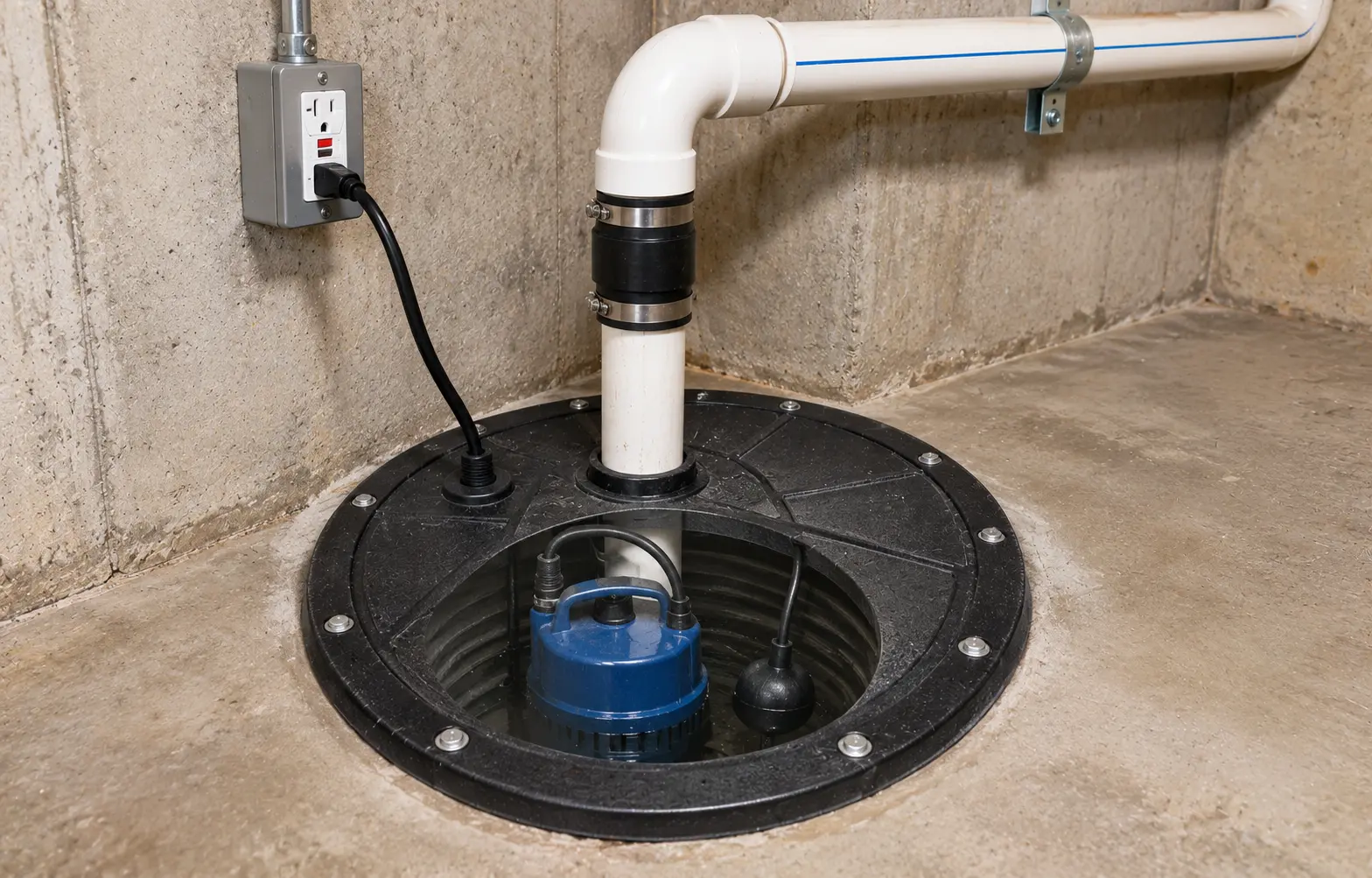
- Check the Sump Pump
- Is the Sump Pump Too Small for Heavy Rain?
E. Choose the right fix
- Fix 1: Correct Gutters, Downspouts and Grading
- Fix 2: Repair Local Floor Cracks
- Fix 3: Seal the Wall-Floor Cove Joint?
- Fix 4: Install or Upgrade a Sump Pump
- Fix 5: Install an Interior Perimeter Drain
- Fix 6: Repair or Replace Exterior Foundation Drainage
- Fix 7: Exterior Waterproofing
F. What not to do
- Why Waterproof Paint Alone Usually Does Not Fix the Problem
- Why a Dehumidifier Does Not Stop Floor Seepage
- Common Basement Water Mistakes
G. Safety and professional help
Why Is Water Coming Up Through My Basement Floor After Heavy Rain?
Heavy rain saturates the soil and can raise groundwater around and beneath the foundation. If drainage cannot carry that water away, it can enter through floor cracks, the wall-floor joint, slab penetrations or drain openings.
NDSU Extension explains that when the water table rises above the basement floor, water can enter where the walls and floor meet and through cracks in the floor (NDSU Extension). Wall cracks can leak too, but that is usually water soaking into the ground from above.
The best fix depends on where the water really comes from. Fix the water source and drainage path first, because interior coatings and crack fillers rarely solve a basement groundwater problem on their own.
University of Minnesota Extension agrees: correct grading, gutters and downspouts first, then add interior or exterior drainage if the problem persists (UMN Extension).
Is the Water Really Coming Through the Floor?
Not always. Water can enter at a wall or a cove joint and then spread across the slab, so it looks as if it started in the middle of the floor.
Look for the first wet point, not the biggest puddle. Mop or towel the floor dry, watch where the first moisture reappears during the next rain, and mark it.
- Check the wall-floor joint all the way around.
- Check cracks and control joints in the slab.
- Check around floor drains, pipes and the sump pit.
- Check the lowest wall course for a ring of dampness.
Floor Crack vs. Wall-Floor Joint vs. Floor Drain
The place water first appears points to the likely source. Table 1 pairs common observations with the first thing to check.
| Observation | Likely source | First check |
|---|---|---|
| Water follows a floor crack | Groundwater through the crack | Drainage and crack condition |
| Water appears along the wall-floor joint | Cove-joint seepage or rising groundwater | Footing drain and sump |
| Water emerges from a floor drain | Sewer or drain backup | Plumber and backflow system |
| Water near one pipe | Plumbing leak | Supply and drain lines |
| Broad damp floor, no puddle | Condensation or vapor | Humidity and moisture testing |
| Water starts only after long storms | Groundwater or drainage overload | Exterior drainage and sump |
| Water near one foundation wall | Surface runoff or window well | Gutters and grading |
How Heavy Rain Raises Groundwater Around a Basement
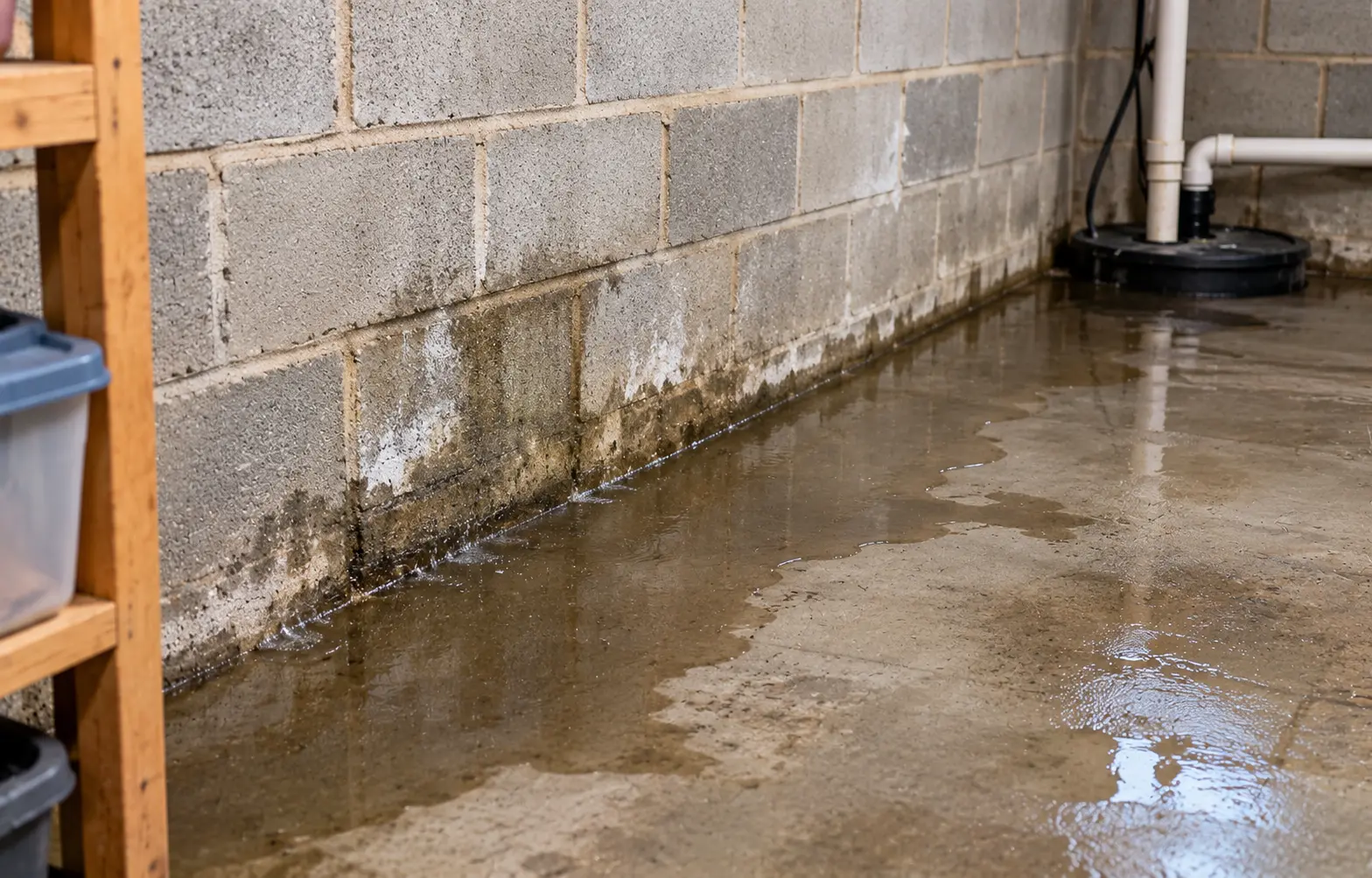
Prolonged rain fills the pore spaces in the soil, the water table rises, and the soil next to the foundation can drain more slowly. Groundwater then looks for the lowest openings it can find.
- Soil becomes saturated.
- The water table rises toward the floor level.
- Drainage capacity around the footing is used up.
- Water seeks low openings such as cracks and joints.
Roof runoff adds to the load. UMN notes that a 1-inch rain puts about 1,250 gallons of water on the roof of a 2,000-square-foot house, and without gutters, downspouts and grading, some of that water can reach the basement.
What Is Hydrostatic Pressure Under a Basement Floor?
Hydrostatic pressure is the pressure of standing water in saturated soil pushing against below-grade construction. In plain terms, it drives water toward any crack, joint or opening it can use.
FEMA notes that the weight of saturated soil presses on basement walls and floors. NDSU adds that products placed inside a basement generally cannot stop water entering when the outside water pressure is high (NDSU).
Do not picture water pushing through solid concrete everywhere. It usually exploits permeable paths and defects, which is why the entry point matters.
After prolonged rain, groundwater can rise around the foundation. If the drainage system cannot lower it, water can enter through cracks and the wall-floor joint.
Could It Be a Plumbing Leak Instead?
It could, if the water does not follow the weather. A plumbing leak keeps running whether or not it has rained.
- It shows up during dry weather.
- The water meter moves when no fixtures are in use.
- The water is warm, or it is near a supply or drain line.
- Seepage continues independent of rain.
If any of these fit, shut off the water supply to the suspect line and call a licensed plumber.
Could It Be a Sewer Backup?
Yes, if the water is dirty and comes from a drain. Sewer backups are a different problem from groundwater seepage.
- Water rises out of a floor drain.
- There is a foul odor.
- The water is gray or brown.
- Toilets gurgle or drain slowly.
FEMA lists sewer backup as one of four ways water gets into a basement, and recommends check valves and backflow protection where backup is a risk (FEMA).
Treat sewage as contaminated. EPA says to bring in a professional for water damage caused by sewage or other contaminated water (EPA).
If your home has a septic system, EPA advises against pumping the tank when the drainfield is flooded or saturated (EPA septic guidance).
Could It Be Condensation?
Possibly, especially in summer. UMN notes that warm, humid outdoor air entering a basement can condense on cool walls and floors, and many homeowners mistake that for a leak.
Condensation forms a surface film or general dampness. Groundwater seepage enters at a specific place and puddles after storms. A simple test is to tape a small plastic sheet to the floor and see whether moisture forms on top (condensation) or underneath (moisture from the slab).
Identify the entry path before choosing a waterproofing repair.
Inspect Gutters and Downspouts
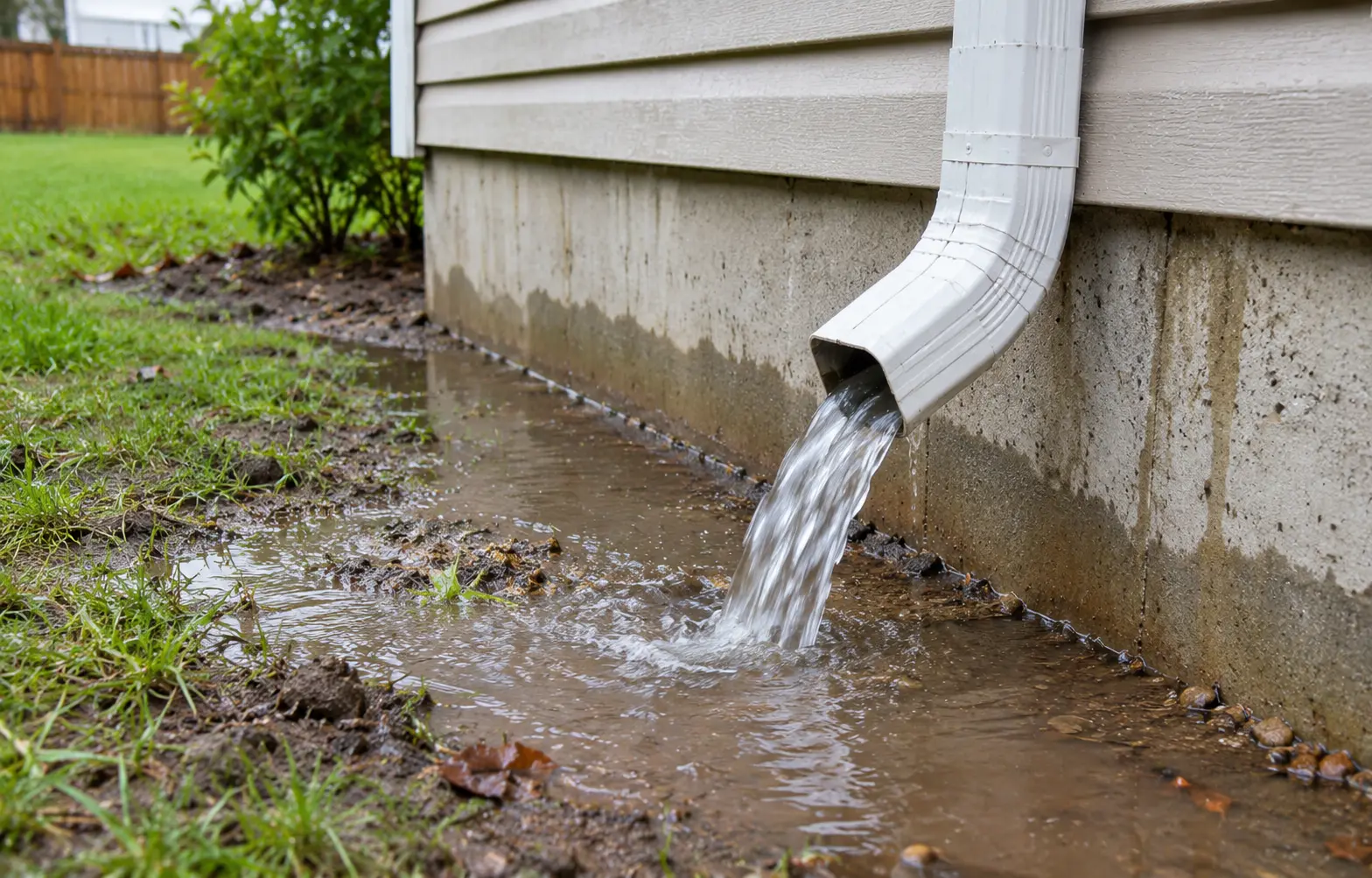
Check the roof drainage first, because it is the cheapest to fix and often the biggest contributor. UMN calls a downspout without an extender or splash block worse than no downspout, since it dumps a huge volume of roof water in one spot.
- Clogged gutters
- Disconnected or damaged downspouts
- Discharge too close to the house
- Underground leaders that are backing up
UMN recommends at least one downspout for every 50 linear feet of eave, with extensions that discharge at least 4 feet beyond the wall. FEMA likewise advises lengthening downspout runs with rigid or flexible extensions.
Check Ground Slope Around the Foundation
The ground should slope away from the foundation. The IRC requires lots to drain surface water away from foundation walls, with a fall of at least 6 inches in the first 10 feet, or a swale or drain where that is not possible (IRC Section R401.3).
The IRC also calls for impervious surfaces within 10 feet to slope at least 2 percent away, subject to local adoption and exceptions.
UMN gives a practical target: slope the soil away from the wall at least 1 inch per foot for at least 6 feet.
FEMA describes a berm sloping about 1 inch per foot for at least 10 feet, and notes that changing the elevation of your property may need a permit (FEMA).
Use the Elevation Grade Calculator to check your slope. Local code and site conditions control.
| Item | Research-backed guidance |
|---|---|
| Soil near the foundation | IRC: at least 6 in. of fall in the first 10 ft. UMN: at least 1 in. per ft for 6 ft |
| Hard surfaces within 10 ft | IRC: at least 2% away from the building |
| Foundation drain | At or below the top of the footing or below the slab where required |
| Drain discharge | Approved gravity or mechanical outlet |
| Gutters and downspouts | Keep clear and discharge at least 4 ft beyond the wall (UMN) |
Check Patios, Sidewalks and Driveways Near the House
Check any paving that touches or sits close to the foundation. A slab that slopes toward the house sends water straight to the wall.
- Patio or porch slabs that tilt toward the wall
- Sidewalks and stoops with settled soil under them
- Driveway runoff that heads toward the foundation
- Open joints where paving meets the wall
UMN notes that soil next to a house is often backfilled without compaction and later settles, especially under stoops. See how to fix standing water on a concrete patio, concrete driveway drainage and concrete driveway slope for the runoff principles.
Check Window Wells and Exterior Low Spots
Window wells and low spots collect water right against the wall. UMN describes an improperly drained window well as a drain next to the basement wall.
- Fill the well with 3/8 to 3/4 inch coarse aggregate from the footing to the sill, as UMN advises.
- Connect a drain tile extension from the footing to the base of the well where practical.
- Use a cover, and keep the well free of leaves and debris. FEMA recommends gravel bottoms and covers.
- Fill low spots and stoop settlement that trap water.
Does Your House Have a Footing Drain?
A footing drain is a perforated pipe or tile set in gravel at the footing that intercepts groundwater and carries it to a gravity outlet or a sump. Many older homes have none.
UMN notes that many existing houses have no subsurface drainage system at all, which dates from a time when basements were not used as living space.
The IRC today requires drains around concrete and masonry foundations that enclose usable space below grade, installed at or below the top of the footing or below the slab and discharging by gravity or mechanical means into an approved system (IRC Section R405.1).
The code has an exception for foundations on well-drained ground, and it varies by jurisdiction. Ask your building department what applies to your home.
How to Tell if the Footing Drain Is Clogged or Overwhelmed
You cannot confirm a clog from the surface, but several clues point to it. Treat them as clues, not proof.
- The sump runs constantly, yet water still enters.
- Seepage starts only in prolonged storms.
- Water appears along the wall-floor joint.
- The drainage system is old.
- Landscaping or sediment changes happened recently.
UMN lists collapsed pipe, silt and tree-root clogging, and a broken connection to the sump as common reasons a drain fails. A plumber or drainage contractor can inspect it with a camera.
Check the Sump Pump
A sump pump can fail even when it seems to work. FEMA notes that heavy rain can saturate soil and overload a pump, and a battery backup is an inexpensive safeguard if the primary pump stops or the power goes out.
- Does the pump start and stop?
- Does the float move freely?
- Is the intake clear?
- Is the discharge open and directed away from the house?
- Does the check valve prevent water from flowing back?
- Does discharged water run back to the foundation?
- Is backup power available?
UMN adds that a sump pit should have an airtight cover, because open pits let moist air in. Always unplug the pump before reaching into the pit.
Is the Sump Pump Too Small for Heavy Rain?
Possibly. A pump has to move more water than the storm sends to the pit, against the height it must lift it. Capacity is a design question, not a number to copy from the internet.
| Check | Possible problem |
|---|---|
| Pump does not start | Power, float or pump failure |
| Pump runs but the pit keeps rising | Undersized pump or blocked discharge |
| Pump cycles constantly | High inflow or water recirculating |
| Water returns after shutoff | Check-valve issue |
| Discharge ends near the foundation | Water recirculates to the footing |
| No backup | Vulnerable during an outage |
| Intake is blocked | Reduced capacity |
| Alarm activates | Excess inflow or a system problem |
Do not publish or follow a single horsepower rule. Have a plumber or waterproofing contractor size the pump to the pit, the discharge height and the expected inflow.
Fix 1: Correct Gutters, Downspouts and Grading
Start with the roof and the soil, because that is the recommended first move and it is often enough. UMN says these corrections should be made first and may solve the problem.
- Clean and repair gutters, and add downspouts where needed.
- Extend downspouts well beyond the wall.
- Regrade soil to slope away from the foundation, which may require hauling in fill.
- Do this before any below-grade drainage work, since it may remove the need for it.
Fix 2: Repair Local Floor Cracks
Crack repair is appropriate only when the leak is truly local, the drainage problem has been corrected and the crack is stable and nonstructural. It does not lower groundwater.
Do not assume crack injection solves rising groundwater everywhere. If you are unsure whether a crack matters, read types of cracks in walls and when to worry about cracks in walls, and see how to fix cracked concrete for repairs.
Cracks that are growing, horizontal or paired with a bowing wall need a structural evaluation. See how to fix structural cracks in walls.
Fix 3: Seal the Wall-Floor Cove Joint?
Maybe, for minor seepage, but sealing one entry point can push water somewhere else if groundwater pressure is significant. A surface sealant is not a substitute for drainage.
UMN says interior membranes and coatings eventually deteriorate or simply move the water to another pathway. NDSU says water generally cannot be stopped by products inside the basement because of the external pressure.
Fix 4: Install or Upgrade a Sump Pump
A sump upgrade makes sense when there is a working drain path that delivers water to the pit. Think of it as a system, not just a pump.
- A primary pump sized for the inflow
- A battery backup for outages
- An alarm for pump failure or rising water
- A discharge line that carries water well away from the foundation
- An airtight cover
Check local rules before choosing where the discharge goes. Sending sump water into a sanitary sewer is restricted in many areas.
Fix 5: Install an Interior Perimeter Drain
An interior perimeter drain collects water at the slab edge and directs it to a sump. UMN describes a perforated pipe beneath the slab at the footing as the most effective of the interior drainage systems.
- The concrete at the slab edge is opened and later replaced.
- A drain pipe is placed inside the footing perimeter.
- Dimpled sheeting at the wall base lets the wall drain into the pipe.
- The pipe connects to a sump.
UMN notes that a simple channel placed on top of the slab cannot drain groundwater from under the slab, and that in low-permeability soils a sub-slab system needs an aggregate layer under the slab to accept rising groundwater.
Fix 6: Repair or Replace Exterior Foundation Drainage
Exterior drainage repair is the most costly but also the most effective approach, according to UMN. It means digging around the foundation and rebuilding the drainage the way a new house is built.
- Excavation around the foundation
- A drainage board or mat against the wall
- A footing drain with coarse aggregate around it
- Waterproofing or dampproofing of the wall
- A sump to receive the water
The IRC treats ordinary dampproofing and waterproofing differently. Where a high water table or other severe soil-water conditions are known to exist, exterior foundation walls must be waterproofed, not just dampproofed (IRC Section R406.2).
Fix 7: Exterior Waterproofing
Exterior waterproofing can be appropriate when wall seepage is substantial, an existing membrane has failed, or the site has a high water table or severe soil-water conditions.
It is more invasive and expensive than correcting surface drainage, and it works alongside drainage, not instead of it. A membrane can still fail in service if the footing drain, discharge or grading is missing.
| Fix | Best for | Invasiveness | Main limitation |
|---|---|---|---|
| Gutter and downspout correction | Roof runoff | Low | Will not fix a failed subdrain alone |
| Regrading | Surface water | Low to moderate | Site constraints |
| Crack repair | A local leak path | Low to moderate | Does not lower groundwater |
| Sump upgrade | Excess sub-slab water | Moderate | Needs a functioning drain path |
| Interior perimeter drain | Recurring cove or slab seepage | Moderate to high | Requires slab-edge work |
| Exterior footing drain | Foundation groundwater | High | Excavation required |
| Exterior waterproofing | Severe wall or soil-water exposure | High | Cost and access |
Basement seepage repairs should start with exterior water control and progress to more invasive drainage work only when needed.
Why Waterproof Paint Alone Usually Does Not Fix the Problem
Waterproof paint does not remove the water or the pressure behind it. UMN says an interior membrane or coating without drainage generally will not solve the problem long term.
It can look like a fix for a season, then peel or move the water to a new path. A coating may be useful only after bulk water entry is controlled and the surface is suitable for the product.
If the surface is already damaged, see concrete efflorescence and concrete spalling for moisture clues, and the concrete vapor barrier guide for vapor versus liquid moisture.
Why a Dehumidifier Does Not Stop Floor Seepage
A dehumidifier controls moisture in the air, not water entering through the floor. It can reduce humidity and odor, but it does not remove the source.
UMN goes further, noting that in a basement with moisture problems a dehumidifier can draw moisture in faster, which can cause more efflorescence and spalling. Treat damp air as a separate job after you stop the seepage.
EPA suggests keeping indoor humidity below 60 percent, ideally between 30 and 50 percent (EPA).
Common Basement Water Mistakes
- Sealing before fixing runoff
- Ignoring where the sump discharges
- Pumping into a sanitary drain where prohibited
- Finishing the basement before solving the water issue
- Assuming every puddle is a cracked slab
- Pumping a deeply flooded basement too quickly
| Mistake | Why it fails |
|---|---|
| Waterproof paint only | The water source and pressure remain |
| Sealing every crack first | Water may find another path |
| Ignoring gutters | Keeps feeding the foundation soil |
| Discharging the sump beside the house | Recirculates groundwater |
| Installing a dehumidifier only | Treats humidity, not bulk water |
| Finishing the basement before fixing seepage | Traps future moisture damage |
| Assuming drain backup is groundwater | Misses a sewer problem |
| Pumping deep floodwater out immediately | Can create dangerous outside pressure |
What to Do Immediately After Basement Water Appears
Make safety your first priority, then find and stop the source. Work through these steps in order.
- Avoid electrical hazards. Turn off power to the area if water is near outlets or equipment.
- Identify and stop the water source if you can.
- Remove shallow, clean water safely.
- Dry wet materials and surfaces.
- Photograph and document the damage.
- Inspect the sump and drainage.
- Clean and disinfect if contamination is suspected.
EPA says to dry water-damaged areas and items within 24 to 48 hours to prevent mold growth, and NDSU notes that wet materials can mold in one to three days (EPA). Remove porous materials such as carpet and cardboard that stay wet.
Deep Flooding: Do Not Pump the Basement Empty at Once
If a basement is substantially flooded, removing all the water quickly can damage walls and floors, because the saturated soil outside is still pushing in. Water inside helps brace the walls.
- Turn off electricity and gas, and check outside walls for cave-ins or damage.
- Do not use an electric pump powered through the home’s wiring. Use a gas pump run outdoors or a pump on an outside line.
- Mark the water level, pump out about 1 foot, and wait about 24 hours.
- If the level rises back above the mark, wait longer. When it holds, pump out 2 to 3 feet at a time, once a day, until empty.
These staged steps come from University of Missouri Extension and FEMA (MU Extension, FEMA). Check with your insurer first, and call an engineer if you see structural damage.
Not every problem needs the same expert. Table 6 shows who to call for each situation.
| Situation | Best professional |
|---|---|
| Sewer or floor drain backup | Licensed plumber |
| Failed sump or discharge | Plumber or waterproofing contractor |
| Recurring groundwater seepage | Waterproofing or drainage contractor |
| Bowed or cracked foundation wall | Structural engineer or foundation specialist |
| Significant exterior grading issue | Drainage or site contractor |
| Mold or contaminated materials | Qualified remediation professional |
| Major flood with structural concern | Engineer or emergency professional |
Basement Floor Water FAQs
Why does water come through my basement floor only after heavy rain?
Heavy rain saturates the soil and can raise the water table around and beneath the foundation. If the footing drain, sump or grading cannot keep up, groundwater finds the lowest openings, such as floor cracks and the wall-floor joint. Surface runoff from gutters and grading can add to it.
Can groundwater come through concrete?
Concrete is not perfectly watertight, but the more common route is through cracks, joints and openings. Water also moves through concrete by capillary suction and as vapor, which can leave a damp ring or film without a visible leak. The entry point matters more than the slab itself.
What is the wall-floor cove joint?
It is the joint where the basement wall meets the floor slab, and it is a common place for water to enter. NDSU Extension notes that groundwater commonly enters where the walls and floor meet, as well as through floor cracks. Drainage, not just sealing, controls it.
Will sealing floor cracks stop basement water?
Only if the leak is truly local and the water source has been controlled. Sealing a crack does not lower groundwater, and the water can find another path. Fix gutters, grading and drainage first, then seal cracks if they still leak.
Do I need a sump pump?
Many homes with groundwater seepage do, but the answer depends on your drainage. A sump collects water from a footing or interior drain and pumps it away. If your soil drains well, you may not need one. A plumber or drainage contractor can assess it.
Can a sump pump be overwhelmed?
Yes. FEMA notes that heavy rain can saturate soil and overload a sump pump, and a pump can fail from power loss, a stuck float or a blocked discharge. A battery backup, an alarm and a properly sized pump reduce the risk.
Does waterproof paint stop groundwater?
No. Paint or an interior coating without drainage generally will not solve a groundwater problem long term, because the water and its pressure remain. UMN Extension says such coatings eventually deteriorate or push the water to another path. Control the water source first.
How do I know if the footing drain is clogged?
You cannot be sure from the surface. Clues include a sump that runs constantly while water still enters, seepage along the wall-floor joint during long storms, and an old drainage system. A camera inspection by a plumber or drainage contractor can confirm it.
Is basement seepage dangerous?
It can be. Damp materials can grow mold within a few days, and wet areas should be dried within 24 to 48 hours. Water near outlets or equipment is an electrical hazard, and sewage is a health risk. Deep flooding can also threaten structural elements.
When should I call a waterproofing contractor, plumber or structural engineer?
Call a plumber for sewer backup, leaks and failed discharge, a waterproofing or drainage contractor for recurring seepage, and a structural engineer for bowing, horizontal or growing cracks. Call a remediation professional for contaminated materials or large mold areas.
Conclusion
When water comes up through a basement floor after heavy rain, identify the entry path first, then fix the source. Correct gutters and grading, inspect the footing drain and sump, and use interior or exterior drainage for recurring groundwater, instead of relying on paint, crack sealers or a dehumidifier.
Start by checking how your soil slopes away from the foundation.
Open the Elevation Grade Calculator