
Pipe Weight Chart 2026 – lb/ft, kg/m & Every Material
Pipe Weight Chart
lb/ft, kg/m & Every Material
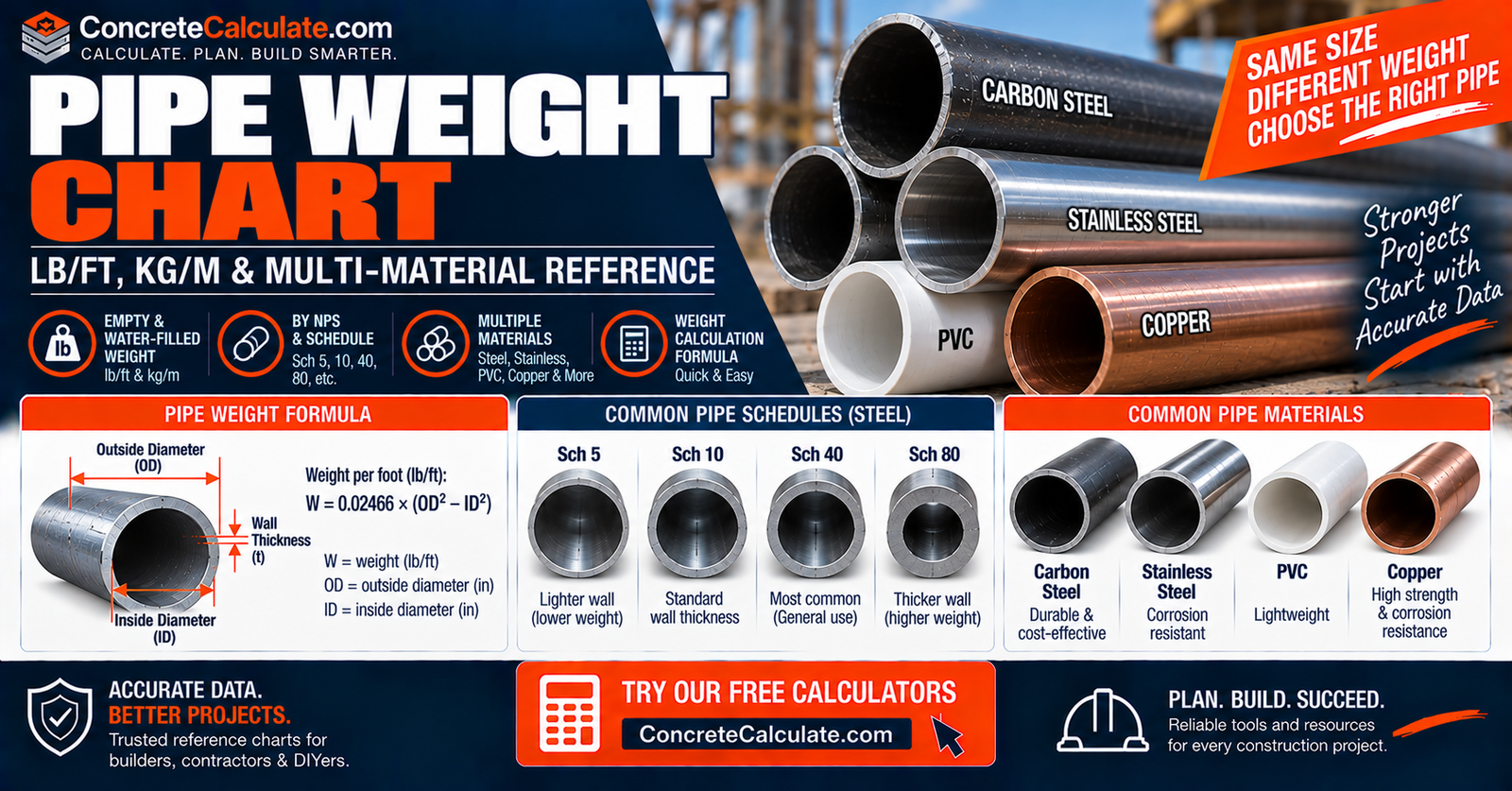
Empty and water-filled pipe weight by NPS, schedule, and wall thickness for steel, stainless, PVC, and copper pipe, plus the formula behind every value on this chart.
 Reviewed by Muhammad Ramzan Babar, PhD Researcher (Plasma Physics) & Calculator Developer, View Profile
Nominal pipe size alone does not determine pipe weight
You need outside diameter, wall thickness, and material density together. This page is the multi-material master reference covering steel, stainless, PVC, and copper weight per foot; for the complete steel-only dataset across every schedule, see the Steel Pipe Weight Chart.
Pipe Weight Chart, Quick Reference
Steel Schedule 40 pipe covers the majority of general U.S. piping search intent, so it leads this chart.
Steel Pipe Weight by Schedule
| NPS (in) | OD (in) | Sch 10 lb/ft | Sch 40 lb/ft | Sch 80 lb/ft | Sch 160 lb/ft |
|---|---|---|---|---|---|
| 1/2 | 0.840 | 0.67 | 0.85 | 1.09 | 1.30 |
| 3/4 | 1.050 | 0.86 | 1.13 | 1.47 | 1.94 |
| 1 | 1.315 | 1.40 | 1.68 | 2.17 | 2.84 |
| 1-1/2 | 1.900 | 2.09 | 2.72 | 3.63 | 4.86 |
| 2 | 2.375 | 2.64 | 3.65 | 5.02 | 7.46 |
| 3 | 3.500 | 4.34 | 7.58 | 10.25 | 14.32 |
| 4 | 4.500 | 5.61 | 10.79 | 14.98 | 22.51 |
| 6 | 6.625 | 9.29 | 18.97 | 28.57 | 45.30 |
| 8 | 8.625 | 13.40 | 28.55 | 43.39 | 74.69 |
Values calculated using the ASME B36.10 plain end weight formula, W (lb/ft) = 10.6802 × t × (OD – t), where t is wall thickness in inches. For the complete steel dataset across every schedule and larger sizes, see the Steel Pipe Weight Chart.
Material Quick Comparison
| Pipe System | Weight Basis |
|---|---|
| Carbon steel | NPS + schedule + steel density |
| Stainless steel | NPS + S schedule + alloy density |
| PVC | Nominal size + schedule + product-specific dimensions |
| Copper | Nominal size + Type K, L, M, or DWV |
Critical Scope Note
Pipe weight is not determined by nominal pipe size alone. The schedule or wall thickness and the material must also be known before a weight value means anything.
What Is Pipe Weight?
The mass or weight of the pipe material itself, usually expressed per unit length.
Common U.S. units include lb/ft, lb per 20-ft length, and lb per 21-ft length. Metric equivalents use kg/m or kg per standard length.
| Term | Definition |
|---|---|
| Empty Pipe Weight | Pipe material only, no contents |
| Filled Pipe Weight | Pipe material plus the contained fluid |
These two values should never be mixed in the same chart column without a clear label.
What Determines Pipe Weight?
Four factors, working together.
| Factor | Effect |
|---|---|
| Outside diameter | Larger OD generally increases metal area for a given wall thickness |
| Wall thickness | Thicker wall means more metal area and more weight |
| Material density | Denser materials weigh more for the same volume |
| Pipe length | Total weight scales directly with length |
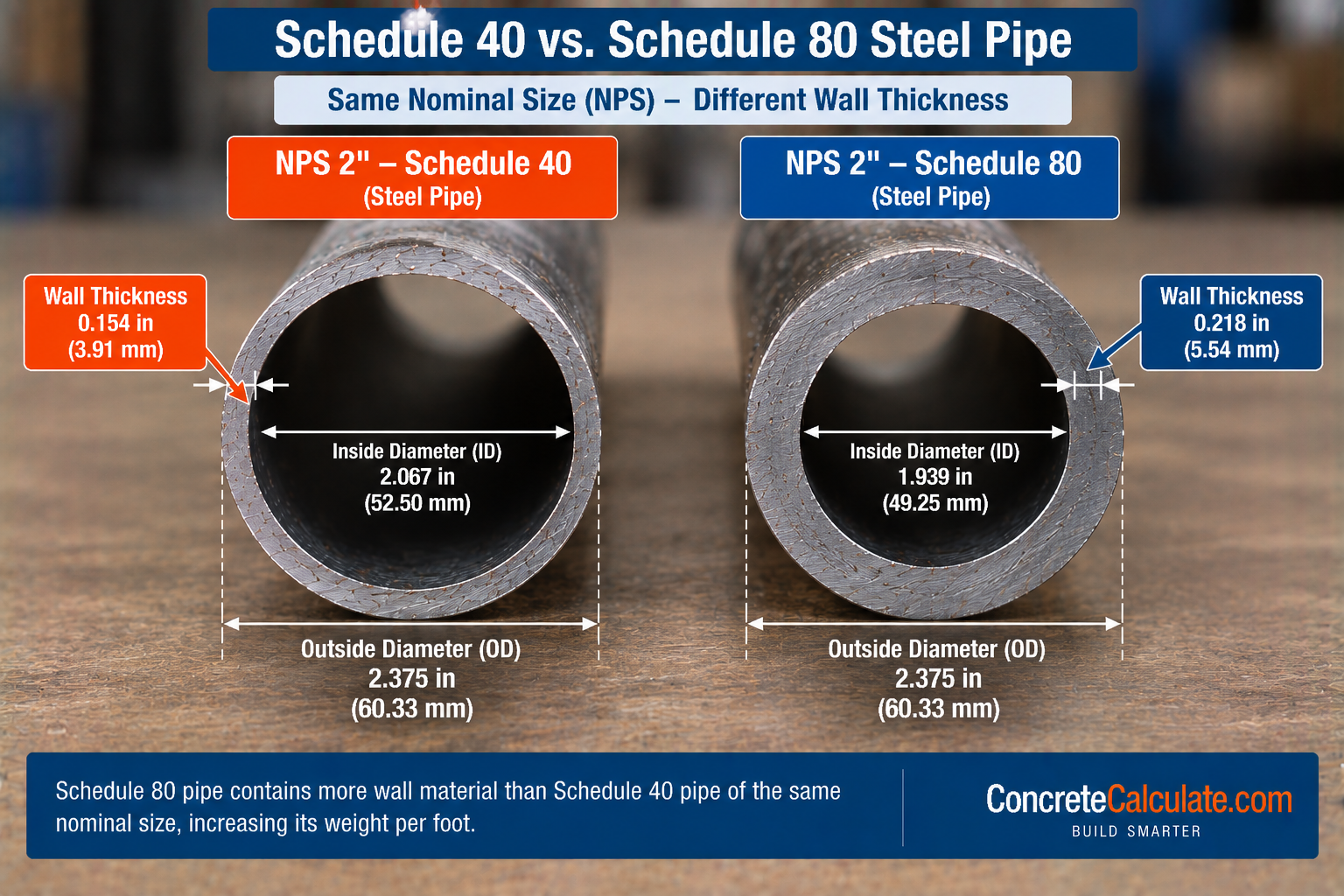
For a fixed OD, a thicker wall means more material area and therefore greater weight per foot. This is why Schedule 80 pipe usually weighs more than Schedule 40 pipe of the same NPS and material.
Pipe Weight Formula
The general formula behind every value in this chart.
Formula
Metal area: Am = (π/4)(OD² – ID²). Weight per length: W(L) = Am × ρ, where ρ is material density. Since ID = OD – 2t, this can also be written Am = (π/4)[OD² – (OD – 2t)²].
How to Calculate Steel Pipe Weight
ASME B36.10 provides a simplified formula for steel that avoids manually working through the full area equation.
ASME B36.10 Plain End Weight Formula
W (lb/ft) = 10.6802 × t × (OD – t), where t is wall thickness in inches and OD is outside diameter in inches. This is the standardized simplification of the general metal-area formula for steel density.
Example: NPS 4 Schedule 40
This matches independently published ASME B36.10 weight tables and the value used in the Steel Pipe Weight Chart.
Pipe Weight in lb/ft vs kg/m
The exact conversion factor between U.S. and metric weight units.
Conversion Factors
1 lb/ft ≈ 1.48816 kg/m. 1 kg/m ≈ 0.67197 lb/ft.
| lb/ft | kg/m |
|---|---|
| 1 | 1.488 |
| 5 | 7.441 |
| 10 | 14.882 |
| 20 | 29.763 |
| 50 | 74.408 |
Steel Pipe Weight Chart
A summary rather than a duplicate of the dedicated steel-only page.
| NPS (in) | OD (in) | Schedule | Wall (in) | lb/ft | kg/m |
|---|---|---|---|---|---|
| 2 | 2.375 | 40 | 0.154 | 3.65 | 5.44 |
| 2 | 2.375 | 80 | 0.218 | 5.02 | 7.47 |
| 4 | 4.500 | 40 | 0.237 | 10.79 | 16.06 |
| 4 | 4.500 | 80 | 0.337 | 14.98 | 22.29 |
| 6 | 6.625 | 40 | 0.280 | 18.97 | 28.24 |
| 6 | 6.625 | 80 | 0.432 | 28.57 | 42.53 |
For the complete NPS × schedule × wall × weight dataset across every ASME B36.10 schedule, see the full Steel Pipe Weight Chart, which owns the detailed steel-only reference.
Schedule 10 Pipe Weight Chart
Schedule 10 has a thinner wall than Schedule 40 for many common sizes, so it generally weighs less for the same NPS and material.
| NPS (in) | OD (in) | Sch 10 Wall (in) | lb/ft | kg/m |
|---|---|---|---|---|
| 1/2 | 0.840 | 0.083 | 0.67 | 1.00 |
| 1 | 1.315 | 0.109 | 1.40 | 2.09 |
| 2 | 2.375 | 0.109 | 2.64 | 3.93 |
| 4 | 4.500 | 0.120 | 5.61 | 8.35 |
| 6 | 6.625 | 0.134 | 9.29 | 13.82 |
| 8 | 8.625 | 0.148 | 13.40 | 19.94 |
Not every pipe size or specification offers a Schedule 10 product; check the Pipe Schedule Chart for size-by-size availability.
Schedule 40 Pipe Weight Chart
Likely the strongest search sub-intent on this entire page.
| NPS (in) | OD (in) | Wall (in) | Empty Weight (lb/ft) | kg/m |
|---|---|---|---|---|
| 1/2 | 0.840 | 0.109 | 0.85 | 1.27 |
| 3/4 | 1.050 | 0.113 | 1.13 | 1.68 |
| 1 | 1.315 | 0.133 | 1.68 | 2.50 |
| 1-1/2 | 1.900 | 0.145 | 2.72 | 4.04 |
| 2 | 2.375 | 0.154 | 3.65 | 5.44 |
| 3 | 3.500 | 0.216 | 7.58 | 11.27 |
| 4 | 4.500 | 0.237 | 10.79 | 16.06 |
| 6 | 6.625 | 0.280 | 18.97 | 28.24 |
| 8 | 8.625 | 0.322 | 28.55 | 42.49 |
| 10 | 10.750 | 0.365 | 40.48 | 60.25 |
| 12 | 12.750 | 0.406 | 53.53 | 79.65 |
For sizes beyond NPS 12, see the Schedule 40 Pipe Chart.
Schedule 80 Pipe Weight Chart
Same NPS and OD, but a thicker wall means more pipe material and higher empty weight.
| NPS (in) | OD (in) | Sch 80 Wall (in) | lb/ft | kg/m |
|---|---|---|---|---|
| 1/2 | 0.840 | 0.147 | 1.09 | 1.62 |
| 3/4 | 1.050 | 0.154 | 1.47 | 2.19 |
| 1 | 1.315 | 0.179 | 2.17 | 3.23 |
| 2 | 2.375 | 0.218 | 5.02 | 7.47 |
| 3 | 3.500 | 0.300 | 10.25 | 15.25 |
| 4 | 4.500 | 0.337 | 14.98 | 22.29 |
| 6 | 6.625 | 0.432 | 28.57 | 42.53 |
| 8 | 8.625 | 0.500 | 43.39 | 64.61 |
For sizes beyond NPS 8, see the Schedule 80 Pipe Chart.
Schedule 160 Pipe Weight Chart
A heavy-wall schedule used in high-pressure industrial piping.
| NPS (in) | OD (in) | Wall (in) | ID (in) | lb/ft | kg/m |
|---|---|---|---|---|---|
| 1/2 | 0.840 | 0.187 | 0.466 | 1.30 | 1.93 |
| 1 | 1.315 | 0.250 | 0.815 | 2.84 | 4.23 |
| 2 | 2.375 | 0.344 | 1.687 | 7.46 | 11.10 |
| 4 | 4.500 | 0.531 | 3.438 | 22.51 | 33.49 |
| 6 | 6.625 | 0.718 | 5.189 | 45.30 | 67.42 |
| 8 | 8.625 | 0.906 | 6.813 | 74.69 | 111.14 |
Not every nominal size or product line offers Schedule 160; where a size is not standardized, treat it as not available rather than assuming a zero or extrapolated weight.
Schedule 40 vs Schedule 80 Pipe Weight
Direct comparison showing exactly how much heavier the thicker-wall schedule becomes.
| NPS (in) | Sch 40 (lb/ft) | Sch 80 (lb/ft) | Difference (lb/ft) | % Heavier |
|---|---|---|---|---|
| 1/2 | 0.85 | 1.09 | 0.24 | 28% |
| 1 | 1.68 | 2.17 | 0.49 | 29% |
| 2 | 3.65 | 5.02 | 1.37 | 38% |
| 4 | 10.79 | 14.98 | 4.19 | 39% |
| 6 | 18.97 | 28.57 | 9.60 | 51% |
The percentage difference is not constant across sizes, which is why “Schedule 80 weighs twice Schedule 40” is not a reliable general rule; each NPS has its own wall-thickness relationship.
How Pipe Schedule Affects Weight
Schedule itself is not a unit of weight; it identifies a wall thickness series.
The Chain of Cause and Effect
Schedule determines wall thickness, wall thickness determines metal cross-sectional area, and metal area combined with density determines weight. Do not create shortcut rules such as “Schedule 80 weighs twice Schedule 40,” since the actual ratio varies by NPS as shown in the comparison above.
ASME B36.10-2022 Steel Pipe Weight Basis
The dimensional authority behind the steel weight tables on this page.
ASME B36.10-2022 standardizes dimensions of welded and seamless wrought steel pipe for high or low temperature and pressure service. This page uses B36.10 values for NPS, OD, and nominal wall thickness, then derives weight from those dimensional values using the applicable density convention. The B36.10 dimensional standard and a material specification such as ASTM A53 or A106 are not the same thing; B36.10 governs dimensions, while separate material specifications govern chemistry and mechanical properties.
✓ Verified Against ASME B36.10-2022STD, XS, and XXS Pipe Weight
Historical wall designations with weight implications that vary by size.
| NPS (in) | STD Weight (lb/ft) | XS Weight (lb/ft) | XXS Weight (lb/ft) |
|---|---|---|---|
| 1/2 | 0.85 | 1.09 | 1.72 |
| 1 | 1.68 | 2.17 | 3.66 |
| 2 | 3.65 | 5.02 | 9.04 |
Do Not Assume Universal Equivalence
STD is not equal to Schedule 40 at every size, and XS is not equal to Schedule 80 at every size. Because their weights derive from wall thickness, STD and XS weights diverge from the equivalent numeric schedule at larger NPS values where the wall thickness relationships change.
Stainless Steel Pipe Weight Chart
ASME B36.19-2022 is the dimensional reference for stainless pipe.
| NPS (in) | OD (in) | 10S (lb/ft) | 40S (lb/ft) | 80S (lb/ft) |
|---|---|---|---|---|
| 1/2 | 0.840 | 0.67 | 0.85 | 1.09 |
| 1 | 1.315 | 1.40 | 1.68 | 2.17 |
| 2 | 2.375 | 2.64 | 3.65 | 5.02 |
| 4 | 4.500 | 5.61 | 10.79 | 14.98 |
B36.19 standardizes welded and seamless wrought stainless pipe dimensions. Weight varies slightly with actual alloy density as well as wall geometry; not all stainless grades share exactly identical density, so these values use a representative austenitic stainless density convention rather than a single alloy-specific figure.
✓ Verified Against ASME B36.19-2022Schedule 40/80 vs 40S/80S Weight
A dedicated distinction because the wall thicknesses are not universally identical.
40S Does Not Always Equal 40, and 80S Does Not Always Equal 80
ASME B36.19 notes that some stainless S-schedule wall thicknesses differ from the corresponding B36.10 schedule dimensions at certain sizes, including specific larger NPS values. Because weight derives directly from wall thickness, weight can differ between these designations wherever the wall thickness differs, even though many common smaller sizes align closely.
Carbon Steel vs Stainless Steel Pipe Weight
Two variables can separate these values: wall thickness and density.
For equal OD and equal wall geometry, carbon steel and stainless steel densities are relatively close but not identical, and stainless density itself varies somewhat by grade. Weight differences between carbon and stainless pipe of the same nominal size can arise from different wall tables (B36.10 vs B36.19) as well as from small material density differences. Do not apply a single universal percentage rule such as “stainless is X percent heavier”; compare the actual wall thickness and alloy density for the specific products being evaluated.
Pipe Weight per Foot vs Total Pipe Weight
The conversion every estimator needs.
Formula
W(total) = w(L) × L, where w(L) is weight per unit length and L is total pipe length.
Example: 20 ft of NPS 4 Schedule 40
10-ft, 20-ft, and 21-ft Pipe Weight Chart
Common commercial pipe lengths for purchasing, handling, and trucking calculations.
| Weight (lb/ft) | 10-ft Piece (lb) | 20-ft Piece (lb) | 21-ft Piece (lb) |
|---|---|---|---|
| 1.68 | 16.8 | 33.6 | 35.3 |
| 3.65 | 36.5 | 73.0 | 76.7 |
| 10.79 | 107.9 | 215.8 | 226.6 |
| 18.97 | 189.7 | 379.4 | 398.4 |
Not every product is commercially supplied in all three lengths; verify actual stock lengths with the supplier before finalizing a material take-off.
Empty Pipe vs Water-Filled Pipe Weight
An extremely useful distinction for support and handling calculations.
Formula
W(filled) = W(pipe) + W(fluid). Water weight per length is based on bore cross-sectional area: W(water) = (πID²/4) × L × ρ(water), using 62.4 lb/ft³ for water.
| NPS (in) | Empty (lb/ft) | Water-Filled (lb/ft) |
|---|---|---|
| 2 | 3.65 | 5.10 |
| 4 | 10.79 | 16.31 |
| 6 | 18.97 | 31.49 |
| 8 | 28.55 | 50.23 |
Pipe Weight With Other Fluids
Water is only one reference case.
Formula
W(fluid) = ρ(fluid) × V, so operating weight varies directly with fluid density. Glycol solutions, oils, chemicals, and slurries all have different densities than water.
Do not apply one universal full-pipe weight figure across different services. For project design, use the actual fluid density at the applicable operating temperature and concentration.
Pipe Weight for Supports and Hangers
Empty pipe weight alone is rarely the correct design load.
Pipe support loads can include pipe self-weight, contained fluid, insulation, valves, flanges, fittings, and other accessories, and sometimes snow, ice, or other environmental loads depending on the installation context. Do not design pipe supports using empty-pipe weight alone when the system operates full; actual support design, including load combinations and safety factors, is outside the scope of this reference chart and should follow project-specific engineering.
Pipe Weight for Handling, Lifting, and Transport
Why contractors care about weight per foot in the first place.
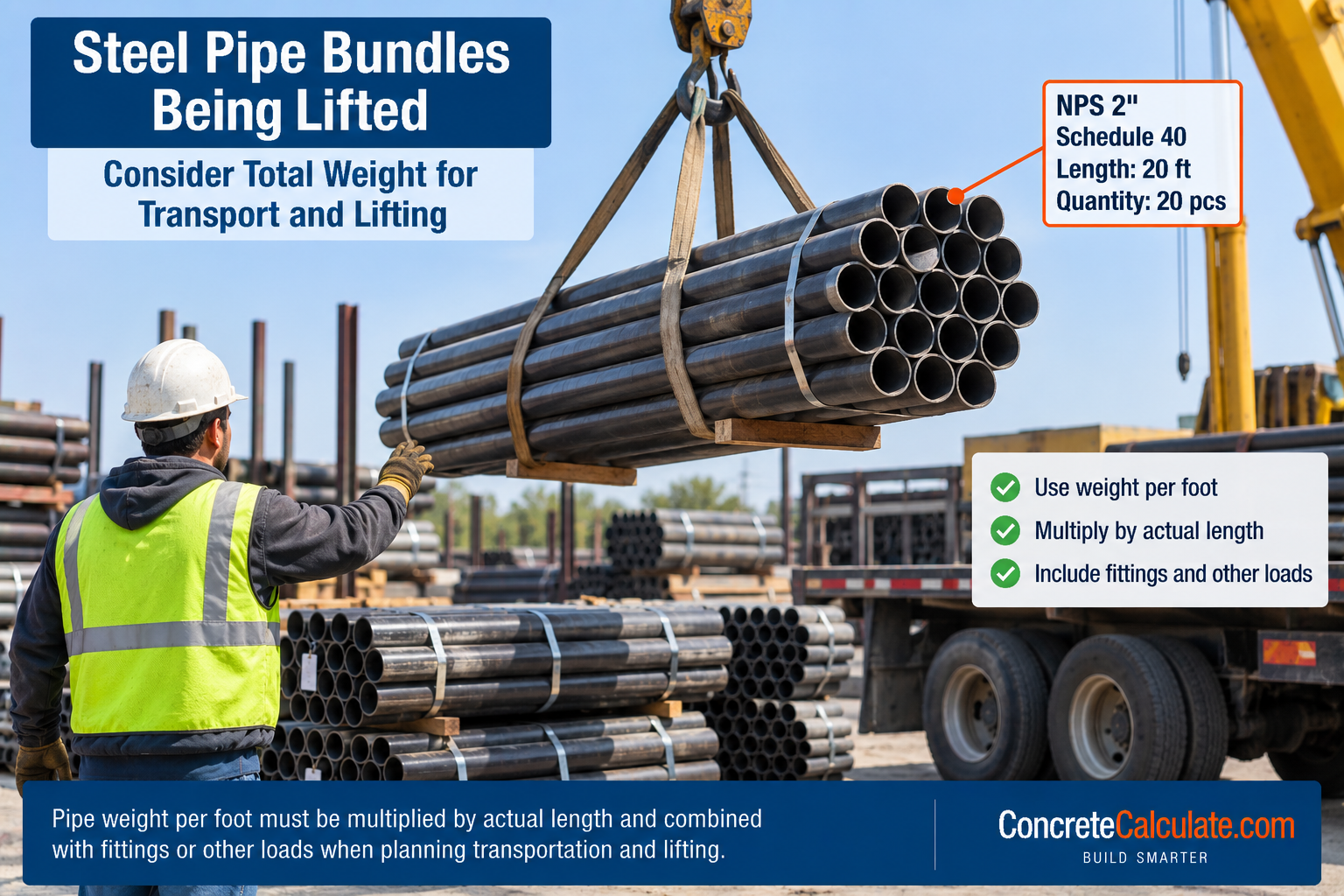
Weight matters for manual lifting, rigging, forklift capacity, crane selection, trucking, and storage rack loads. Published lb/ft multiplied by length gives pipe-body weight only; add fittings, coatings, linings, or other components separately when they are present.
Galvanized, Coated, and Lined Pipe Weight
Additional layers add mass beyond the bare-pipe chart value.
Galvanizing adds zinc coating mass, so galvanized pipe weighs slightly more than bare steel pipe. Do not apply one universal percentage, since coating mass depends on surface area, coating thickness, and the applicable product specification. Other additions such as epoxy coating, polyethylene coating, cement-mortar lining, or rubber lining also add weight beyond the nominal bare-pipe value. Distinguish nominal bare pipe weight from finished installed component weight, and use manufacturer or shipping weight when logistics accuracy is critical.
PVC Pipe Weight Chart
Where this master page distinguishes itself most clearly from steel-only weight data.
PVC pipe weight is based on manufacturer and current product data rather than steel density calculations, since PVC compound density and product-specific wall thickness differ substantially from steel.
| Nominal Size (in) | Sch 80 Weight (lb/100 ft) | Sch 80 Weight (lb/ft) |
|---|---|---|
| 1/2 | 20.3 | 0.203 |
| 3/4 | 27.5 | 0.275 |
| 1 | 40.5 | 0.405 |
| 2 | 93.6 | 0.936 |
| 3 | 194.2 | 1.942 |
| 4 | 279.3 | 2.793 |
| 6 | 532.7 | 5.327 |
These values reflect one manufacturer’s published Schedule 80 PVC product data; other manufacturers may publish slightly different weights for the same nominal size. For complete PVC-specific dimensional data, see the PVC Pipe Size Chart.
Schedule 40 vs Schedule 80 PVC Weight
The same principle as steel, applied to PVC.
For the same nominal PVC pipe size and OD family, Schedule 80 has more wall material than Schedule 40 and therefore generally weighs more per foot. Use manufacturer tables rather than assuming a universal PVC density calculation from nominal size alone, since compound formulation and product-specific dimensions vary by manufacturer.
Copper Pipe/Tube Weight Chart
Copper Development Association data for tube-only weight by type.
| Nominal Size (in) | Type K (lb/ft) | Type L (lb/ft) | Type M (lb/ft) |
|---|---|---|---|
| 1/2 | 0.344 | 0.285 | 0.203 |
| 3/4 | 0.641 | 0.455 | 0.328 |
| 1 | 0.839 | 0.655 | 0.465 |
These are tube-only weights and do not include fittings or contained fluid. For complete copper-specific dimensional data, see the Copper Pipe Size Chart.
Type K vs L vs M Copper Weight
Wall thickness drives weight differences across copper tube types.
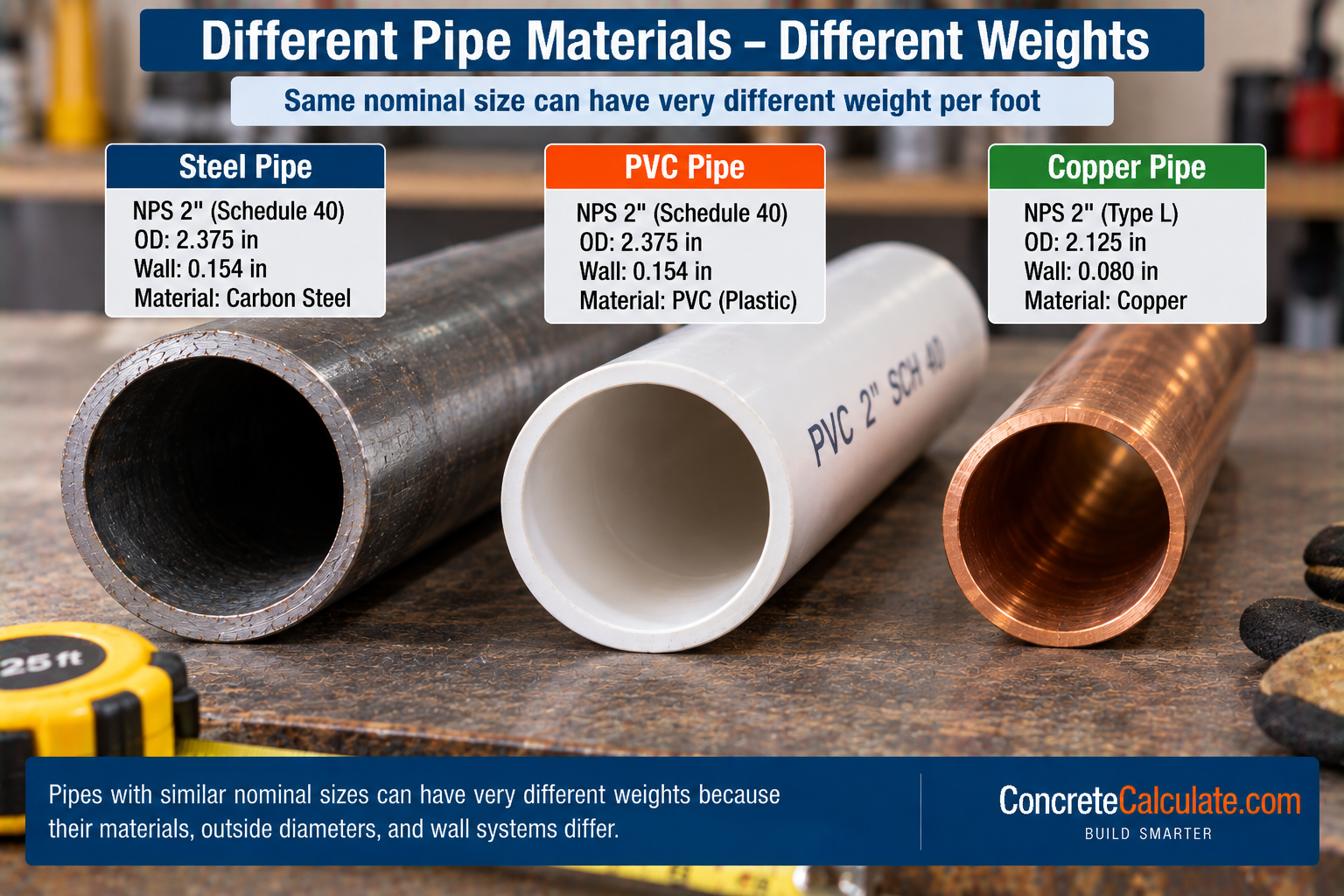
For the same nominal copper size, Type K, the thickest common water-tube wall, generally has the highest empty weight. Type L is intermediate, and Type M, with the thinnest common wall, is the lightest. Do not mix these copper values with NPS steel schedule tables, since the two systems use entirely different dimensional conventions.
Pipe vs Tube Weight
An important sizing distinction before using any weight table.
Tube may be specified by actual OD, wall thickness, or gauge, while pipe typically uses NPS and schedule. The weight lookup needs the correct dimensional system for the product in question; do not use an NPS steel pipe chart to estimate structural HSS or mechanical tubing weight. For structural steel shape and tubing weight, see the structural steel weight reference on this site.
How to Calculate Pipe Weight From OD and Wall Thickness
A practical workflow that works for nonstandard or unusual pipe.
Calculation Workflow
For quick calculations without manual math, use the Pipe Weight Calculator or the general Metal Weight Calculator.
Nominal vs Actual Pipe Weight
An important limitation for procurement and logistics.
Chart weight is typically based on nominal OD, nominal wall thickness, and a nominal material density convention. Actual shipping or field weight can differ because of dimensional tolerances, actual alloy density, coatings, lining, moisture or debris, and normal manufacturing variation.
Important
Use manufacturer shipping weights for procurement and logistics calculations where exact shipping mass matters, rather than relying on the nominal chart value alone.
Common Pipe Weight Chart Mistakes
Using NPS alone to determine weight
NPS alone leaves out schedule and material, both required for a real weight value.
Ignoring schedule
Weight changes significantly with wall thickness even at the same NPS.
Assuming Schedule 80 weighs twice Schedule 40
The actual ratio varies by NPS and is generally well below double.
Assuming same NPS means same weight across materials
Steel, PVC, and copper weigh very differently at the same nominal size.
Using steel values for stainless
Wall tables and alloy density both differ between B36.10 and B36.19 systems.
Assuming 40 and 40S are universally identical
Some sizes have different wall thickness and therefore different weight.
Confusing lb/ft with total weight
Weight per foot must be multiplied by actual length for a project total.
Confusing kg/m with kg/ft
Always keep unit systems consistent through the calculation.
Treating nominal pipe weight as exact shipping weight
Actual weight can differ due to manufacturing tolerances and coatings.
Ignoring coatings or lining
Galvanizing, epoxy, and cement-mortar lining all add weight beyond bare pipe.
Ignoring fluid weight
Operating weight can be substantially higher than empty pipe weight.
Using empty-pipe weight for pipe-support design
Supports must generally account for the full operating condition.
Using water-filled weight for a different-density fluid
Oils, glycols, and slurries have different densities than water.
Confusing pipe and tube
Tube dimensional systems differ from NPS pipe systems.
Using steel schedule tables for copper Type K/L/M
Copper uses its own dimensional and weight system entirely.
Using steel weight for PVC
PVC density and wall systems are entirely different from steel.
Ignoring fittings, valves, flanges, and insulation
These add substantial weight beyond bare pipe in a real system.
Using ID instead of metal area for pipe self-weight
Self-weight comes from the metal wall area, not the bore.
Forgetting wall exists around the full circumference
The metal area formula accounts for the entire ring, not one side.
Assuming all stainless grades have identical density
Density varies somewhat by specific stainless alloy grade.
Pipe Weight Chart Limitations
Read Before Using for Procurement, Logistics, or Support Design
Pipe weight depends on material and wall thickness; NPS alone is insufficient. Schedule is not itself a weight, only a wall-thickness series. Published weights are generally nominal or calculated values, and actual weights vary with manufacturing tolerances. Stainless alloy densities can vary by grade. PVC product weight should follow the applicable product and manufacturer data rather than a steel-based calculation. Copper Type K, L, and M use a different dimensional system from steel schedules. Coatings and linings add weight beyond bare-pipe values. Filled operating weight depends on actual fluid density at service conditions. Valves, fittings, flanges, and insulation are not included in bare-pipe weight. Critical support, lifting, transportation, and structural calculations should use project-specific or manufacturer product data rather than this general reference chart alone.
Frequently Asked Questions
Download Pipe Weight Chart PDF
Save or print this reference including the steel schedule weight tables, the empty vs filled weight comparison, and the PVC and copper weight data for jobsite use.

![Rebar Size Chart - Complete #3 to No. 20 [64] Diameter, Area & Grade Reference](https://concretecalculate.com/wp-content/uploads/2026/07/Rebar-Size-Chart-2026-Complete-3-to-No.-20-64-Diameter-Area-Grade-Reference-390x220.png)