Foundation Frost Depth Chart 2026 – Frost Line & FPSF Guide
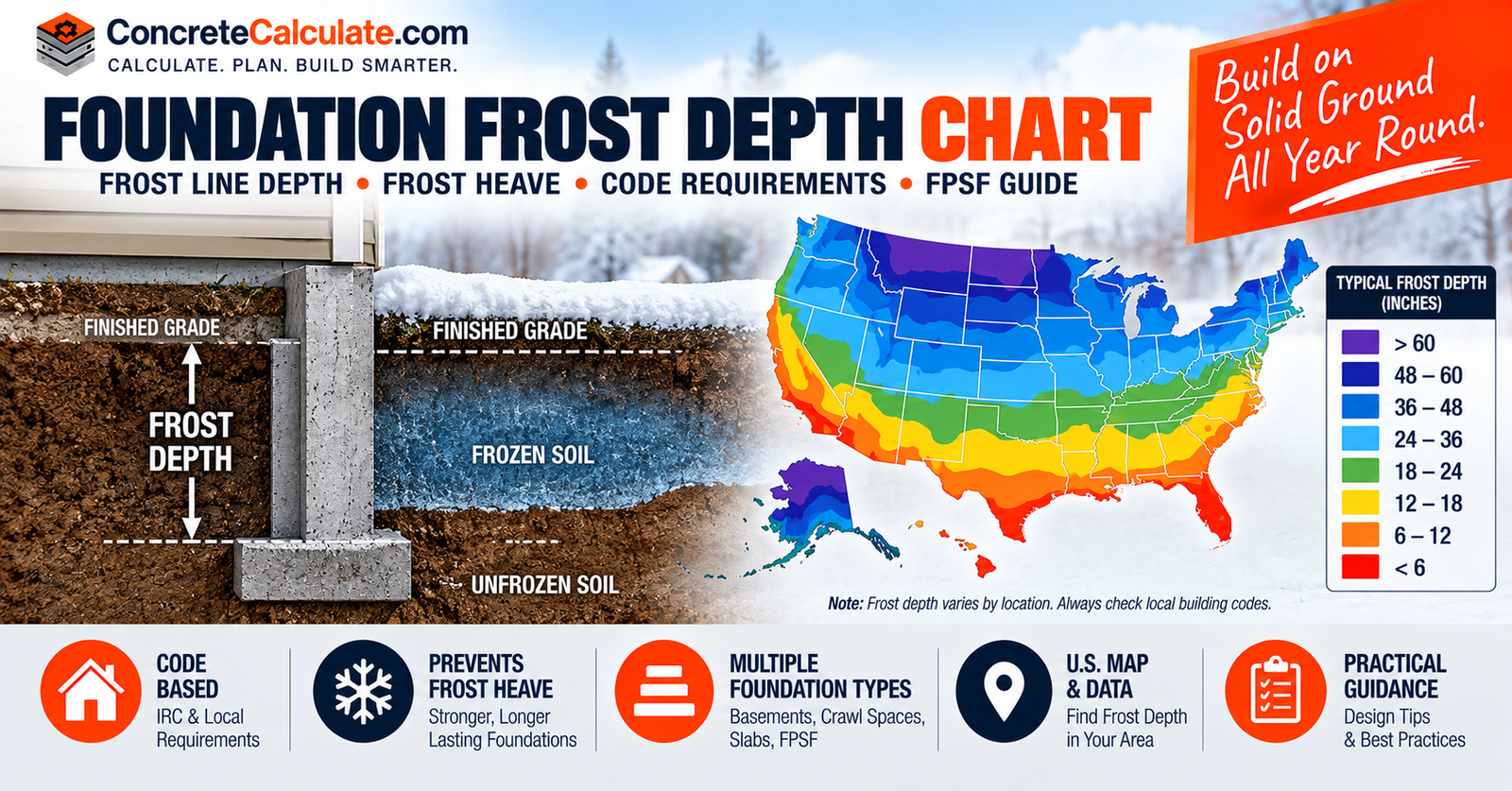
Foundation Frost Depth Chart
Frost Line & FPSF Guide
How local frost-line depth is established, how frost heave occurs, and the IRC methods for protecting foundations from frost, including frost-protected shallow foundations.
 Reviewed by Muhammad Ramzan Babar, PhD Researcher (Plasma Physics) & Calculator Developer, View Profile
There is no single legally applicable frost depth for each U.S. state
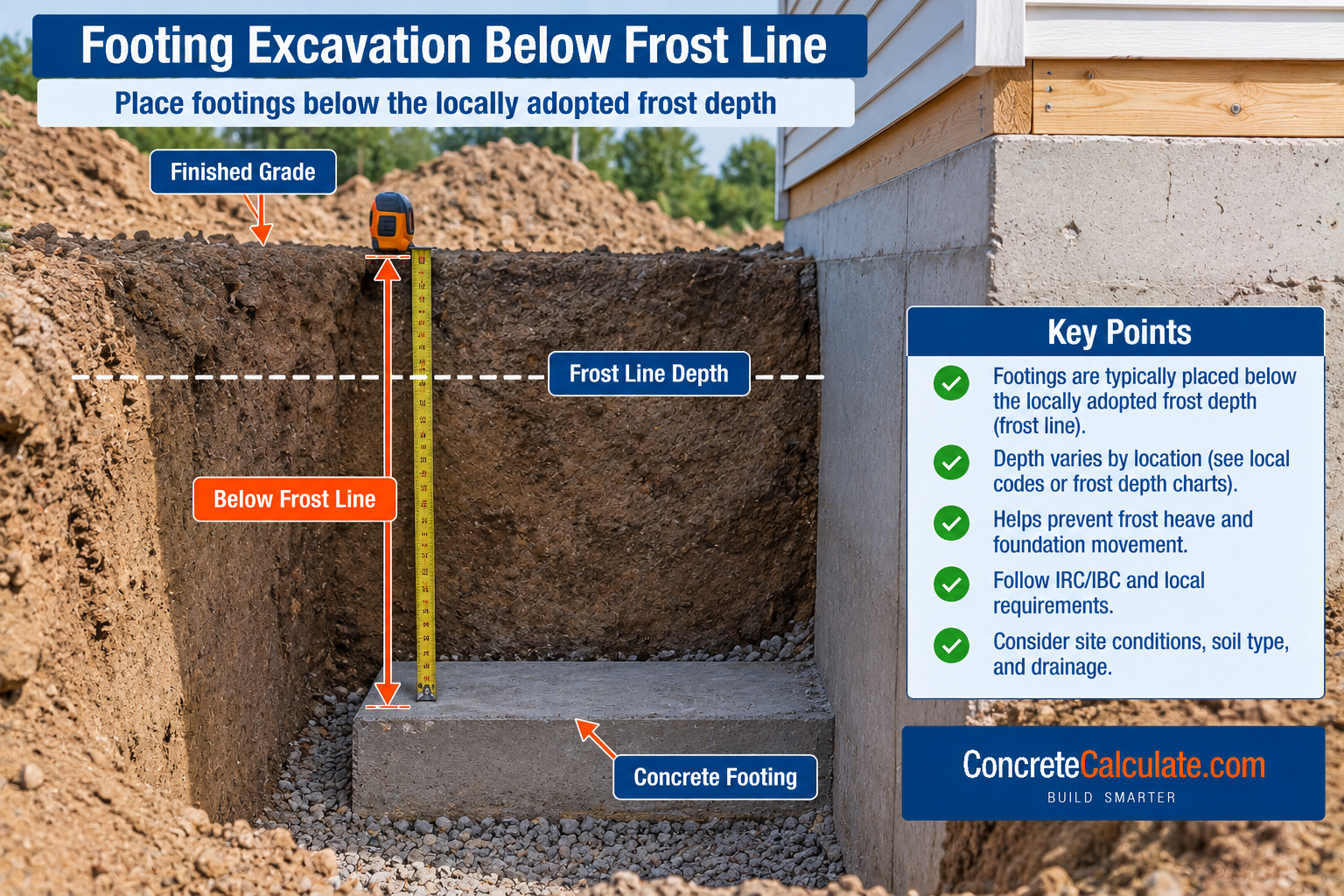
The 2024 IRC does not prescribe one nationwide frost depth. It requires the local jurisdiction to establish the frost-line depth in Table R301.2, and Section R403.1.4.1 requires permanent foundations and supports to be protected from frost by extending below that locally specified frost line, using the IRC frost-protected shallow-foundation provisions, complying with ASCE 32, or bearing on solid rock. Do not use a generic statewide chart in place of your local building department’s adopted value.
Foundation Frost Depth Chart, Quick Reference
Reference frost-depth zones for general orientation, not statewide code requirements.
| Reference Frost Depth | Typical Foundation Implication | Verification Required |
|---|---|---|
| 0-12 in | Little/no seasonal frost in many locations | Local code |
| 12-24 in | Shallow seasonal frost | Local code |
| 24-36 in | Moderate frost protection required | Local code |
| 36-48 in | Cold-climate foundation depth becomes significant | Local code |
| 48-60 in | Deep frost regions | Local code / geotechnical |
| 60+ in | Very cold, high-elevation, or interior regions | Local code / geotechnical |
Reference ranges only
These are not statewide code requirements. They illustrate the general implication of different frost-depth conditions, not a value you can apply directly to a specific project.
Local Code Controls
The IRC requires the jurisdiction to fill in its local frost line depth in Table R301.2. Therefore, the building department’s adopted value should control over any general online frost-depth chart.
Foundation Frost-Protection Options
| Method | IRC Basis |
|---|---|
| Extend foundation below local frost line | R403.1.4.1 |
| Frost-protected shallow foundation | R403.3 |
| Design per ASCE 32 | R403.1.4.1 |
| Found on solid rock | R403.1.4.1 |
What Is Frost Depth?
The physical basis behind every requirement in this chart.
Frost depth is the depth below finished ground to which soil is expected to freeze under specified climatic and site conditions. Related terminology includes frost depth, frost line, frost penetration, and design frost depth. In everyday construction use, “frost line” often means the minimum local depth used to determine where frost-sensitive foundations need protection.
Frost Depth vs Frost Line
Terms often used interchangeably but with a meaningful distinction.
| Term | Meaning |
|---|---|
| Frost Depth | Physical depth of seasonal freezing |
| Code Frost Line | The design depth adopted by a jurisdiction for foundation protection |
Key Message
The code frost line is the number that matters for permit and design purposes, not an online climate estimate by itself.
Frost Depth vs Foundation Depth
An essential ownership distinction for this chart cluster.
| Reference | Owns |
|---|---|
| Frost Depth Chart (this page) | Ground freezing, frost line, frost heave, frost protection, FPSF |
| Foundation Depth Chart | Actual footing/foundation embedment, soil bearing, excavation, basements/crawl spaces, frost as one of several factors |
Foundation depth can be deeper than frost depth for other structural or site reasons, including bearing capacity, groundwater, or basement wall height requirements. See the Foundation Depth Calculator for the broader depth calculation.
2024 IRC Minimum Foundation Depth
A baseline that is not itself a frost-depth value.
The 2024 IRC Section R403.1.4 requires exterior footings to be at least 12 in below undisturbed ground surface, while also requiring additional frost protection where Section R403.1.4.1 applies.
Important
12 inches is not a universal frost depth. It is the general minimum footing depth before frost requirements are considered on top of it.
2024 IRC Frost Protection Requirements
One of the core authority sections on this page.
IRC Section R403.1.4.1 provides four primary methods: extend below the frost line specified by the jurisdiction, use IRC Section R403.3 FPSF provisions, comply with ASCE 32, or bear on solid rock. Footings generally cannot bear on frozen soil unless the frozen condition is permanent.
✓ Verified Against 2024 IRC Section R403.1.4.1Why There Is No Single U.S. Frost Depth
The variables that make one nationwide number impossible.
Frost depth depends on latitude, elevation, local winter temperatures, snow cover, soil type, moisture, ground cover, topography, urban heat effects, and local historical climate. This is why the IRC delegates the frost-line value to the local jurisdiction through Table R301.2 rather than prescribing one number for the entire country.
How Local Jurisdictions Establish Frost-Line Depth
One of the strongest authority sections in this chart.
The IRC’s climatic and geographic design criteria table (Table R301.2) includes frost line depth, ground snow load, wind, seismic category, weathering, termites, air-freezing index, and mean annual temperature. The jurisdiction fills the frost-line column with the required local value based on its own climate data and engineering judgment.
Frost Depth by U.S. Climate Region
Broad regional guidance rather than falsely precise statewide numbers.
| Region | General Tendency |
|---|---|
| Warm / Gulf / Southern Coastal Regions | Often shallow or negligible frost concerns; verify local jurisdiction value |
| Transition / Mid-South | Moderate local frost depths; verify local jurisdiction value |
| Mid-Atlantic / Midwest | Commonly deeper seasonal frost; verify local jurisdiction value |
| Northern Plains / Upper Midwest | Deep frost conditions; verify local jurisdiction value |
| Mountain / High-Elevation Areas | Potentially very deep frost despite a warmer overall state climate; verify local jurisdiction value |
| Alaska / Extreme Cold | Special deep-freeze and permafrost considerations; verify local jurisdiction value |
Why Statewide Frost Depth Values Can Be Misleading
What distinguishes this chart from low-quality competitors.
A single state can contain coastal areas, plains, and mountain areas with dramatically different elevations. One statewide number may be wrong for many counties or cities within that same state. Any “typical statewide reference range” should be clearly labeled as a reference range only, not code-prescriptive, and readers should be directed to check their specific county or city rather than treating it as a required footing depth by state.
How to Find Frost Depth by County or City
The practical “what should I do” section.
Check with your local building department, review the adopted IRC or IBC amendments for your jurisdiction, examine the jurisdiction’s Table R301.2 value, look at local permit handouts for footings or decks, and consult a geotechnical report if one is required for your project.
What Is Frost Heave?
The mechanism behind every frost-protection requirement.
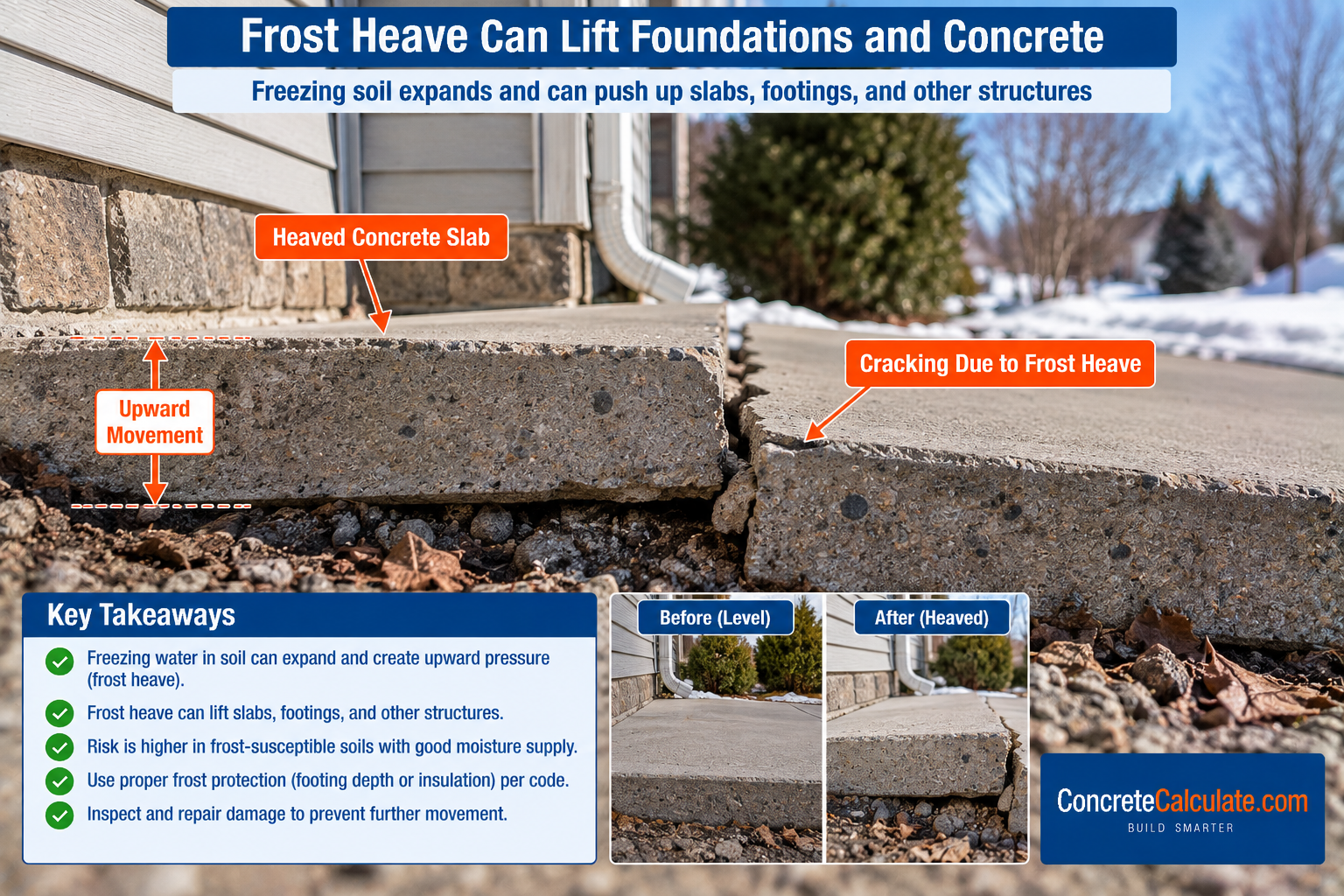
Frost heave occurs when freezing conditions and frost-susceptible soil combine with available moisture to create ice lenses that expand and lift soil. The key variables are freezing temperatures, frost-susceptible soil, and available moisture, all three of which must generally be present for significant heave to occur.
How Frost Heave Damages Foundations
Making the frost-line requirement understandable to homeowners.
Potential consequences of frost heave include lifted footings, differential movement, cracked walls, uneven floors, displaced piers, damaged decks, and sticking doors or windows. These effects can range from cosmetic to structurally significant depending on the severity and location of the heave.
Frost-Susceptible vs Non-Frost-Susceptible Soil
An important advanced distinction.
ASCE 32 recognizes non-frost-susceptible ground and fill, discussing well-drained granular materials as generally lower risk. Its current standard indicates soil classification should be determined appropriately, including geotechnical involvement where required. Broadly, more frost-susceptible soils include silts and certain fine sands that retain moisture, while less frost-susceptible materials include properly drained coarse granular material such as appropriate crushed rock or gravel systems. Do not make a universal soil classification from visual inspection alone.
Soil Moisture, Drainage, and Frost
Frost damage is not just about cold soil.
Water availability matters as much as temperature. Good drainage can meaningfully reduce frost-heave risk. HUD’s FPSF guidance emphasizes good drainage and keeping insulation above the groundwater table, with gravel, sand, or drainage layers used where applicable.
Snow Cover and Frost Penetration
The insulating effect of snow on soil freezing.
Deep, persistent snow cover can reduce frost penetration by insulating the ground beneath it, while bare soil can freeze deeper under similar air temperatures. Air temperature alone does not perfectly predict actual soil freezing depth; ground cover conditions matter significantly.
Air-Freezing Index (AFI)
One of the strongest technical sections in this chart.
The IRC’s FPSF provisions use the air-freezing index as a climate measure. The IRC defines AFI as cumulative degree-days below 32°F and uses a 100-year return-period estimate in its frost-protected foundation design map and table. Conceptually, AFI sums the difference between 32°F and the mean daily temperature across all freezing days in a season. Higher AFI generally means colder or longer winters and greater frost-protection demand.
✓ Verified Against 2024 IRC Table R403.3(1)AFI vs Actual Frost Depth
Related but not identical measures.
AFI is a climate-based measure derived from air temperature records. Actual frost penetration also depends on soil type, moisture, snow cover, vegetation, and surface conditions at the specific site. Do not create a simplistic direct universal conversion between AFI and a physical frost depth in inches; the IRC’s FPSF table uses AFI directly for insulation and footing-depth design rather than converting it to a separate frost-depth number.
IRC Frost-Protected Shallow Foundation Chart
One of the main technical tables on this page.
| Air-Freezing Index (°F-days) | Min Footing Depth (in) | Vertical Insulation R-Value | Horizontal Insulation R-Value (Walls) | Horizontal Insulation R-Value (Corners) |
|---|---|---|---|---|
| 1,500 or less | 12 | 4.5 | Not required | Not required |
| 2,000 | 14 | 5.6 | Not required | Not required |
| 2,500 | 16 | 6.7 | 1.7 | 4.9 |
| 3,000 | 16 | 7.8 | 6.5 | 8.6 |
| 3,500 | 16 | 9.0 | 8.0 | 11.2 |
| 4,000 | 16 | 10.1 | 10.5 | 13.1 |
Important
These values apply only within the specific IRC FPSF conditions for heated buildings, not as general footing depths for conventional foundations.
What Is a Frost-Protected Shallow Foundation?
The core concept behind the alternative to deep excavation.
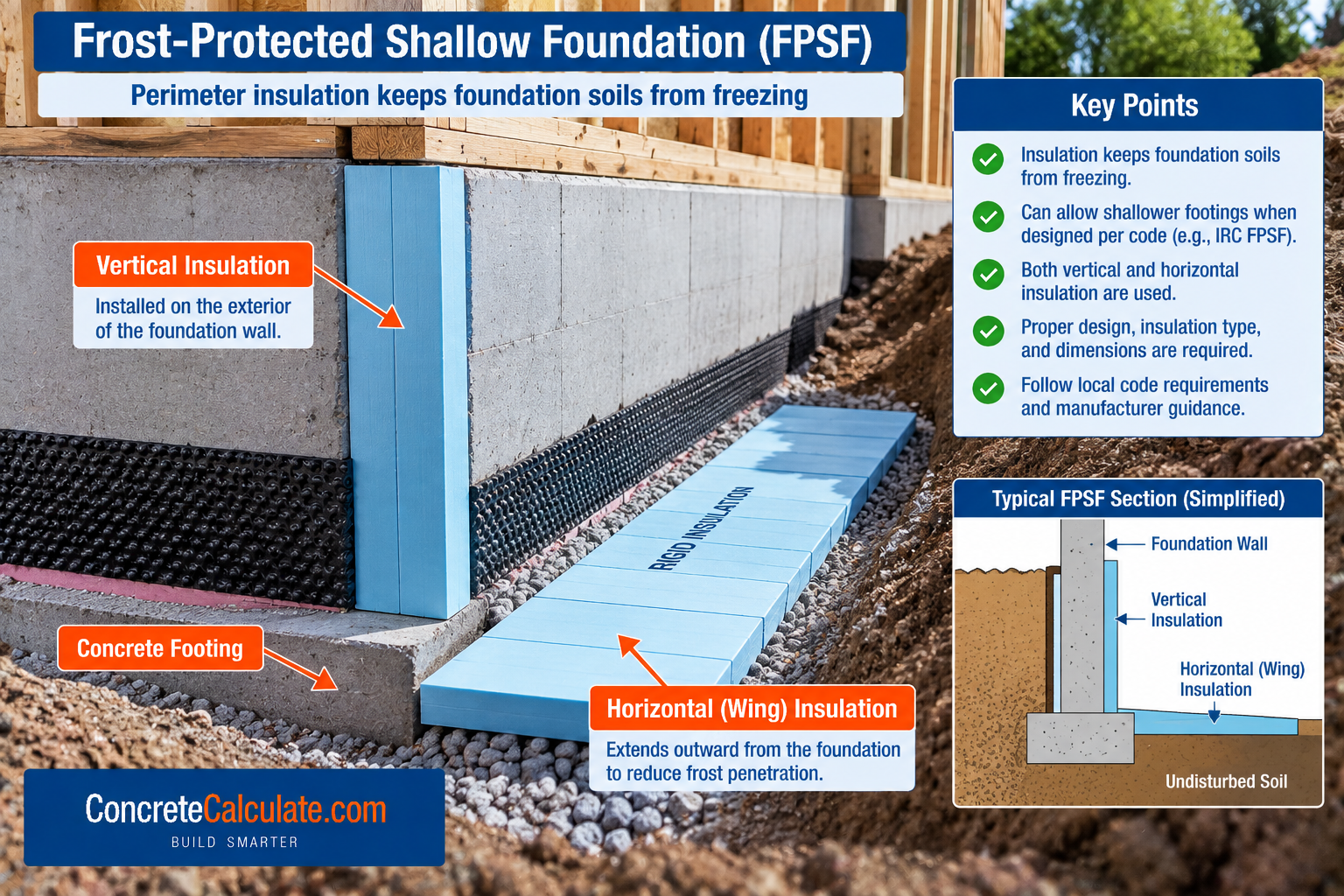
An FPSF uses insulation strategically around the foundation to keep soil near the footing from freezing, allowing shallower foundation construction than conventional below-frost-line footings. HUD describes FPSF as a practical alternative to deeper foundations in cold regions, offering potential excavation and material cost savings.
Conventional Footing vs FPSF
An excellent user-facing comparison.
| Feature | Conventional Frost Footing | FPSF |
|---|---|---|
| Main strategy | Extend below frost line | Insulate soil/foundation |
| Excavation | Usually deeper | Often shallower |
| Thermal design required | Less central | Essential |
| Suitable everywhere automatically? | No | No |
| Code basis | R403.1.4.1 | R403.3 / ASCE 32 |
2024 IRC FPSF Requirements for Heated Buildings
An important temperature qualification.
The 2024 IRC R403.3 permits frost-protected footings for qualifying heated buildings where the building’s monthly mean temperature is maintained at least 64°F (18°C), with insulation provided according to the code tables and figures.
Important Limitation
The simplified IRC provision does not apply indiscriminately to unheated garages, porches, unheated utility spaces, or unheated crawl or basement conditions.
Unheated Buildings and Frost Protection
Where ASCE 32 becomes especially useful.
The current reaffirmed ASCE 32-01(R2025) standard contains design procedures for heated buildings, unheated buildings, and special FPSF conditions. Do not use the simplified heated-building IRC FPSF table for an unheated building unless the applicable design provisions specifically permit it.
ASCE 32-01(R2025) Frost-Protected Shallow Foundations
A dedicated standards section with a genuine freshness advantage.
The current standard is SEI/ASCE 32-01(R2025), Design and Construction of Frost-Protected Shallow Foundations. It was reaffirmed in 2025 by the Frost Protected Shallow Foundations Technical Committee of the Structural Engineering Institute and remains current. It covers heated and unheated building FPSF design, including climate data and insulation requirements.
Freshness Note
The standard is now correctly cited as ASCE 32-01(R2025), not simply “ASCE 32-01” without the 2025 reaffirmation notation.
FPSF Insulation and Corner Requirements
A strong technical detail that distinguishes this chart from generic competitors.
FPSF design may involve vertical insulation, horizontal wing insulation, increased corner insulation, insulation R-value, footing embedment, and drainage. The IRC Table R403.3(1) increases insulation needs with increasing AFI, and specifically distinguishes insulation requirements along straight wall sections from requirements at corners, since corners can lose heat in multiple directions and may need more horizontal insulation than straight runs. Do not create universal R-values independent of the specific climate and design conditions.
Frost Depth for Deck Footings
Very relevant to the existing deck construction cluster.
Deck footings have their own IRC provisions under R507.3, and local frost protection still matters for permanent deck supports. Do not simply copy a house-foundation frost depth into every deck design without checking the adopted deck provisions and local requirements. See the Deck Footing Size Chart for related deck footing dimensional data.
Frost Depth for Piers, Posts, and Exterior Supports
The same foundational protection requirement extends to isolated supports.
R403.1.4.1 explicitly applies frost protection to foundation walls, piers, and other permanent supports, subject to exceptions. This covers deck piers, porch supports, permanent exterior posts, and isolated footings, all of which must satisfy the same frost-protection framework as a full foundation unless a specific exception applies.
Small Accessory Structure Frost Exceptions
A model-code exception worth understanding clearly.
The 2024 IRC includes exceptions for certain small freestanding accessory structures. It exempts frost protection for qualifying light-frame structures 600 sq ft or less with an eave height of 10 ft or less, and other-than-light-frame structures 400 sq ft or less with the same height limit.
Important
This is a model-code exception; local adoption and amendments still control whether it applies to your specific project.
Basements, Crawl Spaces, and Slab-on-Grade Foundations
Where frost is only one of several controlling factors.
Basement and crawl-space foundation depths are usually controlled by several factors beyond frost, including required wall height, soil pressure, drainage, bearing, and groundwater. Often the foundation naturally extends below local frost depth, but that should not be assumed in every design. For slab-on-grade foundations, an interior slab does not simply need to be below frost depth; the critical issue is frost protection of the perimeter foundation edges, insulation, soil conditions, and FPSF design where used, which is where shallow slab-on-grade FPSF construction is especially relevant.
Frost Depth in High-Elevation Areas, and Permafrost vs Seasonal Frost
Why state averages fail, and an important distinction for extreme climates.
Mountain counties can have much deeper frost requirements than low-elevation parts of the same state; verify municipality, county, elevation-specific provisions, and geotechnical conditions rather than assuming a single value across an entire state.
| Condition | Description |
|---|---|
| Seasonal Frost | Ground freezes and thaws annually |
| Permafrost | Ground remains frozen for extended periods |
Foundation design in permafrost regions can require completely different strategies than seasonal-frost design. Do not treat a typical seasonal frost-depth chart as a permafrost design guide.
How to Find the Frost Depth for Your Property
The most practical section on this entire page.
Frost Depth Verification Workflow
Common Foundation Frost Depth Mistakes
Using one frost depth for an entire state
Frost depth can vary significantly by county, elevation, and microclimate.
Treating an online frost map as code
Only the local jurisdiction’s adopted value is legally applicable.
Assuming frost depth equals foundation depth
Foundation depth can be deeper for bearing, drainage, or structural reasons.
Assuming the 12-in minimum footing depth is the frost line
12 in is the general baseline minimum, not a frost-protection value.
Using climate zone instead of local frost-line value
General climate zone designations do not substitute for the specific frost-line requirement.
Confusing frost depth with snow depth
These are unrelated measurements describing different phenomena.
Ignoring elevation
Mountain areas can require much deeper frost protection than nearby lowlands.
Ignoring local amendments
Adopted local code can differ from the base model IRC provisions.
Ignoring frost-susceptible soil
Soil type significantly affects actual frost-heave risk beyond depth alone.
Ignoring soil moisture and drainage
Water availability is as important as temperature for frost-heave risk.
Assuming gravel automatically eliminates all frost issues
Gravel reduces risk but does not universally eliminate frost-heave potential.
Placing footing on frozen soil
Footings generally cannot bear on frozen soil unless the frozen condition is permanent.
Using a heated-building FPSF detail for an unheated garage
The IRC’s simplified table requires a specific minimum heating temperature.
Omitting horizontal corner insulation where required
Corners often need more insulation than straight wall sections.
Ignoring insulation R-value requirements
Required R-value increases with the local air-freezing index.
Assuming all decks need the same footing depth
Deck footing requirements depend on the specific applicable code provisions.
Ignoring accessory-building exceptions
Certain small structures may qualify for a frost-protection exception.
Treating AFI as exact physical frost depth
AFI is a climate metric used for FPSF design, not a direct depth conversion.
Using one mild winter as design basis
Code frost values use long-term historical data, not a single recent season.
Ignoring permafrost conditions
Permafrost requires an entirely different design strategy than seasonal frost.
Excavating below frost depth onto unsuitable bearing soil
Meeting frost depth does not guarantee adequate bearing capacity at that depth.
Foundation Frost Depth Chart Limitations
Read Before Foundation Design or Construction
There is no universal U.S. frost depth. Frost depth can vary within a state and even within a county. The locally adopted code always controls over any general reference chart. IRC Table R301.2 is jurisdiction-specific, not a fixed nationwide table. Frost line is not necessarily the only factor controlling foundation depth. Frost-susceptible soil and moisture conditions matter independently of depth alone. FPSF design requires specific insulation and design per the applicable table or standard. Heated and unheated building FPSF designs differ significantly. Decks and accessory structures can have separate rules and exceptions from the main foundation requirement. Permafrost conditions require specialized design beyond ordinary seasonal-frost provisions. Exact project requirements may need geotechnical or structural engineering input beyond this general reference.
Frequently Asked Questions
Download Foundation Frost Depth Chart PDF
Save or print this reference including the frost-protection method table, the IRC FPSF insulation and footing depth chart, frost heave explanation, and the property frost-depth verification workflow.