Mortar Mix Ratio Chart 2026 – Type M, S, N and O Mortar
October 1, 2026
13 27 minutes read
Mortar Mix Ratio Chart
Mortar Mix Ratio Chart: Type M, S, N & O Proportions | ConcreteCalculate.com
ASTM C270-26 Masonry Mortar Reference
Mortar Mix Ratio Chart Type M, S, N and O Mortar
Compare ASTM C270 mortar proportions, cement-lime-sand relationships, laboratory strengths, code-based application choices, masonry cement and mortar cement combinations, and practical batch and quantity calculations.
Types M, S, N and OCement-Lime, Masonry and Mortar Cementpsi and MPaBatch CheckerIRC and TMS Referenced
Reviewed by Muhammad Ramzan Babar, PhD Researcher (Plasma Physics) & Calculator Developer – View Profile
⚡
Short Answer
There is no single mix ratio for each mortar type. ASTM C270 sets 1 part cement, a permitted lime range (¼ for Type M, over ¼ to ½ for S, over ½ to 1¼ for N, over 1¼ to 2½ for O), and sand at 2¼ to 3 times the total cementitious volume. A shorthand such as 1 : 1 : 6 for Type N is one valid example, not the only recipe. Choose the lowest-strength type that meets the code and project requirements.
Mortar Mix Ratio Chart: Quick Reference
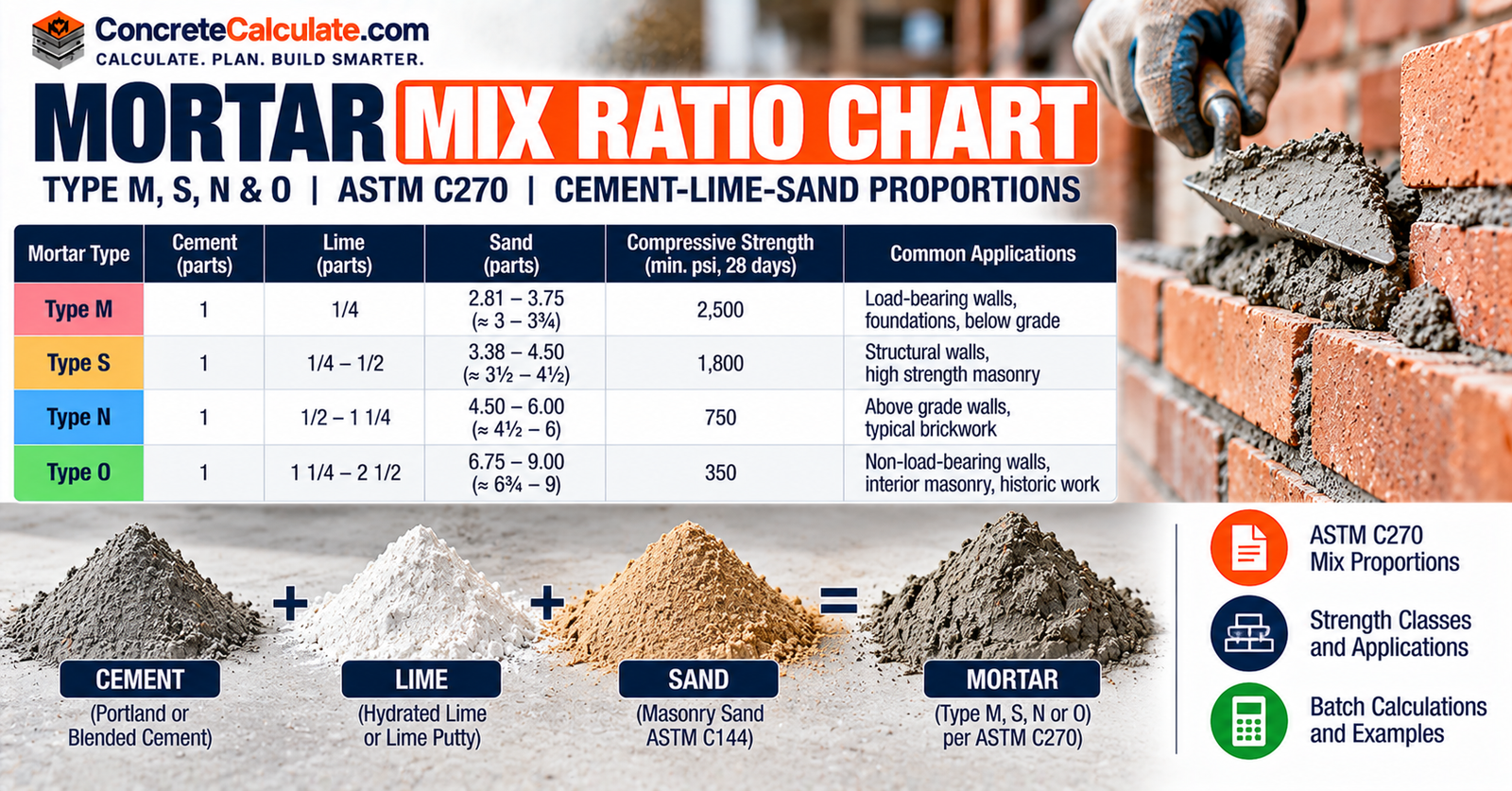
Start here for the ASTM C270 ratios, laboratory strengths and mortar type by application. The chart is built on the actual proportion rules, not a single fixed cement to sand recipe.
📋
How to Read This Chart
These are the ASTM C270 proportion-specification requirements, shown as parts by volume. Cement is always 1 part. Lime is a permitted range, and sand is not a fixed number: it must equal 2¼ to 3 times the total volume of cement plus lime, measured damp and loose. Shorthand mixes such as 1 : 1 : 6 appear later as examples, not as the only compliant recipes.
ASTM Cement-Lime Mortar Ratio Chart
ASTM C270 proportion specification for cement-lime mortar, as reproduced in IRC Table R606.2.8. Parts by volume.
Mortar Type
Portland or Blended Cement (parts)
Hydrated Lime or Lime Putty (parts)
Sand, Damp and Loose (parts)
Type M
1
¼
2¼ to 3 × (cement + lime)
Type S
1
over ¼ to ½
2¼ to 3 × (cement + lime)
Type N
1
over ½ to 1¼
2¼ to 3 × (cement + lime)
Type O
1
over 1¼ to 2½
2¼ to 3 × (cement + lime)
<p>Mortar Mix Ratio Chart via <a href=”https://concretecalculate.com/mortar-mix-ratio-chart/#quick-chart”>ConcreteCalculate.com</a></p>
Aggregate rule: aggregate measured in a damp, loose condition must be not less than 2¼ and not more than 3 times the sum of the separate volumes of the cementitious materials (cement and lime).
Source: ASTM C270 proportion specification and IRC Table R606.2.8
Cement and lime are drawn to scale. The permitted lime range grows from Type M to Type O, while the sand allowance always depends on the total cementitious volume.
Mortar Type Strength Chart
⚠️
Laboratory Values Only
These strengths apply to laboratory-prepared mortar mixed to a prescribed flow under the ASTM C270 property specification. They are not minimum strengths for mortar taken from a jobsite mixer, and they are not the strength of the mortar in the wall.
ASTM C270 property specification, laboratory-prepared mortar. MPa values are converted from psi.
Mortar Type
Min. Average 28-Day Lab Strength (psi)
Min. Average 28-Day Lab Strength (MPa)
Type M
2,500
17.2
Type S
1,800
12.4
Type N
750
5.2
Type O
350
2.4
<p>Mortar Compressive Strength Chart via <a href=”https://concretecalculate.com/mortar-mix-ratio-chart/#strength-chart”>ConcreteCalculate.com</a></p>
Mortar Type by Common Masonry Application
Code rows state the actual requirement. Guidance rows are industry recommendations, not code minimums.
Masonry Condition
Mortar Type
Basis
Important Limitation
Masonry foundation walls (IRC prescriptive tables)
M or S
Code requirement (IRC R606.2.8.1)
Applies to walls built under IRC Tables R404.1.1(1) to (4)
Lateral-force-resisting masonry, SDC A, B, C
M, S or N
Code requirement (IRC R606.2.8.2)
Applies where masonry is the lateral-force-resisting system
Lateral-force-resisting masonry, SDC D0, D1, D2
M or S, portland cement-lime or mortar cement
Code requirement (IRC R606.2.8.3)
Masonry cement mortar is not listed for this condition
Glass-unit masonry
S or N
Code requirement (IRC R607.8)
No retempering after initial set
Adhered masonry veneer
C270 Type S or N, or ANSI A118.4 latex-modified mortar
Code requirement (IRC R606.2.11)
Setting mortar rules differ from anchored veneer
Anchored brick veneer, normal exposure
N
Industry guidance (BIA)
Project specification and unit absorption control
Stronger brickwork (high seismic, high wind)
S
Industry guidance (BIA)
Use lowest strength that meets requirements
Interior nonbearing partitions
N, sometimes O
Industry guidance (BIA, CMHA)
O only where permitted and specified
Repointing historic masonry
Varies
Preservation practice
Match existing units and mortar; no blanket rule
<p>Mortar Type by Application via <a href=”https://concretecalculate.com/mortar-mix-ratio-chart/#application-chart”>ConcreteCalculate.com</a></p>
Local codes, adopted editions and the structural design can be stricter than these model-code and guidance entries.
CONTRACTOR ESTIMATING PACK
Planning your next concrete project?
Plan concrete materials and project costs with our downloadable Excel estimator pack. For estimating only; follow applicable technical standards for design and installation.
Masonry mortar is the material placed between masonry units to bond them into an assembly, make up small differences in unit size, keep the joint continuous, and help resist air and moisture penetration. CMHA describes mortar as a small share of a concrete masonry wall (about 7 percent) with an outsized effect on how the wall performs.
Cementitious binder: portland or blended cement, or a factory blend such as masonry cement or mortar cement.
Lime or plasticizers: hydrated lime or lime putty in cement-lime mortar, or the plasticizing materials already blended into masonry and mortar cements.
Sand: natural or manufactured sand graded for masonry mortar.
Water: clean water added for a workable consistency.
Mortar and concrete both contain cementitious material, aggregate and water, but BIA cautions against treating them as interchangeable. Mortar is designed around bond, workability and water retention against absorptive units. Concrete is designed to work as a structural material by itself. See the Concrete Mix Ratio Chart for concrete proportions, which follow different rules.
<
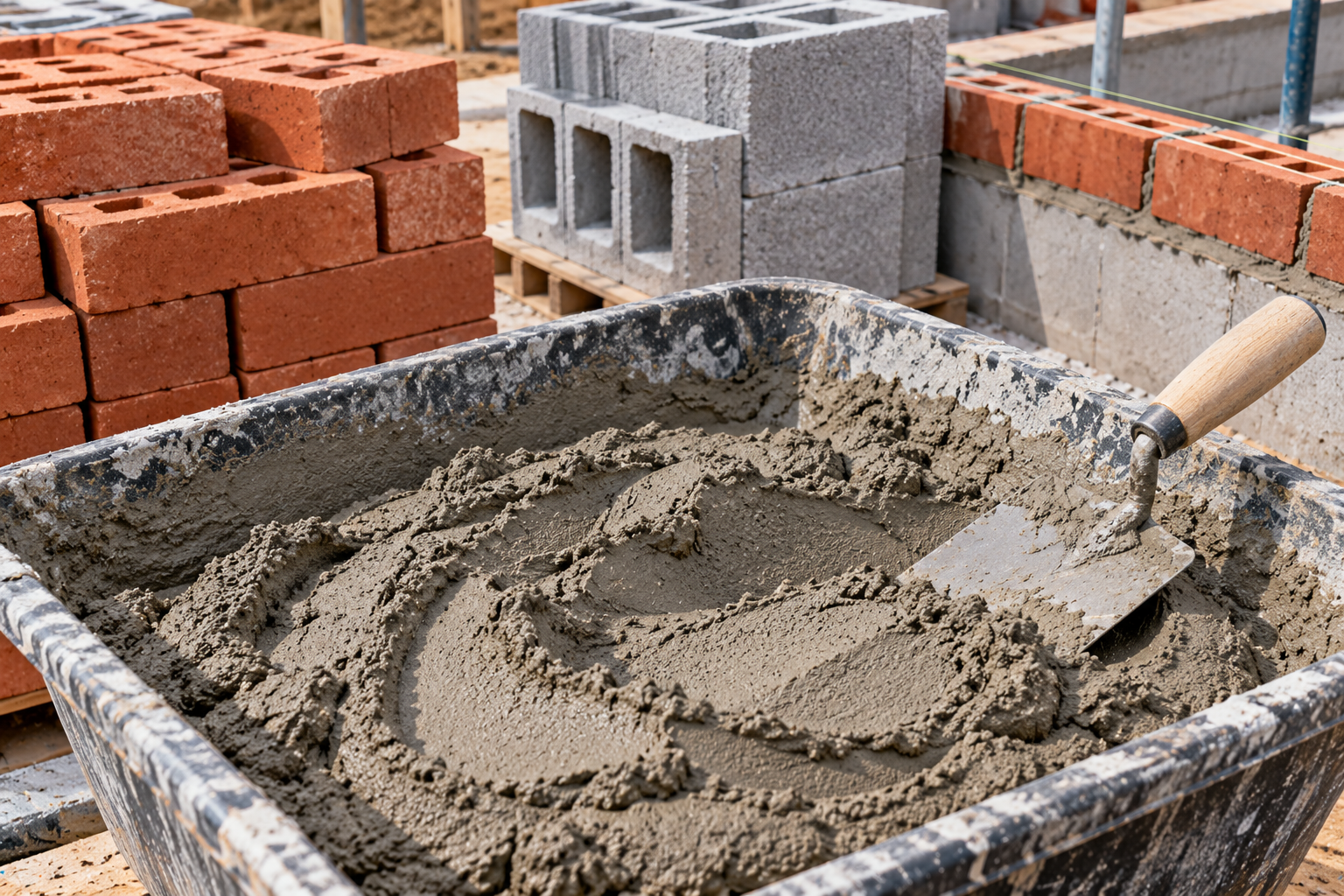
Fresh masonry mortar prepared for brick and concrete block construction, with a masonry trowel ready for application.
Mortar vs. Concrete vs. Grout
Users often search for mortar recipes when they actually need grout or concrete. The three materials have different jobs, different standards and different consistencies.
General comparison. Project specifications govern actual materials and consistency.
Fills cells or cavities, bonds reinforcement to masonry
Structural material cast to its own shape
Aggregate
Masonry sand (ASTM C144)
Fine, or fine plus coarse (pea gravel) aggregate
Sand plus coarse aggregate
Consistency
Plastic and workable, supports the unit
Fluid, commonly 8 to 11 in. slump (CMHA)
Set by the mix design
Relevant standard
ASTM C270
ASTM C476
Project specification, commonly ACI 318
Where it goes
Between masonry units (bed and head joints)
Inside masonry cells or cavities, around rebar
Formwork or cast-in-place and precast elements
<p>Mortar vs Grout vs Concrete via <a href=”https://concretecalculate.com/mortar-mix-ratio-chart/#vs-grout”>ConcreteCalculate.com</a></p>
Mortar sits in the joints, grout fills reinforced cells, and concrete is cast as its own element. The three are not interchangeable.
🧱
Grout Is Governed by a Different Standard
Masonry grout follows ASTM C476, not ASTM C270. The IRC allows Type M or S mortar with enough added water to reach pouring consistency to be used as grout under its specific grout provision only. Do not substitute ordinary mortar for specified structural grout.
Understanding Mortar Types M, S, N and O
ASTM C270 covers four mortar types, M, S, N and O, in each of its two alternative specifications. The types separate mortars by laboratory compressive strength and by the balance of strength, bond and workability. The letter does not describe a single fixed recipe.
Type M: the highest laboratory compressive strength of the four. BIA describes it as high compressive-strength mortar that is not very workable.
Type S: general all-purpose mortar with higher compressive and flexural bond strength, used for more demanding structural and exposure conditions.
Type N: general all-purpose mortar with good bonding capability and workability, widely used above grade.
Type O: low-strength mortar used mostly for interior applications and restoration, where the code and specification allow it.
CMHA notes that building codes typically require Types M, S and N, and may restrict certain mortars for particular uses. Type O should not be treated as a normal structural or exterior mortar.
ASTM C270 Proportion vs. Property Specifications
ASTM C270-26, the current active edition, gives two alternative ways to specify mortar. Only one should be called for in the project documents, not both.
The two ASTM C270 paths are alternatives. Field mortar cubes are not part of qualifying a mortar under the property specification.
Proportion Specification
Compliance comes from using the specified materials and adding them to the mixer in the permitted volume proportions. ASTM C270 states that compliance is verified by confirming the materials are as specified, meet their requirements, and are batched in the proper proportions.
Property Specification
A mortar mixture is qualified by preparing it in the laboratory at a specific flow and testing it against the property requirements. The laboratory then establishes proportions from the successful tests, and those proportions are followed when preparing field mortar. CMHA describes this as a preconstruction evaluation.
What Happens When Neither Is Specified?
ASTM C270 says the proportion specification governs, unless data are presented to and accepted by the specifier showing that the mortar meets the property specification.
Type M Mortar Mix Ratio
For cement-lime Type M, the proportion specification is 1 part portland or blended cement and ¼ part hydrated lime or lime putty. Sand is 2¼ to 3 times the sum of the two, which is 2.81 to 3.75 parts for that combination.
Laboratory property strength: 2,500 psi (17.2 MPa) minimum average at 28 days, for laboratory-prepared mortar only.
Typical uses: masonry foundation walls and below-grade work, where the IRC requires Type M or S, and heavily loaded structural masonry.
Workability: BIA notes Type M is not very workable, which affects how easily units can be bedded.
Limitation: higher compressive strength does not make Type M the best choice for every brick or block. Softer units and many veneer applications do not need it.
Type S Mortar Mix Ratio
For cement-lime Type S, use 1 part cement and over ¼ to ½ part lime, with sand at 2¼ to 3 times their combined volume. At ½ part lime, sand ranges from 3⅜ to 4½ parts.
Laboratory property strength: 1,800 psi (12.4 MPa) minimum average at 28 days, for laboratory-prepared mortar only.
Typical uses: foundation walls (Type M or S under the IRC), structural masonry, and stronger brickwork in high-wind and high-seismic areas.
Seismic: the IRC lists Type M or S portland cement-lime or mortar cement for lateral-force-resisting masonry in SDC D0, D1 and D2.
Balance: Type S offers higher bond and compressive strength than Type N while keeping better workability than Type M.
Type N Mortar Mix Ratio
For cement-lime Type N, use 1 part cement and over ½ to 1¼ parts lime, with sand at 2¼ to 3 times their combined volume. At 1 part lime, sand ranges from 4.5 to 6 parts.
Laboratory property strength: 750 psi (5.2 MPa) minimum average at 28 days, for laboratory-prepared mortar only.
Typical uses: general-purpose brick masonry, most anchored veneer, and above-grade work. BIA recommends Type N for normal use.
Strengths: good bond, workability and water retention.
Limitation: Type N is not allowed where the code or drawings require Type M or S, such as prescriptive masonry foundation walls.
Type O Mortar Mix Ratio
For cement-lime Type O, use 1 part cement and over 1¼ to 2½ parts lime, with sand at 2¼ to 3 times their combined volume. At 2 parts lime, sand ranges from 6.75 to 9 parts.
Laboratory property strength: 350 psi (2.4 MPa) minimum average at 28 days, for laboratory-prepared mortar only.
Typical uses: interior, nonbearing work and some restoration, where permitted and specified.
Softer masonry: a lower-strength mortar can suit softer units, but the choice must come from an evaluation, not a rule of thumb.
Code position: Type O is in ASTM C270, yet building codes typically require Type M, S or N for the structural situations CMHA discusses.
Type M vs. S vs. N vs. O Mortar
Relative terms follow BIA and CMHA descriptions. Strength values are ASTM C270 laboratory property minimums.
<p>Type M vs S vs N vs O Mortar via <a href=”https://concretecalculate.com/mortar-mix-ratio-chart/#compare”>ConcreteCalculate.com</a></p>
✅
Do Not Choose by Strength Alone
BIA recommends selecting the mortar type with the lowest compressive strength that meets the project requirements. A stronger mortar is stiffer, can be harder to place and can be less compatible with softer units.
How the Cement, Lime and Sand Ratio Is Calculated
ASTM C270 controls the sand through the total volume of cementitious materials, not through a fixed number. That is why many quoted ratios are examples of a permitted range.
ASTM Aggregate Rule
Vs = 2.25 to 3.0 × (Vc + Vl)
Vs: volume of sand, measured damp and loose (parts by volume)
Vc: volume of portland or blended cement (parts)
Vl: volume of hydrated lime or lime putty (parts)
Common Shorthand Examples
Examples are representative mixes that fit inside the ASTM framework. They are not the only compliant recipes.
Mortar Type
Representative Example (cement : lime : sand)
ASTM Permitted Lime Range
Sand Range for That Example
Qualification
M
1 : ¼ : 3 to 3¾
¼
2.81 to 3.75
Lime is fixed at ¼
S
1 : ½ : 4½
over ¼ to ½
3.375 to 4.5
Sand shown is the upper limit
N
1 : 1 : 6
over ½ to 1¼
4.5 to 6
Sand shown is the upper limit
O
1 : 2 : 9
over 1¼ to 2½
6.75 to 9
Sand shown is the upper limit
<p>Shorthand Mortar Mix Examples via <a href=”https://concretecalculate.com/mortar-mix-ratio-chart/#shorthand-examples”>ConcreteCalculate.com</a></p>
Sand Range for Selected Lime Amounts
Derived values calculated from the ASTM aggregate rule, rounded to two decimals where needed.
Mortar Type
Lime (parts per 1 part cement)
Total Cementitious (parts)
Minimum Sand (2.25 ×)
Maximum Sand (3 ×)
M
¼
1.25
2.81
3.75
S
½
1.5
3.375
4.5
N
¾
1.75
3.94
5.25
N
1
2
4.5
6
N
1¼
2.25
5.06
6.75
O
1½
2.5
5.63
7.5
O
2
3
6.75
9
O
2½
3.5
7.88
10.5
<p>Mortar Sand Range Chart via <a href=”https://concretecalculate.com/mortar-mix-ratio-chart/#sand-range”>ConcreteCalculate.com</a></p>
1
Worked Type N Example
Given: 1 part cement and 1 part lime (a Type N lime amount)
1
Total cementitious volume: 1 + 1 = 2 parts.
2
Minimum sand: 2.25 × 2 = 4.5 parts.
3
Maximum sand: 3 × 2 = 6 parts.
Result: The sand range for that combination is 4.5 to 6 parts.
Practical interpretation: A 1 : 1 : 6 mix fits the proportion framework, but so does 1 : 1 : 5. The ratio is not the only Type N formulation.
Cement-Lime vs. Masonry Cement vs. Mortar Cement
Three cementitious routes appear in ASTM C270. Bag labels and product type matter, so check what is actually in the bag.
Mortar cement adds a minimum bond-strength requirement that masonry cement does not have.
Route
What It Is
Product Standard
Types
Cement-lime mortar
Portland or blended cement plus hydrated lime or lime putty plus sand
Portland cement ASTM C150; lime ASTM C207
M, S, N, O
Masonry cement mortar
Factory blend of portland or blended cement with plasticizing materials, plus sand
ASTM C91/C91M (C91/C91M-25 is active)
Cement types M, S, N; mortar types M, S, N, O
Mortar cement mortar
Hydraulic cement similar to masonry cement with a minimum bond-strength requirement, plus sand
ASTM C1329/C1329M
Cement types M, S, N; mortar types M, S, N, O
A bag of masonry cement is not one part portland cement and one part lime. It already contains plasticizers, and its proportions come from the ASTM C270 masonry cement rows, not from the cement-lime table.
Masonry Cement and Mortar Cement Ratio Charts
The IRC and ASTM C270 list separate combinations for masonry cement and mortar cement. Aggregate is again 2¼ to 3 times the sum of the separate cementitious volumes, damp and loose.
Masonry Cement Mortar Ratio Chart
IRC Table R606.2.8 and ASTM C270 proportions, parts by volume.
Desired Mortar Type
Cement Product and Parts
Added Portland or Blended Cement
Aggregate Rule
Note
M
1 part Type N masonry cement
1 part
2¼ to 3 × sum of cementitious volumes
Combination route
M
1 part Type M masonry cement
None
2¼ to 3 × sum
Single-product route
S
1 part Type N masonry cement
½ part
2¼ to 3 × sum
Combination route
S
1 part Type S masonry cement
None
2¼ to 3 × sum
Single-product route
N
1 part Type N masonry cement
None
2¼ to 3 × sum
Single-product route
O
1 part Type N masonry cement
None
2¼ to 3 × sum
Single-product route
<p>Masonry Cement Mortar Ratio Chart via <a href=”https://concretecalculate.com/mortar-mix-ratio-chart/#masonry-cement-chart”>ConcreteCalculate.com</a></p>
Mortar Cement Ratio Chart
IRC Table R606.2.8 and ASTM C270 proportions, parts by volume.
Desired Mortar Type
Cement Product and Parts
Added Portland or Blended Cement
Aggregate Rule
Note
M
1 part Type N mortar cement
1 part
2¼ to 3 × sum of cementitious volumes
Combination route
M
1 part Type M mortar cement
None
2¼ to 3 × sum
Single-product route
S
1 part Type N mortar cement
½ part
2¼ to 3 × sum
Combination route
S
1 part Type S mortar cement
None
2¼ to 3 × sum
Single-product route
N
1 part Type N mortar cement
None
2¼ to 3 × sum
Single-product route
O
1 part Type N mortar cement
None
2¼ to 3 × sum
Single-product route
<p>Mortar Cement Ratio Chart via <a href=”https://concretecalculate.com/mortar-mix-ratio-chart/#mortar-cement-chart”>ConcreteCalculate.com</a></p>
🔎
Keep the Products Separate
Masonry cement and mortar cement are separate products under separate ASTM standards. Mortar cement carries a minimum bond-strength requirement. Only use the combination the bag label and the specification support, and note that IRC SDC D0 to D2 masonry lists portland cement-lime or mortar cement, not masonry cement.
Example: 1 part Type N masonry cement plus ½ part portland cement makes Type S. Total cementitious volume is 1.5 parts, so sand ranges from 3.375 to 4.5 parts.
Mortar Compressive Strength Chart
The chart below repeats the ASTM C270 property-specification minimums with metric values. It is a laboratory qualification requirement, so read it together with the next two sections.
Laboratory-prepared mortar mixed to a prescribed flow. 1 psi = 0.00689 MPa.
Mortar Type
Min. Average 28-Day Lab Strength (psi)
Min. Average 28-Day Lab Strength (MPa)
Basis
M
2,500
17.2
ASTM C270 property specification
S
1,800
12.4
ASTM C270 property specification
N
750
5.2
ASTM C270 property specification
O
350
2.4
ASTM C270 property specification
<p>Mortar Compressive Strength Chart via <a href=”https://concretecalculate.com/mortar-mix-ratio-chart/#mortar-strength”>ConcreteCalculate.com</a></p>
⚠️
Not a Jobsite Acceptance Number
ASTM C270 does not set a minimum compressive strength for mortar scooped from a jobsite mixer. CMHA states that ASTM C780 contains no minimum compressive-strength requirement for field mortar. Do not compare these numbers with field specimens. For concrete strength classes, see the Concrete PSI Chart, which is a different concept.
Why Field Mortar Strength Is Different From ASTM C270 Laboratory Strength
Field compressive tests and laboratory property strengths are not the same measurement. Four reasons explain the gap:
Controlled flow: laboratory mortar is mixed to a prescribed flow, so its water content is set by the test.
Water chosen for workability: field mortar carries whatever water the mason needs for a plastic mix.
Absorption by units: absorptive masonry pulls water out of mortar in the wall, lowering its effective water content.
Different geometry: a thin joint has a very different shape factor than a test cube.
CMHA explains that mortar in the wall is typically stronger than field-tested specimens because of that absorption and joint shape. ASTM C270 states that physical properties of field-sampled mortar are not used to determine compliance and are not acceptance criteria. Field testing under ASTM C780 checks that materials and procedures are consistent from batch to batch.
Mortar Strength vs. Masonry Wall Strength
Mortar compressive strength is not the compressive strength of the masonry assembly (f′m). Wall performance depends on the masonry unit strength, mortar type, geometry, grout, reinforcement, construction quality and the design method used.
TMS 402/602-22, the edition referenced by the 2024 IBC, recognizes both a unit-strength approach and prism testing for establishing masonry compressive strength. A Type M mortar with a 2,500 psi laboratory minimum does not produce a 2,500 psi wall.
Bond Strength, Workability and Water Retention
Compressive strength is only one of the properties that matter. BIA and CMHA point to several others that often decide field performance:
Bond: the extent of contact and strength of adhesion between mortar and unit. It rises with mortar strength, though not in direct proportion, and depends on workmanship and unit surface.
Workability and plasticity: the smooth consistency that spreads easily and holds the unit in place.
Water retention: the ability to stay plastic against evaporation and absorptive units, which lets a mason lay a bed two or three units ahead.
Ability to fill irregularities and seal the joint: needed for resistance to water penetration.
Lime improves workability and water retention, which is why increasing cement is not automatically better. Air-entrained materials improve workability and freeze-thaw resistance but reduce bond strength.
Mortar Sand Requirements
ASTM C144 Requirements
ASTM C144-26 covers natural and manufactured sand for masonry mortar. It sets grading limits and requirements such as soundness and deleterious substances. Sand that fails the grading limits may still be used if the resulting mortar meets the ASTM C270 property specification.
Grading: well-graded sand reduces segregation and improves workability. Sand short on fines gives a harsh mortar, while too many fines can lower compressive strength.
Cleanliness: dirty sand can harm bond and durability.
Natural vs. manufactured: natural sand needs less water for the same workability. Manufactured sand has angular particles and needs more water.
Sand Moisture and Bulking
The proportions assume sand measured damp and loose. Moisture makes sand bulk up, so changing moisture between batches changes how much sand a bucket really holds. For volume estimates, the IRC treats 1 ft³ of damp, loose sand as 80 lb of dry sand. Measure with the same container and the same sand condition for every batch. The Masonry Sand Calculator helps with quantity estimates.
Affiliate disclosure: As an Amazon Associate, ConcreteCalculate earns from qualifying purchases. We may also earn a commission from other affiliate links at no additional cost to you.
Hydrated Lime in Mortar
Hydrated lime for masonry follows ASTM C207, which designates Types N, S, NA and SA. Types N and S are non-air-entraining, and NA and SA are air-entraining. Type S is the special hydrated lime, with higher early plasticity, higher water retentivity and a limit on unhydrated oxides. CMHA notes Type N or NA lime is not typically used in mortar unless shown by test or performance record not to harm soundness, and BIA recommends only Type S hydrated lime for masonry mortar.
🔎
Type S Lime Is Not Type S Mortar
ASTM C207 Type S is a lime product classification. ASTM C270 Type S is a mortar type. A Type N mortar can be made with Type S hydrated lime. The IRC also prohibits combining two air-entraining materials in a mortar.
How Much Water Should Be Added to Mortar?
Masonry mortar has no single water-cement ratio. BIA notes that applying the concrete water-cement ratio idea to mortar is misleading, because mortar sits against absorptive units that pull water out of it. Instead, water is adjusted to give a workable, plastic mortar within the approved mix.
Plasticity: the mix should spread easily and support the unit without slumping.
Unit absorption: highly absorptive units draw water quickly.
Weather: heat, wind and sun accelerate water loss.
Sand moisture and mixer size: both change how much added water is needed.
Product instructions: follow them for bagged or preblended mortar.
Too much water or too little water can damage bond and durability. CMHA notes that water must be clean and free of harmful acids, alkalis and organic material, and that drinking water is considered suitable.
Mortar Mix Ratio for Brick Masonry
Above-grade clay brick work is commonly laid with Type N, which BIA recommends for normal use including most anchored veneer. Higher-demand conditions, such as high seismic or high wind areas, typically call for Type S, and some structural or below-grade conditions call for Type M or S.
Brick absorption and unit strength influence how a mortar performs, so no single ratio suits every clay brick. BIA also recommends ASTM C270-compliant mortar and the lowest strength that meets the project requirements. For brick dimensions, coursing and quantities, use the Brick Size Chart and the Brick Calculator.
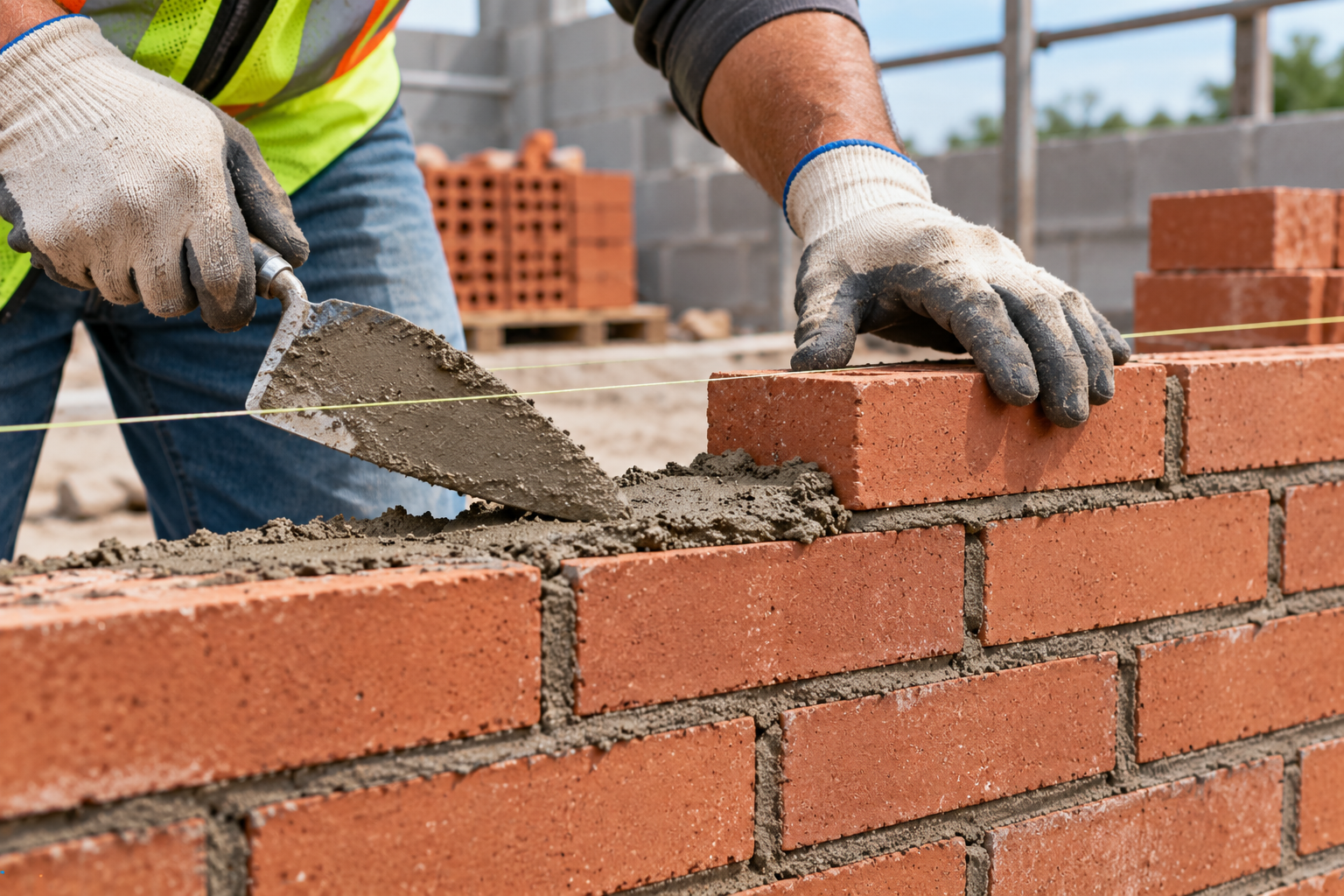
Mason spreading fresh mortar and setting bricks along a string line during brick wall construction.
Mortar Mix Ratio for Concrete Block and CMU
For concrete masonry, the mortar type comes from the design and the adopted code. CMHA notes that building codes typically require Type M, S or N, that empirical foundation wall design needs Type M or S, and that glass-unit masonry needs Type N or S.
Bearing and nonbearing walls: follow the structural drawings and specifications.
Exterior masonry: exposure and wind or seismic demands can push the choice toward Type S.
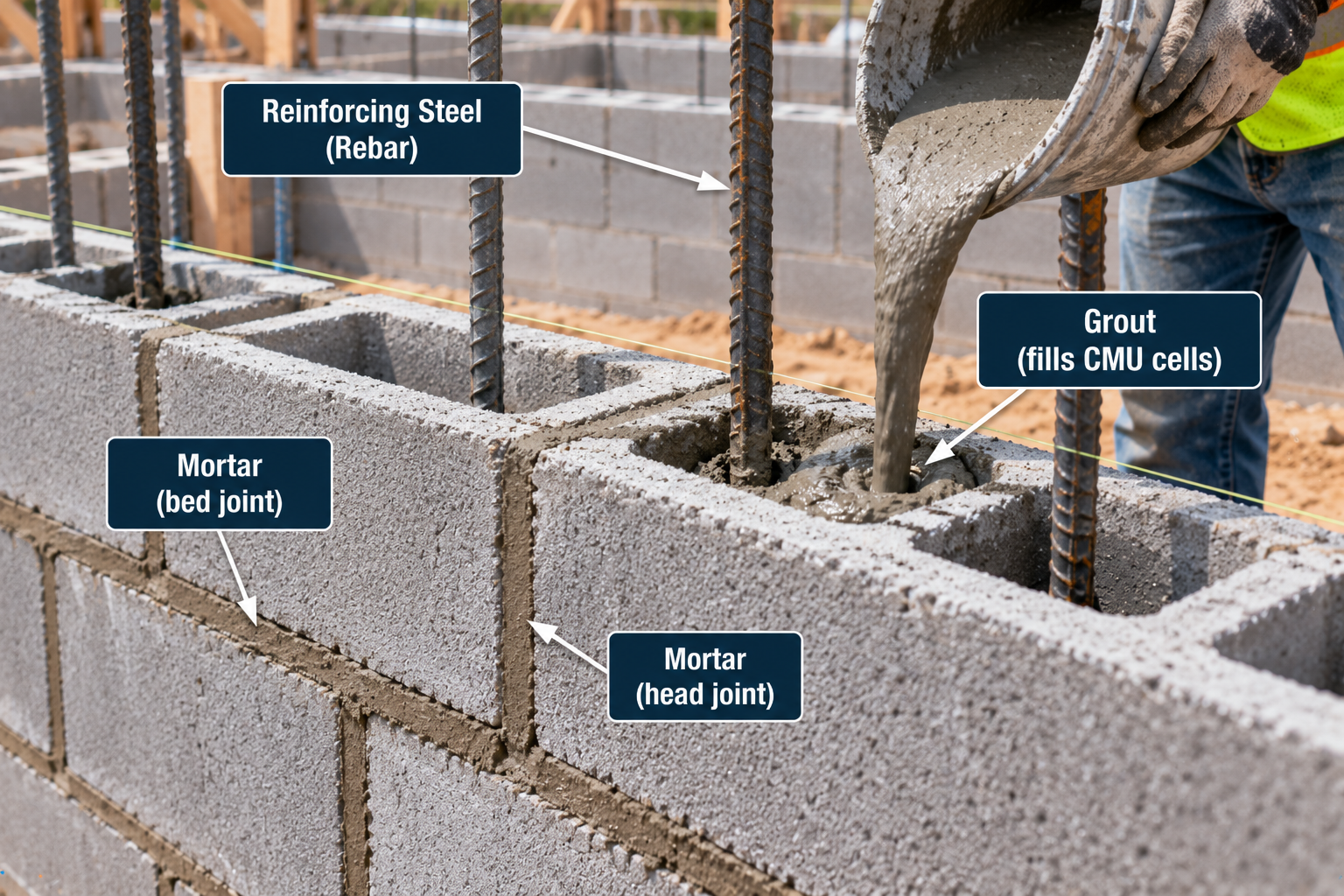
Reinforced CMU: mortar bonds the units, while grout (ASTM C476) fills the reinforced cells.
Foundation walls: Type M or S for IRC prescriptive walls.
Grout fills reinforced CMU cells around vertical rebar, while mortar forms the bed and head joints between concrete masonry units.
Mortar for Foundations and Below-Grade Masonry
The IRC requires Type M or S mortar for masonry foundation walls built under its prescriptive foundation wall tables (R404.1.1(1) through R404.1.1(4)). Below grade, mortar faces soil contact, moisture and lateral earth pressure, which is why the code sets a higher minimum than Type N.
Type N or O should not be casually substituted where M or S is required. Foundation walls designed outside the prescriptive tables follow the engineer’s specification. For wall thickness, see the Foundation Wall Thickness Chart.
Mortar for Veneer and Seismic Masonry
Brick Veneer and Adhered Masonry Veneer
Anchored brick veneer is conventional masonry, and BIA recommends Type N for most of it. Adhered masonry veneer is a different system: the IRC allows ASTM C270 Type S or N mortar, or latex-modified portland cement mortar complying with ANSI A118.4. Setting mortar behind adhered units and pointing mortar in joints can have different requirements, so follow the product and code instructions for each.
Seismic Areas
SDC A, B, C: Type M, S or N where the masonry is the lateral-force-resisting system (IRC R606.2.8.2).
SDC D0, D1, D2: Type M or S portland cement-lime or mortar cement (IRC R606.2.8.3).
Seismic performance comes from the whole structural masonry system: reinforcement, grout, detailing and workmanship. Choosing a stronger mortar alone does not make masonry seismic-resistant.
Mortar for Historic Masonry and Repointing
A hard modern mortar can damage older or softer masonry. Repointing needs an evaluation, not a default recipe.
Existing unit hardness: mortar should not be much harder than the units.
Existing mortar characteristics: composition, color and texture affect a match.
Moisture movement: the joint should let moisture leave the wall at least as easily as the units do.
Preservation specifications and laboratory analysis: ASTM C1324 covers the examination of hardened mortar.
Do not assume Type O for all old brick. It is one possible lower-strength category where appropriate and specified. Full historic restoration is outside the scope of this chart.
Mortar Batch Ratio and Volume Calculations
Ratios only mean something when the same container measures every part. For a chosen batch volume V and a mix with total parts P:
Cement = V × (cement parts ÷ P) Lime = V × (lime parts ÷ P) Sand = V × (sand parts ÷ P)
Use the approved proportion specification, the manufacturer’s instructions, or the batch established under the property specification. An online ratio is not a substitute.
Cement-Lime Mortar Batch Checker
The checker tests your proportions against the ASTM aggregate rule and the cement-lime lime ranges. The batch volume is the combined volume of loose dry ingredients, not the volume of finished mortar. Weights use IRC conventions: portland cement 94 lb/ft³, hydrated lime 40 lb/ft³, damp loose sand 80 lb dry sand per ft³.
Batch Conversion Chart
Illustrative 1 : 1 : 6 cement-lime example. Ratios stay the same regardless of container size.
Container Count
Cement
Lime
Sand
Total Parts
Half batch
½ container
½ container
3 containers
4
Base mix (1:1:6)
1 container
1 container
6 containers
8
Double batch
2 containers
2 containers
12 containers
16
Triple batch
3 containers
3 containers
18 containers
24
<p>Mortar Batch Conversion Chart via <a href=”https://concretecalculate.com/mortar-mix-ratio-chart/#batch-chart”>ConcreteCalculate.com</a></p>
One cubic foot equals 7.48 gallons, so a 5-gallon bucket is roughly 0.67 ft³. Use the same bucket, filled the same way, for every part. Bagged products should be batched by the manufacturer’s stated volumes or an approved procedure, since bag sizes vary.
2
Batching a 16 ft³ Type N Example
Given: A 1 : 1 : 6 cement-lime mix and a 16 ft³ total dry batch
Practical interpretation: This is an illustrative batch. Sand is 12 ÷ 4 = 3.0 times the cementitious volume, at the top of the permitted range.
How Much Mortar Is Needed for Brick and CMU Walls?
Brick Walls
A geometric estimate works from the wall volume minus the volume of the units:
V(mortar) = V(wall) – V(units)
Job estimating normally uses established unit and joint consumption factors, so treat the geometric method as a check. The Mortar Calculator and Brick Calculator handle project totals.
3
Mortar for 500 ft² of Modular Brick Wall
Given: A single-wythe, running-bond wall using modular brick (actual 3⅝ × 2¼ × 7⅝ in.) with 3/8-inch joints, and 10% waste
1
Units per ft²: 144 ÷ [(7.625 + 0.375) × (2.25 + 0.375)] = 144 ÷ 21 = 6.857.
Mortar = 52,200 – 42,646 = 9,554 in³ = 5.53 ft³ per 100 ft². For 500 ft²: 27.6 ft³; with 10% waste: 30.4 ft³.
Result: About 27.6 ft³ of mortar in the joints, or about 30.4 ft³ with 10% waste (about 1.1 yd³).
Practical interpretation: This is a derived, illustrative estimate for full joints and solid units. Cores, frogs, collar joints and rough handling change actual use.
CMU Walls
CMHA gives typical concrete masonry construction as using about 8.5 ft³ of mortar per 100 ft² of wall, assuming 3/8-inch joints, face-shell mortar bedding and a 10% waste allowance. Do not treat it as universal for every block size, full-bed mortar or different joint thickness.
Derived from 8.5 ft³ per 100 ft² (CMHA), 3/8-inch joints, face-shell bedding, 10% waste. 1 yd³ = 27 ft³.
Wall Area (ft²)
Mortar Volume (ft³)
Mortar Volume (yd³)
100
8.5
0.31
500
42.5
1.57
1,000
85
3.15
1,200
102
3.78
<p>CMU Mortar Quantity Chart via <a href=”https://concretecalculate.com/mortar-mix-ratio-chart/#cmu-quantity”>ConcreteCalculate.com</a></p>
Joint thickness changes both appearance and material quantity. Unless the drawings say otherwise, the IRC (R606.3.1) calls for 3/8-inch head and bed joints, except that the bed joint of the starting course over a foundation must be not less than 1/4 inch and not more than 3/4 inch. The IRC tolerance for load-bearing masonry is plus 1/8 inch for bed joints, and minus 1/4 to plus 3/8 inch for head joints.
Anatomy of the joints that drive mortar consumption. No dimensions are implied beyond those stated in the text.
Used where the design requires it; increases volume
Tooled profile
Concave or other finish of the joint
Affects water resistance and appearance
How to Mix Mortar Correctly
Material Measurement and Mixing
Confirm the mortar type and the specification method (proportion or property).
Verify the materials against the specification (cement type, lime type, sand grading).
Measure the cementitious materials accurately by volume or by the approved batching method.
Measure the sand consistently in the same damp, loose condition every batch.
Add part of the mixing water first, then the dry ingredients, and mix thoroughly.
Adjust the water to a workable consistency and keep the batch consistent.
Follow the product and project requirements and place the mortar within the permitted working time.
This is a workflow summary, not a substitute for the project specification on structural work.
Mixing Consistency and Pigmented Mortar
Batch consistency matters most with colored mortar. BIA recommends careful control of pigment quantity and consistent batching, since small changes in water, materials, tooling or curing can change the color. CMHA notes that TMS 602 limits pigments to no more than 1 to 10 percent by weight of cement, depending on the pigment type. Pigment does not by itself change the M, S, N or O classification.
Retempering
Retempering restores workability by mixing in water lost to evaporation, before the mortar has stiffened from hydration. It is different from reusing mortar after initial set, which is not acceptable. BIA gives 2½ hours after initial mixing for normal and cold weather and 2 hours for hot weather. For glass-unit masonry, the IRC forbids retempering after initial set and requires discarding mortar not used within 1½ hours of initial mixing. For ordinary masonry, follow TMS 602 and the project specification.
Hot- and Cold-Weather Mortar Construction
TMS 602 sets temperature-dependent provisions for hot and cold weather, and BIA Technical Note 1 summarizes them for brick masonry. Values below are a summary of BIA Technical Note 1, so confirm them against the current TMS 602 edition and the project specification.
Summary of BIA Technical Note 1 describing TMS 602 provisions. Verify against the current edition.
Condition
Trigger
Key Mortar Requirement
Cold weather
Ambient below 40°F (4.4°C)
Cold-weather procedures apply
Cold, 32°F to 40°F
Ambient 32°F to 40°F
Heat sand or water so mortar is 40°F to 120°F at mixing
Freezing
Ambient below 32°F (0°C)
Keep mortar above 40°F until used
Water and aggregate limit
Heating materials
Do not heat water or aggregates above 140°F (60°C)
Hot weather
Above 100°F, or above 90°F with wind over 8 mph
Mortar not over 120°F; use within 2 hours of mixing
Very hot
Above 115°F, or above 105°F with wind over 8 mph
Shade mortar materials from direct sunlight
<p>Hot and Cold Weather Mortar Requirements via <a href=”https://concretecalculate.com/mortar-mix-ratio-chart/#weather”>ConcreteCalculate.com</a></p>
In cold weather, mix mortar in smaller batches so it can be used before it cools, and protect newly built masonry as required. In hot weather, watch for fast water loss and fog-spray newly built masonry as the specification requires. Cold-weather construction is also affected by footing depth and frost, covered in the Foundation Frost Depth Chart.
Mortar Testing and Quality Control
Preconstruction qualification: under the property specification, laboratory testing establishes the approved proportions.
Material verification: confirm cement, lime and sand match the specification (ASTM C270 compliance is verified by materials and batching).
Batch proportions: observe that ingredients are added in the specified proportions.
ASTM C780: preconstruction and construction evaluation of mortars, used to verify consistency of materials and procedures.
ASTM C1324: examination and analysis of hardened mortar, including petrographic analysis.
Laboratory testing: the property specification requires an evaluated testing agency (ASTM C1093).
Field compressive specimens are useful for checking consistency, not for treating ASTM C270 laboratory property strengths as field acceptance criteria.
How to Choose the Correct Mortar Type
Identify the masonry unit type.
Decide whether the wall is structural or veneer.
Determine above-grade or below-grade exposure.
Identify the locally adopted code and edition.
Check the structural drawings and specifications.
Determine the seismic design category.
Identify unit strength and absorption.
Select the lowest mortar strength that satisfies the requirements.
Choose the approved cement-lime, masonry cement or mortar cement system.
Follow the ASTM C270 proportion or property specification, not a hybrid mixed on site.
Common Mortar Mix Mistakes
📌
Treating 1:1:6 as the only Type N recipe
Type N covers a lime range, and sand depends on the total.
🧮
Assuming sand is always exactly three parts
The rule is 2¼ to 3 times the cementitious volume.
🪣
Measuring sand inconsistently
Use the same container and damp, loose condition every batch.
💧
Ignoring sand moisture and bulking
Wet sand changes the real volume in a bucket.
📦
Confusing masonry cement with portland cement
Masonry cement already contains plasticizers.
🏷️
Confusing mortar cement with masonry cement
They follow separate standards with different bond requirements.
🔤
Confusing Type S mortar with Type S lime
One is a mortar type, the other a lime classification.
💪
Choosing Type M just because it is stronger
BIA advises the lowest strength that meets the requirements.
🧱
Using Type N where M or S is required
Foundation walls are a code example.
🥣
Confusing mortar with grout
Grout follows ASTM C476 and fills cells.
🔬
Treating field cubes as ASTM C270 acceptance
Field tests check consistency, not lab strength.
🚿
Adding excessive water
It hurts bond and durability.
🏖️
Using dirty or poorly graded sand
It affects workability, bond and strength.
🔁
Changing proportions between batches
It changes color, strength and workability.
⚗️
Mixing incompatible air-entraining materials
The IRC forbids combining two air-entraining materials.
⏱️
Reusing mortar after it is unsuitable
Respect working time and initial set.
🌡️
Ignoring weather requirements
Hot and cold conditions change the requirements.
🏛️
Using strong modern mortar on historic masonry
It can damage softer existing units.
📄
Ignoring manufacturer instructions for bagged mortar
Preblended products have their own mixing rules.
📐
Assuming mortar strength equals wall strength
The assembly strength depends on units, grout and design.
Mortar Mix Ratio Chart Limitations
⚠️
What This Chart Does Not Establish
This chart is a U.S. unit-masonry mortar reference. It is not automatically applicable to concrete mixes, masonry grout, tile thin-set, render or plaster, stucco, refractory mortar, polymer-modified specialty mortars, historic lime-only formulations, structural repair grouts or proprietary veneer products.
Project specifications, the adopted code and its edition, ASTM standards, TMS 402/602 requirements and manufacturer instructions govern. Code entries here refer to the IRC; other codes and local amendments can differ. Shorthand ratios are examples, not specifications, and calculated tables are illustrative.
Mortar Mix Ratio FAQs
What is the standard mortar mix ratio?
There is no single standard ratio. ASTM C270 lets you choose Type M, S, N or O and controls the parts by volume of each cementitious ingredient, with sand at 2¼ to 3 times the sum of the cementitious volumes. For Type N cement-lime mortar, that means 1 part cement, over ½ to 1¼ parts lime, and the matching sand range. BIA recommends Type N for normal brickwork, while the project specification and adopted code decide the required type.
What is the ratio for Type M mortar?
For cement-lime Type M, the proportion specification is 1 part portland or blended cement to ¼ part hydrated lime or lime putty. Sand must total 2¼ to 3 times the sum of the two, which is 2.81 to 3.75 parts for that combination. A common shorthand example is 1 : ¼ : 3 to 3¾.
What is the ratio for Type S mortar?
For cement-lime Type S, use 1 part cement and over ¼ to ½ part lime. With ½ part lime, sand ranges from 3⅜ to 4½ parts (3.375 to 4.5). A frequently quoted representative mix is 1 : ½ : 4½, which sits at the top of that sand range.
What is the ratio for Type N mortar?
For cement-lime Type N, use 1 part cement and over ½ to 1¼ parts lime. With 1 part lime, sand ranges from 4.5 to 6 parts, so 1 : 1 : 6 is one valid example. Other lime amounts inside the Type N range give different permitted sand ranges.
What is the ratio for Type O mortar?
For cement-lime Type O, use 1 part cement and over 1¼ to 2½ parts lime. With 2 parts lime, sand ranges from 6.75 to 9 parts, so 1 : 2 : 9 is a representative example. Type O is included in ASTM C270 but building codes typically require Type M, S or N for structural masonry situations.
Is Type S stronger than Type N mortar?
Yes on paper. The ASTM C270 laboratory property minimum is 1,800 psi for Type S and 750 psi for Type N, and BIA describes Type S as having higher compressive and flexural bond strength. Type N is more workable and is recommended for normal brickwork, so the better choice is the lowest strength that meets the project requirements.
Is Type M always better than Type S?
No. Type M has the highest laboratory strength of the four, but BIA notes it is not very workable, and stronger mortar is not automatically better for the masonry. The IRC allows Type M or S for masonry foundation walls, so the choice between them comes from the design, the unit type and the exposure.
What does 1:1:6 mortar mean?
It is a shorthand for parts by volume of portland cement, hydrated lime and sand. The total is 8 parts, made of 1 cement, 1 lime and 6 sand. The 6 parts of sand equals 3 times the 2 parts of cement plus lime, which is the upper limit of the ASTM aggregate rule.
Is 1:1:6 always Type N mortar?
When it is made from portland cement, hydrated lime and damp, loose sand measured by volume, 1 : 1 : 6 falls within the Type N cement-lime proportions. But Type N includes other cement-lime combinations, and the shorthand does not describe mortars made with masonry cement or mortar cement products. Compliance comes from the specified materials and ASTM C270 proportions, not from the numbers alone.
How much sand goes into mortar?
ASTM C270 requires damp, loose sand of not less than 2¼ and not more than 3 times the sum of the separate volumes of the cementitious materials. Add the cement and lime (or the masonry or mortar cement and any added portland cement), then multiply by 2.25 and by 3 to get the permitted range.
Can I make mortar with only cement and sand?
A cement-and-sand-only mix is not one of the listed proportions in the ASTM C270 proportion specification, which lists cement-lime, masonry cement and mortar cement routes. Lime provides workability and water retention, so a plain cement-sand mix tends to be harsh. A different combination of approved materials would have to be qualified under the property specification.
What does lime do in mortar?
Lime improves workability and water retention and adds some limited cementitious and self-healing behavior, according to CMHA. Portland cement supplies strength and durability. Adding more lime shifts a mortar from Type M toward Type O, which is why lime range defines the mortar type in the cement-lime table.
What is the difference between masonry cement and portland cement?
Portland cement (ASTM C150) is a plain hydraulic cement. Masonry cement (ASTM C91/C91M) is a factory blend of portland or blended cement with plasticizing materials such as limestone or lime, and it is classified as Type M, S or N. They are not interchangeable one for one, and a bag of masonry cement is not simply portland cement and lime.
What is mortar cement?
Mortar cement (ASTM C1329/C1329M) is a hydraulic cement similar to masonry cement with an added minimum bond-strength requirement. It is classified as Type N, S or M. The IRC and ASTM C270 list separate proportions for mortar cement mortars.
What mortar should be used for brick?
BIA recommends Type N for normal use, including most anchored veneer applications, and Type S where stronger mortar is needed, such as high-seismic and high-wind areas. Unit absorption, exposure and the project specification can change the answer, so do not assume one mortar suits every brick.
What mortar should be used for concrete block?
The design and the adopted code decide. CMHA notes that building codes typically require Type M, S or N for concrete masonry, and that foundation and basement walls generally call for Type M or S. Use the mortar type shown on the structural drawings and specifications.
What mortar is used for foundation walls?
The IRC requires Type M or S mortar for masonry foundation walls built under its prescriptive foundation-wall tables (Tables R404.1.1(1) through R404.1.1(4)). Projects designed outside those tables follow their own design and specifications.
What mortar should be used below grade?
For prescriptive IRC masonry foundation walls, use Type M or S. CMHA also notes that most codes call for Type M or S in basement walls. Do not substitute Type N or O where the code or drawings require M or S.
What mortar is used for brick veneer?
Type N is recommended by BIA for most anchored brick veneer. Adhered masonry veneer is different: the IRC allows ASTM C270 Type S or N mortar, or latex-modified portland cement mortar complying with ANSI A118.4. Anchored and adhered veneer are separate systems with separate requirements.
What mortar is best for old brick?
There is no blanket answer. Old brick and old mortar are often softer, so a mortar much stronger than the surrounding masonry can cause damage. Match the mortar to the existing units and mortar through evaluation, testing where needed, and the preservation specification. Type O is one possible lower-strength choice only where it is appropriate and specified.
How much water should be added to mortar?
Add enough water for a workable, plastic consistency that suits the units and conditions, and adjust it within the approved mortar system. Do not apply a concrete-style water-cement ratio to mortar, because absorptive units pull water out of the joint. Too much or too little water hurts bond and durability.
Can mortar be retempered?
Yes, in ordinary masonry, adding water to restore workability is acceptable before the mortar has stiffened from hydration. BIA gives 2½ hours after initial mixing for normal and cold weather and 2 hours in hot weather. For glass-unit masonry, the IRC forbids retempering after initial set and requires discarding mortar not used within 1½ hours.
What is the difference between mortar and grout?
Mortar bonds units together in the joints and follows ASTM C270. Grout is a fluid mix that fills cells or cavities around reinforcement in masonry and follows ASTM C476. The IRC permits Type M or S mortar with enough added water to reach pouring consistency to be used as grout only under its specific provision.
Does Type M mortar have 2,500 psi strength?
Type M has a minimum average 28-day laboratory compressive strength of 2,500 psi under the ASTM C270 property specification, measured on laboratory-prepared mortar at a prescribed flow. That is not a guaranteed strength for mortar mixed on site and it does not equal the strength of the masonry wall.
Can field mortar be tested against ASTM C270 laboratory strength?
No. ASTM C270 states that physical properties of field-sampled mortar are not used to determine compliance and are not acceptance criteria. ASTM C780 field testing is used to check consistency of materials and procedures, not to verify laboratory property strength.
How much mortar is needed for 100 ft² of CMU?
CMHA gives about 8.5 ft³ of mortar per 100 ft² of concrete masonry wall, assuming 3/8-inch joints, face-shell mortar bedding and a 10% waste allowance. Full-bed mortar, thicker joints or different unit sizes will change the quantity.
How do you calculate cement, lime and sand for a mortar batch?
Add the parts to get the total, then multiply the batch volume by each part divided by the total. For a 1 : 1 : 6 example and a 16 ft³ batch, that is 2 ft³ cement, 2 ft³ lime and 12 ft³ sand. Follow the approved proportions or manufacturer instructions, not just a ratio found online.
Is Type S hydrated lime the same as Type S mortar?
No. Type S hydrated lime is a product classification under ASTM C207 for special hydrated lime, while Type S mortar is an ASTM C270 mortar type. BIA recommends Type S hydrated lime for masonry mortar, and that lime can appear in any mortar type, including Type N.
Related Charts and Calculators
Use these ConcreteCalculate references for masonry dimensions, weights, foundations and material quantities.

 Reviewed by Muhammad Ramzan Babar, PhD Researcher (Plasma Physics) & Calculator Developer – View Profile