Concrete vs Wood Deck 2026: Cost, Lifespan, Maintenance & Which Wins
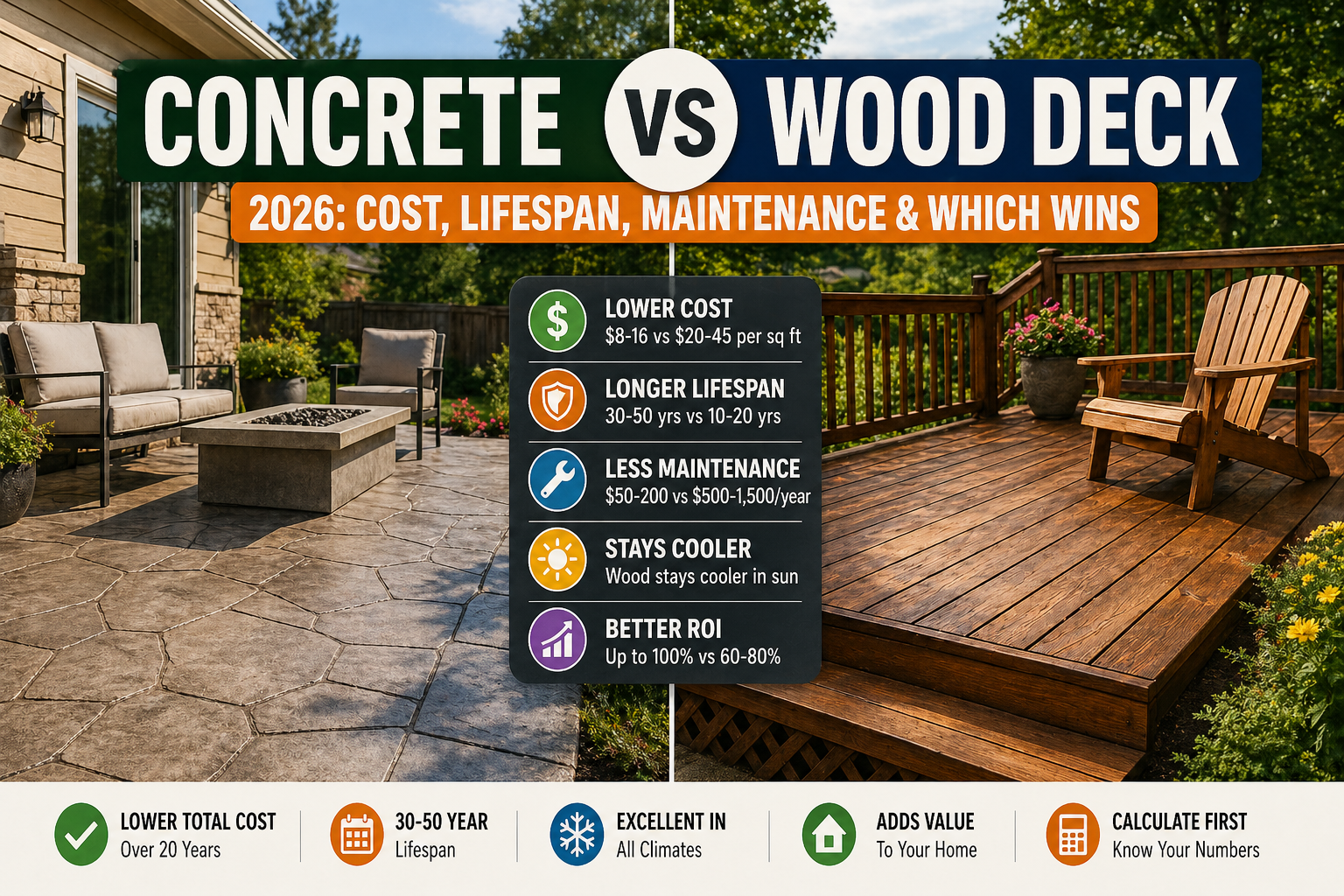
Choosing between a concrete patio and a wood deck comes down to four things: budget, maintenance tolerance, yard layout, and how long you plan to stay in the house. Concrete costs less upfront and far less over time. Wood offers a warmer look and works better on sloped sites. This guide breaks down every relevant factor with real 2026 cost numbers so you can make the right call for your yard.
Concrete vs Wood Deck: The Core Differences
A concrete patio and a wood deck serve the same purpose – outdoor living space – but they are built completely differently and perform very differently over time.
A concrete patio is poured directly onto a prepared sub-base at or near ground level. It is a monolithic slab, typically 4-6 inches thick, that becomes a permanent part of your property. Once it cures, it requires almost no structural maintenance.
A wood deck is a raised platform built on footings, framing, and joists with decking boards fastened on top. It can be built at any height above grade, making it the standard choice when your house exits above ground level or when your yard slopes significantly. The tradeoff is ongoing maintenance and a shorter lifespan compared to concrete.
The table below gives a fast side-by-side look before we go into detail on each factor.
| Factor | Concrete Patio | Wood Deck | Winner |
|---|---|---|---|
| Installed Cost (per sq ft) | $8-16 (basic), $14-25 (stamped) | $20-45 (PT pine to cedar) | Concrete |
| Lifespan | 30-50 years | 10-20 years | Concrete |
| Annual Maintenance Cost | ~$50-200/year | $500-1,500/year | Concrete |
| Appearance / Warmth | Modern, clean, customizable | Warm, natural grain | Wood |
| Works on Sloped Sites | No – flat ground only | Yes – any slope | Wood |
| Freeze-Thaw Resistance | Excellent (4000 PSI + air) | Fair (with proper sealing) | Concrete |
| Heat Retention in Sun | Gets hot in direct sun | Stays cooler to the touch | Wood |
| Resale Value | Up to 100% ROI | 60-80% ROI | Concrete |
| Installation Time | 1-3 days pour + 28 days cure | 3-7 days, usable immediately | Wood |
| Fire Resistance | Non-combustible | Burns (even treated lumber) | Concrete |
| 20-Year Total Cost (400 sq ft) | ~$6,400-11,200 | ~$24,000-52,000 | Concrete |
Cost Comparison: Installed Price Per Square Foot
Cost is where concrete wins most clearly. For the same usable outdoor square footage, concrete almost always costs less to install and significantly less to own over 20 years.
Concrete Patio Installation Cost (2026)
A basic broom-finish concrete patio runs $8-16 per square foot installed in 2026, depending on your region, slab thickness, and contractor rates. That includes site prep, forming, the concrete pour, and basic finishing.
Upgrade options raise the price but still typically beat a wood deck on total cost:
- Broom finish (standard): $8-16 per square foot
- Exposed aggregate: $12-18 per square foot
- Stamped concrete: $14-25 per square foot
- Stained and sealed concrete: $15-22 per square foot
- Polished or decorative finish: $18-30 per square foot
Wood Deck Installation Cost (2026)
Wood decks cost more because you are building an elevated structure – footings, posts, beams, joists, decking boards, railings, and stairs all add up fast. Material choice drives the range:
- Pressure-treated pine (PT): $20-28 per square foot installed – least expensive, but shortest lifespan
- Cedar: $25-35 per square foot – naturally rot-resistant, better appearance
- Ipe (hardwood): $35-50 per square foot – extremely durable, high maintenance finish requirement
- Composite (Trex, TimberTech, Fiberon): $30-50 per square foot – low maintenance, similar lifespan to concrete, but high upfront cost
💰 Side-by-Side Cost Example: 400 Square Foot Outdoor Space
Basic concrete patio (broom finish): 400 sq ft × $12 avg = $4,800 installed
Stamped concrete patio: 400 sq ft × $18 avg = $7,200 installed
Pressure-treated wood deck: 400 sq ft × $24 avg = $9,600 installed
Cedar deck: 400 sq ft × $30 avg = $12,000 installed
Composite deck: 400 sq ft × $40 avg = $16,000 installed
Bottom line: Even a stamped concrete patio costs 40-55% less than a comparable pressure-treated wood deck – and the gap grows significantly when you factor in 20 years of maintenance costs.
🧮 Get Your Project Cost Before Calling a Contractor
Use our concrete cost and slab calculators to estimate material volume and total project cost for your outdoor space.
Use Concrete Cost Calculator →Durability and Lifespan
This is the biggest argument in favor of concrete, and the numbers are not close.
Concrete Patio Lifespan
A properly installed concrete patio lasts 30-50 years with basic maintenance – cleaning, occasional sealing, and crack monitoring. The concrete itself does not rot, warp, split, or attract insects. In northern states, using 4,000 PSI concrete with air entrainment prevents surface scaling from freeze-thaw cycles and deicing salts.
The main threats to concrete patios are cracking from ground movement or improper sub-base preparation, and surface degradation from deicing salt without proper sealing. Both are preventable with good installation practices and basic periodic sealing every 3-5 years.
Wood Deck Lifespan
Pressure-treated pine decks last 10-15 years before boards need significant replacement. Cedar decks typically last 15-20 years with consistent maintenance. The structural subframe – posts and joists – can last longer if properly treated and protected from moisture, but decking boards almost always fail first.
The enemies of wood are moisture, UV radiation, insects, and freeze-thaw cycling. Even pressure-treated lumber deteriorates when consistently wet. In high-humidity climates like the Southeast, or high-UV environments like Colorado and the Mountain West, wood deck lifespans run on the shorter end of these ranges.
Composite decking (Trex, TimberTech, Fiberon) closes the lifespan gap with concrete – most composite products carry 25-30 year warranties. However, composite decks still cost $30-50 per square foot installed, making them the most expensive option. A standard concrete patio still undercuts composite decking on upfront cost by 50-70%, even with decorative finishes. Composite is a strong choice if you specifically want a raised deck platform with low maintenance, but it does not compete with concrete on total value for ground-level outdoor spaces.
Maintenance Requirements and Annual Costs
Over 20 years, maintenance costs are where the true cost comparison shifts dramatically in concrete’s favor.
Concrete Patio Maintenance
A sealed concrete patio is one of the lowest-maintenance outdoor surfaces available. Here is what the typical annual maintenance schedule looks like:
- Regular: Sweep and hose down as needed – 30 minutes, no cost beyond water
- Every 3-5 years: Reseal the surface – $1-3 per square foot in materials for a DIY job, or $2-5 per square foot hired out
- As needed: Fill hairline cracks with polyurethane or epoxy crack filler – $20-60 per repair
- Annual cost estimate (400 sq ft patio): $50-200 per year averaged over 20 years
Wood Deck Maintenance
Wood decks require active, recurring maintenance to prevent accelerated deterioration. Skipping a year of maintenance does not just delay upkeep – it compounds damage that shortens the deck’s useful life.
- Every 1-2 years: Power wash, sand, stain, and reseal the entire deck surface – $1-3 per square foot DIY, $3-7 per square foot hired out
- Every 3-5 years: Replace damaged or cracked boards – $5-12 per linear foot for PT pine, more for cedar
- Every 10-15 years: Inspect and reinforce or replace structural framing as needed
- Annual inspection: Check for soft spots, loose fasteners, railing security, and rot in joists and ledger board
- Annual cost estimate (400 sq ft deck): $500-1,500 per year averaged over 20 years
For a 400 sq ft pressure-treated deck installed at $9,600, add $500-1,500 per year in maintenance over 20 years ($10,000-30,000) plus a likely full replacement around year 12-15 (another $9,600+). Your 20-year total cost can easily exceed $35,000-45,000. A concrete patio installed at $4,800 with $2,000-4,000 in maintenance over 20 years totals $6,800-8,800. That is a potential gap of $30,000+ for the same 400 square feet of outdoor living space.
Appearance and Design Options
This is wood’s strongest argument. Natural wood grain has a warmth and organic quality that concrete, even when decoratively finished, cannot fully replicate.
Wood Deck Appearance
Wood decks feel warm underfoot and look natural in almost any backyard setting. The horizontal grain of cedar or the rich density of hardwoods like ipe create an outdoor surface that genuinely looks built, not poured. For many homeowners, this aesthetic is the deciding factor.
Wood also stays cooler to the touch than concrete in direct summer sun, which matters for barefoot use on hot days. The temperature difference can be significant in southern states – a light-colored wood deck in direct sun may be 10-20 degrees cooler underfoot than a dark concrete surface.
Concrete Patio Design Options
Concrete has come a long way from plain gray slabs. Modern decorative concrete techniques give you significant control over the final appearance:
- Stamped concrete: Mimics brick, stone, slate, cobblestone, or wood plank patterns – the most popular decorative option
- Exposed aggregate: Reveals the stone in the mix for a natural, textured look that also improves slip resistance
- Acid staining: Creates variegated earth-tone colors with a translucent finish that looks nothing like plain gray concrete
- Integral color: Color mixed into the concrete before pouring – stays consistent even after surface wear
- Broom finish: Simple texture that reduces glare and improves traction without additional cost
Stamped concrete patios, in particular, are visually competitive with wood decks at a lower installed cost. The main limitation is that decorative concrete repairs are harder to match than replacing individual wood boards.
Resale Value and ROI
Both options add value to your home, but they do it differently. The better choice for resale depends heavily on your local real estate market and buyer expectations.
Concrete patios tend to return close to 100% of their installation cost at resale because buyers value low-maintenance outdoor spaces. A well-kept concrete patio with a decorative finish is seen as a permanent, low-cost feature – it is already done, and the new owner will not have to maintain it the way they would a wood deck.
Wood decks historically return 60-80% of installation cost at resale. In outdoor-lifestyle markets (Pacific Northwest, Mountain West, coastal Northeast), a large deck can be a strong selling point – buyers in these markets specifically look for deck space. However, buyers increasingly factor in maintenance costs, and an aging wood deck in need of staining can actually reduce perceived value rather than add to it.
Condition at the time of sale matters more than material choice. A freshly sealed, crack-free concrete patio adds more value than an unstained, weathered wood deck – even if the deck is structurally sound. Whatever you install, budget for a maintenance refresh before listing your home.
Climate and Environmental Factors
Your local climate plays a significant role in which material makes more sense long-term.
Northern States: Freeze-Thaw Climates
Both concrete and wood take a beating in northern climates, but concrete responds better when properly specified. For any outdoor concrete flatwork in states that see freezing winters, specify 4,000 PSI with 5-7% air entrainment and a maximum water-cement ratio of 0.45. This protects against freeze-thaw surface scaling, which is the most common failure mode for residential concrete in cold climates. See our full concrete PSI guide for specification details by climate.
Wood decks in northern states suffer from ice and snow loading on the surface, freeze-thaw movement in the structural connections, and repeated wet-dry cycles that accelerate wood breakdown. Consistent annual maintenance is critical – skipping even one season of staining in a northern climate can visibly age a wood deck.
Southern States: Heat and Humidity
In hot, humid climates like the Gulf Coast and Southeast, moisture is wood’s enemy. Consistently humid conditions accelerate rot, mold growth, and insect damage in wood decks, even in pressure-treated lumber. Concrete performs well in these climates with minimal additional specification changes.
The one legitimate complaint about concrete in southern climates is heat retention. Concrete absorbs solar energy throughout the day and stays warm well into the evening. Lighter colored concrete finishes, shade structures, and outdoor rugs mitigate this. In Florida and Texas, many homeowners use stamped concrete with lighter integral colors specifically to reduce heat absorption.
High-UV Mountain and Desert West
Wood decks at altitude (Colorado, Utah, New Mexico, Nevada) deteriorate faster due to intense UV radiation. The Colorado State University Extension notes that UV damage to wood at altitude is significantly more aggressive than at sea level. Concrete is not affected by UV exposure in the same way – decorative concrete sealers do fade over time in high-UV environments, but resealing every 2-3 years keeps appearance and protection intact.
Installation Process and Timeline
Both options require professional installation for the best results, but the process is completely different.
Concrete Patio Installation
- Site prep: Excavate 4-8 inches, compact sub-base, add crushed stone base – 1 day
- Forming: Set perimeter forms to the correct grade and elevation – half day
- Reinforcement: Install rebar or wire mesh per specification
- Pour and finish: Pour, screed, and finish the surface – 1 day
- Cure: 28 days to full design strength. Light foot traffic at 24-48 hours. Normal use at 7 days. Full load at 28 days.
The cure time is the biggest timeline consideration for concrete. You can pour on Monday and walk on it Wednesday, but you should not put heavy patio furniture or a grill on it for a week, and you need to wait 28 days before applying full loads. Use our concrete slab calculator to estimate volume and our yardage calculator to confirm your order before the truck arrives.
Wood Deck Installation
A wood deck build involves footings (often requiring a permit and inspection), post installation, beam and joist framing, decking board installation, railing systems, and stairs if needed. Most decks require a building permit in the US – check with your local building department before starting. A straightforward 400 square foot ground-level deck typically takes a crew 3-5 days to build. Elevated decks with complex framing and stairs can take 7-10 days.
The advantage over concrete: you can use the deck as soon as construction is complete. There is no curing wait. For homeowners who need their outdoor space quickly before a summer event, that matters.
A concrete patio that exceeds a certain size (typically 200-300 square feet, or any patio attached to the house foundation) requires a building permit in most US cities and counties. Wood decks almost universally require permits. Check with your local building department before starting either project. Unpermitted outdoor structures can create problems at resale.
Which One Should You Choose?
The answer depends on your specific situation. Here is a straightforward decision guide.
✅ Choose Concrete If:
- Your yard is flat or within 2 feet of level
- You want the lowest upfront cost
- You want minimal ongoing maintenance
- You plan to stay in the home 15+ years
- You live in a high-moisture or freeze-thaw climate
- You want fire resistance near an outdoor kitchen or firepit
- You are open to stamped or decorative finishes
- Long-term ROI matters more than curb appeal aesthetics
✅ Choose Wood If:
- Your yard slopes significantly (2+ feet across the deck footprint)
- Your home’s entry point is elevated above grade
- You specifically want a warm, natural wood look
- You want to use the space within days of construction
- You plan to sell within 5-7 years and your market favors decks
- You are comfortable with annual maintenance
- Barefoot comfort in summer heat is a priority
For the majority of US homeowners with a flat or near-flat backyard who are focused on long-term value, concrete wins the comparison. The cost advantage is large, the lifespan advantage is large, and the maintenance savings are significant. Wood earns its place when the site conditions require a raised structure or when the natural aesthetic is a non-negotiable priority.
Before you commit to either, get your concrete volume and cost estimate dialed in. Use our concrete volume calculator to find your cubic yards, the concrete cost calculator to price the pour, and review our concrete PSI guide to confirm the right strength grade for your climate.
🎯 Key Takeaways: Concrete vs Wood Deck
- Concrete patios cost $8-16 per square foot installed in 2026 vs $20-45 per square foot for a wood deck
- A concrete patio lasts 30-50 years; a pressure-treated wood deck typically lasts 10-15 years
- Wood deck maintenance runs $500-1,500 per year; concrete maintenance averages $50-200 per year
- Over 20 years, a concrete patio typically costs one-third to one-half the total cost of an equivalent wood deck
- Wood decks outperform on sloped sites, warm natural aesthetics, and immediate usability after installation
- For exterior concrete patios in freeze-thaw climates, specify 4,000 PSI with 5-7% air entrainment
- Concrete returns close to 100% of installation cost at resale; wood decks typically return 60-80%
- Concrete stays hotter underfoot in direct sun – lighter colors and shade structures reduce this in southern climates
- Both options usually require building permits in the US – check local requirements before starting
- Stamped concrete bridges much of the aesthetic gap with wood at a fraction of the cost
Frequently Asked Questions
🔧 Plan Your Concrete Patio Project
Get accurate volume, yardage, and cost estimates before you call a contractor. Know your numbers going in.
Use Concrete Slab Calculator →