How Much Does a Pole Barn Slab Cost? (2026 Pricing by Size)
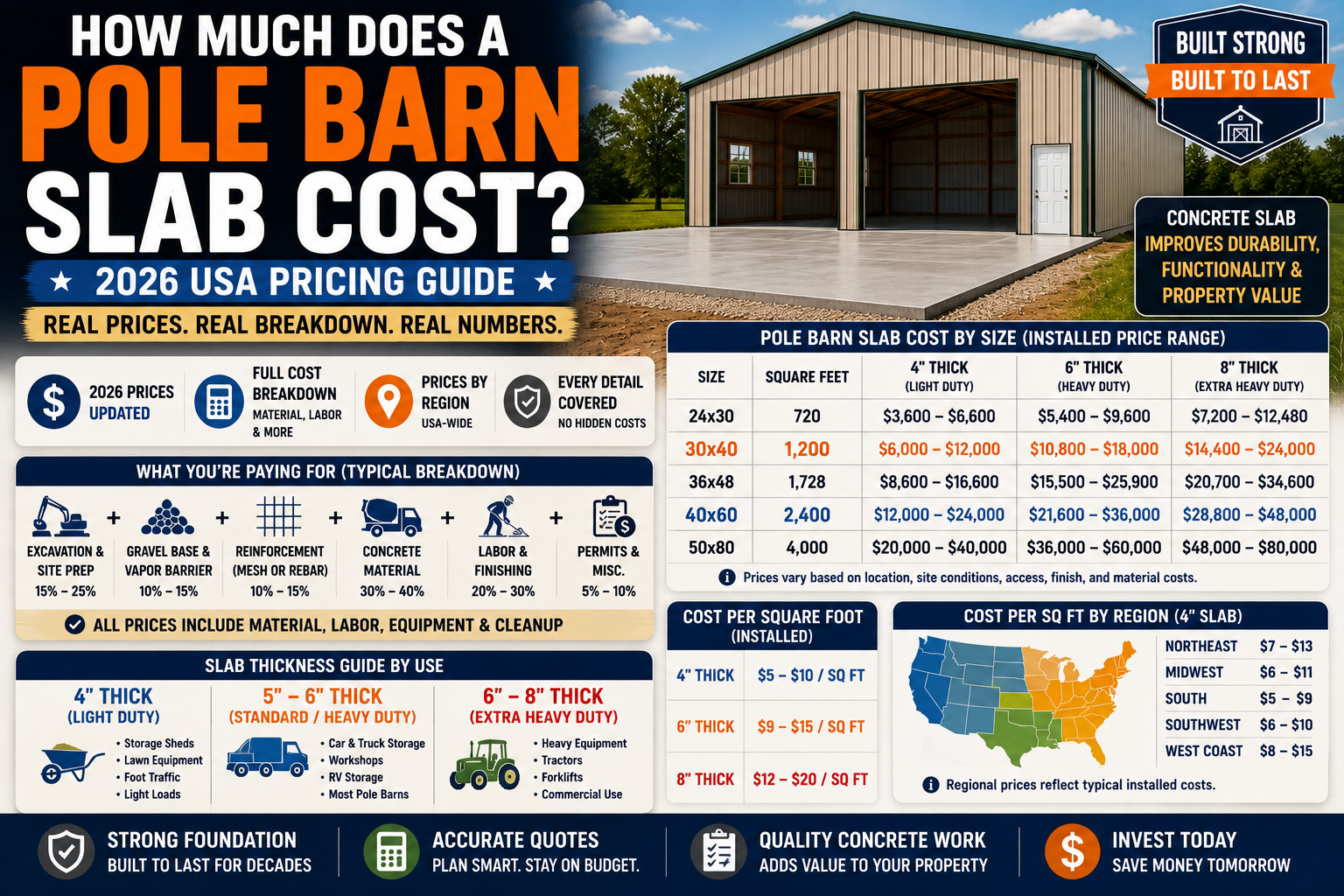
A pole barn concrete slab costs $5 to $18 per square foot in 2026, with most projects landing between $6,000 and $30,000 depending on size and thickness. A standard 4-inch slab for a 30×40 workshop runs $6,000 to $12,000. A heavy-duty 6-inch reinforced slab for a 40×60 building can push $23,000 to $30,000 or more. This guide gives you accurate cost data for every common pole barn size, walks through what drives the price up or down, and explains how to pick the right slab spec for your intended use.
Pole Barn Slab Cost Overview
A concrete slab for a pole barn costs $5 to $18 per square foot installed in 2026. The wide range comes down to two variables: slab thickness and your location. A basic 4-inch slab with wire mesh on a well-prepared site in the Midwest sits at the low end. A 6-inch rebar-reinforced slab in a high-labor-cost state or a site with drainage challenges lands at the upper end.
Unlike a traditional house foundation, a pole barn slab is optional. Post-frame buildings carry their structural loads through posts buried in the ground or set on concrete footings, so the floor is not a load-bearing element. That said, adding a concrete slab dramatically improves a pole barn’s usefulness for workshops, vehicle storage, livestock operations, and commercial applications. According to Steel Structures America, a standard 4-inch slab with wire mesh costs $8 to $12 per square foot in 2026, while a 5- to 6-inch slab with rebar runs $12 to $18 per square foot.
Cost by Pole Barn Size
Pole barns come in standard sizes, and most concrete contractors are familiar with pricing these jobs by the square foot. The table below shows installed slab cost estimates for common pole barn sizes in 2026, covering both a standard 4-inch slab and a heavier 6-inch reinforced slab.
| Pole Barn Size | Square Footage | 4-inch Slab Cost | 6-inch Slab Cost |
|---|---|---|---|
| 24×24 | 576 sq ft | $2,900 – $6,900 | $5,200 – $10,400 |
| 24×32 | 768 sq ft | $3,800 – $9,200 | $6,900 – $13,800 |
| 30×40 | 1,200 sq ft | $6,000 – $14,400 | $10,800 – $21,600 |
| 30×50 | 1,500 sq ft | $7,500 – $18,000 | $13,500 – $27,000 |
| 40×60 | 2,400 sq ft | $12,000 – $28,800 | $21,600 – $36,000 |
| 40×80 | 3,200 sq ft | $16,000 – $38,400 | $28,800 – $48,000 |
| 60×100 | 6,000 sq ft | $30,000 – $72,000 | $54,000 – $90,000 |
30×40 Pole Barn Slab Cost
A 30×40 slab is one of the most common sizes for residential workshops, detached garages, and small farm storage buildings. At 1,200 square feet, a standard 4-inch slab with wire mesh runs $6,000 to $14,400. Great Lakes Post Frame puts a 30×40 concrete slab at $8,400 to $12,000 for 4 inches and $10,800 to $14,400 for 6 inches in the Midwest. The industry average from CC Buildings puts a 30×40 slab floor at $12,000 to $15,600 when using a 4- to 5-inch thickness. Use the slab calculator to get your exact cubic yard requirement before calling local ready-mix suppliers.
40×60 Pole Barn Slab Cost
A 40×60 slab covers 2,400 square feet, which is the most popular size for larger farm shops, commercial storage, and heated workshop buildings. A 4-inch slab with wire mesh costs $12,000 to $28,800. A 6-inch rebar-reinforced slab for vehicle storage or heavy equipment runs $21,600 to $36,000. Barndago reports most contractor quotes for a 40×60 concrete slab coming in at $23,000 to $30,000 as a realistic mid-range estimate for 2026. If you’re running radiant heat in the slab, plan on adding $20 to $35 per square foot total, which brings a 40×60 heated slab to $48,000 to $84,000.
📐 Calculate Your Pole Barn Slab Now
Enter your length, width, and thickness to get the exact cubic yards of concrete you need and a 2026 cost estimate.
Use Slab Calculator →Slab Thickness and Reinforcement Options
Choosing the right slab thickness is the most important technical decision for a pole barn floor. Go too thin and the slab cracks under vehicle loads or frost pressure. Go unnecessarily thick and you’ve wasted $2 to $4 per square foot with no practical benefit. FBI Buildings, a major post-frame builder, provides these standard thickness recommendations based on intended use.
4-Inch Slab: Light-Duty Standard
A 4-inch slab with welded wire mesh (WWM) is the baseline for most residential pole barns. It handles foot traffic, lightweight vehicles, lawn equipment, and general storage without issue. Wire mesh (#10 gauge, 6×6 spacing) is the standard reinforcement for this thickness and adds minimal cost over unreinforced concrete. According to FBI Buildings, 4 inches is the minimum recommended thickness for walkways, patios, radiant heated floors, and lightweight vehicles in a pole barn setting.
This is the right choice if your building is used for light storage, hobby space, or casual vehicle parking. The wire mesh calculator can help you figure out exactly how many rolls of WWM you’ll need for your specific footprint.
5- to 6-Inch Slab: Workshop and Vehicle Storage Standard
A 5- to 6-inch slab with rebar (#4 rebar at 18 inches on center, both directions) handles most workshops, garages, and vehicle storage applications. This thickness is what most concrete contractors recommend as the default for a pole barn that will see regular vehicle traffic, stored equipment, or a vehicle lift. FBI Buildings recommends 5 to 6 inches for motorhomes and dump trucks, and 6 inches for heavy-duty agricultural equipment.
The step from 4 inches to 6 inches increases cost by roughly 40% to 50% per square foot due to additional concrete volume and the added rebar versus wire mesh. For a 40×60 building, that step up costs approximately $8,000 to $10,000 more – money well spent if your slab will carry truck traffic or a lift.
6- to 8-Inch Slab: Heavy Equipment and Commercial Use
Agricultural pole barns storing tractors, combines, and heavy machinery need 6 to 8 inches minimum. These slabs use #5 rebar at 12 inches on center and often include thickened edges (12 inches deep around the perimeter) to resist edge cracking from heavy wheel loads. At this spec, cost reaches $15 to $20 per square foot, making a 40×60 slab a $36,000 to $48,000 project for the concrete work alone.
| Slab Thickness | Reinforcement | Cost per Sq Ft | Best Use |
|---|---|---|---|
| 4 inches | Wire mesh (6×6 #10) | $5 – $10 | Light storage, hobby shop, foot traffic |
| 5 inches | Wire mesh or rebar | $7 – $12 | Livestock, motorhomes, light vehicles |
| 6 inches | Rebar #4 at 18″ o.c. | $9 – $15 | Vehicles, workshop, vehicle lift |
| 6-8 inches | Rebar #5 at 12″ o.c. | $12 – $18 | Heavy equipment, tractors, commercial |
| Radiant heat (any) | PEX tubing + rebar | $20 – $35 | Heated workshop, barndominium |
Concrete vs Gravel vs Dirt Floor
A concrete slab is not the only option for a pole barn floor. Here’s a straight comparison of all three options so you can decide whether a slab investment makes sense for your specific building.
| Floor Type | Cost per Sq Ft | 30×40 Total | 40×60 Total | Best For |
|---|---|---|---|---|
| Dirt (graded) | $0 – $0.50 | $0 – $600 | $0 – $1,200 | Livestock, hay, temporary storage |
| Compacted gravel | $2 – $3 | $2,400 – $3,600 | $4,800 – $7,200 | Budget storage, equipment yards |
| Partial slab | Varies | $3,500 – $6,000 | $6,000 – $12,000 | Workshop area + gravel for equipment |
| 4-inch concrete slab | $5 – $10 | $6,000 – $12,000 | $12,000 – $24,000 | Workshops, garages, light vehicles |
| 6-inch concrete slab | $9 – $15 | $10,800 – $18,000 | $21,600 – $36,000 | Heavy vehicles, commercial use |
A compacted gravel base using 4 to 6 inches of compacted crushed stone costs roughly $2 to $3 per square foot and works well for equipment storage, livestock, and any building where moisture management or occasional heavy equipment is the priority. Use the crushed stone calculator to estimate gravel quantities for a base layer. If you go with concrete, a well-prepared gravel subbase under the slab is still needed – typically 4 inches of compacted stone before the concrete is poured.
What’s Included in the Slab Cost
Concrete contractor quotes for pole barn slabs vary significantly in what they include. Before comparing bids, confirm each of these items is covered – or priced separately so you can make an apples-to-apples comparison.
Site Preparation and Gravel Base
The ground under a concrete slab must be properly graded and compacted before pouring. This includes removing topsoil, grading for drainage, and installing 4 to 6 inches of compacted gravel base. Site prep typically adds $1 to $2 per square foot to the project. For a 40×60 slab, that’s $2,400 to $4,800 just for prep work – often excluded from base quotes. If you need excavation beyond basic grading, use the excavation cost calculator to estimate that separately.
Concrete Materials
Ready-mix concrete is the largest material cost. Most pole barn slabs use 3,000 to 4,000 PSI mix. At current 2026 prices of $110 to $160 per cubic yard delivered, a 40×60 slab at 4 inches thick requires approximately 30 cubic yards, putting concrete material cost at $3,300 to $4,800 before labor and other materials. Use the concrete volume calculator to get your exact cubic yard number. For larger pours, a concrete pump adds $800 to $1,500.
If you’re using bagged concrete for a smaller slab or DIY project, the concrete bag calculator tells you exactly how many 60-pound or 80-pound bags you’ll need based on your dimensions and thickness.
Reinforcement: Rebar or Wire Mesh
Wire mesh (welded wire reinforcement) adds roughly $0.15 to $0.30 per square foot in materials and is standard for 4-inch light-duty slabs. Rebar reinforcement adds $0.40 to $0.70 per square foot depending on bar size and spacing. For a 40×60 slab with #4 rebar at 18 inches on center, rebar materials alone run approximately $1,400 to $2,500. The rebar calculator gives you exact linear footage and weight for any grid spacing.
Vapor Barrier
A 6-mil polyethylene vapor barrier under the slab is standard practice for workshops, heated buildings, and any structure where moisture migration from the ground would be a problem. Material cost runs $0.05 to $0.15 per square foot. Some contractors include it automatically; others charge it separately. Always confirm it’s in the quote for a heated slab or barndominium project.
Forming and Labor
Labor accounts for 40% to 60% of total slab cost. A concrete crew sets forms, places and ties reinforcement, positions the vapor barrier, coordinates the ready-mix delivery, screeds and finishes the surface, and cuts control joints after the pour. For a 40×60 slab, plan on $8,000 to $18,000 in labor depending on your region and finishing requirements.
Control Joints
Concrete shrinks as it cures and will crack. Control joints – saw-cut grooves that guide where cracks form – are cut into the slab on a grid approximately 10 to 15 feet apart. For a 40×60 slab, you need roughly 12 to 20 control joints. This work is usually included in the labor quote but worth confirming. Spacing rules come from ACI 302 guidelines for floor slab construction.
💼 Real-World Example: 40×60 Workshop Slab in Indiana
Size: 40×60 (2,400 sq ft)
Thickness: 6 inches with #4 rebar at 18 inches on center
Site prep and gravel base: $4,200
Ready-mix concrete (45 cubic yards at 3,500 PSI): $6,300
Rebar materials: $1,900
Vapor barrier: $280
Forming, labor, finishing, and control joints: $14,500
Concrete pump rental: $1,100
Total: approximately $28,280 ($11.78 per sq ft)
Want to verify concrete volume? Use the slab calculator with 40 ft x 60 ft x 0.5 ft (6 inches) to confirm the cubic yards.
Factors That Affect the Final Price
Two quotes for the same 40×60 pole barn slab can differ by $10,000 or more. Here is what drives that variation.
Location and Local Labor Rates
Concrete labor rates vary by up to 50% across the country. A slab contractor in rural Iowa charges far less per square foot than one in northern California or the New York metro area. Regional pricing for concrete work is reflected in the state-level calculators – check the Texas concrete cost calculator or California concrete cost calculator for state-specific pricing.
Site Conditions and Drainage
A flat, well-drained lot with stable soil is the ideal scenario. Sloped sites require more grading and sometimes retaining work before the subbase can be prepared. Poor drainage or high water tables require added drainage measures that push costs higher. Sites with soft or organic soil may need additional compacted fill before a stable subbase can be built – sometimes adding $3,000 to $8,000 to the project before a shovel of concrete is poured.
Ready-Mix Concrete Prices
Ready-mix prices fluctuate with cement costs, fuel prices, and regional aggregate availability. In 2026, delivered ready-mix costs between $110 and $160 per cubic yard across most of the US, up approximately 14% from 2025 levels. Check the current 2026 concrete prices guide to verify what you should be paying in your market before accepting a quote.
Slab Finish Type
A standard broom finish is the cheapest option and is appropriate for most pole barn floors. A smooth trowel finish costs slightly more and is better for shop floors where you’ll be rolling tool carts or working on your knees. A stamped or exposed aggregate finish adds $3 to $8 per square foot. For most pole barns, a broom finish is the practical and economical choice.
Radiant Heat
Adding in-floor radiant heating to a pole barn slab is a significant upgrade that heated shop owners rarely regret. PEX tubing is placed on the rebar grid before pouring, connected to a boiler or water heater, and embedded permanently in the slab. Material and installation cost for the radiant system adds $10 to $20 per square foot on top of the slab cost. For a 40×60 heated slab, budget an additional $24,000 to $48,000 for the radiant system.
When to Pour: Before or After Building?
This is one of the most common questions from first-time pole barn owners, and the answer matters for both quality and cost. Most experienced post-frame building contractors strongly recommend pouring the concrete slab after the building shell is erected, not before.
Here is why: pole barn posts are set directly into the ground or on concrete footings before the shell goes up. Pouring the slab before posts are set means the concrete must be cut or drilled around the posts later, which weakens the slab and creates moisture entry points. Beehive Buildings, a post-frame specialist, explicitly advises customers not to pour a slab before building construction begins. Most building inspectors and concrete contractors share this view.
The proper sequence is: posts set, skirt boards installed, building shell erected, then concrete poured. This sequence lets you also verify grade and drainage before committing to a permanent slab. If your building will have radiant heat, roughing in the boiler connections and plumbing lines before the pour is also much easier once the shell is up and protected from weather.
- Posts and skirt boards fully installed
- Building shell up and roof on (for weather protection during cure)
- Underground plumbing and electrical conduit roughed in
- Gravel subbase compacted and graded
- Vapor barrier positioned
- Rebar or wire mesh placed and tied
- Ready-mix ordered for a day with temperatures between 50°F and 85°F
Read the best time to pour concrete guide for temperature and weather recommendations before scheduling your pour.
How to Lower Your Pole Barn Slab Cost
There are several legitimate ways to reduce your slab cost without compromising the structural integrity or long-term performance of the floor.
- Right-spec the thickness. A light storage building does not need a 6-inch slab. Match the thickness to your actual use. Over-building the slab is one of the most common ways to waste money on a pole barn project.
- Get at least three quotes. Slab pricing varies widely between contractors. In competitive rural markets, the difference between the highest and lowest qualified bid can be $3 to $5 per square foot on a large slab.
- Prepare the site yourself. If you own a tractor or have access to equipment, doing your own grading and gravel base installation can save $1,500 to $4,000 compared to having the concrete contractor handle it.
- Avoid pour days in extreme weather. Pouring in very hot or very cold weather adds cost for curing measures, blankets, or accelerating admixtures. Check the pouring concrete in winter guide and the hot weather pouring guide before scheduling.
- Use a partial slab where it makes sense. If part of your barn will always store equipment on dirt or gravel, concrete only the workshop area and leave the rest as compacted gravel. This hybrid approach cuts concrete costs significantly on large buildings.
- Order the right PSI concrete. A 3,000 PSI mix is adequate for most pole barn floors. Paying for 4,000 PSI on a light storage slab adds cost with minimal real-world benefit for that application. Read the concrete PSI guide to understand when the upgrade is worth it.
- Buy bags for very small slabs. For buildings under 400 square feet, buying bagged concrete and renting a mixer can undercut a ready-mix contractor quote. Use the ready-mix bags calculator to compare the bag option before calling ready-mix plants.
🧰 Tools for Planning Your Pole Barn Slab
- Concrete Slab Calculator – Cubic yards for any dimensions and thickness
- Concrete Slab Cost Calculator – Installed cost estimate with 2026 pricing
- Concrete Volume Calculator – Double-check your ready-mix order
- Rebar Calculator – Rebar quantities for your grid spacing
- Wire Mesh Calculator – Rolls needed for light-duty 4-inch slabs
- Gravel Calculator – Subbase aggregate quantity
- Concrete Labor Cost Calculator – Labor cost estimate by region
✅ Key Takeaways
- A pole barn concrete slab costs $5 to $18 per square foot installed in 2026, depending on thickness and location.
- A 30×40 slab (1,200 sq ft) runs $6,000 to $21,600 depending on spec.
- A 40×60 slab (2,400 sq ft) costs $12,000 to $36,000, with most mid-spec projects landing around $23,000 to $30,000.
- A 4-inch slab with wire mesh is sufficient for light storage and hobby use. Use 6 inches with rebar for any vehicle storage or workshop application.
- Concrete is not structurally required for a pole barn – compacted gravel is a legitimate lower-cost alternative for equipment storage and livestock buildings.
- Pour the slab after the building shell is erected, not before.
- Labor makes up 40% to 60% of total slab cost – get multiple quotes and check regional pricing before committing.
Frequently Asked Questions
🔧 Helpful Tools for Your Project
- 📐 Concrete Slab Calculator – Cubic yards for any slab dimensions
- 💵 Concrete Slab Cost Calculator – 2026 installed cost estimate
- 📦 Concrete Volume Calculator – Verify your ready-mix order
- 🔩 Rebar Calculator – Reinforcement quantities by grid spacing
- 🔲 Wire Mesh Calculator – Rolls needed for light-duty slabs
- 🪨 Gravel Calculator – Subbase aggregate quantities
- 💰 Concrete Labor Cost Calculator – Labor cost by region
- 📋 Concrete Prices 2026 – Current ready-mix pricing nationwide