How Much Does a Concrete Slab Cost in 2026: Per Square Foot, Full Project & By Size
A concrete slab costs $6 to $12 per square foot installed in 2026, with the national average around $8 per square foot for a standard 4-inch residential pour. A 20×20 patio slab runs $2,400 to $4,800. A 30×30 garage slab runs $5,400 to $10,800. Your final number shifts based on thickness, reinforcement, finish type, site conditions, and local labor rates. This guide breaks every variable down so you can budget accurately before calling a single contractor.
2026 Concrete Slab Cost Summary
Concrete slab costs in 2026 range from $4 per square foot for simple thin pads in low-cost regions to $18 per square foot for thick, reinforced, or decorative slabs in high-cost markets. The $6 to $12 range covers the vast majority of residential projects across the continental United States, according to data from HomeGuide, Angi, and contractor cost surveys.
The $8 per square foot national average assumes a 4-inch slab with a broom finish, standard wire mesh reinforcement, and a properly prepared gravel subbase. Any deviation from that baseline – thicker slab, more reinforcement, decorative finish, or difficult site conditions – pushes cost upward.
| Slab Application | Typical Thickness | Cost per Sq Ft | Notes |
|---|---|---|---|
| Walkway or sidewalk | 3.5–4 inches | $4–$8 | Light foot traffic only |
| Patio slab | 4 inches | $6–$12 | Standard residential |
| Shed or outbuilding pad | 4 inches | $5–$9 | No vehicle loads |
| Garage floor slab | 4–6 inches | $7–$13 | Vehicle and tool loads |
| Foundation slab | 6–8 inches | $8–$18 | Structural loading, requires engineering |
| Stamped/decorative | 4 inches | $12–$18+ | Patterns, color, texture |
These ranges reflect the continental US. Coastal metros like Boston, San Francisco, and Seattle run 20 to 35% above national averages. The Midwest and Southeast generally land at the lower half of each range. Hawaii and Alaska add 25 to 75% to all costs listed here.
Cost Per Square Foot Breakdown
The concrete slab cost per square foot bundles two main buckets: materials and labor. Both vary by region, but understanding each helps you read contractor quotes critically and spot missing line items before they become surprises.
Materials: $3 to $7 Per Square Foot
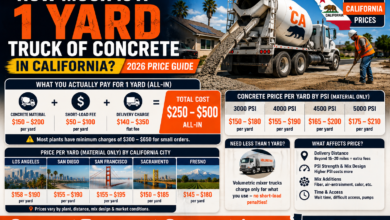
Materials cover ready-mix concrete, gravel subbase, reinforcement (rebar or wire mesh), a vapor barrier for interior slabs, and forming lumber. The ready-mix concrete itself is the largest single cost – running $125 to $180 per cubic yard delivered nationally in 2026, per Concrete Network pricing data.
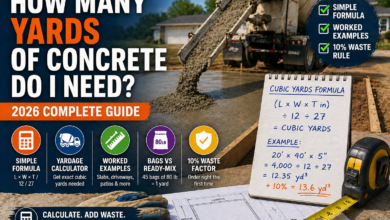
Use the concrete yardage calculator to find exact cubic yards for your dimensions, or run numbers through the concrete cost calculator for a direct material cost estimate.
Labor: $3 to $5 Per Square Foot
Labor covers site grading, forming, pouring, screeding, finishing, curing, and form removal. It accounts for 35 to 50% of total project cost. Nationally, concrete flatwork crews charge $40 to $55 per hour per worker in 2026. A crew of three can pour and finish a 400 sq ft slab in a single day.
High-cost metros like New York, Chicago, or San Francisco push labor to $5 to $8 per square foot for the same scope of work. If your quote seems unusually low, ask what the labor rate is per hour – very low bids sometimes reflect crews skipping proper forming, grading, or joint cutting.
| Cost Component | Cost per Sq Ft | % of Total Project |
|---|---|---|
| Ready-mix concrete | $2.00–$5.00 | 30–40% |
| Gravel subbase | $0.50–$1.25 | 7–12% |
| Rebar or wire mesh | $0.40–$1.50 | 5–10% |
| Vapor barrier | $0.10–$0.30 | 1–3% |
| Labor (forming, pour, finish) | $3.00–$5.00 | 35–50% |
| Sealing (optional) | $0.50–$2.00 | 4–8% |
💰 Calculate Your Slab Cost Instantly
Enter your dimensions, thickness, and finish type to get a project-specific cost estimate in seconds.
Cost by Slab Size
Size is the biggest driver of total concrete slab installation cost. The table below uses the $6 to $12 per square foot installed range for a standard 4-inch broom-finish slab. Decorative or structural slabs will run higher – see the finish and thickness sections below for those adjustments.
| Slab Size | Square Feet | Low (Basic) | High (Standard) | Typical Use |
|---|---|---|---|---|
| 5×5 | 25 | $150 | $300 | AC pad, small step |
| 10×10 | 100 | $600 | $1,200 | Shed pad, small patio |
| 12×12 | 144 | $860 | $1,700 | Storage shed, small pad |
| 16×16 | 256 | $1,500 | $3,000 | Single-car pad, workshop |
| 20×20 | 400 | $2,400 | $4,800 | Patio, single-car garage |
| 20×30 | 600 | $3,600 | $7,200 | Large patio, two-car garage |
| 24×24 | 576 | $3,450 | $6,900 | Two-car garage (standard) |
| 30×30 | 900 | $5,400 | $10,800 | Large garage, workshop |
| 40×40 | 1,600 | $9,600 | $19,200 | Barn, large commercial |
| 2,000 sq ft (house) | 2,000 | $12,000 | $28,000+ | Foundation slab for a home |
💼 Real-World Example: 24×24 Garage Slab
Size: 24 ft x 24 ft = 576 sq ft
Thickness: 4 inches standard, 6 inches recommended for vehicle loads
Volume at 4″: 576 x 0.33 ft / 27 = 7.1 cubic yards
Ready-mix (at $155/yd + delivery): approximately $1,250
Gravel base + rebar + forms: approximately $700
Labor (576 sq ft at $4/sq ft): approximately $2,300
Total estimate: $4,250 to $5,500 for basic 4″ pour
Use the slab cost calculator to run your exact dimensions and get a line-item breakdown.
Concrete Slab Labor Cost
Labor is the most regionally variable part of any concrete slab price estimate. It is also the most commonly underestimated. A full labor scope includes more than just pouring – here is what you are actually paying for.
What Labor Includes
- Site clearing and grading – removing grass, leveling the subgrade, addressing drainage
- Gravel base installation – placing and compacting 4 to 6 inches of crushed stone
- Forming – setting wood or steel perimeter forms to shape the slab
- Vapor barrier installation – laying poly sheeting under interior slabs
- Rebar or mesh placement – positioning reinforcement before the pour
- Concrete pouring and screeding – placing and leveling the wet mix
- Finishing – broom texture, troweling, edging, saw-cut control joints
- Curing – applying curing compound and protecting the surface during hardening
Each of these steps takes time and skill. A 30×30 garage slab typically requires a crew of 3 to 4 workers and a full day on site. Skipping or rushing any step – especially grading and joint cutting – leads to cracking and settlement issues within the first few years.
Bids below $4 per square foot total often exclude proper gravel base prep, rebar, saw-cut joints, or hauling away excavated material. Always ask for a written scope breakdown, not just a total price. A quote missing $1,000 in prep work still has to do that work – it just shows up as an add-on later.
Concrete Slab Materials Cost
Materials make up roughly 50 to 60% of a standard slab installation. Here is what each component costs in 2026 and how it fits into the total.
Ready-Mix Concrete
Ready-mix is the single largest material expense. Nationally, it runs $125 to $180 per cubic yard delivered in 2026, with most markets averaging $140 to $160 per yard. A 30×30 slab at 4 inches uses about 11.1 cubic yards – meaning concrete alone costs $1,385 to $2,000 before labor or any other materials.
Use the concrete price per yard calculator to estimate your ready-mix cost, and the concrete delivery cost calculator to factor in short-load surcharges and delivery distance.
Gravel Subbase
A 4-inch compacted gravel base is standard practice under all residential slabs. Gravel costs $25 to $65 per cubic yard delivered. For a 30×30 slab, you need about 11 cubic yards of gravel, putting subbase material cost at $275 to $715. Use the gravel calculator or base material calculator to size your order before calling a supplier.
Reinforcement
Wire mesh (6×6 W1.4xW1.4) costs $0.12 to $0.25 per square foot. A 30×30 slab uses about 900 sq ft of mesh, costing $108 to $225 in materials. Rebar costs more – #4 rebar runs $0.40 to $0.65 per linear foot – but provides better crack control for garage floors, driveways, and foundation slabs. Consult the slab load calculator if you need to evaluate reinforcement requirements based on expected loads.
Vapor Barrier
A 6-mil polyethylene vapor barrier costs $0.05 to $0.15 per square foot for materials. It is required under all interior slabs (basements, garages, living areas) to block ground moisture from migrating up through the slab. It is often skipped on outdoor patios and walkways.
Cost by Thickness: 4″, 6″, and 8″ Slabs
Thickness is the most direct way to increase or decrease material volume – and cost. Going from a 4-inch to a 6-inch slab increases concrete volume by 50%, adding $1.50 to $3.00 per square foot in materials alone on top of the base price.
Use the concrete thickness calculator to see exactly how different thickness choices change cubic yard requirements for your specific dimensions.
| Thickness | Best For | Cost per Sq Ft | Cu Yds for 30×30 | Added Cost vs 4″ |
|---|---|---|---|---|
| 3.5 inches | Walkways only | $4–$8 | 9.7 | Save $200–$400 |
| 4 inches | Patios, sheds, light foot traffic | $6–$12 | 11.1 | Baseline |
| 5 inches | Light vehicle loads, SUVs | $7–$13 | 13.9 | +$400–$700 |
| 6 inches | Garage floors, driveways, heavy use | $8–$15 | 16.7 | +$800–$1,400 |
| 8 inches | Commercial floors, heavy equipment | $10–$18 | 22.2 | +$1,600–$2,800 |
4 inches is the residential standard for slabs with foot traffic and light furniture loads. Go to 6 inches for any garage floor or surface that will see regular vehicle parking. Use 8 inches or more for structural foundation slabs, heavy machinery pads, or commercial floors. When in doubt, check with a local engineer – under-thickness slabs crack and fail faster than any other single installation error.
Cost by Slab Type
Not all concrete slabs are equal. The use case changes thickness, reinforcement requirements, and sometimes the concrete grade needed. Here is how residential concrete slab cost breaks down by project type.
Patio Slab
A 4-inch patio slab on a well-graded site with wire mesh runs $6 to $10 per square foot installed. A 20×20 patio costs $2,400 to $4,000 for a plain finish. Upgrade to stamped concrete and the same 400 sq ft slab rises to $4,800 to $7,200.
Garage Floor Slab
Garage floors need 4 to 6 inches of concrete and benefit from rebar instead of wire mesh for better crack resistance. Cost runs $7 to $13 per square foot. A standard 24×24 two-car garage slab costs $4,000 to $7,500 installed. In northern states, use 4000 PSI concrete to handle deicing salt and freeze-thaw cycles.
Shed or Outbuilding Pad
A basic 10×12 shed pad at 4 inches costs $700 to $1,400 installed. These are among the most affordable concrete projects because they are small, simple, and do not require engineering or heavy reinforcement. Many homeowners tackle them as DIY projects – see the how to pour a concrete slab guide for step-by-step instructions.
Foundation Slab
A monolithic slab foundation for a residential home is the most expensive slab type. It requires a 6-inch or thicker slab with rebar, a perimeter grade beam, insulation in cold climates, and plumbing roughed-in before the pour. Foundation slab cost runs $8 to $18 per square foot – so a 1,500 sq ft home foundation costs $12,000 to $27,000 in concrete alone, not counting site preparation or permits.
🧮 Ready to Get Your Numbers?
Use our calculators to find your concrete volume, material cost, and total project price before you talk to any contractor.
Extra Costs to Budget For
Base installation quotes often exclude several common add-ons. Knowing these upfront prevents sticker shock when you receive the final invoice.
- Old slab demolition and removal: $1 to $3 per square foot, plus $200 to $500 haul-away fees. A 30×30 slab removal adds $900 to $3,200 to your project.
- Permits: $50 to $500 depending on municipality and project type. Foundation slabs and garage floors almost always require a permit.
- Grading and drainage correction: $500 to $3,000 if the site needs significant regrading, fill, or French drains before the subbase can be set.
- Sealing: $0.50 to $2.50 per square foot for a professional seal coat. Extends slab life and improves stain resistance. Often excluded from base bids.
- Concrete delivery short-load fee: $75 to $200 if your job needs less than a full 8-yard truck. Most suppliers charge this fee for loads under 8 cubic yards.
- Heated slab (radiant heat): Adds $12 to $25 per square foot for electric resistance coils or hydronic tubing embedded in the slab. Common in cold climates for garage and workshop floors.
- Tree root removal or unstable soil remediation: $500 to $5,000 depending on severity. Organic material under a slab leads to settlement and cracking – never skip this if roots or soft spots are present.
DIY vs Professional Installation Cost
For small slabs under 200 square feet, a DIY pour is a realistic way to save 35 to 50% on total project cost. For slabs over 400 square feet, the physical demands, equipment needs, and finishing skill required make professional installation the better choice for most homeowners.
| Factor | DIY | Professional |
|---|---|---|
| Labor cost | $0 (your time) | $3–$5 per sq ft |
| Equipment rentals | $200–$800 (screed, trowel, mixer) | Included in quote |
| Material cost | Same as professional | Same as DIY |
| Finish quality risk | High (honeycomb, cracks, low spots) | Low (experienced crew) |
| Best project size | Under 200 sq ft | Any size |
| Typical savings | 35–50% off total cost | None (but no risk) |
Before attempting a DIY pour, read the full how to pour a concrete slab guide and review the concrete mixing instructions to understand water-cement ratios. Poor mixing is one of the top causes of weak, crumbling DIY slabs. Also review the concrete formula calculations to size your batch quantities correctly.
How to Save on Your Concrete Slab Project
You can reduce the concrete slab installation cost without compromising the finished product. These tactics work in the real market.
- Get three or more quotes. Pricing for identical slab work varies 20 to 40% between contractors in the same market. Never accept the first number.
- Book in the off-season. Late fall and winter (in mild climates) bring slower contractor schedules and lower rates. Scheduling an October or November pour instead of April can save 10 to 15%.
- Do your own site prep. Clearing grass, removing roots, and rough grading yourself saves $200 to $800 on a typical residential job.
- Combine jobs. If you also need a driveway, walkway, or patio, pouring them all in one visit reduces mobilization cost and often gets you a better unit price per yard.
- Choose the right thickness. Do not over-specify. A patio slab does not need 6 inches – a proper 4-inch pour with wire mesh is code-compliant and cost-effective. Check the concrete volume calculator to see what each thickness actually costs for your project.
- Use the right concrete grade. Ordering 5000 PSI for a patio wastes money. Match the PSI to the application – 4000 PSI for freeze-thaw regions, 3000 to 3500 PSI for interior or mild-climate slabs.
- Know your numbers before you call. Contractors discount less often when clients seem uninformed. Run your volume through the ready-mix bags calculator and the slab calculator first so you walk into every conversation prepared.
🎯 Key Takeaways: Concrete Slab Cost 2026
- Most residential concrete slabs cost $6 to $12 per square foot installed; the national average is $8 per square foot for a 4-inch broom-finish slab
- A 10×10 slab costs $600 to $1,200; a 20×20 costs $2,400 to $4,800; a 30×30 costs $5,400 to $10,800
- Labor represents 35 to 50% of total project cost – typically $3 to $5 per square foot nationally
- Ready-mix concrete costs $125 to $180 per cubic yard delivered in 2026
- Going from 4 to 6 inches adds 50% more concrete volume and $800 to $1,400 on a 30×30 slab
- Foundation slabs run $8 to $18 per square foot due to added thickness, rebar, and structural requirements
- Old slab removal is rarely included in base quotes – budget $1 to $3 per square foot separately
- DIY saves 35 to 50% on small slabs but carries significant finish quality risk on large pours
- Get at least three contractor quotes – prices for identical work vary 20 to 40% by contractor
- Use a slab cost calculator before any contractor conversation so you know your baseline numbers
Frequently Asked Questions
🔧 Price Your Slab Before You Call Anyone
Use our full calculator suite to calculate volume, estimate materials, and build a realistic project budget in minutes.