Drop In Anchor Size Chart: Thread Sizes, Drill Bits & Embedment
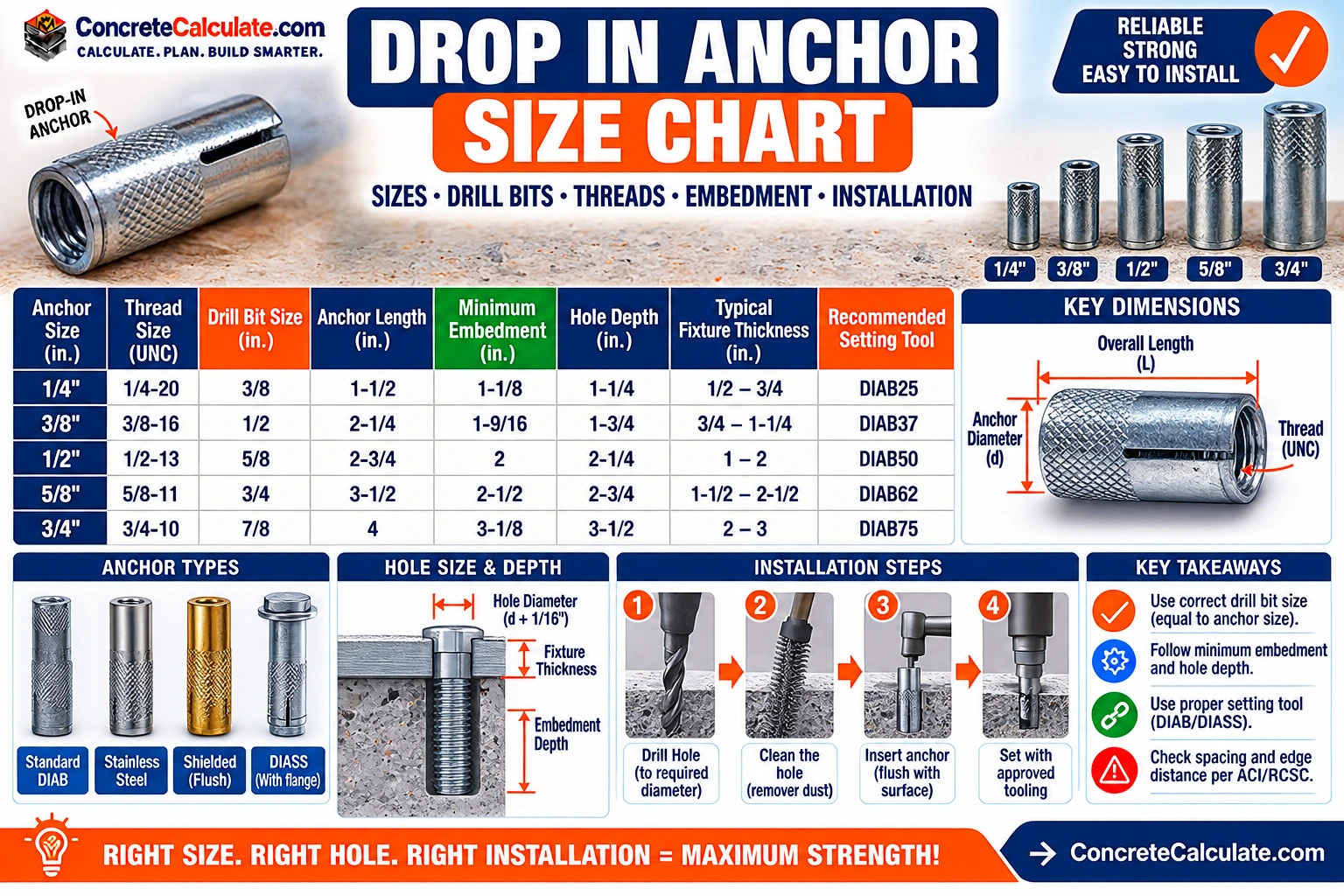
Drop-In Anchor Size Chart: Thread Sizes, Drill Bits & Embedment
Internally threaded drop-in anchor sizes, matching concrete drill bits, body lengths, embedment, setting tools, rod compatibility and the product-specific limits that control installation.
 Reviewed by Muhammad Ramzan Babar, PhD Researcher (Plasma Physics) & Calculator Developer. View Profile
Key Facts
- A drop-in anchor is sized by its internal thread. A 3/8-16 DIAB anchor takes 3/8-16 rod but needs a 1/2 in. concrete drill bit.
- Standard DIAB body lengths and embedments run from 1 in. (1/4 thread) to 3-1/8 in. (3/4 thread), but short and hollow-core anchors have their own geometry and data.
- Drop-in anchors are set by a dedicated setting tool before installing the rod. They are not set by tightening the threaded element.
- For other anchor families, see the Concrete Anchor Drill Bit Size Chart, Sleeve Anchor Size Chart and Wedge Anchor Size Chart.
Drop-In Anchor Size Chart: Quick Reference
Thread sizes, drill bits, body lengths and embedment for five Simpson DIAB anchors.
How to Read This Chart
The first column is the internal thread size. It tells you the rod or bolt that fits, not the drill bit. For example, a 3/8-16 DIAB37 accepts a 3/8-16 threaded rod but requires a 1/2 in. nominal carbide bit, has a 1-9/16 in. body length and minimum embedment, and provides 5/8 in. of internal thread.
| Internal thread size | UNC thread | Concrete drill bit | Anchor body length | Minimum embedment | Internal thread length |
|---|---|---|---|---|---|
| 1/4 in. | 1/4-20 UNC | 3/8 in. | 1 in. | 1 in. | 3/8 in. |
| 3/8 in. | 3/8-16 UNC | 1/2 in. | 1-9/16 in. | 1-9/16 in. | 5/8 in. |
| 1/2 in. | 1/2-13 UNC | 5/8 in. | 2 in. | 2 in. | 3/4 in. |
| 5/8 in. | 5/8-11 UNC | 7/8 in. | 2-1/2 in. | 2-1/2 in. | 1 in. |
| 3/4 in. | 3/4-10 UNC | 1 in. | 3-1/8 in. | 3-1/8 in. | 1-1/4 in. |
Thread Size Is Not Drill-Bit Size
Nominal anchor size identifies the internal thread size. The concrete drill bit is larger than the threaded rod or bolt. Hole depth must follow the installation instructions, and the designated setting tool is required. Coil-thread variants need different threaded elements. This chart is not a universal capacity or structural approval table.
Thread Size and Drill Bit
For drill-bit comparisons across anchor families, see the Concrete Anchor Drill Bit Size Chart.
Anchor Length and Embedment
On these standard DIAB models the published body length and minimum embedment are the same number, but do not assume that applies to every drop-in product.
How to Read the Chart
Use the internal thread to select the compatible rod. Use the drill-bit column for drilling. Use the manufacturer data for all other installation and design conditions.
What Is a Drop-In Anchor?
An internally threaded anchor set with a dedicated tool.
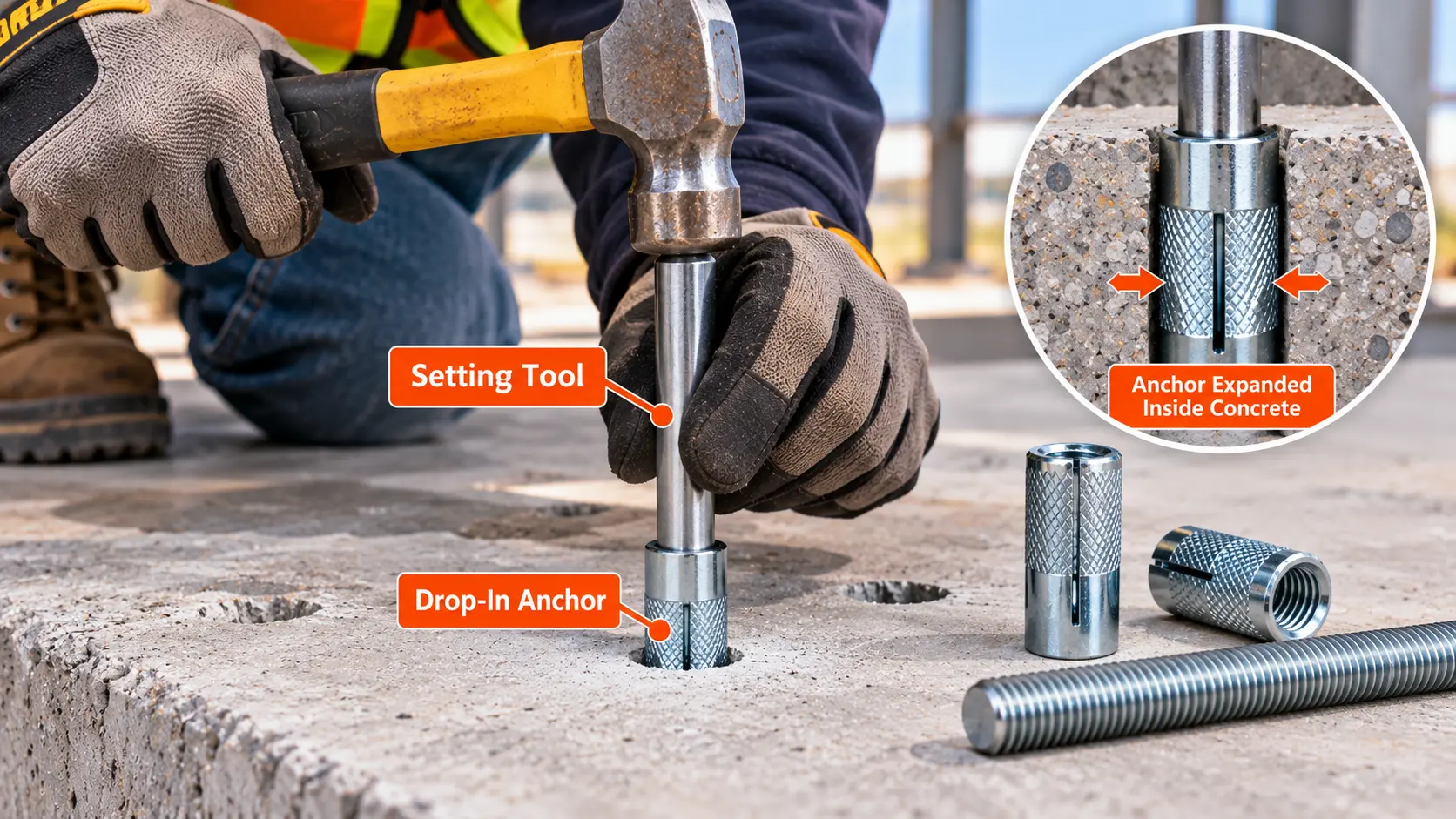
A drop-in anchor is an internally threaded post-installed mechanical expansion anchor. It is inserted flush into a drilled hole in hardened concrete, then a dedicated setting tool drives the internal expansion plug down. The plug forces the lower anchor body outward against the concrete.
How Drop-In Anchors Work
Unlike a sleeve or wedge anchor, a standard drop-in anchor is not expanded by tightening the fixture nut. It is expanded before the threaded rod or bolt goes in. Simpson describes DIAB as a displacement-controlled expansion anchor.
Displacement-Controlled Expansion
The setting tool shoulder contacts the top of the anchor when the plug has moved far enough. This makes the setting procedure repeatable and provides an installation indication.
Drop-In Anchor Parts and Dimensions
The internal thread, expansion plug and outside body all matter.
The outside anchor body, internal thread and drilled hole are three different dimensions.
| Part or dimension | What it means |
|---|---|
| Anchor body | Cylindrical outer shell placed in the concrete hole |
| Internal female threads | Threaded hole for a bolt or rod |
| Expansion plug | Driven down by the setting tool |
| Expandable lower section | Part that expands against concrete |
| Anchor body length | Physical length of the anchor body |
| Thread engagement length | Available internal thread length |
| Setting tool | Product-specific hand or power tool |
Anchor Body, Expansion Plug and Internal Threads
The internal threads start at the top and have a defined length. The plug sits below them and is driven down to expand the lower section.
Anchor Length and Embedment
Body length and embedment are separate terms that happen to match for the standard DIAB models. Other products use their own definitions.
Standard Drop-In Anchor Sizes
Internal thread sizes, conversions and manufacturer examples.
Common standard drop-in internal thread sizes are 1/4, 3/8, 1/2, 5/8 and 3/4 in. Some families offer metric, reduced-depth, lipped or coil-thread configurations, and not every manufacturer supplies all sizes.
Common Inch Sizes
| Thread diameter | Decimal inches | Millimeters |
|---|---|---|
| 1/4 in. | 0.2500 | 6.35 |
| 3/8 in. | 0.3750 | 9.53 |
| 1/2 in. | 0.5000 | 12.70 |
| 5/8 in. | 0.6250 | 15.88 |
| 3/4 in. | 0.7500 | 19.05 |
Decimal and Metric Conversions
A 3/8 in. anchor accepts 3/8-16 UNC rod, not an M10 rod. For UNC details, see the UNC Thread Chart.
Manufacturer Availability
| Product | Sizes noted |
|---|---|
| Simpson DIAB | 1/4, 3/8, 1/2, 5/8, 3/4 in. |
| Simpson DIAS short | 3/8 in. |
| Hilti HDI-P | 1/4, 3/8, 1/2 in. |
| Hilti HDI-TZ | 1/4, 3/8, 1/2 in. |
| Hilti HDI-P TZ | 3/8, 1/2, 5/8 in. |
Drop-In Anchor Drill Bit Size Chart
The bit is chosen from the product table, not the rod size.
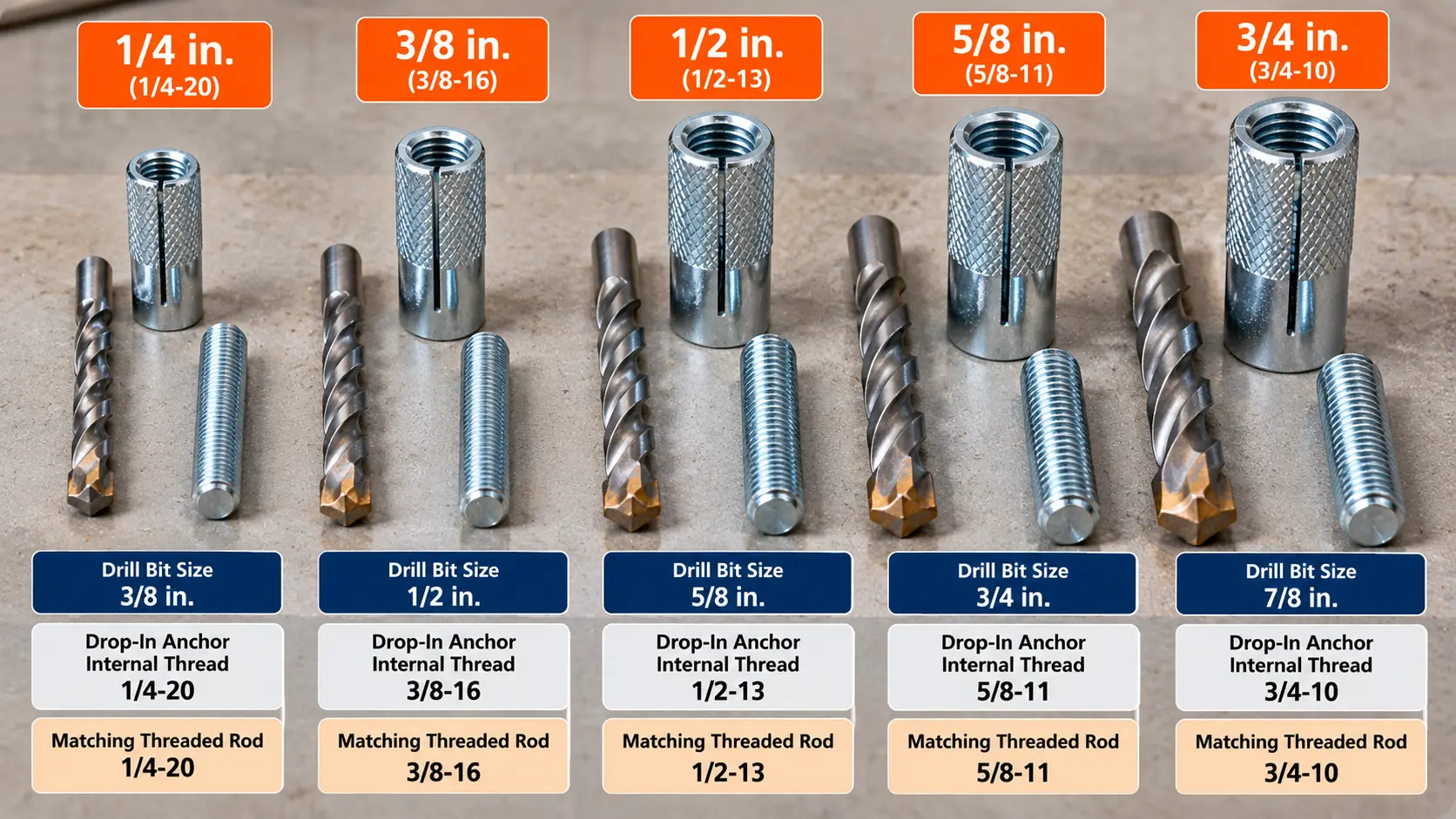
For Simpson DIAB anchors, the carbide bit is larger than the internal thread: 1/4-20 needs 3/8 in., 3/8-16 needs 1/2 in., 1/2-13 needs 5/8 in., 5/8-11 needs 7/8 in. and 3/4-10 needs 1 in. Use the specified carbide bit or fixed-depth bit. Do not choose a bit from the threaded rod diameter.
Matching Drill Diameters
| Internal thread | Required concrete drill bit | Difference between drill and thread diameter |
|---|---|---|
| 1/4-20 | 3/8 in. | 0.125 in. |
| 3/8-16 | 1/2 in. | 0.125 in. |
| 1/2-13 | 5/8 in. | 0.125 in. |
| 5/8-11 | 7/8 in. | 0.250 in. |
| 3/4-10 | 1 in. | 0.250 in. |
Carbide Masonry Bits and Hole Tolerances
Use a carbide-tipped masonry bit. Simpson states the hole must be drilled with the specified bit to the stated embedment, then cleaned with oil-free compressed air for standard DIAB installation. Hole roundness and diameter matter, and a worn bit can create an oversized hole.
Drop-In Anchor Thread Size and Pitch
UNC threads, pitch and coil-thread variants.
Standard DIAB anchors use UNC internal threads. The thread pitch is the reciprocal of TPI.
UNC Thread Chart
| Anchor | Internal UNC thread | TPI | Pitch (in.) | Pitch (mm) |
|---|---|---|---|---|
| DIAB25 | 1/4-20 | 20 | 0.0500 | 1.27 |
| DIAB37 | 3/8-16 | 16 | 0.0625 | 1.59 |
| DIAB50 | 1/2-13 | 13 | 0.0769 | 1.95 |
| DIAB62 | 5/8-11 | 11 | 0.0909 | 2.31 |
| DIAB75 | 3/4-10 | 10 | 0.1000 | 2.54 |
Thread Pitch Formula
🧮 Pitch
3/8-16 example: P = 1/16 = 0.0625 in. Metric threads are not interchangeable with UNC. See the Thread Pitch Chart and Thread Size Chart.
Coil-Thread Variants
| Anchor type | Internal thread | Compatible threaded element |
|---|---|---|
| DIAB25 | 1/4-20 UNC | 1/4-20 bolt or rod |
| DIAB37 | 3/8-16 UNC | 3/8-16 bolt or rod |
| DIAB50 | 1/2-13 UNC | 1/2-13 bolt or rod |
| DIAB62 | 5/8-11 UNC | 5/8-11 bolt or rod |
| DIAB75 | 3/4-10 UNC | 3/4-10 bolt or rod |
| DIAB50C | 1/2 in. coil thread, 6 TPI | Specified 1/2 in. coil-thread rod |
| DIAB75C | 3/4 in. coil thread, 4-1/2 TPI | Specified 3/4 in. coil-thread rod |
Drop-In Anchor Length Chart
Body length, thread length and embedment are separate dimensions.
Anchor body length, internal thread length, embedment and drilled-hole depth are separate. The attached rod or bolt projects outside the anchor and is not included in the body length.
| Model | Internal thread | Drill bit | Body length (in.) | Internal thread length (in.) | Minimum embedment (in.) |
|---|---|---|---|---|---|
| DIAB25 | 1/4-20 | 3/8 | 1 | 3/8 | 1 |
| DIAB37 | 3/8-16 | 1/2 | 1-9/16 | 5/8 | 1-9/16 |
| DIAB50 | 1/2-13 | 5/8 | 2 | 3/4 | 2 |
| DIAB62 | 5/8-11 | 7/8 | 2-1/2 | 1 | 2-1/2 |
| DIAB75 | 3/4-10 | 1 | 3-1/8 | 1-1/4 | 3-1/8 |
Standard Body Length, Internal Thread Length and Embedment Dimensions
A longer body has more embedment and usually more thread depth, but it also requires a deeper hole and thicker concrete. The rod is selected separately.
Standard vs. Shallow Drop-In Anchors
Same thread and bit, different body length and performance data.
Reduced-depth anchors are different products with their own dimensions and performance. A short anchor may help avoid drilling into reinforcing steel or prestressing cable, but it is not automatically approved for every thin slab. Most important: body length and design embedment are not always the same number.
| Product | Thread | Drill bit | Anchor body length | Internal thread length | Published minimum embedment for design data |
|---|---|---|---|---|---|
| Simpson DIAB37 | 3/8-16 | 1/2 in. | 1-9/16 in. | 5/8 in. | 1-9/16 in. |
| Simpson DIA37S | 3/8-16 | 1/2 in. | 3/4 in. | 1/4 in. | 1-9/16 in. |
Short Does Not Mean Shallow Design Embedment
The DIA37S body is 3/4 in. long, but Simpson product listings publish a 1-9/16 in. minimum embedment for its design data. Do not state that it is a 3/4 in. embedment anchor or use it as a universal thin-slab solution.
Selection Limitations
Simpson states short DIAS anchors include a compatible setting tool for consistent installation. Product qualification, concrete thickness and design data control the choice.
Drop-In Anchor Embedment Depth
Minimum, nominal and effective embedment depend on the product.
Embedment is manufacturer-defined. Simpson uses the anchor length as the minimum embedment for standard DIAB anchors. Hilti uses several definitions: nominal embedment hnom, effective embedment hef and hole depth h0, depending on the product.
| Product | Thread | Anchor length (in.) | Nominal or minimum embedment (in.) | Effective embedment (in.) | Hole depth (in.) |
|---|---|---|---|---|---|
| Simpson DIAB37 | 3/8-16 | 1-9/16 | 1-9/16 | Product-defined | Specified embedment depth |
| Hilti HDI-P | 1/4 | 5/8 | 5/8 | Product-defined | 5/8 |
| Hilti HDI-P | 3/8 | 3/4 | 3/4 | Product-defined | 3/4 |
| Hilti HDI-P | 1/2 | 1 | 1 | Product-defined | 1 |
| Hilti HDI-TZ | 3/8 | 1-9/16 | 1-9/16 | 1.42 | 1-9/16 |
| Hilti HDI-TZ | 1/2 | 2 | 2 | 1.65 | 2 |
| Hilti HDI-TZ | 5/8 | 3-3/16 | 3-3/16 | 3 | 3-1/4 |
Minimum, Nominal and Effective Embedment
Use the definition used by the selected product. Deeper body length does not automatically mean proportionally higher load capacity.
Manufacturer Requirements
For Hilti HDI-P TZ in hollow-core panels, the 3/8 in. anchor requires 3/4 in. embedment and a 9/16 in. bit, which is a different product from DIAB37.
Drop-In Anchor Hole Depth
Drilling depth and cleaning follow the product instructions.
Drill to the product’s specified depth. A fixed-depth drill bit or depth gauge helps keep holes consistent. Simpson DIAB directs installers to drill to the specified embedment; DIASS and DIASS stainless instructions add 1/8 in. for flush mounting. Hilti lists hole depths in its tables. Do not use a universal rule that every hole should be 1/4 in. deeper.
| Product family | Published direction |
|---|---|
| Simpson DIAB | Drill to the specified embedment; blow the hole clean with oil-free compressed air. Overhead holes need not be blown clean. |
| Simpson DIASS / DIASS stainless | Drill to the specified embedment depth plus 1/8 in. for flush mounting; blow hole clean. |
| Hilti HDI-P | Use published hole depth h0 (equal to anchor length in the hollow-core data). |
| Hilti HDI-TZ | Use product-specific h0, for example 1-9/16 in. for 3/8 and 2 in. for 1/2. |
Drilling Depth, Fixed-Depth Bits and Hole Cleaning
Clean the hole as the product requires. Dust at the bottom can keep the anchor from seating, and a shallow hole can prevent proper expansion.
Drop-In Anchor Setting Tools
The defining installation tool and its setting indication.
Setting tools are essential. They drive the internal plug down the anchor body and expand the lower section. A bolt, rod or arbitrary punch does not provide the controlled depth and shoulder contact of the designated tool.
| Product family | Setting tool and verification |
|---|---|
| Simpson DIAB | Dedicated DIABST hand or power setting tools. The tool shoulder contacts the anchor to indicate full setting. |
| Simpson DIAS short | Compatible setting tool is included with each anchor. |
| Hilti HDI-P | HST-P hand tools or HSD-G 3/8 tool with hand guard. The HSD-G leaves a mark on the flange when fully set. |
| Hilti HDI-P TZ | Auto setting tool or hand setting tool, with stop drill bit and setting tool designed for the system. |
Hand-Setting and Power-Setting Tools
Manual installation uses a hammer to drive the plug until the tool shoulder contacts the anchor. Power setting uses the compatible SDS tool in hammer-only mode.
Expansion Verification
The setting indication is product-specific. Hilti HDI-P uses a setting mark on the flange, and Simpson uses tool shoulder contact.
How to Install a Drop-In Anchor
Drill, clean, set and then install the rod.
The product installation instructions override generic practice.
- Confirm the product and concrete suitability.
- Check spacing, edge distance and member thickness.
- Select the specified carbide drill bit.
- Drill to the required depth.
- Clean the hole according to instructions.
- Insert the anchor flush with the base material.
- Use the approved setting tool.
- Expand the anchor fully and inspect the indication.
- Install the specified threaded element.
- Verify thread engagement and permitted torque.
Drilling and Cleaning, Anchor Setting and Threaded Element Installation
Never use the threaded rod itself as the setting tool. It can damage the anchor threads or fail to move the plug far enough.
Drop-In Anchor Thread Engagement
Thread depth, bottoming and the eight-turn illustration.
Drop-in anchors have limited internal thread depth. A rod or bolt must engage enough threads without bottoming out against the expansion plug. A long rod does not increase capacity after the available thread depth is reached.
| Anchor | Thread | Internal thread length (in.) | Full turns across thread depth |
|---|---|---|---|
| DIAB25 | 1/4-20 | 3/8 | 7.5 |
| DIAB37 | 3/8-16 | 5/8 | 10.0 |
| DIAB50 | 1/2-13 | 3/4 | 9.8 |
| DIAB62 | 5/8-11 | 1 | 11.0 |
| DIAB75 | 3/4-10 | 1-1/4 | 12.5 |
Thread Depth and Engagement Requirements
Required engagement comes from the product and the threaded element. Avoid thread stripping and do not bottom out against the expansion plug.
Worked Thread Example
Thread Turns in a 3/8-16 Anchor
What it means: Eight turns are not automatically sufficient or approved. Actual required engagement depends on the anchor product, threaded element and manufacturer instructions.
Drop-In Anchor Threaded Rod and Bolt Selection
Match thread, grade and material to the selected anchor.
Match the internal thread exactly: DIAB37 takes 3/8-16 UNC, DIAB50 takes 1/2-13 UNC and so on. Threaded rod diameter, thread series, material grade, thread length and corrosion compatibility all need checking. A matching diameter and pitch do not independently establish material strength or approved compatibility.
| Anchor | Internal thread | Compatible bolt or rod |
|---|---|---|
| DIAB25 | 1/4-20 | 1/4-20 bolt or threaded rod |
| DIAB37 | 3/8-16 | 3/8-16 bolt or threaded rod |
| DIAB50 | 1/2-13 | 1/2-13 bolt or threaded rod |
| DIAB62 | 5/8-11 | 5/8-11 bolt or threaded rod |
| DIAB75 | 3/4-10 | 3/4-10 bolt or threaded rod |
For rod diameters, material grades and thread types, use the Threaded Rod Size Chart. Use the UNC Thread Chart for complete thread geometry. Rod strength and suspended length need a separate design check.
Drop-In Anchor Installation Torque
Setting force and threaded-element torque are different.
Setting torque and fixture torque are not the same thing. Standard drop-in anchors are expanded by the setting tool, not by tightening a bolt. The attached threaded element can have a maximum permitted torque, but it must come from the selected product’s table, not a generic bolt torque chart.
| Product / internal thread | Maximum torque, ft-lb | Hole depth (in.) | Effective embedment hef (in.) | Thread engagement |
|---|---|---|---|---|
| HDI-TZ 1/4 | 4.2 | 1 | 3/4 | 1/4 to 1/2 in. |
| HDI-TZ 3/8 | 5.0 | 1-9/16 | 1.42 | 3/8 to 5/8 in. |
| HDI-TZ 1/2 | 10.4 | 2 | 1.65 | 1/2 to 3/4 in. |
| HDI-P TZ 3/8 | 5.0 | 3/4 | 3/4 | 3/8 to 5/8 in. |
| HDI-P TZ 1/2 | 10.4 | 1 | 1 | 1/2 to 3/4 in. |
| HDI-P TZ 5/8 | 20.8 | 1-1/4 | 1-1/4 | 5/8 to 1 in. |
Do Not Transfer Torque
Do not transfer Hilti torque values to Simpson DIAB or another drop-in anchor. Do not use generic bolt torque to set the expansion plug. For general torque concepts only, see the Bolt Torque Chart.
Setting vs. Tightening and Manufacturer Limits
The tool sets the anchor. Torque may secure the fixture but only up to the product’s permitted maximum.
Drop-In Anchors for Concrete
Strength, cracking and qualification are product-specific.
Concrete suitability is product-specific. Simpson DIAB tables cover normal-weight concrete and lightweight concrete under stated conditions, and Simpson ESR-3037 evaluates certain 3/8 through 1 in. anchors for cracked and uncracked normal-weight and sand-lightweight concrete under static, wind and seismic loads. That does not make every DIAB size or every drop-in anchor suitable for every cracked or seismic condition.
Normal-Weight Concrete and Concrete Strength
Use the published values for the actual f’c. Simpson data lists different values at 2,500, 3,000 and 4,000 psi. Concrete strength at installation matters, so see the Concrete PSI Chart and Concrete Strength Gain Chart.
Cracked vs. Uncracked Concrete
ACI 355.2 provides qualification criteria for mechanical anchors in uncracked concrete only or in cracked and uncracked concrete. The qualification belongs to the exact product, installation and evaluation report.
Anchor Groups, Tension and Shear
Multiple anchors interact, and combined tension and shear need the product data or ACI 318 Chapter 17 design, as applicable.
Drop-In Anchors for Hollow-Core and Precast Concrete
Panel geometry and prestressing change the rules.
Hollow-core and precast concrete require anchors made for the panel geometry and drilling limits. Hilti HDI-P anchors are designed for hollow-core panels and use a dedicated setting tool. The hollow-core supplier must establish acceptable drilling locations before installation, so the contractor avoids the prestressing cables. Drilling or damaging a prestressing tendon is a serious safety hazard.
| Internal thread | Drill bit | Anchor length / hole depth | Min. panel thickness | Min. concrete strength at installation |
|---|---|---|---|---|
| 1/4 in. | 3/8 in. | 5/8 in. | 1-3/8 in. | 7,000 psi |
| 3/8 in. | 1/2 in. | 3/4 in. | 1-3/8 in. | 7,000 psi |
| 1/2 in. | 5/8 in. | 1 in. | 1-3/8 in. | 7,000 psi |
Shallow Anchors, Prestressing Tendons and Approved Drilling Locations
Reduced-depth anchors and hollow-core anchors have distinct qualifications. Do not assume a standard DIAB works in hollow core or that a short body is safe to install anywhere.
Drop-In Anchor Load Capacity
One narrowly defined product example, not a generic rating.
Load capacity is not determined by thread size. Exact product, concrete strength, cracked or uncracked condition, embedment, edge distance, spacing, member thickness, installation quality and anchor group all affect tension and shear resistance.
| Concrete strength | Allowable tension (lb) | Allowable shear (lb) | Assumed minimum spacing | Assumed edge distance |
|---|---|---|---|---|
| 2,500 psi | 740 | 460 | 4-1/2 in. | 3 in. |
| 3,000 psi | 890 | 500 | 4-1/2 in. | 3 in. |
| 4,000 psi | 980 | 540 | 4-1/2 in. | 3 in. |
Ultimate vs. Allowable Loads, Tension and Shear
Manufacturer tables can show allowable loads or design strengths. Read the table heading and notes, and do not turn an ultimate test value into an allowable load.
Structural Design Limitations
ACI 318 anchorage design addresses concrete breakout, pullout, steel failure, groups and combined loading. This page does not calculate a universal capacity.
Drop-In Anchor Spacing Requirements
Anchor groups interact when they are close together.
Spacing is center-to-center distance between anchors. Anchor groups can interact through overlapping concrete breakout regions, reducing the capacity per anchor. Use the selected anchor’s product data or evaluation report. Do not use a generic 6d rule for all drop-in anchors.
| Anchor | Minimum spacing in table | Full-efficiency spacing in table |
|---|---|---|
| DIAB25 | 3 in. | 3 in. |
| DIAB37 | 3 in. | 4-1/2 in. |
| DIAB50 | 3-3/4 in. | 6 in. |
| DIAB62 | 4-1/2 in. | 7-1/2 in. |
| DIAB75 | 6 in. | 9 in. |
Minimum Spacing, Anchor Group Effects and Product-Specific Values
When anchors are closer than the full-efficiency spacing, design values reduce per the manufacturer’s table. Do not copy these values to other drop-in products.
Drop-In Anchor Edge Distance
Near an edge, the concrete cone is smaller.
Edge distance is the distance from the anchor centerline to the nearest free concrete edge. As an anchor gets closer to an edge, the concrete breakout region is truncated and capacity falls. Corners, thin concrete members and groups near an edge need special attention.
| Anchor | Minimum edge distance in table | Full-efficiency edge distance in table |
|---|---|---|
| DIAB25 | 2 in. | 2 in. |
| DIAB37 | 2 in. | 3 in. |
| DIAB50 | 2-1/2 in. | 4 in. |
| DIAB62 | 3 in. | 5 in. |
| DIAB75 | 4 in. | 6 in. |
Edge Distance Measurement and Concrete Breakout
Measure from the anchor centerline to the closest free edge. Reduced resistance or a no-use condition can apply when that dimension is too small.
Reduced Capacity
Read the product table and evaluation report. Do not use one universal edge distance across brands.
Minimum Concrete Thickness
The anchor fitting is not proof that the slab is thick enough.
Anchor embedment, hole depth, remaining concrete below the hole and total member thickness are different dimensions. A short anchor does not automatically qualify for every thin slab, and hollow-core face shells are not the same as solid concrete.
| Check | Why it matters |
|---|---|
| Anchor embedment | Depth the anchor reaches into the base material |
| Hole depth | Depth drilled for installation |
| Remaining concrete below hole | Thin remaining material can reduce breakout resistance |
| Total concrete thickness | Manufacturer may require a minimum member thickness |
| Hollow-core face-shell thickness | Governs whether a reduced-depth anchor can be used |
Embedment vs. Slab Thickness, Hollow-Core Limitations and Drilling Restrictions
Simpson DIAB design data uses a minimum concrete thickness of 1-1/2 times the embedment depth. This is a product-specific reference, not a universal rule. Locate reinforcement before drilling, using drawings or approved scanning where required. The Concrete Cover Chart explains cover but is not drilling-location approval.
Drop-In Anchor Materials and Finishes
Dry interior, wet exposure and product approval.
Standard DIAB anchors are zinc-plated carbon steel for solid concrete. Simpson also offers DIABSS 316 stainless steel drop-in anchors. Choice of material depends on moisture, chlorides, exterior exposure and compatibility with the fixture.
| Material | Typical suitability | Limit |
|---|---|---|
| Zinc-plated carbon steel | Dry interior concrete | Not for corrosive or wet exposure without manufacturer approval |
| 316 stainless steel (DIABSS) | Outdoor, wet or corrosive exposure where the product is approved | Check chlorides, fixture material and the product data |
| Other corrosion-resistant variants | Manufacturer-specific | Check the exact evaluation and environment |
Zinc-Plated Steel, Stainless Steel and Environmental Suitability
Galvanic compatibility matters. Do not assume any stainless anchor has the same capacity or qualification as its zinc-plated counterpart.
Drop-In Anchor vs. Wedge Anchor
Internal threads and setting tools versus external studs and torque expansion.
Drop-in anchors and wedge anchors are both mechanical anchors, but they install and perform differently. See the Wedge Anchor Size Chart for wedge anchor data.
| Topic | Drop-in anchor | Wedge anchor |
|---|---|---|
| Thread configuration | Internally threaded | Externally threaded stud |
| Expansion method | Setting tool drives the plug | Nut draws expansion clip up tapered end |
| Drill bit | Larger than internal thread | Product-specific, typically matches nominal anchor |
| Setting tool | Required | Not used |
| Fixture attachment | Install rod or bolt after setting | Anchor installed through fixture |
| Typical use | Suspended rod and overhead attachment | Fixture and base plate fastening |
Expansion Mechanism, Drill Size and Applications
Do not assume two anchors with the same nominal diameter use the same bit, embedment or capacity.
Drop-In Anchor vs. Sleeve and Concrete Screw Anchors
Different anchor mechanisms, different rules.
Different concrete anchors work in different ways.
| Anchor type | How it develops resistance |
|---|---|
| Drop-in | Internal expansion plug set with a tool |
| Sleeve anchor | External sleeve expanded by a cone, see the Sleeve Anchor Size Chart |
| Concrete screw | Mechanical thread engagement, see the Concrete Screw Size Chart |
| Adhesive anchor | Bonded rod in an approved adhesive system |
Sleeve Anchors, Concrete Screws and Adhesive Anchor Alternatives
Each type has different hole, embedment, setting and qualification rules. Keep drill-bit comparisons on the Concrete Anchor Drill Bit Size Chart.
Common Drop-In Anchor Applications
Suspended rod, mechanical supports and qualified overhead use.
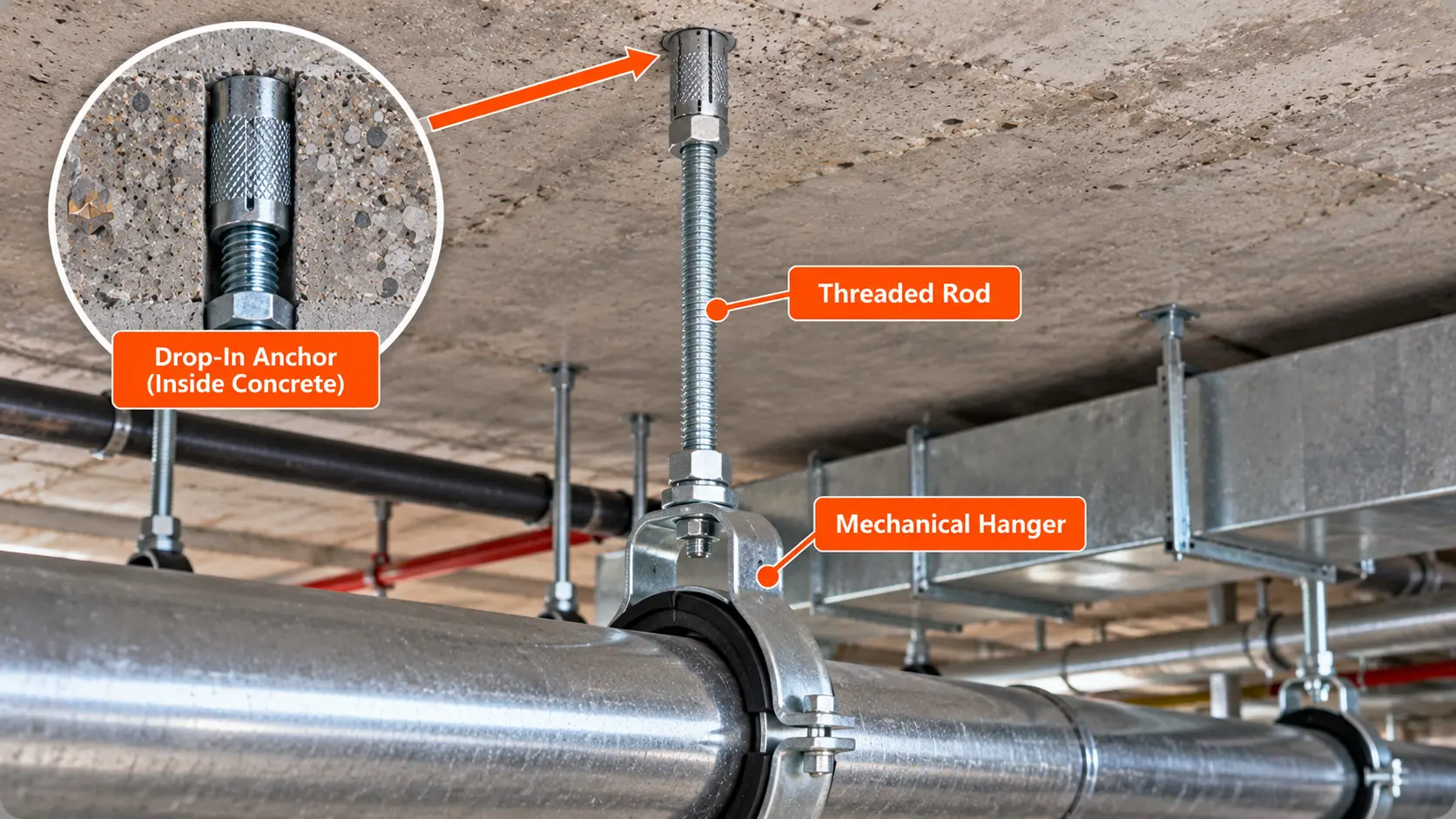
Product-approved uses include suspended pipe supports, HVAC hangers, electrical supports, threaded rod connections and mechanical fixtures.
Pipe and HVAC Supports, Electrical Hangers and Overhead Requirements
Overhead and safety-critical attachments need an appropriately qualified system, including seismic or fire-related requirements where applicable. Follow the selected product evaluation and the hanger manufacturer’s tables.
How to Choose the Correct Drop-In Anchor Size
A selection workflow, not a thread-size lookup.
Choose the qualified product first, then the thread size and hardware.
- Identify the base material and concrete condition.
- Determine applied tension and shear loads.
- Identify structural or seismic requirements.
- Choose a qualified product family.
- Select the internal thread diameter.
- Match the specified drill bit.
- Verify embedment and concrete thickness.
- Check spacing and edge distance.
- Select compatible threaded rod or bolt.
- Confirm setting tool, engagement and installation instructions.
For general anchor families, see the Anchor Bolt Size Chart and Anchor Bolt Grade Chart.
Common Drop-In Anchor Mistakes
The drill, setting, engagement and concrete errors that cause the most trouble.
Drill-bit errors
Confusing thread size with drill-bit size, or selecting the bit from the threaded rod diameter.
Setting errors
Using the wrong setting tool or failing to fully expand the anchor.
Depth errors
Drilling too shallow or ignoring hole cleaning.
Shallow anchor errors
Using a shallow anchor without checking its qualification, or installing in concrete that is too thin.
Thread errors
Using incompatible UNC or coil-thread rods, insufficient engagement or bottoming out the threaded element.
Layout errors
Ignoring edge distance or spacing.
Prestressing hazard
Damaging prestressing tendons in hollow-core panels.
Load errors
Assuming all anchors work in cracked concrete, treating ultimate load as allowable load or using unqualified products overhead.
Reuse
Reusing an expanded anchor without manufacturer authorization.
Drop-In Anchor Chart Limitations and Safety
Reference dimensions are not an anchor design.
This chart does not independently determine:
- Safe working load or structural design strength.
- Seismic suitability or cracked-concrete approval.
- Minimum member thickness or edge-distance requirements.
- Anchor group strength or appropriate suspended-load capacity.
- Acceptable corrosion exposure.
The exact product documentation, evaluation report, applicable code and project requirements govern. ACI 318 Chapter 17 controls structural anchorage design, and ACI 355.2 qualification is product-specific.
Drop-In Anchor Size FAQs
Straight answers to common drop-in anchor questions.
What sizes do drop-in anchors come in?
Standard Simpson DIAB sizes are 1/4, 3/8, 1/2, 5/8 and 3/4 in. internal threads. Other product lines may have metric, shallow or coil-thread versions.
What drill bit is needed for a 1/4-inch drop-in anchor?
A standard 1/4-20 DIAB25 uses a 3/8 in. carbide bit.
What size hole does a 3/8-inch drop-in anchor require?
A standard DIAB37 uses a 1/2 in. carbide bit. The anchor thread is 3/8-16, so thread size and hole size are different.
What drill bit fits a 1/2-inch drop-in anchor?
A standard DIAB50 uses a 5/8 in. carbide bit.
Is drop-in anchor size the same as hole size?
No. The stated anchor size identifies the internal thread. The drill hole is larger and comes from the product table.
What threaded rod fits a 3/8-inch drop-in anchor?
A standard DIAB37 takes 3/8-16 UNC threaded rod or a bolt with the same thread.
How deep should I drill for a drop-in anchor?
Follow the product instructions. Standard DIAB anchors use the specified embedment depth, while DIASS may require embedment plus 1/8 in. for flush mounting. Do not use a universal overdrill rule.
What is the minimum embedment?
It is product-specific. Standard DIAB values are 1 in. for 1/4, 1-9/16 for 3/8, 2 in. for 1/2, 2-1/2 for 5/8 and 3-1/8 in. for 3/4.
How do I set a drop-in anchor?
Drill and clean the hole, insert the anchor flush and strike the designated setting tool until it indicates full setting. Install the threaded rod only after setting.
Do drop-in anchors require a special setting tool?
Yes. Use the compatible manufacturer tool. A bolt, threaded rod or improvised punch can damage the threads or fail to expand the anchor.
Can I use a bolt to set a drop-in anchor?
No. Use the designated setting tool.
What is the difference between standard and shallow drop-in anchors?
They can share a thread and drill size but have different body length, internal thread depth, design embedment and performance data. Do not transfer capacity data between them.
Can drop-in anchors be used in cracked concrete?
Only if the exact product is qualified for cracked concrete and the evaluation report and design conditions allow it.
Can they be used in hollow-core slabs?
Only selected products such as Hilti HDI-P are intended for hollow-core panels, and drilling locations must be approved to avoid prestressing tendons.
How much weight can a 3/8-inch drop-in anchor hold?
There is no universal number. Simpson DIAB37 tables list 740 to 980 lb allowable tension in normal-weight concrete at stated conditions, but edge distance, spacing and concrete strength control.
Can drop-in anchors support overhead pipes?
They can when an appropriately qualified anchor, threaded rod and rated hanger system are selected for the load and conditions.
Can drop-in anchors be removed or reused?
The threaded rod or bolt can be removed, but the expanded anchor body stays in the concrete and should not be reused unless the manufacturer says otherwise.
What is the difference between drop-in and wedge anchors?
Drop-in anchors are internally threaded and set with a tool. Wedge anchors have external threads and expand when the nut pulls a clip over a tapered end. See the Wedge Anchor Size Chart.
Cite or Embed This Chart
📄 Print or Save This Chart as PDF
Use your browser’s print function to save the page as a PDF reference for jobsite binders and estimating folders.
Sources and Standards Used
Dimensions, embedment, setting tools, hole depth, capacities, spacing and edge values are taken from the named Simpson or Hilti product data and apply only to those products. Metric conversions, pitch and thread turns are calculated and marked as derived. Confirm current product data, evaluation reports and project requirements before installation.
- Simpson Strong-Tie, Drop-In (DIAB) Internally Threaded Anchor
- Simpson Strong-Tie, Drop-In (DIAS) Short Internally Threaded Anchor
- Hilti, HDI-P Drop-In Anchors for Hollow Core Concrete Panels
- ICC-ES ESR-4236, Hilti HDI-TZ and HDI-P TZ
- ACI 355.2 and ACI 318, concrete anchorage standards
- ICC Evaluation Service