Metric Bolt Diameter Chart – M Size, Millimeters & Inch Conversion
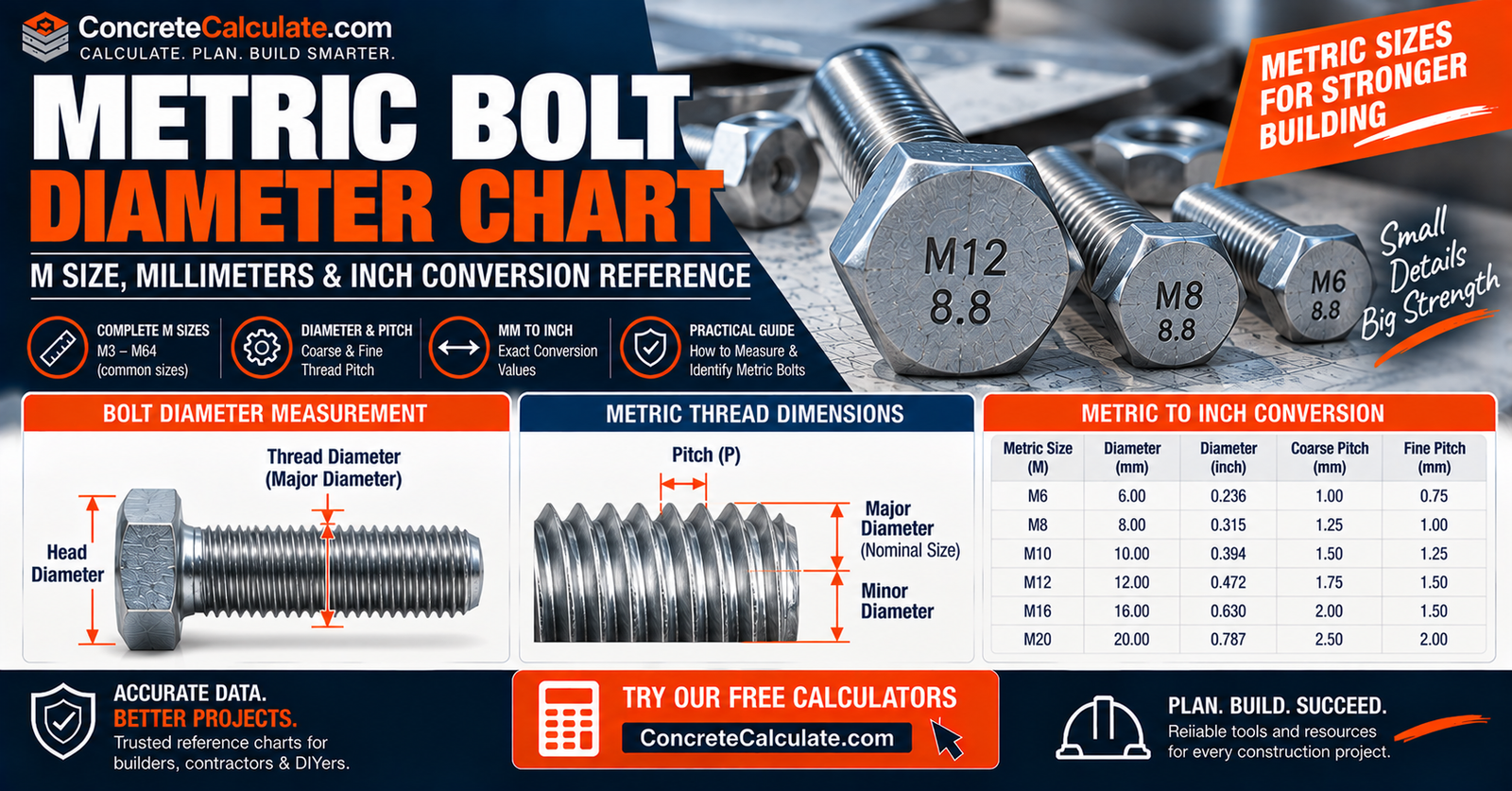
Metric Bolt Diameter Chart
M Size, Millimeters & Inch Conversion
M-size nominal diameter, exact millimeter and inch conversion, coarse and fine pitch context, major/pitch/minor diameter concepts, nominal versus actual thread diameter, and how to correctly measure and identify an unknown metric bolt.
 Reviewed by Muhammad Ramzan Babar, PhD Researcher (Plasma Physics) & Calculator Developer, View Profile
The number after “M” is the nominal thread diameter in millimeters, not the head width, socket size, or exact measured diameter
M12 x 1.75 means a nominal thread diameter of 12 mm and a thread pitch of 1.75 mm per thread. It does not describe a 12-mm wrench, a 12-mm head, or a guaranteed exact 12.000-mm caliper reading.
Metric Bolt Diameter Chart, Quick Reference
Head/wrench dimensions belong to the applicable bolt-product standard and should not be implied solely from diameter.
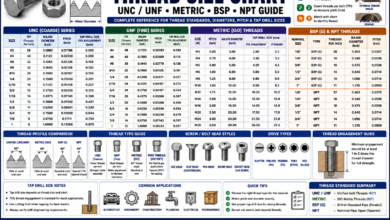
Standard Metric Bolt Diameter Chart
| Metric Size | Nominal Diameter (mm) | Exact Inches | Standard Coarse Pitch | Common Fine Pitch(es) |
|---|---|---|---|---|
| M6 | 6 | 0.2362 | 1.0 | – |
| M8 | 8 | 0.3150 | 1.25 | 1.0 |
| M10 | 10 | 0.3937 | 1.5 | 1.25, 1.0 |
| M12 | 12 | 0.4724 | 1.75 | 1.5, 1.25 |
| M14 | 14 | 0.5512 | 2.0 | 1.5 |
| M16 | 16 | 0.6299 | 2.0 | 1.5 |
| M18 | 18 | 0.7087 | 2.5 | 1.5 |
| M20 | 20 | 0.7874 | 2.5 | 1.5 |
| M22 | 22 | 0.8661 | 2.5 | 1.5 |
| M24 | 24 | 0.9449 | 3.0 | 2.0 |
| M27 | 27 | 1.0630 | 3.0 | 2.0 |
| M30 | 30 | 1.1811 | 3.5 | 2.0 |
ISO 262:2023 covers selected commercial metric thread sizes over the 1 to 100 mm diameter range. Head/wrench dimensions are covered separately later on this page, tied to specific product standards.
What Does Metric Bolt Diameter Mean?
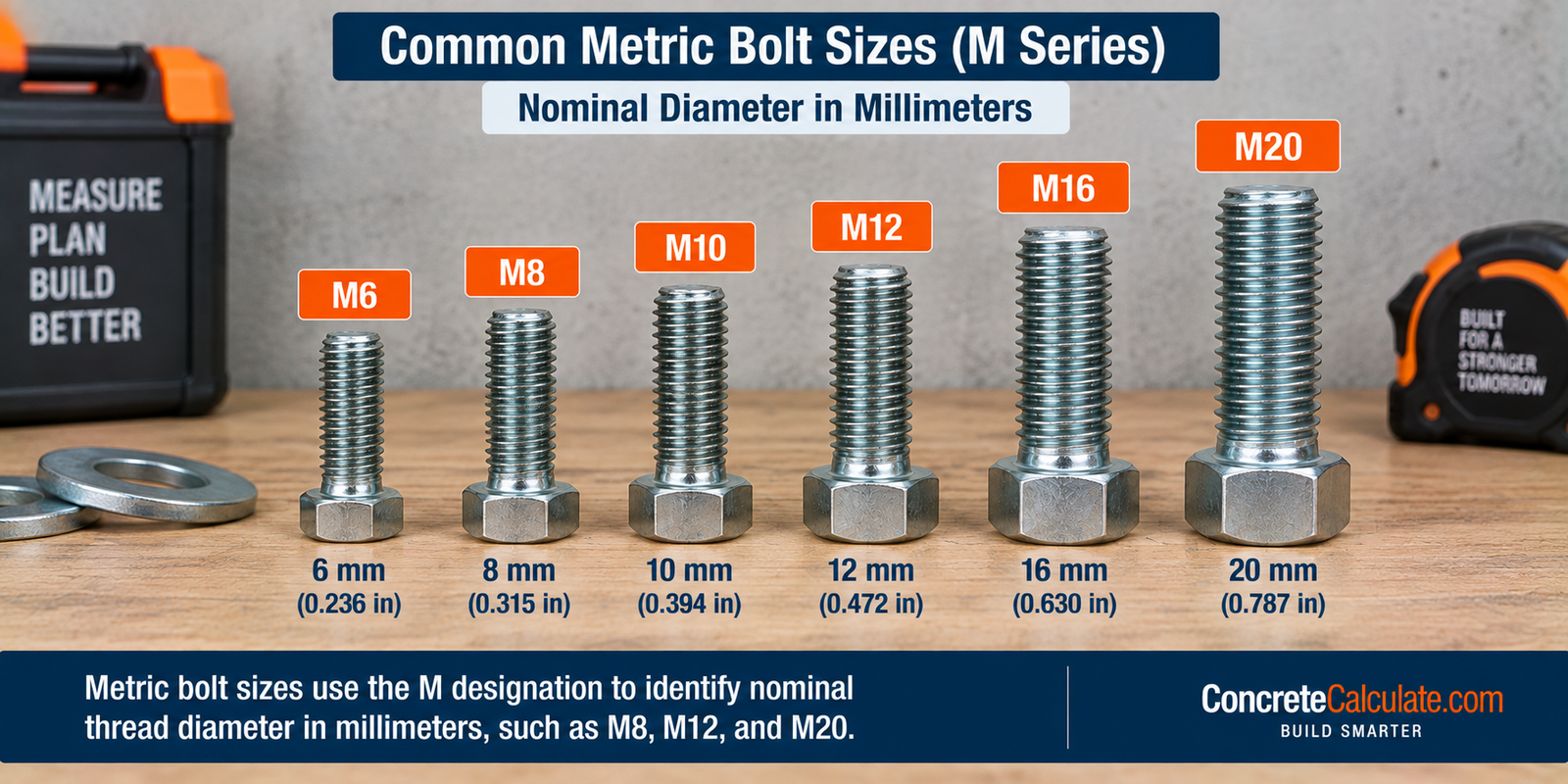
The diameter in an M designation is the nominal major thread diameter in millimeters.
M6 means D = 6 mm. M12 means D = 12 mm. M20 means D = 20 mm. The actual manufactured external thread can measure slightly below its basic nominal diameter because thread tolerances apply.
How to Read a Metric Bolt Size
Worked examples.
M8 x 1.25 means nominal diameter = 8 mm, pitch = 1.25 mm. M10 x 1.5 means nominal diameter = 10 mm, pitch = 1.5 mm. M12 x 1.75 x 60 is a full designation including length: M12 = diameter, 1.75 = pitch, 60 mm = bolt length.
Core Notation
M Diameter x Pitch x Length is the complete metric bolt size formula.
Metric Bolt Diameter Anatomy
The most fundamental visual on this page.
Nominal vs Actual Metric Bolt Diameter
A critical distinction.
| Term | Definition |
|---|---|
| Nominal | An M12 bolt is designated 12 mm |
| Actual | The external thread major diameter may measure somewhat less than exactly 12.000 mm, depending on tolerance class, coating, manufacturing condition, and wear or damage |
ISO 965-1:2026 provides the current tolerance system for ISO general-purpose metric screw threads. Do not reject an M12 bolt merely because a caliper reads slightly under 12.00 mm.
Metric Bolt Diameters Smallest to Largest
Not every whole millimeter is a preferred commercial bolt size.
| Category | Sizes |
|---|---|
| Small Metric Fasteners | M1 through M5 |
| General-Purpose Metric Bolts | M6, M8, M10, M12, M14, M16 |
| Larger Construction/Machinery Bolts | M18, M20, M22, M24, M27, M30, M36 and larger |
ISO 262 selects preferred diameter and pitch combinations from the broader ISO metric thread plan; not every millimeter increment is a standard commercial size.
Metric Bolt Diameter to Inch Conversion Chart
One of the highest-value search tables on this page.
| Metric Bolt | Diameter (mm) | Exact Inches |
|---|---|---|
| M6 | 6 | 0.2362 |
| M8 | 8 | 0.3150 |
| M10 | 10 | 0.3937 |
| M12 | 12 | 0.4724 |
| M16 | 16 | 0.6299 |
| M20 | 20 | 0.7874 |
Metric vs Fractional-Inch Bolt Diameter Chart
Useful for identification, but nearest diameter does not mean interchangeable fastener.
| Metric Size | Exact Inches | Nearest Common Inch Bolt | Difference |
|---|---|---|---|
| M6 | 0.2362 | 1/4 in. (0.250) | 0.35 mm |
| M8 | 0.3150 | 5/16 in. (0.3125) | 0.062 mm |
| M10 | 0.3937 | 3/8 in. (0.375) | 0.475 mm |
| M12 | 0.4724 | 1/2 in. (0.500) | 0.700 mm |
| M16 | 0.6299 | 5/8 in. (0.625) | 0.125 mm |
| M20 | 0.7874 | 3/4 in. (0.750) | 0.950 mm |
Nearest diameter does not mean interchangeable fastener; thread systems and pitch are different.
Why M12 Is Not a 1/2-Inch Bolt
A common mistake that deserves its own dedicated section.
M12 = 12 mm, while 1/2 in. = 12.7 mm, a difference of 0.7 mm. More importantly, metric and Unified inch fasteners use different thread pitch, thread profile designation, and nut compatibility. See the US Bolt Sizes Chart for the complete inch-series reference.
Metric Bolt Diameter vs Thread Pitch
Diameter and pitch are separate characteristics.
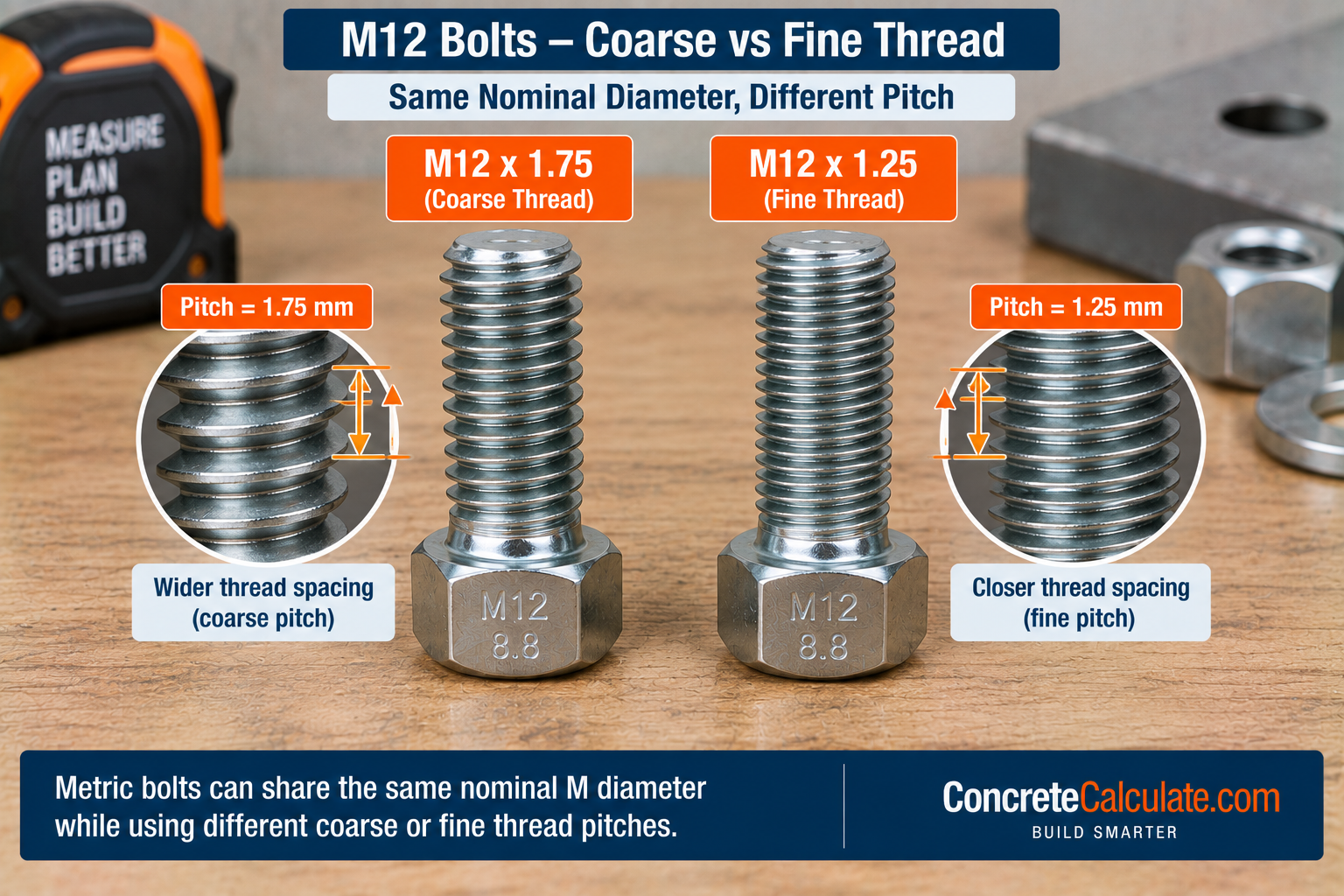
An M12 bolt may exist with a coarse pitch or one or more fine pitches, depending on the standardized series. M12 alone identifies the nominal diameter, but not always the complete thread.
Metric Coarse Thread Diameter Chart
The selected diameter/pitch combinations from ISO 262.
| Metric Size | Coarse Pitch (mm) | Pitch (in.) |
|---|---|---|
| M6 | 1.0 | 0.0394 |
| M8 | 1.25 | 0.0492 |
| M10 | 1.5 | 0.0591 |
| M12 | 1.75 | 0.0689 |
| M16 | 2.0 | 0.0787 |
| M20 | 2.5 | 0.0984 |
For full thread geometry, see the Metric Thread Chart.
Metric Fine Thread Diameter Chart
Fine-thread options are application-specific and must be explicitly stated.
| Metric Diameter | Fine Pitch Option(s) |
|---|---|
| M8 | 1.0 |
| M10 | 1.25, 1.0 |
| M12 | 1.5, 1.25 |
| M16 | 1.5 |
| M20 | 1.5 |
Do not assume a single universal fine pitch for every diameter; fine-pitch availability varies and must be explicitly specified in the designation.
Coarse vs Fine Metric Bolt Threads
A key notation point most generic charts miss.
| Feature | Coarse Metric | Fine Metric |
|---|---|---|
| Pitch | Larger | Smaller |
| Threads per unit length | Fewer | More |
| Diameter | Same possible | Same possible |
| Nut interchangeability | No | No |
| Default omission convention | Often coarse | Must usually be stated |
If only M12 is written in many contexts, the standard coarse pitch is generally implied.
ISO 262:2023 Selected Metric Bolt Sizes
The core commercial-size standard section.
ISO 262:2023 covers selected diameter and pitch combinations for bolts, screws, studs, and nuts from 1 mm through 100 mm, selecting these combinations from ISO 261. ISO 262 determines preferred commercial thread size combinations, not bolt-head geometry.
ISO 261 Metric Thread General Plan
The broader plan behind ISO 262’s selected sizes.
ISO 261:1998 remains current after confirmation in 2024, and it defines the broader general plan for ISO metric threads, from which ISO 262 selects commercial fastener sizes. Keep the distinction clear: ISO 261 is the broad metric thread plan, while ISO 262 is the selected commercial bolt, screw, stud, and nut sizes drawn from it.
ISO 724:2023 Basic Metric Thread Dimensions
The authoritative basic-dimension section.
ISO 724:2023 defines the basic dimensions of ISO metric screw threads in accordance with ISO 261, including major diameter, pitch diameter, minor diameter, and basic profile dimensions. This is the numerical reference behind the thread-diameter data used throughout this page.
ISO 68-1:2023 Metric Thread Profile
Kept concise; only what users need.
ISO 68-1:2023 defines the basic and design profile for general-purpose metric threads. Metric thread form is standardized, and nominal diameter alone does not describe full thread geometry.
ISO 965-1:2026 Metric Thread Tolerances
A newly current standard, published April 2026.
ISO 965-1:2026 specifies the tolerance system for ISO general-purpose metric screw threads, superseding the prior 2013 edition. This explains why actual measured major diameter does not always equal exactly the nominal diameter. Common external and internal tolerance-class concepts exist within this framework, though full thread-fit calculations are beyond the scope of this identification-focused chart.
Major Diameter vs Pitch Diameter vs Minor Diameter
A strong technical differentiator.
| Term | Definition |
|---|---|
| Major Diameter | Outside thread-crest diameter |
| Pitch Diameter | Effective mating diameter |
| Minor Diameter | Root diameter |
Strong Message
For identifying a bolt with a caliper, start with major diameter, not minor diameter.
Metric Bolt Shank / Body Diameter
Controlled by the applicable product standard, not assumed from thread measurement alone.
Partially threaded metric bolts can have an unthreaded shank. Body diameter is controlled by the applicable product standard and tolerances. For ordinary ISO hex bolts, use ISO 4014 data where the product falls within scope; ISO 4014:2022 covers coarse-pitch hexagon-head bolts from M1.6 through M64, product grades A and B.
Fully Threaded vs Partially Threaded Metric Bolts
A strong technical differentiator between two related ISO standards.
| Standard | Product Form |
|---|---|
| ISO 4014 | Hexagon-head bolts, normally partially threaded depending on length/size |
| ISO 4017 | Hexagon-head screws, generally full-thread product form |
ISO 4017:2022 covers coarse-pitch hexagon-head screws from M1.6 through M64, the fully threaded counterpart to ISO 4014’s partially threaded bolts.
Metric Bolt Diameter vs Head Size
The M number is not the hex-head width.
An M12 bolt means a 12-mm nominal thread diameter, not a 12-mm wrench or a 12-mm head. Actual head dimensions depend on the product standard, the generation of ISO standard, and head type. This page does not create a universal M-size-to-head table without tying it to a specific fastener standard.
Metric Bolt Diameter vs Wrench and Socket Size
Connects directly to the Socket Size Chart.
| Metric Bolt Size | ISO 4014/4017 Hex Head Across Flats | Socket/Wrench |
|---|---|---|
| M10 | 16 mm | 16 mm (17 mm on some DIN 931/933 stock) |
| M12 | 18 mm | 18 mm (19 mm on some DIN 931/933 stock) |
| M16 | 24 mm | 24 mm |
Some older DIN-based products and current ISO products can differ in hex-head dimensions for certain sizes, so identify the governing standard. See the Socket Size Chart for the complete reference.
ISO 4014 Metric Hex Bolt Diameter Range
The main standard hex-bolt product section.
ISO 4014:2022 covers steel and stainless hexagon-head bolts with coarse metric threads from M1.6 through M64, product grades A and B. ISO 262’s metric thread range extends beyond ISO 4014’s particular hex-bolt product scope, all the way to M100, so these two standards should not be confused with one another.
ISO 4017 Metric Hex Screw Diameter Range
Reinforces that thread diameter standards and fastener product standards are separate.
ISO 4017:2022 similarly covers coarse-pitch hexagon-head screws from M1.6 through M64, product grades A and B. Thread diameter standard does not equal fastener product standard; each product family has its own defined scope.
Metric Bolt Diameter vs Property Class
A critical distinction that deserves explicit coverage.
Metric property classes such as 4.6, 8.8, 10.9, and 12.9 describe mechanical properties, not diameter. M12 8.8 means M12 = diameter and 8.8 = property class. Do not confuse M8 with 8.8; these numbers answer completely different questions. For grade and marking data, see the Bolt Grade Chart.
Metric Bolt Diameter vs Bolt Length
Bolt length is not part of the diameter.
In a notation such as M12 x 1.75 x 80, M12 = diameter, 1.75 = pitch, and 80 mm = length. The length figure is always separate from the diameter designation.
Metric Bolt Diameter vs Hole Diameter
Clearance hole diameter is larger than nominal bolt diameter.
Exact hole sizing depends on close, normal, or large clearance class, the design standard, and assembly requirements. This page does not publish one universal “hole equals M size plus 1 mm” rule, since that would be inaccurate across sizes and applications.
Metric Bolt Diameter vs Nut and Washer Size
Very useful cluster integration.
For an M12 bolt, compatible nominal hardware is typically an M12 nut with matching pitch and an M12 washer series, but nut across flats is larger than 12 mm and washer ID is larger than 12 mm. See the Nut Size Chart, Washer Size Chart, and Metric Thread Chart for complete mating dimensions.
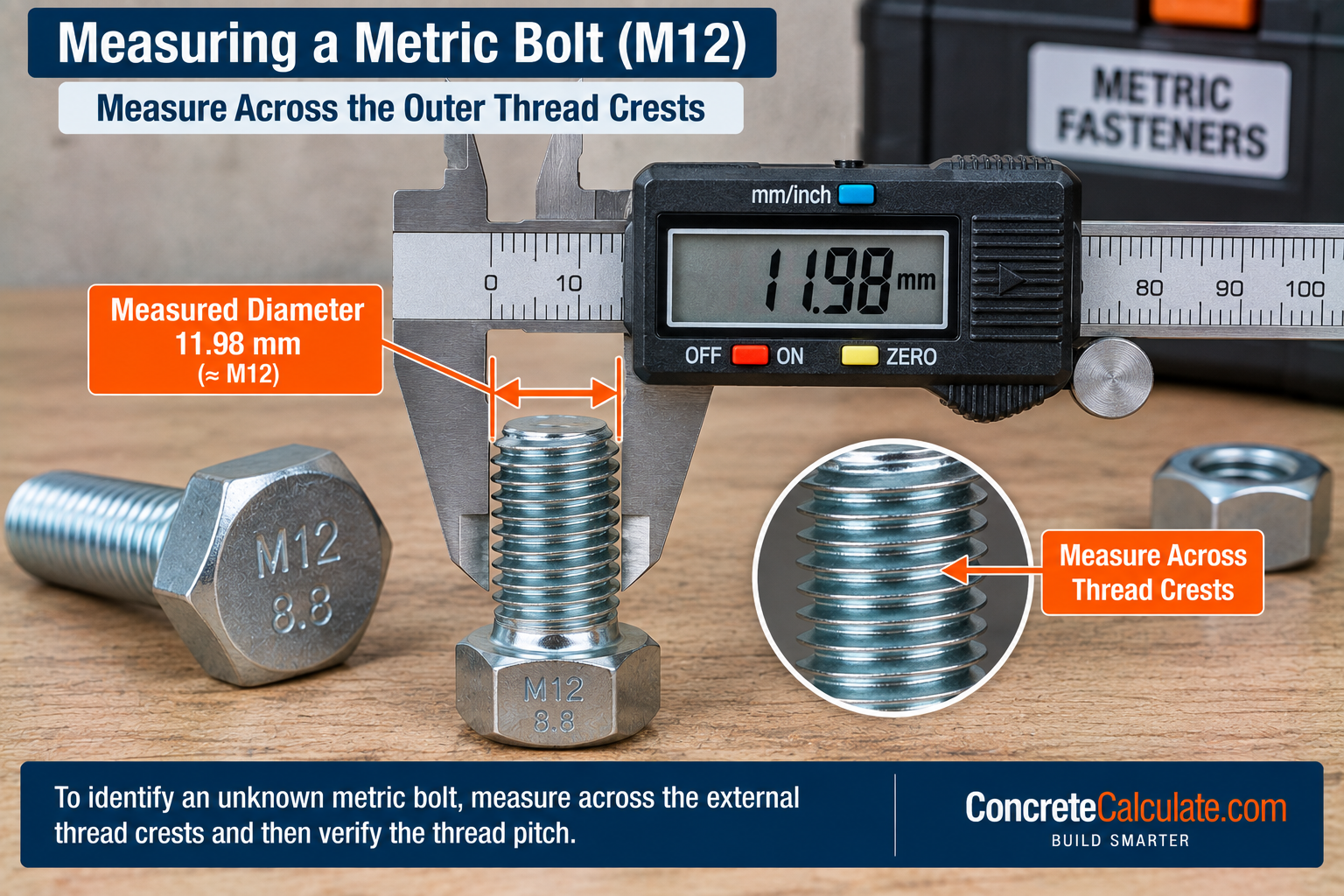
How to Identify an Unknown Metric Bolt Diameter
A practical workflow.
Metric Bolt Diameter Identification Workflow
Measuring Coated, Worn, or Damaged Metric Bolts
Readings can be affected by more than base geometry.
Zinc plating, galvanizing, rust, flattened thread crests, and damage can all affect a caliper reading. Measure multiple crest locations, avoid damaged sections, use pitch as a second identifier, and do not rely on one caliper reading alone.
Common Mistakes and Chart Limitations
Assuming M12 means a 12-mm wrench
Head across flats is a separate, larger dimension defined by the product standard.
Assuming M12 is exactly 12.000 mm when measured
Actual measured diameter has tolerance under ISO 965-1.
Measuring across thread roots instead of crests
This gives the minor diameter, not the nominal major diameter.
Confusing major and pitch diameter
Pitch diameter is a specialized fit dimension, not the identification measurement.
Treating M12 as interchangeable with 1/2 in.
These differ by 0.7 mm and use different thread systems entirely.
Ignoring pitch
Diameter alone does not fully identify a metric bolt’s thread.
Assuming every M size uses only one pitch
Fine-pitch options exist for many diameters and must be specified.
Confusing M8 with property class 8.8
These are unrelated numbers describing size and strength respectively.
Assuming bolt head size identifies diameter
Head size depends on the applicable product standard, not the M number.
Using nearest SAE size as a replacement
Close dimensions do not create thread or fit compatibility.
Using inch nuts on metric bolts
The thread systems are fundamentally incompatible.
Assuming every millimeter diameter is a preferred commercial M size
ISO 262 selects specific preferred sizes, not every whole millimeter.
Confusing ISO 4014 bolts with ISO 4017 screws
ISO 4014 is normally partially threaded; ISO 4017 is fully threaded.
Measuring plating/rust rather than base thread geometry
Coating thickness can distort caliper readings.
Read before finalizing a metric bolt diameter identification
M size is nominal thread diameter, and actual measured external diameter has tolerance. Pitch must be identified separately, and coarse and fine threads can share the same M diameter. Head size and wrench/socket size are separate from bolt diameter, and property class is separate as well. Bolt length is also a separate dimension. ISO 262 covers selected thread sizes; it does not define every bolt product geometry, and ISO 4014/4017 have their own product-size scope. Inch equivalents are for comparison, not substitution, and coating or damage can change measured dimensions. Final fastener identification should use diameter plus pitch plus product form plus markings together.
Metric Bolt Diameter FAQs
Download the Metric Bolt Diameter Chart
Get a printable reference including M size, millimeter, inch conversion, and coarse/fine pitch tables on this page for jobsite or shop use.