Concrete Scaling: Why Surfaces Flake and How to Repair Them
What causes a driveway or patio surface to flake and peel, how serious it is, and which repair actually lasts.
Quick Answer
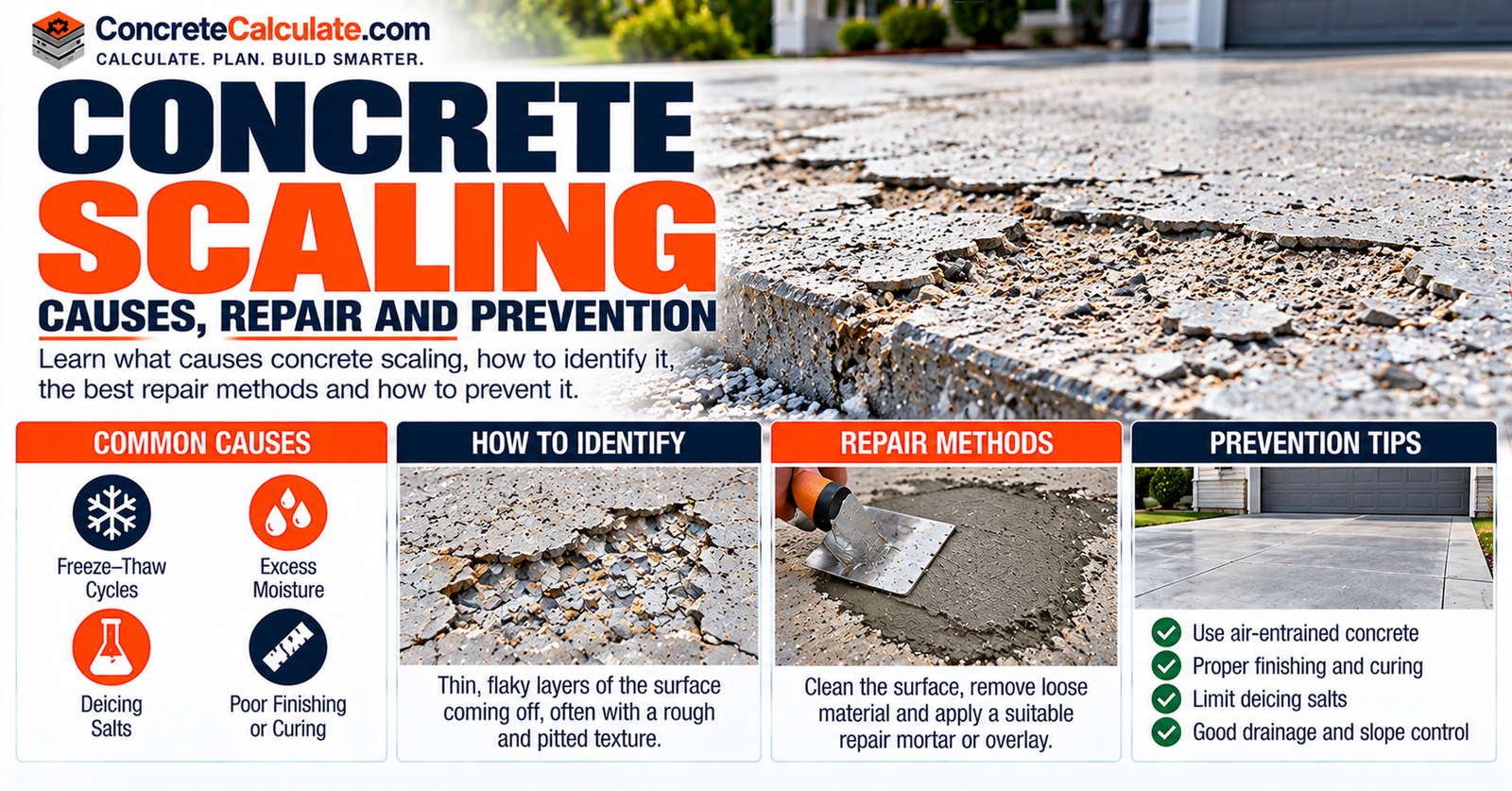
Concrete scaling is the flaking or peeling of the hardened surface, most often caused by repeated freezing and thawing of moisture-exposed concrete. It usually starts as small patches that can merge into larger areas over time.
Light and moderate scaling on otherwise sound concrete can often be repaired with proper surface preparation and a compatible bonded resurfacing material. Widespread or deep deterioration, or scaling accompanied by cracking or structural concerns, needs a closer look before any repair investment.
In This Guide
- 1. What Is Concrete Scaling?
- 2. What Does Scaling Concrete Look Like?
- 3. Light, Moderate and Severe Concrete Scaling
- 4. Concrete Scaling vs. Spalling, Dusting, Delamination and Popouts
- 5. Is Concrete Scaling Cosmetic or a Serious Problem?
- 6. What Causes Concrete Scaling?
- 7. How Freeze-Thaw Cycles Damage Concrete Surfaces
- 8. How Deicing Salts Contribute to Concrete Scaling
- 9. Why Air Entrainment and Concrete Mix Quality Matter
- 10. Can Too Much Water Cause Concrete Scaling?
- 11. Improper Finishing, Bleed Water and Weak Surface Concrete
- 12. Inadequate Curing and Early Winter Exposure
- 13. Why Is My New Concrete Driveway Already Flaking?
- 14. How to Inspect Concrete Scaling Before Repair
- 15. How to Measure the Area and Depth of Scaling
- 16. How to Recognize Unsound Concrete Beneath the Surface
- 17. When Is Scaled Concrete Beyond a Simple Surface Repair?
- 18. Can Concrete Scaling Be Repaired Without Replacing the Slab?
- 19. Concrete Scaling Repair Methods Compared
- 20. How to Prepare Scaled Concrete for Repair
- 21. How to Repair Localized Concrete Scaling: Step by Step
- 22. How to Resurface a Scaling Concrete Driveway or Patio
- 23. Which Repair Materials Work for Scaling Concrete?
- 24. How Long Does a Scaling Repair Take to Cure?
- 25. How Much Does Concrete Scaling Repair Cost?
- 26. How to Prevent Concrete Scaling on New Concrete
- 27. How to Stop Existing Concrete From Scaling Further
- 28. Concrete Scaling FAQs
1. What Is Concrete Scaling?
Concrete scaling is the flaking or peeling of the hardened concrete surface, most commonly associated with repeated freezing and thawing of moisture-exposed concrete. According to NRMCA, it generally starts as small, localized patches that can later merge and spread across a larger area.
Scaling differs from ordinary surface wear because it involves actual loss of the finished mortar layer, not just fading or minor abrasion. Depending on severity, repair options range from simple monitoring to bonded resurfacing or, in more extensive cases, larger repair or replacement.
What This Guide Covers
This article focuses on surface scaling specifically, not deeper material loss. For cavities, broken chunks or exposed reinforcement, see Concrete Spalling, and for crack patterns on their own, see Why Is My Concrete Cracking?
2. What Does Scaling Concrete Look Like?
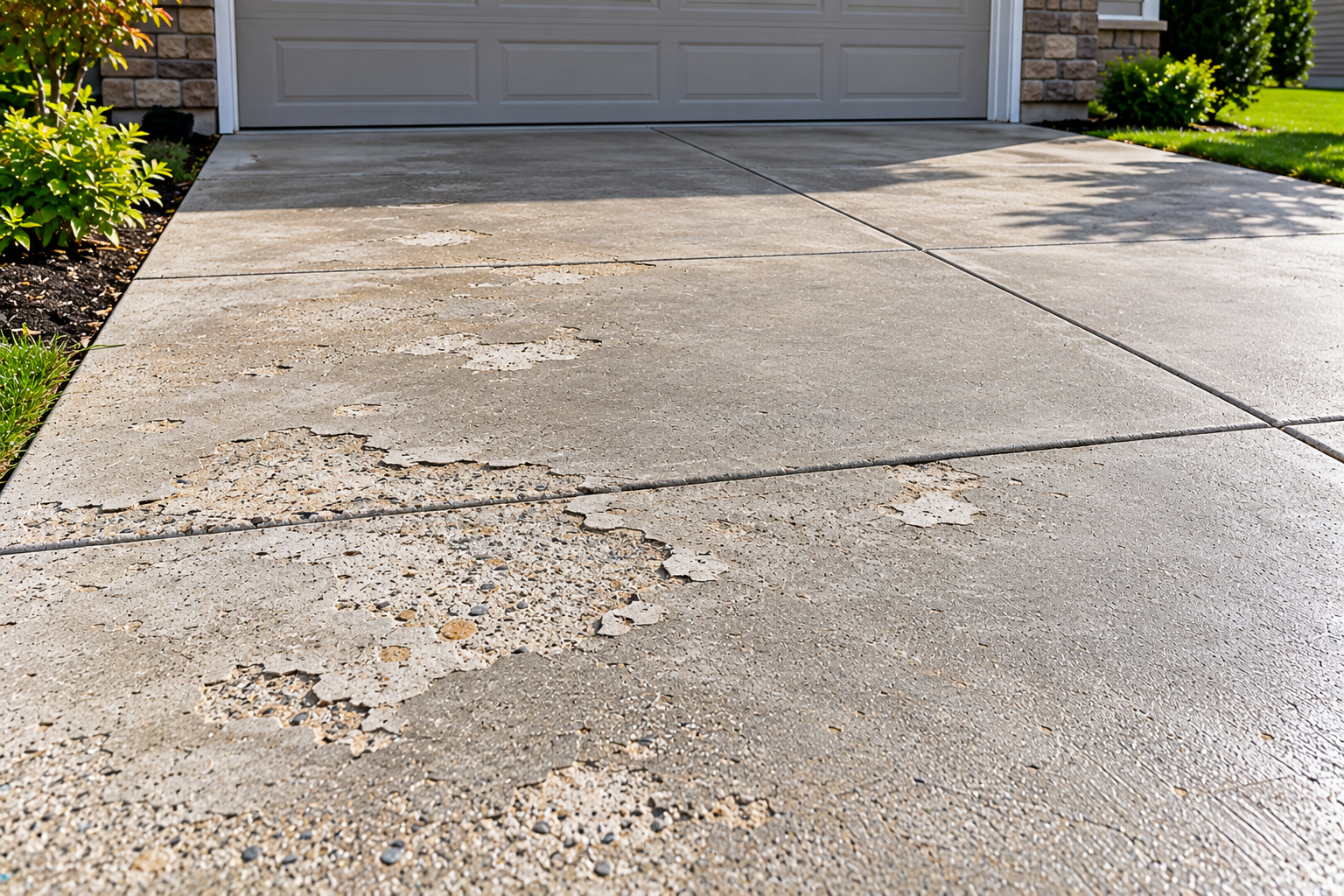
Scaling typically appears as thin flakes or small peeling patches on the concrete surface. In lighter cases, the underlying fine aggregate may show through, while more advanced scaling exposes coarse aggregate and leaves a visibly rough, pitted texture.
What starts as a few small spots can develop into broader deterioration over multiple seasons of freeze-thaw exposure. That said, not every affected slab progresses at the same rate, and some areas remain stable for years without spreading further.
3. Light, Moderate and Severe Concrete Scaling
NRMCA CIP 2 describes three general severity levels that provide a useful shared vocabulary for homeowners and contractors discussing scaling damage.
| Scaling Condition | Typical Appearance | Approximate Surface Loss | Main Implication |
|---|---|---|---|
| Light | Thin surface flakes or peeling mortar, coarse aggregate generally not exposed | Superficial | Assess whether deterioration is stable |
| Moderate | Larger peeled patches and exposed aggregate | NRMCA describes approximately 1/8 to 3/8 in of surface mortar loss | Determine extent and substrate soundness |
| Severe | Pronounced aggregate exposure and substantial surface loss | Beyond moderate surface loss | More extensive assessment and repair selection |
| Progressive or widespread | Multiple areas continue breaking down | Varies | Investigate the deterioration mechanism and depth |
Adapted conceptually from NRMCA CIP 2. These descriptions help identify surface conditions. They do not replace structural assessment.
4. Concrete Scaling vs. Spalling, Dusting, Delamination and Popouts
These terms describe related but different surface conditions, and getting the distinction right helps you choose the correct repair approach.
| Condition | Typical Appearance | Typical Mechanism |
|---|---|---|
| Scaling | Flaking or peeling of the surface mortar layer | Freeze-thaw exposure of moisture-saturated concrete |
| Spalling | Chunks or cavities breaking away, sometimes exposing rebar | Various causes including corrosion, impact and joint distress |
| Dusting | Fine powder generated at the surface under use | Weak, soft surface layer, often from finishing issues |
| Delamination | Hidden separation, surface may sound hollow | Internal separation that can remain invisible until it breaks |
| Popouts | Small, localized holes | Often centered on a specific aggregate particle |
Some industry and contractor resources use the term spalling broadly enough to cover scaling as well. This guide keeps the terms separate because scaling and spalling call for somewhat different diagnosis and repair thinking, even though the line between them isn’t always sharp in practice.
5. Is Concrete Scaling Cosmetic or a Serious Problem?
Localized, superficial scaling on an otherwise sound slab is primarily a cosmetic and maintenance issue. Widespread, progressive scaling, or scaling that appears alongside cracks, exposed reinforcement or settlement, deserves more careful attention.
Practical consequences of surface deterioration include reduced appearance, loose material tracking into a garage or home, potential slip or trip hazards where flaking creates an uneven texture, loss of the original surface finish, and continued moisture exposure at the damaged spots.
Consider professional investigation when scaling is spreading quickly, when it appears together with structural cracking or movement, or when repeated DIY repairs have already failed on the same area.
6. What Causes Concrete Scaling?
Several mechanisms can produce scaling, and more than one often contributes on the same slab.
| Possible Cause | Common Clue | What to Investigate |
|---|---|---|
| Freeze-thaw exposure | Flaking following repeated winter exposure | Moisture history, drainage and freeze-thaw resistance |
| Deicing chemicals | Damage near driveways, entrances or treated areas | Deicer type, amount and accumulation |
| Inadequate air entrainment | Deterioration under severe winter exposure | Actual mixture specification and, if warranted, professional testing |
| Excessive water | Weak or porous surface, sometimes with other defects | Delivery and placement records |
| Premature or excessive finishing | Peeling or weak surface, possibly early in service | Finishing conditions and construction history |
| Inadequate curing | Early deterioration and poor surface performance | Curing method, duration and weather |
| Persistent standing water | Repeated damage in poorly drained locations | Grade, runoff and drainage |
7. How Freeze-Thaw Cycles Damage Concrete Surfaces
When susceptible concrete becomes saturated with water and then repeatedly freezes and thaws, the water expands as it freezes within the concrete’s pore structure. Concrete without adequate capacity to accommodate that expansion can develop surface damage as internal stress builds cycle after cycle.
Microscopic entrained air voids give that expanding water somewhere to go, relieving pressure that would otherwise damage the surrounding paste. Properly air-entrained concrete behaves very differently under freeze-thaw exposure than a mixture that lacks a suitable air-void system for its exposure.
8. How Deicing Salts Contribute to Concrete Scaling
Salted, moisture-exposed surfaces can experience accelerated deterioration, especially where meltwater collects repeatedly or deicers are applied in excessive amounts. Driveways, garage entrances, sidewalks and concrete near public roads treated with deicing chemicals commonly show this pattern.
Not all deicing chemicals behave identically, and it would be inaccurate to assume every surface defect on a salted driveway was caused by salt alone. Moisture exposure, mix quality and finishing all interact with deicer use to determine the actual outcome.
9. Why Air Entrainment and Concrete Mix Quality Matter
A suitable air-void system, adequate strength, appropriate permeability and correct mixture proportions all work together to resist freeze-thaw damage. NRMCA CIP 2 gives illustrative guidance for freeze-thaw-exposed residential exterior concrete, including ordering good-quality air-entrained concrete with a strength of 4,000 psi for concrete exposed to severe freezing and thawing.
This is illustrative prevention guidance for a specific exposure category, not a guarantee that any particular PSI number alone prevents scaling. Strength, air content, water content and finishing all need to be appropriate together.
10. Can Too Much Water Cause Concrete Scaling?
Excessive water in the mixture, including water added at the jobsite for easier workability, can produce a weaker and more permeable surface layer that’s more vulnerable to freeze-thaw damage. NRMCA CIP 2 specifically recommends avoiding excessive water and placing concrete at a slump of 3 to 5 inches.
The specified water-to-cementitious-material ratio, slump and workability are related but distinct concepts. A water-reducing admixture is generally preferable to uncontrolled water addition when better workability is genuinely needed.
11. Improper Finishing, Bleed Water and Weak Surface Concrete
Finishing before bleed water has dissipated, overworking the surface, or using unsuitable finishing techniques such as an early steel trowel can all weaken the surface layer. NRMCA CIP 2 recommends finishing only after bleed water has dissipated and avoiding steel trowels during finishing for this reason.
Peeling caused primarily by finishing defects can occur even without any freezing at all, and NRMCA notes this type of scaling separately from freeze-thaw scaling. Still, a surface weakened by poor finishing may become especially vulnerable once winter conditions are added on top.
12. Inadequate Curing and Early Winter Exposure
Insufficient curing, unfavorable early temperatures, and premature exposure to harsh winter conditions can all compromise how well the surface performs later. Newly poured concrete that faces its first winter before it has properly cured and gained strength is at elevated risk.
For complete curing procedures and weather-related placement guidance, see the Concrete Curing and Drying Time Guide and Best Time to Pour Concrete, since this guide focuses on scaling rather than reproducing full curing procedures.
13. Why Is My New Concrete Driveway Already Flaking?
Scaling appearing within months of installation, or right after the first winter, deserves a focused look at the construction history rather than an assumption about the cause. Compare your installation records, delivery tickets, finishing conditions, curing practices, weather history around the pour, and any deicer use against where the deterioration actually started.
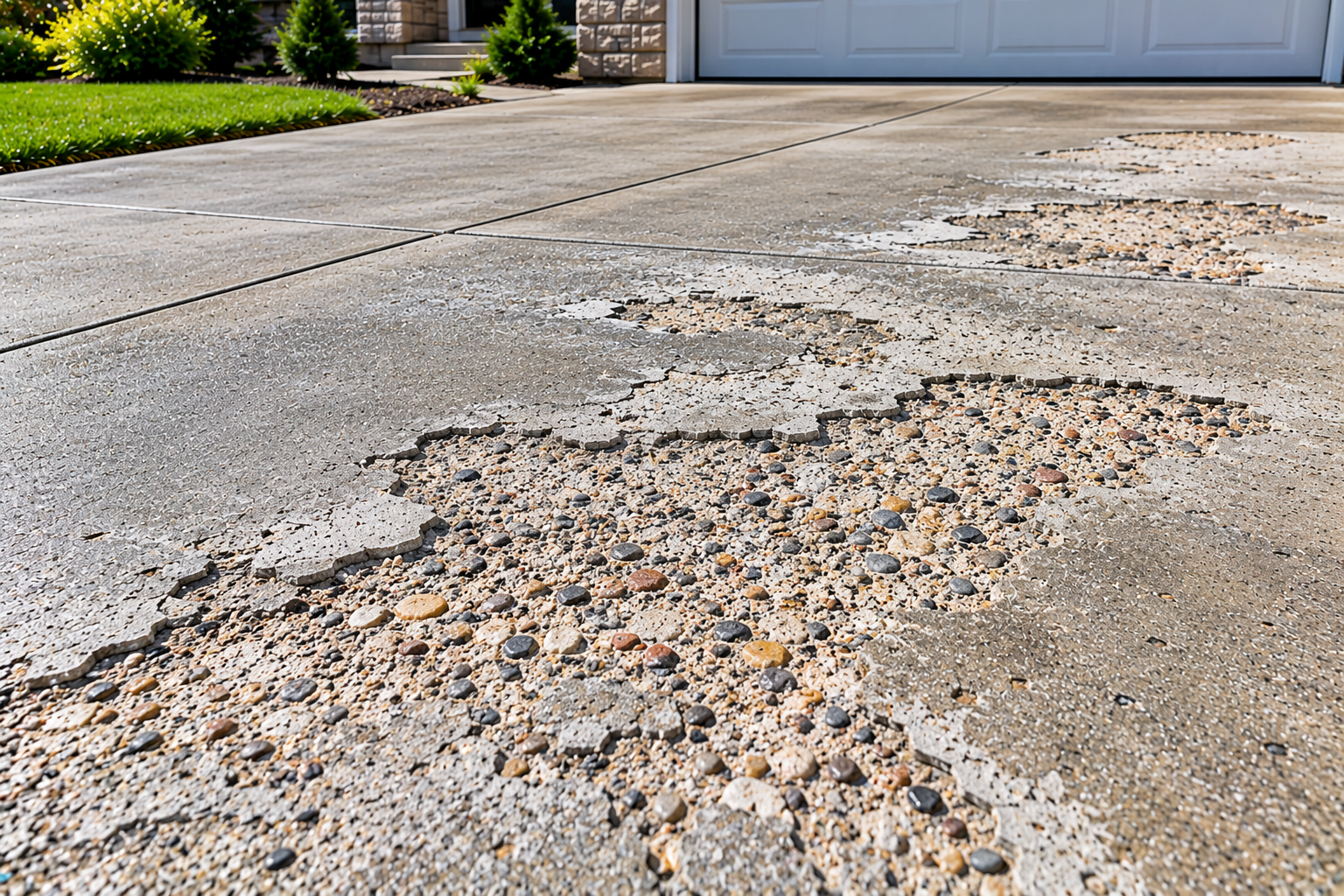
Before contacting the installer or requesting a professional evaluation, document the delivery ticket if available, note the approximate pour date and weather conditions, record when deterioration was first noticed, and photograph the affected areas with clear context showing their location relative to drainage, joints and traffic patterns.
14. How to Inspect Concrete Scaling Before Repair
Photograph the affected surface from multiple angles, then map the approximate boundaries of the deterioration. Note surface moisture and drainage conditions, identify any loose material that moves underfoot, and inspect nearby joints and cracks for related damage.
Keep in mind that the visible condition doesn’t always reveal how deep the deterioration actually extends. Surface appearance is a useful starting point, not a complete diagnosis.
15. How to Measure the Area and Depth of Scaling
Determine the affected square footage by measuring length and width of each damaged region, and estimate repair depth where the deterioration allows a reasonable measurement. Map scattered isolated spots separately from continuous deterioration, since they may call for different repair approaches.
Simple Measurement Worksheet
Measure the length and width of each affected area in feet, then multiply to get square footage per area. Add an estimated average depth in inches where the surface allows a reasonable reading, keeping in mind that this is a starting estimate.
The final repair quantity depends on the actual prepared surface once unsound material is removed, which is often larger and sometimes deeper than the original visible measurement suggested.
16. How to Recognize Unsound Concrete Beneath the Surface
Visible loose material, areas that sound hollow when tapped, and continuing loss of surface mortar all suggest unsound concrete beneath what you can see. Concealed delamination can also be present around visible scaling without being obvious until tested.
Professional sounding methods, such as tapping with a hammer or dragging a chain across the surface, can help identify suspect areas needing further investigation. A simple hammer tap by a homeowner is a useful screening step, not definitive proof of structural safety, so treat any suspicious findings as a reason to investigate further rather than a final diagnosis.
17. When Is Scaled Concrete Beyond a Simple Surface Repair?
When to Investigate Before Repairing
Widespread unsound concrete extending well beyond the visible damage, substantial deterioration depth, repeated repair failures in the same area, structural concerns, or evidence of deterioration that keeps spreading all point toward needing investigation before committing to a repair.
An overlay applied over unsound concrete is likely to fail regardless of how good the overlay material is, since the bond can only be as strong as what it’s attached to. Investigating the underlying condition before a large repair investment protects you from paying for a resurfacing job that debonds within a year or two.
18. Can Concrete Scaling Be Repaired Without Replacing the Slab?
Suitable light or moderate scaling can often be treated without full slab replacement, provided the remaining concrete is sound and the underlying cause has been assessed. NRMCA CIP 2 confirms it’s possible to repair light to moderately scaled surfaces, while noting the repaired surface will only be as strong as the base surface it bonds to.
Options range from cosmetic protection and monitoring, through local patching, up to bonded resurfacing or professional surface treatments. Full replacement is reserved for cases where the deterioration is too extensive or deep for these lighter approaches to work reliably.
19. Concrete Scaling Repair Methods Compared
| Existing Condition | Possible Approach | Main Limitation |
|---|---|---|
| Light, stable surface scaling | Monitoring and compatible surface protection | Does not replace lost material |
| Small isolated damaged areas | Localized patching | Requires sound surrounding concrete |
| Moderate, widespread but shallow scaling | Bonded resurfacing after proper preparation | Overlay performance depends on the substrate |
| Widespread deterioration suitable for professional removal | Grinding or other approved surface treatment | May change texture and expose additional vulnerable concrete |
| Deep or extensively unsound deterioration | More extensive repair or replacement | Requires assessment of actual deterioration depth |
| Scaling with major cracking, movement or structural damage | Professional assessment | Cosmetic repair may be unsuitable |
FHWA supports distinguishing surface-limited deterioration from deeper pavement damage when evaluating repair methods. This table adapts that decision principle for a homeowner audience without transferring highway-specific repair dimensions to residential work.
20. How to Prepare Scaled Concrete for Repair
Remove weak concrete, dirt, oil, existing incompatible coatings and other contaminants before applying any repair material. NRMCA CIP 2 recommends achieving a clean, sound, rough-textured surface using a hammer and chisel, sandblasting, a high-pressure washer or a jackhammer, depending on the scale of the work.
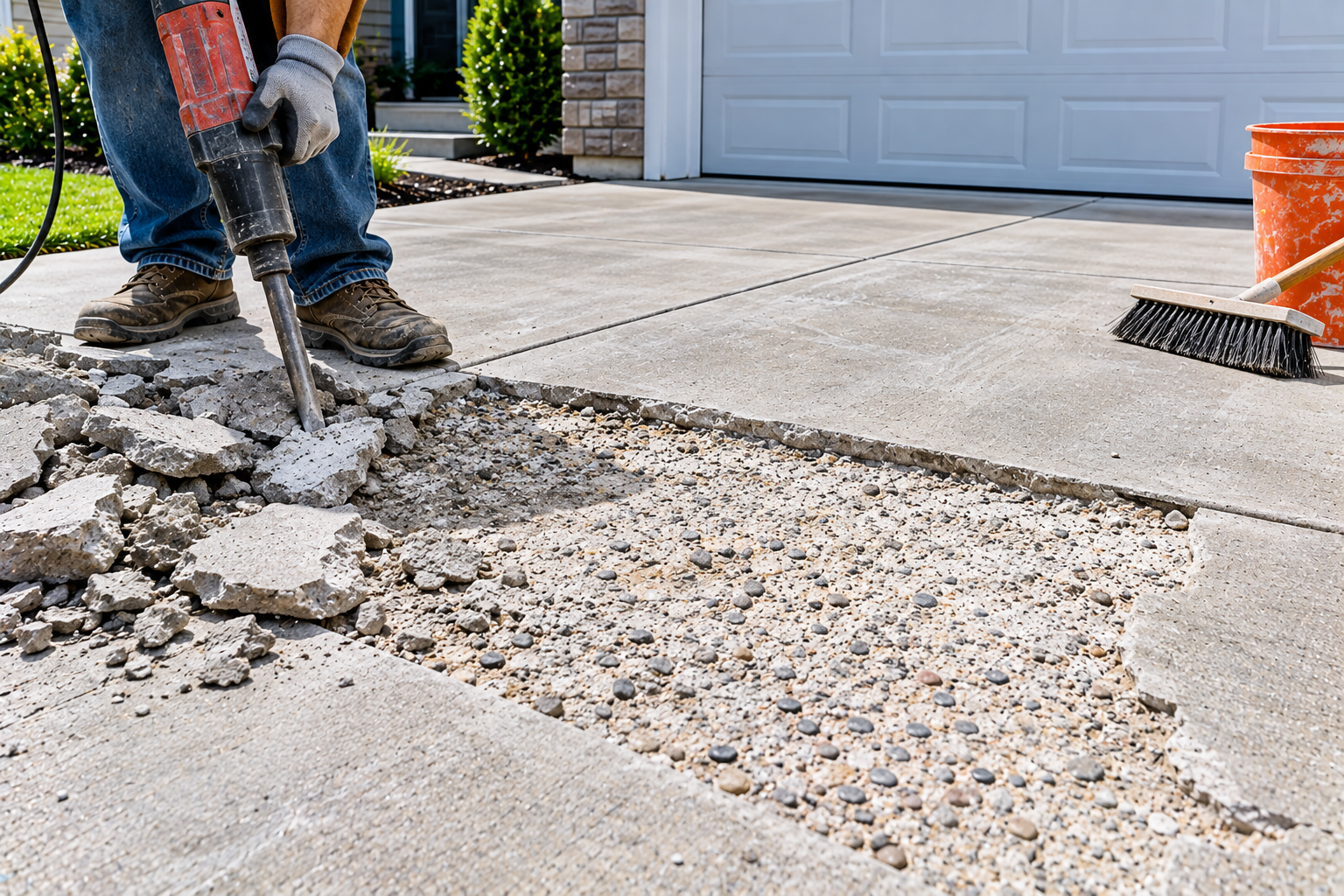
The receiving surface must be genuinely sound, since the repair will only perform as well as what it bonds to. The specific preparation method needs to match both the selected repair system and the actual condition of the slab.
21. How to Repair Localized Concrete Scaling: Step by Step
Define the Repair Area and Prepare Sound Concrete
Establish the repair boundary by sounding the surrounding area, then remove unsuitable material until sound concrete is reached throughout the repair zone.
Meet the Repair Product’s Substrate Requirements
Clean the surface thoroughly, check surface moisture against the product’s requirements, and apply any specified bonding agent before placing the repair material.
Mix, Apply and Finish the Repair
Follow the product-specific mixing ratio, thickness limits and working time exactly, then finish the surface to match the surrounding texture and elevation.
Cure and Protect the Repair
Follow the product’s specified curing method and duration, and keep the repair protected from traffic and weather until it reaches adequate strength.
Dust Safety During Preparation
Concrete cutting, grinding and other dust-generating preparation work can create respirable crystalline silica dust. Use appropriate wet methods or dust collection and suitable respiratory protection for the task and equipment involved.
22. How to Resurface a Scaling Concrete Driveway or Patio
Broad, shallow scaling across a driveway or patio can make resurfacing worth evaluating, provided the substrate beneath the deteriorated layer is genuinely sound once the weak material is removed. The process involves confirming substrate soundness, removing the weak surface layer, preparing the surface texture the overlay product requires, and selecting a compatible overlay system.
Maintain the slab’s existing drainage slope and respect any existing control or expansion joints when resurfacing, since covering or bridging a functional joint can create new problems. Thin bonded overlays are a different scope of work than full-depth replacement, and the dedicated ConcreteCalculate resurfacing guide covers the complete installation procedure in more depth than this article does.
23. Which Repair Materials Work for Scaling Concrete?
| Repair Material | Potential Application | Important Selection Criteria |
|---|---|---|
| Cementitious resurfacer | Suitable shallow, broad surface repairs | Minimum thickness, bond, surface preparation and freeze-thaw suitability |
| Polymer-modified resurfacing mortar | Compatible bonded overlays | Product-specific depth limits, curing and exposure |
| Patching compound | Suitable isolated areas | Minimum and maximum repair depth |
| Larger-section repair concrete | Deeper localized repairs where specified | Placement depth, aggregate size and consolidation |
| Protective penetrating water repellent | Appropriate sound surfaces needing reduced moisture absorption | Does not restore lost concrete, substrate must be suitable |
A general-purpose concrete mix is not automatically suitable for feather-edge resurfacing, since ordinary concrete mixes typically require more minimum thickness than a thin repair layer allows. Always check the manufacturer’s minimum application thickness before selecting a product.
24. How Long Does a Scaling Repair Take to Cure?
Working time, initial set, curing duration, minimum time before foot traffic, and minimum time before vehicle traffic are all separate timeframes that depend on the specific product, weather conditions and actual repair depth. These can vary substantially between a rapid-setting patching compound and a standard cementitious resurfacer.
Use the manufacturer’s technical data sheet for the exact product you select for any specific reopening times, rather than relying on a general rule that may not match your repair material.
25. How Much Does Concrete Scaling Repair Cost?
Repair cost is shaped by the affected area, repair depth, required preparation, selected material, local labor rates, site access and the underlying condition once unsound material is removed. DIY material-only costs are generally lower than professional repair, which adds labor, mobilization and typically a workmanship warranty.
Localized patching of a small area costs far less than resurfacing an entire driveway or patio, so it’s worth confirming the actual extent of sound versus unsound concrete before budgeting for one approach over the other.
Worked Quantity Example: 20 x 12 ft Driveway Section
For a hypothetical 20 ft by 12 ft driveway section needing an assumed average quarter-inch resurfacing layer, provided the selected material is approved for that thickness: total area is 20 x 12 = 240 square feet.
Theoretical material volume works out to roughly 5 cubic feet at a quarter-inch average thickness. Divide that volume by your selected product’s published coverage rate to estimate the number of bags needed, then multiply by the verified local price per bag for a material cost estimate.
| Input | Example |
|---|---|
| Repair length | 20 ft |
| Repair width | 12 ft |
| Total area | 240 ft² |
| Assumed average repair thickness | 1/4 in |
| Theoretical material volume | 5 ft³ |
| Selected product’s coverage | Enter manufacturer’s published yield |
| Number of bags | Calculate from the specified coverage and allowance |
| Estimated material cost | Number of bags multiplied by verified local price |
This theoretical volume does not account for variable existing surface depth, required removal, surface profile, product absorption or the manufacturer’s actual application limits. Get a current local price for your specific selected product rather than relying on a national average.
Estimate Your Repair Materials
Use the Concrete Repair Calculator’s patching and resurfacing options to estimate quantities for your specific project dimensions.
Open the Concrete Repair Calculator26. How to Prevent Concrete Scaling on New Concrete
NRMCA CIP 2 lists specific rules for preventing scaling that homeowners can discuss with a contractor before ordering concrete or scheduling a pour.
Discussing these specific points with your concrete supplier and finishing contractor before the pour is far more effective than trying to correct a scaling problem after the fact.
27. How to Stop Existing Concrete From Scaling Further
For an existing slab already showing some scaling, cause-based maintenance matters more than any single product. Control standing water on the surface, manage deicer exposure by reducing unnecessary application, address any drainage issues directing water toward the slab, and consider a compatible breathable water repellent on sound surfaces.
Sealing may reduce moisture entry on certain sound surfaces, but it cannot restore concrete that’s already been lost, and it cannot compensate for deep deterioration or an unresolved moisture source. For sealing timing and selection, see When to Seal a Concrete Driveway.
Common repair failures include coating over loose or unsound material, poor bonding from inadequate surface preparation, and applying a fix without correcting the underlying cause. Any of these tends to produce a repair that fails again within a season or two.
28. Concrete Scaling FAQs
Does concrete scaling spread if left untreated?
It can, especially when the underlying freeze-thaw or moisture exposure is still active. NRMCA notes that scaling generally starts as small patches that may later merge and extend across larger areas.
Can a flaky concrete driveway be resurfaced?
Often yes, provided the concrete beneath the flaking layer is sound once the weak material is removed. If the substrate itself is unsound or the deterioration runs deeper, resurfacing alone is unlikely to hold up.
Does sealing stop concrete scaling?
A compatible breathable sealer can help reduce moisture entry on sound concrete and may support prevention efforts. It cannot restore already-lost surface material or fix an active, unresolved moisture problem.
Did winter salt cause my concrete to scale?
Salt exposure can contribute, especially combined with freeze-thaw cycling, but it’s rarely the sole cause. Mix quality, air entrainment, finishing practices and moisture exposure all play a role alongside deicer use.
Should a new concrete driveway scale in its first year?
Not typically. Scaling appearing within the first year, especially after the first winter, usually points toward a mix, finishing, curing or early-exposure issue worth investigating rather than normal wear.
Can pressure washing make scaling worse?
Aggressive pressure washing can dislodge already-weakened surface material and, in some cases, push additional moisture into the concrete. Use appropriate pressure and technique for the surface condition rather than assuming maximum pressure is always safe.
When does scaled concrete need to be replaced instead of repaired?
When deterioration extends deep into the slab, when a large proportion of the surface is unsound rather than just a few isolated spots, or when repeated repair attempts have already failed on the same area.
Is concrete scaling the same as spalling?
Not exactly, though the terms overlap in casual use. Scaling refers to flaking of the surface mortar layer, while spalling more often describes chunks or cavities breaking away, sometimes exposing reinforcement.
References
- National Ready Mixed Concrete Association, CIP 2, Scaling Concrete Surfaces. Principal reference for the definition, severity descriptions, causes, prevention and suitable repair considerations, accessed as the 2014 edition.
- Federal Highway Administration, Distress Identification Manual for the Long-Term Pavement Performance Program. Used for standardized visual identification of scaling and distinguishing it from other concrete pavement surface defects. Its measurement conventions are pavement-specific.
- Federal Highway Administration, Detection, Analysis and Treatment of Materials-Related Concrete Pavement Distress. Used for repair-selection principles, determining the extent of deterioration and distinguishing surface-limited damage from deeper problems. This is an archived pavement-engineering publication, not a current residential repair specification.
- Concrete Network, Spalling Concrete Repair, Causes and Prevention. Supporting specialist reference for residential driveway troubleshooting, repair methods and practical homeowner questions.