How to Choose HDPE Pipe SDR: Ratings & Examples
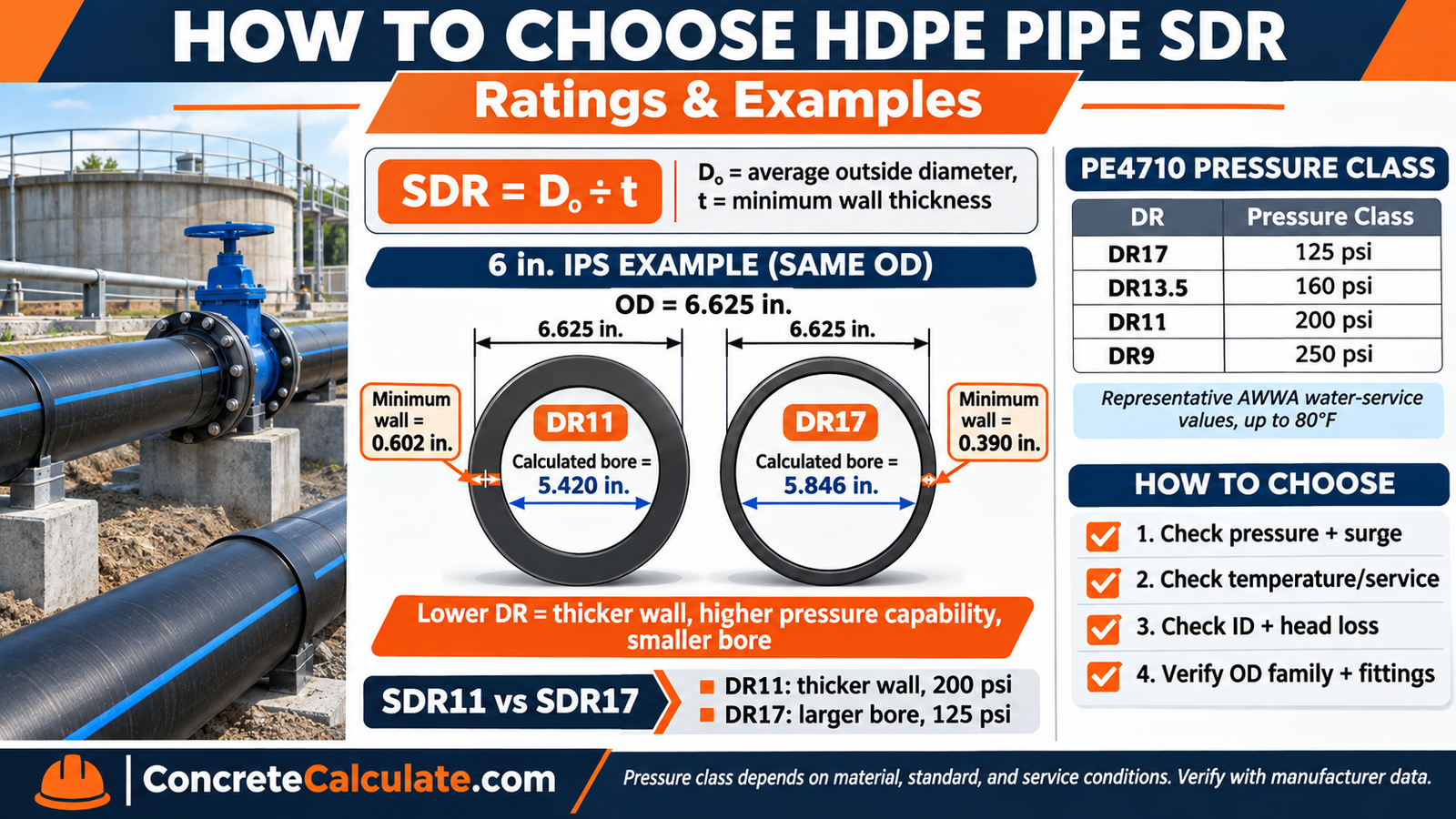
To choose HDPE pipe SDR, confirm the PE material and governing standard, find the sustained and surge pressures, check temperature, then compare dimension ratios by pressure class, bore, and installation needs. For PE4710 water service, DR17 is 125 psi and DR11 is 200 psi.
How to Choose HDPE Pipe SDR in 6 Steps
Choosing an HDPE pipe SDR means matching a dimension ratio to the pipe material, pressure, temperature, and hydraulic and installation needs. Compare candidates by pressure class first, then check bore, loads, and fittings before ordering.
- Identify the application, governing standard, and pipe material.
- Determine the maximum sustained working pressure.
- Identify recurring and occasional pressure surges.
- Check operating temperature and any required derating.
- Compare pressure-class options, inside diameter, and hydraulic performance.
- Verify external loads, fittings, joining requirements, and product documentation.
As a starting example, under the AWWA potable-water conditions described by PPI, PE4710 DR17 has a 125 psi pressure class and DR11 has a 200 psi pressure class. Those are comparison points, not universal recommendations or final engineering approvals.
| Step | Decision | Information needed | Result | Important caution |
|---|---|---|---|---|
| 1 | Identify product | Material, application, standard, OD family | Candidate product family | Different standards cover different sizes and uses |
| 2 | Establish pressure | Maximum sustained operating pressure | Minimum pressure class | Average gauge readings are not the design pressure |
| 3 | Evaluate transients | Recurring and occasional surges | Surge headroom by DR | Surge allowances are not continuous pressure |
| 4 | Adjust for service | Temperature, fluid, environment | Derated pressure capability | Reference ratings assume stated conditions |
| 5 | Check performance | ID, velocity, pressure loss | Hydraulic suitability | Thicker walls reduce the bore |
| 6 | Verify design | Installation, fittings, ratings, documentation | Approved selection | A pressure class alone does not finish the design |
Table 1. Six-step HDPE SDR selection workflow. Selection is not complete after only the pressure-class comparison.
What Does SDR Mean in HDPE Pipe?
SDR stands for Standard Dimension Ratio. It is the ratio of a pipe’s average specified outside diameter to its minimum specified wall thickness.
Formula: Dimension Ratio
Variables: Do is the average specified outside diameter and t is the minimum specified wall thickness, in the same units.
Meaning: the ratio is dimensionless, so the same SDR gives a proportionally similar wall at any pipe size.
HDPE pipe is made in standard ratios so that pressure classes, fittings, and fusion practices can be standardized across sizes. SDR is not the nominal pipe size, a pressure class, or an inside diameter.
For dimension tables by size and DR, see the HDPE Pipe Size Chart.
What Is the Difference Between SDR and DR?
Dimension ratio (DR) is the general relationship between average outside diameter and minimum wall thickness. SDR is a standardized subset of those ratios.
Under ASTM F412 terminology, as summarized in PPI TR-9, a DR that follows the R10 preferred-number series plus one is called an SDR. That is why values such as 9, 11, 13.5, 17, 21, and 26 are standard.
Industry language often uses DR and SDR interchangeably. Keep the exact designation printed on the pipe or in the standard, and do not convert one term into the other casually.
SIDR is a related term for inside-diameter-controlled pipe. It is the ratio of average inside diameter to minimum wall, and it does not apply to outside-diameter-controlled HDPE pressure pipe.
Lower SDR vs Higher SDR: Which Has Thicker Walls?
For the same outside diameter, a lower SDR means a thicker minimum wall, and a higher SDR means a thinner one.
- Lower SDR gives a thicker minimum wall.
- Higher SDR gives a thinner minimum wall.
- Lower SDR generally gives higher internal-pressure capability for the same material.
- Lower SDR generally gives a smaller bore.
SDR11 and SDR17 are the main comparison in this guide. At a 6.625 in. outside diameter, DR11 has a minimum wall near 0.60 in. and DR17 has one near 0.39 in.
For the same outside diameter, HDPE DR11 has a thicker specified minimum wall than DR17, leaving less internal space.
Understanding Common HDPE Pipe SDR Values
Commonly encountered dimension ratios include DR9, DR11, DR13.5, DR17, DR21, and DR26. Each trades wall thickness against bore and pressure capability.
Availability depends on pipe size, producer, standard, and application, so not every value is stocked or approved for every size. Water pressure service also depends on the material and standard, not just the DR.
Table 2 gives the PE4710 water-service pressure-class comparison for the four DRs most often discussed in municipal distribution. See the HDPE Pipe Size Chart for dimensions.
What Is HDPE Pipe Pressure Class?
Pressure class (PC) is a rating defined by the governing standard, not a generic label. PPI describes AWWA pressure class as the design capacity to resist working pressure up to 80°F, including specified allowances for recurring positive surges above working pressure.
That makes it different from working pressure, which is the actual sustained pressure, and from surge pressure, which is a short-lived increase. A pressure class is a capability, and the surge allowances sit inside it.
Pressure Class Definitions Differ by Material
AWWA defines pressure class differently for different materials. The definition for ductile iron or PVC is not identical to the HDPE definition, so do not compare class numbers across materials without checking the standard.
For general pressure-rating concepts, see the Pipe Pressure Rating Chart. It covers PVC, CPVC, and steel, and it states that HDPE values must be kept separate from those tables.
HDPE SDR Pressure Rating Chart for PE4710
Table 2 follows the PPI and Municipal Advisory Board guidance for PE4710 potable water distribution pipe. It assumes the AWWA reference conditions and service up to 80°F.
| DR | AWWA PE4710 pressure class | Recurring surge total pressure | Occasional surge total pressure | Minimum wall at 6.625 in. OD | Interpretation |
|---|---|---|---|---|---|
| 17 | 125 psi | 188 psi | 250 psi | 0.390 in. | Thinnest wall, largest bore, lowest class |
| 13.5 | 160 psi | 240 psi | 320 psi | 0.491 in. | Intermediate wall and class |
| 11 | 200 psi | 300 psi | 400 psi | 0.602 in. | Thicker wall, higher class |
| 9 | 250 psi | 375 psi | 500 psi | 0.736 in. | Thickest wall, smallest bore, highest class |
Table 2. PE4710 potable-water pressure classes and surge allowances from PPI guidance (May 2018). Recurring and occasional values are maximum total pressures, not extra pressure to add. Wall values are calculated as 6.625 ÷ DR.
These are AWWA-oriented examples for PE4710 potable water at the stated baseline. They are not ratings for every HDPE application, every PE grade, gas piping, or chemical service.
Never operate continuously at a surge allowance value. Verify temperature effects, surge frequency, product specification, and the ratings of every system component.
Understanding PE4710, PE3608, and HDPE Material Grades
The material designation matters as much as the DR. PE4710 and PE3608 are different polyethylene designations with different design stresses, so identical DR numbers do not mean identical pressure ratings.
Two terms explain the difference. The hydrostatic design basis (HDB) is a categorized long-term strength at a stated temperature, and the hydrostatic design stress (HDS) is the HDB reduced by a design factor. PPI lists them in TR-4, and PE4710 uses a 0.63 design factor in TR-9.
Keep the rule simple: do not transfer PE4710 pressure ratings to PE3608 merely because the SDR numbers match. Read the rating from the material’s own data and standard.
How to Calculate HDPE Pipe Pressure Rating From DR
PPI’s pressure-rating relationship uses the hydrostatic design stress and the dimension ratio.
Formula: Pressure Rating From DR
Variables: PR is the pressure rating in psi, HDS is the hydrostatic design stress in psi, FT is the temperature factor, AF is the environmental application factor, and DR is the dimension ratio.
Example: a simplified PE4710 water case at reference conditions uses HDS = 1,000 psi and both factors equal to 1. For DR11, PR = 2 × 1,000 ÷ (11 − 1) = 200 psi.
This supplies a rating under stated assumptions. The applicable product standard governs the pressure-class designation and verification.
Use factors only with the equation they belong to. PPI warns that environmental application factors apply to HDS-based equations, not HDB-based ones, and TR-9 notes that HDB design factors and MRS design coefficients cannot be interchanged. Do not mix older HDB-based formulations with the HDS-based form.
How to Calculate Minimum Wall Thickness From SDR
Rearranging the dimension ratio equation gives the minimum wall thickness directly.
Formula: Minimum Wall
Assumption: a 6-inch IPS pipe with a standard OD of 6.625 in.
DR11: t = 6.625 ÷ 11 = 0.6023 in.
DR17: t = 6.625 ÷ 17 = 0.3897 in.
Calculated values are starting points. The published standard and the manufacturer’s dimension table govern the specified minimum thickness and rounding. For comparison, pipe wall thickness data for steel and PVC schedules is on a separate chart because HDPE is sized by DR, not schedule.
| OD | DR | Formula | Calculated minimum wall | Simple ID estimate | Caution |
|---|---|---|---|---|---|
| 6.625 in. | 11 | 6.625 ÷ 11 | 0.6023 in. | 5.4205 in. | Geometric value, not a guaranteed ID |
| 6.625 in. | 13.5 | 6.625 ÷ 13.5 | 0.4907 in. | 5.6435 in. | Geometric value, not a guaranteed ID |
| 6.625 in. | 17 | 6.625 ÷ 17 | 0.3897 in. | 5.8456 in. | Geometric value, not a guaranteed ID |
Table 3. Calculated minimum wall thickness for a 6.625 in. OD. The ID column is OD − 2 × calculated wall, a geometric value only.
How SDR Affects HDPE Pipe Inside Diameter
A thicker wall reduces the bore when the outside diameter is fixed. A simple geometric estimate of the opening is shown below.
Formula: Geometric Inside Diameter
Caution: substituting minimum wall thickness gives a geometric value. It is not necessarily the manufacturer’s nominal average ID.
PPI’s handbook explains why. Wall thickness is specified as a minimum with a tolerance of about +12 percent, so an average ID for flow may be found by deducting twice the average wall, taken as the minimum wall plus half the tolerance, or 6 percent.
Example: 6.625 in. OD, Two Methods
DR11: geometric bore 6.625 − 2(0.6023) = 5.420 in., and the PPI-style average is 6.625 − 2(1.06)(0.6023) = 5.348 in.
DR17: geometric bore 5.846 in., and the PPI-style average is 6.625 − 2(1.06)(0.3897) = 5.799 in.
What it means: these estimates match the published average IDs shown for IPS PE4710 on our HDPE Pipe Size Chart. Never present a minimum-wall bore as a guaranteed hydraulic ID.
For published ID values, use the Pipe Inside Diameter Chart as a general reference and the manufacturer’s data for actual HDPE products.
SDR11 vs SDR17: Which Should You Choose?
Neither is better in general. SDR11 may be warranted when its higher pressure class is needed, while SDR17 can be a suitable option when every engineering check supports it.
| Selection factor | DR11 | DR17 | Why it matters |
|---|---|---|---|
| Minimum wall for equal OD | Thicker | Thinner | Sets pressure capability and material use |
| Representative PE4710 pressure class | 200 psi | 125 psi | Matches sustained and surge pressure |
| Bore for equal OD | Smaller | Larger | Controls velocity and head loss |
| Potential pressure loss at equal flow | Higher if the smaller ID controls | Lower if the larger ID controls | Affects residual pressure and pumping energy |
| Material volume per foot | Greater | Lower | Affects weight and preliminary cost |
| Fittings and availability | Check stock for the OD family | Check stock for the OD family | Availability is secondary to engineering needs |
| Suitability | Depends on full design | Depends on full design | Surge, temperature, loads, and joints still govern |
Table 4. DR11 versus DR17 decision comparison. Do not assume one ratio always has lower total project cost, or that wall thickness alone establishes external-load adequacy.
For 6.625 in. OD pipe, the wall cross-section of DR11 is about 49 percent larger than DR17 per foot of length (11.40 against 7.63 square inches). That is a geometric measure of material quantity, not a price.
SDR9, SDR11, SDR13.5, and SDR17: Practical Selection Differences
Each value balances wall thickness and pressure capability differently for otherwise comparable PE4710 pipe. Table 2 holds the pressure numbers, so this section focuses on how to use them.
- DR17 (125 psi): a candidate when sustained and surge pressures sit well inside its class and a larger bore helps hydraulics.
- DR13.5 (160 psi): an intermediate step when DR17 is too low and DR11 would be more than the project needs.
- DR11 (200 psi): a candidate when higher sustained pressure or surge margin is required.
- DR9 (250 psi): reserved for higher-pressure needs, with the thickest wall and smallest bore of the four.
Use project requirements, not a fixed application per DR, to decide. For example, a main with a high pump discharge pressure points toward a lower DR, while a gravity-fed distribution main with low surge may be well served by a higher one.
How to Determine Required Working Pressure
The governing pressure is the maximum sustained pressure the pipe will see, established from the system, not the typical gauge reading. Average pressure alone rarely sets the design requirement.
- Normal operating pressure
- Maximum pump discharge pressure
- Static pressure at low elevations
- Pressure variation through the distribution system
- Regulator and valve operating conditions
- The actual maximum sustained pressure
Low points in the line carry the highest static pressure, since each foot of elevation drop adds about 0.433 psi of water head. A pipe that is fine at the high point may be near its limit at the bottom.
How to Account for Water Hammer and Pressure Surges
Surges are temporary pressure rises from pump starts and stops, valve operation, emergency shutdowns, and system failures. AWWA-based guidance separates recurring surges from occasional ones.
- Recurring surge: frequent and inherent in normal operation, such as pump startup or normal valve movement. PPI notes these can occur up to millions of times.
- Occasional surge: infrequent, caused by emergencies such as power failure or sudden valve closure.
The same PPI paper gives working-pressure relationships of WPR = 1.5 × PC × FT − PRS for recurring surges and WPR = 2 × PC × FT − POS for occasional surges. The 1.5 and 2.0 multipliers are the totals shown in Table 2.
These allowances are limits on total pressure, not permission to add them onto the continuous rating or to operate at them continuously. Use the applicable waterworks criteria and, when needed, a project-specific transient analysis.
How Temperature Affects HDPE SDR Selection
Higher operating temperatures reduce the pressure HDPE can carry. A rating established at the reference temperature is therefore not enough for warm service, and the AWWA PE4710 class values in Table 2 assume service up to 80°F.
Formula: Temperature-Adjusted Pressure Rating
Use: only for the applicable material and standard where this form is appropriate.
Illustrative example: with an assumed FT of 0.80, a 160 psi pressure class becomes 160 × 0.80 = 128 psi.
Warning: 0.80 is an assumption chosen only to show the arithmetic. The real factor must come from product or PPI technical data.
Avoid generic claims that a pipe is safe at all temperatures below a given value. The factor depends on the material, temperature, and standard, and TR-9 explains how it is derived from HDB values at elevated temperatures.
Why Water, Wastewater, and Chemical Service Need Different Checks
The fluid changes how a pressure rating applies. The PPI handbook lists an environmental application factor of 1.0 at 73°F for water, sewage, and wastewater, but other fluids may need a lower factor.
- Potable water
- Sewage and wastewater
- Industrial process liquids
- Chemical compatibility
- Temperature and concentration
- Environmental application factors
Compatibility and application conditions can alter material suitability or the pressure rating. For nonwater applications, do not reuse potable-water pressure classes without confirming the applicable requirements.
How to Choose the Correct HDPE Pipe OD System
HDPE pressure pipe is sized by controlled outside diameter, and several OD systems are in use. A nominal 6 inch label does not mean the same OD in all of them.
- IPS: Iron Pipe Size, with 6.625 in. OD for nominal 6 inch.
- DIPS: Ductile Iron Pipe Size, with 6.900 in. OD for nominal 6 inch.
- Metric OD: sizes such as 90 mm and larger.
- Other systems: standard-specific systems where relevant.
The OD system affects fusion equipment, mechanical fittings, flange adapters, and transitions. ASTM F714-25 covers DIPS 3, IPS 4, and metric 90 mm and larger, while smaller sizes fall under D3035, per ASTM F714.
Use the HDPE Pipe Size Chart and the Pipe Outside Diameter Chart to identify the relevant OD family.
How to Read an HDPE SDR Size Chart
A complete HDPE designation names several things, and a chart row only makes sense when you read them together.
- Nominal size: a label, not the measured OD.
- OD family: IPS, DIPS, or metric.
- Actual specified OD: the controlled outside diameter.
- DR or SDR: the dimension ratio.
- Minimum wall thickness: OD divided by DR.
- Listed ID: check whether it is average, nominal, or geometric.
- Material designation: such as PE4710.
- Product specification and pressure class: the governing standard.
Annotated Example: 6 in. IPS PE4710 DR11
The nominal size is 6 in., the OD is 6.625 in., the DR is 11, the minimum wall is 0.602 in., and the published average ID on our chart is 5.348 in.
Read together, that line is far more meaningful than “6 inch HDPE pipe.”
Schedule systems like steel and PVC do not apply here. See the Pipe Schedule Chart for those, the Pipe Weight Chart for weight, and how to read pipe size charts for general interpretation.
How SDR Affects Flow Rate and Pressure Loss
A lower SDR gives a thicker wall and a smaller bore, so at the same flow the water moves faster and loses more energy to friction. Flow rate and velocity are linked by the flow area.
Formula: Continuity
Variables: Q is flow rate, A is internal flow area, and V is average velocity.
Friction: head loss depends on ID, flow, roughness, and pipe length, not on SDR directly.
Selecting HDPE dimension ratio requires balancing pressure capability, internal diameter, hydraulic performance, and installation conditions.
The diagram intentionally shows no flow values. The effect on pressure loss depends on pipe size, flow, and the model used, and it is not always large. See how to calculate pipe pressure loss for the method, and the Pipe Flow Rate Chart for flow reference data.
How to Compare SDR Options Using Hydraulic Calculations
A hydraulic comparison follows the same steps each time. SDR alone does not set an acceptable flow rate.
- Obtain actual average IDs from verified pipe data.
- Define the design flow.
- Calculate velocities for candidate pipe sizes.
- Determine friction loss with the appropriate hydraulic model.
- Check required downstream pressure.
- Compare candidate DRs or nominal sizes.
| Parameter | DR11 candidate | DR17 candidate |
|---|---|---|
| OD family | Verify | Verify |
| Specified OD | Same if comparing one OD family | Same |
| Manufacturer average ID | Enter verified value | Enter verified value |
| Design flow | Same design requirement | Same design requirement |
| Average velocity | Calculate | Calculate |
| Friction head loss | Calculate | Calculate |
| Residual service pressure | Calculate | Calculate |
| Meets all criteria? | Verify | Verify |
Table 5. Hydraulic comparison template. Enter verified manufacturer data for each field.
Illustration: 6 in. IPS, Hypothetical Flow
Assumptions: 300 GPM, 1,000 ft of level pipe, no fittings, Hazen-Williams C = 150, and published average IDs of 5.348 in. (DR11) and 5.799 in. (DR17).
DR11: velocity 4.29 ft/s and head loss about 10.7 ft (4.6 psi).
DR17: velocity 3.64 ft/s and head loss about 7.2 ft (3.1 psi).
What it means: the thicker wall costs about 1.5 psi per 1,000 ft here. This is one hypothetical case, not a threshold.
See the Pipe Volume Chart for internal volume by diameter.
How Buried Installation Conditions Affect SDR Selection
Pressure class is only one input for buried pipe. External soil loads, embedment, installation quality, deflection, buckling, groundwater, and construction loads can matter too.
- Soil and embedment properties
- Cover depth
- Groundwater
- Construction traffic
- External loading
- Compaction and support
- Pipe deflection
- Buckling
Buried-pipe design must consider the time-dependent behavior of HDPE and soil-pipe interaction. The PPI Handbook of Polyethylene Pipe covers this in its design chapter, and AWWA M55 gives waterworks guidance.
Do not prescribe a universal minimum SDR for all buried pipelines. Pressure-class selection is not a complete buried-pipe structural design.
Choosing SDR for Above-Ground HDPE Pipe
Above-ground pipe has its own exposure checks, and an internal-pressure rating alone does not cover them.
- Thermal expansion and contraction
- Supports and restraint
- Solar heating
- UV stabilization
- Mechanical loads
- Pressure and temperature conditions
- Wind or environmental exposure
Independent support and stress checks may be needed beyond the pressure rating. Sun-heated pipe can run hotter than the water inside, so temperature derating needs real service data.
SDR Selection for HDD and Trenchless Installation
Horizontal directional drilling and other trenchless methods add demands that buried open-cut pipe does not face. These include pulling tension, bends, bore conditions, external pressures, and installation damage.
Do not choose SDR from working pressure alone when pullback or temporary loads may control. A pipe sized only for service pressure might be stressed beyond its limits during installation.
Use the PPI guidance on horizontal directional drilling in the handbook rather than a shortcut, and treat this section as a reminder, not a design procedure.
HDPE Pipe Fittings, Fusion Joints, and SDR Compatibility
Joining depends on more than the nominal size. Butt fusion, electrofusion, mechanical fittings, and flange connections each impose their own matching requirements.
- PE material
- OD system
- SDR or wall configuration
- Compatible fitting geometry
- Joining process
- Manufacturer-approved procedures
- Complete assembly pressure rating
Heat-fusion procedures follow references such as ASTM F2620, while the dimensional product standards remain separate. Do not assume every DR11 fitting automatically joins to every DR17 pipe, since the wall mismatch and the fitting rating must be checked.
How to Check HDPE Pipe Markings and Specifications
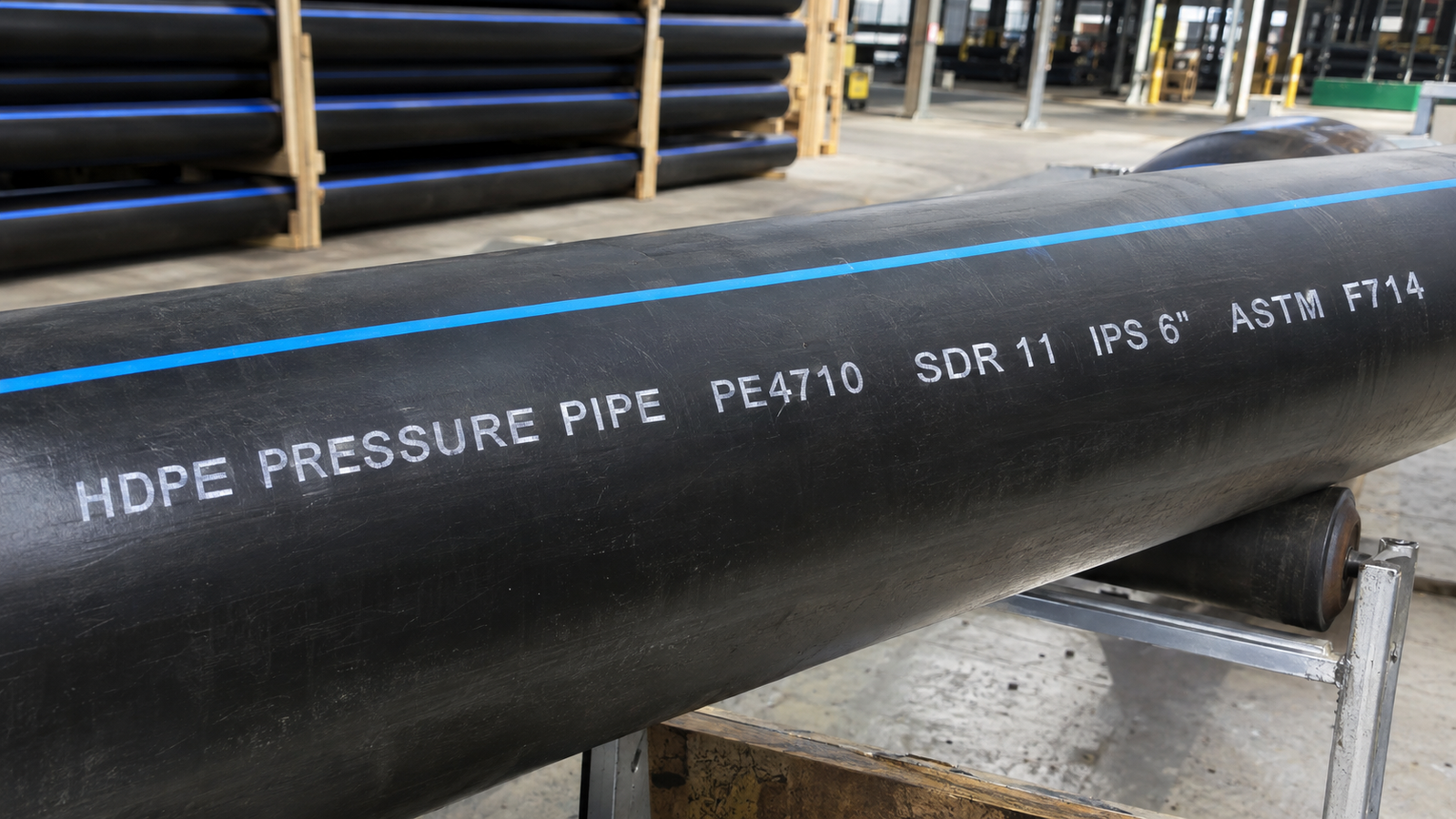
The print line on the pipe is the first line of verification. Check it against the order and the specification at receiving inspection.
- Manufacturer name or trademark
- Nominal size and OD system
- DR or SDR
- Material designation such as PE4710
- Applicable ASTM or AWWA standard
- Relevant pressure classification
- Manufacturing traceability, such as production code
- Potable-water certification where required
Print lines repeat along the pipe, so a cut length should still carry its identification. Markings support quality assurance, but they do not replace the project specification.
How to Choose SDR for Potable Water Distribution
Potable-water selection starts with the right standard. AWWA lists C901 for polyethylene pressure pipe and tubing from 3/4 through 3 inches for water service, and C906 for polyethylene pressure pipe and fittings from 4 through 65 inches for waterworks, in its standards list.
- Review the applicable PE4710 pressure-class table
- Compare sustained pressure and surge conditions
- Confirm potable-water material compliance
- Confirm compatible fittings
- Follow municipal specifications
NSF/ANSI/CAN 61 compliance, where applicable, is separate from pressure-class suitability. A pipe can carry the right marking and still be the wrong class for the pressure.
Do not apply one agency’s preferred pipe size or DR universally. PPI’s municipal guidance discusses commonly stocked DRs, and availability is secondary to validated pressure, hydraulic, and installation needs.
Worked Example: Choosing an HDPE SDR for a Water Main
This hypothetical case shows a first screening. It does not complete a selection.
Assumptions
Potable-water application under an applicable AWWA specification, PE4710 pipe, a sustained maximum working pressure of 145 psi, service temperature within the 80°F reference conditions, surge handled separately, and an available OD family and fittings.
Initial Screening
DR17, 125 psi: below the 145 psi sustained pressure, so it does not pass.
DR13.5, 160 psi: potentially suitable, with 15 psi of headroom.
DR11, 200 psi: also a candidate, but not automatically necessary.
Surge Headroom (Illustrative)
DR13.5: recurring total limit 240 psi leaves 240 − 145 = 95 psi, and occasional limit 320 psi leaves 175 psi.
DR11: recurring total limit 300 psi leaves 155 psi, and occasional limit 400 psi leaves 255 psi.
What it means: the real surge must be determined by analysis, and these figures only show how much room each class offers.
Selection is not finished until surges, hydraulics, temperature, external loading, joints, and project requirements are confirmed. Both DR13.5 and DR11 would then be compared on bore and cost.
HDPE SDR Selection and Material Cost
Wall thickness drives material quantity, and material quantity influences preliminary pipe cost. At 6.625 in. OD, a DR11 pipe has about 49 percent more wall cross-section than DR17, so it uses more resin per foot.
- Pipe material and diameter
- Product specification
- Fittings and joining
- Transportation
- Availability
- Excavation or trenchless installation
- Hydraulic operating cost
- Total installed and life-cycle cost
This guide does not give SDR price multipliers, because prices change with resin markets, region, size, and order quantity. The lowest purchase price does not necessarily deliver the most economical compliant system, since a thinner pipe may need a larger size or more pumping energy.
Common Mistakes When Choosing HDPE Pipe SDR
Most errors come from treating the SDR as the whole answer. Table 6 lists the common ones with the corrective action.
| Error | Potential consequence | Correct approach | Verification source |
|---|---|---|---|
| Using DR as a pressure rating | Wrong class assumed | Check the material-specific pressure class | Standard and product data |
| Applying PE4710 ratings to another grade | Overstated capability | Use the rating for the actual material | PPI TR-4 and manufacturer data |
| Ignoring surges | Pressure exceeds allowances | Assess recurring and occasional events | Waterworks criteria and transient analysis |
| Ignoring operating temperature | Overstated pressure capability | Apply the appropriate service derating | Product or PPI technical data |
| Mixing IPS and DIPS | Fitting and fusion mismatch | Verify the actual OD family | Pipe marking and size chart |
| Assuming minimum-wall ID equals average ID | Flow misjudged | Use published dimensional data | Manufacturer data |
| Choosing a thicker pipe without checking flow | Excess head loss | Evaluate design flow and head loss | Hydraulic calculation |
| Ignoring burial conditions | Deflection or buckling problems | Assess soil-pipe interaction and external loads | Project geotechnical and structural design |
| Ignoring fitting limitations | Assembly rated below the pipe | Check the entire connection assembly | Fitting data and joining procedure |
| Overlooking installation loads | Pullback or handling damage | Check installation demands | PPI guidance and the contractor plan |
| Choosing from stocked sizes only | Unsuitable or noncompliant selection | Confirm complete engineering requirements | Project specification |
| Using outdated standards or data | Wrong product requirements | Verify the adopted edition and product specifications | Current ASTM, AWWA, and manufacturer data |
Table 6. Common HDPE SDR selection mistakes and how to correct them.
How to Verify an HDPE SDR Selection Before Ordering
A final review ties the earlier steps together before anything is purchased. Work through this list and document each item.
- Application and material designation
- Governing standard and edition
- Design pressure and surge assessment
- Operating temperature
- OD family and SDR
- Published dimensions and flow capacity
- Installation requirements
- Joining compatibility
- Certification and documentation
Engineering review is essential for municipal, high-pressure, buried, critical, or unusual applications. This guide supports a preliminary choice and does not replace a stamped design.
HDPE Pipe SDR FAQs and Key Takeaways
Is SDR11 stronger than SDR17?
For the same outside diameter and PE material, SDR11 has a thicker wall and a higher pressure class, so it resists more internal pressure. For PE4710 water service, DR11 is 200 psi and DR17 is 125 psi. Stronger here means pressure capability, and it does not make SDR11 the better choice in every project.
What is the pressure rating of SDR17 HDPE pipe?
For PE4710 under the AWWA potable-water reference conditions, up to 80°F, DR17 has a 125 psi pressure class. That figure does not apply to other PE grades, higher temperatures, chemical service, or other standards. Confirm it against the manufacturer’s product data and the governing standard.
Is SDR11 always rated for 200 PSI?
No. The 200 psi value is the PE4710 water-service pressure class for DR11 under the stated AWWA reference conditions. A different PE material, temperature, fluid, or standard can change the rating. Check the pipe marking, the material designation, and the manufacturer’s published ratings.
What is the difference between SDR and DR?
DR is the general ratio of average outside diameter to minimum wall thickness. SDR is a standardized series of DR values derived from preferred numbers plus one. Industry often uses the terms interchangeably, but keep the exact designation shown in the standard or on the pipe marking.
How do I calculate wall thickness from SDR?
Divide the average outside diameter by the DR. For 6.625 in. IPS pipe at DR11, 6.625 ÷ 11 = 0.6023 in. minimum wall. Published product tables govern the actual specified value and rounding, so treat the calculation as a check and not a substitute for the dimension table.
Does lower SDR reduce internal diameter?
Yes, for the same outside diameter. A lower DR means a thicker wall, which leaves a smaller bore. At 6.625 in. OD, the geometric bore is about 5.42 in. for DR11 and 5.85 in. for DR17. Use the manufacturer’s published average ID for flow calculations.
What is the difference between IPS and DIPS HDPE pipe?
IPS and DIPS are different outside-diameter systems. A nominal 6 inch IPS pipe has a 6.625 in. OD, while 6 inch DIPS has a 6.900 in. OD. Fittings, fusion equipment, and mechanical couplings must match the actual OD system, so the nominal size alone is not enough.
Which SDR is best for underground water piping?
There is no universal best SDR. Choose the DR that satisfies sustained and surge pressure, temperature, hydraulic, and external-load requirements for the project, then confirm it with the engineer and the applicable AWWA and municipal specifications. Common PE4710 candidates include DR17, 13.5, 11, and 9.
Can SDR11 and SDR17 HDPE pipes be joined?
Sometimes, but do not assume it. Joining pipes of different DRs depends on the material, OD system, wall difference, and an approved fusion procedure. Follow the manufacturer’s instructions and the applicable fusion practice, and confirm the complete assembly rating with the supplier.
How does temperature affect HDPE pressure rating?
Pressure capability is rated at a reference temperature, up to 80°F for AWWA PE4710 water service. At higher service temperatures a temperature factor below 1.0 reduces the allowable pressure. The factor depends on the material and standard, so obtain it from product or PPI technical data.
Key Takeaways
- SDR describes wall thickness relative to OD, and pressure capability also depends on the material, temperature, and standard.
- PE4710 water-service classes of 125, 160, 200, and 250 psi apply to DR17, 13.5, 11, and 9 under the stated AWWA conditions.
- Surge allowances are limits on total pressure, not continuous operating pressure.
- A lower DR gives a thicker wall and a smaller bore, so check hydraulics with a verified ID.
- Confirm the OD family, fittings, installation loads, and documentation before ordering.
The decision principle is simple. To choose HDPE pipe SDR, select the correct material and standard, verify operating and surge pressures, compare hydraulic and installation requirements, then choose an available SDR that satisfies the complete system requirements.
Check HDPE Dimensions by Size
Look up controlled OD, minimum wall, and published average ID for IPS and DIPS HDPE pipe before you compare SDR options.
Open the HDPE Pipe Size Chart