How to Clean Concrete Naturally: Safe Methods for Dirt, Stains and Mildew
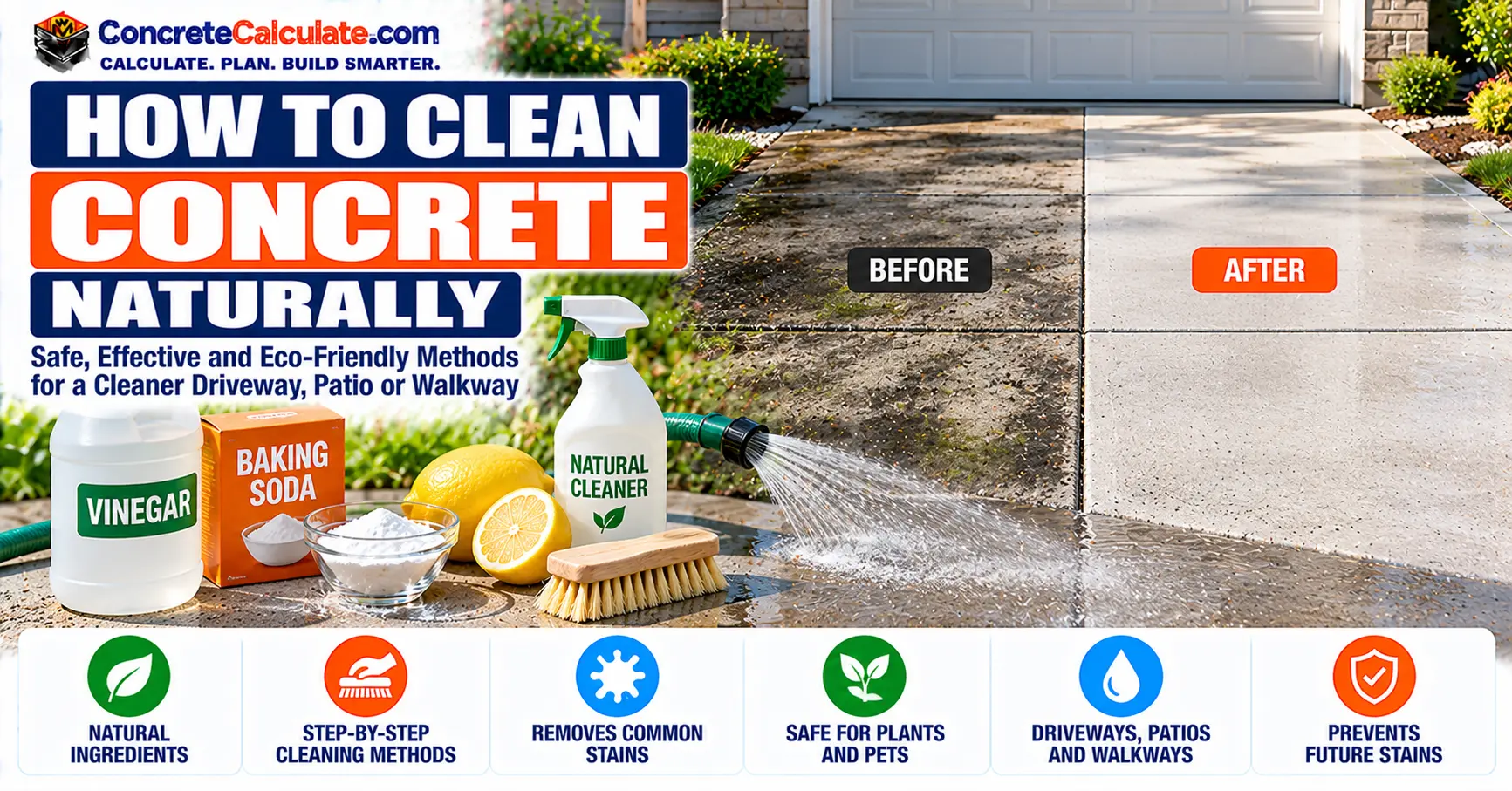
How to Clean Concrete Naturally
Identify the stain and finish first, then use the gentlest method that fits, from water and mild detergent to oxygen bleach, with honest limits on vinegar, baking soda and pressure washing.
Can You Clean Concrete Naturally?
Often, yes. Many ordinary concrete cleaning jobs can be done with water, mild detergent, brushing, baking soda in limited roles, oxygen bleach for suitable organic growth, and controlled pressure washing.
There is a limit. Deep oil, rust, paint, sealers, efflorescence, and some biological stains may need a specialized cleaner instead of a household remedy.
The approach in this guide is to identify the stain first, then use the gentlest method that fits and escalate only if needed.
What Does “Natural Concrete Cleaner” Actually Mean?
The phrase has no strict definition, so it helps to separate the claims on a label:
- Simple household cleaners: water, dish soap, baking soda.
- Biodegradable cleaners: ingredients that break down over time.
- Lower-toxicity products: formulas with fewer hazardous ingredients.
- Naturally derived ingredients: made from plant or mineral sources.
- “Chemical-free” marketing: not a meaningful claim, since everything is chemistry.
The useful question is whether a method is effective, compatible with your surface, and managed responsibly. A product can be natural and still etch concrete or pollute a stream.
Why You Should Identify the Stain Before Cleaning
Cleaners work by chemistry, and each stain responds to a different kind. Concrete Network groups concrete cleaners into pH-neutral, acidic, alkaline degreasers, enzymatic or bacterial, and specialty types, each aimed at certain soils.
| Stain/soil | Gentlest first method | Next step if needed | Avoid as first choice |
|---|---|---|---|
| Loose dirt | Sweep + water | Mild detergent | Acid |
| Mud | Dry scrape/sweep + water | Detergent | High-pressure jet immediately |
| Light food residue | Mild detergent | Oxygen cleaner if compatible | Strong acid |
| Algae/moss | Brush + water | Oxygen bleach | Random solvent |
| Light grease | Absorb + detergent | Alkaline degreaser | Vinegar |
| Deep oil | Absorb/degrease | Poultice/specialist cleaner | Baking soda alone |
| Rust/mineral stain | Identify source | Targeted mild-acid/mineral cleaner | Whole-slab vinegar soak |
| Efflorescence | Dry brush/water first | Proper mineral-deposit treatment | Oil degreaser |
| Tire marks | Detergent + brush | Degreaser/pressure cleaning | Acid |
The safest concrete-cleaning method begins by identifying the stain and surface finish.
If cleaning exposes powdery or flaking concrete, it may not be dirt at all. See Concrete Dusting and Concrete Scaling.
Plain, Sealed, Stamped and Polished Concrete Need Different Cleaning Methods
The finish matters as much as the stain. Harsh cleaners can dull or damage sealers, coatings, and polished finishes even when they do little harm to bare concrete.
- Plain broom-finished concrete.
- Sealed concrete.
- Stamped concrete.
- Colored concrete.
- Polished concrete.
- Painted concrete.
Concrete Network advises against bleach on polished concrete, because it can dull the finish, and on painted concrete, where it can flake the paint. Use neutral pH cleaners on polished floors.
| Surface | Safer starting point | Main caution |
|---|---|---|
| Plain broom-finished concrete | Water + mild detergent | Avoid over-etching |
| Sealed concrete | Manufacturer-approved neutral cleaner | Cleaner may damage sealer |
| Stamped concrete | Mild neutral cleaner | Color/sealer change |
| Stained concrete | Neutral cleaner | Acid can alter color |
| Polished concrete | Neutral pH cleaner | Acids/bleach may dull finish |
| Painted concrete | Coating-compatible cleaner | Cleaner can soften paint |
| Exposed aggregate | Mild detergent + brushing | Avoid paste erosion around aggregate |
What Tools Do You Need for Natural Concrete Cleaning?
Most natural cleaning needs simple tools. Gather these before you start:
- A stiff nylon-bristle broom.
- A soft brush for delicate finishes.
- A bucket.
- A garden hose.
- A wet/dry vacuum where appropriate.
- Absorbent material for spills.
- A microfiber mop for indoor floors.
- A pressure washer for suitable exterior slabs.
- Drain covers or temporary containment.
Skip wire brushes as a default. They scratch surfaces and can leave metal fragments that later rust.
Step 1: Sweep or Vacuum Loose Dirt First
Remove loose grit first. Sand, leaves, tracked soil, dust, and construction debris turn into abrasive mud once you add water.
Sweep outdoor slabs with a stiff broom. For indoor concrete, vacuum instead of dry sweeping where airborne dust is a concern.
Step 2: Try Warm Water and Scrubbing
Many dirt films come off with warm water and elbow grease. Concrete Network points out that plain water has little cleaning ability on its own, so scrubbing does much of the work.
- Wet the area.
- Scrub with a nylon brush.
- Rinse, or recover the water with a wet vacuum.
- Let the surface dry.
- Reassess before adding anything stronger.
Judge the result only when the concrete is dry, since wet concrete can hide discoloration.
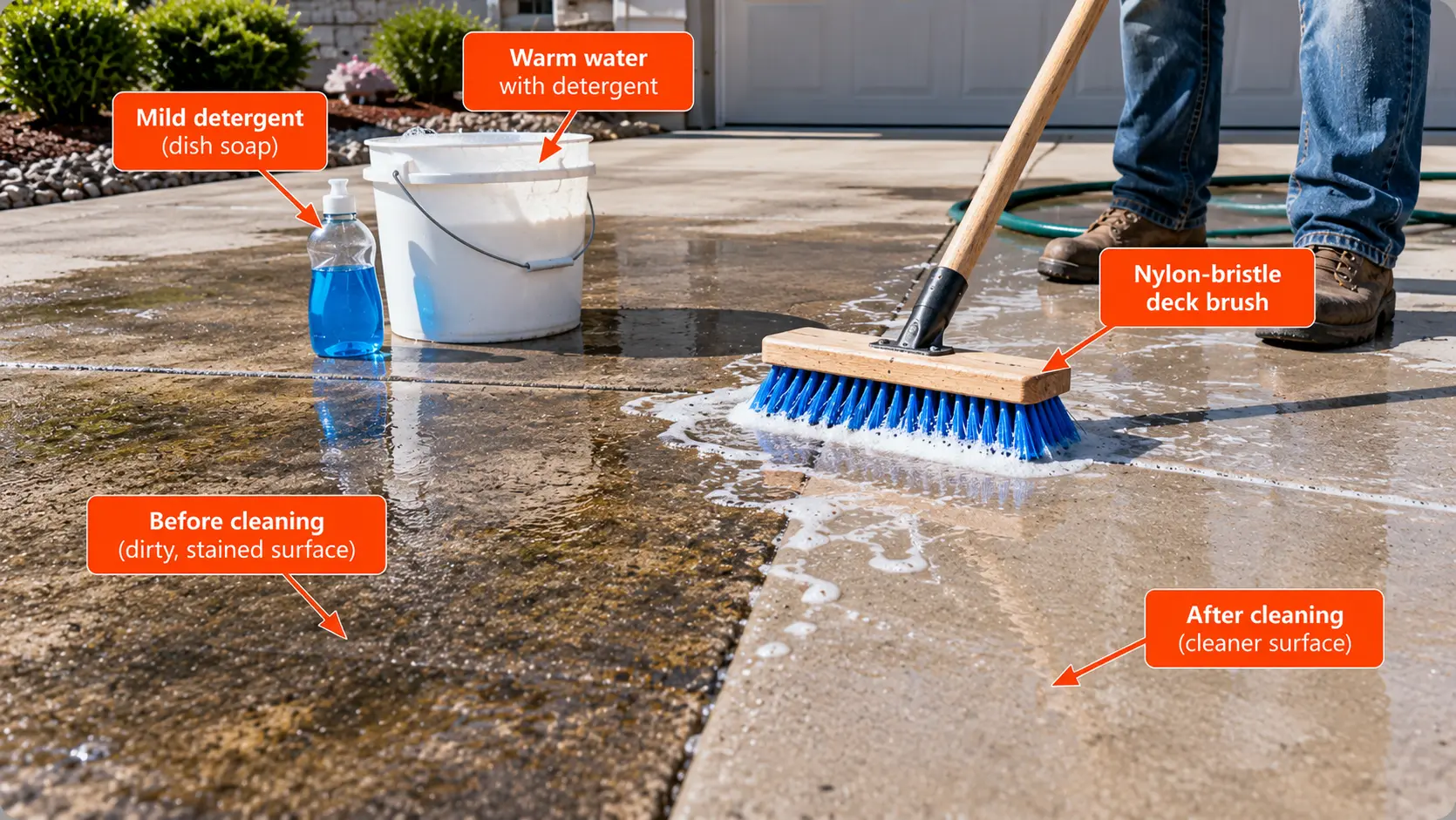
Step 3: Use Mild Dish Soap or Neutral Detergent
A mild detergent helps with general grime, light food residue, tracked dirt, and a light greasy film. Soap works because it surrounds oily or organic dirt so water can carry it away.
Use dish soap or a neutral detergent, and dilute it as the label directs. This guide does not give one recipe, because strengths vary by product.
How to Clean Concrete With Baking Soda
Baking soda has modest, realistic uses on concrete:
- Mild abrasive scrubbing.
- Odor reduction in some situations.
- Absorbing very small fresh spills.
- Neutralizing residual acidity after an acid treatment, where appropriate.
It is not a substitute for an alkaline degreaser on deep oil. Concrete Network notes that modern alkaline cleaners far outperform the old baking-soda-and-water method of neutralizing concrete.
How to Clean Concrete With Oxygen Bleach
Oxygen bleach is sodium percarbonate. Concrete Network lists it, along with distilled white vinegar, as an environmentally friendlier alternative to chlorine bleach for mold and mildew.
It suits algae, mildew-like growth, organic discoloration, and some outdoor grime. Chlorine bleach does not harm concrete itself, but it can eat away at a sealer or coating if it is not rinsed well.
Follow the product label for strength and contact time. This guide does not publish one universal mix ratio.
Can You Clean Concrete With Vinegar?
Yes, in limited targeted situations, but not as a routine whole-slab cleaner. Vinegar is acetic acid, and acids react with cement paste.
Treat it as a spot tool for certain mineral or discoloration problems, with a test patch first. The next three sections explain the chemistry, the valid uses, and the places to avoid it.
Why Vinegar Can Etch Concrete
Concrete contains calcium-bearing cement products, and acids attack them. Even a weak acid slowly dissolves the thin cement paste at the surface.
Concrete Network notes that acidic cleaners must be neutralized and rinsed after use. Acid washing is done on purpose to etch surfaces before coating, which shows why a weak acid is not harmless.
Vinegar is a weak acid, but repeated or prolonged exposure can still attack cement paste and change the concrete surface.
Harm builds with concentration, dwell time, and the condition of the concrete. One brief, rinsed application is very different from repeated soaking of a weak slab.
When Vinegar May Be Useful
NRMCA lists weak acids as a last-resort option for some surface discoloration. If hot water and brushing fail, a dilute solution of a weaker acid such as acetic acid, at about 3 percent, may be tried.
- Certain mineral deposits.
- Selected rust or mineral discoloration.
- Small, targeted areas where a mild acid is appropriate.
NRMCA says to dampen the surface first so the acid does not soak in, to flush with clean water within 15 minutes, and to test an inconspicuous area. Harsh acids can expose the aggregate.
When You Should Avoid Vinegar
Skip vinegar in these cases:
- Polished concrete.
- Sealed surfaces, unless the manufacturer approves.
- Colored or stained decorative concrete.
- Broad driveway cleaning.
- Repeated or long soaking.
- Unknown stains.
- Surfaces that are already weak, scaled, or etched.
The tables below compare common cleaners and correct some popular myths.
| Cleaner | Best use | Main benefit | Main caution |
|---|---|---|---|
| Warm water | General dirt | Safest starting point | Limited stain power |
| Mild dish soap | Light grime/grease | Readily available | May leave residue if overused |
| Baking soda | Mild scrubbing/absorption | Low odor, inexpensive | Weak for embedded oil |
| Oxygen bleach | Organic growth/staining | Lower chlorine burden | Product-specific compatibility |
| Vinegar | Limited mineral-stain use | Inexpensive mild acid | Can etch concrete |
| Enzyme cleaner | Selected organic/odor stains | Lower harsh-chemical use | Slow, stain-specific |
| Alkaline degreaser | Oil/grease | Chemically matched to hydrocarbon stains | Not necessarily “natural” |
| Claim | Better interpretation |
|---|---|
| “Vinegar is natural, so it can’t hurt concrete.” | Vinegar is acidic and can etch cement paste |
| “Baking soda removes all oil stains.” | It may help with fresh/light contamination, not deep oil |
| “Pressure washing uses only water, so it is harmless.” | Excess pressure can erode or stripe concrete |
| “Bleach is the only way to kill green growth.” | Oxygen bleach and mechanical cleaning may be alternatives |
| “Natural runoff can go down the storm drain.” | Dirty wash water may still contain pollutants |
| “If the slab looks cleaner while wet, the stain is gone.” | Wet concrete can temporarily hide discoloration |
How to Clean Dirt and Mud From Concrete Naturally
Use the simplest method first: dry removal, then water, then mild detergent and a nylon brush. Scrape or sweep off heavy mud before wetting it.
Letting thick mud dry first can make removal easier, because dry soil sweeps up instead of smearing. Rinse what remains and let the slab dry before judging the result.
How to Clean Leaf, Berry and Plant Stains
Remove leaves and berries quickly, since organic staining sets over time. Wash with a mild detergent and a brush.
If a stain stays, oxygen bleach may help where the surface allows it. Repeat gentle cleaning instead of reaching for acid, and accept that some tannin staining can persist.
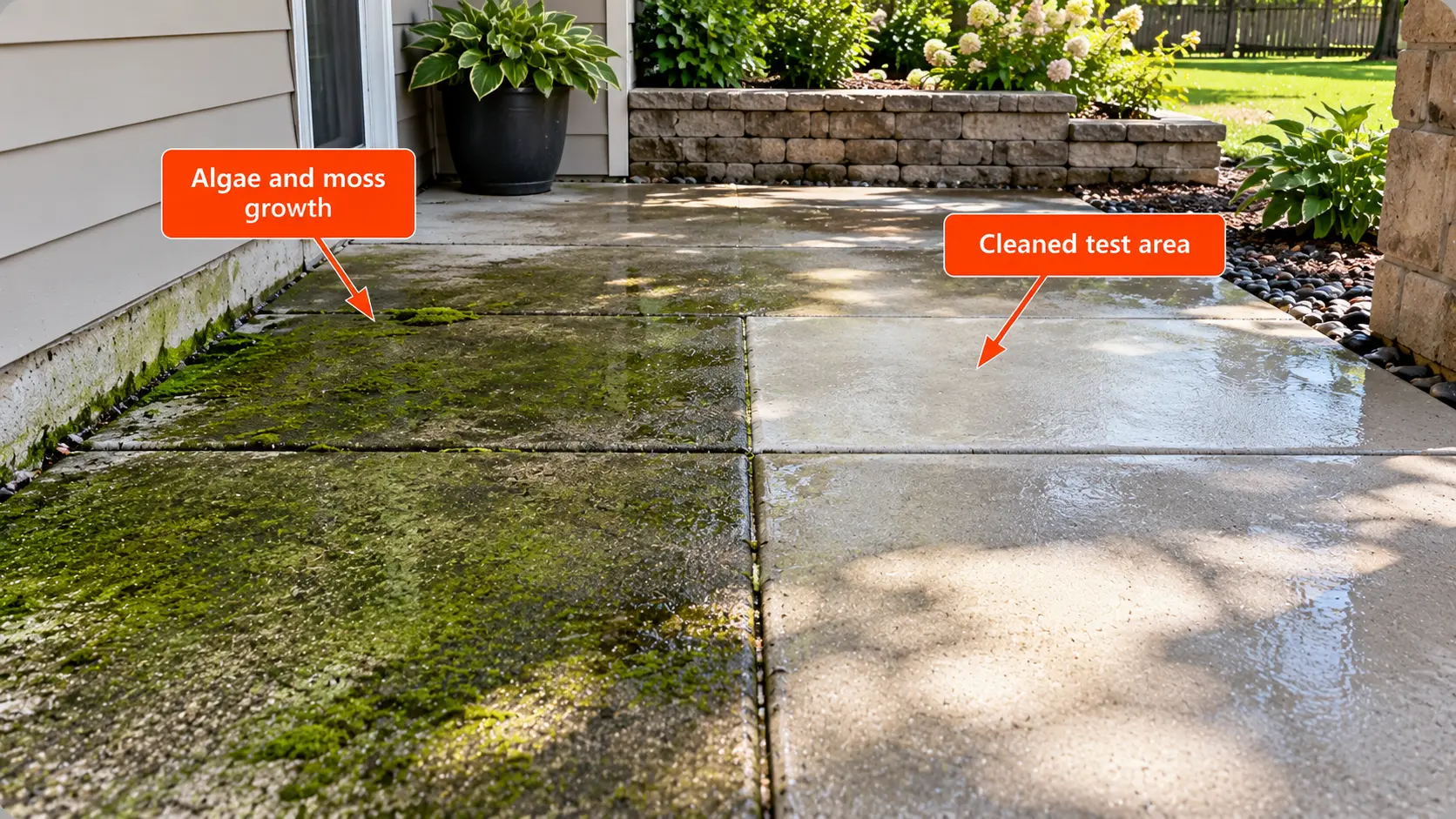
How to Remove Algae, Moss and Green Growth
Algae and moss need cleaning and a change in conditions. Brush off the growth, then treat what is left.
- Brush mechanically with a stiff nylon brush.
- Treat with oxygen bleach, following the label.
- Look for the moisture source, such as shade or poor drainage.
- Improve drainage and sunlight where you can.
Regrowth is likely if the damp environment stays the same. Persistent moisture along a driveway may point to a drainage problem.
<
How to Remove Mildew or Mold-Like Growth From Concrete
Outdoors, mildew responds to brushing and oxygen bleach. Indoors, the moisture source matters most, so correct leaks and improve ventilation before you clean.
Chlorine bleach is not required for every case. Concrete Network says it works on mildew, but it can release harmful fumes indoors and damage sealers, so oxygen bleach may be preferable where it is compatible.
How to Clean Light Grease or Food Stains
Light grease and food stains usually give way to a gentle approach. Work in this order:
- Absorb any fresh spill first.
- Wash with warm water and mild detergent.
- Try an alkaline cleaner if household methods fail.
Concrete Network says alkaline degreasers are the best choice for oil and grease. Deep or old stains belong in the full oil-stain guide.
Can Baking Soda Remove Oil From Concrete?
Only narrowly. Baking soda can absorb or scrub light fresh residue, but it is unlikely to pull deeply embedded petroleum out of porous concrete.
For deep or old stains, use the oil stain removal guide, which covers degreasers, poultices, and wastewater control.
How to Clean Rust and Mineral Stains Naturally
Rust and mineral stains are chemically different from dirt and grease. They usually respond to a targeted mineral or rust cleaner, not detergent.
A mild acid treatment may be considered cautiously, with a test patch and protection for decorative finishes. Concrete Network notes that specialty rust removers exist for concrete, though results vary.
White powdery deposits are efflorescence. Their diagnosis and removal are covered in the concrete efflorescence guide.
How to Clean Tire Marks Without Harsh Chemicals
Tire marks come from rubber transfer, which often resists purely natural remedies. Start with detergent and a brush.
- Detergent and scrubbing.
- A degreaser if detergent is not enough.
- Controlled pressure washing.
Avoid acid for tire marks. If the mark persists, a stronger product may be needed.
Can You Pressure-Wash Concrete Without Chemicals?
Sometimes. Water-only pressure washing can handle dirt, loose algae, and surface grime.
Concrete Network suggests keeping the nozzle about 12 inches from the surface and using a steady sweeping motion. It warns that older, stamped, or stained concrete may respond differently, so test a hidden spot first.
Pressure washing is mechanical cleaning, not a chemical-free guarantee. It can erode the surface if misused, and the wash water still needs to be managed.
How to Pressure-Wash Concrete Without Etching It
A careful workflow avoids etching and stripes. This is a general sequence, not a promise for every surface:
- Inspect the concrete. Weak or scaled surfaces need extra care.
- Test a hidden area first.
- Use a wide fan pattern.
- Hold a consistent distance from the surface.
- Keep moving, and overlap your passes.
- Stop if the cement paste starts to erode.
There is no single PSI that is safe for every surface. Concrete Network notes that contractors often use machines of about 3000 psi for effective cleaning, which is a capability, not a safe setting for all concrete.
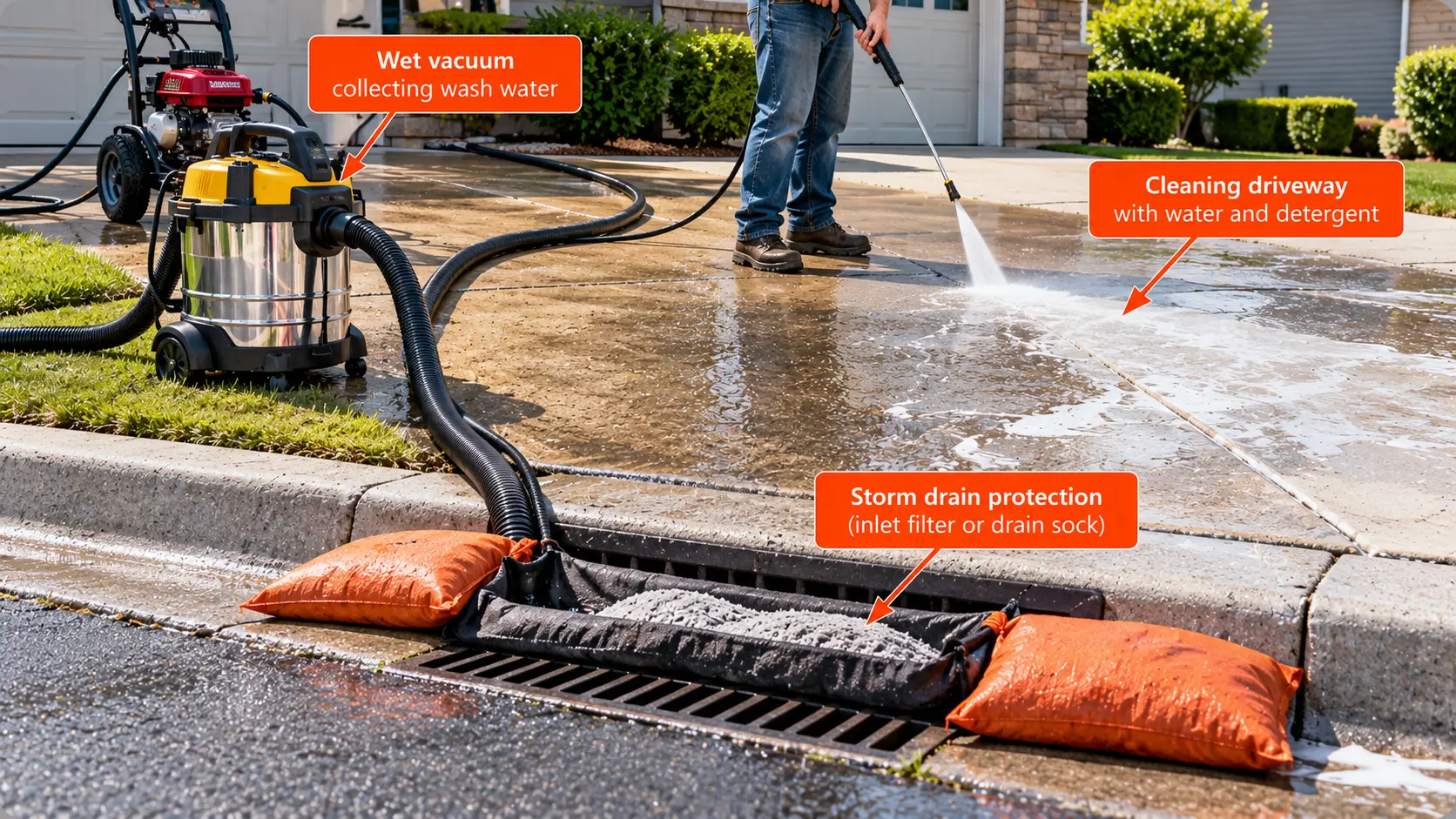
How to Keep Concrete Cleaning Water Out of Storm Drains
Wash water can carry sediment, oil, detergent, and biological matter. Even a mild cleaner does not make contaminated runoff safe for storm drains.
Washington State’s stormwater guidance for pressure washing sums it up as “only rain down the drain.” It advises dry cleanup methods and not hosing off the ground.
- Find the storm drains near your driveway before you start.
- Protect curb inlets with a cover or temporary berm.
- Sweep instead of flooding when you can.
- Collect oily or contaminated wash water with a wet vacuum.
- Check your local stormwater rules for disposal options.
Even a mild cleaner can carry oil, sediment and other pollutants into stormwater unless wash water is controlled.
Concrete Network adds that municipal rules vary and that some places prohibit wash water from entering storm sewers. Ask your local agency what is allowed.
Natural Concrete Cleaning Mistakes to Avoid
Most cleaning damage comes from a few repeat mistakes. The table shows what to do instead.
| Mistake | Possible result | Better approach |
|---|---|---|
| Vinegar left on too long | Etching/discoloration | Short targeted treatment + rinse where appropriate |
| Narrow pressure-washer nozzle too close | Stripes/pitting | Wider fan + greater distance |
| Wire brush | Scratches/rust contamination | Nylon-bristle brush |
| Mixing cleaners | Toxic or unpredictable reaction | Use one labeled system at a time |
| Cleaning sealed concrete aggressively | Sealer damage | Test and use compatible cleaner |
| Washing oil into gutter | Environmental contamination | Contain and recover runoff |
| Scrubbing scaling concrete aggressively | More surface loss | Diagnose scaling instead of “cleaning” it |
Also avoid letting an acidic cleaner dry on the surface, and never skip the test patch on decorative concrete.
Never Mix Vinegar With Bleach or Other Cleaning Chemicals
This is a safety rule, not a suggestion. Concrete Network warns never to mix bleach with ammonia, vinegar, or other household cleaners, because the mixture can produce toxic fumes.
Do not combine cleaners unless the labels say it is allowed. Use one product at a time, rinse thoroughly between products, and ventilate well, especially indoors.
| Step | Action |
|---|---|
| 1 | Identify the stain |
| 2 | Identify the concrete finish |
| 3 | Test a hidden area |
| 4 | Start with dry cleaning/water |
| 5 | Add mild detergent if needed |
| 6 | Use stain-specific lower-toxicity cleaner if needed |
| 7 | Protect landscaping and drains |
| 8 | Control runoff |
| 9 | Allow concrete to dry |
| 10 | Reassess before escalating |
Once the slab is clean and fully dry, you may want to protect it. See When to Seal a Concrete Driveway and How to Seal Concrete, then estimate materials with the Concrete Sealer Calculator and the Concrete Sealing Cost Calculator.
Natural Concrete Cleaning FAQs
What is the best natural cleaner for concrete?
Warm water and a mild detergent with brushing handle most dirt. For algae, oxygen bleach is a lower-impact option. The best choice depends on the stain.
Can baking soda clean concrete?
Yes, for mild scrubbing and absorbing small fresh spills. It is weak against embedded oil.
Can vinegar damage concrete?
Yes. It is acidic and can etch cement paste, especially with repeated or prolonged exposure. Use it only in limited, tested situations.
Can I use dish soap on concrete?
Yes. Mild dish soap helps with general grime and light grease. Rinse well so it does not leave residue.
Is oxygen bleach safe for concrete?
It is considered a lower-impact option for mildew and organic growth, but check compatibility with sealers and colored finishes, and follow the label.
How do I clean concrete without a pressure washer?
Sweep, scrub with warm water and a stiff nylon brush, and add mild detergent. A wet/dry vacuum helps recover the water.
Can I remove oil naturally?
Fresh light spills can be absorbed and scrubbed with detergent. Deep or old oil usually needs an alkaline degreaser or a poultice.
How do I clean algae naturally?
Brush it off, treat with oxygen bleach following the label, and fix the damp conditions that let it grow.
Is pressure washing considered chemical-free?
Water-only washing uses no cleaning chemicals, but it is still mechanical cleaning that can damage concrete, and the wash water must be managed.
How often should concrete be cleaned?
It depends on exposure, shade, and use. Clean when dirt, growth, or stains build up, and sooner in damp, shaded areas.