
Concrete Efflorescence: How to Remove White Deposits and Stop Them Returning
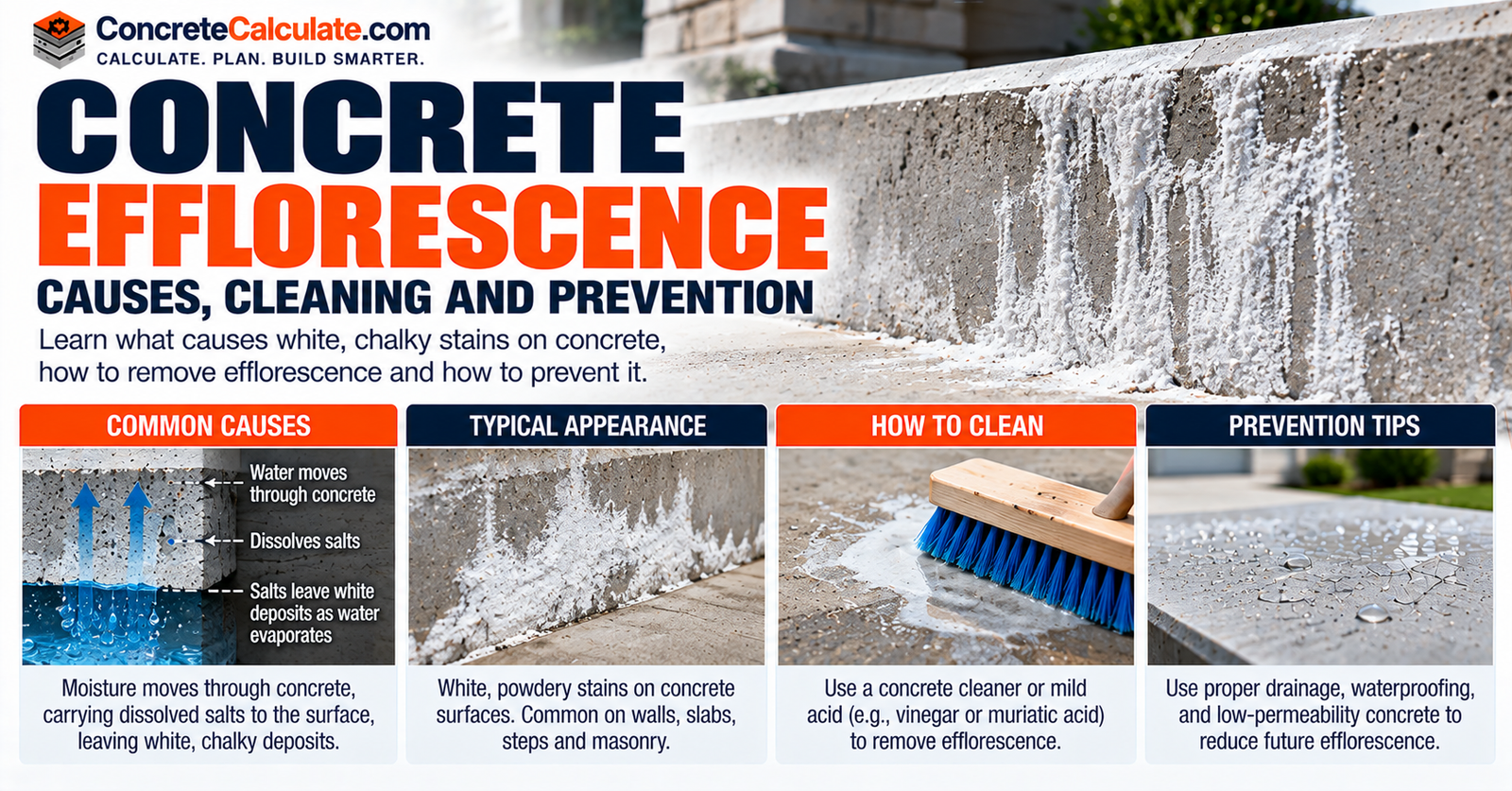
What causes the white powder on your concrete, how to remove it safely, and how to stop it from coming back.
Quick Answer
Efflorescence is a typically whitish deposit of salts or mineral compounds that forms when moisture carries dissolved material through concrete to the surface. It’s usually a cosmetic issue rather than a structural one.
The three main removal approaches are dry brushing, appropriate washing, and specialist cleaning for stubborn deposits. If it keeps coming back, the real fix is finding and correcting the moisture source, not repeated scrubbing.
In This Guide
- 1. What Is Concrete Efflorescence?
- 2. What Does Efflorescence Look Like on Concrete?
- 3. Efflorescence vs. Calcium Deposits, Mold and Other White Stains
- 4. Is Concrete Efflorescence Harmful or a Structural Problem?
- 5. Primary vs. Secondary Efflorescence: What’s the Difference?
- 6. What Causes Concrete Efflorescence?
- 7. How Water Moves Salts Through Concrete
- 8. Where Do the Salts in Concrete Come From?
- 9. Why New Concrete Develops White Powder
- 10. Why Efflorescence Keeps Coming Back
- 11. Efflorescence on Driveways, Patios, Walls and Basement Floors
- 12. How to Remove Efflorescence: Quick Method Selection
- 13. Before Cleaning: Identify the Moisture Source and Test the Surface
- 14. How to Remove Light Efflorescence With Dry Brushing
- 15. When to Use Water to Remove Efflorescence
- 16. Best Cleaners for Stubborn Concrete Efflorescence
- 17. How to Remove Hardened Calcium Deposits
- 18. Can You Pressure Wash Efflorescence Off Concrete?
- 19. Removing Efflorescence From Colored, Stamped and Polished Concrete
- 20. How to Treat Efflorescence Under a Concrete Sealer
- 21. How to Prevent Concrete Efflorescence
- 22. How Drainage and Grading Affect Efflorescence
- 23. Vapor Barriers and Moisture Control Beneath Concrete Slabs
- 24. Does Sealing Concrete Prevent Efflorescence?
- 25. When Should You Seal Concrete After Efflorescence Removal?
- 26. Concrete Efflorescence Removal Cost: DIY vs. Professional Cleaning
- 27. Common Efflorescence Removal and Prevention Mistakes
- 28. Concrete Efflorescence FAQs
1. What Is Concrete Efflorescence?
Efflorescence is a typically whitish deposit of salts or mineral compounds that appears when moisture moves dissolved material through concrete and deposits it at or near the surface as the water evaporates. It usually looks like a powdery film, a chalky patch, or streaks, and in most cases it’s cosmetic rather than harmful.
There are three main removal approaches: dry brushing, appropriate washing, and specialist cleaning for persistent deposits. Which one applies depends on how the deposit behaves and where it’s located, both covered later in this guide.
What This Guide Covers
This article focuses on identifying, removing and preventing efflorescence. For general sealer selection, see How to Seal Concrete, and for subslab moisture and drainage prep, see How to Prepare Soil for a Concrete Slab.
2. What Does Efflorescence Look Like on Concrete?
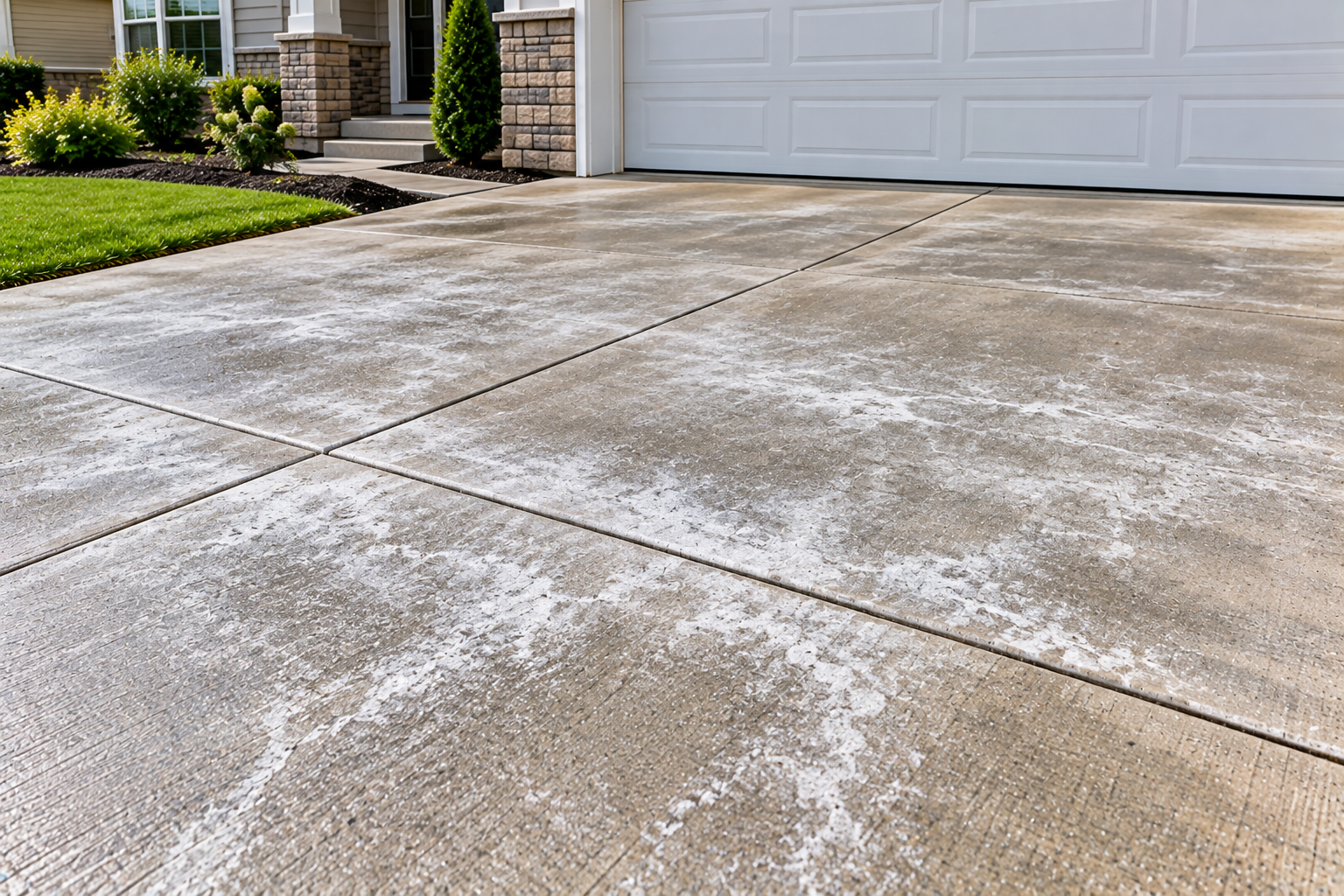
Efflorescence commonly appears as loose white powder or a chalky film, though it can also show up as pale patches, faint streaks, or in some cases a hard white crust. On gray concrete it often looks like a light dusting, while on dark or colored concrete it can appear more noticeable as a washed out or faded patch.
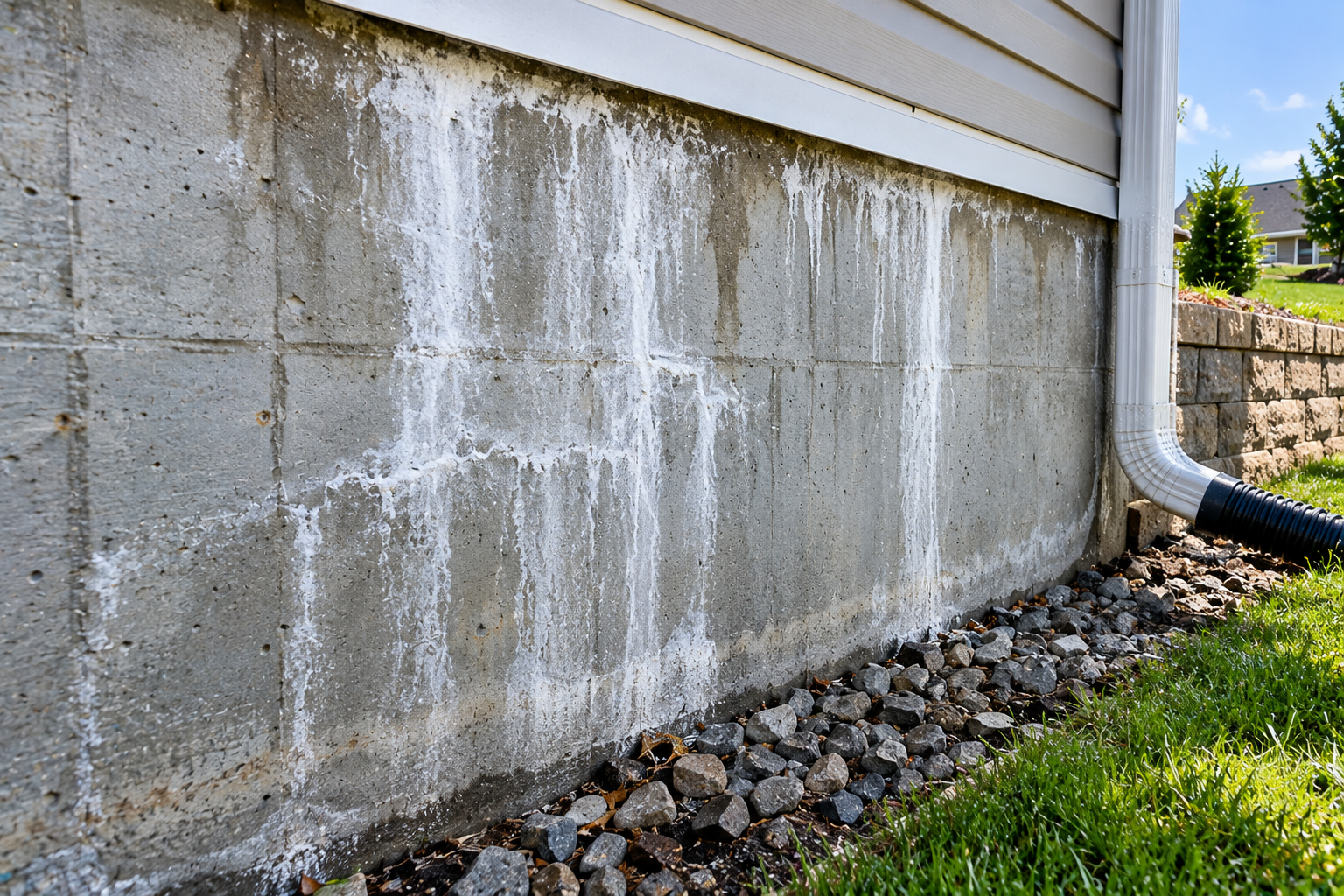
On stamped concrete it tends to collect in the grout lines and texture recesses first. On vertical walls it frequently appears as streaks running down from a joint, crack or the top of the wall.
Deposits concentrated right at a joint often point to water entering through that joint, while deposits spread fairly evenly across a slab usually point to more general moisture movement through the whole surface.
3. Efflorescence vs. Calcium Deposits, Mold and Other White Stains
Not every white mark on concrete is ordinary efflorescence. Several different conditions can look similar at first glance, so it helps to compare them side by side before choosing a treatment.
| Visible Condition | Possible Explanation | Useful Distinguishing Clue | Recommended Next Step |
|---|---|---|---|
| Loose white powder | Soluble efflorescence | Dry, powdery surface deposit | Try dry brushing; investigate moisture if recurring |
| Hard white crust | Persistent calcium bearing deposit | Firmly bonded mineral buildup | Identify the deposit and test a suitable specialist cleaner |
| Cloudiness beneath a sealer | Trapped moisture, coating blush or deposits | Cannot simply be brushed away | Check coating condition and moisture |
| Irregular light and dark areas | General concrete discoloration | May lack a removable surface residue | Review curing, finishing and mixture history |
| Fuzzy or discolored growth | Possible mold or other biological growth | Appearance and moisture conditions differ | Identify the growth and correct moisture problems |
Appearance alone is only a preliminary screening tool, since a simple household test can’t reliably identify every unknown white substance. When in doubt, especially on valuable or decorative surfaces, get a professional opinion before cleaning.
4. Is Concrete Efflorescence Harmful or a Structural Problem?
Ordinary surface efflorescence is primarily an appearance issue and doesn’t by itself weaken the concrete. But the moisture behind recurring deposits deserves a closer look, since persistent water movement can sometimes accompany other problems.
Warning Signs Worth Investigating
Persistent dampness that doesn’t dry out between occurrences, visible water intrusion, leaks or standing water nearby, and coatings that are bubbling, peeling or delaminating all warrant a closer look. The same is true of scaling, spalling or corrosion staining near the deposits, or damage spreading to adjacent finishes or materials.
Most efflorescence on its own is harmless in appearance only, but don’t diagnose structural damage from white residue alone. If any of the warning signs above are present, investigate the underlying moisture and structural condition separately.
5. Primary vs. Secondary Efflorescence: What’s the Difference?
Primary, or early age, efflorescence happens as new concrete loses its original construction moisture, and it’s a normal part of concrete curing. Secondary, or recurring, efflorescence happens later and is driven by an ongoing water source rather than the concrete’s original mix water.
| Clue | Points Toward Primary | Points Toward Secondary |
|---|---|---|
| Concrete age | Relatively new, still curing | Older, previously dry concrete |
| Pattern | General haze across the surface | Localized, tied to a specific spot or source |
| History | Appeared shortly after placement | Follows rain, irrigation or a known leak |
| Recurrence | Often fades with time and normal weathering | Keeps returning after cleaning |
If deposits keep coming back on older concrete, that’s secondary efflorescence, and it needs a moisture source investigation rather than just repeated cleaning.
6. What Causes Concrete Efflorescence?
Efflorescence needs three things happening together: a source of soluble material, moisture to dissolve it, and a path for that moisture to reach the surface.
| Condition | What It Means |
|---|---|
| Soluble material present | Salts or calcium compounds exist within or in contact with the concrete |
| Moisture available | Water is present long enough to dissolve that material |
| A path to the surface | The concrete’s pore structure allows the solution to migrate and evaporate |
Remove any one of these three conditions and efflorescence generally stops forming. That’s why chasing the moisture source matters more than repeated surface cleaning.
7. How Water Moves Salts Through Concrete
Concrete is porous at a microscopic level, and liquid water can move through that pore network by absorption and capillary action. As it moves, it can carry dissolved salts along with it.
Water vapor also moves through concrete, driven by humidity and temperature differences, and it’s part of the broader moisture picture. But it doesn’t carry intact salt crystals the way liquid water transport does.
When that liquid water reaches the surface and evaporates, the dissolved material stays behind as a visible deposit.
8. Where Do the Salts in Concrete Come From?
Soluble material can come from several places, including cementitious materials, aggregates, admixtures, groundwater, and water entering the structure from outside. One especially common source is calcium hydroxide, a natural byproduct of cement hydration.
When calcium hydroxide dissolves in moisture and reaches the surface, it can react with carbon dioxide in the air, forming calcium carbonate, a more persistent deposit than an ordinary soluble salt. This is one reason some efflorescence brushes away easily while other deposits feel hard and bonded to the surface.
The chemistry matters mainly because it explains removal difficulty, not because homeowners need to memorize every reaction.
9. Why New Concrete Develops White Powder
New concrete naturally contains water used during mixing and finishing. As that construction moisture works its way out over the following weeks, it can carry dissolved compounds to the surface, and environmental conditions, the specific concrete mixture, and early exposure to rain can all influence how noticeable this becomes.
Normal Does Not Mean Guaranteed
Early age efflorescence on new concrete doesn’t necessarily mean the construction was defective. At the same time, don’t assume every early deposit will disappear within some fixed number of days, since how long it takes varies by mixture, weather and exposure.
For background on how new concrete loses moisture during curing, see the Concrete Curing and Drying Time Guide.
10. Why Efflorescence Keeps Coming Back
If cleaning works but the white deposits return again and again, an active water source is almost always the reason.
Scrubbing the visible deposit does not stop new deposits from forming, since as long as the water source stays active, more dissolved material keeps arriving at the surface. Fixing the source is what actually breaks the cycle.
11. Efflorescence on Driveways, Patios, Walls and Basement Floors
The basic mechanism is the same everywhere, but the likely water source differs by location.
Driveways and Patios
Rain, sprinkler overspray, and general grading around the slab are the most common contributors here, since exposure to the weather means these surfaces see moisture cycles often.
Basement Floors and Interior Slabs
Subslab moisture, vapor control conditions, and flooring or coating compatibility all matter indoors. A missing or damaged vapor retarder can let ground moisture reach the slab surface.
Concrete Walls and Masonry
Water often enters higher up, through a cap, coping, or wall penetration, then travels down and shows up as streaking lower on the wall. Drainage details at the base of the wall matter too.
| Location | Most Likely Source | Where to Look Next |
|---|---|---|
| Driveway or patio | Rain, sprinklers, drainage, grading | Sections 21 to 22 on prevention and drainage |
| Basement or interior slab | Subslab moisture, vapor control gaps | Section 23 on vapor barriers |
| Wall or masonry | Water entry higher up, drainage details | Sections 13 and 22 on diagnosis and drainage |
12. How to Remove Efflorescence: Quick Method Selection
| Removal Method | Suitable Situation | Main Limitation | Important Precaution |
|---|---|---|---|
| Dry brushing | Loose, dry deposits | Ineffective for some hardened crusts | Avoid damaging decorative finishes |
| Gentle water cleaning | Compatible, sound surfaces with washable deposits | Can introduce more moisture | Control runoff and allow drying |
| Manufacturer-approved cleaner | Persistent deposits on compatible substrates | Not universally suitable for every finish | Conduct a test patch and follow instructions |
| Acid-based cleaning | Selected deposits where explicitly appropriate | Can etch or discolor concrete | Professional advice and safety controls may be needed |
| Specialist mechanical treatment | Particularly stubborn buildup | Can change surface texture | Have a qualified professional assess suitability |
| Coating removal and remediation | Trapped deposits or coating problems | Often more extensive than ordinary cleaning | Address moisture and compatibility before recoating |
13. Before Cleaning: Identify the Moisture Source and Test the Surface
Take a photo of the deposit before you start. This gives you a record to compare against after cleaning and later, if it returns.
Inspect the surrounding drainage and moisture conditions, looking at grading, gutters, sprinklers and nearby cracks or joints. Choose an inconspicuous test area before treating the whole surface, and this matters even more on colored, stamped, polished or previously sealed concrete, since these finishes can respond differently to cleaning than plain gray concrete.
Always check the cleaner’s technical instructions and safety data sheet first, whether it’s a household product or a specialty concrete cleaner.
14. How to Remove Light Efflorescence With Dry Brushing
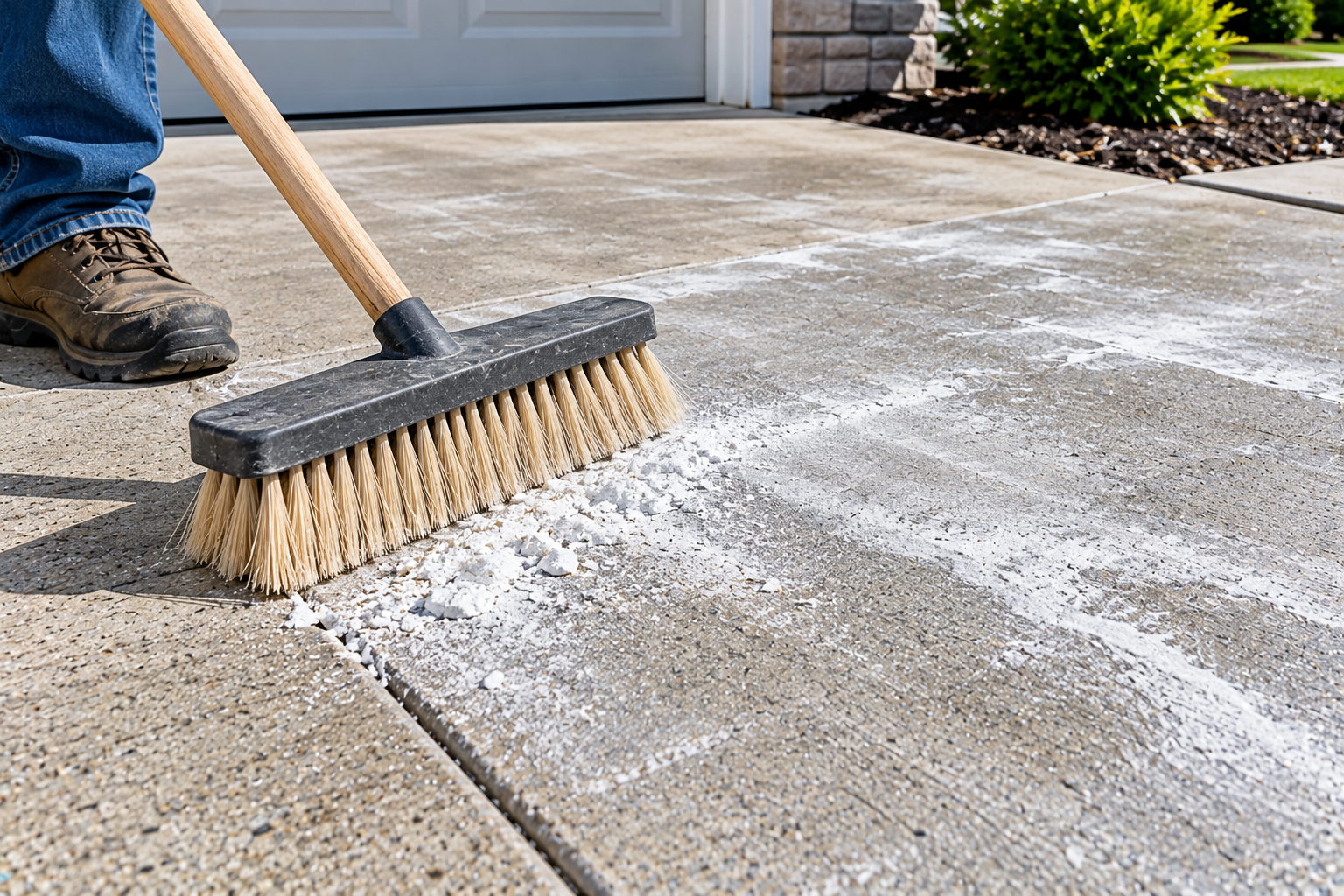
Dry brushing is the first option to try for a loose, dry deposit on a sound surface.
- Let the surface dry completely. Brushing damp deposits can smear them instead of removing them.
- Use an appropriate nonmetallic brush. A stiff fiber brush works well without scratching most finishes.
- Brush firmly but don’t gouge decorative textures. Work in manageable sections.
- Collect the loosened material. Sweep or vacuum it up rather than letting it spread.
- Recheck the surface. See if the deposit is fully gone or if some remains bonded.
Keep the loose material out of nearby drains and landscaping, since dispersing it indiscriminately just moves the problem instead of solving it.
15. When to Use Water to Remove Efflorescence
Gentle washing with clean water can work for compatible, sound surfaces with deposits that dry brushing alone didn’t fully remove. But water isn’t automatically the right next step.
Water Can Make Things Worse
Introducing more water can worsen an underlying moisture problem. CMHA specifically cautions that high pressure water can push additional moisture into masonry, which can contribute to renewed efflorescence rather than solving it, and the exact effect depends on the specific concrete surface and construction.
If you do use water, rinse thoroughly and control where the runoff goes so it doesn’t just relocate the deposit. Let the surface fully dry, then check whether the deposit returns before deciding on further treatment.
16. Best Cleaners for Stubborn Concrete Efflorescence
There’s no single cleaner that’s universally correct for every deposit and surface.
| Surface | First Option to Evaluate | Extra Consideration |
|---|---|---|
| Plain, unsealed concrete | Dry brushing | Determine whether deposits are loose or hardened |
| Broom-finished driveway | Dry brushing or compatible cleaning | Texture may retain deposits |
| Colored concrete | Gentle, tested cleaning | Potential color changes or etching |
| Stamped and sealed concrete | Identify if deposits are above or below the coating | Possible coating removal and specialist work |
| Polished concrete | Manufacturer or installer approved cleaning | Preserve the finish and sheen |
| Concrete masonry wall | Identify the moisture source before cleaning | Avoid driving water deeper into the wall |
Don’t Assume Any Household Acid Is Safe
Vinegar, hydrochloric acid and other household chemicals are not universally appropriate for concrete. Acid can react with the cement paste itself, which can alter the concrete’s appearance and damage certain decorative finishes permanently.
17. How to Remove Hardened Calcium Deposits
Hardened calcium carbonate crusts behave differently from loose, water soluble efflorescence. Ordinary dry brushing and gentle washing often can’t remove them, because these deposits are chemically bonded to the surface rather than just resting on top of it.
Specialist chemical or mechanical removal is sometimes needed for these stubborn crusts, but aggressive treatment carries real risk, since overly aggressive cleaning can permanently change the surface’s texture or color. Test any specialist product in an inconspicuous area first, and consider professional help for valuable surfaces.
18. Can You Pressure Wash Efflorescence Off Concrete?
Sometimes, but not universally, and not at just any pressure setting. Sound exterior flatwork can often tolerate careful pressure washing, while porous masonry, deteriorated surfaces, delicate decorative finishes, and previously coated concrete are more at risk.
Excessive pressure can force additional moisture into the assembly or physically damage the surface texture or an existing coating. There’s no single universal pressure setting that’s correct for every surface, so match the equipment and technique to the specific concrete condition and test a small area first.
19. Removing Efflorescence From Colored, Stamped and Polished Concrete
Decorative concrete deserves extra caution before any cleaning begins. Possible risks include discoloration, damage to an existing sealer, changes in sheen, staining, and surface etching, and these effects can be far more noticeable and harder to fix on decorative work than on plain gray concrete.
Always test any cleaning method on a small, inconspicuous, manufacturer-compatible test patch first. For valuable or specialized finishes, professional advice is worth the cost before you risk permanent damage.
20. How to Treat Efflorescence Under a Concrete Sealer
Loose deposits sitting on top of a sealer are a different problem than deposits or haze trapped underneath it. Surface deposits can often be cleaned using the same methods described earlier in this guide, but trapped moisture or deposits beneath the coating are more complicated.
What Trapped Moisture Under a Coating Usually Requires
Identifying how moisture is moving into or through the coating system, evaluating whether the coating is still properly adhered, removing an incompatible or failing coating if necessary, and resolving the underlying moisture source before any recoating happens.
Don’t automatically add another coat of sealer on top of existing haze or trapped moisture, since that typically traps the problem rather than fixing it. The correct remedy depends on the existing coating type and the specific moisture conditions involved.
21. How to Prevent Concrete Efflorescence
Prevention centers on a few practical areas working together.
Zero efflorescence can’t be guaranteed under every condition. Preventive measures need to match the actual exposure and moisture source at your specific project, not a generic checklist.
22. How Drainage and Grading Affect Efflorescence
Water management is one of the most effective, and most overlooked, prevention tools.
A deposit can reappear after heavy rain or a seasonal groundwater shift, even if a previous cleaning fully removed it. That’s not a failed cleaning job. It’s a sign the underlying water exposure is still active.
23. Vapor Barriers and Moisture Control Beneath Concrete Slabs
For interior, moisture sensitive floors, the vapor retarder beneath the slab matters, since its selection, placement and continuity all affect how much ground moisture reaches the slab.
Liquid water intrusion and vapor transmission are related but different issues. A vapor retarder addresses vapor movement, but it’s not a cure for high groundwater, flooding, or direct liquid water entry.
A dedicated ConcreteCalculate vapor barrier guide will expand on selection and installation once published. In the meantime, see How to Prepare Soil for a Concrete Slab for related subgrade and drainage preparation.
24. Does Sealing Concrete Prevent Efflorescence?
Compatible penetrating sealers can reduce certain sources of water absorption, which can in some situations help limit new efflorescence. Film-forming coatings work differently, since they sit on top of the surface and can develop their own problems if significant moisture movement continues underneath.
The right choice depends on exposure conditions, substrate moisture, any existing coatings, and the specific product’s technical requirements.
A Sealer Is Not a Substitute for Fixing Drainage
Sealing over an active water intrusion problem doesn’t solve it. It often just delays and complicates the eventual repair, so correct the drainage or water source first.
25. When Should You Seal Concrete After Efflorescence Removal?
Follow a clear sequence rather than jumping straight to sealing.
- Identify and address the cause. Confirm the moisture source has actually been corrected.
- Clean the surface appropriately. Use a method suited to the deposit and finish.
- Check for recurrence. Give it time to see if deposits or moisture return.
- Verify the manufacturer’s surface requirements. Confirm dryness and preparation match the sealer’s technical data sheet.
- Apply a compatible system if suitable. Only once the above steps check out.
This sequence applies to new concrete, decorative finishes, and existing coated surfaces alike. There’s no universal 24 hour, 7 day, or 28 day waiting period that fits every situation, so follow the product’s specific technical requirements instead.
For sealer timing on driveways specifically, see When to Seal a Concrete Driveway. To estimate how much product you’ll need once you’ve selected a suitable sealer, use the Concrete Sealer Calculator.
26. Concrete Efflorescence Removal Cost: DIY vs. Professional Cleaning
Cost depends heavily on scope. Light cleaning, specialist removers, professional cleaning, coating removal, and drainage repairs are all separate cost categories.
| Work Scope | Main Expenses | When Professional Help May Be Appropriate |
|---|---|---|
| Small dry deposit | Suitable brush, collection and cleaning supplies | Usually unnecessary if the material is identified and the surface is sound |
| Moderate exterior buildup | Compatible cleaning product, tools and protective materials | Valuable decorative finish or uncertain deposit |
| Hardened mineral crust | Specialized cleaner or equipment | Risk of permanent surface damage |
| Deposits under sealer | Coating removal, preparation and replacement | Coating failure or persistent subslab moisture |
| Recurring severe deposits | Moisture investigation and necessary repairs | Persistent leaks, basement water intrusion or unexplained deterioration |
Budgeting Worksheet
Rather than a speculative national price average, use this worksheet with your own local numbers: surface area to be cleaned, cleaner coverage per unit from the product label, and the number of applications needed based on deposit severity.
Add your local product price from a current supplier quote, labor cost if hiring a professional, and any moisture remediation costs such as drainage, gutter, or grading repairs identified during diagnosis.
Keep cleaning costs and moisture correction costs as separate line items. Combining them hides whether you’re actually paying to fix the source or just to repeat the cleanup.
27. Common Efflorescence Removal and Prevention Mistakes
| Mistake | Consequence | Better Approach |
|---|---|---|
| Cleaning without fixing the water source | Deposits return again and again | Investigate drainage, leaks or moisture before repeat cleaning |
| Applying an unsuitable acid cleaner | Etching, discoloration or surface damage | Test patch first and confirm compatibility |
| Aggressive pressure washing | Forced moisture intrusion or surface damage | Match pressure and technique to the actual surface |
| Treating all white deposits as efflorescence | Wrong treatment for mold, blush or discoloration | Identify the deposit type before choosing a method |
| Sealing over an active moisture problem | Trapped moisture and coating failure later | Resolve the source first, then seal if appropriate |
| Aggressive cleaning of decorative surfaces | Permanent color or texture change | Use manufacturer-approved, tested methods |
28. Concrete Efflorescence FAQs
Does efflorescence go away on its own?
Early age deposits on new concrete sometimes fade with normal weathering over time. Recurring deposits driven by an active water source generally don’t disappear on their own.
Does efflorescence damage concrete?
The visible deposit itself is usually cosmetic, but the moisture movement behind recurring efflorescence can sometimes accompany other problems worth investigating.
Will rain wash efflorescence away?
Rain can sometimes rinse loose surface deposits, but rain is also a common moisture source that can bring new deposits to the surface later.
Is vinegar a good efflorescence remover?
Vinegar is not universally suitable for concrete. It’s an acid and can react with the cement paste, potentially altering appearance or damaging decorative finishes.
Can efflorescence form beneath a sealer?
Yes, moisture or dissolved compounds can become trapped beneath a coating. This shows up as cloudiness or haze rather than a loose powder you can brush away.
Why does efflorescence keep returning after I clean it?
An active moisture source is almost always the reason. Cleaning removes the visible deposit but doesn’t stop new dissolved material from reaching the surface.
Should new concrete be sealed right away to prevent efflorescence?
Not automatically. New concrete needs time to lose its construction moisture first, and sealing too early can trap that moisture instead.
When should I get a professional investigation instead of cleaning it myself?
Consider professional help when deposits keep recurring, when there’s visible water intrusion or deterioration, or when a valuable decorative finish is at risk from DIY cleaning.
References
- Concrete Masonry and Hardscapes Association, TEK 08-03A, Control and Removal of Efflorescence. Used for deposit types, soluble salts, hardened calcium carbonate, identifying moisture sources and removal guidance. Its specific cleaning details principally concern concrete masonry.
- National Ready Mixed Concrete Association, CIP 23, Discoloration. Used to distinguish efflorescence-related light patches from other causes of concrete surface discoloration.
- Concrete Network, A Guide to Concrete Efflorescence. Used as a specialist reference for primary and secondary efflorescence, decorative concrete, moisture beneath slabs and deposits trapped by sealers.
- Brick Industry Association, Technical Note 23A, Efflorescence, Causes and Prevention. Used as supporting explanation of the salt and moisture mechanism and the importance of controlling water entry. Its recommendations are written for clay brick construction and are not transferred directly to concrete-specific cleaning or detailing.
Planning to Seal After Cleanup?
Once the moisture source is corrected and the surface is properly cleaned and dry, estimate the sealer quantity you actually need.
Use the Concrete Sealer Calculator