How Much Does a Concrete Garage Floor Cost? (2026 Pricing)
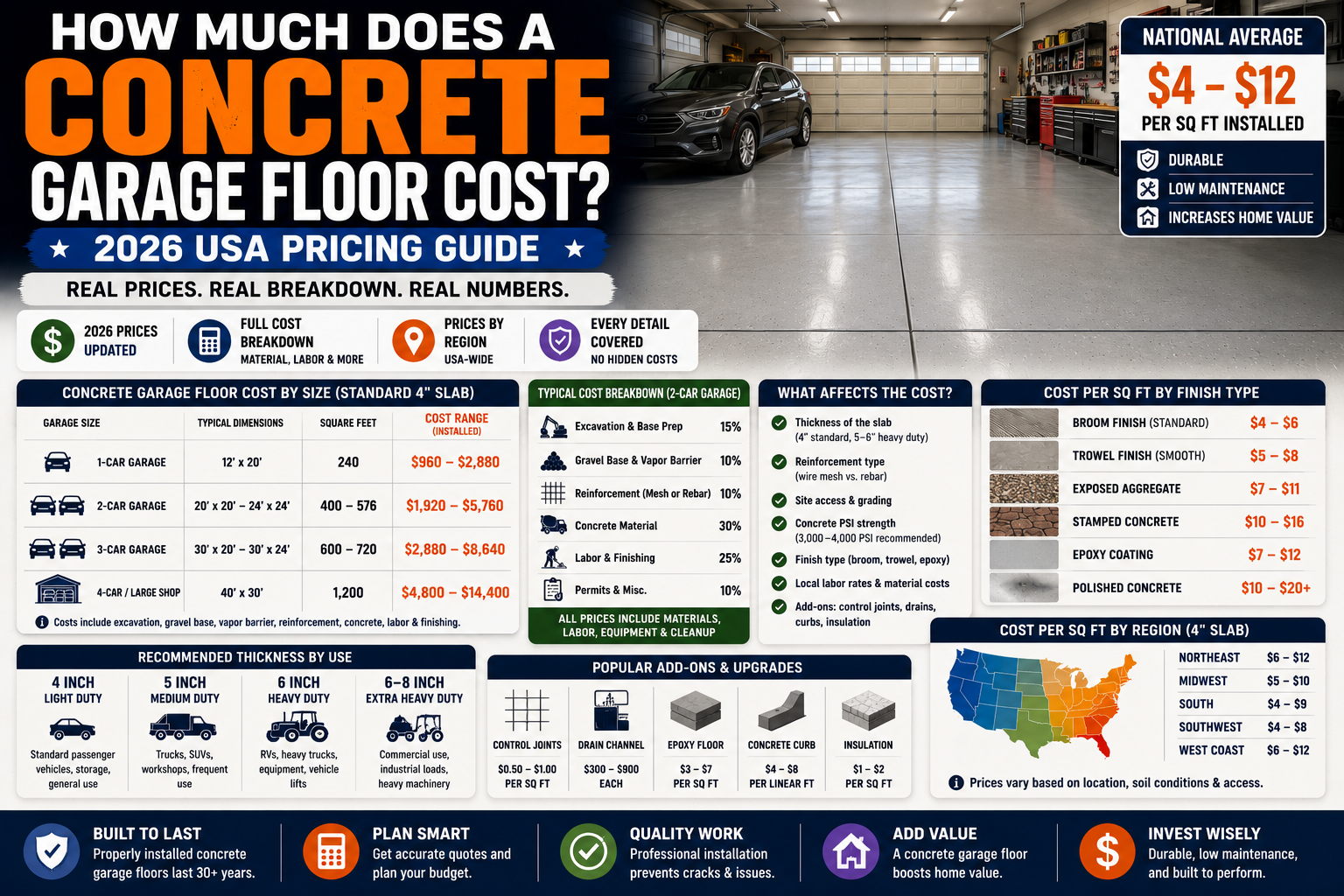
A concrete garage floor costs $4 to $12 per square foot installed in 2026, putting a standard 2-car garage floor (480 sq ft) at $3,500 to $7,200 for a basic broom-finished 4-inch slab. Add epoxy coating, stamped finishes, or a thicker slab for heavy trucks and the price climbs to $10,000 or more. This guide covers real costs by garage size, slab thickness, finish type, and region, so you can budget your project accurately and spot a fair contractor quote when you see one.
Average Concrete Garage Floor Cost
The average cost to pour a new concrete garage floor in the United States is $4 to $12 per square foot installed in 2026, including materials, labor, and a standard broom finish. Based on data from HomeGuide and Local Concrete Contractor, most residential garage floor projects fall between $1,920 and $8,640 total for basic poured slabs, before any premium finishes or coatings. Build Estimatory reports that a standard 24×24 garage floor costs approximately $3,500 to $6,000 in current market conditions.
Costs vary most by garage size, slab thickness, your region, and how you finish the surface. A plain broom-finished slab for storing one car is a very different project from a polished or epoxy-coated floor in a finished workshop. Always confirm what is included in any quote before comparing bids – site prep, gravel base, and concrete sealer are often excluded from contractor estimates.
Cost by Garage Size
Garage size is the biggest single driver of total project cost. Standard garage dimensions in the US run from a compact 1-car single bay to a spacious 3-car or 4-car structure. Below are realistic 2026 cost ranges for each standard size, covering a basic 4-inch broom-finished slab and a heavier 6-inch reinforced slab.
1-Car Garage Floor Cost
A 1-car garage typically measures 12×20 to 12×24 feet, giving a floor area of 240 to 288 square feet. A 4-inch slab for a 1-car garage costs $960 to $3,500 depending on finish and location. Most contractor quotes for a basic 1-car garage floor in 2026 land between $1,500 and $2,500 for a plain broom-finished slab. That range is tight enough that the upgrade to a sealed or epoxy-coated floor often makes financial sense – it costs only $500 to $1,500 more on a small floor and dramatically improves durability and appearance.
2-Car Garage Floor Cost
A 2-car garage typically measures 20×20 to 24×24 feet, with floor areas ranging from 400 to 576 square feet. This is the most common garage size in American homes and the benchmark most concrete contractors price against. A standard 4-inch slab runs $3,500 to $7,200. Build Estimatory puts a 24×24 garage floor at approximately $3,500 to $6,000 in 2026. A 6-inch reinforced slab for heavier trucks or an SUV fleet costs $5,400 to $9,600. Use the concrete slab calculator to get the exact cubic yard figure for your specific dimensions before calling a ready-mix supplier.
3-Car Garage Floor Cost
A 3-car garage runs 24×36 to 36×36 feet, giving floor areas of 720 to 1,296 square feet. A basic 4-inch slab for a 3-car garage floor costs $4,320 to $9,000 on the low end. Upgrading to a 6-inch reinforced slab pushes the budget to $6,500 to $15,000. Large 3-car slabs often require a concrete pump for proper placement, which adds $800 to $1,500 to the project. The bigger floor area also means more control joint saw-cutting, which is an additional labor cost to confirm with your contractor.
| Garage Size | Square Feet | 4-inch Slab Cost | 6-inch Slab Cost | With Epoxy Coating |
|---|---|---|---|---|
| 1-Car (12×24) | 288 sq ft | $1,150 – $3,500 | $1,730 – $4,900 | $2,350 – $6,300 |
| 2-Car (20×20) | 400 sq ft | $1,600 – $4,800 | $2,400 – $7,200 | $3,200 – $9,600 |
| 2-Car (24×24) | 576 sq ft | $3,500 – $7,200 | $5,200 – $10,400 | $6,200 – $13,200 |
| 3-Car (24×36) | 864 sq ft | $3,500 – $10,400 | $5,200 – $15,600 | $7,000 – $18,900 |
| 3-Car (36×36) | 1,296 sq ft | $5,200 – $15,600 | $7,800 – $23,400 | $9,800 – $27,600 |
| 4-Car (40×40) | 1,600 sq ft | $6,400 – $19,200 | $9,600 – $28,800 | $12,000 – $36,000 |
💰 Calculate Your Garage Floor Cost
Enter your garage dimensions, slab thickness, and finish type to get an instant 2026 cost estimate for your project.
Use Garage Floor Cost Calculator →Slab Thickness and Reinforcement
Getting the slab thickness right is one of the most important decisions you make on a garage floor project. Too thin and you risk cracking under vehicle loads. Unnecessarily thick and you overspend on materials and labor with no real benefit. ACI 332 Chapter 10, Section 10.4 specifies a minimum slab thickness of 3.5 inches for residential slabs-on-ground. In practice, the concrete industry treats 4 inches as the working minimum for a garage floor.
4-Inch Slab: Standard Residential Garage
A 4-inch slab with wire mesh or fiber mesh is the industry standard for a residential garage storing standard passenger cars, SUVs, and light trucks. The Constructor confirms that 4 inches is appropriate for one to two light cars. Garage Made Simple, citing ACI 332, confirms 4 inches as the standard specification for residential garage slabs with light loads. Wire mesh (6×6, #10 gauge) adds roughly $0.15 to $0.30 per square foot in materials and is sufficient for light-duty use.
5- to 6-Inch Slab: Heavy Vehicles and Workshops
If you park a heavy pickup truck, RV, or full-size SUV, step up to 5 or 6 inches of concrete with rebar reinforcement. The Constructor recommends 6 inches for medium to heavy trucks. At 6 inches, the slab uses 50% more concrete than a 4-inch slab, which is the main reason the cost premium is significant. Rebar (#4 bar at 18 inches on center) replaces wire mesh at this thickness and adds $0.40 to $0.70 per square foot in materials. Use the rebar calculator to estimate reinforcement quantities for your floor dimensions.
6- to 8-Inch Slab: Vehicle Lifts and Heavy Equipment
If you plan to install a vehicle lift, the floor under the lift posts typically needs to be thickened to 8 to 12 inches with dense rebar in that specific zone, even if the rest of the floor is 4 to 6 inches. Lift manufacturers specify the exact footing requirements in their installation guides. For a full 6-inch floor across the entire garage, budget for $9 to $15 per square foot installed, with the lift pad area costing more. Always consult the lift manufacturer and a local structural engineer before designing a lift pit or thickened slab zone.
| Thickness | Reinforcement | Cost per Sq Ft | Best For | ACI Standard |
|---|---|---|---|---|
| 3.5 inches | Fiber mesh | $3.50 – $7 | Minimum code – light use only | ACI 332 minimum |
| 4 inches | Wire mesh or fiber | $4 – $8 | Passenger cars, light SUVs, general storage | Industry standard |
| 5 inches | Wire mesh or rebar | $6 – $10 | Heavy SUVs, light trucks, motorhomes | Recommended upgrade |
| 6 inches | Rebar #4 at 18″ o.c. | $9 – $15 | Heavy trucks, workshops, vehicle storage | Medium-heavy loads |
| 6-8 inches | Rebar #5 at 12″ o.c. | $12 – $18 | Vehicle lifts, heavy equipment, commercial | Heavy-duty applications |
Finish Options and Their Costs
The base slab pour is just the starting point. The finish you choose determines the final appearance, durability, and ongoing maintenance requirements of your garage floor. Here are the main options from cheapest to most expensive.
Broom Finish: $0 Additional Cost
A broom finish is the standard garage floor finish – the contractor drags a broom across the fresh concrete to create a textured, slip-resistant surface. It costs nothing extra because it is the default finishing method. A plain broom-finished slab is perfectly functional for most residential garages, lasts decades with basic maintenance, and is what nearly all base quotes include.
Concrete Sealer: $0.50 to $1.50 per Sq Ft
A penetrating sealer applied after the slab cures protects against oil stains, road salt damage, and moisture penetration. For a 24×24 garage (576 sq ft), sealer adds $290 to $865 to the project. This is one of the highest-value upgrades for the money – a properly sealed garage floor resists the salt and moisture tracked in by vehicles during winter months. Use the concrete sealer calculator to estimate coverage and product quantities.
Epoxy Coating: $3 to $12 per Sq Ft
Epoxy is the most popular garage floor upgrade in the US. According to HomeGuide, garage floor coating costs $4 to $12 per square foot for professional installation in 2026. For a 2-car 24×24 garage, that puts total epoxy coating cost at $2,300 to $6,900 on top of the base slab. Croc Coatings puts a standard 2-car garage epoxy project at $2,400 to $3,800, while a premium full-flake system runs up to $6,000. Epoxy lasts 10 to 20 years with proper maintenance and is highly resistant to vehicle fluids, chemicals, and road salt.
Polished Concrete: $3 to $8 per Sq Ft
Polishing grinds the surface to a mirror-like sheen and then seals it with a densifier and guard. It looks excellent in a finished garage or barndominium, costs $3 to $8 per square foot above the base slab cost, and lasts the life of the concrete when maintained. The tradeoff is that a polished floor can be slippery when wet – an anti-slip additive is recommended for any garage application.
Stamped Concrete: $3 to $8 per Sq Ft
Stamping adds texture patterns – stone, slate, brick, and other designs – to the surface during the pour. It adds $3 to $8 per square foot on top of the base cost. For most garages, stamped concrete is more common on driveways and patios than on garage interiors. If you are interested in combining a decorative exterior with your garage project, use the stamped concrete calculator to estimate quantities.
| Finish Type | Added Cost per Sq Ft | 2-Car Garage Added Cost | Durability | Maintenance Level |
|---|---|---|---|---|
| Broom Finish | Included | $0 | Good | Low |
| Penetrating Sealer | $0.50 – $1.50 | $290 – $865 | Better | Low (reseal every 3-5 yrs) |
| Standard Epoxy | $3 – $7 | $1,730 – $4,030 | Excellent | Low (clean regularly) |
| Full Flake Epoxy | $5 – $12 | $2,880 – $6,900 | Excellent | Low |
| Polished Concrete | $3 – $8 | $1,730 – $4,610 | Excellent (lifetime) | Low |
| Stamped Concrete | $3 – $8 | $1,730 – $4,610 | Good | Medium (seal every 2-3 yrs) |
Full Cost Breakdown
A concrete garage floor involves several cost components beyond just the ready-mix concrete. Before accepting a quote, confirm whether each item below is included or whether it will appear as a separate line on the invoice.
Site Preparation and Subbase
The ground under a garage slab must be properly graded and compacted before the pour. A 4-inch gravel base (compacted crushed stone) is standard practice to prevent settling and improve drainage. Site prep including excavation of topsoil and gravel installation typically adds $1 to $2 per square foot, or $580 to $1,150 for a 24×24 garage. Some contractors include this in their base quote; others itemize it separately. Use the gravel calculator to estimate the subbase material independently.
Ready-Mix Concrete
Ready-mix concrete costs $110 to $160 per cubic yard delivered in 2026. A standard 4-inch slab for a 24×24 garage requires approximately 7 to 8 cubic yards of concrete, putting material cost at $770 to $1,280. A 6-inch slab for the same garage needs 11 cubic yards, costing $1,210 to $1,760 for materials alone. Use the concrete volume calculator to verify the exact cubic yard count before placing your ready-mix order.
Reinforcement
Wire mesh (6×6 #10) costs $0.15 to $0.30 per square foot in materials for a 4-inch slab. Fiber mesh is added directly to the ready-mix at the plant and adds roughly $5 to $8 per cubic yard to the concrete order. Rebar (#4 at 18 inches on center for a 6-inch slab) costs $0.40 to $0.70 per square foot in materials. The wire mesh calculator and rebar calculator help you estimate exact material quantities for either option.
Forming and Labor
Labor is the largest single line item, representing 40% to 60% of total project cost. A concrete crew sets the perimeter forms, installs the vapor barrier, lays reinforcement, coordinates the ready-mix delivery, screeds and finishes the surface, and cuts control joints after the pour. For a 24×24 garage floor, plan on $2,400 to $4,500 in labor based on regional rate data from the Concrete Contractors Eugene database. Use the concrete labor cost calculator to estimate labor costs for your specific region.
Vapor Barrier
A 6-mil polyethylene vapor barrier between the gravel base and the concrete slab prevents ground moisture from migrating up through the concrete. This is particularly important in areas with high water tables or when the garage will be climate controlled. Material cost is minimal at $0.05 to $0.15 per square foot, but confirm with your contractor that it is included in the quote.
Concrete Pump
A concrete pump is typically not needed for a 1- or 2-car garage where the truck can reach the pour area directly. For a 3-car or 4-car garage with limited access, or any floor where hand wheeling would be impractical, a pump adds $800 to $1,500 to the project. The pump makes the pour faster and reduces labor, so it can partially offset its own cost on large floors.
💼 Real-World Example: 24×24 Two-Car Garage in Tennessee
Size: 24×24 ft (576 sq ft)
Spec: 4-inch slab, wire mesh, broom finish, sealed after cure
Gravel base and site prep: $750
Ready-mix concrete (7.5 cu yd at 3,500 PSI): $1,050
Wire mesh and vapor barrier: $220
Forming, labor, and finishing: $3,100
Control joint saw-cutting: included in labor
Penetrating sealer (applied after 28-day cure): $380
Total: approximately $5,500 ($9.55 per sq ft)
Foster Hayward Concrete in Tennessee reports typical 2026 garage floor pricing at $6.50 to $13 per square foot for plain broom-finished slabs, which aligns with this estimate.
Replacing an Existing Garage Floor
If your existing garage floor is cracked, sunken, or deteriorated beyond repair, you need to factor in removal and disposal costs on top of the new slab price. Concrete demolition and removal costs $1 to $3 per square foot for a standard residential garage slab. That adds $576 to $1,730 for a 24×24 garage, bringing total replacement cost to $6,000 to $12,000 for a plain slab replacement in most markets.
Before committing to full replacement, check whether resurfacing is a viable option. A concrete overlay or resurfacing product can restore a structurally sound but cosmetically damaged floor for $3 to $7 per square foot – significantly less than a full replacement. The concrete resurfacing calculator estimates product quantities and costs for that option. Use the concrete removal cost calculator to estimate the demo cost for a full replacement project.
Minor surface cracks that are not structural can often be repaired rather than replaced. The concrete repair cost calculator helps you estimate repair costs before deciding between patch, resurface, or replace.
Factors That Affect the Final Price
Two identical garage sizes in different situations can produce quotes that differ by thousands of dollars. Here is what pushes costs higher or lower on any garage floor project.
Geographic Location
Labor rates vary by up to 50% across the US. A concrete contractor in San Francisco charges significantly more per square foot than one in rural Tennessee or Ohio. State-specific cost data is available through the California concrete cost calculator, Florida concrete cost calculator, and New York concrete cost calculator for region-adjusted estimates.
Soil Conditions and Subbase Work
Soft soil, fill soil, or a site with poor drainage requires additional subbase preparation – sometimes including geotextile fabric, extra compacted fill, or drainage improvements before the concrete can be poured. These site conditions can add $1,500 to $5,000 to a garage floor project and are impossible to price accurately without a site visit. If you are building on a previously undeveloped lot or fill site, budget conservatively and get a site assessment before finalizing your quote comparisons.
Ready-Mix Concrete Prices
Ready-mix prices rose approximately 14% from 2025 to 2026 due to higher cement costs and fuel surcharges. Concrete costs $110 to $160 per cubic yard in most US markets, with coastal cities and isolated rural areas on the higher end. Checking the current 2026 concrete prices guide before negotiating with contractors helps you verify that material costs in a quote are reasonable for your area.
Time of Year
Pouring concrete in very hot or very cold weather adds cost for protective measures. Pours in temperatures below 40°F need heated enclosures or insulating blankets to maintain proper curing temperatures. Pours in temperatures above 90°F may require ice, chilled water, or accelerating admixtures. The ideal pour temperature range is 50°F to 85°F. Read the best time to pour concrete guide and avoid scheduling pours during extreme weather whenever possible.
How to Reduce Concrete Garage Floor Costs
There are several effective ways to reduce your garage floor cost without sacrificing structural quality or long-term performance.
- Match thickness to your actual use. A basic storage garage with passenger cars does not need a 6-inch slab. Paying for 4 inches when 6 is not needed saves $1,500 to $3,000 on a 2-car garage.
- Get three or more quotes from licensed contractors. Garage floor pricing varies significantly between contractors. Multiple bids help you identify the fair market price and flag unusually low quotes that may indicate corners are being cut on subbase prep or reinforcement.
- Handle your own site prep if you have the equipment. Removing the topsoil and installing and compacting the gravel base yourself can save $750 to $2,000 on a standard garage floor project.
- Use fiber mesh instead of wire mesh for light-duty slabs. Fiber mesh is added directly to the ready-mix and eliminates the labor cost of installing wire mesh sheets. For a plain 4-inch residential garage, the performance difference is minimal and fiber mesh is slightly cheaper overall.
- Seal the slab yourself after the cure period. Applying a penetrating concrete sealer is a DIY-friendly task. Buying the product and applying it yourself instead of having the concrete contractor do it saves $150 to $400 on a standard 2-car garage. Use the sealer calculator to buy the right amount.
- Pour when weather conditions are ideal. Avoiding extreme heat or cold eliminates the cost of protective admixtures and curing blankets. Plan your pour for spring or fall in cold-climate states. Read the winter concrete guide before scheduling any pour in cold-weather months.
- Order the correct PSI concrete – not more than you need. A 3,000 PSI mix is adequate for most residential garages. Upgrading to 4,000 PSI makes sense for garages in freeze-thaw climates or those exposed to deicing salts, but 5,000 PSI is unnecessary for residential use and adds $15 to $30 per cubic yard with no practical benefit.
🧰 Useful Calculators for Your Garage Floor Project
- Concrete Garage Floor Calculator – Cubic yards for your specific dimensions
- Garage Floor Cost Calculator – 2026 installed cost with finish options
- Concrete Slab Calculator – General slab volume tool
- Concrete Volume Calculator – Double-check your ready-mix order
- Rebar Calculator – Reinforcement quantities by grid spacing
- Concrete Sealer Calculator – Sealer product quantities
- Concrete Labor Cost Calculator – Labor estimate by region
- Concrete Removal Cost Calculator – Demo cost for replacements
✅ Key Takeaways
- A concrete garage floor costs $4 to $12 per square foot installed in 2026 for a standard broom-finished slab.
- A 2-car garage (24×24) runs $3,500 to $7,200 for a basic 4-inch slab, or up to $10,400 for a 6-inch reinforced slab.
- ACI 332 specifies a 3.5-inch minimum. The industry standard is 4 inches for passenger cars and 6 inches for heavy trucks or vehicle lifts.
- Use 3,000 to 4,000 PSI concrete for residential garages. ACI 318 recommends 4,000 PSI for freeze-thaw and deicing salt exposure.
- Epoxy coating adds $3 to $12 per square foot and is the most popular garage floor upgrade in the US.
- Garage floor replacement including demolition costs $6,000 to $12,000 for a standard 2-car garage.
- Labor makes up 40% to 60% of total cost. Get at least three quotes and confirm what is included in each before comparing prices.
Frequently Asked Questions
🔧 Helpful Tools for Your Garage Floor Project
- 📐 Concrete Garage Floor Calculator – Cubic yards by your exact dimensions
- 💵 Garage Floor Cost Calculator – 2026 installed cost estimate
- 📦 Concrete Volume Calculator – Verify your ready-mix order
- 🔩 Rebar Calculator – Reinforcement quantities for 5- to 6-inch slabs
- 🔲 Wire Mesh Calculator – Rolls needed for standard 4-inch slabs
- 🪨 Gravel Calculator – Subbase aggregate quantities
- 🎨 Concrete Sealer Calculator – Sealer coverage for your floor
- 🔨 Concrete Removal Cost Calculator – Demo cost for replacement projects
- 🔧 Concrete Resurfacing Calculator – Overlay quantities and cost
Related Articles



-
Ready Mix Concrete Cost Per Yard: Complete 2026 Pricing GuideFebruary 17, 2026