Lumber Size Chart 2026 – Nominal vs Actual Dimensions
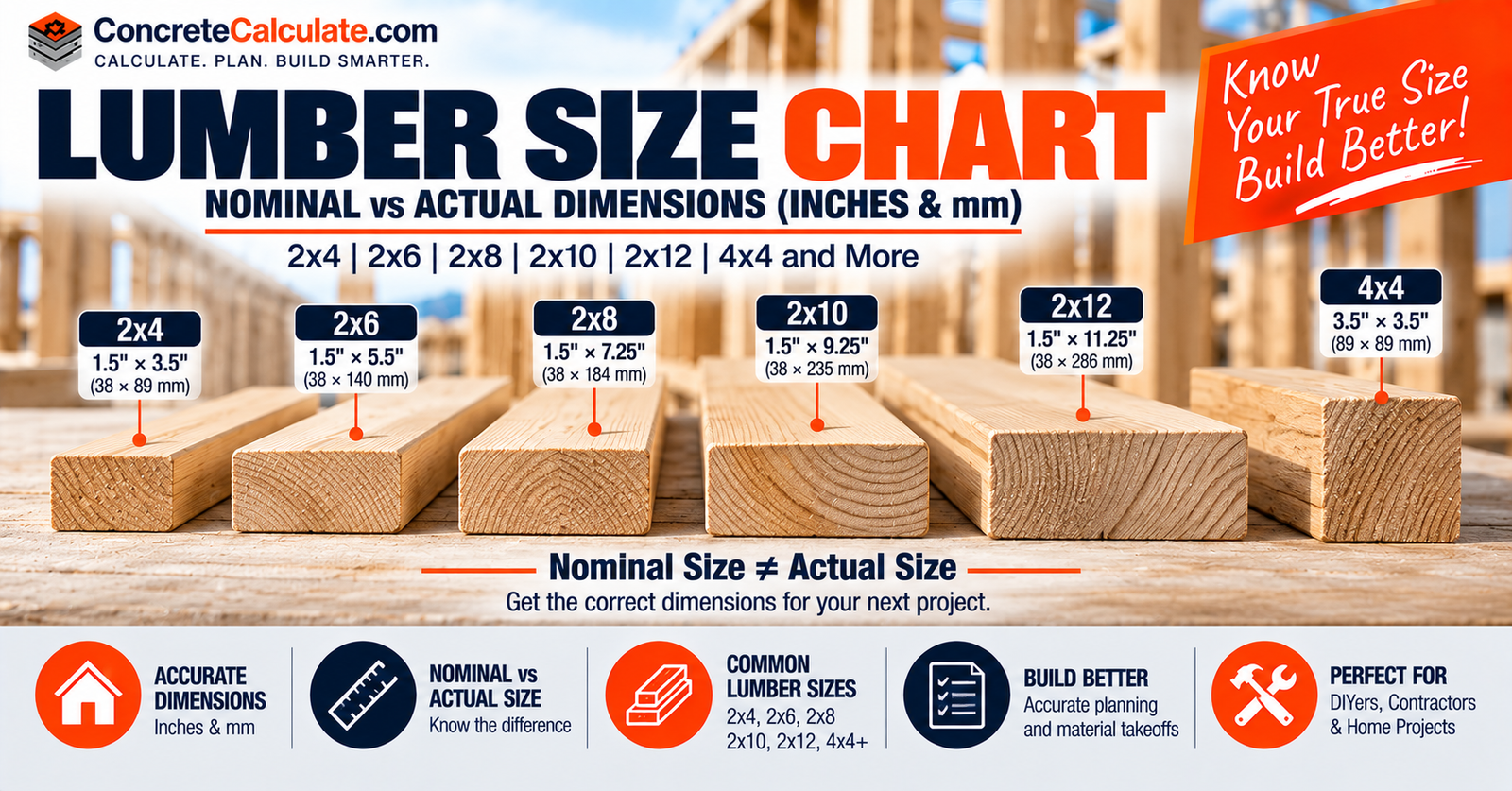
Lumber Size Chart
Nominal vs Actual Dimensions
Actual dimensions of 1x, 2x, and 4x lumber compared to nominal trade sizes, with board foot, cross-sectional area, and metric conversions.
 Reviewed by Muhammad Ramzan Babar, PhD Researcher (Plasma Physics) & Calculator Developer, View Profile
A board sold as a 2×4 does not measure 2 by 4 inches
Nominal lumber sizes are trade designations, not finished dimensions. The reduction in actual width is not the same for every nominal size: a 2×6 is 5-1/2 in wide, while a 2×8 is 7-1/4 in wide. Do not assume every nominal board simply loses half an inch.
Nominal vs Actual Lumber Dimensions
Common U.S. surfaced-dry softwood sizes. Dimensions in inches; metric values are rounded references.
| Nominal Size | Actual Thickness (in) | Actual Width (in) | Decimal (in) | Millimeters |
|---|---|---|---|---|
| 1×4 | 3/4 | 3-1/2 | 0.75 x 3.50 | 19 x 89 |
| 1×6 | 3/4 | 5-1/2 | 0.75 x 5.50 | 19 x 140 |
| 1×8 | 3/4 | 7-1/4 | 0.75 x 7.25 | 19 x 184 |
| 2×4 | 1-1/2 | 3-1/2 | 1.50 x 3.50 | 38 x 89 |
| 2×6 | 1-1/2 | 5-1/2 | 1.50 x 5.50 | 38 x 140 |
| 2×8 | 1-1/2 | 7-1/4 | 1.50 x 7.25 | 38 x 184 |
| 2×10 | 1-1/2 | 9-1/4 | 1.50 x 9.25 | 38 x 235 |
| 2×12 | 1-1/2 | 11-1/4 | 1.50 x 11.25 | 38 x 286 |
| 4×4 | 3-1/2 | 3-1/2 | 3.50 x 3.50 | 89 x 89 |
Based on standard dry-dressed size conventions. Actual products may differ according to surfacing, moisture condition, special milling, or product specification.
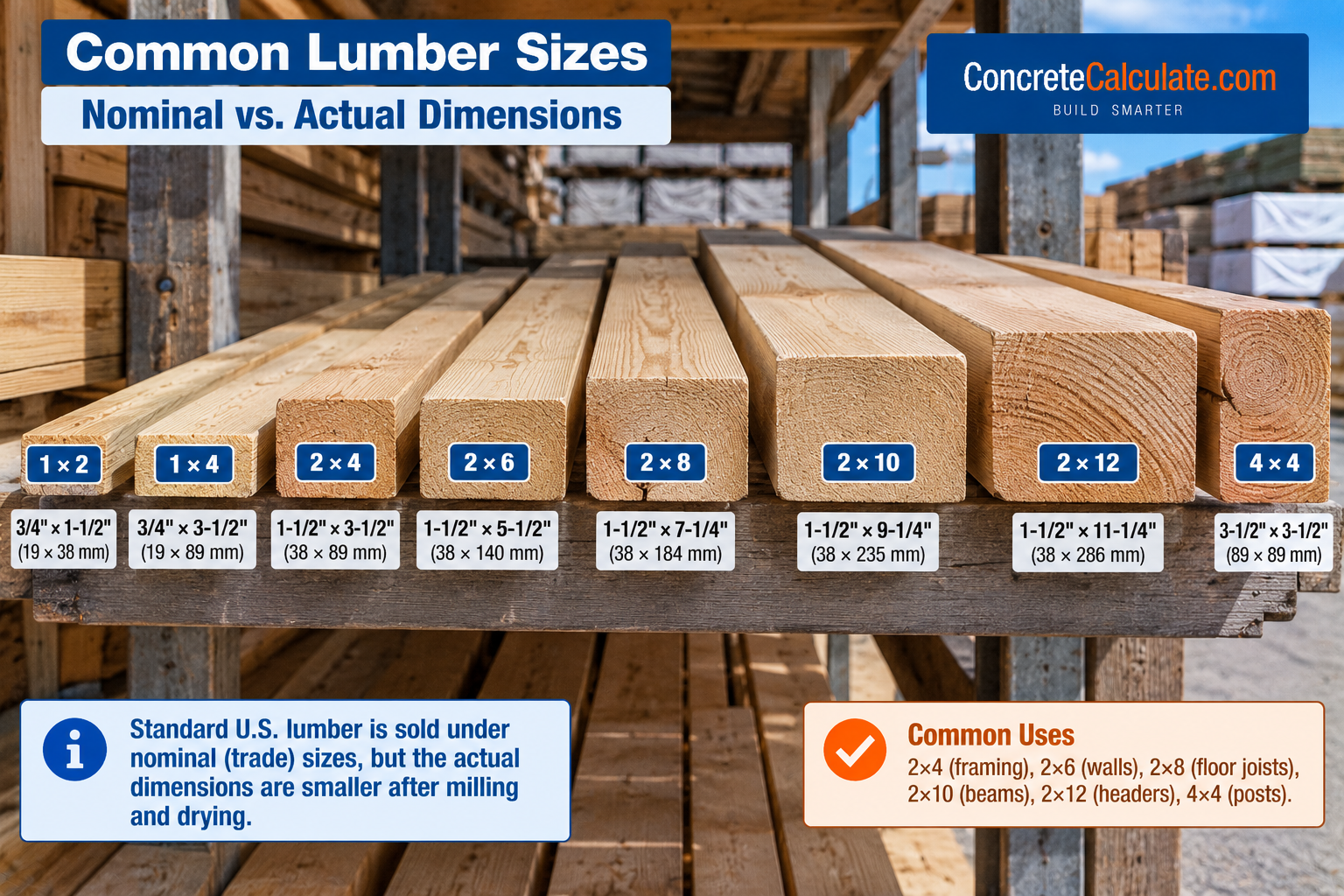
What Is Nominal Lumber Size?
Why a board sold as a 2×4 does not measure 2 by 4 inches.
Nominal lumber size is a commercial trade designation, distinct from the board’s finished dimensions. The rough-sawn size before drying and surfacing is closer to the nominal number, but drying and planing reduce the final dimensions to the standard dressed size.
Nominal vs Actual Lumber Size
A side-by-side comparison across common sizes.
| Nominal | Actual (in) |
|---|---|
| 1×4 | 3/4 x 3-1/2 |
| 2×4 | 1-1/2 x 3-1/2 |
| 2×6 | 1-1/2 x 5-1/2 |
| 2×8 | 1-1/2 x 7-1/4 |
| 4×4 | 3-1/2 x 3-1/2 |
Nominal dimensions are useful for ordering, but actual dimensions are necessary for precise layout and material calculations.
Why Is a 2×4 Actually 1-1/2 x 3-1/2 Inches?
The manufacturing process behind the size difference.
Rough-sawn dimensions start closer to the nominal 2 by 4 in size. Drying shrinkage reduces the board slightly as moisture leaves the wood, and planing to a smooth, uniform surface removes additional material from all four sides. The nominal designation remains a conventional trade name; it is not a promise that the board originally measured exactly 2 by 4 inches at every manufacturing stage.
Nominal vs Actual Lumber Thickness Chart
A compact table isolating the thickness dimension.
| Nominal Thickness | Standard Dressed Thickness |
|---|---|
| 1 in | 3/4 in |
| 2 in | 1-1/2 in |
| 3 in | 2-1/2 in |
| 4 in | 3-1/2 in |
Larger timbers and specially milled products can follow different sizing rules than standard dimension lumber; verify against the specific product specification.
Nominal vs Actual Lumber Width Chart
Why the reduction changes at nominal 8 inches and larger.
| Nominal Width | Standard Dressed Width | Reduction |
|---|---|---|
| 2 in | 1-1/2 in | 1/2 in |
| 4 in | 3-1/2 in | 1/2 in |
| 6 in | 5-1/2 in | 1/2 in |
| 8 in | 7-1/4 in | 3/4 in |
| 10 in | 9-1/4 in | 3/4 in |
| 12 in | 11-1/4 in | 3/4 in |
Important
A 2×10 is 9-1/4 in wide, not 9-1/2 in. Nominal widths of 8 in and larger lose 3/4 in rather than the 1/2 in seen at 6 in and smaller.
1x Lumber Size Chart
Common boards used for trim, shelving, and general-purpose applications.
| Nominal Size | Actual Size (in) | Typical Uses |
|---|---|---|
| 1×2 | 3/4 x 1-1/2 | Furring, blocking |
| 1×3 | 3/4 x 2-1/2 | Trim, blocking |
| 1×4 | 3/4 x 3-1/2 | Trim, fascia, general boards |
| 1×6 | 3/4 x 5-1/2 | Fascia, shelving, siding |
| 1×8 | 3/4 x 7-1/4 | Shelving, fascia |
| 1×10 | 3/4 x 9-1/4 | Wide shelving, trim |
| 1×12 | 3/4 x 11-1/4 | Shelving, stair risers |
A conventional surfaced-dry 1x board is 3/4 in thick, subject to the relevant product specification.
2x Lumber Size Chart
The most commercially useful section for framing lumber.
| Nominal Size | Actual Size (in) | Typical Uses |
|---|---|---|
| 2×2 | 1-1/2 x 1-1/2 | Furring, blocking |
| 2×3 | 1-1/2 x 2-1/2 | Furring, light framing |
| 2×4 | 1-1/2 x 3-1/2 | Wall framing, studs |
| 2×6 | 1-1/2 x 5-1/2 | Framing, decking joists |
| 2×8 | 1-1/2 x 7-1/4 | Joists, rafters, headers |
| 2×10 | 1-1/2 x 9-1/4 | Floor joists, rafters, beams |
| 2×12 | 1-1/2 x 11-1/4 | Floor joists, stair stringers, beams |
4×4, 4×6, and Larger Post Sizes
Post dimensions presented separately from dimension-lumber boards.
| Nominal Size | Actual Size (in) | Common Use |
|---|---|---|
| 4×4 | 3-1/2 x 3-1/2 | Deck posts, fence posts |
| 4×6 | 3-1/2 x 5-1/2 | Larger deck and structural posts |
| 6×6 | 5-1/2 x 5-1/2 | Heavy posts, larger structural columns |
Post size, timber classification, treatment, and actual dimensions can involve different product availability and rules than standard 2x boards. Do not assume every large beam follows the same reduction pattern as 2x lumber.
Timber and Large Beam Size Chart
Larger sections used for heavy structural members.
Larger sections such as 6×6, 6×8, and 8×8 exist as both rough-sawn timbers and surfaced products, with actual dimensions depending on the specific product and mill. Provide only standard-verified or manufacturer-verified dimensions for these larger sizes rather than assuming they follow the same reduction pattern as smaller dimension lumber. For structural selection of large beams, see the Wood Beam Span Chart.
Lumber Length Chart
Common stock lengths independent of cross-sectional size.
| Stock Length (ft) |
|---|
| 8 |
| 10 |
| 12 |
| 14 |
| 16 |
| 18 |
| 20 |
Longer lengths and availability depend on species, grade, size, region, and supplier. Nominal cross-sectional dimensions (such as 2×4) do not determine the length a board is stocked in.
Stud Lumber Sizes and Precut Lengths
Wall framing coordination beyond the raw cross-section.
Ordinary 2×4 and 2×6 studs are commonly available as full-length stock or as precut studs sized to coordinate with standard wall heights once plates are added. Precut stud length and quantity depend on the specific wall assembly and plate configuration; detailed wall-spacing and structural capacity tables remain on their dedicated pages rather than being duplicated here.
Dry vs Green Lumber Dimensions
Two distinct moisture conditions with different sizing rules.
| Condition | General Sizing Approach |
|---|---|
| Surfaced Dry | Standard dressed dimensions shown throughout this chart |
| Surfaced Green | Often dressed slightly larger to account for subsequent shrinkage as the board dries |
Green lumber is often dressed larger to account for subsequent shrinkage. Do not claim that green lumber universally equals rough lumber; they are separate concepts describing moisture condition and surfacing status respectively.
Rough-Sawn vs Surfaced Lumber
An important distinction for hardware compatibility.
Rough-sawn lumber has not been planed and typically measures closer to its full nominal dimension. S2S means surfaced two sides, and S4S means surfaced four sides, referring to how many faces have been planed smooth. Nominal trade sizes, standard dressed dimensions, and custom mill dimensions are three distinct concepts.
Practical Example
A rough-sawn “2×4” can be noticeably larger than a standard surfaced 2×4, potentially causing hardware and connectors designed for standard dressed dimensions to fit poorly or not at all.
DOC PS 20-25 American Softwood Lumber Standard
The primary standards section for this entire chart.
The current American Softwood Lumber Standard is DOC PS 20-25, which supersedes PS 20-20 Revision 1. Developed under U.S. Department of Commerce procedures at the initiation of the American Lumber Standard Committee, PS 20-25 became effective for products produced under it beginning January 2025. It governs product definitions, minimum dressed dimensions, moisture conditions, and lumber grading and marking. Many existing lumber-size references still cite the older PS 20-20 edition.
✓ Verified Against NIST-Published DOC PS 20-25Lumber Grades and Grade Stamps
What the marks on a board actually communicate.
A grade stamp typically communicates species identification, lumber grade, the certifying inspection agency, the producing mill, and moisture designation at the time of surfacing. Common visually graded categories vary by species group and grading agency. Grade stamps communicate quality and identification information; they are distinct from a board’s physical dimensions, which follow the applicable dimensional standard separately.
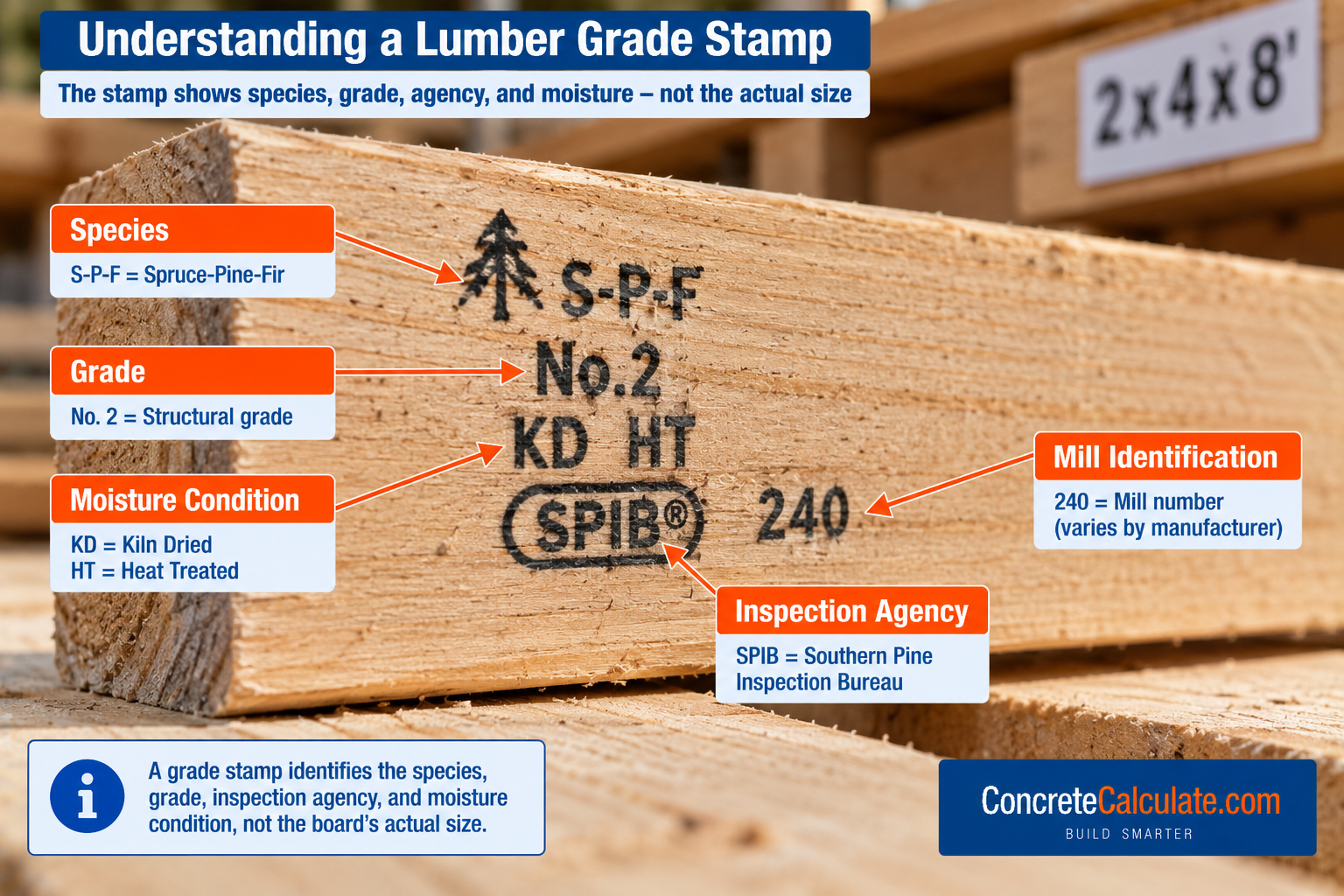
KD, S-DRY, S-GRN, and Moisture Content
Common moisture and dressing marks explained.
| Mark | General Meaning |
|---|---|
| KD | Kiln-dried |
| S-DRY | Surfaced dry (moisture content 19% or less at time of surfacing, per standard convention) |
| S-GRN | Surfaced green (higher moisture content at time of surfacing) |
Moisture condition connects to actual dimensions and dimensional movement, but an individual board will not always shrink by one predictable amount; actual movement depends on species, initial moisture, and drying conditions.
Softwood vs Hardwood Lumber Sizing
An entirely different sizing convention for hardwood.
Hardwood is often sold by rough quarter-inch thickness designations such as 4/4, 5/4, 6/4, and 8/4, referring to quarters of an inch in rough thickness before surfacing. The National Hardwood Lumber Association rulebook provides standardized rough and surfaced thickness guidance for hardwood, which differs from the softwood nominal-to-actual dressed-size convention used throughout the rest of this chart. Do not apply softwood conventions to hardwood boards.
| Hardwood Designation | Approx. Rough Thickness |
|---|---|
| 4/4 | 1 in |
| 5/4 | 1-1/4 in |
| 6/4 | 1-1/2 in |
| 8/4 | 2 in |
Lumber Size Conversion Chart, Inches to Millimeters
Convert actual dimensions, not nominal labels.
| Nominal Size | Actual (in) | Actual (mm) |
|---|---|---|
| 2×4 | 1.5 x 3.5 | 38 x 89 |
| 2×6 | 1.5 x 5.5 | 38 x 140 |
| 2×8 | 1.5 x 7.25 | 38 x 184 |
| 2×10 | 1.5 x 9.25 | 38 x 235 |
| 2×12 | 1.5 x 11.25 | 38 x 286 |
| 4×4 | 3.5 x 3.5 | 89 x 89 |
A 2×4 converts to approximately 38 by 89 mm, based on its actual dimensions, not its nominal label. Converting the nominal “2×4” directly would incorrectly suggest 51 by 102 mm.
Actual Lumber Cross-Sectional Area Chart
Useful for volume estimates and basic geometry.
Formula
A = b × t, where b is actual width and t is actual thickness.
| Nominal Size | Actual Thickness (in) | Actual Width (in) | Area (in²) |
|---|---|---|---|
| 2×4 | 1.5 | 3.5 | 5.250 |
| 2×6 | 1.5 | 5.5 | 8.250 |
| 2×8 | 1.5 | 7.25 | 10.875 |
| 2×10 | 1.5 | 9.25 | 13.875 |
| 2×12 | 1.5 | 11.25 | 16.875 |
| 4×4 | 3.5 | 3.5 | 12.250 |
This is used for volume estimates and basic geometry, not as a standalone structural-capacity check; see the Joist Span Chart for span-based structural sizing.
Board Feet vs Actual Cubic Volume
A crucial distinction between traditional nominal-size estimates and net finished volume.
Formula
BF = T × W × L ÷ 12, with thickness and width in inches and length in feet.
Example: 2x4x8 Board
Lumber Weight by Size and Length
Estimating weight from actual volume and species density.
Formula
Weight = Board Feet (actual) × density (lb/ft³) ÷ 12
An 8-ft 2×4 (actual board feet = 3.5) in kiln-dried softwood commonly weighs in the range of roughly 9 to 13 lb, depending on species density, which for common softwoods ranges from approximately 23 to 39 lb/ft³ at typical moisture content. Avoid universal weights for all 2x4s, since species and moisture content both affect mass significantly.
How to Calculate Lumber Quantity
Short worked examples for common estimating scenarios.
Example: Studs for a Framed Wall
Explain waste, cuts, openings, spacing, and stock-length selection using project-specific calculators for detailed material lists; see the Lumber Calculator and Framing Calculator rather than duplicating full material-list logic here.
Common Lumber Sizes and Their Uses
A general application reference, not a structural design guide.
| Size | Common Application |
|---|---|
| 2×4 | Wall framing, blocking |
| 2×6 | Wall framing, deck joists |
| 2×8 to 2×12 | Floor joists, rafters, headers, depending on span and application |
| 4×4, 4×6, 6×6 | Posts and beams |
Important Qualification
A common application is not proof that a particular size is adequate for a specified span or load. Always check the appropriate span table for the actual project conditions.
Lumber Size vs Structural Strength
The most important cannibalization boundary on this page.
Actual depth, width, species, grade, span, spacing, loading, and service conditions all matter for structural capacity. Span-table methodology combines these inputs rather than relying on nominal size alone. See the Lumber Span Chart, Floor Joist Span Chart, Roof Rafter Span Chart, and Header Span Chart for the specialized span data instead of relying on dimensional size alone.
Dimensional Lumber vs Engineered Lumber
Why manufacturer-specific products need their own dimensional reference.
Ordinary solid-sawn lumber follows the nominal-to-actual conventions covered throughout this chart, while engineered products such as LVL, glulam, and I-joists often have manufacturer-specific dimensions. These engineered products should not automatically be converted using ordinary nominal lumber tables. See the LVL Span Chart and Glulam Beam Size Chart for those product-specific dimensional references.
Pressure-Treated Lumber Dimensions
Familiar sizing with product-specific verification still required.
Conventional pressure-treated dimensional lumber generally uses the same familiar nominal sizes as untreated lumber, but physical dimensions, moisture, milling, and product specifications still need verification for the specific product. Preservative treatment is distinct from structural grade; treatment tags and use categories communicate chemical treatment and intended exposure, not size or strength grade information.
Decking and Fence Board Sizes
Common outdoor board sizes, with an important product distinction.
| Product | Typical Actual Thickness |
|---|---|
| Standard 1x decking | 3/4 in |
| Specialty 5/4 decking | Approximately 1 in |
| 2x lumber decking | 1-1/2 in |
Distinguish ordinary lumber, specialty 5/4 decking, and wood-composite products; never treat their dimensions as universally identical. See the Decking Calculator and Deck Post Size Chart for related deck-specific sizing.
How to Read Lumber Labels at the Store
What to look for on a mock product label.
| Label Element | What It Tells You |
|---|---|
| Nominal size | Trade designation used for ordering |
| Actual dimensions | Real finished size, sometimes shown alongside nominal |
| Length | Stock length in feet |
| Species | Wood type, affects strength, weight, and appearance |
| Grade | Quality classification |
| Treatment | Preservative treatment status, if applicable |
| Price unit | Per piece, per linear foot, or per board foot |
Applicable U.S. retail labeling requirements distinguish nominal descriptions from prominently displayed actual or minimum surfaced sizes. Verify dimensions before buying, especially for critical fit applications.
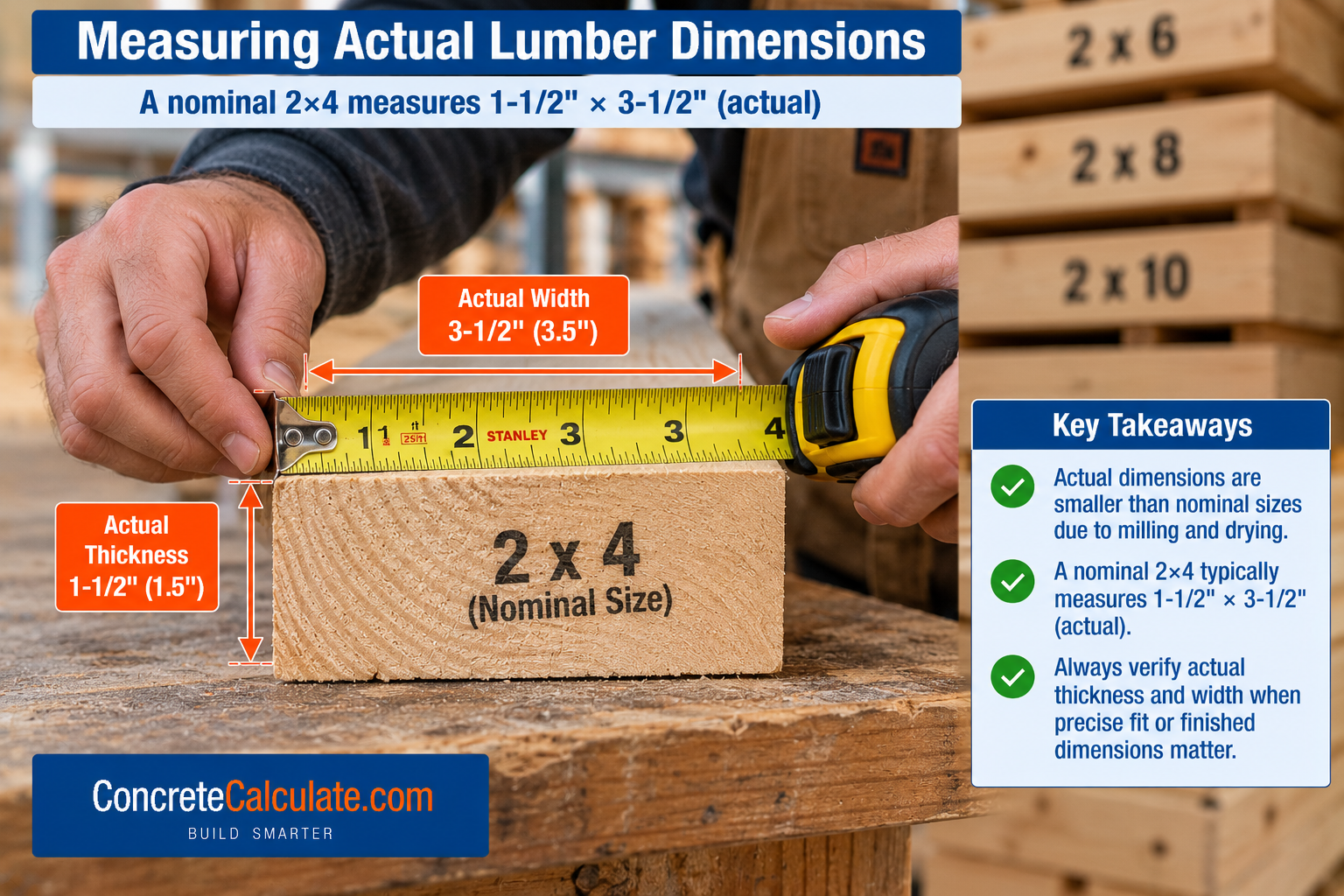
How to Measure Lumber Correctly
A practical field-identification workflow.
Measurement Workflow
How to Choose the Right Lumber Size
The page’s primary decision workflow.
Selection Workflow
Common Lumber Size Mistakes
Measuring nominal sizes as actual
A 2×4 is 1-1/2 by 3-1/2 in, not 2 by 4 in.
Using rough lumber dimensions for surfaced stock
Rough-sawn boards measure closer to nominal than standard dressed lumber.
Confusing thickness with width
These are two separate dimensions with different reduction patterns by size.
Overlooking green-lumber differences
Green lumber may be dressed larger to account for shrinkage during drying.
Ordering the wrong stud length
Precut studs are sized for specific wall-height assemblies, not universal use.
Mixing metric nominal and actual sizes
Always convert actual dimensions, not the nominal trade label.
Ignoring specialty decking dimensions
5/4 decking has its own actual thickness, different from standard 1x lumber.
Relying on size alone for structural design
Species, grade, span, spacing, and load all factor into structural capacity.
Lumber Size Chart Limitations
Read Before Ordering or Structural Design
The main chart is for standard U.S. surfaced-dry softwood lumber. Specialty milling, rough timbers, engineered wood, hardwood, moisture movement, treatment, manufacturing tolerances, and individual supplier specifications may produce different dimensions than shown here. Structural capacity depends on far more than nominal or actual size alone; always verify against the appropriate span chart or engineered design data for load-bearing applications.
Frequently Asked Questions
Download Lumber Size Chart PDF
Save or print this reference including the nominal-vs-actual dimension tables, board foot formulas, metric conversions, and the lumber measurement and selection workflows.